Paragraph 63 · 50% changed
Every version of it
Screener
/
SEC EDGAR
/CIK 0001782524
/10-K filed Feb 26, 2026, compared with Feb 27, 2025
/Numbers from the XBRL of the 10-Ks
NYSE
Financials
Morgan Stanley Direct Lending Fund MSDL
The 10-K against last year's
148 changes: 31 added, 25 removed, 88 reworded, 4 quiet changes
10-K Feb 26, 2026 vs Feb 27, 2025
Risk Factors
12.5%
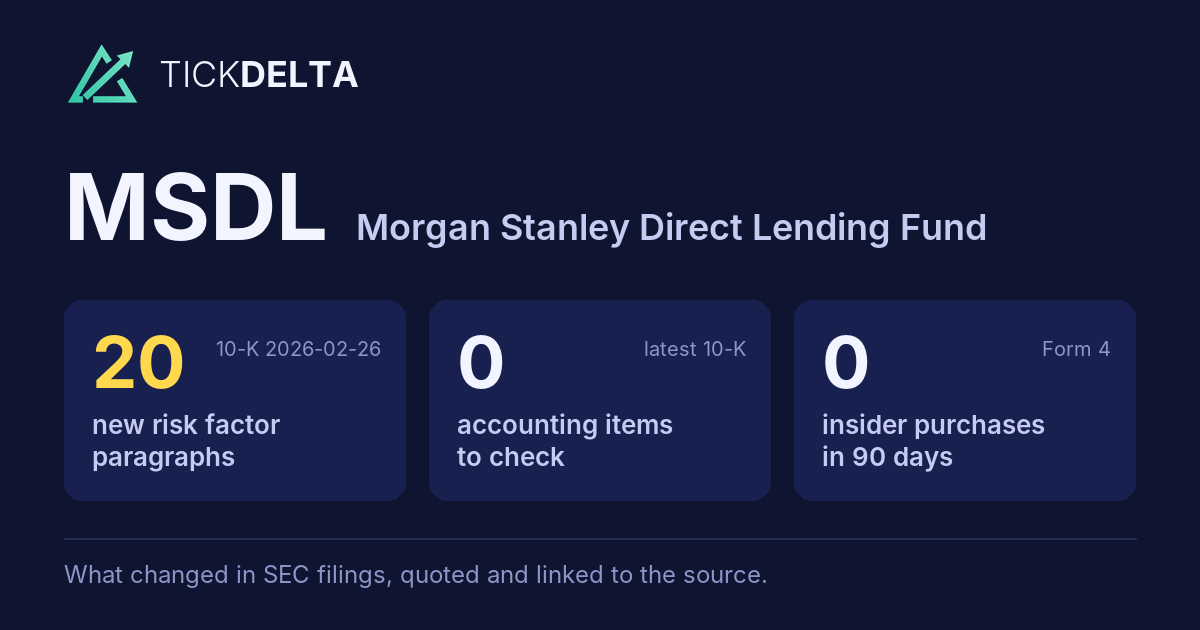
of the text changed · 33,468 words now · 20 new paragraphs, 16 gone
MD&A
24.3%
of the text changed · 4,947 words now · 11 new paragraphs, 9 gone
10-K 0001193125-26-076632 (Feb 26, 2026) vs 10-K 0001782524-25-000009 (Feb 27, 2025) Not compared: Legal Proceedings, Accounting Policies.
Every paragraph, and how much of it changed
One bar per paragraph, in the order of the 10-K. Height and colour show the share of its words not in the closest paragraph a year earlier; the tallest bars are new paragraphs.
Risk Factors
339 paragraphs · 20 new · 97 reworded · 16 gone · 10-K Feb 26, 2026 against Feb 27, 2025
New paragraph
Reworded (5% of its words or more)
Same or nearly
Paragraph 180 · 49% changed
Every version of it
Paragraph 4 · 47% changed
Every version of it
Paragraph 198 · 42% changed
Every version of it
Paragraph 326 · 40% changed
Every version of it
Paragraph 129 · 36% changed
Every version of it
Paragraph 45 · 34% changed
Every version of it
We may, however, invest alongside our Adviser’s and/or its affiliates’ other clients, in certain circumstances where doing so is consistent with applicable law and SEC staff interpretations, guidance and exemptive relief orders. However, although the Adviser endeavors to fairly allocate investment opportunities in the long-run, we can offer no assurance that investment opportunities will be allocated to us fairly or equitably in the short-term or over time. The SEC has granted us and our Adviser the Order that allows us to enter into certain negotiated co-investment transactions alongside certain Regulated Funds and Affiliated Funds (each as defined in the Order) in a manner consistent with our investment objective, positions, policies, strategies, and restrictions as well as regulatory requirements and other pertinent factors, subject to compliance with the conditions specified in the Order. Pursuant to the Order, we are permitted able to co-invest enter into certain negotiated co-investment transactions alongside certain Regulated Funds and Affiliated Entities (each as defined in the Order), in a manner consistent with our affiliates if investment objective, positions, policies, strategies, and restrictions as well as regulatory requirements and other pertinent factors, subject to compliance with the Order. The Order contains certain conditions and requires the Board to maintain oversight of our participation in the co-investment program. The Order also requires a “required majority” (as defined in Section 57(o) of the 1940 Act) of our eligible directors to make certain conclusions pursuant to Section 57(f) of the 1940 Act in connection with a certain co-investment transaction, including that (1) the terms of the transactions, including co-investment transactions in which an affiliate is an existing investor in the consideration to be paid, are reasonable portfolio company, non-pro rata follow on investments and fair to us and our stockholders and do not involve overreaching in respect non-pro rata dispositions of us or our stockholders on the part of any person concerned, and (2) the transaction is consistent with the interests of our stockholders and is consistent with our investment objective and strategies. investments.
Paragraph 114 · 34% changed
Every version of it
Paragraph 63 · 50% changed
Every version of it
10-K Feb 27, 2025We may issue debt securities or preferred stock and/or borrow money from banks or other financial institutions, which we refer to collectively as “senior securities,” up to the maximum amount permitted by the 1940 Act. Under the provisions of the 1940 Act, we are currently permitted to issue "senior securities," including borrowing money from banks or other financial institutions, only in amounts such that our asset coverage, as defined in the 1940 Act, equals at least 150% of gross assets less all liabilities and indebtedness not represented by senior securities, after each issuance of senior securities. If we fail to comply with certain disclosure requirements, our asset coverage ratio under the 1940 Act would be 200%, which would decrease the amount of leverage we are able to incur. If the value of our assets declines, we may be unable to satisfy the applicable asset coverage ratio. If that happens, we may be required to sell a portion of our investments and, depending on the nature of our leverage, repay a portion of our indebtedness at a time when such sales may be disadvantageous. Also, any amounts that we use to service our indebtedness would not be available for distributions to holders of shares of our Common Stock. If we issue senior securities, we will be exposed to typical risks associated with leverage, including an increased risk of loss.
10-K Feb 26, 2026
time when such sales may be disadvantageous. Also, any amounts that we use to service our indebtedness would not be available for distributions to holders of shares of our Common Stock. If we issue senior securities, we will be exposed to typical risks associated with leverage, including an increased risk of loss.
Paragraph 180 · 49% changed
Every version of it
10-K Feb 27, 2025Our portfolio companies may prepay loans, which may reduce our yields if capital returned cannot be invested in transactions with equal or greater expected yields.
10-K Feb 26, 2026
returned cannot be invested in transactions with equal or greater expected yields, which could have a material adverse effect on our business, financial condition and results of operations.
Paragraph 4 · 47% changed
Every version of it
10-K Feb 27, 2025The 1940 Act imposes numerous constraints on the operations of BDCs that do not apply to certain of the other investment vehicles advised by our Adviser and its affiliates. BDCs are required, for example, to invest at least 70% of their total assets primarily in securities of U.S. private or thinly traded public companies, cash, cash equivalents, U.S. government securities and other high-quality debt instruments that mature in one year or less from the date of investment. These constraints may hinder our ability to take advantage of attractive investment opportunities and to achieve our investment objective. Furthermore, any failure to comply with the requirements imposed on BDCs by the 1940 Act could cause the SEC to bring an enforcement action against us and/or expose us to claims of private litigants.
10-K Feb 26, 2026
achieve our investment objective. Furthermore, any failure to comply with the requirements imposed on BDCs by the 1940 Act could cause the SEC to bring an enforcement action against us and/or expose us to claims of private litigants.
Paragraph 198 · 42% changed
Every version of it
10-K Feb 27, 2025We have discretion to make follow-on investments, subject to the availability of capital resources and certain limitations on co-investment with affiliates under the 1940 Act. Failure on our part to make follow-on investments may, in some circumstances, jeopardize the continued viability of a portfolio company and our initial investment, or may result in a missed opportunity for us to increase our participation in a successful portfolio company. Even if we have sufficient capital to make a desired follow-on investment, we may elect not to make a follow-on investment because we may not want to increase our level of risk, because we prefer other opportunities or because of regulatory or other considerations. Our ability to make follow-on investments may also be limited by the Adviser’s allocation policies and procedures.
10-K Feb 26, 2026
because we may not want to increase our level of risk, because we prefer other opportunities or because of regulatory or other considerations. Our ability to make follow-on investments may also be limited by the Adviser’s allocation policies and procedures.
Paragraph 326 · 40% changed
Every version of it
10-K Feb 27, 2025The conflict between Russia and Ukraine and in the Middle East, and resulting market volatility, could also adversely affect the Company’s business, operating results, and financial condition. The extent and duration or escalation of such conflicts, resulting sanctions and resulting future market disruptions are impossible to predict, but could be significant. Any disruptions resulting from such conflicts and any future conflict (including cyberattacks, espionage or the use or threatened use of nuclear weapons) or resulting from actual or threatened responses to such actions could cause disruptions to any of our portfolio companies located in Europe or the Middle East or that have substantial business relationships with companies in affected regions. It is not possible to predict the duration or extent of longer-term consequences of these conflicts, which could include further sanctions, retaliatory and escalating measures, embargoes, regional instability, geopolitical shifts and adverse effects on or involving macroeconomic conditions, the energy sector, supply chains, inflation, security conditions, currency exchange rates and financial markets around the globe. Any such market disruptions could affect our portfolio companies’ operations and, as a result, could have a material adverse effect on our business, financial condition and results of operations.
10-K Feb 26, 2026
measures, embargoes, regional instability, geopolitical shifts and adverse effects on or involving macroeconomic conditions, the energy sector, supply chains, inflation, security conditions, currency exchange rates and financial markets around the globe. Any such market disruptions could affect our portfolio companies’ operations and, as a result, could have a material adverse effect on our business, financial condition and results of operations.
Paragraph 129 · 36% changed
Every version of it
10-K Feb 27, 2025In November 2020, the SEC adopted a revised version of Rule 18f-4, which is designed to modernize the regulation of the use of derivatives by registered investment companies and BDCs. Among other things, Rule 18f-4 requires BDCs that use derivatives to be subject to a value-at-risk leverage limit and requires the adoption and implementation of a derivatives risk management program that is reasonably designed to identify, assess and manage its derivatives transaction trading risk, subject to certain exceptions. Additionally, subject to certain conditions, funds that do not invest heavily in derivatives may be deemed limited derivatives users and would not be subject to the full requirements of Rule 18f-4. The Company intends to operate under the limited derivatives user exemption of Rule 18f-4 and has adopted written policies and procedures reasonably designed to manage the Company’s derivatives risk pursuant to Rule 18f-4. In connection with the adoption of Rule 18f-4, the SEC also eliminated the asset segregation and cover framework arising from prior SEC guidance for covering derivatives and certain financial instruments. Compliance with Rule 18f-4 has been required since August 2022. Collectively, these requirements may limit our ability to use derivatives and/or enter into certain other financial contracts.
10-K Feb 26, 2026
Rule 18f-4 under the 1940 Act requires BDCs that use derivatives to be subject to a value-at-risk leverage limit and requires the adoption and implementation of a derivatives risk management program that is reasonably designed to identify, assess and manage its derivatives transaction trading risk, subject to certain exceptions. Additionally, subject to certain conditions, funds that do not invest heavily in derivatives may be deemed limited derivatives users and would not be subject to the full requirements of Rule 18f-4. The Company intends to operate under the limited derivatives user exemption of Rule 18f-4 and has adopted written policies and procedures reasonably designed to manage the Company’s derivatives risk pursuant to Rule 18f-4. In connection with the adoption of Rule 18f-4, the SEC also eliminated the asset segregation and cover framework arising from prior SEC guidance for covering derivatives and certain financial instruments. Collectively, these requirements may limit our ability to use derivatives and/or enter into certain other financial contracts. Rule 18f-4 also permits us to enter into reverse repurchase agreements or similar financing transactions notwithstanding the senior security provision of the 1940 Act if we aggregate the amount of indebtedness associated with our reverse repurchase agreements or similar financing transactions with the aggregate amount of any other senior securities representing indebtedness when calculating the asset coverage ratios as discussed herein. In addition, under the “delayed-settlement securities” provision of Rule 18f-4, we are permitted to invest in a security on a when-issued or forward-settling basis, or with a non-standard settlement cycle, and the transaction will be deemed not to involve a senior security under the 1940 Act, provided that (i) we intend to physically settle the transaction and (ii) the transaction will settle within 35 days of its trade date. We may otherwise engage in such transaction as a “derivatives transaction” for purposes of compliance with the rule. Furthermore, we are permitted to enter into an unfunded commitment agreement, and such unfunded commitment agreement will not be subject to the asset coverage requirements under the 1940 Act if we reasonably believe, at the time we enter into such agreement, that we will have sufficient cash and cash equivalents to meet our obligations with respect to all such agreements as they come due. We cannot predict the effects of these requirements.
Paragraph 45 · 34% changed
Every version of it
10-K Feb 27, 2025
allocated to us fairly or equitably in the short-term or over time. The SEC has granted us and our Adviser the Order that allows us to enter into certain negotiated co-investment transactions alongside certain Regulated Funds and Affiliated Funds (each as defined in the Order) in a manner consistent with our investment objective, positions, policies, strategies, and restrictions as well as regulatory requirements and other pertinent factors, subject to compliance with the conditions specified in the Order. Pursuant to the Order, we are permitted to co-invest with our affiliates if a “required majority” (as defined in Section 57(o) of the 1940 Act) of our eligible directors make certain conclusions in connection with a co-investment transaction, including that (1) the terms of the transactions, including the consideration to be paid, are reasonable and fair to us and our stockholders and do not involve overreaching in respect of us or our stockholders on the part of any person concerned, and (2) the transaction is consistent with the interests of our stockholders and is consistent with our investment objective and strategies.
10-K Feb 26, 2026
We may, however, invest alongside our Adviser’s and/or its affiliates’ other clients, in certain circumstances where doing so is consistent with applicable law and SEC staff interpretations, guidance and exemptive relief orders. However, although the Adviser endeavors to fairly allocate investment opportunities in the long-run, we can offer no assurance that investment opportunities will be allocated to us fairly or equitably in the short-term or over time. The SEC has granted us and our Adviser the Order that allows us to enter into certain negotiated co-investment transactions alongside certain Regulated Funds and Affiliated Funds (each as defined in the Order) in a manner consistent with our investment objective, positions, policies, strategies, and restrictions as well as regulatory requirements and other pertinent factors, subject to compliance with the conditions specified in the Order. Pursuant to the Order, we are able to enter into certain negotiated co-investment transactions alongside certain Regulated Funds and Affiliated Entities (each as defined in the Order), in a manner consistent with our investment objective, positions, policies, strategies, and restrictions as well as regulatory requirements and other pertinent factors, subject to compliance with the Order. The Order contains certain conditions and requires the Board to maintain oversight of our participation in the co-investment program. The Order also requires a “required majority” (as defined in Section 57(o) of the 1940 Act) of our eligible directors to make certain conclusions pursuant to Section 57(f) of the 1940 Act in connection with certain co-investment transactions, including co-investment transactions in which an affiliate is an existing investor in the portfolio company, non-pro rata follow on investments and non-pro rata dispositions of investments.
Paragraph 114 · 34% changed
Every version of it
10-K Feb 27, 2025The Administrator has the right to resign under the Administration Agreement at any time upon not less than 60 days’ written notice, whether we have found a replacement or not. If the Administrator resigns, we may not be able to find a new administrator or hire internal management with similar expertise and ability to provide the same or equivalent services on acceptable terms, or at all. If we are unable to do so quickly, our operations are likely to experience a disruption, our financial condition, business and results of operations as well as our ability to pay distributions are likely to be adversely affected and the value of our shares may decline. In addition, the coordination of our internal management and administrative activities is likely to suffer if we are unable to identify and reach an agreement with a service provider or individuals with the expertise possessed by the Administrator. Even if we are able to retain a comparable service provider or individuals to perform such services, whether internal or external, their integration into our
10-K Feb 26, 2026
are likely to be adversely affected and the value of our Common Stock may decline. In addition, the coordination of our internal management and administrative activities is likely to suffer if we are unable to identify and reach an agreement with a service provider or individuals with the expertise possessed by the Administrator. Even if we are able to retain a comparable service provider or individuals to perform such services, whether internal or external, their integration into our business and lack of familiarity with our investment objective may result in additional costs and time delays that may adversely affect our business, financial condition, results of operations and cash flows.
MD&A
88 paragraphs · 11 new · 37 reworded · 9 gone · 10-K Feb 26, 2026 against Feb 27, 2025
New paragraph
Reworded (5% of its words or more)
Same or nearly
Paragraph 74 · 50% changed
Our outstanding debt obligations were as follows (each as defined in Note 6. “Debt” in the notes to the accompanying consolidated financial statements if not defined herein): statements):
Paragraph 84 · 46% changed
On February 27, 2025, 26, 2026, our Board authorized an amended and restated approved a share repurchase plan, or the Amended and Restated Company 10b5-1 Plan. Under the Amended and Restated Company 10b5-1 Plan, program under which we may acquire can repurchase up to $100 million in the aggregate of our Common Stock at prices below our net asset value per share over a specified 24-month period, in accordance with all applicable securities laws and regulations. We have in the guidelines specified past, and could in the future, enter into a plan to repurchase shares of our Common Stock pursuant to the Program in a manner intended to comply with the requirements of Rule 10b5-1 and Rule 10b-18 of under the Exchange Act. The Amended Program is discretionary and Restated Company 10b5-1 Plan whether purchases will terminate upon the earliest to occur of (i) 24-months from the commencement date of the original Company 10b5-1 Plan, (ii) the end of the trading day on which the aggregate purchase price for all shares purchased be made under the Amended Program and Restated Company 10b5-1 Plan equals $100 million how much will be purchased at any time is uncertain and (iii) the occurrence dependent on prevailing market prices and trading volumes, all of certain other events described in the Amended and Restated Company 10b5-1 Plan. which we cannot predict.
Paragraph 67 · 45% changed
Paragraph 7 · 36% changed
Pursuant to the Order, we are able to enter into certain negotiated co-investment transactions alongside certain Regulated Funds and Affiliated Funds (each as Entities (as defined in the Order) Order), which may include proprietary accounts of Morgan Stanley, in a manner consistent with our investment objective, positions, policies, strategies, and restrictions as well as regulatory requirements and other pertinent factors, subject to compliance with the Order. Pursuant The Order contains certain conditions and requires the Board to maintain oversight of our participation in the Order, we are permitted to co-invest with our affiliates if co-investment program. The Order also requires a “required majority” (as defined in Section 57(o) of the 1940 Act) of our eligible directors to make certain conclusions pursuant to Section 57(f) of the 1940 Act in connection with a certain co-investment transaction, including that (1) the terms of the transactions, including co-investment transactions in which an affiliate of ours is an existing investor in the consideration to be paid, are reasonable portfolio company, non-pro rata follow on investments and fair to us and our stockholders and do not involve overreaching in respect non-pro rata dispositions of us or our stockholders on the part of any person concerned, and (2) the transaction is consistent with the interests of our stockholders and is consistent with our investment objective and strategies. investments.
Paragraph 66 · 35% changed
Paragraph 71 · 30% changed
Paragraph 76 · 26% changed
Paragraph 50 · 23% changed
In the table above, total investment income increased decreased from $367,738 for the year ended December 31, 2023 to $416,075 for the year ended December 31, 2024. 2024 to $397,287 for the year ended December 31, 2025. The increase decrease was primarily driven by declining base rates and repricings on our deployment of capital. The size of our investment portfolio existing portfolio. Our weighted average yield at amortized cost increased from $3,226,776 decreased to 9.3% as of December 31, 2023 to $3,813,127 2025 from 10.4% as of December 31, 2024. This was partially offset by a decrease in our weighted average yield at cost and fair value to 10.4% and 10.5%, respectively, at December 31, 2024 from 12.0% and 12.1% at December 31, 2023, respectively, which was primarily driven by the reduction in base rates and repricing on our existing portfolio.
Paragraph 74 · 50% changed
10-K Feb 27, 2025
in the notes to the accompanying consolidated financial statements if not defined herein):
10-K Feb 26, 2026
Our outstanding debt obligations were as follows (each as defined in Note 6. “Debt” in the notes to the accompanying consolidated financial statements):
Paragraph 84 · 46% changed
10-K Feb 27, 2025
On February 27, 2025, our Board authorized an amended and restated share repurchase plan, or the Amended and Restated Company 10b5-1 Plan. Under the Amended and Restated Company 10b5-1 Plan, we may acquire up to $100 million in the aggregate of our Common Stock at prices below our net asset value per share over a specified period, in accordance with the guidelines specified in Rule 10b5-1 and Rule 10b-18 of the Exchange Act. The Amended and Restated Company 10b5-1 Plan will terminate upon the earliest to occur of (i) 24-months from the commencement date of the original Company 10b5-1 Plan, (ii) the end of the trading day on which the aggregate purchase price for all shares purchased under the Amended and Restated Company 10b5-1 Plan equals $100 million and (iii) the occurrence of certain other events described in the Amended and Restated Company 10b5-1 Plan.
10-K Feb 26, 2026
On February 26, 2026, our Board approved a share repurchase program under which we can repurchase up to $100 million in the aggregate of our Common Stock at prices below our net asset value per share over a 24-month period, in accordance with all applicable securities laws and regulations. We have in the past, and could in the future, enter into a plan to repurchase shares of our Common Stock pursuant to the Program in a manner intended to comply with the requirements of Rule 10b5-1 under the Exchange Act. The Program is discretionary and whether purchases will be made under the Program and how much will be purchased at any time is uncertain and dependent on prevailing market prices and trading volumes, all of which we cannot predict.
Paragraph 67 · 45% changed
10-K Feb 27, 2025No shares were repurchased under our 10b5-1 Plan during the year ended December 31, 2023.
10-K Feb 26, 2026
For the year ended December 31, 2025 and December 31, 2024, there were no shares issued through ATM offerings.
Paragraph 7 · 36% changed
10-K Feb 27, 2025
Pursuant to the Order, we are able to enter into certain negotiated co-investment transactions alongside certain Regulated Funds and Affiliated Funds (each as defined in the Order) in a manner consistent with our investment objective, positions, policies, strategies, and restrictions as well as regulatory requirements and other pertinent factors, subject to compliance with the Order. Pursuant to the Order, we are permitted to co-invest with our affiliates if a “required majority” (as defined in Section 57(o) of the 1940 Act) of our eligible directors make certain conclusions in connection with a co-investment transaction, including that (1) the terms of the transactions, including the consideration to be paid, are reasonable and fair to us and our stockholders and do not involve overreaching in respect of us or our stockholders on the part of any person concerned, and (2) the transaction is consistent with the interests of our stockholders and is consistent with our investment objective and strategies.
10-K Feb 26, 2026
Pursuant to the Order, we are able to enter into certain negotiated co-investment transactions alongside certain Regulated Funds and Affiliated Entities (as defined in the Order), which may include proprietary accounts of Morgan Stanley, in a manner consistent with our investment objective, positions, policies, strategies, and restrictions as well as regulatory requirements and other pertinent factors, subject to compliance with the Order. The Order contains certain conditions and requires the Board to maintain oversight of our participation in the co-investment program. The Order also requires a “required majority” (as defined in Section 57(o) of the 1940 Act) of our eligible directors to make certain conclusions pursuant to Section 57(f) of the 1940 Act in connection with certain co-investment transactions, including co-investment transactions in which an affiliate of ours is an existing investor in the portfolio company, non-pro rata follow on investments and non-pro rata dispositions of investments.
Paragraph 66 · 35% changed
10-K Feb 27, 2025See Note 3. “Related Party Transactions” to our consolidated financial statements included in this Report.
10-K Feb 26, 2026
For further details regarding the Equity Distribution Agreements, see Note 8 “Net Assets” to our consolidated financial statements included in this Report.
Paragraph 71 · 30% changed
10-K Feb 27, 2025On January 25, 2024, we entered into the Company 10b5-1 Plan, to acquire up to $100 million in the aggregate of our Common Stock at prices below our net asset value per share over a specified period, in accordance with the guidelines specified in Rule 10b5-1 and Rule 10b-18 of the Securities Exchange Act of 1934, as amended.
10-K Feb 26, 2026
In January 2024, our Board authorized a share repurchase program to acquire up to $100 million in the aggregate of our Common Stock at prices below our net asset value per share over a specified period, in accordance with all applicable securities laws and regulations, which was further amended by our Board on February 27, 2025.
Paragraph 76 · 26% changed
10-K Feb 27, 2025(3)As of December 31, 2024, the carrying value of the Company’s 2027 Notes, 2025 Notes and 2029 Notes were presented net of unamortized debt issuance costs of $2,374, $856 and $3,297 and unamortized original issuance discount of $452, $0 and $3,398, respectively. As of December 31, 2023, the carrying value of the Company’s 2027 Notes, 2025 Notes and 2029 Notes were presented net of unamortized debt issuance costs of $3,499, $2,065 $0, and unamortized original issuance discount of $667, $0 and $0, respectively.
10-K Feb 26, 2026
(2)As of December 31, 2025 and December 31, 2024, the carrying value of the CLO 2025-1 Issued Debt was presented net of unamortized debt issuance costs of $2,869 and $0, respectively.
Paragraph 50 · 23% changed
10-K Feb 27, 2025
In the table above, total investment income increased from $367,738 for the year ended December 31, 2023 to $416,075 for the year ended December 31, 2024. The increase was primarily driven by our deployment of capital. The size of our investment portfolio at amortized cost increased from $3,226,776 as of December 31, 2023 to $3,813,127 as of December 31, 2024. This was partially offset by a decrease in our weighted average yield at cost and fair value to 10.4% and 10.5%, respectively, at December 31, 2024 from 12.0% and 12.1% at December 31, 2023, respectively, which was primarily driven by the reduction in base rates and repricing on our existing portfolio.
10-K Feb 26, 2026
In the table above, total investment income decreased from $416,075 for the year ended December 31, 2024 to $397,287 for the year ended December 31, 2025. The decrease was primarily driven by declining base rates and repricings on our existing portfolio. Our weighted average yield at cost decreased to 9.3% as of December 31, 2025 from 10.4% as of December 31, 2024.
A paragraph is matched with the one last year that shares the most of its words; under half in common makes it new. The paragraphs shown are the 8 reworded the most in each section.
The paragraph that changed most in each section
The redline
Marked against last year's 10-K: cut words struck through, new words highlighted.
Risk Factors265 words changed in this paragraph; it is 54% similar to last year's version.
Source: Item 1A, 10-K 0001193125-26-076632 vs Item 1A, 10-K 0001782524-25-000009
MD&A172 words changed in this paragraph; it is 37% similar to last year's version.
On February 27, 2025, 26, 2026, our Board authorized an amended and restated approved a share repurchase plan, or the Amended and Restated Company 10b5-1 Plan. Under the Amended and Restated Company 10b5-1 Plan, program under which we may acquire can repurchase up to $100 million in the aggregate of our Common Stock at prices below our net asset value per share over a specified 24-month period, in accordance with all applicable securities laws and regulations. We have in the guidelines specified past, and could in the future, enter into a plan to repurchase shares of our Common Stock pursuant to the Program in a manner intended to comply with the requirements of Rule 10b5-1 and Rule 10b-18 of under the Exchange Act. The Amended Program is discretionary and Restated Company 10b5-1 Plan whether purchases will terminate upon the earliest to occur of (i) 24-months from the commencement date of the original Company 10b5-1 Plan, (ii) the end of the trading day on which the aggregate purchase price for all shares purchased be made under the Amended Program and Restated Company 10b5-1 Plan equals $100 million how much will be purchased at any time is uncertain and (iii) the occurrence dependent on prevailing market prices and trading volumes, all of certain other events described in the Amended and Restated Company 10b5-1 Plan. which we cannot predict.
Source: Item 7, 10-K 0001193125-26-076632 vs Item 7, 10-K 0001782524-25-000009
Sentences and paragraphs added, removed or reworded
Every change, by type
Sentences and paragraphs of MSDL's Risk Factors and MD&A, 10-K Feb 26, 2026 against 10-K Feb 27, 2025. Each links to the text at sec.gov.
Quiet changes are sentences kept from last year with one to four words changed, at least one of them a hedge, a modal or a qualifier (may, could, will, not, significant, material…). A year or date rolling forward is not counted.
The full word list
adverse, adversely, all, although, anticipate, anticipates, any, approximately, believe, believes, can, cannot, certain, could, expect, expects, generally, however, if, intend, intends, largely, likely, many, material, materially, may, might, most, must, never, no, not, possible, primarily, probable, should, significant, significantly, some, substantial, substantially, unlikely, will, would
AddedRisk Factors
Our financial condition and results of operations depend on our ability to manage future growth effectively.
Read it in 10-K Feb 26, 2026 at sec.gov
AddedRisk Factors
other investors, the availability of investment opportunities generally will be subject to market conditions as well as, in many cases, the prevailing regulatory or political climate. We can offer no assurance that we will be successful in obtaining suitable investments, or that if we make such investments, our objectives will be achieved.
Read it in 10-K Feb 26, 2026 at sec.gov
AddedRisk Factors
In connection with the 2025-1 Debt Securitization (and any other CLO we may form in the future), we depend (or will depend) in part on distributions from the CLO’s assets out of its earnings and cash flows to enable us to make distributions to shareholders. The ability of a CLO to make distributions will be, and in connection with the 2025-1 Debt Securitization is, subject to various limitations, including the terms and covenants of the debt it issues. The Subordinated Notes and that portion of the Class D Notes (each as defined in Note 6. “Debt” in the notes to the accompanying consolidated financial statements) issued by North Haven Private Credit CLO 1 LLC (“CLO 2025-1 Issuer”) and retained by us are the most junior classes of notes issued by CLO 2025-1 Issuer, are subordinated in priority of payment to the other CLO 2025-1 Debt (as defined in Note 6. “Debt” in the notes to the accompanying consolidated financial statements) issued by CLO 2025-1 Issuer and are subject to certain payment restrictions set forth in the indenture governing the CLO 2025-1 Senior Secured Notes (as defined in Note 6. “Debt” in the notes to the accompanying consolidated financial statements) and Subordinated Notes issued by CLO 2025-1 Issuer. Therefore, we only receive cash distributions on the Subordinated Notes and those Class D Notes retained by us if CLO 2025-1 Issuer has made all cash interest payments to all other CLO 2025-1 Senior Secured Notes it has issued.
Read it in 10-K Feb 26, 2026 at sec.gov
AddedRisk Factors
Also, a CLO may take actions to retain cash or other assets to satisfy asset coverage requirements or other tests commonly provided for holders of the CLO’s debt, which could impact our ability to receive distributions from the CLO. With respect to the 2025-1 Debt Securitization, if CLO 2025-1 Issuer does not meet the asset coverage tests or the interest coverage test set forth in the documents governing the 2025-1 Debt Securitization, cash would be diverted from the Subordinated Notes and/or Class D Notes that we hold to first pay the more senior CLO 2025-1 Notes issued by CLO 2025-1 Issuer in amounts sufficient to cause such tests to be satisfied. If we do not receive cash flow from any such CLO, including in connection with the 2025-1 Debt Securitization, that is necessary to satisfy the annual distribution requirement for maintaining RIC status, and we are unable to obtain cash from other sources necessary to satisfy this requirement, we may not maintain our qualification as a RIC, which would have a material adverse effect on an investment in the shares.
Read it in 10-K Feb 26, 2026 at sec.gov
AddedRisk Factors
In addition, a decline in the credit quality of loans in a CLO due to poor operating results of the relevant borrower or increases in defaults, among other things, may result in a reduction of earnings and, in turn, cash potentially available for distribution to us for distribution to shareholders. To the extent that any losses are incurred by the CLO in respect of any collateral, including, with respect to the 2025-1 Debt Securitization, the value of the portfolio of loan investments held by CLO 2025-1 Issuer, such losses will be borne first by us as owner of equity interests in the CLO and, in the case of the 2025-1 Debt Securitization, the value of the Subordinated Notes and Class D Notes that we have retained could be reduced at their redemption and could not be paid in full or at all.
Read it in 10-K Feb 26, 2026 at sec.gov
AddedRisk Factors
We may invest in derivatives or other assets that expose us to certain risks, including market risk, liquidity risk and other risks similar to those associated with the use of leverage.
Read it in 10-K Feb 26, 2026 at sec.gov
AddedRisk Factors
We may invest in derivatives and other assets that are subject to many of the same types of risks related to the use of leverage. Derivative transactions, if any, will generally create leverage for us and involve significant risks. The primary risks related to derivative transactions include counterparty, correlation, liquidity, leverage, volatility, over-the-counter trading, operational and legal risks. In addition, a small investment in derivatives could have a large potential impact on our performance, effecting a form of investment leverage on our portfolio. In certain types of derivative transactions, we could lose the entire amount of our investment; in other types of derivative transactions the potential loss is theoretically unlimited.
Read it in 10-K Feb 26, 2026 at sec.gov
AddedRisk Factors
to repay the outstanding secured loan obligations, then our unsecured claims would rank equally with the unpaid portion of such secured creditors’ claims against the portfolio company’s remaining assets, if any.
Read it in 10-K Feb 26, 2026 at sec.gov
Show the other 64
AddedRisk Factors
The outcome of the U.S. presidential, congressional and other elections creates significant uncertainty with respect to the legal, tax and regulatory regime in which we and our portfolio companies will operate.
Read it in 10-K Feb 26, 2026 at sec.gov
AddedRisk Factors
Changes in the composition of the U.S. government following an election could result in changes to U.S. and non-U.S. fiscal, tax and other policies, as well as the global financial markets generally. Any significant changes in economic policy, the regulation of the asset management industry, international trade policy and/or tax law, among other things, could have a material adverse impact on us and our investments. General fluctuations in the market prices of securities and interest rates could affect our investment opportunities and the value of our investments. We could also be affected by difficult conditions in the capital markets and any overall weakening of the financial services industry. Ongoing disruptions in the global credit markets could affect issuers’ ability to pay debts and obligations on a timely basis. If defaults occur, we could lose both invested capital in, and anticipated profits from, any affected investments.
Read it in 10-K Feb 26, 2026 at sec.gov
AddedRisk Factors
While the current U.S. administration has signaled a reduced emphasis on regulation, past U.S. administrations supported an enhanced regulatory agenda. Changes in regulation can impose greater costs on certain sectors, including financial services, or otherwise impact the competitive environment for obligors, which could adversely impact us and our clients.
Read it in 10-K Feb 26, 2026 at sec.gov
AddedRisk Factors
The Company and the Adviser may use or rely on proprietary and/or third-party technology, including artificial intelligence solutions. Artificial intelligence (“AI”) refers to computer systems capable of performing tasks that typically require human intelligence, including but not limited to machine learning, natural language processing, and generative and agentic AI technologies. These systems are designed to analyze data, learn from patterns, make decisions and solve problems. Actual usage of AI will vary and is likely to change over time. Investors should be aware that the use of AI tools, while potentially beneficial, presents a range of risks and may result in material adverse consequences (including the risks discussed in further detail below) for the Company or its third-party service providers or counterparties, and no assurance can be given that any controls adopted to govern the use of AI will fully mitigate the risks associated with AI technologies.
Read it in 10-K Feb 26, 2026 at sec.gov
RemovedRisk Factors
RemovedRisk Factors
RemovedRisk Factors
RemovedRisk Factors
RemovedRisk Factors
RemovedRisk Factors
RemovedRisk Factors
RemovedRisk Factors
RemovedRisk Factors
RemovedRisk Factors
RemovedRisk Factors
RemovedRisk Factors
RewordedRisk Factors
In the event that material nonpublic information is obtained with respect to such companies, or we become subject to trading restrictions in order to comply with applicable law, regulatory restrictions or internal policies or procedures, including without limitation joint transaction restrictions pursuant to the 1940 Act, we could be prohibited for a period of time from purchasing or selling the securities of such companies, and this prohibition may have an adverse effect on us.
Read it in 10-K Feb 26, 2026 at sec.gov
RewordedRisk Factors
RewordedRisk Factors
RewordedRisk Factors
These measures also could result in certain liabilities in the event of the bankruptcy or reorganization of a portfolio company, could result in claims against us if a designated director violates their fiduciary or other duties to a portfolio company or fail to exercise appropriate levels of care under applicable corporate or securities laws, environmental laws or other legal principles, and could expose us to claims that we have interfered in management to the detriment of a portfolio company.
Read it in 10-K Feb 26, 2026 at sec.gov
RewordedRisk Factors
The types of factors that our Valuation Designee, under the supervision of our Board of Directors may take into account in determining the fair value of our investments generally include, as appropriate, comparison to publicly traded securities, including such factors as yield, maturity and measures of credit quality, the enterprise value of a portfolio company, the nature and realizable value of any collateral, the portfolio company’s ability to make payments and its earnings and discounted cash flow, the markets in which the portfolio company does business and other relevant factors.
Read it in 10-K Feb 26, 2026 at sec.gov
RewordedRisk Factors
This change could also reduce our net investment income to the extent any debt investments have fixed interest rates. rates, or floating interest rates subject to an interest rate cap below the then-current levels, and as a result such interest rates of these debt investments will not increase.
Read it in 10-K Feb 26, 2026 at sec.gov
RewordedRisk Factors
Even if we are able to retain a comparable service provider or individuals to perform such services, whether internal or external, their integration into our business and lack of familiarity with our investment objective may result in additional costs and time delays that may adversely affect our business, financial condition, results of operations and cash flows.
Read it in 10-K Feb 26, 2026 at sec.gov
RewordedRisk Factors
RewordedRisk Factors
It is not possible to predict the duration or extent of longer-term consequences of these conflicts, which could include further sanctions, retaliatory and escalating measures, embargoes, regional instability, geopolitical shifts and adverse effects on or involving macroeconomic conditions, the energy sector, supply chains, inflation, security conditions, currency exchange rates and financial markets around the globe.
Read it in 10-K Feb 26, 2026 at sec.gov
RewordedRisk Factors
If, and to the extent that, we engage in securitization transactions that require the retention of an economic interest, these rules would increase our financing costs in comparison to other types of financings and this increase in financing costs would ultimately be borne by our stockholders.
Read it in 10-K Feb 26, 2026 at sec.gov
RewordedRisk Factors
Based on our outstanding indebtedness of $1,983,401 $2,093,153 as of December 31, 2024 2025 and the effective weighted average annual interest rate of 6.46% 5.95% (excluding unused fees fees, financing costs and financing costs), net change in unrealized (appreciation) depreciation on effective interest rate swaps and hedged items), our investment portfolio would have been required to experience an annual return of at least 3.28% 3.18% to cover annual interest payments on the outstanding debt.
Read it in 10-K Feb 26, 2026 at sec.gov
RewordedRisk Factors
As a result, the Notes are effectively subordinated to any secured indebtedness we or our subsidiaries have outstanding or that we or our subsidiaries may incur in the future (or any indebtedness that is initially unsecured in respect of which we subsequently grant security) to the extent of the value of the assets securing such indebtedness.
Read it in 10-K Feb 26, 2026 at sec.gov
Quiet changesRisk Factors
We may be are subject to risks associated with any collateralized loan obligations, or CLOs, we enter into to finance our investments.
Read it in 10-K Feb 26, 2026 at sec.gov
Quiet changesRisk Factors
In addition, we have agreed to indemnify the Adviser and each of its directors, trustees, officers, stockholders or members (and their stockholders or members, including the owners of their stockholders or members), agents, employees, any person controlling or controlled by the Adviser, any other person affiliated with the Adviser and any other person or entity acting on behalf of the Adviser from and against any claims or liabilities, including reasonable legal fees and other expenses reasonably incurred, arising out of or in connection with the performance of such person’s duties or obligations under the Investment Advisory Agreement or otherwise as an investment adviser to the Company, except where primarily attributable to the willful misfeasance, bad faith or gross negligence in the performance of the Adviser’s duties or by reason of reckless disregard of the Adviser’s obligations or duties under the Investment Advisory Agreement, subject to the provisions of the Company’s organizational documents, the 1940 Act, and the laws of the State of New York.
Read it in 10-K Feb 26, 2026 at sec.gov
Quiet changesRisk Factors
Under the Administration Agreement, the Administrator and certain specified parties providing administrative services pursuant to that agreement are not liable to us or our stockholders for, and we have agreed to indemnify them for, any claims or losses arising out of the good faith performance of their duties or obligations under the Administration Agreement, except where primarily attributable to the willful misfeasance, bad faith or gross negligence or by reason of reckless disregard of the Administrator’s duties or obligations under the Administration Agreement, subject to the provisions of the 1940 Act.
Read it in 10-K Feb 26, 2026 at sec.gov
Quiet changesRisk Factors
However, such hedging can could establish other positions designed to gain from those same developments, thereby offsetting the decline in the value of such portfolio positions.
Read it in 10-K Feb 26, 2026 at sec.gov
AddedMD&A
The distribution of our portfolio on the Investment Adviser’s Internal Risk Rating System is as follows:
Read it in 10-K Feb 26, 2026 at sec.gov
AddedMD&A
The table below presents the amortized cost of our performing and non-accrual investments as of the following periods:
Read it in 10-K Feb 26, 2026 at sec.gov
AddedMD&A
(1)As of December 31, 2025 and December 31, 2024 the company had certain investments in four and two portfolio companies, respectively, that were on non-accrual status.
Read it in 10-K Feb 26, 2026 at sec.gov
AddedMD&A
Investments are generally placed on non-accrual status when there is reasonable doubt that principal or interest will be collected in full. Accrued interest is reversed when an investment is placed on non-accrual status. Additionally, any original issue discount and market discount are no longer accreted to interest income as of the date the investment is placed on non-accrual status. We may determine to not place an investment on non-accrual status if the investment has sufficient collateral value and is in the process of collection.
Read it in 10-K Feb 26, 2026 at sec.gov
AddedMD&A
Additionally, for the year ended December 31, 2025, we recorded $5,967 of non-recurring interest income (e.g., prepayment premiums, accelerated accretion of upfront loan origination fees and unamortized discounts, etc.) as compared to $5,036 for the same periods in the prior year, primarily as a result of prepayments.
Read it in 10-K Feb 26, 2026 at sec.gov
AddedMD&A
Net change in unrealized appreciation (depreciation) on investments (46,588) 11,904
Read it in 10-K Feb 26, 2026 at sec.gov
AddedMD&A
A comparison of the fiscal years ended December 31, 2024 and December 31, 2023 can be found in our Form 10-K for the fiscal year ended December 31, 2024 within “Part II, Item 7. Management’s Discussion and Analysis of Financial Condition and Results of Operations.”, which is incorporated herein by reference.
Read it in 10-K Feb 26, 2026 at sec.gov
AddedMD&A
We may, from time to time, issue and sell shares of our common stock through public or at-the-market (“ATM”) offerings. On March 28, 2025, we entered into equity distribution agreements (the “Equity Distribution Agreements”) by and among us, the Adviser, and each of Truist Securities, Inc., Keefe, Bruyette & Woods, Inc., RBC Capital Markets, LLC, Raymond James & Associates, Inc. and Regions Securities LLC.
Read it in 10-K Feb 26, 2026 at sec.gov
AddedMD&A
Capstone Lending LLC, a Delaware limited liability company, formed as a joint venture (“Capstone Lending”) between us and an institutional partner (the “JV Partner”), commenced operations on January 2, 2026 and operates under a limited liability company agreement. Capstone Lending's principal purpose is to make investments, primarily in senior secured loans issued by middle-market companies. We and the JV Partner each agreed to contribute up to $200,000 and $50,000, respectively, to Capstone Lending. We and the JV Partner have equal control of Capstone Lending's investment decisions and generally all other decisions in respect of Capstone Lending must be approved by Capstone Lending's investment committee or board of directors, each of which consists of an equal number of representatives of us and the JV Partner.
Read it in 10-K Feb 26, 2026 at sec.gov
AddedMD&A
We and the JV Partner initially contributed $94,532 and $23,633, respectively, of equity to Capstone Lending. On February 19, 2026, Capstone Lending acquired a portfolio of directly originated senior secured term loans issued by U.S. middle-market companies in which private equity sponsors have a controlling equity stake in the portfolio company with aggregate principal of $372.8 million.
Read it in 10-K Feb 26, 2026 at sec.gov
AddedMD&A
On February 19, 2026, Capstone Lending entered into a senior secured revolving credit facility (the “JV Credit Facility”) with a third party lender, providing for total commitments of up to $500,000. The JV Credit Facility is secured by substantially all of the assets of Capstone Lending.
Read it in 10-K Feb 26, 2026 at sec.gov
RemovedMD&A
RemovedMD&A
RemovedMD&A
RemovedMD&A
RemovedMD&A
RemovedMD&A
RemovedMD&A
RemovedMD&A
RemovedMD&A
RewordedMD&A
As of December 31, 2024 2025 December 31, 2023 2024 Number of portfolio companies 227 208 172 Number of new investment commitments in portfolio companies 44 60 29 Number of portfolio companies exited or fully repaid 25 24 7 Percentage of performing debt bearing a floating rate, at fair value 99.6 % 99.9 % 99.6% 99.6% Percentage of performing debt bearing a fixed rate, at fair value 0.4 % 0.1 % 0.4% 0.4% Weighted average yield on debt and income producing investments, at cost(3) 10.4 % 12.0 % 9.3% 10.4% Weighted average yield on debt and income producing investments, at fair value(3) 10.5 % 12.1 % 9.5% 10.5% Weighted average yield on total portfolio, at cost(4) 9.2% 10.3% Weighted average yield on total portfolio, at fair value(4) 9.4% 10.4% Weighted average 12-month EBITDA $ 155.3 $ 147.7 $ 153.1 Median 12-month EBITDA 90.3 86.3 80.0 Weighted average net leverage through tranche(4) tranche(5) 5.9x 5.8x 6.0x Weighted average interest coverage(5) coverage(6) 1.7x 1.6x 1.5x Weighted average loan to value(6) 39.7 % 43.0 % value(7) 39.9% 39.7% Percentage of debt investments with one or more financial covenants 64.6 % 74.6 % 54.1% 64.6% Percentage of our debt investments that are sponsor backed 99.7 % 98.5 % 98.9% 99.7% Percentage of loans and other debt in support of LBOs and acquisitions 69.2 % 76.3 % 69.9% 69.2% Percentage of our debt portfolio subject to business cycle volatility 4.8 % 6.0 % Percentage of our total portfolio on non-accrual, at cost 0.2 % 0.6 % 4.7% 4.8% Average position size of our investments $ 16.6 $ 18.2 $ 18.6
Read it in 10-K Feb 26, 2026 at sec.gov
RewordedMD&A
RewordedMD&A
RewordedMD&A
RewordedMD&A
Interest and other financing expenses $ 136,132 $ 122,928 $ 112,883 Management fees 38,466 35,415 30,550 Income based incentive fees 35,685 43,467 42,012 Professional fees 8,017 6,718 4,470 Directors’ fees 517 533 345 Administrative service fees 287 216 178 General and other expenses 359 97 633 Total expenses 219,463 209,374 191,071 Management fees waiver (641) (9,936) (22,913) Incentive fees waiver (375) (6,035) — Net expenses $ 218,447 $ 193,403 $ 168,158 Excise tax expense $ 2,814 $ 2,437 $ 1,519
Read it in 10-K Feb 26, 2026 at sec.gov
RewordedMD&A
As of December 31, 2024, 2025, we had approximately $70.4 million $90,590 of unrestricted cash and cash, cash equivalents, which and short term investments (including investments in money market funds), which, taken together with our approximately $284.0 million $249,000 and $680.8 million $1,132,072 of availability under the BNP Funding Facility and the Truist Credit Facility (subject to borrowing base availability) (each as defined in Note 6.
Read it in 10-K Feb 26, 2026 at sec.gov
RewordedMD&A
RewordedMD&A
RewordedMD&A
In the table above, total investment income increased decreased from $367,738 for the year ended December 31, 2023 to $416,075 for the year ended December 31, 2024. 2024 to $397,287 for the year ended December 31, 2025.
Read it in 10-K Feb 26, 2026 at sec.gov
RewordedMD&A
(3)As of December 31, 2024, 2025, the carrying value values of the Company’s 2027 Notes, 2025 Notes, 2029 Notes and 2029 2030 Notes were presented net of unamortized debt issuance costs of $2,374, $856 $1,252, $0, $2,626 and $3,297 $3,798 and unamortized original issuance discount of $452, $0 $238, $0, $2,621 and $3,398, $3,286, respectively.
Read it in 10-K Feb 26, 2026 at sec.gov
RewordedMD&A
Our actual results could differ materially from those anticipated by such forward-looking information due to factors discussed under “Risk Factors” and “Cautionary Statement Regarding Forward-Looking Statements” appearing elsewhere in this Form 10-K.
Read it in 10-K Feb 26, 2026 at sec.gov
RewordedMD&A
Interest and other financing expenses, including unused commitment fees, amortization of debt issuance costs, net change in unrealized (appreciation) depreciation on effective interest rate swaps and hedged items and deferred financing costs, were $122,928 and $112,883 increased to $136,132 for the year ended December 31, 2024 and 2025 from $122,928 for the year ended December 31, 2023 respectively. 2024.
Read it in 10-K Feb 26, 2026 at sec.gov
Sources
The two latest 10-Ks on EDGAR, section by section. Each change links to the text at sec.gov.
Also
New risk factors: paragraphs with nothing like them last year, quoted in full.
Work with it
Excel workbook · CSV. Google Sheet that stays up to date: paste =IMPORTDATA("https://tickdelta.com/company/MSDL/export.csv") into a cell.