RemovedRisk Factors
The 10-K against last year's
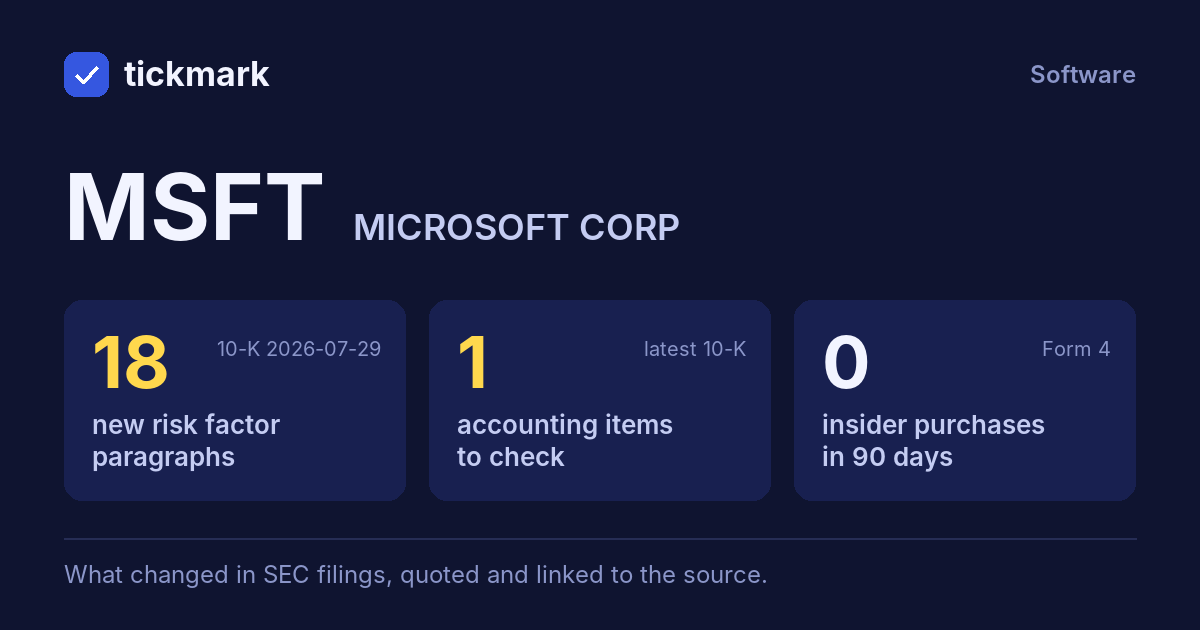
130 changes: 30 added, 9 removed, 88 reworded, 3 quiet changes
10-K 0001193125-26-323660 (2026-07-29) vs 10-K 0000950170-25-100235 (2025-07-30)
The redline
The paragraph that changed most in each section
Marked against last year's 10-K:
cut words struck through, new words highlighted and underlined.
Risk Factors 287 words changed in this paragraph; it is 62% similar to last year's version.
Issues in the development, deployment, and use of AI may result in reputational or competitive harm or liability. We are building providing access to AI into many of across our offerings, including offerings and enabling customers and partners to build AI-based solutions using our productivity services, and we are also making AI available for our customers to use in solutions that they build. This AI platforms. These capabilities may be developed by Microsoft or others, including our strategic partner, OpenAI. We expect these elements third parties and are becoming an increasing part of our business business. The increasing scale and adoption of AI amplifies challenges that may affect its development, deployment, and use, which could give rise to grow. We envision a future in which reputational, competitive, or legal harm. Our AI operating in devices, applications, models and the cloud helps our customers be more productive in their work and personal lives. As with many innovations, AI presents risks and challenges that could affect its adoption, and therefore our business. AI algorithms or training methodologies used to train them may be flawed. Datasets may be overbroad, insufficient, or contain biased or inaccurate information. Content generated by AI systems may be offensive, illegal, inaccurate, or otherwise harmful. Ineffective or inadequate AI development or deployment practices by Microsoft or others could result in incidents that impair the acceptance of AI solutions, cause harm to individuals, customers, or society, or result in our products and services not working as intended. Human review of certain inputs and outputs or other forms of human oversight may be required, including for agentic AI systems that can take actions autonomously. Companion or highly-personalized AI systems may result in over-reliance or dependence by users that is harmful. Our implementation of AI systems could result in legal liability, regulatory action, litigation, brand, reputational, or competitive harm, or other adverse impacts. These risks may stem from issues related to AI model and system capabilities, intellectual property, data privacy, product liability, and other claims associated with AI training training, outputs, and outputs. system behavior. They are further compounded by the evolving regulatory landscape, with new laws emerging globally, including the European Union (“EU”). Some globally and increased scrutiny from regulators and lawmakers. Certain AI scenarios technologies and use cases present ethical issues or may have broad or uneven impacts on society or vulnerable groups within society. There is also rising divergence globally in how to address these issues and impacts, with the result that we will need to navigate a web of different tensions across geographies. Finally, if We have experienced, and expect to continue to experience, instances in which the AI solutions we enable or offer AI solutions that have produce unintended consequences, unintended usage are used or customization customized in unforeseen ways by our customers and or partners, are contrary to our responsible AI policies and practices, or are otherwise controversial because of the impact on human rights, privacy, employment, or other social, economic, or political issues, our reputation, competitive position, business, financial condition, and results of operations could be adversely affected. operate in a
Source: Item 1A, 10-K 0001193125-26-323660 vs Item 1A, 10-K 0000950170-25-100235
MD&A 141 words changed in this paragraph; it is 57% similar to last year's version.
Cash from operations increased $17.6 $46.8 billion to $136.2 $182.9 billion for fiscal year 2025, 2026, primarily due to an increase in cash received from customers, customers and a decrease in cash used to pay income taxes, offset in part by an increase in cash paid to suppliers and employees and cash used to pay income taxes. suppliers. Cash used in financing increased $13.9 billion $847 million to $51.7 $52.5 billion for fiscal year 2025, 2026, primarily due to a $9.5 $6.0 billion increase decrease in cash used for repayments of debt, net of proceeds. offset in part by a $3.9 billion increase in common stock repurchases and a $2.4 billion increase in dividends paid. Cash used in investing decreased $24.4 increased $66.9 billion to $72.6 $139.5 billion for fiscal year 2025, 2026, primarily due to a $63.2 $51.4 billion increase in additions to property and equipment and a $22.2 billion increase in cash used in other investing primarily to facilitate the purchase of components, offset in part by a $4.2 billion decrease in cash used for acquisitions in the acquisition of companies, net of cash acquired and divestitures, and purchases of intangible and other assets, offset in part by assets and a $22.3 $2.4 billion increase decrease in cash used in net investment purchases, sales, and maturities, and a $20.1 billion increase in additions to property and equipment. maturities.
Source: Item 7, 10-K 0001193125-26-323660 vs Item 7, 10-K 0000950170-25-100235
Accounting Policies 128 words changed in this paragraph; it is 55% similar to last year's version.
Equity investments with readily determinable fair values are generally measured at fair value. Equity investments without readily determinable that are not recorded at fair values value are measured using the equity method of accounting when required or measured at cost less impairments, if any, with adjustments for observable changes in price or impairments (referred to as the measurement alternative). We Identifying observable changes in price requires judgment in evaluating whether transactions are orderly and whether the securities are comparable, including consideration of the rights and preferences of the securities, the composition of the investor group, and other relevant facts and circumstances. For equity investments not recorded at fair value, we perform a qualitative assessment on a periodic basis and recognize an impairment if there are sufficient indicators that the fair value of the investment is less than carrying value. Changes in fair value are recorded in other income (expense), net. Equity method investments may be recorded on a lag of up to three months when sufficient financial information is not available in a timely manner. For equity method investments recorded on a lag, we recognize the impact of intervening events that have a material impact on our consolidated financial statements in the period in which they occurred.
Source: Item 8, Note 1 – ACCOUNTING POLICIES, 10-K 0001193125-26-323660 vs Item 8, Note 1 – ACCOUNTING POLICIES, 10-K 0000950170-25-100235
Legal Proceedings 32 words changed in this paragraph; it is 81% similar to last year's version.
In 2018, the Irish Data Protection Commission (“IDPC”) began investigating a complaint against LinkedIn as to whether LinkedIn’s targeted advertising practices violated the recently implemented European Union General Data Protection Regulation (“GDPR”). Microsoft cooperated throughout the period of inquiry. In October 2024, the IDPC provided LinkedIn with a final decision alleging GDPR violations and assessing a fine. In November 2024, LinkedIn appealed the final decision to the Irish courts, and the next decision. A preliminary hearing is scheduled for was held in December 2025. The court issued a ruling on the standard of appeal, which the IDPC may appeal.
Source: Item 3, via Note 14 – CONTINGENCIES, 10-K 0001193125-26-323660 vs Item 3, via Note 14 – CONTINGENCIES, 10-K 0000950170-25-100235
Every change, by type
Sentences and paragraphs added, removed or reworded
Sentences and paragraphs of MSFT's Risk Factors and MD&A, 10-K 2026-07-29 against 10-K 2025-07-30. Each links to the text at sec.gov.
RemovedRisk Factors
RemovedRisk Factors
RemovedRisk Factors
RemovedRisk Factors
RemovedMD&A
RemovedMD&A
RemovedMD&A
Show the other 1
RemovedMD&A