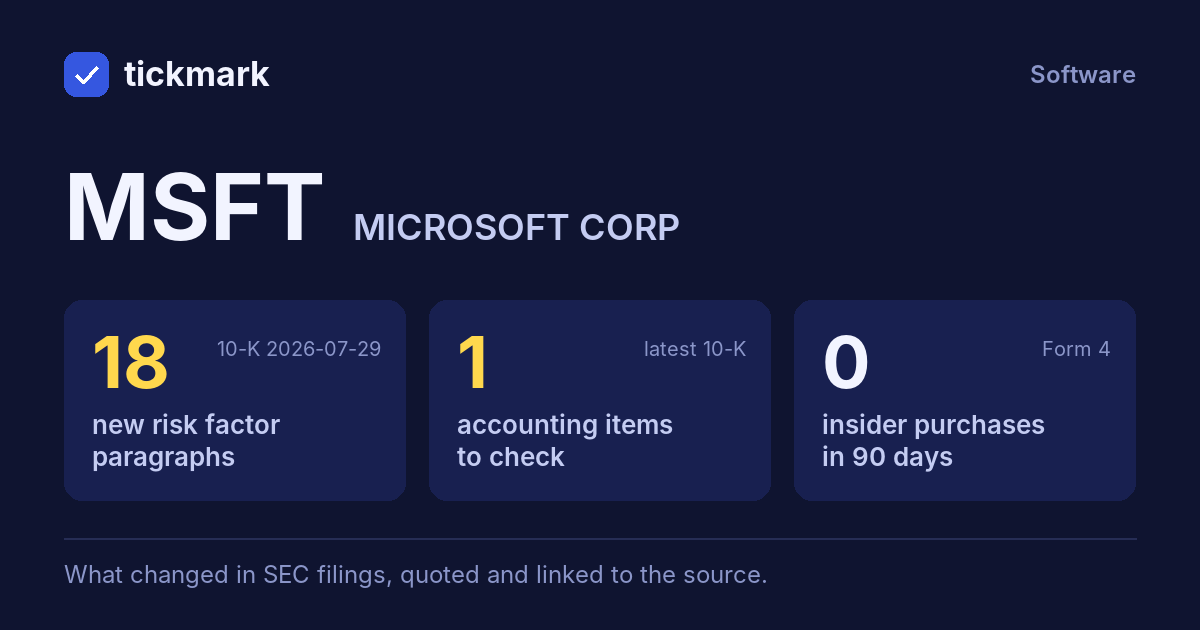
10-K 0001193125-26-323660 (2026-07-29) vs 10-K 0000950170-25-100235 (2025-07-30)
| Section | Compared text | Words now | Changed |
|---|
| Risk Factors | Item 1A | 11,553 |
21.0% |
| MD&A | Item 7 | 6,849 |
17.3% |
| Legal Proceedings | Item 3, via Note 14 – CONTINGENCIES | 225 |
7.3% |
| Accounting Policies | Item 8, Note 1 – ACCOUNTING POLICIES | 4,508 |
11.9% |
The redline: what was cut and what was added
In each section, the paragraph that changed most, marked against last year's 10-K:
cut words struck through, new words highlighted and underlined.
Risk Factors 287 words changed in this paragraph; it is 62% similar to last year's version.
Issues in the development, deployment, and use of AI may result in reputational or competitive harm or liability. We are building providing access to AI into many of across our offerings, including offerings and enabling customers and partners to build AI-based solutions using our productivity services, and we are also making AI available for our customers to use in solutions that they build. This AI platforms. These capabilities may be developed by Microsoft or others, including our strategic partner, OpenAI. We expect these elements third parties and are becoming an increasing part of our business business. The increasing scale and adoption of AI amplifies challenges that may affect its development, deployment, and use, which could give rise to grow. We envision a future in which reputational, competitive, or legal harm. Our AI operating in devices, applications, models and the cloud helps our customers be more productive in their work and personal lives. As with many innovations, AI presents risks and challenges that could affect its adoption, and therefore our business. AI algorithms or training methodologies used to train them may be flawed. Datasets may be overbroad, insufficient, or contain biased or inaccurate information. Content generated by AI systems may be offensive, illegal, inaccurate, or otherwise harmful. Ineffective or inadequate AI development or deployment practices by Microsoft or others could result in incidents that impair the acceptance of AI solutions, cause harm to individuals, customers, or society, or result in our products and services not working as intended. Human review of certain inputs and outputs or other forms of human oversight may be required, including for agentic AI systems that can take actions autonomously. Companion or highly-personalized AI systems may result in over-reliance or dependence by users that is harmful. Our implementation of AI systems could result in legal liability, regulatory action, litigation, brand, reputational, or competitive harm, or other adverse impacts. These risks may stem from issues related to AI model and system capabilities, intellectual property, data privacy, product liability, and other claims associated with AI training training, outputs, and outputs. system behavior. They are further compounded by the evolving regulatory landscape, with new laws emerging globally, including the European Union (“EU”). Some globally and increased scrutiny from regulators and lawmakers. Certain AI scenarios technologies and use cases present ethical issues or may have broad or uneven impacts on society or vulnerable groups within society. There is also rising divergence globally in how to address these issues and impacts, with the result that we will need to navigate a web of different tensions across geographies. Finally, if We have experienced, and expect to continue to experience, instances in which the AI solutions we enable or offer AI solutions that have produce unintended consequences, unintended usage are used or customization customized in unforeseen ways by our customers and or partners, are contrary to our responsible AI policies and practices, or are otherwise controversial because of the impact on human rights, privacy, employment, or other social, economic, or political issues, our reputation, competitive position, business, financial condition, and results of operations could be adversely affected. operate in a
Source: Item 1A, 10-K 0001193125-26-323660 vs Item 1A, 10-K 0000950170-25-100235
MD&A 141 words changed in this paragraph; it is 57% similar to last year's version.
Cash from operations increased $17.6 $46.8 billion to $136.2 $182.9 billion for fiscal year 2025, 2026, primarily due to an increase in cash received from customers, customers and a decrease in cash used to pay income taxes, offset in part by an increase in cash paid to suppliers and employees and cash used to pay income taxes. suppliers. Cash used in financing increased $13.9 billion $847 million to $51.7 $52.5 billion for fiscal year 2025, 2026, primarily due to a $9.5 $6.0 billion increase decrease in cash used for repayments of debt, net of proceeds. offset in part by a $3.9 billion increase in common stock repurchases and a $2.4 billion increase in dividends paid. Cash used in investing decreased $24.4 increased $66.9 billion to $72.6 $139.5 billion for fiscal year 2025, 2026, primarily due to a $63.2 $51.4 billion increase in additions to property and equipment and a $22.2 billion increase in cash used in other investing primarily to facilitate the purchase of components, offset in part by a $4.2 billion decrease in cash used for acquisitions in the acquisition of companies, net of cash acquired and divestitures, and purchases of intangible and other assets, offset in part by assets and a $22.3 $2.4 billion increase decrease in cash used in net investment purchases, sales, and maturities, and a $20.1 billion increase in additions to property and equipment. maturities.
Source: Item 7, 10-K 0001193125-26-323660 vs Item 7, 10-K 0000950170-25-100235
Accounting Policies 128 words changed in this paragraph; it is 55% similar to last year's version.
Equity investments with readily determinable fair values are generally measured at fair value. Equity investments without readily determinable that are not recorded at fair values value are measured using the equity method of accounting when required or measured at cost less impairments, if any, with adjustments for observable changes in price or impairments (referred to as the measurement alternative). We Identifying observable changes in price requires judgment in evaluating whether transactions are orderly and whether the securities are comparable, including consideration of the rights and preferences of the securities, the composition of the investor group, and other relevant facts and circumstances. For equity investments not recorded at fair value, we perform a qualitative assessment on a periodic basis and recognize an impairment if there are sufficient indicators that the fair value of the investment is less than carrying value. Changes in fair value are recorded in other income (expense), net. Equity method investments may be recorded on a lag of up to three months when sufficient financial information is not available in a timely manner. For equity method investments recorded on a lag, we recognize the impact of intervening events that have a material impact on our consolidated financial statements in the period in which they occurred.
Source: Item 8, Note 1 – ACCOUNTING POLICIES, 10-K 0001193125-26-323660 vs Item 8, Note 1 – ACCOUNTING POLICIES, 10-K 0000950170-25-100235
Legal Proceedings 32 words changed in this paragraph; it is 81% similar to last year's version.
In 2018, the Irish Data Protection Commission (“IDPC”) began investigating a complaint against LinkedIn as to whether LinkedIn’s targeted advertising practices violated the recently implemented European Union General Data Protection Regulation (“GDPR”). Microsoft cooperated throughout the period of inquiry. In October 2024, the IDPC provided LinkedIn with a final decision alleging GDPR violations and assessing a fine. In November 2024, LinkedIn appealed the final decision to the Irish courts, and the next decision. A preliminary hearing is scheduled for was held in December 2025. The court issued a ruling on the standard of appeal, which the IDPC may appeal.
Source: Item 3, via Note 14 – CONTINGENCIES, 10-K 0001193125-26-323660 vs Item 3, via Note 14 – CONTINGENCIES, 10-K 0000950170-25-100235
Every change, by type
Sentences and paragraphs of MSFT's Risk Factors and MD&A, 10-K 2026-07-29 against 10-K 2025-07-30.
Each links to the text at sec.gov.
Quiet changes are sentences kept from last year with one to four words changed, at least one of them a hedge, a modal or a qualifier
(may, could, will, not, significant, material…). A year or date rolling forward is not counted.
The full word list
adverse, adversely, all, although, anticipate, anticipates, any, approximately, believe, believes, can, cannot, certain, could, expect, expects, generally, however, if, intend, intends, largely, likely, many, material, materially, may, might, most, must, never, no, not, possible, primarily, probable, should, significant, significantly, some, substantial, substantially, unlikely, will, would
AddedRisk Factors
Our cloud and AI strategy requires substantial investments and depends on evolving customer demand, technological developments, competitive dynamics, and regulatory conditions, any of which could adversely affect our business, financial condition, and results of operations. We have made and are continuing to make significant capital and operational investments to develop, train, deploy, and support AI models and related cloud-based services, including building and expanding datacenters, acquiring necessary components, and securing energy resources. These investments are being made at significant scale and on an accelerated timeline, require substantial and increasing capital expenditures and continued access to capital, and are in advance of fully developed revenue streams. The associated revenue may not be realized in the expected timeframes or at expected levels. Our capital and operational investments are complex and involve projects in multiple locations around the world that expose us to increased compliance risks and political challenges, among others. Our ability to fund these investments depends on our ability to generate sufficient cash flows and obtain financing on acceptable terms. Adverse changes in interest rates, credit markets, investor sentiment, our credit ratings, or other factors affecting capital availability could increase our cost of capital or limit our ability to execute our infrastructure strategy. The financial success of these investments depends on a number of uncertain factors, including customer demand for cloud-based and AI products and services and continued customer use of Azure to build, train, deploy, and run AI workloads, our ability to price and monetize those services at levels sufficient to recover our costs, competitive dynamics affecting pricing, and the pace of adoption of AI. Customers may reduce, delay, or shift AI workloads to competing platforms, on-premises or local deployments, or other alternatives. If adoption of our AI services develops more slowly than expected, or if customers do not continue to utilize Azure for AI workloads at anticipated levels, we may not realize the expected returns on our investments.
Read it in 10-K 2026-07-29 at sec.gov ↗
AddedRisk Factors
Demand for cloud-based and AI products and services is evolving and difficult to forecast. Overestimation of demand or misalignment of capacity investments may result in underutilization of infrastructure and may lead to impairment of assets on our balance sheet. Conversely, demand exceeding available capacity limits our ability to meet customer needs in a timely manner.
Read it in 10-K 2026-07-29 at sec.gov ↗
AddedRisk Factors
The cost structure for AI products and services is subject to significant uncertainty, including with respect to model training and inference costs, the availability and pricing of components, and energy costs. If these costs increase, remain elevated, or fail to decline, or if pricing for AI products and services declines as a result of competition, commoditization, or other market forces, our margins, financial condition, and results of operations could be adversely affected.
Read it in 10-K 2026-07-29 at sec.gov ↗
AddedRisk Factors
Our AI strategy also depends in part on strategic relationships with third parties that provide technologies, models, products, and services that enhance our offerings. These relationships may change over time, and many of these partners compete with us with respect to certain products and services. Changes in strategic priorities, contractual arrangements, our access to third-party technologies, or key commercial relationships could adversely affect the competitiveness of our AI products and services. In some cases, these parties are significant customers of Azure and other cloud services. The economic benefits we expect to derive from these relationships, including through commercial arrangements, technology access, and Azure consumption, may not be realized or sustained. As we manage infrastructure capacity constraints and evolving customer demand, we may modify capacity allocations, deployment priorities, pricing, or other commercial arrangements. Strategic partners and other customers may likewise adjust their purchasing decisions, deployment strategies, workloads, or anticipated use of our products and services. As a result, expected consumption or anticipated demand may not materialize, may be delayed or reduced, or may decline over time. Any such developments could adversely affect our business, financial condition, and results of operations.
Read it in 10-K 2026-07-29 at sec.gov ↗
AddedRisk Factors
Our success depends on our ability to develop, deliver, and maintain competitive cloud-based and AI products and services that achieve broad customer adoption and sustainable revenue growth. Our ability to succeed depends on our ability to develop and deliver differentiated products and services that meet evolving customer needs, achieve broad adoption, maintain customer trust, and generate sustainable revenue and growth. The markets for cloud-based and AI products and services are highly dynamic, characterized by shifting customer expectations, increasing regulatory and governmental scrutiny, intense competition, and rapid technological change, such as the accelerating importance of agentic computing. Whether we succeed in cloud-based and AI products and services depends on our execution in several areas, including:
Read it in 10-K 2026-07-29 at sec.gov ↗
AddedRisk Factors
•Driving customer adoption, usage, and retention of our cloud-based and AI products and services.
Read it in 10-K 2026-07-29 at sec.gov ↗
AddedRisk Factors
•Effectively monetizing our cloud-based and AI products through pricing models that reflect their value while remaining competitive.
Read it in 10-K 2026-07-29 at sec.gov ↗
AddedRisk Factors
•Attracting third parties to utilize, build on, and extend our cloud and AI platforms.
Read it in 10-K 2026-07-29 at sec.gov ↗
AddedRisk Factors
Our cloud-based and AI products and services may be misused by customers, users, or malicious actors for unintended, fraudulent, abusive, or unlawful purposes. Our efforts to detect, prevent, and mitigate such misuse may not be successful, which could result in reputational harm, regulatory scrutiny, service disruptions, or adverse impacts on our business, financial condition, and results of operations.
Read it in 10-K 2026-07-29 at sec.gov ↗
AddedRisk Factors
manner inconsistent with our responsible AI policies and practices. These outcomes may give rise to public controversy, societal concerns, or regulatory actions relating to human rights, privacy, employment, or other social, economic, or political issues, and could adversely affect our reputation, competitive position, business, financial condition, and results of operations.
Read it in 10-K 2026-07-29 at sec.gov ↗
AddedRisk Factors
The availability, reliability, and cost of electrical power are critical to the operation and expansion of our datacenters. In many regions, electricity generation, transmission, and distribution infrastructure is experiencing increasing demand and capacity constraints. Limitations in power availability, delays in obtaining power connections, outages, shortages, increased energy costs, or requirements imposed by utilities, regulators, or other market participants could restrict our ability to develop or expand datacenter capacity. In addition, alternative energy sources and other emerging solutions may not be available in sufficient quantities, may not timely scale to meet our requirements, or may be available only at higher costs. If we are unable to secure adequate power resources on commercially reasonable terms, our ability to support customer demand and execute our growth strategy could be adversely affected.
Read it in 10-K 2026-07-29 at sec.gov ↗
AddedRisk Factors
Our ability to develop additional capacity is also subject to land availability, zoning restrictions, environmental reviews, permitting requirements, and other regulatory approvals. Changes in governmental policies, permitting processes, environmental regulations, sustainability requirements, building standards, energy regulations, or other factors beyond our control may delay projects, restrict development opportunities, impose additional compliance obligations, or increase costs. We also face community opposition, state and local moratoriums, and hyper-local dissent, as well as increasingly coordinated opposition to infrastructure development across jurisdictions, including through the involvement or influence of elected officials, policymakers, and advocacy groups. Our failure to navigate successfully any of these challenges may delay projects, restrict development opportunities, impose additional compliance obligations, or increase costs.
Read it in 10-K 2026-07-29 at sec.gov ↗
RemovedRisk Factors
Our focus on cloud-based and AI services presents execution and competitive risks. We are incurring significant costs to build and maintain infrastructure to support cloud-based and AI services, reducing operating margins. Whether we succeed in cloud-based and AI services depends on our execution in several areas, including:
Read it in 10-K 2025-07-30 at sec.gov ↗
RemovedRisk Factors
•Continuing to enhance the attractiveness of our cloud platforms to third-party developers.
Read it in 10-K 2025-07-30 at sec.gov ↗
RemovedRisk Factors
•Making our suite of cloud-based services platform-agnostic, available on a wide range of devices and ecosystems, including those of our competitors.
Read it in 10-K 2025-07-30 at sec.gov ↗
RemovedRisk Factors
Our AI systems offer users powerful tools and capabilities. However, there may be instances where these systems are used in ways that are unintended or inappropriate. In addition, some users may also engage in fraudulent or abusive activities through our cloud-based and AI services, such as unauthorized account access, payment fraud, or terms of service violations including cryptocurrency mining or launching cyberattacks. While we are committed to detecting and controlling such misuse of our cloud-based and AI services, our efforts may not be effective, and we may incur reputational damage or experience adverse impacts to our business and results of operations.
Read it in 10-K 2025-07-30 at sec.gov ↗
RemovedRisk Factors
Changes in the law may continue to weaken our ability to prevent the use of patented technology. Our increasing engagement with open source software will also cause us to license our intellectual property rights broadly in certain situations. If we are unable to protect our intellectual property, our results of operations could be adversely affected.
Read it in 10-K 2025-07-30 at sec.gov ↗
RewordedRisk Factors
Changes in the law or interpretations of the law may weaken Limitations on our ability to prevent third parties from scraping or gathering information or content through use of bots or other measures and using it for their own benefit which due to, among other things, changes in the law, interpretations of law, or increasing use of agentic AI, could adversely affect our business, financial condition, and results of operations.
Read it in 10-K 2026-07-29 at sec.gov ↗
RewordedRisk Factors
Worsening economic conditions, including inflation, recession, pandemic, or other changes in economic conditions, periods of economic uncertainty, evolution of customer demand, technology investment cycles, interest rates, foreign exchange rates, or the timing and mix of customer spending, may cause lower or delayed IT spending and adversely affect our results of operations.
Read it in 10-K 2026-07-29 at sec.gov ↗
RewordedRisk Factors
Capacity available to us may be affected as Our competitors are also scaling their infrastructure and use some of the same suppliers and materials for hardware components. components as we do, which impacts price and availability.
Read it in 10-K 2026-07-29 at sec.gov ↗
RewordedRisk Factors
U.S. tariff and tariffs, shifting AI export controls policies, like the AI Diffusion Rule, could and disagreements among governments on sanctions policies toward third countries, has and may continue to increase operational costs, create uncertainty in the continuity of our products, and accelerate sovereignty initiatives among international partners and customers.
Read it in 10-K 2026-07-29 at sec.gov ↗
RewordedRisk Factors
Malicious actors have and may employ continue to exploit the supply chain to introduce malware compromise our systems by, for example, injecting malware, including through software updates or compromised supplier accounts or open-source software code, accounts, or hardware.
Read it in 10-K 2026-07-29 at sec.gov ↗
RewordedRisk Factors
Product vulnerabilities can persist even after we have issued security patches if customers have not installed the most recent updates, or if attackers, potentially with the attackers exploited assistance of artificial intelligence, reconstruct and exploit the vulnerabilities before patching to install additional malware to further compromise customers’ systems. patching.
Read it in 10-K 2026-07-29 at sec.gov ↗
RewordedRisk Factors
In addition, we must develop mitigation technologies that help to secure customers from attacks even when software updates are not deployed, and maintain the digital security infrastructure that protects the integrity of our network, products, and services.
Read it in 10-K 2026-07-29 at sec.gov ↗
RewordedRisk Factors
If we are not effective in executing organizational and technical changes to increase efficiency and accelerate innovation, or if we fail to generate sufficient usage of our new products and services, we the timing or magnitude of any revenue growth may not grow revenue be in line with the infrastructure and development investments described above. these costs.
Read it in 10-K 2026-07-29 at sec.gov ↗
RewordedRisk Factors
Despite our efforts to improve the security controls across our business groups and geographies, it is possible our Our security controls over personal data, our training of employees and third parties on data security, and other practices we follow may not prevent the improper disclosure or misuse of customer or user data we or our vendors store and manage.
Read it in 10-K 2026-07-29 at sec.gov ↗
RewordedRisk Factors
We have spent and will continue to spend substantial amounts to build, purchase, or lease datacenters and equipment and to upgrade our technology and network infrastructure to handle more traffic on our websites and in our datacenters. infrastructure.
Read it in 10-K 2026-07-29 at sec.gov ↗
RewordedRisk Factors
Inefficiencies or operational failures, including temporary or permanent loss of customer data, outages, insufficient Internet connectivity, insufficient or unavailable power or water supply, inefficient operation of our of our cloud-based and AI products and services on our infrastructure, or inadequate storage and compute capacity could diminish the actual or perceived quality of our products, services, and user experience, resulting in contractual liability, claims by customers and other third parties, regulatory actions, damage to our reputation, and loss of current and potential users, subscribers, and advertisers, each of which could adversely affect our business, operations, financial condition, and results of operations.
Read it in 10-K 2026-07-29 at sec.gov ↗
RewordedRisk Factors
For example, as previously disclosed in our Form 8-K filed with the Securities and Exchange Commission on January 19, 2024 and amended on March 8, 2024, beginning in late November 2023, a nation-state associated threat actor used a password spray attack to compromise a legacy test account and, in turn, gain access to Microsoft email accounts.
Read it in 10-K 2026-07-29 at sec.gov ↗
Quiet changesRisk Factors
Employees or third parties may intentionally compromise our or our users’ security or systems or reveal confidential information, and laws in foreign certain jurisdictions may compel actions by such parties against our interests and could limit our recourse.
Read it in 10-K 2026-07-29 at sec.gov ↗
Quiet changesRisk Factors
Weaknesses in our processes could result in defects we do not detect and fix in pre-release testing, which could cause reduced sales, damage to our reputation, repair or remediation costs, delays in the release of new products or versions, or legal liability, and any of which could adversely affect our business, financial condition, and results of operations.
Read it in 10-K 2026-07-29 at sec.gov ↗
Quiet changesRisk Factors
Economic sanctions in the U.S., the EU, and other countries could prohibit most business with restricted entities or countries.
Read it in 10-K 2026-07-29 at sec.gov ↗
AddedMD&A
(In millions, except percentages and per share amounts) 2026 2025 Percentage Change Revenue $ 331,839 $ 281,724 18% Gross margin 225,465 193,893 16% Operating income 155,237 128,528 21% Net income 133,749 101,832 31% Diluted earnings per share 17.95 13.64 32% Adjusted net income (non-GAAP) 128,786 105,452 22% Adjusted diluted earnings per share (non-GAAP) 17.28 14.13 22%
Read it in 10-K 2026-07-29 at sec.gov ↗
AddedMD&A
Adjusted net income and adjusted diluted earnings per share (“EPS”) are non-GAAP financial measures. These non-GAAP financial measures exclude net gains and losses from investments in OpenAI. Refer to the Non-GAAP Financial Measures section below for a reconciliation of our financial results reported in accordance with GAAP to non-GAAP financial results.
Read it in 10-K 2026-07-29 at sec.gov ↗
AddedMD&A
Operating expenses increased $4.9 billion or 7% driven by continued investments in research and development compute capacity, AI talent, and data to support product development that benefits the entire portfolio, impairment and other related expenses in our XBOX business, investments in commercial sales, and higher Copilot advertising expenses.
Read it in 10-K 2026-07-29 at sec.gov ↗
AddedMD&A
Revenue and operating income both included a favorable foreign currency impact of 2%.
Read it in 10-K 2026-07-29 at sec.gov ↗
AddedMD&A
Current year net income and diluted EPS were positively impacted by net gains from investments in OpenAI, which resulted in an increase in net income and diluted EPS of $5.0 billion and $0.67, respectively. Prior year net income and diluted EPS were negatively impacted by net losses from investments in OpenAI, which resulted in a decrease in net income and diluted EPS of $3.6 billion and $0.49, respectively.
Read it in 10-K 2026-07-29 at sec.gov ↗
AddedMD&A
Revenue, gross margin, and operating income included a favorable foreign currency impact of 2%, 3%, and 3%, respectively.
Read it in 10-K 2026-07-29 at sec.gov ↗
AddedMD&A
•Operating expenses increased $940 million or 6% driven by impairment and other related expenses in our XBOX business and continued investments in research and development compute capacity, AI talent, and data to support product development that benefits the entire portfolio.
Read it in 10-K 2026-07-29 at sec.gov ↗
AddedMD&A
Other income (expense), net included $6.5 billion of net gains and $4.8 billion of net losses for fiscal years 2026 and 2025, respectively, from investments in OpenAI, primarily net recognized gains (losses) on our equity method investment reflected in Other, net. The net gains recorded for fiscal year 2026 primarily relate to the dilution gain from the OpenAI Recapitalization.
Read it in 10-K 2026-07-29 at sec.gov ↗
AddedMD&A
Adjusted other income (expense), net, adjusted net income, and adjusted diluted EPS are non-GAAP financial measures which exclude net (gains) losses from investments in OpenAI. We believe these non-GAAP measures aid investors by providing additional insight into our financial performance and help clarify trends affecting our business. For comparability of reporting, management considers non-GAAP measures in conjunction with GAAP financial results in evaluating business performance. These non-GAAP financial measures presented should not be considered a substitute for, or superior to, the measures of financial performance prepared in accordance with GAAP.
Read it in 10-K 2026-07-29 at sec.gov ↗
AddedMD&A
The following table reconciles our financial results reported in accordance with GAAP to non-GAAP financial results:
Read it in 10-K 2026-07-29 at sec.gov ↗
AddedMD&A
Remaining performance obligations represent the revenue we expect to recognize for our products and services for which control has not yet been transferred to customers. We estimate total consideration to be received at the outset of the agreement and throughout the term of the agreement. Estimating the total consideration and revenue that will be allocated to remaining performance obligation can involve significant judgments, including identifying and assessing variable consideration and potential renegotiation of commitments. We consider factors such as the nature of the terms and duration of the contract across our portfolio of contracts.
Read it in 10-K 2026-07-29 at sec.gov ↗
AddedMD&A
Investments purchased by Microsoft are typically accounted for as available-for-sale debt securities, equity investments with readily determinable fair values, or equity investments without readily determinable fair values measured using either the equity method when required or at cost less impairments, if any, with adjustments for observable changes in price (referred to as the measurement alternative). Equity method investments may be recorded on a lag of up to three months when sufficient financial information is not available in a timely manner. For equity method investments recorded on a lag, we recognize the impact of intervening events that have a material impact on our consolidated financial statements in the period in which they occurred.
Read it in 10-K 2026-07-29 at sec.gov ↗
RemovedMD&A
In August 2024, we announced changes to the composition of our segments. These changes align our segments with how we currently manage our business, most notably bringing the commercial components of Microsoft 365 together in the Productivity and Business Processes segment. Beginning in fiscal year 2025, the information that our chief operating decision maker is regularly provided and reviews for purposes of allocating resources and assessing performance reflects these segment changes. Prior period segment information has been recast to conform to the way we internally manage and monitor our business during fiscal year 2025.
Read it in 10-K 2025-07-30 at sec.gov ↗
RemovedMD&A
The Organisation for Economic Co-operation and Development (“OECD”) published its model rules “Tax Challenges Arising From the Digitalisation of the Economy - Global Anti-Base Erosion Model Rules (Pillar Two)” which established a global minimum corporate tax rate of 15% for certain multinational enterprises. Many countries have implemented or are in the process of implementing the Pillar Two legislation, which applies to Microsoft beginning in fiscal year 2025. While we do not currently estimate a material impact to our consolidated financial statements, we continue to monitor the impact as countries implement legislation and the OECD provides additional guidance.
Read it in 10-K 2025-07-30 at sec.gov ↗
RemovedMD&A
We are currently assessing the One Big Beautiful Bill Act (“OBBBA”) which was enacted on July 4, 2025. The OBBBA provides a U.S. global intangible low-taxed income effective tax rate of 14% effective fiscal year 2027 for Microsoft. It also provides bonus depreciation for certain assets placed into service after January 19, 2025 and an election to expense U.S. incurred research or experimental expenditures.
Read it in 10-K 2025-07-30 at sec.gov ↗
RemovedMD&A
As a result of the TCJA, we are required to pay a one-time transition tax on deferred foreign income not previously subject to U.S. income tax. Under the TCJA, the transition tax is payable in interest-free installments over eight years, with 8% due in each of the first five years, 15% in year six, 20% in year seven, and 25% in year eight. As of June 30, 2025, our eighth transition tax installment of $4.4 billion is short-term and payable in the first quarter of fiscal year 2026.
Read it in 10-K 2025-07-30 at sec.gov ↗
RewordedMD&A
Cash used in investing decreased $24.4 increased $66.9 billion to $72.6 $139.5 billion for fiscal year 2025, 2026, primarily due to a $63.2 $51.4 billion increase in additions to property and equipment and a $22.2 billion increase in cash used in other investing primarily to facilitate the purchase of components, offset in part by a $4.2 billion decrease in cash used for acquisitions in the acquisition of companies, net of cash acquired and divestitures, and purchases of intangible and other assets, offset in part by assets and a $22.3 $2.4 billion increase decrease in cash used in net investment purchases, sales, and maturities, and a $20.1 billion increase in additions to property and equipment. maturities.
Read it in 10-K 2026-07-29 at sec.gov ↗
RewordedMD&A
Cash used in financing increased $13.9 billion $847 million to $51.7 $52.5 billion for fiscal year 2025, 2026, primarily due to a $9.5 $6.0 billion increase decrease in cash used for repayments of debt, net of proceeds. offset in part by a $3.9 billion increase in common stock repurchases and a $2.4 billion increase in dividends paid.
Read it in 10-K 2026-07-29 at sec.gov ↗
RewordedMD&A
Gross margin percentage decreased increased slightly primarily driven by the impact of scaling our AI infrastructure, offset in part by efficiency gains in Microsoft 365 Commercial cloud. cloud, offset in part by continued investments in AI infrastructure and growing AI product usage.
Read it in 10-K 2026-07-29 at sec.gov ↗
RewordedMD&A
Cash from operations increased $17.6 $46.8 billion to $136.2 $182.9 billion for fiscal year 2025, 2026, primarily due to an increase in cash received from customers, customers and a decrease in cash used to pay income taxes, offset in part by an increase in cash paid to suppliers and employees and cash used to pay income taxes. suppliers.
Read it in 10-K 2026-07-29 at sec.gov ↗
RewordedMD&A
Microsoft 365 Commercial cloud revenue growth Revenue from Microsoft 365 Commercial subscriptions, comprising Microsoft 365 Commercial, Enterprise Mobility + Security, the cloud portion of Windows Commercial, the per-user portion of Power BI, Exchange, SharePoint, Microsoft Teams, Microsoft 365 Security and Compliance, and Microsoft 365 Copilot Microsoft 365 Commercial seat growth The number of Microsoft 365 Commercial seats at end of period where seats are paid users covered by a Microsoft 365 Commercial subscription Microsoft 365 Consumer cloud revenue growth Revenue from Microsoft 365 Consumer subscriptions and other consumer services Microsoft 365 Consumer subscribers The number of Microsoft 365 Consumer subscribers at end of period LinkedIn revenue growth Revenue from LinkedIn, including Talent Solutions, Marketing Solutions, Premium Subscriptions, and Sales Solutions Dynamics 365 revenue growth Revenue from Dynamics 365, including a set of intelligent, cloud-based applications across ERP, CRM, Power Apps, and Power Automate Azure and other cloud services revenue growth Revenue from Azure and other cloud services, including cloud and AI consumption-based services, GitHub cloud services, Health and Life Sciences cloud services (formerly Nuance Healthcare cloud services, services), virtual desktop offerings, and other cloud services
Read it in 10-K 2026-07-29 at sec.gov ↗
RewordedMD&A
Server products revenue decreased 3% increased 1% primarily driven by a decrease higher purchases of licenses running in transactional purchasing with multi-cloud environments, offset in part by continued customer shift to cloud offerings. cloud.
Read it in 10-K 2026-07-29 at sec.gov ↗
RewordedMD&A
Microsoft 365 Commercial cloud revenue seats grew 15% with Microsoft 365 Commercial seat growth of 6% driven by small and medium businesses and frontline worker offerings, as well as growth in revenue per user. offerings.
Read it in 10-K 2026-07-29 at sec.gov ↗
RewordedMD&A
Microsoft 365 Commercial products revenue grew 7% 13% driven by growth in the Windows Commercial on-premises components of Microsoft 365 suite sales and sales, as well as an increase in Office 2024 transactional purchasing with the launch of Office 2024. purchasing.
Read it in 10-K 2026-07-29 at sec.gov ↗
RewordedMD&A
In the first quarter of fiscal year 2025, 2026, we made updates to our metrics in connection to align with the segment changes described above. how we manage and monitor certain businesses.
Read it in 10-K 2026-07-29 at sec.gov ↗
RewordedMD&A
We have operating and finance leases for datacenters, datacenters and related infrastructure, servers and network equipment, corporate offices, and research and development facilities, Microsoft Experience Centers, and certain equipment. facilities.
Read it in 10-K 2026-07-29 at sec.gov ↗
RewordedMD&A
Gross margin percentage decreased driven by the impact of scaling our continued investments in AI infrastructure, infrastructure as well as sales mix shift to Azure, offset in part by efficiency gains in Azure.
Read it in 10-K 2026-07-29 at sec.gov ↗
RewordedMD&A
Sales and marketing expenses increased $1.2 $1.1 billion or 5% 4% driven by investments in commercial sales and Gaming, including the impact of the Activision Blizzard acquisition. higher Copilot advertising expenses.
Read it in 10-K 2026-07-29 at sec.gov ↗