Matador Resources Co MTDR
New risk paragraphs, branching off last year
Each branch is a paragraph in Risk Factors with nothing like it in the 10-K filed Feb 25, 2025. A box jumps to the paragraph as filed, below.
Paragraphs with nothing like them in last year's 10-K
10 paragraphs in Risk Factors of the 10-K filed Feb 26, 2026 with nothing like them in the 10-K filed Feb 25, 2025. Quoted exactly. Paragraphs that were only edited are under 10-K change.
•speculative trading of, and other financial market conditions affecting, oil and natural gas futures contracts;
In addition, a change in control (as defined in the Credit Agreement, the San Mateo Credit Facility and the indentures governing our senior notes) could result in an event of default or prepayment event under the applicable debt instrument, which could have an adverse effect on our business by limiting our ability to take advantage of financing, merger and acquisition, or other opportunities.
In April 2025, the Board approved the Share Repurchase Program authorizing the repurchase of up to $400.0 million of common stock. However, the timing and number of shares that we may repurchase under the Share Repurchase Program is subject to a variety of factors, including our stock price, market conditions, trading volume and other uses for our free cash flow. There can be no assurance regarding the exact number of shares to be repurchased by us, if any. Depending on market conditions and other factors, these repurchases may be commenced or suspended at any time or periodically without prior notice, and the Share Repurchase Program does not obligate us to acquire any amount of common stock.
Moreover, our revenues may not increase immediately, or at all, upon the expenditure of funds on a particular project. For instance, if we or San Mateo build additional gathering assets, the construction may occur over an extended period of time and we may not receive any material increases in revenues until the project is completed or at all. We or San Mateo may construct facilities to capture anticipated future production growth from our customers in an area where such growth does not materialize. As a result, new midstream assets may not be able to attract enough throughput to achieve our expected investment return, which could adversely affect our financial condition and results of operations.
properties or otherwise violated state and federal rules regulating waste disposal. Private parties may also pursue legal actions challenging permitting programs that authorize certain of our operations.
Show the other 4
implemented more stringent regulatory requirements applicable to hydraulic fracturing, including bans or moratoria on drilling that effectively prohibit further production of oil and natural gas through the use of hydraulic fracturing or similar operations.
have implemented rules and regulations relating to greenhouse gas emissions. For further discussion of these federal and state regulations, see “Business—Regulation—Environmental, Health and Safety Regulation.”
On March 6, 2024, the SEC adopted new rules that would require significantly expanded climate-related disclosures in SEC filings, including certain climate-related risks, climate-related metrics and greenhouse gas emissions, information about
climate-related targets and goals, transition plans, if any, and extensive attestation requirements (the “SEC Climate Disclosure Rules”). The SEC Climate Disclosure Rules included certain phase-in compliance dates for disclosure of material Scope 1 and 2 greenhouse gas emissions. Litigation challenging the SEC Climate Disclosure Rules was filed by multiple parties in multiple jurisdictions, which was consolidated and assigned to the U.S. Court of Appeals for the Eighth Circuit. On April 4, 2024, the SEC issued an order staying implementation of the SEC Climate Disclosure Rules while the U.S. Court of Appeals considered the litigation. On March 27, 2025, the SEC voted to end its defense of the SEC Climate Disclosure Rules in the litigation, and on July 23, 2025, it filed a status report requesting that the U.S. Court of Appeals proceed with the case and issue an opinion on the challenges to the climate disclosure rules. On September 12, 2025, the U.S. Court of Appeals denied the SEC’s request to proceed with the case and indicated that the case would be held in abeyance until the SEC either renews its defense of the rules or revises the rules through notice-and-comment rulemaking. Accordingly, it is not clear whether, when or in what form the SEC Climate Disclosure Rules will be implemented or the ultimate timing of required compliance with such rules, and at this time we cannot predict the costs of implementation or any potential adverse impacts resulting from the SEC Climate Disclosure Rules. In addition, in the absence of federal action, states may propose and adopt climate disclosure requirements.
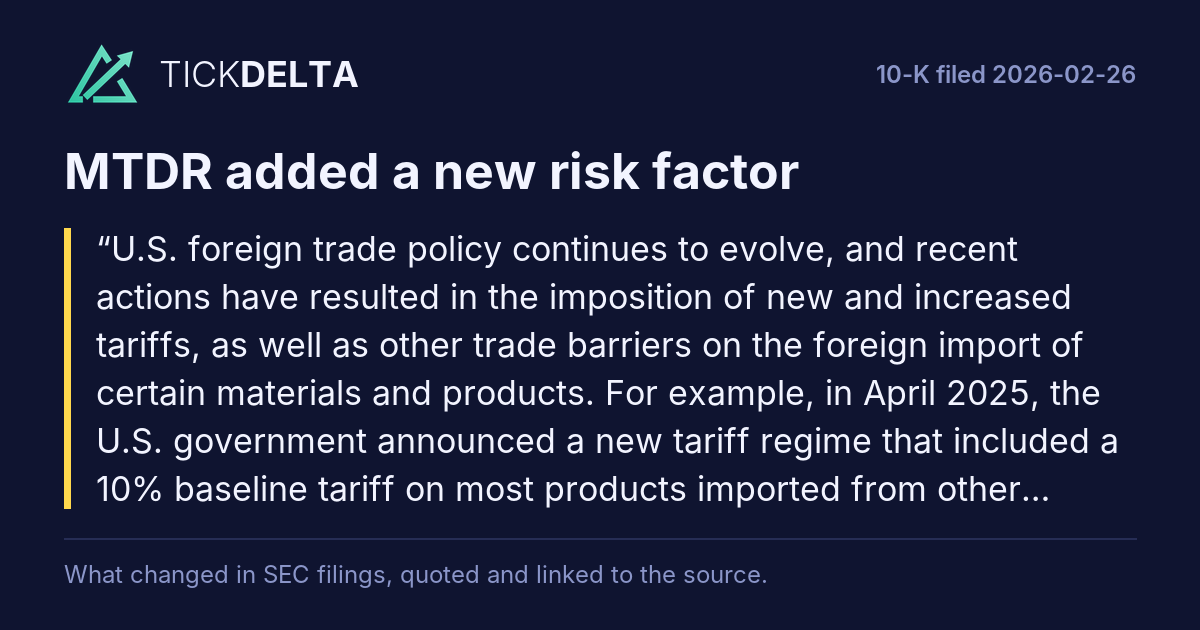
U.S. foreign trade policy continues to evolve, and recent actions have resulted in the imposition of new and increased tariffs, as well as other trade barriers on the foreign import of certain materials and products. For example, in April 2025, the U.S. government announced a new tariff regime that included a 10% baseline tariff on most products imported from other countries and an additional individualized reciprocal tariff on the countries with which the U.S. has the largest trade deficits, including China. Since that time, the U.S. expanded tariffs on key industrial inputs, including tariffs on steel and aluminum imports, and at times announced, rescinded, modified and temporarily suspended multiple tariffs on several foreign jurisdictions, which increased uncertainty regarding the ultimate effect of the tariffs on economic conditions. In August 2025, however, the U.S. Court of Appeals for the Federal Circuit ruled that the tariffs imposed under the Trump Administration exceed presidential authority and therefore are invalid, and in February 2026, the U.S. Supreme Court affirmed such decision. Following the ruling, the Trump Administration signed an executive order imposing a 10% “global tariff” and later indicated an intention to increase such “global tariff” to 15%, effective immediately, using presidential powers under certain U.S. trade laws. If implemented, such tariffs can remain in effect for up to 150 days, which may be extended by the U.S. Congress. The Trump Administration may continue to impose additional tariffs under other U.S. trade laws. In addition, from time to time, certain leaders in the U.S. government, including in the Trump administration, have indicated a willingness to revise, renegotiate or terminate various existing bilateral and multilateral trade agreements. The uncertainty over such policies has caused volatility in commodity, capital and financial markets, increased concerns over domestic and global inflation and adversely impacted consumer confidence in the U.S and worldwide. Any future tariffs or other trade restrictions may lead to continuing uncertainty and volatility in U.S. and global financial and economic conditions and commodity markets, declining consumer confidence, significant inflation and diminished expectations for the economy, and ultimately reduced demand for oil and natural gas.
Paragraphs in the 10-Q filed Nov 6, 2026 that were not in the one before
New in the latest 10-Q
26 paragraphs in the 10-Q filed Nov 6, 2026 with nothing like them in the 10-Q filed Aug 7, 2026 (at least half the words must differ; new numbers alone do not count). Quoted exactly, grouped by the item heading above them. This is text that changed, not a judgement of how serious it is.
Financial statements and notes
Amortization of intangibles with definite lives is calculated using the straight-line method, which is reflective of the benefit pattern in which the estimated economic benefit is expected to be received over the estimated useful life of the intangible asset. Intangibles subject to amortization are reviewed for impairment whenever events or changes in circumstances indicate that the carrying amount of the intangible may not be recoverable. If the sum of the expected undiscounted future cash flows related to the asset is less than the carrying amount of the asset, an impairment loss is recognized based on the fair value of the asset.
Read in the 10-Q
Goodwill represents the excess of the purchase price over the estimated fair value of the net assets acquired in the acquisition of a business. Goodwill is not amortized, but rather is tested for impairment at the reporting unit level annually and when events or changes in circumstances indicate that the fair value of a reporting unit with goodwill has been reduced below carrying value. If the Company determines, based on a qualitative assessment, that it is not more likely than not that a reporting unit’s fair value is less than its carrying amount, no further impairment testing is required. If the Company does not perform a qualitative assessment or if that assessment indicates that further impairment testing is required, the fair value of each reporting
Read in the 10-Q
unit is determined using an income and market approach which is compared to the carrying value of the reporting unit. If the carrying amount of the reporting unit exceeds its fair value, an impairment loss would be recognized in an amount equal to that excess, limited to the total amount of goodwill allocated to that reporting unit.
Read in the 10-Q
The Cardinal Acquisition was accounted for under the acquisition method of accounting as a business combination in accordance with Accounting Standards Codification 805, Business Combinations (“ASC 805”). Under ASC 805, the purchase price is allocated to the underlying tangible and intangible assets acquired and liabilities assumed based upon their estimated fair values as of the respective acquisition date, with any excess purchase price allocated to goodwill. As San Mateo acquired 100% of the membership interests of Cardinal, the acquisition was treated as an asset acquisition for tax purposes.
Read in the 10-Q
The preliminary allocation of the total purchase price for the Cardinal Acquisition is set forth below (in thousands). As of the date of this filing, the valuation of property, plant and equipment and intangible assets, as well as certain working capital adjustments in connection with the final settlement, remain ongoing and adjustments may be made. The Company expects to complete the final purchase price allocation during the 12-month period subsequent to the Cardinal Acquisition closing date.
Read in the 10-Q
Show the other 21
Cash consideration $ 760,958 Allocation of purchase price Current assets 14,233 Property, plant and equipment 431,350 Intangible assets 266,100 Goodwill 54,864 Other long-term assets(1) 14,217 Current liabilities(1) (10,008) Asset retirement obligations (237) Other long-term liabilities(1) $ (9,561) Net assets acquired $ 760,958
Read in the 10-Q
(1) Other long-term assets and other long-term liabilities represent lease balances, and current liabilities includes current lease liabilities of $ 4.7 million.
Read in the 10-Q
Goodwill represents the excess of the purchase price of an acquired business over the fair value of net assets acquired. The goodwill recognized in connection with the Cardinal Acquisition reflects the value to San Mateo of flowing additional volumes through the system, including those of Matador. The goodwill is deductible over 15 years for tax purposes, which creates associated deferred tax balances post closing.
Read in the 10-Q
The results of operations for the Cardinal Acquisition since the closing date have been included in the Company’s unaudited condensed consolidated financial statements for the three and nine months ended September 30, 2026. Additionally, the Company incurred $ 3.1 million and $ 4.1 million in acquisition-related costs for the Cardinal Acquisition during the three and nine months ended September 30, 2026, respectively, which were included in general and administrative expenses in the unaudited condensed consolidated statements of operations.
Read in the 10-Q
The pro forma impacts of this business combination to revenues and net income for the three and nine months ended September 30, 2026 and 2025 were not material to the Company’s revenues and net income as reported.
Read in the 10-Q
The following table summarizes the Company’s intangible assets at September 30, 2026 and December 31, 2025 (in thousands), all of which is derived from the Cardinal Acquisition and attributable to the midstream segment and has been assigned a 20-year economic life. The intangible assets are deductible over 15 years for tax purposes, which creates associated deferred tax balances post closing.
Read in the 10-Q
The following table presents estimated amortization expense through 2030 (in thousands):
Read in the 10-Q
Between September 30, 2026 and November 3, 2026, net borrowings under the Credit Agreement increased $ 1.30 billion primarily in connection with the Paloma Acquisition (see Note 14, Subsequent Events). Of this increase in net borrowings, $ 150 million was repaid following the closing of the Paloma Acquisition. At November 3, 2026, the Company had $ 2.25 billion in borrowings outstanding under the Credit Agreement.
Read in the 10-Q
In July 2026, in connection with the Cardinal Acquisition, San Mateo amended the San Mateo Credit Facility to include the $ 650.0 million San Mateo Term Loan.
Read in the 10-Q
Total deferred financing costs for the San Mateo Term Loan were $ 2.7 million at September 30, 2026, which are being amortized to interest expense over the term of the loan. The Company recognizes these costs as a deduction to the principal balance in the interim unaudited condensed consolidated balance sheet. San Mateo’s effective interest rate under the San Mateo Term Loan was 6.91 % at September 30, 2026.
Read in the 10-Q
As of September 30, 2026, the San Mateo Term Loan is due within twelve months and has therefore been presented as a current liability in the Company’s interim unaudited condensed consolidated balance sheet. San Mateo’s management presently believes measures being taken to refinance the San Mateo Term Loan will enable San Mateo to successfully refinance the balance on a long-term basis prior to its maturity, although no assurance can be given. In the absence of being able to refinance the San Mateo Term Loan on a long-term basis, San Mateo believes it could satisfy the obligation through a combination of cash on hand, cash flows from operations, borrowings under the San Mateo Revolving Credit Facility and contributions from its members.
Read in the 10-Q
The decreases in the current, deferred and total income tax provisions for the nine months ended September 30, 2026 compared to the respective period of 2025 were primarily the result of lower income before income taxes.
Read in the 10-Q
The Cardinal Acquisition was accounted for under the acquisition method of accounting as a business combination in accordance with Accounting Standards Codification 805, Business Combinations (“ASC 805”). Under ASC 805, the purchase price is allocated to the underlying tangible and intangible assets acquired and liabilities assumed based upon their estimated fair values as of the respective acquisition date, with any excess purchase price allocated to goodwill. The Cardinal Acquisition purchase price allocation resulted in customer relationship intangible assets and goodwill. See Note 3, Acquisitions, to the unaudited condensed consolidated financial statements in this Quarterly Report for additional information on the Cardinal Acquisition including the preliminary allocation of the total purchase price and the inputs, estimates and judgments used in the valuation.
Read in the 10-Q
Amortization of intangibles with definite lives is calculated using the straight-line method, which is reflective of the benefit pattern in which the estimated economic benefit is expected to be received over the estimated useful life of the intangible asset. Intangibles subject to amortization are reviewed for impairment whenever events or changes in circumstances indicate that the carrying amount of the intangible may not be recoverable. If the sum of the expected undiscounted future cash flows related to the asset is less than the carrying amount of the asset, an impairment loss is recognized based on the fair value of the asset.
Read in the 10-Q
Goodwill represents the excess of the purchase price over the estimated fair value of the net assets acquired in the acquisition of a business. Goodwill is not amortized, but rather is tested for impairment at the reporting unit level annually and when events or changes in circumstances indicate that the fair value of a reporting unit with goodwill has been reduced below carrying value. If we determine, based on a qualitative assessment, that it is not more likely than not that a reporting unit’s fair value is less than its carrying amount, no further impairment testing is required. If we do not perform a qualitative assessment or if that assessment indicates that further impairment testing is required, the fair value of each reporting unit is determined using an income and market approach which is compared to the carrying value of the reporting unit. If the carrying amount of the reporting unit exceeds its fair value, an impairment loss would be recognized in an amount equal to that excess, limited to the total amount of goodwill allocated to that reporting unit. The fair value under the income approach is calculated using the expected present value of future cash flows method. Significant assumptions used in the cash flow forecasts include future net operating margins, future volumes, discount rates and future capital requirements.
Read in the 10-Q
Accretion of asset retirement obligations. The increase in accretion of asset retirement obligations was primarily due to an increase in estimated future costs.
Read in the 10-Q
Between September 30, 2026 and November 3, 2026, our borrowings increased $1.30 billion under the Credit Agreement primarily in connection with the Paloma Acquisition, and at November 3, 2026, we had $2.25 billion in borrowings outstanding under the Credit Agreement. We expect to repay between $350 and $400 million in borrowings under the Credit Agreement based on market conditions as of November 3, 2026, funded by free cash flow generation, in the fourth quarter of 2026 following the closing of the Paloma Acquisition, of which $150 million has been repaid as of November 3, 2026.
Read in the 10-Q
In connection with the Cardinal Acquisition, on July 31, 2026, San Mateo amended the San Mateo Credit Facility (as defined in Note 6, Debt) to include a $650.0 million incremental senior secured term loan (the “San Mateo Term Loan”), and fully drew on that term loan on the same date. In addition to the San Mateo Term Loan, the Cardinal Acquisition was funded through capital contributions by Matador and Five Point to San Mateo of $51.0 million and $49.0 million, respectively, and cash on hand. As of September 30, 2026, the San Mateo Term Loan is due within twelve months and has therefore been presented as a current liability in our interim unaudited condensed consolidated balance sheet. San Mateo’s management is evaluating the refinancing of the San Mateo Term Loan and presently believes the measures being taken will enable San Mateo to successfully refinance the balance on a long-term basis prior to its maturity, although no assurance can be given. In the absence of being able to refinance the San Mateo Term Loan on a long-term basis, San Mateo believes it could satisfy the obligation through a combination of cash on hand, cash flows from operations, borrowings under the San Mateo Revolving Credit Facility (as defined in Note 6, Debt) and contributions from its members.
Read in the 10-Q
Item 6
4.1 First Supplemental Indenture, dated as of November 3, 2026, by and among MRC Ranger, LLC, Paloma Permian, LLC, Paloma Permian AssetCo, LLC and Paloma Permian Nominee Corporation, the existing Guarantors party thereto, Matador Resources Company and U.S. Bank Trust Company, National Association, as trustee (filed herewith).
Read in the 10-Q
4.2 Second Supplemental Indenture, dated as of November 3, 2026, by and among MRC Ranger, LLC, Paloma Permian, LLC, Paloma Permian AssetCo, LLC and Paloma Permian Nominee Corporation, the existing Guarantors party thereto, Matador Resources Company and U.S. Bank Trust Company, National Association, as trustee (filed herewith).
Read in the 10-Q
4.3 Third Supplemental Indenture, dated as of November 3, 2026, by and among MRC Ranger, LLC, Paloma Permian, LLC, Paloma Permian AssetCo, LLC and Paloma Permian Nominee Corporation, the existing Guarantors party thereto, Matador Resources Company and U.S. Bank Trust Company, National Association, as trustee (filed herewith).
Read in the 10-Q
The 10-Q's risk factors against the 10-K
Item 1A of the 10-Q filed Nov 6, 2026 against Item 1A of the 10-K filed Feb 26, 2026.
A 10-Q repeats only the risks that changed, so a 10-K paragraph that is missing from it is not counted as removed.
Added is a paragraph with nothing like it in the 10-K, Reworded a sentence that is in both with several words changed,
Quiet changes a sentence in both where one to four words changed and one is a hedge or a modal
(cut words struck through, new words highlighted).
Text on the page, not a score; each links to the filing at sec.gov.
What the 10-Q itself says about its risk factors:We are subject to various risks and uncertainties in the course of our business. For a discussion of such risks and uncertainties, please see “Item 1A. Risk Factors” in the Annual Report. During the three months ended September 30, 2026, there were no material changes to the risk factors we have disclosed in the Annual Report.
Read in the 10-Q
1 paragraph in the 10-Q's Item 1A, and none of them adds, rewords or quietly edits a paragraph of the 10-K's.
Phrases used for the first time
Two-word phrases in Risk Factors of the 10-K filed Feb 26, 2026 that are in none of the 1 earlier 10-Ks stored, back to Feb 25, 2025
Where each one is used
- floods fires: •weather conditions and natural disasters, including floods, fires, tornadoes, droughts, hurricanes, tropical storms and severe cold weather;
- fires tornadoes: •weather conditions and natural disasters, including floods, fires, tornadoes, droughts, hurricanes, tropical storms and severe cold weather;
- tornadoes droughts: •weather conditions and natural disasters, including floods, fires, tornadoes, droughts, hurricanes, tropical storms and severe cold weather;
- droughts hurricanes: •weather conditions and natural disasters, including floods, fires, tornadoes, droughts, hurricanes, tropical storms and severe cold weather;
- share repurchase: In April 2025, the Board approved the Share Repurchase Program authorizing the repurchase of up to $400.0 million of common stock. However, the timing and number of shares that we may repurchase under the Share Repurchase Program is subject to a variety of factors, including our stock price, market conditions,...
- repurchase program: In April 2025, the Board approved the Share Repurchase Program authorizing the repurchase of up to $400.0 million of common stock. However, the timing and number of shares that we may repurchase under the Share Repurchase Program is subject to a variety of factors, including our stock price, market conditions,...
- armed conflicts: •We cannot predict the impact of armed conflicts, including the ongoing military conflicts between Russia and Ukraine and in the Middle East.
- pressures affecting: Although inflation in the U.S. softened in 2024 and 2025, prices for many services, materials and equipment have remained elevated relative to pre-2022 levels. Since 2022, we have experienced significant increases in the costs of certain oilfield services, materials and equipment, including diesel, steel, labor,...
Used at least twice, small words left out. Counted, not picked: a phrase can be new because the company renamed something.
What was taken out
23 paragraphs of last year's Risk Factors with nothing like them now. The longest are quoted.
Sources
Item 1A of each 10-K and 10-Q on EDGAR, quoted exactly. Each paragraph links to the filing at sec.gov.
Also
10-K change: what was reworded or cut, section by section.
Work with it
Excel workbook · CSV. Google Sheet that stays up to date: paste =IMPORTDATA("https://tickdelta.com/company/MTDR/export.csv") into a cell.