Paragraph 145 · 46% changed
Every version of it
Screener
/
SEC EDGAR
/CIK 0000876437
/10-K filed Feb 25, 2026, compared with Feb 26, 2025
/Numbers from the XBRL of the 10-Ks
NYSE
Financials · Surety Insurance
Mgic Investment Corp MTG
The 10-K against last year's
254 changes: 40 added, 58 removed, 151 reworded, 5 quiet changes
10-K Feb 25, 2026 vs Feb 26, 2025
Risk Factors
23.1%
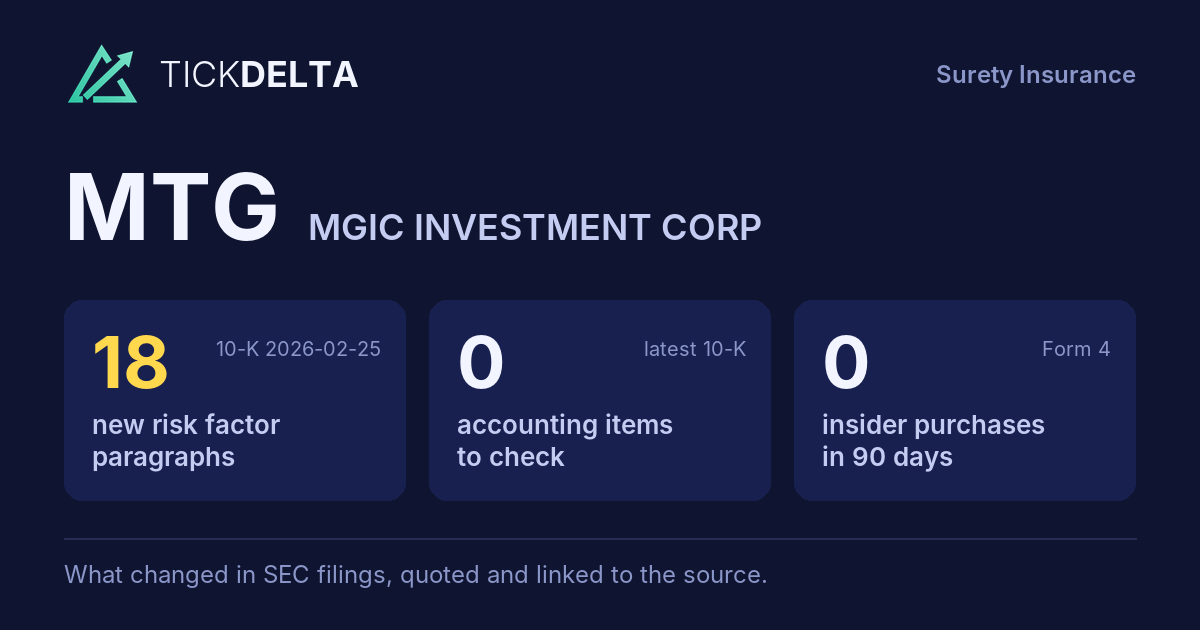
of the text changed · 12,252 words now · 18 new paragraphs, 20 gone
MD&A
25.4%
of the text changed · 14,558 words now · 22 new paragraphs, 38 gone
Accounting Policies
12.6%
of the text changed · 3,660 words now
10-K 0000876437-26-000010 (Feb 25, 2026) vs 10-K 0000876437-25-000036 (Feb 26, 2025) Not compared: Legal Proceedings.
Every paragraph, and how much of it changed
One bar per paragraph, in the order of the 10-K. Height and colour show the share of its words not in the closest paragraph a year earlier; the tallest bars are new paragraphs.
Risk Factors
151 paragraphs · 18 new · 65 reworded · 20 gone · 10-K Feb 25, 2026 against Feb 26, 2025
New paragraph
Reworded (5% of its words or more)
Same or nearly
Paragraph 132 · 45% changed
Every version of it
We operate in a highly regulated industry that is subject to the risk of litigation and regulatory proceedings, including related to our claims paying practices. From time to time, we are a party to material litigation and are also subject to legal and regulatory claims, assertions, actions, reviews, audits, inquiries and investigations. Additional lawsuits, legal and regulatory proceedings and inquiries or other matters may arise in the future. The outcome of future legal and regulatory proceedings, inquiries or other matters could result in adverse judgments, settlements, fines, injunctions, restitutions or other relief which could require significant expenditures or have a material adverse effect on our business, results of operations and financial condition. See our risk factor titled "We are subject to comprehensive regulation and other requirements, which we may fail to satisfy" for additional information about risks related to government enforcement actions.
Paragraph 88 · 45% changed
Every version of it
Paragraph 141 · 44% changed
Every version of it
Paragraph 29 · 43% changed
Every version of it
Paragraph 118 · 37% changed
Every version of it
Paragraph 49 · 34% changed
Every version of it
Paragraph 109 · 34% changed
Every version of it
Paragraph 145 · 46% changed
Every version of it
10-K Feb 26, 2025MGIC Investment Corporation is the holding company for our insurance operating subsidiaries. At the holding company level, our principal assets are the shares of capital stock of our insurance company subsidiaries and cash and investments. Dividends and other permitted distributions from MGIC are the holding company's primary source of funds used to meet ongoing cash requirements, including future debt service payments, repurchases of its shares, payment of dividends to our shareholders, and other expenses. Other sources of holding company cash inflow include investment income and raising capital in the public markets. The payment of dividends from MGIC is subject to regulatory approval as described in our Annual Reports on Form 10-K. In general, dividends in excess of prescribed limits are deemed “extraordinary” and may not be paid if disapproved by the OCI. The prescribed limits are based on a rolling 12-month period, and as such, the impact of the limitations will vary over time. In the twelve months ended December 31, 2024, MGIC paid $750 million in dividends to the holding company. Future dividend payments from MGIC to the holding company will be determined in consultation with the Board of Directors, and after considering any updated estimates about our business, subject to regulatory approval.
10-K Feb 25, 2026
State of Wisconsin ("OCI"). The prescribed limits are based on a rolling 12-month period, and as such, the impact of the limitations will vary over time. Dividend payments from MGIC to the holding company are determined in consultation with the Board of Directors, and after considering any updated estimates about our business, subject to regulatory approval.
Paragraph 132 · 45% changed
Every version of it
10-K Feb 26, 2025
We operate in a highly regulated industry that is subject to the risk of litigation and regulatory proceedings, including related to our claims paying practices. From time to time, we are a party to material litigation and are also subject to legal and regulatory claims, assertions, actions, reviews, audits, inquiries and investigations. Additional lawsuits, legal and regulatory proceedings and inquiries or other matters may arise in the future. The outcome of future legal and regulatory proceedings, inquiries or other matters could result in adverse judgments, settlements, fines, injunctions, restitutions or other relief which could require significant expenditures or have a material adverse effect on our business, results of operations and financial condition. See our risk factor titled "We are subject to comprehensive regulation and other requirements, which we may fail to satisfy" for additional information about risks related to government enforcement actions.
10-K Feb 25, 2026
We operate in a highly regulated industry that is subject to the risk of litigation and regulatory proceedings, including related to our claims paying practices. From time to time, we are a party to material litigation and are also subject to legal and regulatory claims,
Paragraph 88 · 45% changed
Every version of it
10-K Feb 26, 2025Additionally, technological advancements and innovation are occurring at a rapid pace that may continue to accelerate. Our competitive position could be impacted if we are unable to utilize, in a cost effective and competitive manner, technology such as AI and machine learning that collects and analyzes data to inform underwriting or other decisions, or if our competitors collect and use data which we do not have the ability to access or use. Changes in technology related to collection and application of data could expose us to regulatory or legal actions and may have a material adverse effect on our business, reputation, results of operations and financial condition.
10-K Feb 25, 2026
Technological advancements are occurring at a rapid pace. If we are unable to effectively deploy technology such as artificial intelligence ("AI"), our business and results of operations may be materially affected. Technological advancements must also be implemented in compliance with applicable laws, exposing us to regulatory action or legal liability that may have a material adverse effect on our business, reputation, results of operations and financial condition.
Paragraph 141 · 44% changed
Every version of it
10-K Feb 26, 2025We carry certain financial instruments at fair value and disclose the fair value of all financial instruments. Valuations use inputs and assumptions that are not always observable or may require estimation; valuation methods may be complex and may also require estimation, thereby resulting in values that are less certain and may vary significantly from the value at which the investments may be ultimately sold. For additional information about the methodologies, estimates and assumptions we use in determining the fair value of our investments refer to Note 3 of Item 8 in Part II our Annual Report on Form 10-K for the year ended December 31, 2023 - "Fair Value Measurements."
10-K Feb 25, 2026
Our investment portfolio is also subject to increased valuation uncertainties when investment markets are illiquid. The valuation of investments is more subjective when markets are illiquid, thereby increasing the risk that estimated fair values reflected in our financial statements is different than actual market prices. For additional information about the methodologies, estimates and assumptions we use in determining the fair value of our investments refer to Note 6 - "Fair Value Measurements" of Item 8 in Part II our Annual Report in this Form 10-K.
Paragraph 29 · 43% changed
Every version of it
10-K Feb 26, 2025Reinsurance may be unavailable at current levels and prices, and/or the GSEs may reduce the amount of capital credit we receive for our reinsurance transactions.
10-K Feb 25, 2026
•Changes to the amount of credit we receive for risk ceded under our QSR and XOL reinsurance transactions, which are discussed in our risk factors titled "Our underwriting practices and the mix of business we write affects our Minimum Required Assets under the PMIERs, our premium yields and the likelihood of claims" and "Reinsurance may be unavailable at current levels and prices, and/or the GSEs may reduce the amount of capital credit we receive for our reinsurance transactions."
Paragraph 118 · 37% changed
Every version of it
10-K Feb 26, 2025The mortgage insurance industry is highly competitive and is expected to remain so. Our competitors primarily include other private mortgage insurers and governmental agencies, principally the FHA and VA. We believe we currently compete with other private mortgage insurers based on premium rates, underwriting requirements, financial strength (including based on credit or financial strength ratings), customer relationships, name recognition, reputation, strength of management teams and field organizations, the ancillary products and services provided to lenders, and the effective use of technology and innovation in the delivery and servicing of our mortgage insurance products. Recently reported increases in the credit quality of borrowers, and the relative financial results of the existing mortgage insurance companies, may encourage new entrants into the private mortgage insurance industry, which could further increase competition in our business. Changes in the competitive landscape, including as a result of new market entrants, may adversely impact our results.
10-K Feb 25, 2026
Recently reported increases in the credit quality of borrowers, and the relative financial results of the existing mortgage insurance companies, may encourage new entrants into the private mortgage insurance industry, which could further increase competition in our business. Based on public disclosures, a potential new market entrant intends to begin writing mortgage insurance in 2026. Changes in the competitive landscape, including as a result of this or other new market entrants, may adversely impact our results.
Paragraph 49 · 34% changed
Every version of it
10-K Feb 26, 2025The GSEs may change the credit they allow under the PMIERs for risk ceded under our reinsurance transactions. If the GSEs were to reduce the credit that we receive for reinsurance under the PMIERs, it could result in decreased returns absent an increase in our premium rates. An increase in our premium rates to adjust for a decrease in reinsurance credit may lead to a decrease in our NIW and net income.
10-K Feb 25, 2026
Additionally, the GSEs may change the credit they allow under the PMIERs for risk ceded under our reinsurance transactions. In addition, we may not receive the same level of credit under future reinsurance transactions that we receive under existing transactions. Refer to “Consolidated Results of Operations – Reinsurance Transactions” in Part II, Item 7 of our Annual Report in this Form 10-K for information about the calculated PMIERs credit for our XOL transactions. At present, the GSE capital framework provides more capital credit for transactions with higher rated counterparties, as well as those who are diversified. If the GSEs were to reduce the credit that we receive for reinsurance under the PMIERs, it could result in decreased returns absent an increase in our premium rates. An increase in our premium rates to adjust for a decrease in reinsurance credit may lead to a decrease in our NIW and net income.
Paragraph 109 · 34% changed
Every version of it
10-K Feb 26, 2025The PMIERs require us to maintain significantly more "Minimum Required Assets" for delinquent loans than for performing loans. See our risk factor titled "We may not continue to meet the GSEs’ private mortgage insurer eligibility requirements and our returns may decrease if we are required to maintain more capital in order to maintain our eligibility."
10-K Feb 25, 2026
Our premium rates are also based in part on the amount of capital we are required to hold against the insured risk. If the amount of capital we are required to hold increases from the amount we were required to hold when we set the premiums, our returns may be lower than we assumed. For a discussion of the amount of capital we are required to hold, see our risk factor titled "We may not continue to meet the GSEs’ private mortgage insurer eligibility requirements and our returns may decrease if we are required to maintain more capital in order to maintain our eligibility."
MD&A
257 paragraphs · 22 new · 133 reworded · 38 gone · 10-K Feb 25, 2026 against Feb 26, 2025
New paragraph
Reworded (5% of its words or more)
Same or nearly
Paragraph 92 · 50% changed
Paragraph 104 · 50% changed
Our 2009 and later books possess significantly improved risk characteristics when compared to our 2005-2008 books. Modification and refinance programs, We believe changes such as HAMP more rigorous underwriting standards, higher quality credit profiles, strengthened mortgage loan servicing, and HARP, which expired at the end of 2016 government support to help borrowers stay in their homes, have led to improved credit performance on our 2009 and 2018, respectively, but have been replaced by other GSE modification programs, make outstanding loans more affordable to borrowers with the goal of reducing the number of foreclosures. As of December 31, 2024, loans with modifications accounted for approximately 3.0% of our total primary RIF, compared to 3.6% at December 31, 2023. Loans associated with 87.6% of all our modifications were current as of December 31, 2024. later books. For additional information on the composition of our primary RIF see "Business - Our "Our Products and Services" Services - Business"
Paragraph 196 · 50% changed
established on new delinquency notices, offset partially by favorable development on previously received delinquencies. See Note 9 8 - "Reinsurance," "Loss Reserves" to our consolidated financial statements for additional discussion information on the composition of our XOL Transactions. loss reserves.
Paragraph 29 · 48% changed
Paragraph 158 · 47% changed
Paragraph 204 · 46% changed
Our largest source of cash is from premiums received from our insurance policies, which we receive on a monthly installment basis for most policies. Our largest cash outflows have generally been for our operating expenses and claims paid on our mortgage insurance policies. Net cash provided by operating activities in 2024 2025 increased compared to 2023 2024 primarily due to an increase a decrease in investment income, taxes paid, an increase in premiums written, received, and a decrease in underwriting expenses paid, partially offset by an increase in underwriting and operating expenses losses paid, and an increase in loss payments. net.
Paragraph 168 · 44% changed
The following table summarizes our capital structure gross loss reserves as of December 31, 2024, 2025, and 2023. 2024 appear in the table below.
Paragraph 131 · 44% changed
Paragraph 92 · 50% changed
10-K Feb 26, 2025Premiums earned for 2024 were $970.8 million, compared with $952.6 million in the prior year. The increase in premiums earned compared with the prior year is primarily due to a decrease in ceded premiums.
10-K Feb 25, 2026
NIW in 2025 was $60.2 billion compared with $55.7 billion in the prior year. The increase for the year ended December 31, 2025 reflects a higher expected market position compared with the same period in the prior year.
Paragraph 104 · 50% changed
10-K Feb 26, 2025
Our 2009 and later books possess significantly improved risk characteristics when compared to our 2005-2008 books. Modification and refinance programs, such as HAMP and HARP, which expired at the end of 2016 and 2018, respectively, but have been replaced by other GSE modification programs, make outstanding loans more affordable to borrowers with the goal of reducing the number of foreclosures. As of December 31, 2024, loans with modifications accounted for approximately 3.0% of our total primary RIF, compared to 3.6% at December 31, 2023. Loans associated with 87.6% of all our modifications were current as of December 31, 2024. For additional information on the composition of our primary RIF see "Business - Our Products and Services"
10-K Feb 25, 2026
Our 2009 and later books possess significantly improved risk characteristics when compared to our 2005-2008 books. We believe changes such as more rigorous underwriting standards, higher quality credit profiles, strengthened mortgage loan servicing, and government support to help borrowers stay in their homes, have led to improved credit performance on our 2009 and later books. For additional information on the composition of our primary RIF see "Our Products and Services - Business"
Paragraph 196 · 50% changed
10-K Feb 26, 2025
See Note 9 - "Reinsurance," to our consolidated financial statements for additional discussion of our XOL Transactions.
10-K Feb 25, 2026
established on new delinquency notices, offset partially by favorable development on previously received delinquencies. See Note 8 - "Loss Reserves" to our consolidated financial statements for additional information on the composition of our loss reserves.
Paragraph 29 · 48% changed
10-K Feb 26, 2025The FHFA has been the conservator of the GSEs since 2008 and has the authority to control and direct their operations. Given that the Director of the FHFA is removable by the President at will, the agency's agenda, policies and actions are influenced by the current administration. The increased role that the federal government has assumed in the residential housing finance system through the GSE conservatorships may increase the likelihood that the business practices of the GSEs change, including through administration changes and actions. Such changes could have a material adverse effect on us.
10-K Feb 25, 2026
FHFA placed the GSEs into conservatorship on September 7, 2008 and the FHFA has the authority to control and direct their operations. Given that the Director of the FHFA serves at the pleasure of the President, the agency's agenda, policies and actions may be influenced by the then-current administration.
Paragraph 158 · 47% changed
10-K Feb 26, 2025As discussed in Note 8 - "Loss Reserves," our loss reserves estimates take into consideration trends over time, because the development of the delinquencies may vary from period to period without establishing a meaningful trend. An increase in third party property sales, prior to claim settlement has resulted in a decrease in the average claim paid and the average claim paid as a percentage of exposure in recent years. We expect average claims paid as a percentage of exposure to increase as we receive delinquencies that have not experienced the same level of home price appreciation as in recent years. The extent and timing of these increases are uncertain.
10-K Feb 25, 2026
a percentage of exposure. We expect average claims paid as a percentage of exposure to increase as we receive delinquencies that have not experienced the same level of home price appreciation. The extent and timing of their increase is uncertain.
Paragraph 204 · 46% changed
10-K Feb 26, 2025
Net cash provided by operating activities in 2024 increased compared to 2023 primarily due to an increase in investment income, an increase in premiums written, partially offset by an increase in underwriting and operating expenses paid, and an increase in loss payments.
10-K Feb 25, 2026
Our largest source of cash is from premiums received from our insurance policies, which we receive on a monthly installment basis for most policies. Our largest cash outflows have generally been for our operating expenses and claims paid on our mortgage insurance policies. Net cash provided by operating activities in 2025 increased compared to 2024 primarily due to a decrease in taxes paid, an increase in premiums received, and a decrease in underwriting expenses paid, partially offset by an increase in losses paid, net.
Paragraph 168 · 44% changed
10-K Feb 26, 2025
The following table summarizes our capital structure as of December 31, 2024, and 2023.
10-K Feb 25, 2026
The gross loss reserves as of December 31, 2025, and 2024 appear in the table below.
Paragraph 131 · 44% changed
10-K Feb 26, 2025In the fourth quarter of 2024 we exercised the early termination option on our 2021 quota share reinsurance transaction. After providing reinsurers the termination notice but prior to the termination date, we agreed to amended terms with certain participants from the existing reinsurance panel that effectively reduced the quota share cede rate from 30% to 26% on the remaining eligible insurance. We
10-K Feb 25, 2026
We executed two 40% QSR Transactions with groups of unaffiliated reinsurers covering eligible NIW in 2026 and NIW in 2027. Additionally, we amended the terms on our 2022 quota share reinsurance transaction with certain participants from the existing reinsurance panel. The quota share cede rate decreased from 30% to 28%, effective December 31, 2025.
A paragraph is matched with the one last year that shares the most of its words; under half in common makes it new. The paragraphs shown are the 8 reworded the most in each section.
The paragraph that changed most in each section
The redline
Marked against last year's 10-K: cut words struck through, new words highlighted.
Risk Factors228 words changed in this paragraph; it is 52% similar to last year's version.
A decline in home prices may make it more difficult for borrowers to sell or refinance their homes, increasing the chances risk of default. Additionally, A decline in home prices may occur even absent a deterioration in economic conditions, such as changes in buyers’ perceptions of the potential for future appreciation, restrictions on and the cost of mortgage credit due to more stringent underwriting standards, elevated interest rates, increased cost of homeowners insurance, changes to the tax deductibility of mortgage interest, decreases in the rate of household formations, or other factors. A decline in home prices may result in loan balances exceeding home values, discouraging borrowers from continuing to make payments. The Although the rate of home price appreciation recently reached historically high rates, the rate of growth is moderating: according to the seasonally-adjusted Purchase-Only U.S. Home Price Index of the Federal Housing Finance Agency (the “FHFA”), which is based on single-family properties whose mortgages have been purchased or securitized by Fannie Mae or Freddie Mac, indicates that home prices increased .3% nationwide in November, 2024 compared to October, 2024. Although the 12 month change in home prices recently reached historically high rates, the rate of growth is moderating: it increased by 4.1% in the first 11 months of 2024, 1.4% from January 2025 through November 2025, after increasing 6.7%, 6.8%, 4.8% and 17.8% 6.7% in 2024 and 2023, 2022, and 2021, respectively. The national average price-to-income ratio exceeds its historical average, in part as a result of recent home price appreciation outpacing increases in income. Affordability issues can put Elevated home prices have contributed to affordability constraints, which may lead to reduced demand and downward pressure on home prices. A decline in home prices may occur even absent a deterioration in economic conditions due to declines in demand for homes, which in turn may result from changes in buyers’ perceptions of the potential for future appreciation, restrictions on at both regional and the cost of mortgage credit due to more stringent underwriting standards, higher interest rates, changes to the tax deductibility of mortgage interest, decreases in the rate of household formations, or other factors. national levels.
Source: Item 1A, 10-K 0000876437-26-000010 vs Item 1A, 10-K 0000876437-25-000036
Accounting Policies147 words changed in this paragraph; it is 44% similar to last year's version.
Basic earnings per share ("EPS") is calculated by dividing net income by the weighted average number of shares of common stock outstanding. Our "participating securities" are composed of vested restricted stock and restricted stock units ("RSUs") with non-forfeitable rights to dividends. Diluted EPS includes the components of basic EPS and also gives effect to dilutive common stock equivalents. We calculate diluted EPS using the treasury stock method and if-converted method. Under the treasury stock method, diluted EPS reflects the potential dilution that could occur if our unvested restricted stock units result in the issuance of common stock. Prior to our redemption of the outstanding principal on our 9% debentures in 2023, we utilized the if-converted method, to calculate the potential dilution that could occur if our 9% Debentures were converted to common stock. The determination of potentially issuable shares did not consider the satisfaction of the conversion requirements and the shares were included in the determination of diluted EPS as of the beginning of the period, if dilutive. For purposes of calculating basic and diluted EPS, vested RSUs are considered outstanding. In 2023, under the terms of our 9% Debentures, we exercised our option to redeem the outstanding principal. (See Note 7 - “Debt”.)
Source: Item 8, Note 2 – Significant Accounting Policies, 10-K 0000876437-26-000010 vs Item 8, Note 3 – Significant Accounting Policies, 10-K 0000876437-25-000036
MD&A135 words changed in this paragraph; it is 56% similar to last year's version.
Estimation of losses is inherently judgmental. Even in a stable environment, changes to our estimates could result in a material impact to our consolidated results of operations and financial position. The conditions that affect the claim rate and claim severity include the current and future state of the domestic economy, including unemployment, unemployment and the current and future strength of local housing markets; exposure on insured loans; the amount of time between delinquency and claim filing (all else being equal, the longer the period between delinquency and claim filing, the greater the severity); the effectiveness of loss mitigation efforts; and curtailments and rescissions. The actual amount of the claim payments may be substantially different than our loss reserve estimates. Our estimates could be adversely affected by several factors, including a deterioration of regional or national economic conditions, including unemployment, leading to a reduction in borrowers’ income and thus their ability to make mortgage payments, the impact of past and future government initiatives and actions taken by the GSEs (including mortgage forbearance programs and foreclosure moratoriums), and a drop in housing values which may affect borrower willingness to continue to make mortgage payments when the value of the home is below the mortgage balance. Loss reserves in future periods will also be dependent on the number of loans reported to us as delinquent.
Source: Item 7, 10-K 0000876437-26-000010 vs Item 7, 10-K 0000876437-25-000036
Sentences and paragraphs added, removed or reworded
Every change, by type
Sentences and paragraphs of MTG's Risk Factors and MD&A, 10-K Feb 25, 2026 against 10-K Feb 26, 2025. Each links to the text at sec.gov.
Quiet changes are sentences kept from last year with one to four words changed, at least one of them a hedge, a modal or a qualifier (may, could, will, not, significant, material…). A year or date rolling forward is not counted.
The full word list
adverse, adversely, all, although, anticipate, anticipates, any, approximately, believe, believes, can, cannot, certain, could, expect, expects, generally, however, if, intend, intends, largely, likely, many, material, materially, may, might, most, must, never, no, not, possible, primarily, probable, should, significant, significantly, some, substantial, substantially, unlikely, will, would
AddedRisk Factors
•Benchmarks established by the FHFA for loans to be purchased by the GSEs, which can affect the loans available to be insured.
Read it in 10-K Feb 25, 2026 at sec.gov
AddedRisk Factors
•The establishment, modification, or termination of programs intended to promote affordable housing for low-income borrowers.
Read it in 10-K Feb 25, 2026 at sec.gov
AddedRisk Factors
To the extent the business practices and policies of the GSEs regarding mortgage insurance coverage, costs and cancellation change, such changes may negatively impact the mortgage insurance industry and our financial results.
Read it in 10-K Feb 25, 2026 at sec.gov
AddedRisk Factors
Congress and executive branch officials have periodically proposed various plans for the reform of the GSEs, including through privatization and/or termination of FHFA's conservatorship. However, it is unclear what reforms will ultimately be implemented, if any, and what the time frame for any such reforms will be. The potential impact of any such plan on our business and financial results remains uncertain.
Read it in 10-K Feb 25, 2026 at sec.gov
AddedRisk Factors
•Amendments to PMIERs, or changes to the way the GSEs interpret the existing PMIERs.
Read it in 10-K Feb 25, 2026 at sec.gov
AddedRisk Factors
•The credit we receive for the investments in our investment portfolio. Under PMIERs, specified assets are excluded, limited or haircut for purposes of being counted as Available Assets.
Read it in 10-K Feb 25, 2026 at sec.gov
AddedRisk Factors
•Failure to meet certain transactional approval conditions imposed by PMIERs. Such failure may restrict or delay us from taking certain actions that would be advantageous to our investors.
Read it in 10-K Feb 25, 2026 at sec.gov
AddedRisk Factors
flood insurance, or the increased cost of such insurance, could lead to a decrease in home prices in the affected areas and an increase in delinquencies and our incurred losses.
Read it in 10-K Feb 25, 2026 at sec.gov
Show the other 69
AddedRisk Factors
To the extent that government authorities, including FHFA and the GSEs, change their approach to the management of climate risk (including through GSE guideline or mortgage insurance policy changes) those changes could affect the volume and characteristics of our NIW (including its policy terms), and home prices and defaults in certain areas, in turn impacting our business and financial results.
Read it in 10-K Feb 25, 2026 at sec.gov
AddedRisk Factors
servicers have. Consolidation in the mortgage servicing market may also lead to increased risk as a large servicer's operational failures, system outages, or policy changes could affect a larger portion of our IIF.
Read it in 10-K Feb 25, 2026 at sec.gov
AddedRisk Factors
reinsurance coverage periods, we retain the first layer of aggregate losses and the reinsurers provide second layer coverage up to the outstanding reinsurance coverage amount.
Read it in 10-K Feb 25, 2026 at sec.gov
AddedRisk Factors
Our investment portfolio is subject to credit and interest rate risk, may suffer reduced or low returns, and/or material realized or unrealized losses.
Read it in 10-K Feb 25, 2026 at sec.gov
RemovedRisk Factors
RemovedRisk Factors
RemovedRisk Factors
RemovedRisk Factors
RemovedRisk Factors
RemovedRisk Factors
RemovedRisk Factors
RemovedRisk Factors
RemovedRisk Factors
RemovedRisk Factors
RemovedRisk Factors
RemovedRisk Factors
RewordedRisk Factors
The factors that may affect the volume of low down payment mortgage originations include the health of the U.S. economy; conditions in regional and local economies and the level of consumer confidence; the health and stability of the financial services industry; restrictions on mortgage credit due to more stringent underwriting standards, liquidity issues or risk-retention and/or capital requirements affecting lenders; the level of home mortgage interest rates; housing affordability; new and existing housing availability; the rate of household formation, which is influenced, in part, by population and immigration trends; homeownership rates; the rate of home price appreciation, which in times of heavy refinancing can affect whether refinanced loans have LTV ratios that require private mortgage insurance; the extent to which the GSEs' business practices shift the market away from the GSEs to the FHA, other government execution channels, or lender portfolios; tax policy; and government housing policy encouraging equitable housing and loans to first-time homebuyers. policy.
Read it in 10-K Feb 25, 2026 at sec.gov
RewordedRisk Factors
Even though we do not generally insure losses related to property damage, the inability of a borrower to obtain hazard and/or flood insurance, or the increased cost of such insurance, could lead to a decrease in home prices in the affected areas and an increase in delinquencies and our incurred losses.
Read it in 10-K Feb 25, 2026 at sec.gov
RewordedRisk Factors
Refer to our risk factor titled “Downturns in the domestic economy or “Economic downturns and/or declines in home prices may result in more homeowners defaulting and our losses increasing, with a corresponding decrease in our returns” lead to increased losses.” for more information about the potential effects of a deterioration of economic conditions on our business.
Read it in 10-K Feb 25, 2026 at sec.gov
RewordedRisk Factors
RewordedRisk Factors
Home Price Index of the Federal Housing Finance Agency (the “FHFA”), which is based on single-family properties whose mortgages have been purchased or securitized by Fannie Mae or Freddie Mac, indicates that home prices increased .3% nationwide by 1.4% from January 2025 through November 2025, after increasing 4.8% and 6.7% in November, 2024 compared to October, 2024. and 2023, respectively.
Read it in 10-K Feb 25, 2026 at sec.gov
RewordedRisk Factors
We could be competitively disadvantaged with some market participants because the financial strength ratings of our insurance subsidiaries are lower than those at least one of our competitors and some competitors. of our competitors have financial strength ratings from rating agencies that do not rate our insurance subsidiaries.
Read it in 10-K Feb 25, 2026 at sec.gov
RewordedRisk Factors
Financial strength ratings, which various rating agencies publish as independent opinions of an insurer's financial strength and ability to meet ongoing insurance and contract obligations, credit ratings are important to maintaining public confidence in our mortgage insurance coverage and our competitive position.
Read it in 10-K Feb 25, 2026 at sec.gov
RewordedRisk Factors
Threats have the potential to jeopardize the information processed and stored in, and transmitted through, our computer systems and networks and otherwise cause interruptions or malfunctions in our operations, which could result in damage to our reputation, financial losses, litigation, increased costs, regulatory penalties or customer dissatisfaction.
Read it in 10-K Feb 25, 2026 at sec.gov
RewordedRisk Factors
For additional information about the methodologies, estimates and assumptions we use in determining the fair value of our investments refer to Note 3 6 - "Fair Value Measurements" of Item 8 in Part II our Annual Report on in this Form 10-K for the year ended December 31, 2023 - "Fair Value Measurements." 10-K.
Read it in 10-K Feb 25, 2026 at sec.gov
RewordedRisk Factors
RewordedRisk Factors
If we are required to hold more capital relative to our insured loans it could adversely affect our business and results of operations, or prohibit or delay us from taking actions that would be advantageous to our investors. operations.
Read it in 10-K Feb 25, 2026 at sec.gov
RewordedRisk Factors
While we have established policies and procedures to comply with applicable laws and regulations, many such laws and regulations are complex and it is not possible to predict the eventual scope, duration or outcome of any reviews or investigations nor is it possible to predict their effect on us or the mortgage insurance industry. investigations.
Read it in 10-K Feb 25, 2026 at sec.gov
Quiet changesRisk Factors
The inability of these providers to successfully provide and support those products could have an a material adverse impact on our business and results of operations.
Read it in 10-K Feb 25, 2026 at sec.gov
AddedMD&A
The following discussion highlights factors influencing our financial results and results of operations and may not contain all of the information that is important to readers of this Annual Report. It should be read in conjunction with the consolidated financial statements and related notes found under Item 8. contained herein.
Read it in 10-K Feb 25, 2026 at sec.gov
AddedMD&A
The private mortgage insurance industry is highly competitive and is expected to remain so. We compete against five other private mortgage insurers, as well as governmental agencies, principally the FHA and VA.
Read it in 10-K Feb 25, 2026 at sec.gov
AddedMD&A
MGIC's estimated market share within the PMI industry is shown in the table below.
Read it in 10-K Feb 25, 2026 at sec.gov
AddedMD&A
MGIC is in compliance with the PMIERs and eligible to insure loans purchased by the GSEs; however, if our Available Assets fall below our Minimum Required Assets, we would not be in compliance with the PMIERs. Our ability to continue to comply with PMIERS financial requirements could be affected by several factors, including:
Read it in 10-K Feb 25, 2026 at sec.gov
AddedMD&A
•Amendments to PMIERs, or changes to the way the GSEs interpret the existing PMIERs.
Read it in 10-K Feb 25, 2026 at sec.gov
AddedMD&A
•The credit we receive for the investments in our investment portfolio. Under PMIERs, specified assets are excluded, limited or haircut for purposes of being counted as Available Assets.
Read it in 10-K Feb 25, 2026 at sec.gov
AddedMD&A
•Failure to meet certain transactional approval conditions imposed by PMIERs. Such failure may restrict or delay us from taking certain actions that would be advantageous to our investors.
Read it in 10-K Feb 25, 2026 at sec.gov
AddedMD&A
Congress and executive branch officials have periodically proposed various plans for the reform of the GSEs, including through privatization and/or termination of FHFA's conservatorship. However, it is unclear what reforms will ultimately be implemented, if any, and what the time frame for any such reforms will be. The potential impact of any such plan on our business and financial results remains uncertain.
Read it in 10-K Feb 25, 2026 at sec.gov
AddedMD&A
Recently, FHFA, the GSEs and industry stakeholders have undertaken efforts to modernize credit scoring. These efforts center on the transition to reportedly more inclusive models that leverage trended and alternative data. In 2022, FHFA announced the validation of two new credit score models – VantageScore 4.0 and FICO 10T. In 2025, FHFA announced that it would permit lenders to deliver mortgage loans to the GSEs using a credit score generated by either the Classic FICO model or the VantageScore 4.0 model but the implementation date remains to be determined. FHFA has indicated that FICO 10T remains an approved credit score model and is planned for future use by the GSEs.
Read it in 10-K Feb 25, 2026 at sec.gov
AddedMD&A
In 2025, the FHFA also announced that inclusion of VantageScore 4.0 credit scores will not change the GSEs' current credit reporting requirements; however, some industry stakeholders have recently advocated for allowing lenders the option to use a single credit report from one national credit bureau for borrowers above a stated minimum.
Read it in 10-K Feb 25, 2026 at sec.gov
AddedMD&A
While we anticipate some operational impacts when the GSEs finalize their implementation efforts, we do not foresee a material adverse impact on our overall business and financial results
Read it in 10-K Feb 25, 2026 at sec.gov
AddedMD&A
Even when home prices are stable or rising, mortgages with certain characteristics have higher probabilities of claims. In general, these characteristics include mortgages with high LTV and DTI ratios and low credit scores, which are determined at the time of loan origination. When home prices increase, interest rates increase and/or the percentage of our NIW from purchase transactions increases, our NIW on mortgages with DTI ratios over 45% and LTVs over 95% may fluctuate. We consider a variety of loan characteristics when assessing the risk of a loan.
Read it in 10-K Feb 25, 2026 at sec.gov
RemovedMD&A
RemovedMD&A
RemovedMD&A
RemovedMD&A
RemovedMD&A
RemovedMD&A
RemovedMD&A
RemovedMD&A
RemovedMD&A
RemovedMD&A
RemovedMD&A
RemovedMD&A
RewordedMD&A
RewordedMD&A
Primary delinquency inventory Delinquency Inventory by jurisdiction Jurisdiction 2025 2024 2023 Florida * 2,291 2,648 2,100 Texas 2,245 2,207 2,094 Illinois * 1,769 1,762 1,684 California 1,623 1,499 Pennsylvania * 1,522 1,504 1,433 California 1,499 1,354 Michigan 1,301 1,231 Ohio * 1,276 1,268 1,246 Michigan 1,231 1,115 New York * 1,204 1,229 1,342 Georgia 1,040 1,025 955 North Carolina 880 705 Maryland 807 655 New Jersey * 783 753 774 North Carolina 766 880 Indiana * 693 690 645 Maryland 655 680 Minnesota 651 616 566 South Carolina * 597 517 Virginia 581 526 All other jurisdictions 8,227 8,440 8,520 8,298 Total 27,072 26,791 25,650 Note:
Read it in 10-K Feb 25, 2026 at sec.gov
RewordedMD&A
Our estimates could be adversely affected by several factors, including a deterioration of regional or national economic conditions, including unemployment, leading to a reduction in borrowers’ which may reduce borrowers' income and thus their ability to make mortgage payments, the impact of past and future government initiatives and actions taken by the GSEs (including mortgage forbearance programs and foreclosure moratoriums), and a drop in housing values which may affect borrower willingness to continue to make mortgage payments when the value of the home is below the mortgage balance. payments.
Read it in 10-K Feb 25, 2026 at sec.gov
RewordedMD&A
The increase decrease in net income is primarily due to an increase in investment income, net of losses incurred, net, partially offset by a decrease in underwriting and other expenses, an increase in net premiums earned, net, and a decrease in other underwriting and operating expenses, net. the provision for income taxes.
Read it in 10-K Feb 25, 2026 at sec.gov
RewordedMD&A
Quota Share Reinsurance As of and For the Years Ended December 31, ($ in thousands) 2025 2024 Ceded premiums written and earned, net of profit commission $ 128,853 $ 115,306 $ 123,955 % of direct premiums written 12 % 10 % 11 % % of direct premiums earned 11 % 10 % 11 % Profit commission 121,942 108,368 133,145 Ceding commissions 50,105 44,532 50,397 Ceded losses incurred 28,402 20,607 15,623 Mortgage insurance portfolio:
Read it in 10-K Feb 25, 2026 at sec.gov
RewordedMD&A
On January 28, 2025, the 27, 2026, our Board of Directors declared a quarterly cash dividend to holders of the company's $0.15 per common stock of $0.13 per share payable on March 5, 2025, to shareholders of record at the close of business on February 18, 2025. 17, 2026, payable on March 6, 2026.
Read it in 10-K Feb 25, 2026 at sec.gov
RewordedMD&A
As of December 31, 2024, 50% 2025, 44% of our primary RIF was written subsequent to December 31, 2022, 61% of our primary RIF was written subsequent to December 31, 2021, 74% and 80% of our primary RIF was written subsequent to December 31, 2020, and 87% of our primary RIF was written subsequent to December 31, 2019. 2020.
Read it in 10-K Feb 25, 2026 at sec.gov
RewordedMD&A
Net realized investment (gains) losses 75 16 59 6,914 1,452 5,462 14,549 3,055 11,494 Adjusted pre-tax operating income / Adjusted net operating income $ 928,612 $190,206 $738,406 $ 975,623 $207,167 $768,456 $ 916,778 207,167 $ 192,335 $ 724,443 768,456 Reconciliation of Net income Income per diluted share Diluted Share to Adjusted net operating income Net Operating Income per diluted share: Diluted Share:
Read it in 10-K Feb 25, 2026 at sec.gov
RewordedMD&A
As of December 31, 2024, 50% 2025, 44% of our primary RIF was written subsequent to December 31, 2022, 61% of our primary RIF was written subsequent to December 31, 2021, 74% and 80% of our primary RIF was written subsequent to December 31, 2020, and 87% of our primary RIF was written subsequent to December 31, 2019. 2020.
Read it in 10-K Feb 25, 2026 at sec.gov
RewordedMD&A
Net cash provided by operating activities in 2024 2025 increased compared to 2023 2024 primarily due to an increase a decrease in investment income, taxes paid, an increase in premiums written, received, and a decrease in underwriting expenses paid, partially offset by an increase in underwriting and operating expenses losses paid, and an increase in loss payments. net.
Read it in 10-K Feb 25, 2026 at sec.gov
RewordedMD&A
(1)RIF – net, as shown in the table above, is net of reinsurance and exposure on policies currently delinquent ($1.8 billion at December 31, 2024 and $1.6 billion at December 31, 2023) and for which case loss reserves have been established. established ($1.8 billion at December 31, 2025 and $1.8 billion at December 31, 2024).
Read it in 10-K Feb 25, 2026 at sec.gov
RewordedMD&A
As of December 31, (in thousands) 2025 2024 2023 % Change Investments $ 5,807,662 $ 5,867,560 $ 5,738,734 2 (1) Cash and cash equivalents 368,989 229,485 363,666 (37) 61 Reinsurance recoverable on loss reserves (1) 65,055 47,281 33,302 42 38 Deferred incomes taxes, net 18,512 69,875 79,782 (12) (74) Other assets 379,268 333,034 322,896 3 14 Total Assets $ 6,639,486 $ 6,547,235 $ 6,538,380 0 1 (1) See "Liabilities and Equity" section below for further discussion.
Read it in 10-K Feb 25, 2026 at sec.gov
Quiet changesMD&A
The strong credit quality of our insurance portfolio reflects several years of favorable housing fundamentals, and in our view, generally favorable risk characteristics on our recently insured loans.
Read it in 10-K Feb 25, 2026 at sec.gov
Quiet changesMD&A
The amount of premiums we cede in 2025 2026 will be affected by any changes in our reinsurance coverage.
Read it in 10-K Feb 25, 2026 at sec.gov
Quiet changesMD&A
Investment gains and losses reflect the difference between the amount received on the sale of a fixed income security and the fixed income security’s cost basis, as well as any credit allowances and any impairments on securities we intend to sell prior to recovery of its amortized cost basis.
Read it in 10-K Feb 25, 2026 at sec.gov
Quiet changesMD&A
The lagged effects of the FOMC’s actions and other ongoing macroeconomic and geopolitical factors could create significant economic uncertainty and alter forward rate expectations, which may result in interest rate and credit spread volatility.
Read it in 10-K Feb 25, 2026 at sec.gov
Sources
The two latest 10-Ks on EDGAR, section by section. Each change links to the text at sec.gov.
Also
New risk factors: paragraphs with nothing like them last year, quoted in full.
Work with it
Excel workbook · CSV. Google Sheet that stays up to date: paste =IMPORTDATA("https://tickdelta.com/company/MTG/export.csv") into a cell.