Paragraph 79 · 39% changed
Every version of it
Screener
/
SEC EDGAR
/CIK 0000833079
/10-K filed Feb 13, 2026, compared with Feb 20, 2025
/Numbers from the XBRL of the 10-Ks
NYSE
Consumer discretionary · Homebuilders
Meritage Homes CORP MTH
The 10-K against last year's
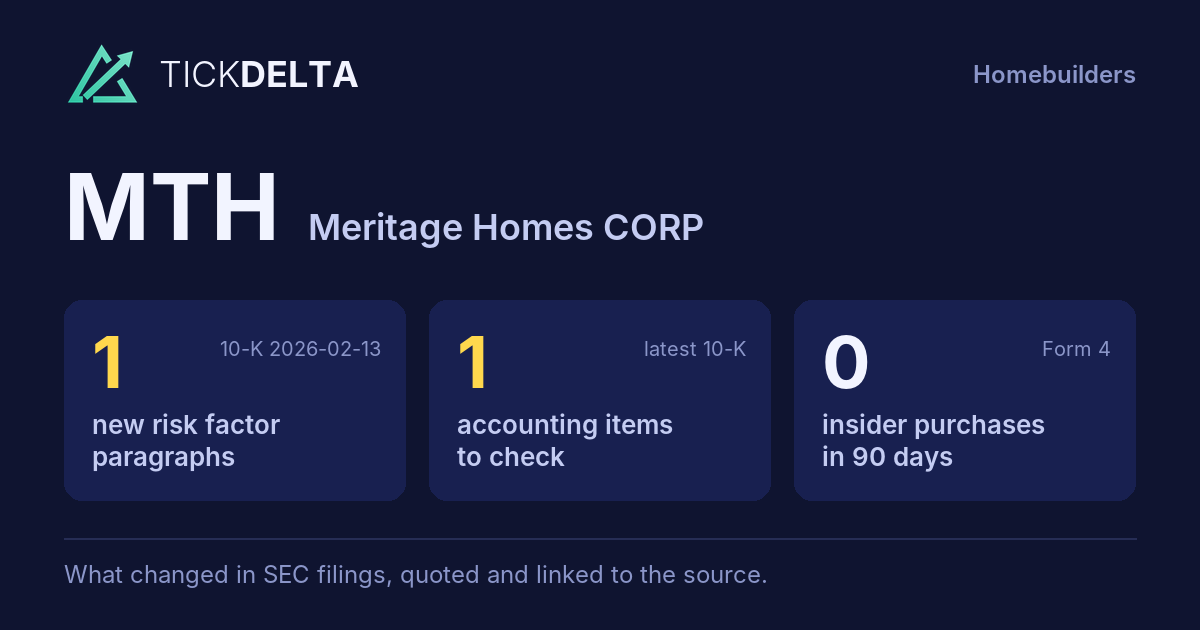
73 changes: 15 added, 6 removed, 51 reworded, 1 quiet changes
10-K Feb 13, 2026 vs Feb 20, 2025
Risk Factors
4.1%
of the text changed · 7,310 words now · 1 new paragraphs, 4 gone
MD&A
33.3%
of the text changed · 8,254 words now · 14 new paragraphs, 2 gone
Legal Proceedings
3.4%
of the text changed · 287 words now
Accounting Policies
15.7%
of the text changed · 5,186 words now
10-K 0000833079-26-000010 (Feb 13, 2026) vs 10-K 0000833079-25-000021 (Feb 20, 2025)
Every paragraph, and how much of it changed
One bar per paragraph, in the order of the 10-K. Height and colour show the share of its words not in the closest paragraph a year earlier; the tallest bars are new paragraphs.
Risk Factors
88 paragraphs · 1 new · 23 reworded · 4 gone · 10-K Feb 13, 2026 against Feb 20, 2025
New paragraph
Reworded (5% of its words or more)
Same or nearly
Paragraph 78 · 11% changed
Every version of it
Our mortgage joint venture is engaged in mortgage broker activities and provides services to our homebuyers. Potential changes to federal and state laws and regulations could have the effect of limiting our activities or how our mortgage joint venture conducts its operations and this could have an adverse effect on our results of operations. The mortgage industry remains under intense scrutiny and continues to face increasing regulation at the federal, state and local level. Although we do not originate mortgages, we may be directly or indirectly subject to certain of these regulations. In addition, if we are determined to have violated federal or state regulations, we face the loss of our licenses or other required approvals or we could be subject to fines, penalties, civil actions or we could be required to suspend our activities, each of which could have an adverse effect on our reputation, results and operations.
Paragraph 53 · 11% changed
Every version of it
During significant economic downturns, we may forfeit significant amounts of deposits and write off significant amounts of related pre-acquisition costs related to projects we no longer deem feasible if they are not projected to generate acceptable returns. At December 31, 2024, 2025, we had Deposits on real estate under option or contract of $192.4 $174.2 million, of which $176.8 $161.5 million related to committed projects. Although our participation in land options is limited at this time, a downturn in the homebuilding market may cause us to re-evaluate the feasibility of our optioned projects which may result in us forfeiting associated deposits, which would reduce our assets and stockholders’ equity. For example, during 2025 we recognized charges on terminated land contracts of $39.4 million as we elected to terminate certain positions to release capital to top-grade our land portfolio as better opportunities become available.
Paragraph 62 · 9% changed
Every version of it
See Item 1C - “Cybersecurity" in Part I of this Form 10-K Annual Report for additional information regarding our cybersecurity risk management, strategy and governance.
Paragraph 20 · 9% changed
Every version of it
Downturns in the economy, or specifically in the homebuilding industry, require us to re-evaluate the value of our land holdings, which could result in significant impairment charges and decrease both the book value of our assets and stockholders’ equity. During the last significant downturn that began in 2008, and in certain isolated circumstances afterward, we had to impair many of our real-estate assets to fair-value, incurring large impairment charges which negatively impacted our financial results and financial position. During the year ended December 31, 2025, we recognized relatively smaller impairment charges due to softening economic conditions.
Paragraph 59 · 7% changed
Every version of it
We use information technology ("IT") and other digital resources to carry out important operational, financial and marketing activities as well as maintain our business records. Many of these resources are provided to us and/or maintained on our behalf by third-party service providers pursuant to agreements that specify certain security and service level standards. We and our service providers employ what we believe are appropriate security, disaster recovery and other preventative and corrective systems, processes and controls. Additionally, we maintain cybersecurity insurance and require our employees to complete ongoing information security training; however, our ability to conduct our business may be impaired if these information technology resources are compromised, degraded, damaged or fail, whether due to a virus or other harmful circumstance, intentional penetration or disruption of our information technology resources by a third party, natural disaster, hardware or software corruption or failure or error (including a failure of security controls incorporated into or applied to such hardware or software), telecommunications system failure, service provider error or failure, intentional or unintentional personnel actions (including the failure to follow our security protocols), or lost connectivity to our networked resources.
Paragraph 12 · 7% changed
Every version of it
Our ability to timely construct our homes may be significantly impacted by circumstances beyond our control, such as work stoppages, shortages of qualified trades people or municipal employees, lack of utility infrastructure and services, our need to rely on local subcontractors, and shortages or delays in availability of building materials. Constraints on the availability of raw materials and finished goods or in the distribution channels of our construction inputs can delay delivery of our homes to customers and can increase our building costs or lead to sales orders cancellations. These delays impact the timing of our expected home closings and may also result in cost increases that we may not be able to pass to our current or future customers. Sustained increases in construction costs may, over time, erode our margins, and impact our total order and closing volumes. Over During the last several years, global pandemic, supply chain and labor constraints related to sustained demand amid the backdrop of a global pandemic caused our construction cycle times to lengthen, although in recent years the supply chain and labor capacity are currently have been at normal levels.
Paragraph 10 · 6% changed
Every version of it
Our backlog reflects the number and value of homes for which we have entered into non-contingent sales contracts with customers but have not yet delivered those homes. In connection with the sale of a home, our policy is to generally collect a deposit from our customers, although typically this deposit reflects a small percentage of the total purchase price, and due to local regulations, regulations or other considerations, the deposit may, in certain circumstances, be fully or partially refundable prior to closing. If While our 60-day closing ready guarantee shortens the time between order and closing, if the prices for our homes in a given community decline, our neighboring competitors reduce their sales prices (or increase their sales incentives), interest rates increase, the availability of mortgage financing tightens or there is a downturn in local, regional or national economies, homebuyers may elect to cancel their home purchase contracts with us. Although cancellations are currently at normal levels, significant cancellations in the future could have a material adverse effect on our business, which could result in lost sales revenue and the accumulation of unsold housing inventory.
Paragraph 79 · 39% changed
Every version of it
10-K Feb 20, 2025Our mortgage joint venture is engaged in mortgage broker activities and provides services to our homebuyers. Potential changes to federal and state laws and regulations could have the effect of limiting our activities or how our mortgage joint venture conducts its operations and this could have an adverse effect on our results of operations. The mortgage industry remains under intense scrutiny and continues to face increasing regulation at the federal, state and local level. Although we do not originate mortgages, we may be directly or indirectly subject to certain of these regulations. In addition, if we are determined to have violated federal or state regulations, we face the loss of our licenses or other required approvals or we could be subject to fines, penalties, civil actions or we could be required to suspend our activities, each of which could have an adverse effect on our reputation, results and operations.
10-K Feb 13, 2026
determined to have violated federal or state regulations, we could face the loss of our licenses or other required approvals or we could be subject to fines, penalties, civil actions or we could be required to suspend our activities, each of which could have an adverse effect on our reputation, results and operations.
Paragraph 78 · 11% changed
Every version of it
10-K Feb 20, 2025
Our mortgage joint venture is engaged in mortgage broker activities and provides services to our homebuyers. Potential changes to federal and state laws and regulations could have the effect of limiting our activities or how our mortgage joint venture conducts its operations and this could have an adverse effect on our results of operations. The mortgage industry remains under intense scrutiny and continues to face increasing regulation at the federal, state and local level. Although we do not originate mortgages, we may be directly or indirectly subject to certain of these regulations. In addition, if we are determined to have violated federal or state regulations, we face the loss of our licenses or other required approvals or we could be subject to fines, penalties, civil actions or we could be required to suspend our activities, each of which could have an adverse effect on our reputation, results and operations.
10-K Feb 13, 2026
Our mortgage joint venture is engaged in mortgage broker activities and provides services to our homebuyers. Potential changes to federal and state laws and regulations could have the effect of limiting our activities or how our mortgage joint venture conducts its operations and this could have an adverse effect on our results of operations. The mortgage industry remains under intense scrutiny and continues to face increasing regulation at the federal, state and local level. Although we do not originate mortgages, we may be directly or indirectly subject to certain of these regulations. In addition, if we are
Paragraph 53 · 11% changed
Every version of it
10-K Feb 20, 2025
During significant economic downturns, we may forfeit significant amounts of deposits and write off significant amounts of related pre-acquisition costs related to projects we no longer deem feasible if they are not projected to generate acceptable returns. At December 31, 2024, we had Deposits on real estate under option or contract of $192.4 million, of which $176.8 million related to committed projects. Although our participation in land options is limited at this time, a downturn in the homebuilding market may cause us to re-evaluate the feasibility of our optioned projects which may result in us forfeiting associated deposits, which would reduce our assets and stockholders’ equity.
10-K Feb 13, 2026
During significant economic downturns, we may forfeit significant amounts of deposits and write off significant amounts of related pre-acquisition costs related to projects we no longer deem feasible if they are not projected to generate acceptable returns. At December 31, 2025, we had Deposits on real estate under option or contract of $174.2 million, of which $161.5 million related to committed projects. Although our participation in land options is limited at this time, a downturn in the homebuilding market may cause us to re-evaluate the feasibility of our optioned projects which may result in us forfeiting associated deposits, which would reduce our assets and stockholders’ equity. For example, during 2025 we recognized charges on terminated land contracts of $39.4 million as we elected to terminate certain positions to release capital to top-grade our land portfolio as better opportunities become available.
Paragraph 62 · 9% changed
Every version of it
10-K Feb 20, 2025
See Item 1C - “Cybersecurity" in Part I of this Form 10-K for additional information regarding our cybersecurity risk management, strategy and governance.
10-K Feb 13, 2026
See Item 1C - “Cybersecurity" in Part I of this Annual Report for additional information regarding our cybersecurity risk management, strategy and governance.
Paragraph 20 · 9% changed
Every version of it
10-K Feb 20, 2025
Downturns in the economy, or specifically in the homebuilding industry, require us to re-evaluate the value of our land holdings, which could result in significant impairment charges and decrease both the book value of our assets and stockholders’ equity. During the last significant downturn that began in 2008, and in certain isolated circumstances afterward, we had to impair many of our real-estate assets to fair-value, incurring large impairment charges which negatively impacted our financial results and financial position.
10-K Feb 13, 2026
Downturns in the economy, or specifically in the homebuilding industry, require us to re-evaluate the value of our land holdings, which could result in significant impairment charges and decrease both the book value of our assets and stockholders’ equity. During the last significant downturn that began in 2008, and in certain isolated circumstances afterward, we had to impair many of our real-estate assets to fair-value, incurring large impairment charges which negatively impacted our financial results and financial position. During the year ended December 31, 2025, we recognized relatively smaller impairment charges due to softening economic conditions.
Paragraph 59 · 7% changed
Every version of it
10-K Feb 20, 2025
We use information technology ("IT") and other digital resources to carry out important operational, financial and marketing activities as well as maintain our business records. Many of these resources are provided to us and/or maintained on our behalf by third-party service providers pursuant to agreements that specify certain security and service level standards. We and our service providers employ what we believe are appropriate security, disaster recovery and other preventative and corrective systems, processes and controls. Additionally, we maintain cybersecurity insurance and require our employees to complete ongoing information security training; however, our ability to conduct our business may be impaired if these information technology resources are compromised, degraded, damaged or fail, whether due to a virus or other harmful circumstance, intentional penetration or disruption of our information technology resources by a third party, natural disaster, hardware or software corruption or failure or error (including a failure of security controls incorporated into or applied to such
10-K Feb 13, 2026
We use information technology ("IT") and other digital resources to carry out important operational, financial and marketing activities as well as maintain our business records. Many of these resources are provided to us and/or maintained on our behalf by third-party service providers pursuant to agreements that specify certain security and service level standards. We and our service providers employ what we believe are appropriate security, disaster recovery and other preventative and corrective systems, processes and controls. Additionally, we maintain cybersecurity insurance and require our employees to complete ongoing information security training; however, our ability to conduct our business may be impaired if these information technology resources are compromised, degraded, damaged or fail, whether due to a virus or other harmful circumstance, intentional penetration or disruption of our information technology resources by a third party, natural disaster, hardware or software corruption or failure or error (including a failure of security controls incorporated into or applied to such hardware or software), telecommunications system failure, service provider error or failure, intentional or unintentional personnel actions (including the failure to follow our security protocols), or lost connectivity to our networked resources.
Paragraph 12 · 7% changed
Every version of it
10-K Feb 20, 2025
Our ability to timely construct our homes may be significantly impacted by circumstances beyond our control, such as work stoppages, shortages of qualified trades people or municipal employees, lack of utility infrastructure and services, our need to rely on local subcontractors, and shortages or delays in availability of building materials. Constraints on the availability of raw materials and finished goods or in the distribution channels of our construction inputs can delay delivery of our homes to customers and can increase our building costs or lead to sales orders cancellations. These delays impact the timing of our expected home closings and may also result in cost increases that we may not be able to pass to our current or future customers. Sustained increases in construction costs may, over time, erode our margins, and impact our total order and closing volumes. Over the last several years, supply chain and labor constraints related to sustained demand amid the backdrop of a global pandemic caused our construction cycle times to lengthen, although the supply chain and labor capacity are currently at normal levels.
10-K Feb 13, 2026
Our ability to timely construct our homes may be significantly impacted by circumstances beyond our control, such as work stoppages, shortages of qualified trades people or municipal employees, lack of utility infrastructure and services, our need to rely on local subcontractors, and shortages or delays in availability of building materials. Constraints on the availability of raw materials and finished goods or in the distribution channels of our construction inputs can delay delivery of our homes to customers and can increase our building costs or lead to sales orders cancellations. These delays impact the timing of our expected home closings and may also result in cost increases that we may not be able to pass to our current or future customers. Sustained increases in construction costs may, over time, erode our margins, and impact our total order and closing volumes. During the global pandemic, supply chain and labor constraints related to sustained demand caused our construction cycle times to lengthen, although in recent years the supply chain and labor capacity have been at normal levels.
Paragraph 10 · 6% changed
Every version of it
10-K Feb 20, 2025
Our backlog reflects the number and value of homes for which we have entered into non-contingent sales contracts with customers but have not yet delivered those homes. In connection with the sale of a home, our policy is to generally collect a deposit from our customers, although typically this deposit reflects a small percentage of the total purchase price, and due to local regulations, the deposit may, in certain circumstances, be fully or partially refundable prior to closing. If the prices for our homes in a given community decline, our neighboring competitors reduce their sales prices (or increase their sales incentives), interest rates increase, the availability of mortgage financing tightens or there is a downturn in local, regional or national economies, homebuyers may elect to cancel their home purchase contracts with us. Although cancellations are currently at normal levels, significant cancellations in the future could have a material adverse effect on our business, which could result in lost sales revenue and the accumulation of unsold housing inventory.
10-K Feb 13, 2026
Our backlog reflects the number and value of homes for which we have entered into non-contingent sales contracts with customers but have not yet delivered those homes. In connection with the sale of a home, our policy is to generally collect a deposit from our customers, although typically this deposit reflects a small percentage of the total purchase price, and due to local regulations or other considerations, the deposit may, in certain circumstances, be fully or partially refundable prior to closing. While our 60-day closing ready guarantee shortens the time between order and closing, if the prices for our homes in a given community decline, our neighboring competitors reduce their sales prices (or increase their sales incentives), interest rates increase, the availability of mortgage financing tightens or there is a downturn in local, regional or national economies, homebuyers may elect to cancel their home purchase contracts with us. Although cancellations are currently at normal levels, significant cancellations in the future could have a material adverse effect on our business, which could result in lost revenue and the accumulation of unsold housing inventory.
MD&A
91 paragraphs · 14 new · 45 reworded · 2 gone · 10-K Feb 13, 2026 against Feb 20, 2025
New paragraph
Reworded (5% of its words or more)
Same or nearly
Paragraph 70 · 50% changed
Income Taxes. The effective tax rate was 22.5% and 21.6% for 2025 and 22.2% for 2024 and 2023, 2024, respectively. The effective tax higher rate in both years 2025 reflects fewer homes qualifying for energy tax credits under the Internal Revenue Code ("IRC") §45L energy-efficient homes federal tax credit, given the new higher construction thresholds required to earn these tax credits on qualifying homes under the Inflation Reduction Act of 2022 (the "IRA"). beginning in 2025, which was partially offset by acquired below-market transferrable clean fuel production tax credits in 2025.
Paragraph 15 · 47% changed
•Increasing homeowner satisfaction by offering energy-efficient homes that come equipped with a suite of home automation standard features. are cleaner and healthier.
Paragraph 60 · 46% changed
Central. The Central Region home closing gross margin of 26.2% declined 60 basis points year-over-year from 26.8% was 20.9% for the year ended December 31, 2025, the highest in the prior year, primarily Company. The 510 basis point decrease from 26.0% in 2024 was due to increased an increase in utilization of financing incentives combined with higher and elevated lot costs, which were partially offset by lower direct construction costs and savings resulting from shorter faster construction cycle times. Non-recurring charges for impairments on real estate, terminated land contracts, and severance costs also contributed to the margin decline. Excluding these non-recurring charges, adjusted home closing gross margin for the Central Region was 21.6% and 26.0% for the years ending December 31, 2025 and 2024, respectively.
Paragraph 65 · 46% changed
Commissions and Other Sales Costs. Commissions and other sales costs are comprised of internal and external commissions and related sales and marketing expenses such as advertising and sales office costs. These For the year ended December 31, 2025, these costs decreased $4.7 million, to $404.4 million, but increased $24.2 million to 7.0% of home closing revenue, compared to 6.5% in the prior year. The lower dollar spend was due primarily to higher lower home closing volume and revenue, but with an offsetting increase in spend for spec maintenance and utilities as a result of higher levels of spec inventory. As a percentage of home closing revenue, commissions the 50 basis point increase is largely the result of higher external broker commission rates reflecting the tougher selling environment, coupled with a higher external broker participation rate, as well as higher costs for maintaining a larger number of completed homes. The increase in spec home inventory and other sales costs associated overhead expenses is a result of 6.5% were relatively flat with 6.4% our new 60-day closing ready commitment in 2023. order to have sufficient inventory available.
Paragraph 2 · 46% changed
The market for new homes in 2025 was healthy in 2024 marked by much softer demand than anticipated, as the largest U.S. population cohorts of the affordability challenges persisted and consumer confidence deteriorated. While demand for affordable, move-in ready homes from millennial, Gen Z and baby boomer generations continue continues, buyers are increasingly reliant on financing assistance to need affordable, move-in ready homes. While demand was stable, volatile overcome market uncertainty and elevated interest rates resulted in increased need for interest rate assistance for potential homebuyers to help with manage monthly mortgage affordability. The payments. Our ability to offer financing incentives, including interest rate locks and buy-downs, combined with remains a short supply of re-sale inventory available has shifted demand key differentiator, primarily compared to the new home market in recent years. We believe that our ability to offer financing incentives gives us a competitive advantage, particularly over resale homes, as where individual home sellers are typically not typically able to provide such incentives, incentives. With our strategy to provide affordable, move-in ready homes that can close within 60 days, and that our all-spec strategy with a commitment to affordability can meet this demand, providing us partner with ample opportunity third-party brokers, who facilitate most residential real estate transactions in the U.S., we believe we are well positioned to capture existing demand and grow our market share. share when demand improves.
Paragraph 61 · 45% changed
East. The East Region home closing gross margin of 25.9% in 2024 declined 130 18.3% for the year ended December 31, 2025 decreased 780 basis points from 27.2% 26.1% in the prior year. year period. The decline in home closing gross margin reflects greater utilization and higher cost of financing incentives and elevated lot costs, which were offset in part by savings in directs costs and construction cycle time improvements. The East Region increased financing incentives to address challenging demand conditions home closing gross margin in the later half of 2024, particularly in Florida. The 2024 2025 was negatively impacted by charges for terminated land contracts, real-estate impairments and severance costs. Excluding these items, adjusted home closing gross margin in the East Region was also negatively impacted by higher lot costs which were partially offset by lower direct costs 20.1% in 2025, compared to adjusted home closing gross margin of 26.2% the year over year. ended December 31, 2024.
Paragraph 8 · 44% changed
Paragraph 58 · 43% changed
Paragraph 70 · 50% changed
10-K Feb 20, 2025
Income Taxes. The effective tax rate was 21.6% and 22.2% for 2024 and 2023, respectively. The effective tax rate in both years reflects the energy-efficient homes tax credits on qualifying homes under the Inflation Reduction Act of 2022 (the "IRA").
10-K Feb 13, 2026
Income Taxes. The effective tax rate was 22.5% and 21.6% for 2025 and 2024, respectively. The higher rate in 2025 reflects fewer homes qualifying for energy tax credits under the Internal Revenue Code ("IRC") §45L energy-efficient homes federal tax credit, given the new higher construction thresholds required to earn these tax credits beginning in 2025, which was partially offset by acquired below-market transferrable clean fuel production tax credits in 2025.
Paragraph 15 · 47% changed
10-K Feb 20, 2025
•Increasing homeowner satisfaction by offering energy-efficient homes that come equipped with a suite of home automation standard features.
10-K Feb 13, 2026
•Increasing homeowner satisfaction by offering energy-efficient homes that are cleaner and healthier.
Paragraph 60 · 46% changed
10-K Feb 20, 2025
Central. The Central Region home closing gross margin of 26.2% declined 60 basis points year-over-year from 26.8% in the prior year, primarily due to increased financing incentives combined with higher lot costs, which were partially offset by lower direct construction costs and savings resulting from shorter construction cycle times.
10-K Feb 13, 2026
Central. The Central Region home closing gross margin was 20.9% for the year ended December 31, 2025, the highest in the Company. The 510 basis point decrease from 26.0% in 2024 was due to an increase in utilization of financing incentives and elevated lot costs, offset by lower direct costs and faster construction cycle times. Non-recurring charges for impairments on real estate, terminated land contracts, and severance costs also contributed to the margin decline. Excluding these non-recurring charges, adjusted home closing gross margin for the Central Region was 21.6% and 26.0% for the years ending December 31, 2025 and 2024, respectively.
Paragraph 65 · 46% changed
10-K Feb 20, 2025
Commissions and Other Sales Costs. Commissions and other sales costs are comprised of internal and external commissions and related sales and marketing expenses such as advertising and sales office costs. These costs increased $24.2 million due to higher home closing volume and revenue, but as a percentage of home closing revenue, commissions and other sales costs of 6.5% were relatively flat with 6.4% in 2023.
10-K Feb 13, 2026
Commissions and Other Sales Costs. Commissions and other sales costs are comprised of internal and external commissions and related sales and marketing expenses such as advertising and sales office costs. For the year ended December 31, 2025, these costs decreased $4.7 million, to $404.4 million, but increased to 7.0% of home closing revenue, compared to 6.5% in the prior year. The lower dollar spend was due primarily to lower home closing volume and revenue, with an offsetting increase in spend for spec maintenance and utilities as a result of higher levels of spec inventory. As a percentage of home closing revenue, the 50 basis point increase is largely the result of higher external broker commission rates reflecting the tougher selling environment, coupled with a higher external broker participation rate, as well as higher costs for maintaining a larger number of completed homes. The increase in spec home inventory and associated overhead expenses is a result of our new 60-day closing ready commitment in order to have sufficient inventory available.
Paragraph 2 · 46% changed
10-K Feb 20, 2025
The market for new homes was healthy in 2024 as the largest U.S. population cohorts of the millennial, Gen Z and baby boomer generations continue to need affordable, move-in ready homes. While demand was stable, volatile and elevated interest rates resulted in increased need for interest rate assistance for potential homebuyers to help with monthly mortgage affordability. The ability to offer financing incentives, including interest rate locks and buy-downs, combined with a short supply of re-sale inventory available has shifted demand to the new home market in recent years. We believe that our ability to offer financing incentives gives us a competitive advantage, particularly over resale homes, as individual home sellers are not typically able to provide such incentives, and that our all-spec strategy with a commitment to affordability can meet this demand, providing us with ample opportunity to capture and grow our market share.
10-K Feb 13, 2026
The market for new homes in 2025 was marked by much softer demand than anticipated, as affordability challenges persisted and consumer confidence deteriorated. While demand for affordable, move-in ready homes from millennial, Gen Z and baby boomer generations continues, buyers are increasingly reliant on financing assistance to overcome market uncertainty and manage monthly payments. Our ability to offer financing incentives, including interest rate locks and buy-downs, remains a key differentiator, primarily compared to resale homes, where individual sellers are typically not able to provide such incentives. With our strategy to provide affordable, move-in ready homes that can close within 60 days, and a commitment to partner with third-party brokers, who facilitate most residential real estate transactions in the U.S., we believe we are well positioned to capture existing demand and grow our market share when demand improves.
Paragraph 61 · 45% changed
10-K Feb 20, 2025
East. The East Region home closing gross margin of 25.9% in 2024 declined 130 basis points from 27.2% in the prior year. The East Region increased financing incentives to address challenging demand conditions in the later half of 2024, particularly in Florida. The 2024 home closing gross margin in the East Region was also negatively impacted by higher lot costs which were partially offset by lower direct costs year over year.
10-K Feb 13, 2026
East. The East Region home closing gross margin of 18.3% for the year ended December 31, 2025 decreased 780 basis points from 26.1% in the prior year period. The decline in home closing gross margin reflects greater utilization and higher cost of financing incentives and elevated lot costs, which were offset in part by savings in directs costs and construction cycle time improvements. The East Region home closing gross margin in 2025 was negatively impacted by charges for terminated land contracts, real-estate impairments and severance costs. Excluding these items, adjusted home closing gross margin in the East Region was 20.1% in 2025, compared to adjusted home closing gross margin of 26.2% the year ended December 31, 2024.
Paragraph 8 · 44% changed
10-K Feb 20, 2025During the years ended December 31, 2024 and 2023, net cash used in investing activities totaled $44.1 million and $43.6 million, respectively. Cash used in investing activities in 2024 was mainly attributable to purchases of property and equipment of $28.7 million and investments in unconsolidated entities of $18.5 million. Cash used in investing activities in 2023 was mainly attributable to purchases of property and equipment of $38.2 million.
10-K Feb 13, 2026
was 22.5% as compared to 21.6% in 2024, leading to net income of $453.0 million and $786.2 million for the years ended December 31, 2025 and 2024, respectively.
Paragraph 58 · 43% changed
10-K Feb 20, 2025Central. The Central Region home closing gross margin of 26.2% declined 60 basis points year-over-year from 26.8% in the prior year, primarily due to increased financing incentives combined with higher lot costs, which were partially offset by lower direct construction costs and savings resulting from shorter construction cycle times.
10-K Feb 13, 2026
Companywide. Home closing gross margin of 19.7% for the year ended December 31, 2025 was down 520 basis points from 24.9% in the prior year due to increased utilization of financing incentives, higher lot costs, real estate-related impairments and charges related to terminated land contracts, and severance costs, all of which offset lower direct costs and savings generated from faster construction cycle times. Excluding terminated land contracts, real estate-related impairments, and severance costs, adjusted home closing gross margin was 20.8% for the year ended December 31, 2025, compared to adjusted home closing gross margin of 25.0% in 2024 when excluding $6.7 million in terminated land contracts. There were no impairments or severance costs during the year ended December 31, 2024.
A paragraph is matched with the one last year that shares the most of its words; under half in common makes it new. The paragraphs shown are the 8 reworded the most in each section.
The paragraph that changed most in each section
The redline
Marked against last year's 10-K: cut words struck through, new words highlighted.
MD&A338 words changed in this paragraph; it is 45% similar to last year's version.
Total home closing revenue of $6.3 $5.8 billion for the year ended December 31, 2024 increased 4.7% 2025 decreased 9.1% from $6.1 $6.3 billion in 2023, 2024, due to 11.7% higher 3.7% fewer home closing volume closings and 6.3% lower a 5.6% reduction in ASP on closings. Home closing gross margin was 24.9% 19.7% for the year ended December 31, 2024, consistent with 24.8% 2025 compared to 24.9% in 2023, as lower direct costs, leverage of higher home closing revenue on overhead costs and shorter construction cycle times were offset by greater 2024. The year-over-year margin decline was due to increased utilization of financing incentives and incentives, higher lot costs, and reduced leverage of fixed costs on lower home closing revenue, all of which offset savings in direct costs and faster cycle times. Home closing gross margin was also impacted by $39.4 million in charges incurred related to terminated land contracts, $16.5 million of real estate-related impairments, and $4.3 million of severance costs. Excluding these costs, adjusted home closing gross margin was 20.8% for the year ended December 31, 2025, compared to adjusted home closing gross margin of 25.0% in 2024 which included $6.7 million in terminated land contracts. Financial services profit of $18.6 million increased from $14.4 million in the same period of 2024 due to fewer charges in the current period related to the expiration of interest rate forward commitments. Commissions and other sales costs of $409.1 $404.4 million for the full year ended December 31, 2024 increased $24.2 2025 decreased $4.7 million from the prior year period due to higher lower home closing revenue. Commissions revenue, offset by higher maintenance and other sales utility costs were 6.5% as a result of home closing revenue having more spec homes in 2024, relatively consistent with the prior year. inventory. General and administrative expenses of $230.9 $211.8 million for the year ended December 31, 2024 were 3.6% of home closing revenue and improved 20 basis points 2025 decreased $19.1 million year over year, primarily due to leverage of higher home closing revenue on fixed overhead expenses and lower performance-based compensation. compensation, which was partially offset by increased technology spend and severance costs. Other income, net of $45.2 $44.1 million in 2024 decreased 5.8% from the 2025 was relatively flat with prior year primarily due to lower interest income earned on smaller cash balances. In May 2024 we redeemed the remaining $250.0 million of our 6.00% Senior Notes due 2025 (the "2025 Notes"), resulting in charges of $0.6 million reflected in Loss on early extinguishment of debt, compared with charges of $0.9 million in 2023. year. Earnings before income taxes of $584.6 million in 2025 decreased 41.7% from $1.0 billion in 2024 increased 5.6% from $949.4 million in 2023. 2024. Our effective tax rate for the year ended December 31, 2024 was 21.6% as compared to 22.2% in 2023, leading to net income of $786.2 million and $738.7 million for the years ended December 31, 2024 and 2023, respectively. 2025
Source: Item 7, 10-K 0000833079-26-000010 vs Item 7, 10-K 0000833079-25-000021
Accounting Policies145 words changed in this paragraph; it is 32% similar to last year's version.
All of our land inventory and related real estate assets are periodically reviewed for recoverability when certain criteria are met, but at least annually, as our inventory is considered “long-lived” in accordance with GAAP. Community-level reviews are performed quarterly to determine if indicators of potential impairment exist. If indicators of potential impairment exist and the undiscounted cash flows expected to be generated by an asset are lower than its carrying amount, impairment charges are recorded to write down the asset to its estimated fair value. The impairment of a community is allocated to each remaining unstarted lot in the community on a straight-line basis and is recognized in Cost of home closings in the period in which the impairment is determined. Our determination of fair value is based on projections and estimates. Changes in these expectations may lead to a change in the outcome of our impairment analysis, and actual results may also differ from our assumptions, although if financial metrics improve, we do not reverse impairments once recorded. See Note 2 for additional information related to Real estate.
Source: Item 8, Note 1 – BUSINESS AND SUMMARY OF SIGNIFICANT ACCOUNTING POLICIES, 10-K 0000833079-26-000010 vs Item 8, Note 1 – BUSINESS AND SUMMARY OF SIGNIFICANT ACCOUNTING POLICIES, 10-K 0000833079-25-000021
Risk Factors52 words changed in this paragraph; it is 79% similar to last year's version.
Our mortgage joint venture is engaged in mortgage broker activities and provides services to our homebuyers. Potential changes to federal and state laws and regulations could have the effect of limiting our activities or how our mortgage joint venture conducts its operations and this could have an adverse effect on our results of operations. The mortgage industry remains under intense scrutiny and continues to face increasing regulation at the federal, state and local level. Although we do not originate mortgages, we may be directly or indirectly subject to certain of these regulations. In addition, if we are determined to have violated federal or state regulations, we face the loss of our licenses or other required approvals or we could be subject to fines, penalties, civil actions or we could be required to suspend our activities, each of which could have an adverse effect on our reputation, results and operations.
Source: Item 1A, 10-K 0000833079-26-000010 vs Item 1A, 10-K 0000833079-25-000021
Legal Proceedings20 words changed in this paragraph; it is 93% similar to last year's version.
We have case specific reserves within our $32.7 $26.7 million of total warranty reserves related to alleged stucco defects in certain homes we constructed predominantly between 2006 2015 and 2017. 2019. Our review and management of these matters is ongoing and our estimate of and reserves for resolving them is based on internal data, historical experience, our judgment and various assumptions and estimates. Due to the degree of judgment and the potential for variability in our underlying assumptions and data, as we obtain additional information, we may revise our estimate and thus our related reserves. As of December 31, 2024, 2025, after considering potential recoveries from the consultants and contractors involved and their insurers and the potential recovery under our general liability insurance policies, we recorded a favorable adjustment to our reserve balance of $1.0 million in the year ended December 31, 2024 and we believe our reserves are sufficient to cover the above mentioned matters. See Note 1 for information related to our warranty obligations.
Source: Item 3, via Note 16 – COMMITMENTS AND CONTINGENCIES, 10-K 0000833079-26-000010 vs Item 3, via Note 16 – COMMITMENTS AND CONTINGENCIES, 10-K 0000833079-25-000021
Sentences and paragraphs added, removed or reworded
Every change, by type
Sentences and paragraphs of MTH's Risk Factors and MD&A, 10-K Feb 13, 2026 against 10-K Feb 20, 2025. Each links to the text at sec.gov.
Quiet changes are sentences kept from last year with one to four words changed, at least one of them a hedge, a modal or a qualifier (may, could, will, not, significant, material…). A year or date rolling forward is not counted.
The full word list
adverse, adversely, all, although, anticipate, anticipates, any, approximately, believe, believes, can, cannot, certain, could, expect, expects, generally, however, if, intend, intends, largely, likely, many, material, materially, may, might, most, must, never, no, not, possible, primarily, probable, should, significant, significantly, some, substantial, substantially, unlikely, will, would
AddedRisk Factors
On July 4, 2025, President Trump signed into law the One Big Beautiful Bill Act, which includes several significant corporate tax changes. The legislation modifies or extends provisions originally enacted under the Tax Act, including, but not limited to, the repeal of the §45L energy-efficient home credit for homes acquired after June 30, 2026. The impact of more stringent building criteria for these tax credits is already reflected in our 2025 financial results with low participation rates, so we anticipate a limited impact on a go-forward basis.
Read it in 10-K Feb 13, 2026 at sec.gov
RemovedRisk Factors
RemovedRisk Factors
RemovedRisk Factors
RemovedRisk Factors
RewordedRisk Factors
Additionally, we maintain cybersecurity insurance and require our employees to complete ongoing information security training; however, our ability to conduct our business may be impaired if these information technology resources are compromised, degraded, damaged or fail, whether due to a virus or other harmful circumstance, intentional penetration or disruption of our information technology resources by a third party, natural disaster, hardware or software corruption or failure or error (including a failure of security controls incorporated into or applied to such hardware or software), telecommunications system failure, service provider error or failure, intentional or unintentional personnel actions (including the failure to follow our security protocols), or lost connectivity to our networked resources.
Read it in 10-K Feb 13, 2026 at sec.gov
RewordedRisk Factors
RewordedRisk Factors
Show the other 36
RewordedRisk Factors
Forward-looking statements in this Annual Report include statements concerning our belief that we have ample liquidity; our cash management strategy and intentions; our goals, strategies and strategic initiatives including our all spec and move-in ready strategy and our focus on external real estate brokers as customers, and the anticipated benefits relating thereto; our intentions and the expected benefits and advantages of our product and land positioning strategies, including with respect to our focus on the first-time and first move-up buyer and housing demand for affordable homes; the benefits of our financing incentive programs; the benefits of and our intentions to use options to acquire land; our preselected design collections strategy; our exposure to supplier concentration risk and other matters concerning our supply chain; our delivery of substantially all of our backlog existing as of year end; our positions and our expected outcome relating to litigation and regulatory proceedings in general; that we may repurchase, redeem or retire our debt and equity securities; our non-use of derivative financial instruments; expectations regarding our industry and our business into 2025 2026 and beyond; the demand for and the pricing of our homes; our land and lot acquisition strategy, including that we will redeploy cash to acquire well-positioned finished lots and that we may participate in joint ventures or other opportunities; that we may expand into new markets; the availability of labor and materials for our operations; that we may seek additional debt or equity capital; our expectation that existing guarantees, letters of credit and performance and surety bonds will not be drawn on; the sufficiency of our insurance coverage and warranty reserves; the sufficiency of our capital resources to support our business strategy; the sufficiency of our land pipeline; the impact of new accounting standards and changes in accounting estimates; trends and expectations concerning future demand for homes, sales prices, sales orders, construction cycle times, cancellations, labor, construction and materials costs and availability, gross margins, profitability, liquidity, land costs, community counts and profitability and future home supply and inventories; our future cash needs and sources; the impact of seasonality; that we intend to pay dividends in the future; and our future compliance with debt covenants.
Read it in 10-K Feb 13, 2026 at sec.gov
RewordedRisk Factors
RewordedRisk Factors
RewordedRisk Factors
In addition, the cost of insuring against construction defect and product liability claims is high, and the amount of coverage offered by insurance companies is currently limited. may not be sufficient to cover all costs.
Read it in 10-K Feb 13, 2026 at sec.gov
RewordedRisk Factors
RewordedRisk Factors
Environmental regulations can also have an adverse impact on the use, availability and price of certain raw materials, such as lumber. materials and natural resources.
Read it in 10-K Feb 13, 2026 at sec.gov
RewordedRisk Factors
The cost of certain building materials is influenced by changes in local and global commodity prices as well as government regulation, such as government-imposed tariffs on building supplies such as lumber and flooring materials. supplies.
Read it in 10-K Feb 13, 2026 at sec.gov
RewordedRisk Factors
We have homebuilding operations in Arizona, California, Colorado, Utah, Tennessee, Texas, Alabama, Florida, Georgia, Mississippi, North Carolina, Carolina and South Carolina, and Tennessee. Carolina.
Read it in 10-K Feb 13, 2026 at sec.gov
RewordedRisk Factors
While interest rates have stabilized, they are still elevated. elevated from previously historically low levels.
Read it in 10-K Feb 13, 2026 at sec.gov
Quiet changesRisk Factors
Traditionally, we have attempted to pass cost increases on to our customers through higher sales prices, although in recent years we have had to absorb higher material land development and labor costs, which have negatively impacted our profitability.
Read it in 10-K Feb 13, 2026 at sec.gov
AddedMD&A
During 2025, we further shortened our construction cycle times to under 110 calendar days, below our historical normalized time of approximately 120 days. Our all-spec strategy minimizes variability and creates efficiencies through repeatability, which combined with increased capacity from declining market demand, were the drivers for this cycle time improvement. Cycle time improvement was also supported by a healthy channel of materials available in the supply chain. While material costs have eased, land costs remain elevated following years of historically high land acquisition and development costs. Our scale and purchasing power allow us to secure volume discounts from national vendors, helping offset some of these cost pressures.
Read it in 10-K Feb 13, 2026 at sec.gov
AddedMD&A
In response to the broader economic conditions, during the fourth quarter of 2025 we conducted an in-depth review of our land portfolio and elected to terminate certain positions to release capital to top-grade our land portfolio as better opportunities become available. We also took steps to reduce our go-forward overhead costs, with a strategic focus on both cost savings and technological efficiencies for certain back-office functions. As a result of these strategic reviews, we recognized charges on terminated land contracts of $39.4 million and severance costs totaling $8.4 million during the year ended December 31, 2025.
Read it in 10-K Feb 13, 2026 at sec.gov
AddedMD&A
•Offering our customers affordable, move-in ready homes with a 60-day closing ready commitment;
Read it in 10-K Feb 13, 2026 at sec.gov
AddedMD&A
•Achieving or maintaining a top 5 market position in all of our markets, and maintaining our status as a top 5 national builder (based on homes closed in 2024);
Read it in 10-K Feb 13, 2026 at sec.gov
AddedMD&A
All of our land inventory and related real estate assets are periodically reviewed for recoverability when certain criteria are met, but at least annually, as our inventory is considered “long-lived” in accordance with GAAP.
Read it in 10-K Feb 13, 2026 at sec.gov
AddedMD&A
Existing communities. Community-level reviews on active communities are performed quarterly, with the community review bifurcated between started and unstarted lots, to determine if indicators of potential impairment exist. If indicators of potential impairment exist and the undiscounted cash flows expected to be generated by an asset are lower than its carrying amount, impairment charges are recorded to write down the asset to its estimated fair value. The impairment of a community is allocated across the remaining lots in the community and is recognized in Cost of home closings in the period in which the impairment is determined. The fair value of the community’s assets is determined using either a market-based approach for projects to be sold or a discounted cash flow model for projects we intend to build out. If a market-based approach is used, we determine fair value based on recent comparable purchase and sale activity in the local market, adjusted for variances as determined by our knowledge of the region and general real estate expertise. If a discounted cash flow approach is used, we compute fair value using projections, estimates and observable and unobservable inputs such as (i) home selling prices in the community adjusted for current and expected sales discounts and incentives, (ii) costs related to the community — both land development and home construction — including costs spent to date and budgeted remaining costs to spend, (iii) projected sales absorption rates, reflecting any product mix change strategies implemented to stimulate the orders pace, (iv) expected cancellation rates, (v) alternative land uses including disposition of all or a portion of the land owned, if applicable, and (vi) discount rate, which is currently 10-14% and varies based on the perceived risk inherent in the community’s other cash flow assumptions. These assumptions vary widely across different communities and geographies and are largely dependent on local market conditions. Community-level factors that may impact our key estimates include:
Read it in 10-K Feb 13, 2026 at sec.gov
AddedMD&A
•The presence and significance of local competitors, including their offered product type, comparable lot size, remaining lots and competitive actions such as incentive offerings;
Read it in 10-K Feb 13, 2026 at sec.gov
AddedMD&A
•Economic and related demographic conditions for the surrounding community, such as major employers;
Read it in 10-K Feb 13, 2026 at sec.gov
AddedMD&A
•Desirability of the particular community, including unique amenities or other favorable or unfavorable attributes; and
Read it in 10-K Feb 13, 2026 at sec.gov
AddedMD&A
These local circumstances may significantly impact our assumptions and the resulting computation of fair value and are, therefore, closely evaluated by our division personnel in their preparation of the discounted cash flow models. The models are also evaluated by regional and corporate personnel for consistency and integration, as decisions that affect pricing or absorption at one community may have resulting consequences for neighboring communities.
Read it in 10-K Feb 13, 2026 at sec.gov
AddedMD&A
Mothball communities. In certain cases, we may elect to stop development of an existing actively selling community (mothball) if we believe the economic performance of the community would be maximized by deferring development for a period of time to allow market conditions to improve. The decision may be based on financial and/or operational metrics. If we decide to mothball a community, we will impair it to its fair value, if applicable, as discussed above and then cease future development activity until such a time when management believes that market conditions have improved and economic performance will be maximized. Impairment charges, if any, are recognized in Cost of home closings in the period in which the impairment is determined. No costs are capitalized to communities that are designated as mothballed. When a community is initially placed into mothball status, it is management’s belief that the community is affected by local market conditions that are expected to improve within the next 1-5 years. Mothball communities are reviewed at least annually to determine if they are at risk of future impairment. The financial and operational status and expectations of these communities are analyzed as well as any unique attributes that could be viewed as indicators for future impairments. Adjustments are made accordingly and incremental impairments, if any, are recorded at each re-evaluation.
Read it in 10-K Feb 13, 2026 at sec.gov
AddedMD&A
Land held for sale or future development. Land held for sale or future development is reviewed at least annually to determine if it is at risk of future impairment. Our assessments on land held for sale or land held for future development typically involve third-party valuations, such as broker opinions, and recent comparable land sales in the area. Our assessments typically include highly subjective estimates for future performance, including the timing of development, the product to be offered, orders pace and selling prices of the product when the community is anticipated to open for sales, and the projected costs to develop and construct the community. We evaluate various factors to develop our forecasts, including the availability of and demand for homes and finished lots within the surrounding community, historical, current and future sales trends, and third-party data, if available. Based on these factors, we reach conclusions for future performance based on our judgment. If land held for sale or future development is deemed to be impaired, impairment changes are recognized in the period in which the impairment is determined. Impairments on land held for sale are recognized in Cost of land closings and impairments on land held for future development are recognized in Cost of home closings.
Read it in 10-K Feb 13, 2026 at sec.gov
RemovedMD&A
RemovedMD&A
RewordedMD&A
RewordedMD&A
The West Region generated $2.2 $1.8 billion in home closing revenue for the year ended December 31, 2024, 2025, a 5.5% increase 17.7% decrease from $2.1 $2.2 billion in the prior year, due to a 10.1% increase in 15.6% lower home closing volume that was partially offset by and a 4.2% 2.6% decrease in ASP on closings as a result of geographic mix within the region, product shift mix to more entry-level homes, and increased utilization of financing incentives. closings.
Read it in 10-K Feb 13, 2026 at sec.gov
RewordedMD&A
RewordedMD&A
General and administrative expenses of $230.9 $211.8 million for the year ended December 31, 2024 were 3.6% of home closing revenue and improved 20 basis points 2025 decreased $19.1 million year over year, primarily due to leverage of higher home closing revenue on fixed overhead expenses and lower performance-based compensation. compensation, which was partially offset by increased technology spend and severance costs.
Read it in 10-K Feb 13, 2026 at sec.gov
RewordedMD&A
RewordedMD&A
Commissions and other sales costs of $409.1 $404.4 million for the full year ended December 31, 2024 increased $24.2 2025 decreased $4.7 million from the prior year period due to higher lower home closing revenue. revenue, offset by higher maintenance and utility costs as a result of having more spec homes in inventory.
Read it in 10-K Feb 13, 2026 at sec.gov
RewordedMD&A
During the year years ended December 31, 2025 and 2024, net cash provided by financing activities totaled $63.0 million and $2.0 million, as compared to net cash used in financing activities of $252.3 million during the year ended December 31, 2023. respectively.
Read it in 10-K Feb 13, 2026 at sec.gov
RewordedMD&A
We ended the year with 1,168 homes in backlog valued at $440.6 million, compared to 1,544 homes in backlog valued at $629.5 million, compared to 2,549 homes in backlog valued at $1.1 billion, decreases of 39.4% 24.4% and 42.1%, 30.0%, respectively, compared to 2023. 2024.
Read it in 10-K Feb 13, 2026 at sec.gov
RewordedMD&A
Total home closing revenue of $6.3 $5.8 billion for the year ended December 31, 2024 increased 4.7% 2025 decreased 9.1% from $6.1 $6.3 billion in 2023, 2024, due to 11.7% higher 3.7% fewer home closing volume closings and 6.3% lower a 5.6% reduction in ASP on closings.
Read it in 10-K Feb 13, 2026 at sec.gov
RewordedMD&A
The number of homes in backlog decreased declining year over year due to is the result of our higher backlog conversion rates throughout 2024. 2025, as well as lower orders in the fourth quarter of 2025 due to market conditions.
Read it in 10-K Feb 13, 2026 at sec.gov
RewordedMD&A
Reduced construction cycle times and our all spec strategy led to record backlog conversions throughout the full year 2024, 2025, resulting in 39.4% 24.4% fewer homes in backlog at December 31, 2024, 2025, with 1,168 units valued at $440.6 million compared to 1,544 units valued at $629.5 million compared to 2,549 units valued at $1.1 billion at December 31, 2023. 2024.
Read it in 10-K Feb 13, 2026 at sec.gov
RewordedMD&A
The Central Region, made up of our Texas markets, Region closed 4,834 5,264 homes and generated home closing revenue of $1.7 $1.8 billion for the year ended December 31, 2024 2025, compared to 4,486 5,525 homes and $1.8 $2.0 billion in 2023. 2024.
Read it in 10-K Feb 13, 2026 at sec.gov
Sources
The two latest 10-Ks on EDGAR, section by section. Each change links to the text at sec.gov.
Also
New risk factors: paragraphs with nothing like them last year, quoted in full.
Work with it
Excel workbook · CSV. Google Sheet that stays up to date: paste =IMPORTDATA("https://tickdelta.com/company/MTH/export.csv") into a cell.