Paragraphs with nothing like them in last year's 10-K
Quoted exactly
10 paragraphs in Risk Factors of the 10-K filed Nov 12, 2026
with nothing like them in the 10-K filed Nov 14, 2025. Quoted exactly.
Paragraphs that were only edited are under 10-K change.
In addition, if terrorist activity, armed conflict, civil, economic or military unrest, natural disasters, global pandemics, embargoes or other economic sanctions, enforcement actions against governments, governmental entities or private entities or political instability
In addition, any significant changes enacted by the current U.S. Government Administration to the Internal Revenue Code of 1986, as amended (the “Code”), or specifically to the Tax Cuts and Jobs Act (the “U.S. Tax Act”) enacted in 2017, or to regulatory guidance associated with the U.S. Tax Act, could materially adversely affect our effective tax rate. On July 4, 2025, Public Law 119-21 (the “2025 Bill”) was enacted. The 2025 Bill, among other changes, increased the CHIPS Act investment tax credit (“ITC”) from 25% to 35% for qualifying assets placed in service after December 31, 2025 and permits the deduction of applicable domestic research and development costs in the year incurred rather than requiring their deferral and amortization over five years. While some provisions of the 2025 Bill may reduce our tax liability, such as modifications to corporate taxes, deductions, credits, treatment of foreign income and expensing rules, others may introduce additional complexity and audit risk. The ultimate impact of the 2025 Bill will depend on future Treasury regulations, IRS guidance and our business operations, and we may be adversely affected if the 2025 Bill or related guidance is modified or interpreted in a manner that increases our tax liabilities or compliance costs.
with merger and acquisition transactions; and increasing expense associated with amortization or depreciation of intangible and tangible assets we acquire.
may not realize the competitive advantages, revenues or profits we anticipate from new products, any of which may lead to higher R&D expense, lower than expected revenues and gross margin and reduced profitability, or may otherwise harm our business or reduce the price of our common stock. Such results, or anticipated results, may cause us to reevaluate our investment in those areas of our business.
be able to prevent misappropriation of our technology or may need to expend significant financial and other resources in defending our rights.
Show the other 4
In addition, in April 2025, the BIS announced the initiation of investigations under Section 232 of the Trade Expansion Act of 1962 into the effects on U.S. national security of imports of semiconductors, semiconductor manufacturing equipment and derivative products. On January 14, 2026, the President issued a presidential proclamation formally concurring with the findings of BIS’s report on such investigations and adopting a two-phase implementation plan, which includes the imposition of additional tariffs on certain advanced computing semiconductors and derivative hardware. These tariffs, and any additional import restrictions or other trade measures affecting semiconductor products, could increase our costs, restrict our market access or otherwise adversely affect our business and results of operations.
and policies by the U.S. or other countries, and the resulting response to such actions, may have an adverse effect on our business, financial condition and results of operations.
In addition, we may in the future incur costs defending against environmental litigation brought by government agencies, lessors at sites we currently lease or have been associated with in the past and other private parties. A significant judgment or fine levied against us or agreed settlement payment could materially harm our business, financial condition and results of operations.
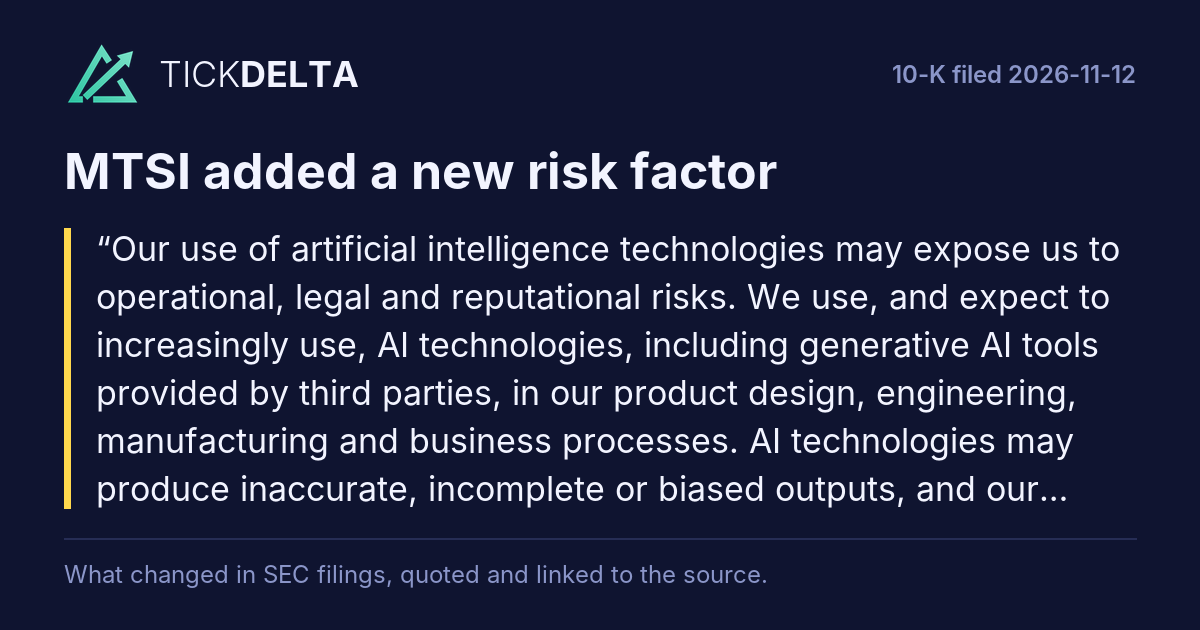
Our use of artificial intelligence technologies may expose us to operational, legal and reputational risks.
We use, and expect to increasingly use, AI technologies, including generative AI tools provided by third parties, in our product design, engineering, manufacturing and business processes. AI technologies may produce inaccurate, incomplete or biased outputs, and our use of them could result in the unintended disclosure of our or third parties’ confidential information, trade secrets or export-controlled technical data, claims of intellectual property infringement, or our inability to obtain or enforce intellectual property protection for AI-assisted developments. Laws and regulations governing AI are evolving rapidly and inconsistently across jurisdictions, and compliance may require significant resources. If we fail to implement appropriate governance over our use of AI, or if AI tools we rely on fail or are compromised, our business, reputation and results of operations could be adversely affected.
Paragraphs in the 10-Q filed Aug 6, 2026 that were not in the one before
New in the latest 10-Q
4 paragraphs in the 10-Q filed Aug 6, 2026 with nothing like
them in the 10-Q filed May 7, 2026 (at least half the words must differ; new numbers alone do not count).
Quoted exactly, grouped by the item heading above them. This is text that changed, not a judgement of how serious it is.
Financial statements and notes
On May 28, 2026, we completed an investment in IQE plc (“Investee”), which included entering into a Subscription Agreement to purchase newly-issued ordinary shares of Investee (representing approximately 12 % of Investee’s issued and outstanding ordinary shares on the date of issuance), for £ 30.0 million ($ 40.4 million) (“Equity Investment”), a five-year Convertible Loan Note Agreement with a principal balance of £ 15.0 million ($ 20.2 million) (“Debt Investment”, collectively, “Long-Term Investments”) and long-term supply agreements. The Debt Investment has a zero-coupon rate and is expected to be repaid beginning on the third anniversary of the issuance. The Debt Investment is convertible into Investee ordinary shares at a conversion price equal to the same price per share as was paid in the Equity Investment. The conversion option is available if the Debt Investment is repaid prior to the contractual maturity date, based on the occurrence of certain contingent events. Warrants for shares of Investee’s ordinary shares were issued as part of the Debt Investment, which become exercisable in lieu of conversion under the early repayment terms. In accordance with ASC 323, Investments - Equity Method and Joint Ventures, and upon consideration of the totality of our agreements, including our right to appoint two members to Investee’s board of directors, we concluded the Equity Investment is an equity method investment. We have elected to account for the Long-Term Investments using the fair value option for simplification. The Long-Term Investments are recorded within “Long-term investments” on the condensed consolidated balance sheet, and changes in fair value are recorded through “Gain on investment fair value” within the condensed consolidated statement of operations. The Equity Investment is valued using a market approach and the Debt Investment is valued using an income approach based on contractual future cash flows discounted to present value as of the last day of our fiscal quarter.
Read in the 10-Qopen_in_new
As of July 3, 2026, the Equity Investment and Debt Investment were recorded at their fair values of $ 90.0 million and $ 12.1 million, respectively, and the fair value of the warrants was not material. During the three and nine months ended July 3, 2026, we recorded a net gain of $ 41.5 million on Long-Term Investments, comprised of a gain of $ 49.6 million on the Equity Investment and a loss of $ 8.1 million on the Debt Investment.
Read in the 10-Qopen_in_new
During the fiscal quarter ended July 3, 2026, the Stock Price Trigger was satisfied, and as a result, holders of our 2029 Convertible Notes may convert their notes at their option at any time during our fourth fiscal quarter ending October 2, 2026, and the 2029 Convertible Notes balance of $ 340.5 million, net of deferred financing costs, is classified as short-term debt in our condensed consolidated balance sheet.
Read in the 10-Qopen_in_new
Following the closing of our investment in Investee on May 28, 2026, as described in Note 4 - Investments, we purchased $2.9 million of inventory from Investee during the remainder of the nine months ended July 3, 2026. As of July 3, 2026, $1.6 million was due to Investee.
Read in the 10-Qopen_in_new
The 10-Q's risk factors against the 10-K
Item 1A of the 10-Q filed Aug 6, 2026 against Item 1A of the 10-K filed Nov 14, 2025.
A 10-Q repeats only the risks that changed, so a 10-K paragraph that is missing from it is not counted as removed.
Added is a paragraph with nothing like it in the 10-K, Reworded a sentence that is in both with several words changed,
Quiet changes a sentence in both where one to four words changed and one is a hedge or a modal
(cut words struck through, new words highlighted).
Text on the page, not a score; each links to the filing at sec.gov.
Added10-Q Aug 6, 2026 vs 10-K Nov 14, 2025
Our business involves a high degree of risk. In addition to the other information set forth in this Quarterly Report on Form 10-Q, you should carefully consider the factors discussed in Part I, “Item 1A. Risk Factors” in our 2025 Annual Report on Form 10-K, which could materially affect our business, financial condition or future results. As of the date of this Quarterly Report on Form 10-Q, there have been no material changes in any of the risk factors described in our 2025 Annual Report on Form 10-K, except as discussed in Part II, “Item 1A. Risk Factors” in our Quarterly Report on Form 10-Q for the fiscal quarters ended January 2, 2026 and April 3, 2026, as filed with the SEC on February 5, 2026 and May 7, 2026, respectively.
Read it in the 10-Q at sec.govopen_in_new
Phrases used for the first time
Two-word phrases in Risk Factors of the 10-K filed Nov 12, 2026 that are in none of the 1 earlier 10-Ks stored, back to Nov 14, 2025
technology transitions ×2center operators ×2cybersecurity requirements ×2entity list ×2compliance obligations ×2investee iqe ×2iqe plc ×2ordinary shares ×2million million ×2critical materials ×2gallium germanium ×2european union ×2pillar two ×2
Where each one is used
- technology transitions: The semiconductor industry is highly cyclical and characterized by constant and rapid technological change, price erosion, product obsolescence, evolving standards, short product lifecycles and significant fluctuations in supply and demand. Historically, these conditions have led to product overcapacity, high...
- center operators: In the fiscal year ended October 2, 2026, no direct customers individually accounted for 10% or more of our revenue and sales to our top 10 direct and distribution customers accounted for an aggregate of 58.3% of our revenue. Two of our resellers individually accounted for 20.3% and 14.3% of our revenue in fiscal...
- cybersecurity requirements: U.S. and foreign regulators, as well as customers and service providers, have also increased their focus on cybersecurity vulnerabilities and risks. Compliance with laws, regulations and contractual provisions concerning privacy, cybersecurity, secure technology development, data governance, data protection,...
- entity list: Sales to customers located outside the U.S. accounted for 61.9% of our revenue for the fiscal year ended October 2, 2026. Sales to customers located in China and the Asia Pacific region typically account for a large portion of our overall sales to customers located outside the U.S. For example, fiscal year 2026...
- compliance obligations: For example, in January 2025 we announced a preliminary, non-binding agreement with the CHIPS Program Office (the “CPO”) that could provide for proposed direct funding to the Company from the U.S. Department of Commerce under the CHIPS and Science Act of 2022 (the “CHIPS Act”) of up to $70.0 million. The U.S....
- investee iqe: We routinely evaluate potential acquisitions, investments and strategic alliances involving complementary technologies, design teams, products and businesses. We expect to pursue such transactions if appropriate opportunities arise. However, we may not be able to identify suitable transactions in the future or if...
- iqe plc: We routinely evaluate potential acquisitions, investments and strategic alliances involving complementary technologies, design teams, products and businesses. We expect to pursue such transactions if appropriate opportunities arise. However, we may not be able to identify suitable transactions in the future or if...
- ordinary shares: We routinely evaluate potential acquisitions, investments and strategic alliances involving complementary technologies, design teams, products and businesses. We expect to pursue such transactions if appropriate opportunities arise. However, we may not be able to identify suitable transactions in the future or if...
The 10-K at sec.govopen_in_new
Used at least twice, small words left out. Counted, not picked: a phrase can be new because the company renamed something.
In addition, we may in the future incur costs defending against environmental litigation brought by government agencies, lessors at sites we currently lease or have been associated with in the past and other private parties. A significant judgment or fine levied against us or agreed settlement payment could materially harm our business, financial condition and results of operations. For example, since 1993, one of our legal entities has been named as a potentially responsible party (“PRP”) along with more than 100 other companies that used the Omega Chemical Corporation waste treatment...
In the 10-K filed Nov 14, 2025open_in_new
Various countries require companies selling a broad range of electrical equipment to conform to regulations such as the Waste Electrical and Electronic Equipment (“WEEE”) and the European Directive on Restriction of Hazardous Substances (“RoHS”). Environmental standards such as these could require us to redesign our products in order to comply with the standards, require the development of compliance administration systems or otherwise limit our flexibility in running our business or require us to incur substantial compliance costs. We have already invested significant resources into...
In the 10-K filed Nov 14, 2025open_in_new
As of October 3, 2025, we had approximately $63.8 million in money market funds and $673.8 million in short-term investments, respectively. The debt security investments consisted of commercial paper, corporate bonds and U.S. Treasury securities. We currently do not use derivative financial instruments to adjust our investment portfolio risk or income profile. These investments, as well as any cash deposited in bank accounts, are subject to general credit, liquidity, market and interest rate risks. We regularly maintain cash balances that are not insured or are in excess of the FDIC’s...
In the 10-K filed Nov 14, 2025open_in_new
Our largest stockholder controls a significant amount of our outstanding common stock. As of October 3, 2025, Susan Ocampo beneficially owned 12.5% of our common stock. As a result, this stockholder will be able to exert a significant degree of influence over our management and affairs and control over matters requiring stockholder approval, including the election of our directors and approval of significant corporate transactions. In addition, this concentration of ownership may delay or prevent a change in control of us and might affect the market price of our securities. In addition,...
In the 10-K filed Nov 14, 2025open_in_new
Sources
Item 1A of each 10-K and 10-Q on EDGAR, quoted exactly. Each paragraph links to the filing at sec.gov.
Also
10-K change: what was reworded or cut, section by section.
Work with it
Excel workbook · CSV. Google Sheet that stays up to date: paste =IMPORTDATA("https://tickdelta.com/company/MTSI/export.csv") into a cell.