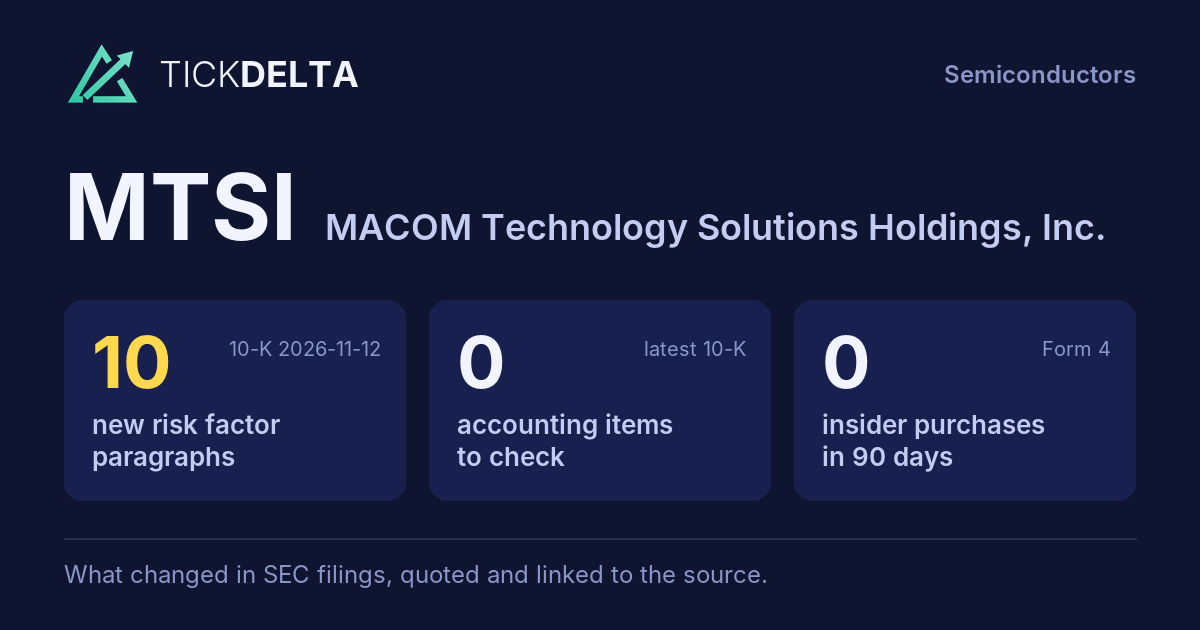
Screener / SEC EDGAR /CIK 0001493594 /10-K filed Nov 12, 2026, compared with Nov 14, 2025 /Numbers from the XBRL of the 10-Ks
Nasdaq Technology · Semiconductors

MACOM Technology Solutions Holdings, Inc. MTSI

Compare with peers Embed
The 10-K against last year's

113 changes: 11 added, 15 removed, 86 reworded, 1 quiet changes

10-K Nov 12, 2026 vs Nov 14, 2025

10-K 0001493594-26-000044 (Nov 12, 2026) vs 10-K 0001493594-25-000054 (Nov 14, 2025)

Every paragraph, and how much of it changed

One bar per paragraph, in the order of the 10-K. Height and colour show the share of its words not in the closest paragraph a year earlier; the tallest bars are new paragraphs.

Risk Factors

128 paragraphs · 10 new · 49 reworded · 13 gone · 10-K Nov 12, 2026 against Nov 14, 2025
New paragraph Reworded (5% of its words or more) Same or nearly
Paragraph 73 · 46% changed Every version of it
Our manufacturing yield, or the percentage of units of a given product in a given period that is usable relative to all such units produced, is a combination of yields including wafer fabrication, assembly and test yields. Due to the complexity of our products, we periodically experience difficulties in achieving acceptable yields as even minor deviations in the manufacturing process can cause substantial manufacturing yield loss or halt production. Our customers may also test our components once they have been assembled into their products. The number of usable products that result from our production process can fluctuate as a result of many factors, including design errors; defects in photomasks, used to print circuits on wafers; minute impurities in materials used; contamination of the manufacturing environment; equipment failure or variations in the manufacturing processes; losses from broken wafers or other human errors; defects in packaging; and issues and errors in testing. Typically, for a given level of sales, when our yields improve, our gross margin improves. Conversely, when our yields decrease, our unit costs are typically higher, our gross margin is lower and our profitability is adversely affected, any or all of which can harm our results of operations and lower our stock price.
Paragraph 16 · 38% changed Every version of it
The foregoing factors are difficult to forecast. These and similar factors could materially and adversely affect our quarterly and annual operating results and related expectations for future periods. If our operating results in any period do not meet our publicly stated guidance or the expectations of investors or securities analysts, our stock price may decline and has, in the past, declined as a result.
Paragraph 51 · 37% changed Every version of it
Further, For example, in January 2025 we announced a preliminary, non-binding agreement with the CHIPS Program Office (the “CPO”) that could provide for proposed direct funding to the Company from the U.S. Department of Commerce under the CHIPS and Science Act of 2022 (the “CHIPS Act”) of up to $70.0 million. The U.S. Government Administration may reverse or modify the terms of the CHIPS Act and associated funding provisions and opportunities contained therein and resulting therefrom, potentially freezing or retracting the provision of government funding under the CHIPS Act and impacting our ability to execute our strategic investment plan and to negotiate and finalize a definitive agreement with and receive funding from the Federal and State governments. Any definitive funding agreement may impose conditions relating to technology sharing, restrictions on licensing our intellectual property, reporting and compliance obligations. These conditions could constrain our ability to use, license or commercialize our intellectual property and increase our costs and operational restrictions.
Paragraph 32 · 36% changed Every version of it
From time to time, we may be a party to certain litigation matters. Any such disputes, litigations, investigations, administrative proceedings or enforcement actions may divert financial and management resources that would otherwise be used to benefit our operations, result in negative publicity and harm our customer or supplier relationships. An adverse resolution of any such matter in the future, including the results of any amicable settlement, could subject us to material damage awards or settlement payments, loss of contractual or other rights, injunctions or other limitations on the operation of our business or other material harm to our business.
Paragraph 54 · 36% changed Every version of it
We have made made, and may, in the future, make expect to make, acquisitions and investments, which involve numerous risks.
Paragraph 95 · 30% changed Every version of it
Our future results could be adversely affected by changes in interpretations of existing laws and regulations, or changes in laws and regulations, including, among others, changes in accounting standards, taxation requirements, competition laws, trade laws, import and export restrictions, privacy laws and environmental laws in the U.S. and other countries. The U.S. Government has implemented tariff and other trade control policies, and may take further actions, that have led to, and may lead to further, changes to U.S. and international export and import controls or trade policies, including tariffs affecting certain products exported by a number of U.S. trading partners, including China. In response, many of those trading partners, including China, have imposed or proposed new or higher tariffs on American products and export controls related to China’s on rare earth metals. elements and on gallium, germanium, indium and other critical minerals, which could impact our supply chain and increase our costs. It is unknown whether and to what extent new tariffs, export control measures or other new laws or regulations will be adopted, or the effect that any such actions would have on us or our industry and customers. Any unfavorable government policies on international trade, such as export and import controls, capital controls or tariffs, may affect the demand for our products and services, increase the cost of components, delay production, impact the competitive position of our products or prevent us from being able to sell products in certain countries. If any new export or import controls, tariffs, legislation or regulations are implemented or if existing trade agreements are renegotiated such changes could have an adverse effect on our business, financial condition and results of operations. In addition, proceedings to enforce, or the enforcement of, any laws, regulations and policies by the U.S. or other countries, and the resulting response to such actions, may have an adverse effect on our business, financial condition and results of operations.
Paragraph 55 · 29% changed Every version of it
We have made certain acquisitions and continue to routinely evaluate potential acquisitions, investments and strategic alliances involving complementary technologies, design teams, products and companies. businesses. We expect to continue to pursue such transactions if appropriate opportunities arise. However, we may not be able to identify suitable transactions in the future or if we do identify such transactions, we may not be able to complete them on commercially acceptable terms or at all and may face intense competition for such opportunities. For example, on May 28, 2026, MACOM U.S. completed an investment in Investee (IQE plc) that included a subscription for newly issued ordinary shares of Investee for £30.0 million ($40.4 million), representing approximately 12% of Investee’s issued and outstanding ordinary shares on the date of issuance, a five-year, zero-coupon convertible loan note with a principal balance of £15.0 million ($20.2 million), long-term supply agreements and rights to appoint two members to Investee’s board of directors. In pursuing transactions, this transaction and any other potential transactions we have and may pursue in the future, we will continue to face numerous risks, including including, among others, diverting management’s attention from normal daily operations of our business; inability to exercise control or influence over the operations, strategy or financial decisions of a company in which we have made an investment; dependence on the existing management, board and operations of investee companies to successfully execute their business plans; exposure to risks and liabilities arising from the operations of investee companies over which we may have limited or no control; decline in the value of our investments due to factors including the investee company's financial performance, market conditions, competitive pressures or adverse developments in the investee company's industry; failing to realize the anticipated strategic benefits and synergies of an acquisition or investment; difficulties in integrating the financial reporting capabilities and operating systems of any acquired operations to maintain effective internal control over financial reporting and disclosure controls and procedures; potential loss of key personnel of the acquired company as well as their know-how, relationships and expertise; challenges successfully integrating acquired personnel, operations and businesses; failing to realize the anticipated synergies and benefits of an acquisition; maintaining favorable business relationships of acquired operations; generating insufficient revenue from completed transactions to offset expenses associated with our efforts; acquiring material or unknown liabilities associated with any acquired operations; litigation associated with merger and acquisition transactions; and increasing expense associated with amortization or depreciation of intangible and tangible assets we acquire.
Paragraph 97 · 28% changed Every version of it
tariff and other trade control policies, and may take further actions, that have led to, and may lead to further, changes to U.S. and international export and import controls or trade policies, including tariffs affecting certain products exported by a number of U.S. trading partners, including China. In response, many of those trading partners, including China, have imposed or proposed new or higher tariffs on American products and export controls related to China’s rare earth metals. It is unknown whether and to what extent new tariffs, export control measures or other new laws or regulations will be adopted, or the effect that any such actions would have on us or our industry and customers. Any unfavorable government policies on international trade, such as export and import controls, capital controls or tariffs, may affect the demand for our products and services, increase the cost of components, delay production, impact the competitive position of our products or prevent us from being able to sell products in certain countries. If any new export or import controls, tariffs, legislation or regulations are implemented or if existing trade agreements are renegotiated such changes could have an adverse effect on our business, financial condition and results of operations. In addition, proceedings to enforce, or the enforcement of, any laws, regulations and policies by the U.S. or other countries, and the resulting response to such actions, may have an adverse effect on our business, financial condition and results of operations.

MD&A

66 paragraphs · 1 new · 35 reworded · 2 gone · 10-K Nov 12, 2026 against Nov 14, 2025
New paragraph Reworded (5% of its words or more) Same or nearly
Paragraph 17 · 48% changed
Our discussion and analysis of our financial condition and results of operations are based on our consolidated financial statements. The preparation of financial statements, in conformity with U.S. generally accepted accounting principles (“GAAP”), requires management to make estimates and judgments that affect the reported amounts of assets and liabilities, the reported amounts of revenue and expenses during the reporting period and disclosure of contingent assets and liabilities at the date of the financial statements. By their nature, these estimates and judgments are subject to an inherent degree of uncertainty and could be material if our actual or expected experience were to change unexpectedly. On an ongoing basis, we re-evaluate our estimates and judgments.
Paragraph 49 · 37% changed
Interest income. Income tax expense. In fiscal year 2025, interest 2026, income tax expense was $29.9 million, or 3.0% of our revenue, $54.6 million compared to $23.0 an expense of $25.2 million of interest income, or 3.1% of our revenue, for fiscal year 2024. 2025. The change increase in fiscal year 2025 the provision is primarily due to an increase in short-term investments and associated interest income. income from operations before income taxes.
Paragraph 51 · 36% changed
In July 2025, the U.S. Government enacted the July 4, 2025 Bill which did not have a significant impact to our financials for the year ended October 3, 2025. The Company is currently evaluating the impact of the July 4, 2025 Bill which will restore the ability to deduct domestic research and development costs in the year they are incurred and no longer requires the deferral and amortization of these costs over five years, among other changes. We anticipate this change will impact the Company beginning in our fiscal year ending October 2, 2026. The July 4, 2025 Bill permits the acceleration of any unamortized balance of domestic research and development expenses which were previously deferred and also increases the investment tax credit (“ITC”) ITC relating to the CHIPS Act from 25% to 35% for qualifying assets placed into service after December 31, 2025. For fiscal year 2026, the Company has deducted $112.4 million of domestic research and development costs which were previously capitalized.
Paragraph 46 · 31% changed
Loss Gain on extinguishment of debt. investment fair value. In fiscal year 2025, 2026, we recognized recorded a $193.1 million loss gain on exchange investment fair value of our 2026 Convertible Notes. $61.0 million, related to changes in the fair value of Long-Term Investments. See Note 15 5 - Debt Investments to the Consolidated Financial Statements included in this Annual Report for additional information.
Paragraph 61 · 30% changed
During the fiscal quarter ended October 3, 2025, our common stock price for at least 20 trading days (whether or not consecutive) during 2, 2026, the 30 consecutive trading days ending October 3, 2025 Stock Price Trigger (as defined in Note 15 - Debt to the Consolidated Financial Statements included in this Annual Report) was greater than $106.76 on each applicable trading day. Therefore, satisfied. As a result, holders of our 2026 2029 Convertible Notes (as defined in Note 15 - Debt to the Consolidated Financial Statements included in this Annual Report) may convert their notes at their option at any time during the subsequent first fiscal quarter ended ending January 2, 2026 1, 2027 in multiples of $1,000 principal amount. On or after December 15, 2025 until the close of business on the second scheduled trading day immediately preceding the maturity date, holders may convert their notes in multiples of $1,000 principal amount. We made an irrevocable election to pay cash for the principal amount of notes to be converted. The aggregate principal balance of the 2026 Convertible Notes is $161.2 million. For additional information related to our Liquidity and Capital Resources, see Note 15 - Debt to our Consolidated Financial Statements included in this Annual Report.
Paragraph 39 · 29% changed
Certain areas of our end markets continue to be negatively impacted by macroeconomic and geopolitical conditions, which we expect may result in weaker near-term demand for our products across all three of our primary markets. In addition, we could be negatively affected by any weakening of global economic conditions, including as a result of geopolitical conflicts and related trade restrictions, the evolving impacts from tariffs, export bans, sanctions sanctions, obtaining required licenses or other trade tensions (including implementation of new tariffs or retaliatory trade measures).
Paragraph 56 · 25% changed
Our cash flow used in investing activities for fiscal year 2025 2026 of $328.3 $147.9 million consisted primarily of purchases of $592.4 $264.9 million of short-term investments, capital expenditures of $42.6 $64.4 million, purchase purchases of property under financing arrangement long-term investments of $28.8 $60.6 million and cash paid for acquisitions, net purchases of cash acquired software licenses and licensed technology of $12.7 $10.7 million, partially offset by proceeds of $360.2 $249.8 million for the sale and maturities of short-term investments. investments and other investing activities of $2.8 million.
Paragraph 36 · 25% changed
In fiscal year 2025, 2026, our I&D market revenue increased by $68.1 $116.6 million, or 19.4%, 27.8%, compared to fiscal year 2024. 2025. The increase was primarily driven by revenue growth from defense defense-related programs in support of RF and the full year contribution of acquisitions. optical systems across communications, radar systems, electronic warfare, UAS and CUAS.

A paragraph is matched with the one last year that shares the most of its words; under half in common makes it new. The paragraphs shown are the 8 reworded the most in each section.

The paragraph that changed most in each section

The redline

Marked against last year's 10-K: cut words struck through, new words highlighted.

Risk Factors243 words changed in this paragraph; it is 58% similar to last year's version.
We have made certain acquisitions and continue to routinely evaluate potential acquisitions, investments and strategic alliances involving complementary technologies, design teams, products and companies. businesses. We expect to continue to pursue such transactions if appropriate opportunities arise. However, we may not be able to identify suitable transactions in the future or if we do identify such transactions, we may not be able to complete them on commercially acceptable terms or at all and may face intense competition for such opportunities. For example, on May 28, 2026, MACOM U.S. completed an investment in Investee (IQE plc) that included a subscription for newly issued ordinary shares of Investee for £30.0 million ($40.4 million), representing approximately 12% of Investee’s issued and outstanding ordinary shares on the date of issuance, a five-year, zero-coupon convertible loan note with a principal balance of £15.0 million ($20.2 million), long-term supply agreements and rights to appoint two members to Investee’s board of directors. In pursuing transactions, this transaction and any other potential transactions we have and may pursue in the future, we will continue to face numerous risks, including including, among others, diverting management’s attention from normal daily operations of our business; inability to exercise control or influence over the operations, strategy or financial decisions of a company in which we have made an investment; dependence on the existing management, board and operations of investee companies to successfully execute their business plans; exposure to risks and liabilities arising from the operations of investee companies over which we may have limited or no control; decline in the value of our investments due to factors including the investee company's financial performance, market conditions, competitive pressures or adverse developments in the investee company's industry; failing to realize the anticipated strategic benefits and synergies of an acquisition or investment; difficulties in integrating the financial reporting capabilities and operating systems of any acquired operations to maintain effective internal control over financial reporting and disclosure controls and procedures; potential loss of key personnel of the acquired company as well as their know-how, relationships and expertise; challenges successfully integrating acquired personnel, operations and businesses; failing to realize the anticipated synergies and benefits of an acquisition; maintaining favorable business relationships of acquired operations; generating insufficient revenue from completed transactions to offset expenses associated with our efforts; acquiring material or unknown liabilities associated with any acquired operations; litigation associated with merger and acquisition transactions; and increasing expense associated with amortization or depreciation of intangible and tangible assets we acquire.

Source: Item 1A, 10-K 0001493594-26-000044 vs Item 1A, 10-K 0001493594-25-000054

MD&A118 words changed in this paragraph; it is 57% similar to last year's version.
Our cash flow from operating activities for fiscal year 2024 was $162.6 2025 of $235.4 million and consisted of a net income loss of $76.9 $54.2 million, plus adjustments which included non-cash charges of $327.4 million, primarily related to reconcile our net income to cash provided loss on extinguishment of debt of $193.1 million, depreciation and intangible amortization expense of $63.3 million, share-based compensation expense of $79.4 million, partially offset by operating activities of $116.8 million, and cash used by operating assets and liabilities of $31.0 $37.8 million. Adjustments to reconcile our net income to cash provided by operating activities of $116.8 million primarily included depreciation and intangible amortization expense of $67.2 million, share-based compensation expense of $45.6 million and deferred income tax expense of $4.9 million, partially offset by $7.6 million in amortization on marketable securities. In addition, The cash used by operating assets and liabilities of $37.8 million was $31.0 million for fiscal year 2024, primarily driven by an increase in inventory of $30.2 $26.6 million, an increase in accounts receivable of $16.8 $42.0 million, partially offset by an increase in accounts payable of $22.2 million and a decrease an increase in accrued and other liabilities of $7.3 million, partially offset by a decrease in accounts payable of $18.2 $11.8 million.

Source: Item 7, 10-K 0001493594-26-000044 vs Item 7, 10-K 0001493594-25-000054

Accounting Policies58 words changed in this paragraph; it is 80% similar to last year's version.
In December 2023, the FASB issued ASU 2023-09, Income Taxes (Topic 740) Improvements to Income Tax Disclosures, which require greater disaggregation of income tax disclosures. The amendments in this update improve the transparency of income tax disclosures by requiring (1) consistent categories and greater disaggregation of information in the rate reconciliation and (2) income taxes paid disaggregated by jurisdiction. Other amendments in this update improve the effectiveness and comparability of disclosures by (1) adding disclosures of pretax income (or loss) and income tax expense (or benefit) and (2) removing disclosures that no longer are considered cost beneficial or relevant. This ASU should be applied on a prospective basis, with retrospective application permitted. The guidance in this update is effective for fiscal years beginning after December 15, 2024. We are currently evaluating the future effect the adoption of adopted this ASU will have on our consolidated financial statements and related disclosures. a prospective basis for the fiscal year ended October 2, 2026 for annual reporting periods. See Note 20 - Income Taxes for additional information.

Source: Item 8, Note 2 – SUMMARY OF SIGNIFICANT ACCOUNTING POLICIES, 10-K 0001493594-26-000044 vs Item 8, Note 2 – SUMMARY OF SIGNIFICANT ACCOUNTING POLICIES, 10-K 0001493594-25-000054

Legal Proceedings2 words changed in this paragraph; it is 99% similar to last year's version.
Asset Retirement Obligations—We are obligated under certain facility leases to restore those facilities to the condition in which we or our predecessors first occupied the facilities. We are required to remove leasehold improvements and equipment installed in these facilities prior to termination of the leases. As of October 2, 2026 and October 3, 2025 and September 27, 2024, 2025, the estimated cost for the removal of these assets that are recorded as asset retirement obligations in other long-term liabilities in our Consolidated Balance Sheets was $1.9 million.

Source: Item 3, via Note 14 – COMMITMENTS AND CONTINGENCIES, 10-K 0001493594-26-000044 vs Item 3, via Note 14 – COMMITMENTS AND CONTINGENCIES, 10-K 0001493594-25-000054

Sentences and paragraphs added, removed or reworded

Every change, by type

Sentences and paragraphs of MTSI's Risk Factors and MD&A, 10-K Nov 12, 2026 against 10-K Nov 14, 2025. Each links to the text at sec.gov.

Quiet changes are sentences kept from last year with one to four words changed, at least one of them a hedge, a modal or a qualifier (may, could, will, not, significant, material…). A year or date rolling forward is not counted.

The full word list

adverse, adversely, all, although, anticipate, anticipates, any, approximately, believe, believes, can, cannot, certain, could, expect, expects, generally, however, if, intend, intends, largely, likely, many, material, materially, may, might, most, must, never, no, not, possible, primarily, probable, should, significant, significantly, some, substantial, substantially, unlikely, will, would

AddedRisk Factors
In addition, if terrorist activity, armed conflict, civil, economic or military unrest, natural disasters, global pandemics, embargoes or other economic sanctions, enforcement actions against governments, governmental entities or private entities or political instability
Read it in 10-K Nov 12, 2026 at sec.gov
AddedRisk Factors
In addition, any significant changes enacted by the current U.S. Government Administration to the Internal Revenue Code of 1986, as amended (the “Code”), or specifically to the Tax Cuts and Jobs Act (the “U.S. Tax Act”) enacted in 2017, or to regulatory guidance associated with the U.S. Tax Act, could materially adversely affect our effective tax rate. On July 4, 2025, Public Law 119-21 (the “2025 Bill”) was enacted. The 2025 Bill, among other changes, increased the CHIPS Act investment tax credit (“ITC”) from 25% to 35% for qualifying assets placed in service after December 31, 2025 and permits the deduction of applicable domestic research and development costs in the year incurred rather than requiring their deferral and amortization over five years. While some provisions of the 2025 Bill may reduce our tax liability, such as modifications to corporate taxes, deductions, credits, treatment of foreign income and expensing rules, others may introduce additional complexity and audit risk. The ultimate impact of the 2025 Bill will depend on future Treasury regulations, IRS guidance and our business operations, and we may be adversely affected if the 2025 Bill or related guidance is modified or interpreted in a manner that increases our tax liabilities or compliance costs.
Read it in 10-K Nov 12, 2026 at sec.gov
AddedRisk Factors
may not realize the competitive advantages, revenues or profits we anticipate from new products, any of which may lead to higher R&D expense, lower than expected revenues and gross margin and reduced profitability, or may otherwise harm our business or reduce the price of our common stock. Such results, or anticipated results, may cause us to reevaluate our investment in those areas of our business.
Read it in 10-K Nov 12, 2026 at sec.gov
AddedRisk Factors
In addition, in April 2025, the BIS announced the initiation of investigations under Section 232 of the Trade Expansion Act of 1962 into the effects on U.S. national security of imports of semiconductors, semiconductor manufacturing equipment and derivative products. On January 14, 2026, the President issued a presidential proclamation formally concurring with the findings of BIS’s report on such investigations and adopting a two-phase implementation plan, which includes the imposition of additional tariffs on certain advanced computing semiconductors and derivative hardware. These tariffs, and any additional import restrictions or other trade measures affecting semiconductor products, could increase our costs, restrict our market access or otherwise adversely affect our business and results of operations.
Read it in 10-K Nov 12, 2026 at sec.gov
AddedRisk Factors
and policies by the U.S. or other countries, and the resulting response to such actions, may have an adverse effect on our business, financial condition and results of operations.
Read it in 10-K Nov 12, 2026 at sec.gov
AddedRisk Factors
In addition, we may in the future incur costs defending against environmental litigation brought by government agencies, lessors at sites we currently lease or have been associated with in the past and other private parties. A significant judgment or fine levied against us or agreed settlement payment could materially harm our business, financial condition and results of operations.
Read it in 10-K Nov 12, 2026 at sec.gov
Show the other 42
AddedRisk Factors
We use, and expect to increasingly use, AI technologies, including generative AI tools provided by third parties, in our product design, engineering, manufacturing and business processes. AI technologies may produce inaccurate, incomplete or biased outputs, and our use of them could result in the unintended disclosure of our or third parties’ confidential information, trade secrets or export-controlled technical data, claims of intellectual property infringement, or our inability to obtain or enforce intellectual property protection for AI-assisted developments. Laws and regulations governing AI are evolving rapidly and inconsistently across jurisdictions, and compliance may require significant resources. If we fail to implement appropriate governance over our use of AI, or if AI tools we rely on fail or are compromised, our business, reputation and results of operations could be adversely affected.
Read it in 10-K Nov 12, 2026 at sec.gov
RemovedRisk Factors
We rely on third parties to provide corporate infrastructure services necessary for the operation of our business. Any failure of one or more of our vendors to provide these services could have a material adverse effect on our business.
Read it in 10-K Nov 14, 2025 at sec.gov
RemovedRisk Factors
We rely on third-party vendors to provide critical corporate infrastructure services, including, among other things, certain services related to information technology and network development and monitoring. We depend on these vendors to ensure that our corporate infrastructure will consistently meet our business requirements. The ability of these third-party vendors to successfully provide reliable, high quality services is subject to technical and operational uncertainties that are beyond our control. Any failure of our corporate infrastructure could have a material adverse effect on our business, financial condition and results of operations.
Read it in 10-K Nov 14, 2025 at sec.gov
RemovedRisk Factors
Our short-term investment portfolio and certain cash balances could experience a decline in market value or otherwise become illiquid, which could materially and adversely affect our financial results.
Read it in 10-K Nov 14, 2025 at sec.gov
RemovedRisk Factors
As of October 3, 2025, we had approximately $63.8 million in money market funds and $673.8 million in short-term investments, respectively. The debt security investments consisted of commercial paper, corporate bonds and U.S. Treasury securities. We currently do not use derivative financial instruments to adjust our investment portfolio risk or income profile. These investments, as well as any cash deposited in bank accounts, are subject to general credit, liquidity, market and interest rate risks. We regularly maintain cash balances that are not insured or are in excess of the FDIC’s insurance limit. If the global financial markets continue to experience volatility or deteriorate, our investment portfolio and cash balances may be impacted and some or all of our investments may become illiquid or otherwise experience loss which could adversely impact our financial results and position.
Read it in 10-K Nov 14, 2025 at sec.gov
RemovedRisk Factors
In addition, any significant changes enacted by the current U.S. Government Administration to the Code or specifically to the Tax Cuts and Jobs Act (the “U.S. Tax Act”) enacted in 2017, or to regulatory guidance associated with the U.S. Tax Act, could materially adversely affect our effective tax rate.
Read it in 10-K Nov 14, 2025 at sec.gov
RemovedRisk Factors
future contracts for a specified period of time. Any such suspension or debarment or other sanction could have an adverse effect on our business. In addition, if we are unable to comply with security clearance requirements, we might be unable to perform these contracts or compete for other projects of this nature, which could adversely affect our revenue.
Read it in 10-K Nov 14, 2025 at sec.gov
RemovedRisk Factors
demand that we otherwise could have fulfilled at attractive prices. If we have a firm commitment to supply our customers but are unable to do so we may be liable for resulting damages and expense incurred by our customers.
Read it in 10-K Nov 14, 2025 at sec.gov
RemovedRisk Factors
In addition, we may in the future incur costs defending against environmental litigation brought by government agencies, lessors at sites we currently lease or have been associated with in the past and other private parties. A significant judgment or fine levied against us or agreed settlement payment could materially harm our business, financial condition and results of operations. For example, since 1993, one of our legal entities has been named as a potentially responsible party (“PRP”) along with more than 100 other companies that used the Omega Chemical Corporation waste treatment facility in Whittier, California (the “Omega Site”). The U.S. Environmental Protection Agency has alleged that the Omega Site failed to properly treat and dispose of certain hazardous waste material. We are a member of a large group of PRPs, which has agreed to fund certain ongoing remediation efforts at and nearby the Omega Site. Based on currently available information with respect to the total anticipated level of investigatory, remedial and monitoring costs to be incurred by the group of PRPs and our allocable share of those costs, we have a loss accrual for the Omega Site that is not material. However, the proceedings are ongoing and several factors beyond our control could cause this loss accrual to prove inadequate, and any future increases to our allocation of responsibility among the PRPs or the future reduction of parties participating in the PRP group could materially increase our potential liability relating to the Omega Site.
Read it in 10-K Nov 14, 2025 at sec.gov
RemovedRisk Factors
Various countries require companies selling a broad range of electrical equipment to conform to regulations such as the Waste Electrical and Electronic Equipment (“WEEE”) and the European Directive on Restriction of Hazardous Substances (“RoHS”). Environmental standards such as these could require us to redesign our products in order to comply with the standards, require the development of compliance administration systems or otherwise limit our flexibility in running our business or require us to incur substantial compliance costs. We have already invested significant resources into complying with these regimes, and further investments may be required. Alternative designs implemented in response to regulation may be costlier to produce, resulting in an adverse effect on our gross profit margin. If we cannot develop compliant products in a timely fashion or properly administer our compliance programs, our revenue may also decline due to lower sales, which would adversely affect our operating results. Further, if we were found to be non-compliant with any rule or regulation, we could be subject to fines, penalties and/or restrictions imposed by government agencies that could adversely affect our operating results.
Read it in 10-K Nov 14, 2025 at sec.gov
RewordedRisk Factors
In pursuing transactions, this transaction and any other potential transactions we have and may pursue in the future, we will continue to face numerous risks, including including, among others, diverting management’s attention from normal daily operations of our business; inability to exercise control or influence over the operations, strategy or financial decisions of a company in which we have made an investment; dependence on the existing management, board and operations of investee companies to successfully execute their business plans; exposure to risks and liabilities arising from the operations of investee companies over which we may have limited or no control; decline in the value of our investments due to factors including the investee company's financial performance, market conditions, competitive pressures or adverse developments in the investee company's industry; failing to realize the anticipated strategic benefits and synergies of an acquisition or investment; difficulties in integrating the financial reporting capabilities and operating systems of any acquired operations to maintain effective internal control over financial reporting and disclosure controls and procedures; potential loss of key personnel of the acquired company as well as their know-how, relationships and expertise; challenges successfully integrating acquired personnel, operations and businesses; failing to realize the anticipated synergies and benefits of an acquisition; maintaining favorable business relationships of acquired operations; generating insufficient revenue from completed transactions to offset expenses associated with our efforts; acquiring material or unknown liabilities associated with any acquired operations; litigation associated with merger and acquisition transactions; and increasing expense associated with amortization or depreciation of intangible and tangible assets we acquire.
Read it in 10-K Nov 12, 2026 at sec.gov
RewordedRisk Factors
A slowdown in the global economy or in a particular region or industry, uncertainty and volatility in financial markets and other unfavorable changes in economic conditions, such as inflation or major central bank policy actions, as well as an increase in geopolitical conflicts, trade tensions and restrictions, including related tariffs, including, but not limited to, the implementation of new tariffs and retaliatory trade measures, sanctions, and the need to obtain required licenses and approvals could disrupt our access to markets, customers and suppliers, negatively impact our investment portfolio and cash balances, including rendering some or all of our investment portfolio illiquid, and negatively impact our business, financial condition and liquidity.
Read it in 10-K Nov 12, 2026 at sec.gov
RewordedRisk Factors
Our ability to make payments of the principal of our 2026 0.00% convertible senior notes due 2029 (the “2029 Convertible Notes and our 2029 Convertible Notes (each as defined in Note 15 - Debt to the Consolidated Financial Statements included in this Annual Report), Notes”), or to make cash payments in connection with any conversion of the 2026 Convertible Notes and the 2029 Convertible Notes Notes, depends on our future performance, which is subject to economic, financial, competitive and other factors beyond our control.
Read it in 10-K Nov 12, 2026 at sec.gov
RewordedRisk Factors
The occurrence of any of these events, including the conflicts in Ukraine and Israel, the Middle East and any escalation of tensions between China and Taiwan, where we operate an assembly and test facility and where certain of our suppliers are located, could have a material adverse effect on our operating results.
Read it in 10-K Nov 12, 2026 at sec.gov
RewordedRisk Factors
In response, many of those trading partners, including China, have imposed or proposed new or higher tariffs on American products and export controls related to China’s on rare earth metals. elements and on gallium, germanium, indium and other critical minerals, which could impact our supply chain and increase our costs.
Read it in 10-K Nov 12, 2026 at sec.gov
RewordedRisk Factors
If our operating results in any period do not meet our publicly stated guidance or the expectations of investors or securities analysts, our stock price may decline and has, in the past, declined as a result.
Read it in 10-K Nov 12, 2026 at sec.gov
RewordedRisk Factors
If capital spending on Data Center infrastructure slows down, if customers delay or reduce deployments of new AI infrastructure, or if we fail to anticipate and keep pace with these technology transitions, demand for our products may decline.
Read it in 10-K Nov 12, 2026 at sec.gov
RewordedRisk Factors
The potential difficulties we may face in integrating the operations of our acquisitions include, among others: failure to implement our business plans for the combined businesses and consolidation or expansion of production capacity as planned and where applicable; unexpected losses of key employees, customers or suppliers of our acquired companies and businesses; unanticipated issues in conforming our acquired companies’ and businesses’ standards, processes, procedures and controls with our operations; coordinating new product and process development; increasing the scope, geographic diversity and complexity of our operations; diversion of management’s attention from other business concerns; adverse effects on our or our acquired companies’ and businesses’ existing business relationships; unanticipated changes in applicable laws and regulations; operating risks inherent in our acquired companies’ and businesses’ business and operations; unanticipated expenses and liabilities; potential unfamiliarity with our acquired companies companies’ and businesses businesses’ technology, products and markets, which may place us at a competitive disadvantage; and other difficulties in the assimilation of our acquired companies and businesses operations, technologies, products and systems.
Read it in 10-K Nov 12, 2026 at sec.gov
RewordedRisk Factors
Although we intend to vigorously defend our intellectual property rights, we may not be able to prevent misappropriation of our technology or may need to expend significant financial and other resources in defending our rights.
Read it in 10-K Nov 12, 2026 at sec.gov
RewordedRisk Factors
The industry has historically experienced significant fluctuations in demand and product obsolescence, resulting in Historically, these conditions have led to product overcapacity, high inventory levels and accelerated erosion of average selling prices (“ASPs”).
Read it in 10-K Nov 12, 2026 at sec.gov
RewordedRisk Factors
For example, between February 5, 2025 May 26, 2026 and April 8, 2025, July 29, 2026, the market price of our common stock had a cumulative decline of approximately 35.4%. 44.2%.
Read it in 10-K Nov 12, 2026 at sec.gov
Quiet changesRisk Factors
Past transactions, whether completed or abandoned not by us, have resulted, and in the future may result, in significant time and attention, costs, expenses, liabilities and charges to earnings.
Read it in 10-K Nov 12, 2026 at sec.gov
AddedMD&A
Sales to customers located in China, based on customer billing address, increased to 37.7% of our revenue in fiscal year 2026 from 28.4% in fiscal year 2025. Changes in U.S. or Chinese trade, export control or tariff policies, including those described in “Item 1A - Risk Factors,” could adversely affect our ability to sell products to customers in China.
Read it in 10-K Nov 12, 2026 at sec.gov
RemovedMD&A
On December 19, 2024, we exchanged approximately $288.8 million in aggregate principal amount of our 2026 Convertible Notes (as defined in Note 15 - Debt to our Consolidated Financial Statements included in this Annual Report) for approximately $257.7 million in aggregate principal amount of the 2029 Convertible Notes (as defined in Note 15 - Debt to our Consolidated Financial Statements included in this Annual Report), 1,582,958 newly-issued shares of the Company’s common stock, issued at a fair value of $205.9 million, and $17.6 million in cash. We also issued approximately $86.6 million in aggregate principal amount of the 2029 Convertible Notes, and net proceeds, net of amounts paid associated with the exchange, totaled approximately $63.5 million and are expected to be used for general corporate purposes. As of October 3, 2025, the aggregate principal balances of the 2026 Convertible Notes and 2029 Convertible Notes are $161.2 million and $344.3 million, respectively, and we are required to pay cash for the principal amount of the notes upon conversion.
Read it in 10-K Nov 14, 2025 at sec.gov
RewordedMD&A
The increase in fiscal year 2025 2026 is primarily due to increases in interest expense on financing obligations and amortization of debt issuance costs, partially offset by a decrease in interest expense on convertible notes (see Note 15 16 - Debt and Note 16- Financing Obligation to the Consolidated Financial Statements included in this Annual Report), partially offset by a decrease in interest expense due to the settlement of the 2026 Convertible Notes (as defined in Note 15 - Debt to our Consolidated Financial Statements included in this Annual Report).
Read it in 10-K Nov 12, 2026 at sec.gov
RewordedMD&A
Our cash flow from operating activities for fiscal year 2025 was $235.4 2026 of $357.1 million and consisted of a net loss income of $54.2 $335.3 million, plus adjustments which included non-cash charges of $114.5 million, primarily related to reconcile our net loss to cash provided share-based compensation expense of $87.8 million, depreciation and intangible amortization expense of $62.6 million, partially offset by operating activities the gain on investment fair value of $327.4 $61.0 million, and cash used by operating assets and liabilities of $37.8 $92.7 million.
Read it in 10-K Nov 12, 2026 at sec.gov
RewordedMD&A
Our cash flow from operating activities for fiscal year 2025 was of $235.4 million and consisted of a net loss of $54.2 million, plus adjustments to reconcile our net loss to cash provided by operating activities which included non-cash charges of $327.4 million, primarily related to loss on extinguishment of debt of $193.1 million, depreciation and intangible amortization expense of $63.3 million, share-based compensation expense of $79.4 million, partially offset by cash used by operating assets and liabilities of $37.8 million.
Read it in 10-K Nov 12, 2026 at sec.gov
RewordedMD&A
Our cash flow used in investing activities for fiscal year 2025 2026 of $328.3 $147.9 million consisted primarily of purchases of $592.4 $264.9 million of short-term investments, capital expenditures of $42.6 $64.4 million, purchase purchases of property under financing arrangement long-term investments of $28.8 $60.6 million and cash paid for acquisitions, net purchases of cash acquired software licenses and licensed technology of $12.7 $10.7 million, partially offset by proceeds of $360.2 $249.8 million for the sale and maturities of short-term investments. investments and other investing activities of $2.8 million.
Read it in 10-K Nov 12, 2026 at sec.gov
RewordedMD&A
Interest income 2.2 3.0 3.1 3.2 Interest expense (0.5) (0.6) (0.7) (1.9) Gain on investment fair value 4.6 — — Loss on extinguishment of debt — (20.0) — — Gain on acquired assets and other income, net — 1.0 — Total other income (expense), net 1.0 — (0.1) Total other (expense) income, net 6.4 (16.6) 2.4 1.2 (Loss) income Income (loss) before income taxes 29.4 (3.2) 12.5 17.8 Income tax expense 4.1 2.6 2.0 3.7 Net income (loss) income 25.3% (5.8)% 10.5% 14.1%
Read it in 10-K Nov 12, 2026 at sec.gov
RewordedMD&A
During fiscal year 2024, 2026, our cash used in financing activities of $9.1 $209.2 million was primarily related to $14.2 $161.2 million of repayment of the 2026 Convertible Notes, $56.9 million of common stock withheld associated with employee taxes on vested equity awards, awards and $2.6 million of payments for finance leases and other financing activities, partially offset by $6.6 $11.5 million of proceeds from stock option exercises and employee stock purchases.
Read it in 10-K Nov 12, 2026 at sec.gov
RewordedMD&A
In addition, The cash used by operating assets and liabilities of $92.7 million was $37.8 million for fiscal year 2025, primarily driven by an increase in inventory accounts receivable of $26.6 $60.9 million, an increase in accounts receivable inventory of $42.0 $46.6 million, partially offset by an increase in accounts payable of $22.2 million and an increase in accrued and other liabilities of $11.8 $9.1 million.
Read it in 10-K Nov 12, 2026 at sec.gov
RewordedMD&A
Fiscal Year Ended October 2, 2026 October 3, 2025 September 27, 2024 Cash and cash equivalents, beginning of period $ 112,142 $ 146,806 $ 173,952 Net cash provided by operating activities 357,086 235,368 162,640 Net cash used in investing activities (147,932) (328,263) (181,133) Net cash used in (used in) provided by financing activities (209,156) 58,099 (9,064) Effect of exchange rates on cash balances (129) 132 411 Cash and cash equivalents, end of period $ 112,011 $ 112,142 $ 146,806
Read it in 10-K Nov 12, 2026 at sec.gov
RewordedMD&A
Selling, general and administrative expenses increased during fiscal year 2025 2026 primarily due to an increase increases in employee-related costs, including share-based compensation expense, variable compensation and share-based compensation, partially offset by decreases in acquisition-related transaction selling costs and intangible asset amortization. professional fees.
Read it in 10-K Nov 12, 2026 at sec.gov
RewordedMD&A
The difference between our effective tax rate for fiscal year 2025 2026 and the U.S. federal income tax rate of 21% was primarily driven by non-deductibility the utilization of research and development credits against taxable income, foreign rate differential, and share-based compensation activity during the loss on extinguishment of debt. year.
Read it in 10-K Nov 12, 2026 at sec.gov
RewordedMD&A
The increase was primarily driven by an increase in higher sales of high-performance analog and coherent optical Data Center products primarily products, including photodetectors, supporting high speed data rates from 100G up to 1.6T. 1.6T related to data center infrastructure build-outs.
Read it in 10-K Nov 12, 2026 at sec.gov
RewordedMD&A
In fiscal year 2025, 2026, research and development expense increased by $62.3 $41.4 million, or 34.2%, 16.9%, to $285.8 million, representing 21.5% of revenue, compared with $244.5 million, representing 25.3% of revenue, compared with $182.2 million, representing 25.0% of revenue, in fiscal year 2024. 2025.
Read it in 10-K Nov 12, 2026 at sec.gov

Sources

The two latest 10-Ks on EDGAR, section by section. Each change links to the text at sec.gov.

Also

New risk factors: paragraphs with nothing like them last year, quoted in full.

Work with it

Excel workbook · CSV. Google Sheet that stays up to date: paste =IMPORTDATA("https://tickdelta.com/company/MTSI/export.csv") into a cell.

Next:Related parties
Esc

Type a ticker such as AAPL, a name, an investor such as Buffett, or a topic such as tariffs. ↑ ↓ to move, Enter to open.