Mastec Inc MTZ
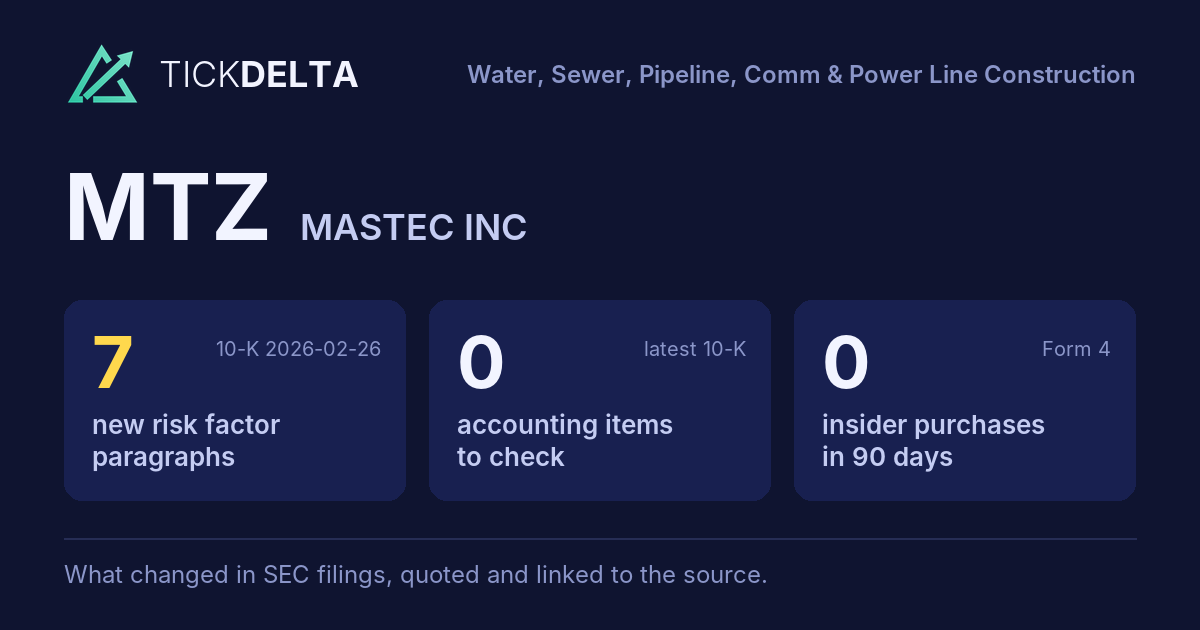
What the 10-K filed Feb 26, 2026 says off the balance sheet
10-K notesRisks that are not on the face of the balance sheet. Tickdelta picks sentences with specifics and quotes them as filed. New marks a sentence with nothing like it in the 10-K filed Feb 28, 2025.
Big customers
Customers the company names as a large share of revenue or receivables (it must name any worth 10% of revenue).
“As of each of December 31, 2025, 2024 and 2023, amounts due from customers from which foreign revenue was derived accounted for approximately 1% of the Company’s consolidated net accounts receivable position, which is calculated as accounts receivable, net, less deferred revenue.”
1% in the 10-K filed 2026-02-26, 1% in the one filed 2025-02-28
Read it in the 10-K
“No customer represented greater than 10% of the Company’s total consolidated revenue in either of the years ended December 31, 2024 and 2023.”
10% in the 10-K filed 2026-02-26, 10% in the one filed 2025-02-28
Read it in the 10-K
“As of December 31, 2025, one customer accounted for approximately 10% of the Company’s consolidated net accounts receivable position, which is calculated as accounts receivable, net, less deferred revenue.”
10% in the 10-K filed 2026-02-26, 10% in the one filed 2025-02-28
Read it in the 10-K
“As of December 31, 2024, no customer represented greater than 10% of the Company’s consolidated net accounts receivable position.”
10% in the 10-K filed 2026-02-26, 10% in the one filed 2025-02-28
Read it in the 10-K
Key suppliers
Parts or manufacturing that depend on one or a few suppliers.
No specific sentence about this in the 10-K.
Lawsuits and legal claims
Pending cases, settlements and what the company has set aside for them.
“Accruals for litigation and contingencies are based on our assessment, including advice of legal counsel, of the expected outcome of litigation or other dispute resolution proceedings and/or the expected resolution of contingencies.”
Read it in the 10-K
“Accruals for litigation and contingencies are reflected in the consolidated financial statements based on management’s assessment, including advice of legal counsel, of the expected outcome of litigation or other dispute resolution proceedings and/or the expected resolution of contingencies.”
Read it in the 10-K
Guarantees and indemnities
Promises to pay someone else's debts or losses if they cannot.
“Our significant off-balance sheet transactions include liabilities associated with non-cancelable operating leases with durations of less than twelve months, letter of credit obligations, surety and performance and payment bonds entered into in the normal course of business, self-insurance liabilities, liabilities associated with multiemployer pension plans, liabilities associated with potential funding obligations and indemnification and/or guarantee arrangements relating to our equity and other investment arrangements, including our variable interest entities.”
Read it in the 10-K
“Outstanding performance guarantees on behalf of this contractual joint venture totaled Canadian $9.7 million as of both December 31, 2025 and 2024, or approximately $7.1 million and $6.7 million, respectively.”
Read it in the 10-K
Debt covenants
Conditions in loan agreements that, if broken, can make debt due early.
“These definitions of EBITDA and Adjusted EBITDA are not the same as in our Credit Facility or in the indenture governing our senior notes; therefore, EBITDA and Adjusted EBITDA as presented in this discussion should not be used for purposes of determining our compliance with the covenants contained in our debt instruments.”
Read it in the 10-K
“We were in compliance with the provisions and covenants contained in our outstanding debt instruments as of December 31, 2025, and we expect to be in compliance with these provisions and covenants for the next twelve months.”
Read it in the 10-K
New “The amendment also eliminated certain restrictions on the ability of the Company to make distributions or repurchase capital stock, the requirement of the Company to maintain a minimum consolidated interest coverage ratio and certain other negative covenants.”
Read it in the 10-K
“The 5.900% Senior Notes Indenture provides for customary events of default, which include, subject, in certain cases, to customary grace and cure periods, among others, nonpayment of principal or interest; breach of other covenants or agreements in the 5.900% Senior Notes Indenture; failure to pay certain other indebtedness; and certain events of bankruptcy or insolvency.”
Read it in the 10-K
“The 6.625% Senior Notes Indenture provides for customary events of default, which include, subject, in certain cases, to customary grace and cure periods, among others, nonpayment of principal or interest; breach of other covenants or agreements in the 6.625% Senior Notes Indenture; failure to pay certain other indebtedness; and certain events of bankruptcy or insolvency.”
Read it in the 10-K
Commitments off the balance sheet
Contracts the company must pay for later: purchase obligations, take-or-pay deals.
No specific sentence about this in the 10-K.
Companies it names
Tracked companies that its latest 10-K or its 8-Ks of the last year call a customer or a supplier.
No other tracked company is named as a customer or a supplier in the latest filings.
Companies that name it
Tracked companies whose latest 10-K or 8-Ks call it a customer or a supplier.
No other tracked company names it as a customer or a supplier in the latest filings.
Sentences are chosen by their words, not read by AI, so some can be off topic. Always check the filing. Open the 10-K
Sources
The notes to the financial statements, Legal Proceedings and the MD&A of the latest 10-K (and, for customers and suppliers, Business and Risk Factors), quoted as filed.
Also
Debt: the debt note in numbers.
Work with it
Excel workbook · CSV. Google Sheet that stays up to date: paste =IMPORTDATA("https://tickdelta.com/company/MTZ/export.csv") into a cell.