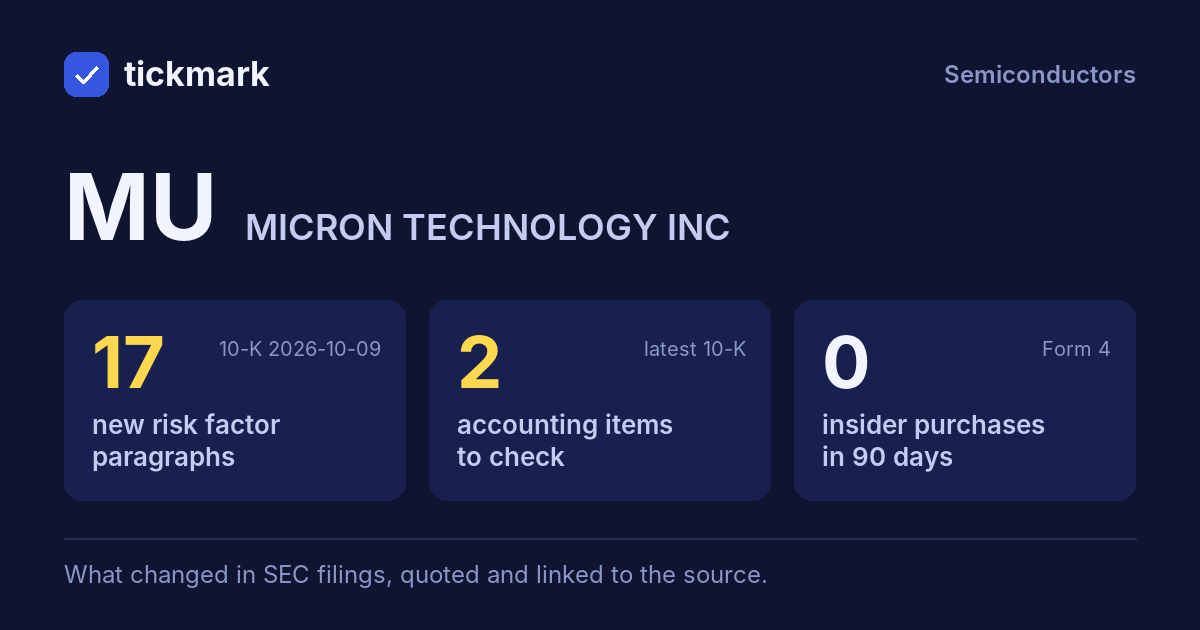
10-K 0000723125-26-000023 (2026-10-09) vs 10-K 0000723125-25-000028 (2025-10-03)
| Section | Compared text | Words now | Changed |
|---|
| Risk Factors | Item 1A | 16,667 |
13.1% |
| MD&A | Item 7 | 5,672 |
32.6% |
| Legal Proceedings | Item 3, via Note 11 – Contingencies | 1,975 |
58.9% |
| Accounting Policies | Item 8, Note 1 – Significant Accounting Policies | 1,953 |
17.0% |
The redline: what was cut and what was added
In each section, the paragraph that changed most, marked against last year's 10-K:
cut words struck through, new words highlighted and underlined.
Risk Factors 302 words changed in this paragraph; it is 35% similar to last year's version.
In 2025, 2026, over half of our total revenue came from our top ten customers. Among our end markets, approximately one-half 60% of our total revenue was concentrated in the data center end market. A disruption in our relationship with any of our top customers or a significant decrease in demand for our data center products, including due to disruptions or delays in the build-out of data centers by our customers and partners, or in the overall data center end market, could adversely affect our business. We could experience fluctuations in our customer base Particularly with respect to data center build outs, supply constraints or the mix of availability issues with respect to any one component have had and may continue to have a broader revenue by customer or end market, as markets and strategies evolve. Demand for our products may fluctuate due to factors beyond our control. Our inability to qualify our products to meet customer or end market requirements could adversely impact our revenue. A meaningful change in inventory strategy by our top customers or in certain end markets could impact our industry bit demand growth outlook. In addition, any consolidation of our customers or consolidation of significant end markets could limit the opportunity for sale of our products. The loss of, or restrictions on impact. For example, our ability to sell to, one or more certain products has been and could be impeded if components necessary for the finished products are not available from third parties. In addition, the build-out of data centers by our major customers or in certain end markets, and partners requires significant energy capacity, water, and capital, and any shortage of these and other necessary resources, any stakeholder opposition to data center development, or any significant reduction delays in orders the build-out of data centers, could impact our future revenue and financial performance. In addition, access to capital for our customers could be constrained, which may cause companies to face difficulties securing financing for large-scale infrastructure projects. These limitations could delay customer and partner deployments or a shift in product mix, could have a material adverse effect on our business, results reduce the scale of operations, or financial condition. See Part II, Item 8. Financial Statements and Supplementary Data, Notes to Consolidated Financial Statements, Note 28. Certain Concentrations.
Source: Item 1A, 10-K 0000723125-26-000023 vs Item 1A, 10-K 0000723125-25-000028
MD&A 186 words changed in this paragraph; it is 30% similar to last year's version.
AI-driven memory and storage demand is accelerating and growth is outpacing industry supply. In 2025, 2026, we benefited continued to benefit from substantial improvements in DRAM pricing, volumes pricing and margins as compared to 2024, margins, reflecting strong demand growth, driven in large part by the continued advancement of AI. During 2025, we shifted a portion of our DRAM supply to The AI-driven growth in the data center has accelerated demand for memory and hyperscale cloud markets storage at a rate greater than our ability and the industry’s ability to meet the strong demand fueled by AI, with emphasis on HBM products, resulting in a revenue mix weighted more prominently toward segments experiencing higher growth. The pivot to higher-growth segments, together with our strong execution, robust overall industry DRAM demand, and constrained supply, increase supply. This has led to decisions on supply allocation that may impact certain customers and end markets. Robust overall DRAM and NAND demand and constrained supply has led to increased pricing and improved the profitability across our DRAM portfolio. In 2025, NAND revenue increased from 2024 on higher bit shipments due to demand growth. The 2025 NAND gross margin percentage increased from 2024 due to cost reductions. We continue to prudently manage our NAND business to ensure we align our supply growth and technology node cadence with our projections of the demand environment.
Source: Item 7, 10-K 0000723125-26-000023 vs Item 7, 10-K 0000723125-25-000028
Accounting Policies 145 words changed in this paragraph; it is 41% similar to last year's version.
Revenue is primarily recognized at a point in time when control of the promised goods is transferred to our customers in at an amount that reflects the consideration we expect to be entitled to in exchange for those goods. Contracts with certain of our customers are generally short-term in duration at fixed, negotiated prices duration. We also have strategic customer agreements structured as take-or-pay agreements, with payment binding commitments for specific contractually enforceable volumes over the multi-year contract terms. Pricing for our contracts is either fixed or periodically negotiated, with the majority of the strategic customer agreements having pricing that is subject to minimum and maximum bands. For all of our contracts, payments are generally due shortly after delivery. We estimate a liability for returns using the expected value method based on historical returns. In addition, we generally offer price protection to our distributors, which is a form of variable consideration that decreases the transaction price. We use the expected value method, based on historical price adjustments and current pricing trends, to estimate the amount of revenue recognized from sales to distributors. Differences between the estimated and actual amounts are recognized as adjustments to revenue.
Source: Item 8, Note 1 – Significant Accounting Policies, 10-K 0000723125-26-000023 vs Item 8, Note 1 – Significant Accounting Policies, 10-K 0000723125-25-000028
Legal Proceedings 93 words changed in this paragraph; it is 35% similar to last year's version.
On November 9, 2023, Yangtze Memory Technologies Company, Ltd. (“YMTC”) May 19, 2025, Netlist filed a patent infringement complaint against Micron Micron, MSP, and MTEC in E.D. Tex. alleging that one of its subsidiaries in U.S. patent is infringed by our HBM products. On March 6, 2026, the E.D. Tex. transferred the case to the U.S. District Court for the Northern District of California (“N.D. Cal.”). The Delaware (“D. Del.”) pursuant to a motion by Micron to dismiss or transfer for improper venue. On July 28, 2025, Netlist filed an additional complaint alleges against Micron, MSP, and MTEC in E.D. Tex. alleging that eight one U.S. patents are patent is infringed by certain of our 3D NAND products. The DIMMs.
Source: Item 3, via Note 11 – Contingencies, 10-K 0000723125-26-000023 vs Item 3, via Note 14 – Contingencies, 10-K 0000723125-25-000028
Every change, by type
Sentences and paragraphs of MU's Risk Factors and MD&A, 10-K 2026-10-09 against 10-K 2025-10-03.
Each links to the text at sec.gov.
Quiet changes are sentences kept from last year with one to four words changed, at least one of them a hedge, a modal or a qualifier
(may, could, will, not, significant, material…). A year or date rolling forward is not counted.
The full word list
adverse, adversely, all, although, anticipate, anticipates, any, approximately, believe, believes, can, cannot, certain, could, expect, expects, generally, however, if, intend, intends, largely, likely, many, material, materially, may, might, most, must, never, no, not, possible, primarily, probable, should, significant, significantly, some, substantial, substantially, unlikely, will, would
AddedRisk Factors
•labor disputes, union activity, work stoppages, or other disruptions at our manufacturing facilities;
Read it in 10-K 2026-10-09 at sec.gov ↗
AddedRisk Factors
•increases in capital expenditures, including start-up or other costs associated with capacity expansions;
Read it in 10-K 2026-10-09 at sec.gov ↗
AddedRisk Factors
•timely complete facility expansions and transitions of products to new fabrication facilities;
Read it in 10-K 2026-10-09 at sec.gov ↗
AddedRisk Factors
•issues arising from cultural, language or compensation differences, and labor unrest;
Read it in 10-K 2026-10-09 at sec.gov ↗
AddedRisk Factors
In 2026, over half of our total revenue came from our top ten customers. Among our end markets, approximately 60% of our total revenue was concentrated in the data center end market. A disruption in our relationship with any of our top customers or a significant decrease in demand for our data center products, including due to disruptions or delays in the build-out of data centers by our customers and partners, or in the overall data center end market, could adversely affect our business. Particularly with respect to data center build outs, supply constraints or availability issues with respect to any one component have had and may continue to have a broader revenue impact. For example, our ability to sell certain products has been and could be impeded if components necessary for the finished products are not available from third parties. In addition, the build-out of data centers by our customers and partners requires significant energy capacity, water, and capital, and any shortage of these and other necessary resources, any stakeholder opposition to data center development, or any delays in the build-out of data centers, could impact our future revenue and financial performance. In addition, access to capital for our customers could be constrained, which may cause companies to face difficulties securing financing for large-scale infrastructure projects. These limitations could delay customer and partner deployments or reduce the scale of
Read it in 10-K 2026-10-09 at sec.gov ↗
AddedRisk Factors
We could experience fluctuations in our customer base or the mix of revenue by customer or end market, as markets and strategies evolve. Demand for our products may fluctuate due to factors beyond our control. Our inability to qualify our products to meet customer or end market requirements could adversely impact our revenue. A meaningful change in inventory strategy by our top customers or in certain end markets could impact our industry bit demand growth outlook. In addition, any consolidation of our customers or consolidation of significant end markets could limit the opportunity for sale of our products. While we have entered into, and expect to continue to enter into, strategic customer agreements with certain customers with specific contractually enforceable volumes over the multi-year contract terms, the nature of these agreements still subjects us to risk. Pricing for our contracts is either fixed or periodically negotiated, with the majority of the strategic customer agreements having pricing that is subject to minimum and maximum bands. In connection with these customer agreements, we have received, and expect to continue to receive, customer deposits and letters of credit. Any failure to perform our obligations under these arrangements could subject us to contractual damages or other financial consequences. These arrangements could also constrain our available supply and limit our flexibility to respond to changes in market conditions, and if customers fail to meet their purchase commitments, we may need to enforce our contractual rights, which could result in litigation or disputes that could adversely affect our business, customer relationships, or both, and any such disputes could have a material adverse effect on our business, results of operations, or financial condition. Further, if we are unable to satisfy customer demand and customers are required to purchase products from our competitors, they may shift immediate and future purchases to such competitors, which could harm our customer relationships and adversely impact our access to certain end markets. Efforts by us and our competitors to align supply to long-term customer agreements could contribute to industry supply exceeding demand if customers were to breach their purchase obligations and if overall demand is lower than anticipated. In addition, customer purchases in excess of production needs to satisfy their obligations under long-term agreements may result in elevated customer inventories. If these conditions materialize, they may cause an oversupplied memory and storage market, downward pressure on pricing, and a material adverse effect on our business, results of operations, or financial condition.
Read it in 10-K 2026-10-09 at sec.gov ↗
AddedRisk Factors
Additionally, AI algorithms or training methodologies may be flawed, and datasets may contain irrelevant, insufficient, or biased information, which can cause errors in outputs. Failures to develop, deploy, or use AI technologies in a safe, responsible, and effective manner, whether by us, our customers, suppliers, partners, or third-party AI providers, could result in product quality issues, operational disruptions, legal liability, regulatory scrutiny, or reputational harm. We manage AI-related risks through our existing cybersecurity, privacy, legal, compliance, information governance, and enterprise risk management processes. However, these processes may not identify or mitigate all risks associated with evolving AI technologies, regulations, and industry practices.
Read it in 10-K 2026-10-09 at sec.gov ↗
AddedRisk Factors
We rely on a large, skilled workforce to operate our semiconductor manufacturing facilities worldwide. A substantial portion of our global production capacity is concentrated in several of our manufacturing facilities, and our wafer fabrication output depends on their continued, uninterrupted operation.
Read it in 10-K 2026-10-09 at sec.gov ↗
AddedRisk Factors
Certain of our employees have formed or joined labor unions, and additional unionization efforts may occur in the future. Labor unions representing a portion of our workforce have been engaged in union organizing and collective bargaining activities, including formal mediations (which, if not successful, could permit strike actions), and public demands for revised incentive structures. Such disputes could escalate rapidly and affect manufacturing output across the industry.
Read it in 10-K 2026-10-09 at sec.gov ↗
AddedRisk Factors
A strike, work stoppage, slowdown, or other labor action at any of our manufacturing facilities could cause significant business interruption, including the temporary or prolonged cessation of production at one or more fabrication lines. Even a brief disruption could result in substantial losses of production volume, reduced manufacturing yields, damage to work-in-process inventory, and delays in fulfilling customer orders. Such disruptions could also impair our ability to meet delivery schedules under strategic customer agreements, which could result in contractual liability, loss of customer confidence, or diversion of customer demand to competing suppliers.
Read it in 10-K 2026-10-09 at sec.gov ↗
AddedRisk Factors
The resolution of labor disputes may require us to increase wages, benefits, or incentive compensation, implement new profit-sharing or bonus programs, or make other concessions, any of which could significantly increase our manufacturing costs. We may also incur substantial costs in connection with labor negotiations, mediation or arbitration proceedings, and related legal or advisory expenses. We may not be able to resolve labor disputes on terms acceptable to us, and any resolution may be materially more costly than our existing compensation arrangements.
Read it in 10-K 2026-10-09 at sec.gov ↗
AddedRisk Factors
We cannot predict whether or when a strike or other work stoppage may occur at our facilities, the duration or severity of any such action, or the extent of any resulting business interruption. Even without actual work stoppage, prolonged labor negotiations, threats of strike action, and related workforce uncertainty may adversely affect employee morale and productivity, increase attrition of skilled employees, complicate our ability to recruit and retain the skilled engineers and technicians essential to our operations, and harm our reputation. Any of the foregoing could have a material adverse effect on our business, results of operations, or financial condition.
Read it in 10-K 2026-10-09 at sec.gov ↗
RewordedRisk Factors
The trading price of our common stock may fluctuate widely due to various factors, including, but not limited to, actual or anticipated fluctuations in our financial condition and operating results, changes in financial forecasts or estimates by us or us, other participants in our markets, including our customers and competitors, changes in financial or other market estimates and ratings by securities and other analysts, margin trading, trading by memory-focused exchange-traded funds, short sales, prediction markets, hedging and derivative transactions involving our common stock, changes in our capital structure, including issuance of additional debt or equity to the public, interest rate changes, regulatory changes, news regarding our products or products of our competitors, market perception regarding certain technologies, and broad market and industry fluctuations.
Read it in 10-K 2026-10-09 at sec.gov ↗
RewordedRisk Factors
In addition to the impact of Our gross margins are dependent upon our average selling prices, as well as our gross margins are dependent, in part, upon continuing decreases in ability to continue decreasing per gigabit manufacturing costs costs, which is primarily achieved through improvements in our manufacturing processes and product designs.
Read it in 10-K 2026-10-09 at sec.gov ↗
RewordedRisk Factors
We have experienced significant volatility in our average selling prices and may continue to experience such volatility in the future. future due to a variety of factors, including imbalances in the supply of and demand for our products, which may be caused by circumstances that are out of our control.
Read it in 10-K 2026-10-09 at sec.gov ↗
RewordedRisk Factors
Increases in If worldwide supply of demand for semiconductor memory and storage, if storage does not accompanied by commensurate increases in demand, could lead to declines in increase or remain stable, average selling prices for our products could decline materially and could materially adversely affect our business, results of operations, or financial condition.
Read it in 10-K 2026-10-09 at sec.gov ↗
RewordedRisk Factors
From time to time, we have because Because of the nature of our business, we have entered, and may in the future, enter into restructure initiatives in order to, among other items, to streamline our operations, increase our synergies, respond to changes in business conditions, our markets, or product offerings, or to centralize certain key functions. functions, and meet other objectives.
Read it in 10-K 2026-10-09 at sec.gov ↗
RewordedRisk Factors
As a result, it may be is difficult to accurately forecast such demand demand, particularly over the longer term, and we may have incurred and expect to continue to incur costs in anticipation of demand that ultimately does may not materialize. materialize or may not be sustained.
Read it in 10-K 2026-10-09 at sec.gov ↗
RewordedRisk Factors
The emergence emergence, maturation, and maturation increasing availability of AI capabilities may also lead to new and/or more sophisticated methods of attack. attack that leverage AI technologies, including AI technologies that have the potential to increase the speed and impact of cyberattacks.
Read it in 10-K 2026-10-09 at sec.gov ↗
RewordedRisk Factors
Although However, AI is a relatively new demand driver for our products, it is evolving rapidly, and the expected timing and amount of investments demand related to AI can change significantly. significantly and may be impacted by many factors.
Read it in 10-K 2026-10-09 at sec.gov ↗
RewordedRisk Factors
Additionally, difficulties in obtaining labor, skilled sub-contractors and other service providers providers, or other resources could result in delays in completion of our construction projects and cost increases, including costs to operate these facilities. facilities, and could impair our ability to meet customer demand and result in loss of market share to competitors.
Read it in 10-K 2026-10-09 at sec.gov ↗
RewordedRisk Factors
From time to time, there have been disruptions in our manufacturing operations as a result of power outages, improperly functioning equipment and facilities, disruptions in supply of raw materials or components, equipment failures, or equipment failures. the lack of availability of water, electricity, or labor resources to support our existing operations or planned expansions.
Read it in 10-K 2026-10-09 at sec.gov ↗
RewordedRisk Factors
In Over the past five fiscal years, annual percentage changes in DRAM and NAND average selling prices have ranged from plus low 30% an increase of approximately 200% to a minus low 50% range. decrease of approximately 50%.
Read it in 10-K 2026-10-09 at sec.gov ↗
RewordedRisk Factors
For example, in December 2024, we entered into direct funding agreements, providing agreements to provide funds for the construction of fab facilities in Idaho and New York, with the United States Department of Commerce (the “Department”) under the Department’s CHIPS Incentives Program established pursuant to the CHIPS Act. Commerce.
Read it in 10-K 2026-10-09 at sec.gov ↗
Quiet changesRisk Factors
Share repurchases could also increase the volatility of the trading price of our stock and will would diminish our cash reserves.
Read it in 10-K 2026-10-09 at sec.gov ↗
AddedMD&A
The evolving industry landscape, characterized by strong long-term customer demand for memory solutions and structurally constrained supply growth, has elevated the strategic importance of memory to our customers’ product roadmaps. As customers increasingly seek to secure committed long-term access to advanced memory technology and committed long-term memory supply, we have experienced increased customer engagement in strategic commitments. In the third and fourth quarters of 2026, we entered into, and expect to continue to enter into, strategic customer agreements. These agreements provide customers with contracted supply assurance and greater pricing visibility, and provide us with greater visibility and improved stability in our business performance.
Read it in 10-K 2026-10-09 at sec.gov ↗
AddedMD&A
Strategic customer agreements are structured as take-or-pay agreements, with binding commitments for specific volumes over the multi-year contract terms. Pricing for our contracts is either fixed or periodically negotiated, with the majority of the strategic customer agreements having pricing that is subject to minimum and maximum bands. We expect gross margins from our strategic customer agreements with price bands, even at floor pricing levels, to yield gross margins meaningfully above our peak quarterly margins in any past cycle. Accordingly, we believe these agreements accelerate the transformation of our business model and will significantly enhance the durability and predictability of our financial performance.
Read it in 10-K 2026-10-09 at sec.gov ↗
AddedMD&A
The change in our effective tax rate for 2026 as compared to 2025 was primarily due to the 15% minimum tax Pillar Two Model Rules (“Pillar Two”). Singapore enacted legislation to implement Pillar Two, effective for us in 2026, which largely offsets the benefit from our Singapore tax incentive arrangements. The change in our effective tax rate for 2025 as compared to 2024 was primarily due to changes in profitability.
Read it in 10-K 2026-10-09 at sec.gov ↗
AddedMD&A
Our primary source of liquidity is cash generated from operations. We also receive significant funding from government assistance and customer deposits associated with strategic customer agreements. In prior years, we have obtained significant financing from capital markets and financial institutions. Cash generated from operations is highly dependent on selling prices for our products, which can vary significantly from period to period.
Read it in 10-K 2026-10-09 at sec.gov ↗
AddedMD&A
In 2026, we executed strategic customer agreements with a number of customers. These agreements included binding commitments for specific contractually enforceable volumes over the multi-year contract terms. Strategic customer agreements often include substantial customer deposits that are returned to the customer if the customer meets the minimum purchase commitments. If the customer does not meet the minimum purchase commitments, we may retain all or a portion of the deposit. In connection with these strategic customer agreements, we received cash deposits of $12.75 billion in 2026. Nearly all of the deposits are scheduled to be repaid between 2029 and 2031. Certain strategic customer agreements also include terms requiring our customers to maintain letters of credit with third-party financial institutions. Our right to access such letters of credit is contingent upon the occurrence of specified events of default or breach by our customers. Letters of credit are not recognized as revenue unless an event of default or breach has occurred. The aggregate amount of letters of credit issued, or contractually committed to be issued, by third-party financial institutions was $7 billion as of September 3, 2026. In the event of customer default or breach, our contractual recovery rights may include proceeds from letters of credit, rights to decrement customer deposits and other contractual remedies.
Read it in 10-K 2026-10-09 at sec.gov ↗
AddedMD&A
In 2026, we launched first production starts of our 1α (1-alpha) DDR4 technology in our Manassas, Virginia, fab, which will add to our capability to support the legacy product needs of our customers in auto, industrial, medical, aerospace and defense markets.
Read it in 10-K 2026-10-09 at sec.gov ↗
AddedMD&A
In August 2026, we announced the establishment of Micron Research Labs, a long-horizon research institution headquartered in Boise, Idaho, supported by a planned investment of approximately $10 billion over the next decade to advance memory, compute and semiconductor manufacturing technologies.
Read it in 10-K 2026-10-09 at sec.gov ↗
AddedMD&A
•India: Our assembly and test facility in Gujarat commenced commercial shipments and started ramping production in 2026;
Read it in 10-K 2026-10-09 at sec.gov ↗
AddedMD&A
•Japan: We broke ground in July 2026 on a new cleanroom project at our Hiroshima manufacturing facility as part of our ongoing modernization efforts to support future DRAM technology transitions, including HBM and other AI-driven memory products. The project will expand available cleanroom space and we expect initial output in late calendar 2028, enhancing our advanced memory manufacturing capabilities and supporting future customer demand;
Read it in 10-K 2026-10-09 at sec.gov ↗
AddedMD&A
•Taiwan: We are modernizing and expanding our existing production capacity for DRAM and HBM products to meet rising market demand. In March 2026, we completed the acquisition of a wafer fabrication facility in Tongluo, Miaoli County, Taiwan, from Powerchip Semiconductor Manufacturing Corporation for cash consideration of $1.8 billion. We expect this site to support meaningful product shipments from the existing fab beginning in mid-calendar 2027. Adding to the existing fab, we have begun construction of a similar-sized second cleanroom at this site.
Read it in 10-K 2026-10-09 at sec.gov ↗
AddedMD&A
In certain countries outside of the United States, we receive or expect to receive, government incentives related to our investments. The amounts of these government incentives generally offset a portion of our planned investments and require us to meet certain conditions in order to receive such incentives.
Read it in 10-K 2026-10-09 at sec.gov ↗
RemovedMD&A
Throughout 2024, we experienced substantial improvements in pricing and margins due to improving market conditions as compared to 2023. Increasing demand growth, driven in part by deployment of AI and mostly normal customer inventories, combined with industry-wide supply discipline, resulted in an industry supply and demand balance that substantially improved from downturn conditions in memory and storage markets during 2023. In connection with improved market conditions in 2024, we reinstated our bonuses and phased out certain other temporary cost-saving measures that were implemented in 2023.
Read it in 10-K 2025-10-03 at sec.gov ↗
RemovedMD&A
In 2023, China’s Cyberspace Administration (the “CAC”) conducted a cybersecurity review of our products sold in China and decided that our products presented a cybersecurity risk. The CAC determined that critical information infrastructure operators in China may not purchase Micron products. The CAC decision has impacted our business, particularly in the domestic data center and networking markets in China, and we have been working to mitigate that impact.
Read it in 10-K 2025-10-03 at sec.gov ↗
RemovedMD&A
Inventory NRV Write-Downs: Our consolidated gross margin was impacted by charges in 2023 to write down inventories to their estimated NRV as a result of declines in average selling prices for both DRAM and NAND. As charges to write down inventories are recorded in advance of when inventories are sold, costs of goods sold in subsequent periods were lower than they otherwise would be. The impact of inventory NRV write-downs for each period reflects (1) inventory write-downs in that period, offset by (2) lower costs in that period on the sale of inventory written down in prior periods. The impacts of inventory NRV write-downs are summarized below:
Read it in 10-K 2025-10-03 at sec.gov ↗
RemovedMD&A
For the year ended 2025 2024 2023 Provision to write down inventory to NRV $ $ — $ (1,831) Lower costs from sale of inventory written down in prior periods — 987 844 $ $ 987 $ (987)
Read it in 10-K 2025-10-03 at sec.gov ↗
RemovedMD&A
The change in our effective tax rate for 2025 as compared to 2024, and for 2024 as compared to 2023, were primarily due to changes in profitability. Despite a consolidated pre-tax loss on a worldwide basis in 2023, we had taxes payable in certain geographies due to minimum taxable income reportable in those geographies.
Read it in 10-K 2025-10-03 at sec.gov ↗
RemovedMD&A
On July 4, 2025, the One Big Beautiful Bill Act (“OBBBA”) was enacted, introducing broad changes to the U.S. tax code, including modifications to corporate and international tax provisions, which primarily are effective for us beginning in 2026 and 2027. The aggregate impact of the OBBBA remains uncertain. We will continue to monitor future developments, including regulatory guidance and interpretations, which could have a material impact. Further changes in the tax laws of foreign jurisdictions could arise as a result of the base erosion and profit-shifting project, including Pillar Two Model Rules (“Pillar Two”), undertaken by the Organisation for Economic Co-operation and Development. On November 27, 2024, Singapore enacted legislation to implement Pillar Two, which will apply to us starting in 2026. We continue to monitor for additional guidance and legislative changes related to Pillar Two in the jurisdictions where we operate.
Read it in 10-K 2025-10-03 at sec.gov ↗
RemovedMD&A
•India: our construction is progressing for the assembly and test facility in Gujarat to address demand in the latter half of this decade;
Read it in 10-K 2025-10-03 at sec.gov ↗
RemovedMD&A
•Japan: we are modernizing our Hiroshima manufacturing facility to support the production of DRAM using EUV lithography;
Read it in 10-K 2025-10-03 at sec.gov ↗
RemovedMD&A
•Taiwan: we are modernizing our production capacity for DRAM and HBM products to meet rising market demand.
Read it in 10-K 2025-10-03 at sec.gov ↗
RemovedMD&A
Goodwill: We test goodwill for impairment in our fourth quarter each year, or more frequently if indicators of an impairment exist, to determine whether it is more likely than not that the fair value of the reporting unit with goodwill is less than its carrying value. For reporting units for which this assessment concludes that it is more likely than not that the fair value is more than its carrying value, goodwill is considered not impaired, and we are not required to perform the quantitative goodwill impairment test. Qualitative factors considered in this assessment include industry and market considerations, overall financial performance, and other relevant events and factors affecting the fair value of the reporting unit. For reporting units for which this assessment concludes that it is more likely than not that the fair value is below the carrying value, goodwill is tested for impairment by determining the fair value of each reporting unit and comparing it to the carrying value of the net assets assigned to the reporting unit. If the fair value of the reporting unit exceeds its carrying value, goodwill is considered not impaired. If the carrying value of the reporting unit exceeds its fair value, we recognize an impairment loss up to the difference between the carrying value and implied fair value. We recognized a charge of $101 million in 2023 to impair all of the goodwill assigned to our former Storage Business Unit reporting unit based on our quantitative assessment for impairment. As a result of reorganizing our segments in the fourth quarter of 2025, we performed a quantitative goodwill impairment assessment for each of our reporting units immediately before and after our business unit reorganization. We concluded based on both our pre- and post-reorganization impairment tests that goodwill was not impaired.
Read it in 10-K 2025-10-03 at sec.gov ↗
RemovedMD&A
Determining when to test for impairment, the reporting units, the assets and liabilities of the reporting unit, and the fair value of the reporting unit requires significant judgment and involves the use of significant estimates and assumptions. These estimates and assumptions include revenue growth rates, forecasted manufacturing costs, and other expenses and are developed as part of our long-range planning process. The same estimates are used in business planning, forecasting, and capital budgeting as part of our long-term manufacturing capacity analysis. These estimates and assumptions are used to calculate projected future cash flows for the reporting unit, which are discounted using a risk-adjusted rate to estimate a fair value. The discount rate requires determination of appropriate market comparables. We base fair value estimates on assumptions we believe to be reasonable but that are unpredictable and inherently uncertain. Actual future results may differ from those estimates. We assess the reasonableness of our methodology, forecasts, and assumptions by comparing the aggregate calculated fair value of our reporting units to our market capitalization.
Read it in 10-K 2025-10-03 at sec.gov ↗
RewordedMD&A
The increase in cash provided by operating activities for 2025 2026 as compared to 2024 2025 was primarily due to higher net income in 2025 2026, adjusted for non-cash items, the effect of changes an increase in receivables and accounts payable and accrued expenses, expenses mostly related to income and a decrease in inventory, partially offset by a decrease other taxes and salaries, wages, and benefits, an increase in other current liabilities. liabilities resulting mainly from higher consideration payable to customers for pricing adjustments, and an increase in noncurrent liabilities largely due to higher noncurrent income taxes payable related to the implementation of Pillar Two.
Read it in 10-K 2026-10-09 at sec.gov ↗
RewordedMD&A
For 2024, 2025, net cash used for financing activities consisted primarily of $1.90 $4.62 billion of repayments of debt, which included the prepayment of the 2024 Term Loan A and the 2025 Term Loan A borrowings, $513 debt; $522 million for the payments of dividends to shareholders, $300 shareholders; and $340 million for the acquisition repurchases of 3.2 million shares of our common stock under our share repurchase authorization, and $149 million of payments for withholdings on equipment purchase contracts, employee equity awards; partially offset by approximately $1.00 $4.43 billion of proceeds from the issuance of the 2031 Notes. debt.
Read it in 10-K 2026-10-09 at sec.gov ↗
RewordedMD&A
For 2024, net cash used for financing activities consisted primarily of $1.90 billion of repayments of debt, which included the prepayment of the 2024 Term Loan A and the 2025 Term Loan A borrowings, debt; $513 million for the payments of dividends to shareholders, shareholders; $300 million for the acquisition of 3.2 million shares of our common stock under our share repurchase authorization, authorization; and $149 $233 million for the repurchases of payments common stock for withholdings on equipment purchase contracts, employee equity awards; partially offset by approximately $1.00 billion of proceeds from the issuance of the 2031 Notes. debt.
Read it in 10-K 2026-10-09 at sec.gov ↗
RewordedMD&A
Our In 2018, our Board of Directors has authorized the discretionary repurchase of up to $10 billion of our outstanding common stock through open-market purchases, block trades, privately-negotiated transactions, derivative transactions, and/or pursuant to Rule 10b5-1 trading plans. plans and on October 8, 2026 our Board of Directors authorized an increase in the maximum amount of discretionary repurchases of our outstanding common stock to be made from December 9, 2026 to $35.16 billion.
Read it in 10-K 2026-10-09 at sec.gov ↗
RewordedMD&A
The effect of Singapore legislation surrounding Pillar Two largely offset our Singapore tax incentive arrangements, resulting in a net benefit from tax incentive arrangements reduced for our tax provision of $2.21 billion (benefiting our diluted earnings per share by $1.93) and $1.05 billion (benefiting our diluted earnings per share by $0.93) for 2025. 2026 and 2025, respectively.
Read it in 10-K 2026-10-09 at sec.gov ↗
RewordedMD&A
For 2024, 2026, net cash used for investing activities consisted primarily of $8.39 $32.88 billion of expenditures for property, plant, and equipment, and $205 million of net outflows from purchases, maturities, and sales of available-for-sale securities, $30.71 billion of expenditures for property, plant, and equipment, and $1.05 billion of purchases of non-marketable equity securities, partially offset by $315 million $3.32 billion of proceeds from government incentives to offset capital expenditures.
Read it in 10-K 2026-10-09 at sec.gov ↗
RewordedMD&A
DRAM margins Margins improved primarily due to increases in average selling prices, an increased prices and also benefited from favorable mix of higher-margin products, including HBM, and manufacturing cost reductions driven by improvements in product and process technology. due to continued strong execution.
Read it in 10-K 2026-10-09 at sec.gov ↗
RewordedMD&A
Our income tax (provision) benefit consisted of the following:For the year ended 2026 2025 2024 2023 Income before taxes $ 99,671 $ 9,654 $ 1,240 Income tax (provision) benefit (14,761) (1,124) (451) Effective tax rate 14.8 % 11.6 % 36.4 %
Read it in 10-K 2026-10-09 at sec.gov ↗
RewordedMD&A
Our consolidated gross margin has been impacted by the factors described in the section titled “Industry Conditions” above Conditions—Memory and the effects of 2023 inventory write-downs on our 2024 and 2023 gross margin, as detailed in the table below. Storage Demand” above.
Read it in 10-K 2026-10-09 at sec.gov ↗
RewordedMD&A
The pivot to higher-growth segments, together with our strong execution, robust Robust overall industry DRAM demand, and NAND demand and constrained supply, supply has led to increased pricing and improved the profitability across our DRAM portfolio.
Read it in 10-K 2026-10-09 at sec.gov ↗
RewordedMD&A
We estimate capital expenditures for property, plant, and equipment, net of proceeds from government incentives, to be approximately $4.5 $11.5 billion in the first quarter of 2026. 2027, approximately $25 billion in the first six months of 2027, and higher in the second half of 2027.
Read it in 10-K 2026-10-09 at sec.gov ↗
RewordedMD&A
On In June 11, 2025, we entered into amendments to the direct funding agreements to add a second planned fab in Boise, Idaho, and allocate certain award funding to the second planned Idaho fab from the $6.1 billion grants previously awarded to under the second planned Idaho fab. December 2024 direct funding agreements.
Read it in 10-K 2026-10-09 at sec.gov ↗