Paragraph 36 · 46% changed
Every version of it
Screener
/
SEC EDGAR
/CIK 0000717423
/10-K filed Feb 25, 2026, compared with Feb 27, 2025
/Numbers from the XBRL of the 10-Ks
NYSE
Energy · Oil & Gas Production
Murphy Oil Corp MUR
The 10-K against last year's
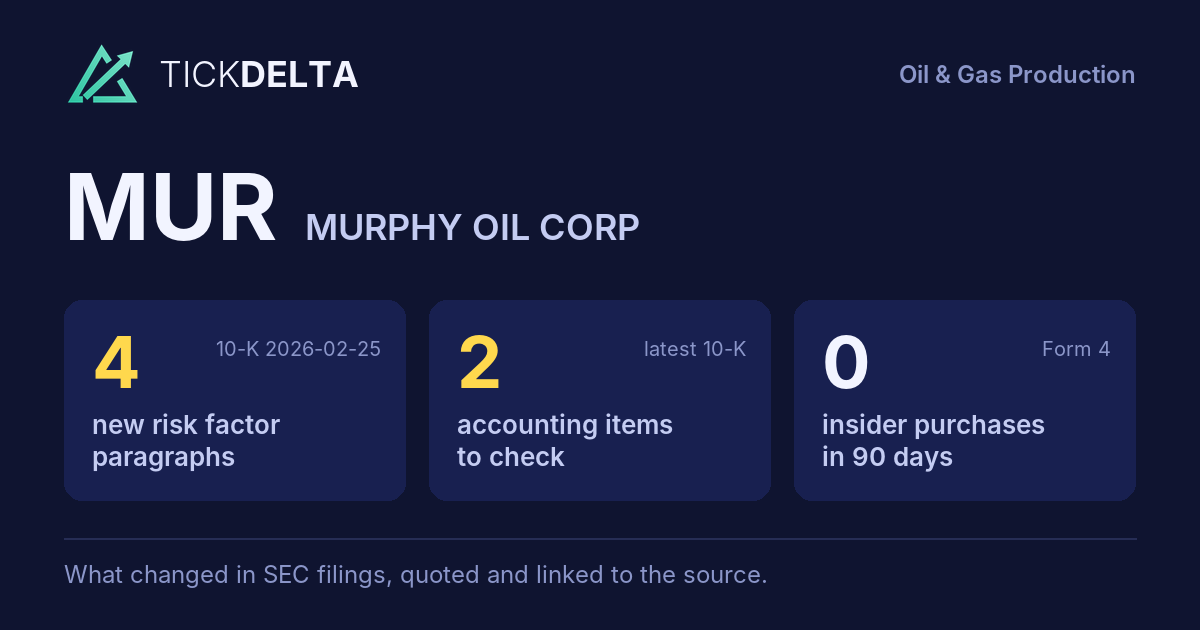
154 changes: 24 added, 16 removed, 109 reworded, 5 quiet changes
10-K Feb 25, 2026 vs Feb 27, 2025
Risk Factors
13.0%
of the text changed · 9,568 words now · 4 new paragraphs, 2 gone
MD&A
24.5%
of the text changed · 10,355 words now · 20 new paragraphs, 14 gone
10-K 0001628280-26-011709 (Feb 25, 2026) vs 10-K 0000717423-25-000006 (Feb 27, 2025) Not compared: Legal Proceedings, Accounting Policies.
Every paragraph, and how much of it changed
One bar per paragraph, in the order of the 10-K. Height and colour show the share of its words not in the closest paragraph a year earlier; the tallest bars are new paragraphs.
Risk Factors
127 paragraphs · 4 new · 48 reworded · 2 gone · 10-K Feb 25, 2026 against Feb 27, 2025
New paragraph
Reworded (5% of its words or more)
Same or nearly
Paragraph 63 · 44% changed
Every version of it
The Company primarily uses hydraulic fracturing in the Eagle Ford Shale in South Texas and in the Kaybob Duvernay and the Tupper Montney in Western Canada. Texas law imposes permitting, disclosure, disposal and well construction requirements on hydraulic fracturing operations, as well as public disclosure of certain information regarding the components used in the hydraulic fracturing process. Regulations in the provinces of British Columbia and Alberta also govern various aspects of hydraulic fracturing activities under their jurisdictions. It is possible that Texas, other states in which we may conduct fracturing in the future, the U.S., Canadian provinces and certain municipalities may adopt further laws or regulations which could render the process unlawful, less effective or drive up its costs. If any such action is taken in the future, the Company’s production levels could be adversely affected, or its costs of drilling and completion could be increased. Once new laws and/or regulations have been enacted and adopted, the costs of compliance are appraised.
Paragraph 33 · 32% changed
Every version of it
The Company drills exploratory wells which subject its exploration and production E&P operating results to exposure to dry hole expense, which has in the past, and may in the future, adversely affect our results of operations. The Company plans to continue assessing exploration activities as part of its overall strategy. In 2024, 2025, the Company participated in four five exploration wells. The Lac Da Hong-1X (Pink Camel), Block 15-1/05 and the Hai Su Vang-1X Vang-2X (Golden Sea Lion), Block 15/2-17 15-2/17 exploration wells, in Vietnam, resulted in commercial discoveries, while the Civette-1X (Block CI-502) exploration well, located in offshore Vietnam, and Côte d’Ivoire, did not encounter commercial hydrocarbons. Subsequent to year end, the non-operated Ocotillo Banjo #1 (Mississippi Canyon 40) 385) and Cello #1 (Mississippi Canyon 385) exploration well, located wells, in the Gulf of America, resulted in commercial discoveries while the Sebastian #1 (Mississippi Canyon 387) discoveries. The Company’s 2026 exploration and non-operated Orange #1 (Mississippi Canyon 216) wells, located in the Gulf appraisal program capital expenditures guidance of America, did not encounter commercial hydrocarbons. Additionally, the Company expensed previously suspended costs associated with the Hoffe Park #1 (Mississippi Canyon 166) well which was determined to be non-commercial. The Company has budgeted $145 $320 million for its 2025 exploration program, which includes drilling three wells in Vietnam and two wells in Vietnam, two Côte d’Ivoire. One of these exploration wells in the Gulf of America, Côte d’Ivoire, Caracal-1X (Block CI-102), was completed in February 2026, and one well in Côte d’Ivoire. will be plugged and abandoned as a dry hole after encountering non-commercial hydrocarbon shows.
Paragraph 74 · 31% changed
Every version of it
Murphy usually must spend and risk a significant amount of capital to find and develop reserves before revenue is generated from production. Although most capital needs are funded from operating cash flow, the timing of cash flows from operations and capital funding requirements may not always coincide, and the levels of cash flow generated by operations may not fully cover capital funding requirements, especially in periods of low commodity prices. Therefore, the Company maintains financing arrangements with lending institutions to meet certain funding needs. The Company periodically renews these financing arrangements based on foreseeable financing needs or as they expire. Subsequent to year end, in January 2026, the Company entered into an amendment (the “Second Amendment”) to its credit agreement governing a $2.00 billion senior unsecured guaranteed revolving credit facility (Amended RCF) with a maturity date in January 2031. As of December 31, 2025, the Company had $100 million outstanding borrowings under the previous senior unsecured guaranteed revolving credit facility (RCF). See Note F for further details on the RCF.
Paragraph 99 · 29% changed
Every version of it
We are subject to income- and non-income-based taxes in the U.S. under federal, state and local jurisdictions and in the foreign jurisdictions in which we operate. Tax laws and regulations, or their interpretation, and administrative practices in various jurisdictions may be subject to significant change, with or without advance notice, due to economic, political and other conditions, and significant judgment is required in evaluating and estimating our provision and accruals for these taxes. Our tax liabilities could be affected by numerous factors, such as changes in tax, accounting and other laws, regulations, administrative practices, principles and interpretations, the mix and level of earnings in a given taxing jurisdiction or our ownership or capital structure. In recent years, multiple domestic and international tax proposals have been introduced that, if enacted into law would impose greater tax burdens on certain multinational enterprises. For example, the Organization for Economic Co-operation and Development (OECD) continues to advance proposals or guidance in international taxation, including the establishment of model rules for a new 15% global minimum tax on certain multinational enterprises, also known as Pillar Two. Many countries have implemented or are In June 2025, the U.S. reached an understanding with the Group of Seven (G7) members that the U.S. would remove a proposed retaliatory tax from the OBBBA in exchange for an exclusion of U.S. parented groups from certain aspects of Pillar Two. This understanding was non-binding and included only the process G7 states. However, the OECD released significant administrative guidance on January 5, 2026, which is intended to resolve uncertainty regarding how Pillar Two will apply to U.S. parented groups. In this regard, the administrative guidance introduced a safe harbor that should effectively deem the U.S. tax system to be compliant with Pillar Two and therefore exempt U.S. parented groups from the scope of implementing these model rules. certain taxes, which should simplify ongoing compliance for affected enterprises. While we do not currently expect that Pillar Two will have a material impact on our results of operations, we continue to monitor the impact as countries implement legislation and the OECD provides additional guidance. In addition, guidance and countries implement legislation. Further, the IRA, OBBBA, enacted in the U.S. on August 16, 2022, imposes several new taxes that were effective in 2023, including, but not limited to, July 4, 2025, includes a 15% corporate book minimum broad range of tax for taxpayers with adjusted financial statement income exceeding an average of $1 billion over a three-year testing period and a 1% excise tax on certain stock repurchases made after December 31, 2022. reform provisions affecting corporations. We continue to analyze the potential impact of the IRA OBBBA on our consolidated financial statements and to monitor guidance issued by the U.S. Department of the Treasury. It is possible that further changes may be enacted to U.S. and international tax rules and regulations, including the U.S. corporate tax system, which could have a material effect on our consolidated cash taxes in the future.
Paragraph 106 · 28% changed
Every version of it
A digital infrastructure failure or a successfully executed, undetected cyberattack could significantly disrupt business operations. For example, it might lead to downtime, revenue loss, diversion of management or work force attention, and increased costs for remediation. Additionally, the compromise, theft, or unauthorized release of critical data could damage our reputation, weaken our competitive edge, negatively impact our financial stability stability, and expose us to legal risk in multiple jurisdictions. Due to the sophisticated nature of cyberattacks, breaches to our systems could go undetected for a prolonged period of time. Nevertheless, even Additionally, we are increasingly vulnerable to cybersecurity incidents originating within our supply chain, including compromises of third-party vendors, software providers, cloud platforms, and other external partners whose environments we depend on. Even if we successfully defend our own digital infrastructure, we also rely weaknesses or breaches within these third-party environments could compromise our data, disrupt our operations, harm our individuals, have a material financial impact on the business, or create attack paths into our customers and suppliers, with whom we may share data and services, to protect their digital infrastructure and services from cybersecurity incidents. systems.
Paragraph 110 · 26% changed
Every version of it
The use of AI can lead to unintended consequences, including the unauthorized use or disclosure of confidential and proprietary information, or generating content that appears correct but is factually inaccurate, misleading, or otherwise flawed, which could expose us to risks related to inaccuracies or errors in the output of such technologies. Additionally, emerging forms of autonomous (or semi-autonomous) AI tools, such as AI agents capable of independently executing tasks, interacting with systems, or initiating actions, present additional risks such as unauthorized access, sensitive data leakage or unintended operational impacts. The use of unapproved AI tools within the organization further increases the risk of security incidents, compliance failures, and exposure of sensitive information. It is not possible to predict all of the risks related to the use of AI, machine learning learning, and automated decision making, automation, and developments in the regulatory frameworks governing the use of such technologies and in related stakeholder expectations may adversely affect our ability to develop and use such technologies or subject us to liability.
Paragraph 114 · 25% changed
Every version of it
In March 2024, the SEC adopted rules requiring disclosure of a wide range of climate change-related information, including, among other things, companies’ climate change risk management; short-, medium-, and long-term climate-related financial risks; and disclosure of Scope 1 and Scope 2 emissions. Similar laws and regulations regarding climate change-related disclosures have been proposed or enacted in other jurisdictions, including California and the European Union. The SEC’s climate disclosure rules have been stayed pending legal challenges, challenges and further action by the SEC, but implementation of the rules as finalized could be costly and time consuming. On February 11, 2025, the SEC notified the U.S. Court of Appeals of a statement issued by the SEC’s Acting Chairman regarding, among other things, the fact that the majority of current SEC Commissioners had previously voted against adopting the rules, and requested that the U.S. Court of Appeals not schedule the case for argument to provide time for the SEC to deliberate and determine the appropriate next steps in the cases.
Paragraph 36 · 46% changed
Every version of it
10-K Feb 27, 2025Murphy continually depletes its oil and natural gas reserves as production occurs. To sustain and grow its business, the Company must successfully replace the oil and natural gas it produces with additional reserves. Therefore, it must create and maintain a portfolio of good prospects for future reserves additions and production. The Company must find, acquire or develop, and produce reserves at a competitive cost to be successful in the long-term. Murphy’s ability to operate profitably in the exploration and production business, therefore, is dependent on its ability to find (and/or acquire), develop and produce oil and natural gas reserves at costs that are less than the realized sales price for these products.
10-K Feb 25, 2026
on its ability to find (and/or acquire), develop and produce oil and natural gas reserves at costs that are less than the realized sales price for these products.
Paragraph 63 · 44% changed
Every version of it
10-K Feb 27, 2025
The Company primarily uses hydraulic fracturing in the Eagle Ford Shale in South Texas and in Kaybob Duvernay and Tupper Montney in Western Canada. Texas law imposes permitting, disclosure, disposal and well construction requirements on hydraulic fracturing operations, as well as public disclosure of certain information regarding the components used in the hydraulic fracturing process. Regulations in the provinces of British Columbia and Alberta also govern various aspects of hydraulic fracturing activities under their jurisdictions. It is possible that Texas, other states in which we may conduct fracturing in the future, the U.S., Canadian provinces and certain municipalities may adopt further laws or regulations which could render the process unlawful, less effective or drive up its costs. If any such action is taken in the future, the Company’s production levels could be adversely affected, or its costs of drilling and completion could be increased. Once new laws and/or regulations have been enacted and adopted, the costs of compliance are appraised.
10-K Feb 25, 2026
The Company primarily uses hydraulic fracturing in the Eagle Ford Shale in South Texas and in the Kaybob Duvernay and the Tupper Montney in Western Canada. Texas law imposes permitting, disclosure, disposal and well construction requirements on hydraulic fracturing operations, as well as public disclosure of certain information regarding the components used in the hydraulic fracturing process. Regulations in the provinces of
Paragraph 33 · 32% changed
Every version of it
10-K Feb 27, 2025
The Company drills exploratory wells which subject its exploration and production operating results to exposure to dry hole expense, which has in the past, and may in the future, adversely affect our results of operations. The Company plans to continue assessing exploration activities as part of its overall strategy. In 2024, the Company participated in four exploration wells. The Hai Su Vang-1X (Golden Sea Lion), Block 15/2-17 exploration well, located in offshore Vietnam, and the non-operated Ocotillo #1 (Mississippi Canyon 40) exploration well, located in the Gulf of America, resulted in commercial discoveries while the Sebastian #1 (Mississippi Canyon 387) and non-operated Orange #1 (Mississippi Canyon 216) wells, located in the Gulf of America, did not encounter commercial hydrocarbons. Additionally, the Company expensed previously suspended costs associated with the Hoffe Park #1 (Mississippi Canyon 166) well which was determined to be non-commercial. The Company has budgeted $145 million for its 2025 exploration program, which includes drilling two wells in Vietnam, two wells in the Gulf of America, and one well in Côte d’Ivoire.
10-K Feb 25, 2026
The Company drills exploratory wells which subject its E&P operating results to exposure to dry hole expense, which has in the past, and may in the future, adversely affect our results of operations. The Company plans to continue assessing exploration activities as part of its overall strategy. In 2025, the Company participated in five exploration wells. The Lac Da Hong-1X (Pink Camel), Block 15-1/05 and the Hai Su Vang-2X (Golden Sea Lion), Block 15-2/17 exploration wells, in Vietnam, resulted in commercial discoveries, while the Civette-1X (Block CI-502) exploration well, in Côte d’Ivoire, did not encounter commercial hydrocarbons. Subsequent to year end, the Banjo #1 (Mississippi Canyon 385) and Cello #1 (Mississippi Canyon 385) exploration wells, in the Gulf of America, resulted in commercial discoveries. The Company’s 2026 exploration and appraisal program capital expenditures guidance of $320 million includes drilling three wells in Vietnam and two wells in Côte d’Ivoire. One of these exploration wells in Côte d’Ivoire, Caracal-1X (Block CI-102), was completed in February 2026, and will be plugged and abandoned as a dry hole after encountering non-commercial hydrocarbon shows.
Paragraph 74 · 31% changed
Every version of it
10-K Feb 27, 2025
Murphy usually must spend and risk a significant amount of capital to find and develop reserves before revenue is generated from production. Although most capital needs are funded from operating cash flow, the timing of cash flows from operations and capital funding requirements may not always coincide, and the levels of cash flow generated by operations may not fully cover capital funding requirements, especially in periods of low commodity prices. Therefore, the Company maintains financing arrangements with lending institutions to meet
10-K Feb 25, 2026
Murphy usually must spend and risk a significant amount of capital to find and develop reserves before revenue is generated from production. Although most capital needs are funded from operating cash flow, the timing of cash flows from operations and capital funding requirements may not always coincide, and the levels of cash flow generated by operations may not fully cover capital funding requirements, especially in periods of low commodity prices. Therefore, the Company maintains financing arrangements with lending institutions to meet certain funding needs. The Company periodically renews these financing arrangements based on foreseeable financing needs or as they expire. Subsequent to year end, in January 2026, the Company entered into an amendment (the “Second Amendment”) to its credit agreement governing a $2.00 billion senior unsecured guaranteed revolving credit facility (Amended RCF) with a maturity date in January 2031. As of December 31, 2025, the Company had $100 million outstanding borrowings under the previous senior unsecured guaranteed revolving credit facility (RCF). See Note F for further details on the RCF.
Paragraph 99 · 29% changed
Every version of it
10-K Feb 27, 2025
We are subject to income- and non-income-based taxes in the U.S. under federal, state and local jurisdictions and in the foreign jurisdictions in which we operate. Tax laws and regulations, or their interpretation, and administrative practices in various jurisdictions may be subject to significant change, with or without advance notice, due to economic, political and other conditions, and significant judgment is required in evaluating and estimating our provision and accruals for these taxes. Our tax liabilities could be affected by numerous factors, such as changes in tax, accounting and other laws, regulations, administrative practices, principles and interpretations, the mix and level of earnings in a given taxing jurisdiction or our ownership or capital structure. In recent years, multiple domestic and international tax proposals have been introduced that, if enacted into law would impose greater tax burdens on certain multinational enterprises. For example, the Organization for Economic Co-operation and Development (OECD) continues to advance proposals or guidance in international taxation, including the establishment of model rules for a new 15% global minimum tax on certain multinational enterprises, also known as Pillar Two. Many countries have implemented or are in the process of implementing these model rules. While we do not currently expect that Pillar Two will have a material impact on our results of operations, we continue to monitor the impact as countries implement legislation and the OECD provides additional guidance. In addition, the IRA, enacted in the U.S. on August 16, 2022, imposes several new taxes that were effective in 2023, including, but not limited to, a 15% corporate book minimum tax for taxpayers with adjusted financial statement income exceeding an average of $1 billion over a three-year testing period and a 1% excise tax on certain stock repurchases made after December 31, 2022. We continue to analyze the potential impact of the IRA on our consolidated financial statements and to monitor guidance issued by the U.S. Department of the Treasury. It is possible that further changes may be enacted to U.S. and international tax rules and regulations, including the U.S. corporate tax system, which could have a material effect on our consolidated cash taxes in the future.
10-K Feb 25, 2026
We are subject to income- and non-income-based taxes in the U.S. under federal, state and local jurisdictions and in the foreign jurisdictions in which we operate. Tax laws and regulations, or their interpretation, and administrative practices in various jurisdictions may be subject to significant change, with or without advance notice, due to economic, political and other conditions, and significant judgment is required in evaluating and estimating our provision and accruals for these taxes. Our tax liabilities could be affected by numerous factors, such as changes in tax, accounting and other laws, regulations, administrative practices, principles and interpretations, the mix and level of earnings in a given taxing jurisdiction or our ownership or capital structure. In recent years, multiple domestic and international tax proposals have been introduced that, if enacted into law would impose greater tax burdens on certain multinational enterprises. For example, the Organization for Economic Co-operation and Development (OECD) continues to advance proposals or guidance in international taxation, including the establishment of a global minimum tax on certain multinational enterprises, also known as Pillar Two. In June 2025, the U.S. reached an understanding with the Group of Seven (G7) members that the U.S. would remove a proposed retaliatory tax from the OBBBA in exchange for an exclusion of U.S. parented groups from certain aspects of Pillar Two. This understanding was non-binding and included only the G7 states. However, the OECD released significant administrative guidance on January 5, 2026, which is intended to resolve uncertainty regarding how Pillar Two will apply to U.S. parented groups. In this regard, the administrative guidance introduced a safe harbor that should effectively deem the U.S. tax system to be compliant with Pillar Two and therefore exempt U.S. parented groups from the scope of certain taxes, which should simplify ongoing compliance for affected enterprises. While we do not currently expect that Pillar Two will have a material impact on our results of operations, we continue to monitor the impact as the OECD provides additional guidance and countries implement legislation. Further, the OBBBA, enacted in the U.S. on July 4, 2025, includes a broad range of tax reform provisions affecting corporations. We continue to analyze the potential impact of the OBBBA on
Paragraph 106 · 28% changed
Every version of it
10-K Feb 27, 2025
A digital infrastructure failure or a successfully executed, undetected cyberattack could significantly disrupt business operations. For example, it might lead to downtime, revenue loss, diversion of management or work force attention, and increased costs for remediation. Additionally, the compromise, theft, or unauthorized release of critical data could damage our reputation, weaken our competitive edge, negatively impact our financial stability and expose us to legal risk in multiple jurisdictions. Due to the nature of cyberattacks, breaches to our systems could go undetected for a prolonged period of time. Nevertheless, even if we successfully defend our own digital infrastructure, we also rely on our customers and suppliers, with whom we may share data and services, to protect their digital infrastructure and services from cybersecurity incidents.
10-K Feb 25, 2026
A digital infrastructure failure or a successfully executed, undetected cyberattack could significantly disrupt business operations. For example, it might lead to downtime, revenue loss, diversion of management or work force attention, and increased costs for remediation. Additionally, the compromise, theft, or unauthorized release of critical data could damage our reputation, weaken our competitive edge, negatively impact our financial stability, and expose us to legal risk in multiple jurisdictions. Due to the sophisticated nature of cyberattacks, breaches to our systems could go undetected for a prolonged period of time. Additionally, we are increasingly vulnerable to cybersecurity incidents originating within our supply chain, including compromises of third-party vendors, software providers, cloud platforms, and other external partners whose environments we depend on. Even if we successfully defend our own digital infrastructure, weaknesses or breaches within these third-party environments could compromise our data, disrupt our operations, harm our individuals, have a material financial impact on the business, or create attack paths into our systems.
Paragraph 110 · 26% changed
Every version of it
10-K Feb 27, 2025
The use of AI can lead to unintended consequences, including the unauthorized use or disclosure of confidential and proprietary information, or generating content that appears correct but is factually inaccurate, misleading, or otherwise flawed, which could expose us to risks related to inaccuracies or errors in the output of such technologies. It is not possible to predict all of the risks related to the use of AI, machine learning and automated decision making, and developments in the regulatory frameworks governing the use of such technologies and in related stakeholder expectations may adversely affect our ability to develop and use such technologies or subject us to liability.
10-K Feb 25, 2026
The use of AI can lead to unintended consequences, including the unauthorized use or disclosure of confidential and proprietary information, or generating content that appears correct but is factually inaccurate, misleading, or otherwise flawed, which could expose us to risks related to inaccuracies or errors in the output of such technologies. Additionally, emerging forms of autonomous (or semi-autonomous) AI tools, such as AI agents capable of independently executing tasks, interacting with systems, or initiating actions, present additional risks such as unauthorized access, sensitive data leakage or unintended operational impacts. The use of unapproved AI tools within the organization further increases the risk of security incidents, compliance failures, and exposure of sensitive information. It is not possible to predict all of the risks related to the use of AI, machine learning, and automation, and developments in the regulatory frameworks governing the use of such technologies and in related stakeholder expectations may adversely affect our ability to develop and use such technologies or subject us to liability.
Paragraph 114 · 25% changed
Every version of it
10-K Feb 27, 2025
In March 2024, the SEC adopted rules requiring disclosure of a wide range of climate change-related information, including, among other things, companies’ climate change risk management; short-, medium-, and long-term climate-related financial risks; and disclosure of Scope 1 and Scope 2 emissions. Similar laws and regulations regarding climate change-related disclosures have been proposed or enacted in other jurisdictions, including California and the European Union. The SEC’s climate disclosure rules have been stayed pending legal challenges, but implementation of the rules as finalized could be costly and time consuming. On February 11, 2025, the SEC notified the U.S. Court of Appeals of a statement issued by the SEC’s Acting Chairman regarding, among other things, the fact that the majority of current SEC Commissioners had previously voted against adopting the rules, and requested that the U.S. Court of Appeals not schedule the case for argument to provide time for the SEC to deliberate and determine the appropriate next steps in the cases.
10-K Feb 25, 2026
In March 2024, the SEC adopted rules requiring disclosure of a wide range of climate change-related information, including, among other things, companies’ climate change risk management; short-, medium-, and long-term climate-related financial risks; and disclosure of Scope 1 and Scope 2 emissions. Similar laws and regulations regarding climate change-related disclosures have been proposed or enacted in other jurisdictions, including California and the European Union. The SEC’s climate disclosure rules have been stayed pending legal challenges and further action by the SEC, but implementation of the rules as finalized could be costly and time consuming.
MD&A
164 paragraphs · 20 new · 76 reworded · 14 gone · 10-K Feb 25, 2026 against Feb 27, 2025
New paragraph
Reworded (5% of its words or more)
Same or nearly
Paragraph 97 · 50% changed
Year Ended December 31, (Millions of dollars) 2025 2024 2023 2022 Property Net cash provided by continuing operations activities (GAAP) $ 1,247.8 $ 1,729.0 $ 1,748.8 Exclude: (decrease) increase in non-cash working capital 74.1 (74.9) 99.4 Operating cash flow excluding working capital adjustments 1,321.9 1,654.1 1,848.2 Less: property additions and dry hole costs per 1 (1,020.6) (900.1) (1,066.0) Free cash flow statements (Non-GAAP) $ 908.2 301.3 $ 1,066.0 754.0 $ 985.5 Geophysical and other exploration expenses 44.8 46.0 30.6 Acquisition 782.2 Less: cash dividends paid (186.2) (180.0) (171.0) Less: distributions to noncontrolling interest (63.8) (118.6) (29.4) Less: debt costs (0.4) (40.6) — Less: contingent consideration payment — — (60.2) Less: withholding tax on stock-based incentive awards (9.8) (25.3) (14.3) Less: acquisition of oil and natural gas properties per the (29.0) (8.0) (35.6) Adjusted free cash flow statements — 35.6 128.5 Capital expenditure accrual changes and other 11.8 (9.5) 38.6 Total capital expenditures (Non-GAAP) $ 964.8 12.1 $ 1,138.1 381.5 $ 1,183.2 471.7
Paragraph 71 · 49% changed
Exploration costs in 2024 2025 were $221.7 million, primarily comprised of attributable to activities in Vietnam for the Lac Da Hong-1X (Pink Camel), Block 15-1/05, and Hai Su Vang-1X and Hai Su Vang-2X (Golden Sea Lion), Block 15-2/17 exploration wells, activities in the Gulf of America related to the Sebastian Cello #1 (Mississippi Canyon 387), Orange 385) and Banjo #1 (Mississippi Canyon 216), 385) exploration wells, and non-operated Oso #1 (Atwater Valley 138) activities in Côte d’Ivoire related to the Bubale-1X (Block CI-709), Civette-1X (Block CI-502), and Caracal-1X (Block CI-102) exploration wells. Sebastian #1 and Orange #1 encountered non-commercial hydrocarbons during 2024. Non-operated Oso #1 encountered non-commercial hydrocarbons in 2023, and operations completed in 2024. Additional exploratory costs relate to oil discoveries, including the non-operated Ocotillo #1 (Mississippi Canyon 40) exploration well in the Gulf of America and the Hai Su Vang-1X (Golden Sea Lion), Block 15/2-17 exploration well in Vietnam, as well as other ongoing projects.
Paragraph 68 · 44% changed
Capital expenditures of $1,218.0 million in 2024 2025 were primarily relate related to development drilling and ($551.4 million), field development ($400.2 million) and exploration ($221.7 million) activities. Development activities were mainly in the Gulf of America, America ($330.8 million), primarily related to the Cascade and Chinook, Mormont, Khaleesi, Lucius, St. Malo and Samurai fields ($306.9 million), at Eagle Ford Shale ($291.8 million), at Tupper Montney and Kaybob Duvernay ($116.3 million), at other international locations ($45.1 million), and at non-operated Hibernia ($18.2 million). In addition, total exploration costs were $153.9 million.
Paragraph 95 · 42% changed
Paragraph 96 · 42% changed
The following table reconciles reported net income attributable to Murphy to adjusted net income from cash provided by continuing operations attributable activities to Murphy. FCF and adjusted FCF.
Paragraph 40 · 41% changed
Revenues from production in 2024 2025 decreased by $361.7 $325.1 million compared to 2023. Revenue was 2024. Lower revenues were primarily driven by lower crude oil prices, as well as decreased production in the Gulf of America, mostly driven by America due to well issues at Samurai, natural decline, and downtime for workovers, hurricane-related downtime and timing of new wells. Eagle Ford Shale revenues decreased due to timing and performance of wells brought online. maintenance at Khaleesi. These decreases were partially offset by wells brought back online at Mormont and Neidermeyer in the fourth quarter Gulf of 2023 at non-operated Terra Nova. Lower America, improved performance, new wells, and the acquisition of additional working interests in the Eagle Ford Shale, and new wells and improved performance in the Tupper Montney. Higher realized gas pricing across all products in the period was also contributed an offset to the decrease during the period. in revenue.
Paragraph 49 · 35% changed
Exploration expenses in 2024 2025 decreased by $101.3 $21.8 million compared to 2023. 2024. In 2025, dry holes were related to the operated Civette-1X (Block CI-502) exploration well in Côte d’Ivoire. In 2024, dry holes and previously suspended exploration costs primarily related to the Sebastian #1 (Mississippi Canyon 387) exploration well, the non-operated Orange #1 (Mississippi Canyon 216) exploration well, and the previously suspended exploration well at Hoffe Park #1 (Mississippi Canyon 166) in the Gulf of America. In 2023, dry holes and previously suspended exploration costs related The decrease due to previously suspended exploration costs for the Cholula-1EXP well in offshore Mexico and lower dry hole costs for was partially offset by increases to geological, geophysical and other exploration costs, related to the Chinook #7 (Walker Ridge 425) exploration well and the non-operated Oso #1 (Atwater Valley 138) exploration well in the Company’s Gulf of America, both of which encountered non-commercial hydrocarbons. America and Côte d'Ivoire exploration programs.
Paragraph 159 · 33% changed
Paragraph 97 · 50% changed
10-K Feb 27, 2025
Year Ended December 31, (Millions of dollars) 2024 2023 2022 Property additions and dry hole costs per cash flow statements $ 908.2 $ 1,066.0 $ 985.5 Geophysical and other exploration expenses 44.8 46.0 30.6 Acquisition of oil and natural gas properties per the cash flow statements — 35.6 128.5 Capital expenditure accrual changes and other 11.8 (9.5) 38.6 Total capital expenditures $ 964.8 $ 1,138.1 $ 1,183.2
10-K Feb 25, 2026
Year Ended December 31, (Millions of dollars) 2025 2024 2023 Net cash provided by continuing operations activities (GAAP) $ 1,247.8 $ 1,729.0 $ 1,748.8 Exclude: (decrease) increase in non-cash working capital 74.1 (74.9) 99.4 Operating cash flow excluding working capital adjustments 1,321.9 1,654.1 1,848.2 Less: property additions and dry hole costs 1 (1,020.6) (900.1) (1,066.0) Free cash flow (Non-GAAP) $ 301.3 $ 754.0 $ 782.2 Less: cash dividends paid (186.2) (180.0) (171.0) Less: distributions to noncontrolling interest (63.8) (118.6) (29.4) Less: debt costs (0.4) (40.6) — Less: contingent consideration payment — — (60.2) Less: withholding tax on stock-based incentive awards (9.8) (25.3) (14.3) Less: acquisition of oil and natural gas properties (29.0) (8.0) (35.6) Adjusted free cash flow (Non-GAAP) $ 12.1 $ 381.5 $ 471.7
Paragraph 71 · 49% changed
10-K Feb 27, 2025
Exploration costs in 2024 were primarily comprised of activities in the Gulf of America related to the Sebastian #1 (Mississippi Canyon 387), Orange #1 (Mississippi Canyon 216), and non-operated Oso #1 (Atwater Valley 138) exploration wells. Sebastian #1 and Orange #1 encountered non-commercial hydrocarbons during 2024. Non-operated Oso #1 encountered non-commercial hydrocarbons in 2023, and operations completed in 2024. Additional exploratory costs relate to oil discoveries, including the non-operated Ocotillo #1 (Mississippi Canyon 40) exploration well in the Gulf of America and the Hai Su Vang-1X (Golden Sea Lion), Block 15/2-17 exploration well in Vietnam, as well as other ongoing projects.
10-K Feb 25, 2026
Exploration costs in 2025 were $221.7 million, primarily attributable to activities in Vietnam for the Lac Da Hong-1X (Pink Camel), Block 15-1/05, and Hai Su Vang-1X and Hai Su Vang-2X (Golden Sea Lion), Block 15-2/17 exploration wells, activities in the Gulf of America related to the Cello #1 (Mississippi Canyon 385) and Banjo #1 (Mississippi Canyon 385) exploration wells, and activities in Côte d’Ivoire related to the Bubale-1X (Block CI-709), Civette-1X (Block CI-502), and Caracal-1X (Block CI-102) exploration wells.
Paragraph 68 · 44% changed
10-K Feb 27, 2025
Capital expenditures in 2024 primarily relate to development drilling and field development activities in the Gulf of America, primarily related to the Mormont, Khaleesi, Lucius, St. Malo and Samurai fields ($306.9 million), at Eagle Ford Shale ($291.8 million), at Tupper Montney and Kaybob Duvernay ($116.3 million), at other international locations ($45.1 million), and at non-operated Hibernia ($18.2 million). In addition, total exploration costs were $153.9 million.
10-K Feb 25, 2026
Capital expenditures of $1,218.0 million in 2025 were primarily related to development drilling ($551.4 million), field development ($400.2 million) and exploration ($221.7 million) activities. Development activities were mainly in the Gulf of America ($330.8 million), primarily related to the Cascade and Chinook, Mormont,
Paragraph 95 · 42% changed
10-K Feb 27, 2025The Company uses other operational performance and income metrics to review operational performance. Management uses adjusted net income, earnings before interest, taxes, depreciation and amortization (EBITDA) and adjusted EBITDA internally to evaluate the Company’s operational performance and trends between periods and relative to its industry competitors. Adjusted net income excludes certain items that management believes affects the comparability of results between periods. Management believes this information may be useful to investors and analysts to gain a better understanding of the Company’s financial results. Adjusted net income, EBITDA, and adjusted EBITDA are non-GAAP financial measures and should not be considered a substitute for net income (loss) or cash provided by operating activities as determined in accordance with GAAP.
10-K Feb 25, 2026
Management uses FCF and adjusted FCF internally as additional measures of liquidity to evaluate the Company’s ability to internally generate cash, excluding the timing impacts of working capital, and to measure funds available for investing and financing activities. Management also believes this information may be useful to investors and analysts to monitor the Company’s financial health and its performance over time. FCF and adjusted FCF are non-GAAP financial measures and should not be considered a substitute for net cash provided by operating, investing, or financing activities as determined in accordance with GAAP.
Paragraph 96 · 42% changed
10-K Feb 27, 2025
The following table reconciles reported net income attributable to Murphy to adjusted net income from continuing operations attributable to Murphy.
10-K Feb 25, 2026
The following table reconciles net cash provided by continuing operations activities to FCF and adjusted FCF.
Paragraph 40 · 41% changed
10-K Feb 27, 2025
Revenues from production in 2024 decreased by $361.7 million compared to 2023. Revenue was lower in the Gulf of America, mostly driven by downtime for workovers, hurricane-related downtime and timing of new wells. Eagle Ford Shale revenues decreased due to timing and performance of wells brought online. These decreases were partially offset by wells brought back online in the fourth quarter of 2023 at non-operated Terra Nova. Lower pricing across all products also contributed to the decrease during the period.
10-K Feb 25, 2026
Revenues from production in 2025 decreased by $325.1 million compared to 2024. Lower revenues were primarily driven by lower crude oil prices, as well as decreased production in the Gulf of America due to well issues at Samurai, natural decline, and downtime for maintenance at Khaleesi. These decreases were partially offset by wells online at Mormont and Neidermeyer in the Gulf of America, improved performance, new wells, and the acquisition of additional working interests in the Eagle Ford Shale, and new wells and improved performance in the Tupper Montney. Higher realized gas pricing in the period was also an offset to the decrease in revenue.
Paragraph 49 · 35% changed
10-K Feb 27, 2025
Exploration expenses in 2024 decreased by $101.3 million compared to 2023. In 2024, dry holes and previously suspended exploration costs primarily related to the Sebastian #1 (Mississippi Canyon 387) exploration well, the non-operated Orange #1 (Mississippi Canyon 216) exploration well, and the previously suspended exploration well at Hoffe Park #1 (Mississippi Canyon 166) in the Gulf of America. In 2023, dry holes and previously suspended exploration costs related to previously suspended exploration costs for the Cholula-1EXP well in offshore Mexico and dry hole costs for the Chinook #7 (Walker Ridge 425) exploration well and the non-operated Oso #1 (Atwater Valley 138) exploration well in the Gulf of America, both of which encountered non-commercial hydrocarbons.
10-K Feb 25, 2026
Exploration expenses in 2025 decreased by $21.8 million compared to 2024. In 2025, dry holes were related to the operated Civette-1X (Block CI-502) exploration well in Côte d’Ivoire. In 2024, dry holes and previously suspended exploration costs primarily related to the Sebastian #1 (Mississippi Canyon 387) exploration well, the non-operated Orange #1 (Mississippi Canyon 216) exploration well, and the previously suspended exploration well at Hoffe Park #1 (Mississippi Canyon 166) in the Gulf of America. The decrease due to lower dry hole costs was partially offset by increases to geological, geophysical and other exploration costs, related to the Company’s Gulf of America and Côte d'Ivoire exploration programs.
Paragraph 159 · 33% changed
10-K Feb 27, 2025In addition, subsequent to the balance sheet date, on January 30, 2025, the Board of Directors declared a quarterly cash dividend on the Common Stock of Murphy Oil Corporation of $0.325 per share, or $1.30 per
10-K Feb 25, 2026
On January 28, 2026, the Board of Directors declared a quarterly cash dividend on the Common Stock of Murphy Oil Corporation of $0.35 per share, which on an annualized basis would be $1.40 per share. The dividend is payable on March 2, 2026, to stockholders of record as of February 17, 2026.
A paragraph is matched with the one last year that shares the most of its words; under half in common makes it new. The paragraphs shown are the 8 reworded the most in each section.
The paragraph that changed most in each section
The redline
Marked against last year's 10-K: cut words struck through, new words highlighted.
Risk Factors266 words changed in this paragraph; it is 63% similar to last year's version.
We are subject to income- and non-income-based taxes in the U.S. under federal, state and local jurisdictions and in the foreign jurisdictions in which we operate. Tax laws and regulations, or their interpretation, and administrative practices in various jurisdictions may be subject to significant change, with or without advance notice, due to economic, political and other conditions, and significant judgment is required in evaluating and estimating our provision and accruals for these taxes. Our tax liabilities could be affected by numerous factors, such as changes in tax, accounting and other laws, regulations, administrative practices, principles and interpretations, the mix and level of earnings in a given taxing jurisdiction or our ownership or capital structure. In recent years, multiple domestic and international tax proposals have been introduced that, if enacted into law would impose greater tax burdens on certain multinational enterprises. For example, the Organization for Economic Co-operation and Development (OECD) continues to advance proposals or guidance in international taxation, including the establishment of model rules for a new 15% global minimum tax on certain multinational enterprises, also known as Pillar Two. Many countries have implemented or are In June 2025, the U.S. reached an understanding with the Group of Seven (G7) members that the U.S. would remove a proposed retaliatory tax from the OBBBA in exchange for an exclusion of U.S. parented groups from certain aspects of Pillar Two. This understanding was non-binding and included only the process G7 states. However, the OECD released significant administrative guidance on January 5, 2026, which is intended to resolve uncertainty regarding how Pillar Two will apply to U.S. parented groups. In this regard, the administrative guidance introduced a safe harbor that should effectively deem the U.S. tax system to be compliant with Pillar Two and therefore exempt U.S. parented groups from the scope of implementing these model rules. certain taxes, which should simplify ongoing compliance for affected enterprises. While we do not currently expect that Pillar Two will have a material impact on our results of operations, we continue to monitor the impact as countries implement legislation and the OECD provides additional guidance. In addition, guidance and countries implement legislation. Further, the IRA, OBBBA, enacted in the U.S. on August 16, 2022, imposes several new taxes that were effective in 2023, including, but not limited to, July 4, 2025, includes a 15% corporate book minimum broad range of tax for taxpayers with adjusted financial statement income exceeding an average of $1 billion over a three-year testing period and a 1% excise tax on certain stock repurchases made after December 31, 2022. reform provisions affecting corporations. We continue to analyze the potential impact of the IRA OBBBA on our consolidated financial statements and to monitor guidance issued by the U.S. Department of the Treasury. It is possible that further changes may be enacted to U.S. and international tax rules and regulations, including the U.S. corporate tax system, which could have a material effect on our consolidated cash taxes in the future.
Source: Item 1A, 10-K 0001628280-26-011709 vs Item 1A, 10-K 0000717423-25-000006
MD&A146 words changed in this paragraph; it is 46% similar to last year's version.
As of December 31, 2024, 2025, net working capital had an unfavorable decrease of $63.2 $88.5 million compared to December 31, 2023. 2024. The decrease was primarily attributable to lower higher accounts receivable ($71.5 payable ($100.0 million), higher operating lease liabilities ($45.4 million), higher current ARO liabilities ($37.4 ($25.6 million), and higher accounts payable ($25.3 a lower cash balance ($46.4 million), partially offset by a higher cash balance ($106.5 million). Lower accounts receivable were primarily due to lower sales volumes for crude oil and natural gas, and lower pricing received for all crude oil, natural gas and NGLs. Higher operating lease liabilities are primarily due to an extension of an existing drilling ship lease in the Gulf of America. Higher current ARO liabilities are primarily due to certain Gulf of America obligations to be completed in 2025. ($74.2 million). Higher accounts payable are were primarily due to the timing of payments for certain drilling activities and ongoing workover projects. Higher operating lease liabilities were primarily due to the addition of a new drilling rig and support vessels in Vietnam, partially offset by the purchase of the Pioneer FPSO and normal amortization of leases. Higher accounts receivable were due primarily to timing of partner billing and related cash calls, partially offset by lower pricing.
Source: Item 7, 10-K 0001628280-26-011709 vs Item 7, 10-K 0000717423-25-000006
Sentences and paragraphs added, removed or reworded
Every change, by type
Sentences and paragraphs of MUR's Risk Factors and MD&A, 10-K Feb 25, 2026 against 10-K Feb 27, 2025. Each links to the text at sec.gov.
Quiet changes are sentences kept from last year with one to four words changed, at least one of them a hedge, a modal or a qualifier (may, could, will, not, significant, material…). A year or date rolling forward is not counted.
The full word list
adverse, adversely, all, although, anticipate, anticipates, any, approximately, believe, believes, can, cannot, certain, could, expect, expects, generally, however, if, intend, intends, largely, likely, many, material, materially, may, might, most, must, never, no, not, possible, primarily, probable, should, significant, significantly, some, substantial, substantially, unlikely, will, would
AddedRisk Factors
•technological advances, such as artificial intelligence (AI) and data center development, affecting energy consumption and energy supply;
Read it in 10-K Feb 25, 2026 at sec.gov
AddedRisk Factors
divergence in stakeholder expectations could expose us to reputational risks and potentially disrupt relationships with certain stakeholders.
Read it in 10-K Feb 25, 2026 at sec.gov
AddedRisk Factors
that we will seek to do any of the foregoing or that we will be able to do any of the foregoing on terms acceptable to us or at all.
Read it in 10-K Feb 25, 2026 at sec.gov
AddedRisk Factors
our consolidated financial statements and to monitor guidance issued by the U.S. Department of the Treasury. It is possible that further changes may be enacted to U.S. and international tax rules and regulations, including the U.S. corporate tax system, which could have a material effect on our consolidated cash taxes in the future.
Read it in 10-K Feb 25, 2026 at sec.gov
RemovedRisk Factors
RemovedRisk Factors
RewordedRisk Factors
We rely on our information systems, systems and our cybersecurity training controls, training, and policies, policies to protect and secure information technology (IT), operational technology (OT), including industrial control and supervisory control and data acquisition systems and the intellectual property, strategic plans, customer information, and personally identifiable information of both our employees and our customers. customers contained within those information systems.
Read it in 10-K Feb 25, 2026 at sec.gov
RewordedRisk Factors
Show the other 51
RewordedRisk Factors
For example, in March 2024, the EPA published its final rule New Source Performance Standards and Emissions Guidelines for the oil and gas industry regulating methane and volatile organic compounds emissions in the oil and gas industry which, among other things, requires periodic inspections to detect leaks (and subsequent repairs), places stringent restrictions on venting and flaring of methane, and establishes a program whereby third parties can monitor and report large methane emissions to the U.S. EPA.
Read it in 10-K Feb 25, 2026 at sec.gov
RewordedRisk Factors
The Company also has exposure to the Canadian benchmark natural gas price, Alberta Energy Company (AECO), which averaged C$1.46 C$1.68 per MCF thousand cubic feet (MCF) in 2024, 2025, compared to C$1.46 in 2024 and C$2.64 in 2023 and C$5.31 in 2022. 2023.
Read it in 10-K Feb 25, 2026 at sec.gov
RewordedRisk Factors
RewordedRisk Factors
West Texas Intermediate (WTI) crude oil prices averaged $75.72 $64.81 per BBL barrel in 2024, 2025, compared to $75.72 in 2024 and $77.62 in 2023 and $94.23 in 2022. 2023.
Read it in 10-K Feb 25, 2026 at sec.gov
RewordedRisk Factors
Our business increasingly utilizes artificial intelligence (“AI”), AI and machine learning, learning to automate certain tasks and automated decision making to improve our internal processes.
Read it in 10-K Feb 25, 2026 at sec.gov
RewordedRisk Factors
The average New York Mercantile Exchange (NYMEX) natural gas sales price was $2.24 $3.54 per million British Thermal Units (MMBTU) in 2024, 2025, compared to $2.24 in 2024 and $2.53 in 2023 and $6.38 in 2022. 2023.
Read it in 10-K Feb 25, 2026 at sec.gov
RewordedRisk Factors
Anti‑development activists are working to, among other things, delay or cancel certain operations such as offshore drilling and development or development, onshore hydraulic fracking. fracking, and construction of pipelines for oil and natural gas.
Read it in 10-K Feb 25, 2026 at sec.gov
RewordedRisk Factors
We continue to analyze the potential impact of the IRA OBBBA on our consolidated financial statements and to monitor guidance issued by the U.S.
Read it in 10-K Feb 25, 2026 at sec.gov
RewordedRisk Factors
Such tariffs may put upwards pressure on the prices of goods and services across the jurisdictions in which we operate, which could reduce our ability to offer competitive pricing to potential customers. operate.
Read it in 10-K Feb 25, 2026 at sec.gov
RewordedRisk Factors
See “Risk Factors - Price Risk Factors – Volatility in the global prices of crude oil, oil and natural gas and NGLs can significantly affect the Company’s operating results.” results, cash flows and financial condition.”
Read it in 10-K Feb 25, 2026 at sec.gov
Quiet changesRisk Factors
To the extent that the Company enters into these contracts and in the event that prices for oil and natural gas increase in future periods, the Company will may not fully benefit from the price improvement on all production.
Read it in 10-K Feb 25, 2026 at sec.gov
Quiet changesRisk Factors
Therefore, the Company maintains financing arrangements with lending institutions to meet certain funding needs.
Read it in 10-K Feb 25, 2026 at sec.gov
Quiet changesRisk Factors
AddedMD&A
•Closed the strategic acquisition of the Pioneer floating production, storage and offloading vessel (FPSO) in the Gulf of America for a gross purchase price of $125.0 million; and
Read it in 10-K Feb 25, 2026 at sec.gov
AddedMD&A
•Drilled oil discoveries at the Lac Da Hong-1X (Pink Camel), Block 15-1/05 and Hai Su Vang-1X (Golden Sea Lion), Block 15-2/17 exploration wells in Vietnam.
Read it in 10-K Feb 25, 2026 at sec.gov
AddedMD&A
•Upsized senior unsecured revolving credit facility from $1.35 billion to $2.00 billion and extended maturity from 2029 to 2031;
Read it in 10-K Feb 25, 2026 at sec.gov
AddedMD&A
•Drilled oil discoveries at Cello #1 (Mississippi Canyon 385) and Banjo #1 (Mississippi Canyon 385) exploration wells in the Gulf of America, and announced a dry hole at Civette-1X (Block CI-502) and Caracal-1X (Block CI-102) in Côte d’Ivoire; and
Read it in 10-K Feb 25, 2026 at sec.gov
AddedMD&A
•Increased the quarterly cash dividend to $0.35 per share, which on an annualized basis would be $1.40 per share.
Read it in 10-K Feb 25, 2026 at sec.gov
AddedMD&A
For the year ended December 31, 2025, the Company’s net income from continuing operations was $138.3 million, a decrease of $351.0 million compared to 2024. Lower net income from continuing operations was largely driven by lower revenues and other income ($309.7 million), higher depreciation, depletion and amortization expense (DD&A) ($112.0 million), higher other losses ($93.2 million), higher impairment expense ($52.1 million) and higher selling and general expenses ($27.2 million). These items were partially offset by lower lease operating expenses ($171.7 million), lower income tax expense ($33.7 million), and lower exploration expenses ($21.9 million).
Read it in 10-K Feb 25, 2026 at sec.gov
AddedMD&A
Lower revenues from production were primarily driven by lower average oil prices and lower volumes in the Gulf of America due to downtime and the natural decline of new wells, and was partially offset by increased production in the Eagle Ford Shale due to new wells and improved performance, as well as higher realized natural gas prices in Canada, at the Tupper Montney. Higher DD&A was primarily due to increased production and higher rates in the Eagle Ford Shale, and higher rates in the Gulf of America, and was partially offset by lower production in the Gulf of America. Higher other losses were mainly due to unrealized losses on foreign exchange related to our Canada business and were partially offset by lower interest expenses due to no debt repayment fees in the current year. Impairment expense of $115.0 million in 2025 was related to the impairment of the Dalmatian property due to reserve reductions, as certain projects in the field were less competitive for capital allocation. Higher selling and general expenses were due to higher salary and compensation costs in 2025. Lower lease operating expenses were due to lower workovers in the current year, combined with lower operating costs related to the purchase of the Pioneer FPSO. Lower income tax expense was primarily attributable to lower taxable income and was partially offset by the non-recurrence of an income tax deduction that occurred in 2024 relating to prior years’ Australian exploration spend. Lower exploration expenses were due to lower dry hole costs in the current period, which related to the Civette-1X (Block CI-502) exploration well in Côte d’Ivoire, and was partially offset by higher exploration, geological, geophysical and other costs related to the Company’s U.S. Offshore and Côte d’Ivoire exploration programs.
Read it in 10-K Feb 25, 2026 at sec.gov
AddedMD&A
Other income was $17.6 million in 2025, an increase of $11.6 million compared to 2024. Higher other income was primarily the result of a gain recognized on contingent consideration related to the 2022 sale of working interests in Block CA-2 in Brunei.
Read it in 10-K Feb 25, 2026 at sec.gov
AddedMD&A
FPSO and lower production handling fees. In the Eagle Ford Shale, lower operating costs resulted from cost-savings initiatives, including workforce reductions at the end of 2024, lower repairs and maintenance, and equipment optimizations, and were partially offset by higher volume related costs.
Read it in 10-K Feb 25, 2026 at sec.gov
AddedMD&A
In the third quarter of 2025, the Company recorded impairment costs in the Gulf of America totaling $115.0 million ($92.0 million excluding NCI), related to the partial write-down of the Dalmatian field due to reserve reductions, as certain projects in the field were less competitive for capital allocation.
Read it in 10-K Feb 25, 2026 at sec.gov
AddedMD&A
Selling and general expenses were $46.2 million in 2025, an increase of $22.4 million compared to 2024. Selling and general expenses were higher due to higher salary and long-term incentive compensation costs primarily related to a higher average share price throughout 2025.
Read it in 10-K Feb 25, 2026 at sec.gov
AddedMD&A
Total other losses were $16.5 million in 2025, an increase of $16.2 million compared to 2024. The increase was primarily due to no repeat of interest income on outstanding joint interest receivables that was received in 2024.
Read it in 10-K Feb 25, 2026 at sec.gov
RemovedMD&A
RemovedMD&A
RemovedMD&A
RemovedMD&A
RemovedMD&A
RemovedMD&A
RemovedMD&A
RemovedMD&A
RemovedMD&A
RemovedMD&A
RemovedMD&A
RemovedMD&A
RewordedMD&A
Year Ended December 31, (Millions of dollars) 2025 2024 2023 2022 Net (loss) income attributable to Murphy (GAAP) 1 $ 104.2 $ 407.2 $ 661.6 $ 965.0 Income tax expense 44.6 78.3 195.9 309.5 Interest expense, net 96.1 105.9 112.4 150.8 Depreciation, depletion and amortization expense 1 ¹ 946.8 833.1 836.7 748.2 EBITDA attributable to Murphy (Non-GAAP) $ 1,191.7 $ 1,424.5 $ 1,806.6 2,173.5 Exploration expenses 1 111.6 133.5 204.6 EBITDAX attributable to Murphy (Non-GAAP) $ 1,303.3 $ 1,558.0 $ 2,011.2 EBITDA attributable to Murphy (Non-GAAP) $ 1,191.7 $ 1,424.5 $ 1,806.6 Impairment of assets asset 1 92.0 62.9 — — Foreign exchange (gain) loss 29.4 (45.4) 10.8 Accretion of asset retirement obligations 1 ¹ 51.5 46.9 41.0 40.9 Foreign exchange Unrealized (gain) loss (45.4) 10.8 (23.0) on derivative instruments (1.7) 1.7 — Write-off of previously suspended exploration well — 26.1 17.1 22.7 Discontinued operations loss 2.8 1.5 2.1 Mark-to-market loss (gain) on derivative instruments 1.7 Asset retirement obligation losses — (214.7) Mark-to-market — 16.9 Unrealized loss on contingent consideration — — 7.1 78.3 Asset retirement obligation losses — 16.9 30.8 Gain on sale of assets 1 — — (14.5) Discontinued operations (income) loss (0.5) 2.8 1.5 Adjusted EBITDA attributable to Murphy (Non-GAAP) $ 1,362.4 $ 1,519.5 $ 1,901.0 Other exploration expenses 2 111.6 107.4 187.5 Adjusted EBITDAX attributable to Murphy (Non-GAAP) $ 2,096.1 1,474.0 $ 1,626.9 $ 2,088.5
Read it in 10-K Feb 25, 2026 at sec.gov
RewordedMD&A
Impairment of assets 1 92.0 62.9 — Foreign exchange (gain) loss 29.4 (45.4) 10.9 Unrealized (gain) loss on derivative instruments (1.7) 1.7 — Write-off of previously suspended exploration well — 26.1 17.1 22.7 Foreign exchange (gain) Unrealized loss (45.4) 10.9 (23.0) on contingent consideration — — 7.1 Asset retirement obligation losses — — 16.9 Refinancing and early redemption of debt costs (non-cash) — 3.7 — 10.3 Mark-to-market loss (gain) on derivative instruments 1.7 — (214.7) Asset retirement obligation losses — 16.9 30.8 Mark-to-market loss on contingent consideration — 7.1 78.3 (Gain) on sale of assets — — (14.5) Total adjustments, before taxes 119.7 49.0 52.0 (110.1) Income tax (benefit) expense related to adjustments (26.4) (8.3) (6.4) 23.8 Tax (benefit) benefits on investments in foreign areas — (34.0) — — Total adjustments adjustments, after taxes 93.3 6.7 45.6 (86.3) Adjusted net income from continuing operations attributable to Murphy (Non-GAAP) $ 197.0 $ 416.7 $ 708.7 $ 880.8 Net income from continuing operations per average diluted share (GAAP) $ 0.72 $ 2.72 $ 4.23 $ 6.14 Adjusted net income from continuing operations attributable to Murphy per average diluted share (Non-GAAP) $ 1.37 $ 2.76 $ 4.52 $ 5.59
Read it in 10-K Feb 25, 2026 at sec.gov
RewordedMD&A
(Barrels per day unless otherwise noted) 2025 2024 2023 2022 Net crude oil and condensate United States - Onshore 26,186 21,151 24,070 24,437 United States - Offshore 1 56,797 63,047 73,473 65,411 Canada - Onshore 2,958 2,868 2,937 4,005 Canada - Offshore 6,981 7,251 3,020 2,812 Other 275 219 250 700 Total net crude oil and condensate 93,197 94,536 103,750 97,365 Net natural gas liquids United States - Onshore 5,870 4,442 4,617 5,181 United States - Offshore 1 4,436 4,544 5,924 4,597 Canada - Onshore 521 597 681 903 Total net natural gas liquids 10,827 9,583 11,222 10,681 Net natural gas – thousands of cubic feet per day United States - Onshore 33,415 25,028 25,863 29,050 United States - Offshore 1 51,793 57,228 70,239 63,380 Canada - Onshore 422,742 398,786 369,906 310,230 Total net natural gas 507,950 481,042 466,008 402,660 Total net hydrocarbons - including NCI 2,3 noncontrolling interest 2 188,682 184,293 192,640 175,156 Noncontrolling interest Net crude oil and condensate – barrels per day (5,876) (6,358) (6,210) (7,452) Net natural gas liquids – barrels per day (217) (199) (220) (280) Net natural gas – thousands of cubic feet per day (1,767) (1,942) (2,089) (2,468) Total noncontrolling interest 2,3 2 (6,388) (6,881) (6,778) (8,143) Total net hydrocarbons - excluding NCI 2,3 noncontrolling interest 2 182,294 177,412 185,862 167,013 Estimated total proved net hydrocarbon reserves 730.0 729.0 739.5 715.4 - million equivalent barrels 3,4 3
Read it in 10-K Feb 25, 2026 at sec.gov
RewordedMD&A
Year Ended December 31, (Millions of dollars) 2025 2024 2023 2022 Capital Expenditures Exploration and production $ 1,196.8 $ 935.7 $ 1,114.0 $ 1,161.5 Corporate 21.2 29.1 24.1 21.7 Total capital expenditures 1,218.0 964.8 1,138.1 1,183.2 Less: acquisition of oil and natural gas properties 29.0 8.1 35.6 Total capital expenditures excluding proved property acquisitions 964.8 1,111.0 1,054.7 acquisition of oil and natural gas properties 1,189.0 956.7 1,102.5 Total capital expenditures excluding proved property acquisitions acquisition of oil and NCI natural gas properties and noncontrolling interest $ 952.8 1,157.0 $ 1,040.8 944.7 $ 1,028.8 1,032.3
Read it in 10-K Feb 25, 2026 at sec.gov
RewordedMD&A
(Barrels per day unless otherwise noted) 2025 2024 2023 2022 Net crude oil and condensate United States - Onshore 26,186 21,151 24,070 24,437 United States - Offshore 1 56,532 63,612 73,373 64,840 Canada - Onshore 2,958 2,868 2,937 4,005 Canada - Offshore 7,451 6,445 2,559 3,002 Other 226 230 349 663 Total net crude oil and condensate 93,353 94,306 103,288 96,947 Net natural gas liquids United States - Onshore 5,870 4,443 4,617 5,181 United States - Offshore 1 4,436 4,543 5,924 4,597 Canada - Onshore 521 597 681 903 Total net natural gas liquids 10,827 9,583 11,222 10,681 Net natural gas – thousands of cubic feet per day United States - Onshore 33,415 25,028 25,863 29,050 United States - Offshore 1 51,793 57,228 70,239 63,380 Canada - Onshore 422,742 398,786 369,906 310,230 Total net natural gas 507,950 481,042 466,008 402,660 Total net hydrocarbons - including NCI 2,3 noncontrolling interest 2 188,838 184,063 192,178 174,738 Noncontrolling interest Net crude oil and condensate – barrels per day (5,837) (6,438) (6,200) (7,369) Net natural gas liquids – barrels per day (217) (198) (220) (280) Net natural gas – thousands of cubic feet per day (1,767) (1,942) (2,089) (2,468) Total noncontrolling interest 2,3 2 (6,349) (6,960) (6,768) (8,060) Total net hydrocarbons - excluding NCI 2,3 noncontrolling interest 2 182,489 177,103 185,410 166,678
Read it in 10-K Feb 25, 2026 at sec.gov
RewordedMD&A
(Millions of dollars) 2025 2024 2023 2022 Revenues and other income Revenue from production $ 2,689.8 $ 3,014.9 $ 3,376.6 $ 4,038.5 Sales of purchased natural gas — 3.7 72.2 181.7 Other Gain on sale of assets and other operating income 17.6 6.0 8.0 26.7 Total revenues and other income 2,707.4 3,024.6 3,456.8 4,246.9 Costs and Expenses Lease operating expenses 765.2 937.0 784.4 679.3 Severance and ad valorem taxes 39.2 39.2 42.8 57.0 Transportation, gathering and processing 199.7 210.8 233.0 212.7 Costs of purchased natural gas — 3.1 51.7 172.0 Depreciation, depletion and amortization 969.4 856.9 850.5 763.9 Impairments of assets 115.0 62.9 — — Accretion of asset retirement obligations 57.6 52.4 46.0 46.2 Total exploration expenses, including undeveloped lease amortization 111.7 133.5 234.8 133.1 Selling and general expenses 46.2 23.8 37.7 44.5 Other 16.5 0.3 56.9 141.8 Results of operations before taxes 386.9 704.7 1,119.0 1,996.4 Income tax provisions expense 90.2 106.3 237.8 417.3 Results of operations (excluding Corporate segment) 1 $ 296.7 $ 598.4 $ 881.2 $ 1,579.1
Read it in 10-K Feb 25, 2026 at sec.gov
RewordedMD&A
Volumes Price/MCF Remaining Period (MMCF/d) (MMCF/D) Area Commodity Type Start Date End Date Canada Natural Gas Fixed price forward sales 40 C$2.75 1/1/2025 12/31/2025 50 C$3.03 1/1/2026 3/31/2026 Canada Natural Gas Fixed price forward sales 50 C$3.03 1/1/2026 78 C$2.94 4/1/2026 6/30/2026 Canada Natural Gas Fixed price forward sales 78 C$2.94 7/1/2026 9/30/2026 Canada Natural Gas Fixed price forward sales 59 C$3.00 10/1/2026 12/31/2026 Canada Natural Gas Fixed price forward sales 9.5 C$3.14 1/1/2027 12/31/2027
Read it in 10-K Feb 25, 2026 at sec.gov
RewordedMD&A
The decrease increase was primarily due to lower higher property additions and dry hole costs ($157.9 ($120.5 million) and lower higher acquisition capital ($35.6 ($21.0 million), partially offset by the absence of proceeds from realization of contingent consideration receivable from the 2022 sale of certain non-core operated Kaybob Duvernay assets and all of the non-operated Placid Montney assets ($102.9 million). Brunei assets.
Read it in 10-K Feb 25, 2026 at sec.gov
RewordedMD&A
In 2024, 2025, cash used in financing activities was principally for year-to-date cash dividends to shareholders of $1.30 per share ($186.2 million), the repurchase of common shares ($301.4 million, ($102.6 million), excluding excise tax). tax, distributions to the noncontrolling interest in MP GOM ($63.8 million), and partially offset by net borrowings on the RCF ($100.0 million).
Read it in 10-K Feb 25, 2026 at sec.gov
RewordedMD&A
RewordedMD&A
Murphy’s shareholders’ equity decreased by $168.5 $75.9 million in 2024 2025 primarily due to cash dividends paid ($180.0 million), ($186.2 million) and shares repurchased ($302.7 million, ($100.8 million), including excise tax), and tax, partially offset by foreign currency translation losses ($134.7 ($74.0 million), partially offset by net income earned ($407.2 ($104.2 million), and awarded restricted stock ($22.4 million).
Read it in 10-K Feb 25, 2026 at sec.gov
RewordedMD&A
Factors that could cause one or more of these future events, results or plans not to occur as implied by any forward-looking statement, which consequently could cause actual results or activities to differ materially from the expectations expressed or implied by such forward-looking statements, include, but are not limited to: macro conditions in the oil and natural gas industry, including supply/demand supply and demand levels, actions taken by major oil exporters and the resulting impacts on commodity prices; geopolitical concerns; increased volatility or deterioration in the success rate of our exploration programs or in our ability to maintain production rates and replace reserves; reduced customer demand for our products due to environmental, regulatory, technological or other reasons; adverse foreign exchange movements; political and regulatory instability in the markets where we do business; the impact on our operations or market markets of health pandemics such as COVID-19 and related government responses; other natural hazards impacting our operations or markets; any other deterioration in our business, markets or prospects; cyber attacks and other cybersecurity risks; any failure to obtain necessary regulatory approvals; the impact of current and future laws, rulings and governmental regulations; any inability to service or refinance our outstanding debt or to access debt markets at acceptable prices; or adverse developments in the U.S. or global capital markets, credit markets, banking system or economies in general, including inflation inflation, trade policies, tariffs and other trade policies. restrictions.
Read it in 10-K Feb 25, 2026 at sec.gov
Quiet changesMD&A
Higher accounts payable are were primarily due to the timing of payments for certain drilling activities and ongoing workover projects.
Read it in 10-K Feb 25, 2026 at sec.gov
Quiet changesMD&A
Murphy continues to strive toward safely executing our work in an ever-increasingly efficient manner to mitigate possible potential inflationary pressures in our its business.
Read it in 10-K Feb 25, 2026 at sec.gov
Sources
The two latest 10-Ks on EDGAR, section by section. Each change links to the text at sec.gov.
Also
New risk factors: paragraphs with nothing like them last year, quoted in full.
Work with it
Excel workbook · CSV. Google Sheet that stays up to date: paste =IMPORTDATA("https://tickdelta.com/company/MUR/export.csv") into a cell.