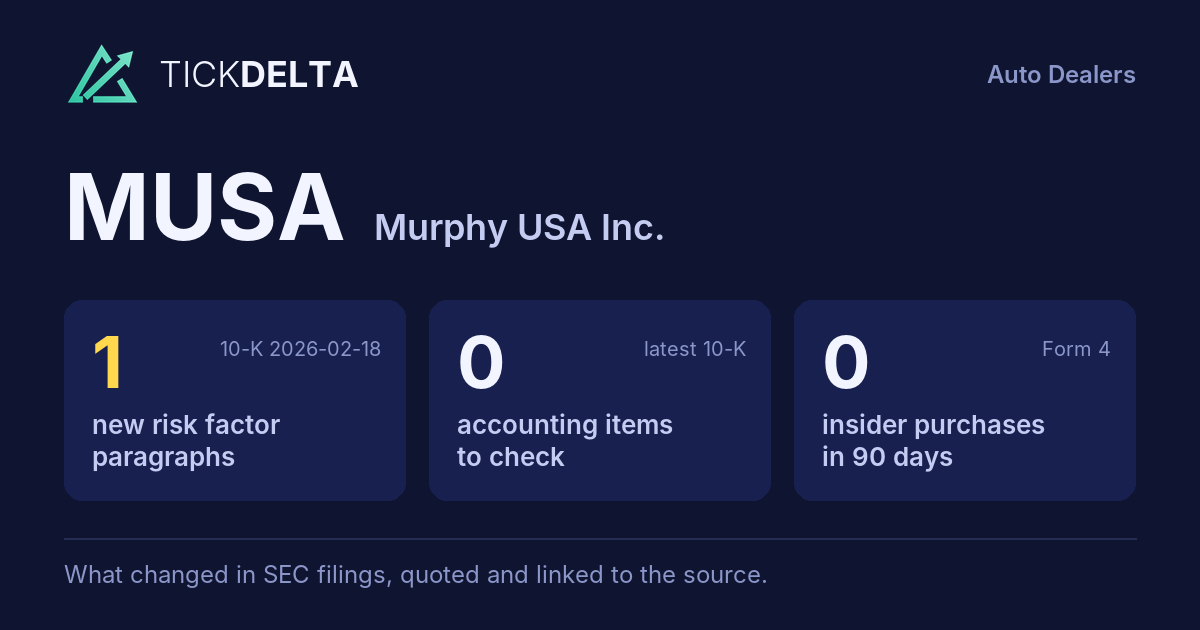
Screener / SEC EDGAR /CIK 0001573516 /10-K filed Feb 18, 2026, compared with Feb 20, 2025 /Numbers from the XBRL of the 10-Ks
NYSE Consumer discretionary · Auto Dealers

Murphy USA Inc. MUSA

Compare with peers Embed
SEC comment letters, last 20 years

2 reviews of MUSA's filings by SEC staff

UPLOAD and CORRESP
Reviews 2 latest letter May 6, 2020
Questions asked 6 each answered in the company's own letter
No closing letter 0 reviews without a letter saying the staff completed it

When the SEC's staff reviews a filing, it writes to the company with numbered questions, and the company answers each one in a letter. SEC publishes the exchange once the review is over, at least 20 business days later. A question is not an accusation; most reviews end with the company adding detail to its next filing.

How the reviews went

Every review on EDGAR, from the first staff letter to the letter that closes it

  1. 1. Staff letters 2 UPLOAD
  2. 2. Questions in them 6 numbered comments
  3. 3. Company replies 1 CORRESP
  4. 4. Reviews closed 2 of 2 closing letter

Half the closed reviews took 26 days or less from the first letter to the closing letter.

Form 10-K for the Year Ended December 31, 2019

2020-05-06 to 2020-05-14 · 1 question · 1 letter from the SEC, 0 from the company
Review closed 2020-05-14
Results discussion (MD&A)Liquidity and cash
SEC letter of May 6, 2020 ↗ no reply letter on EDGAR
Management's Discussion and Analysis of Financial Condition and Results of Operations · Operating Activities, page 35
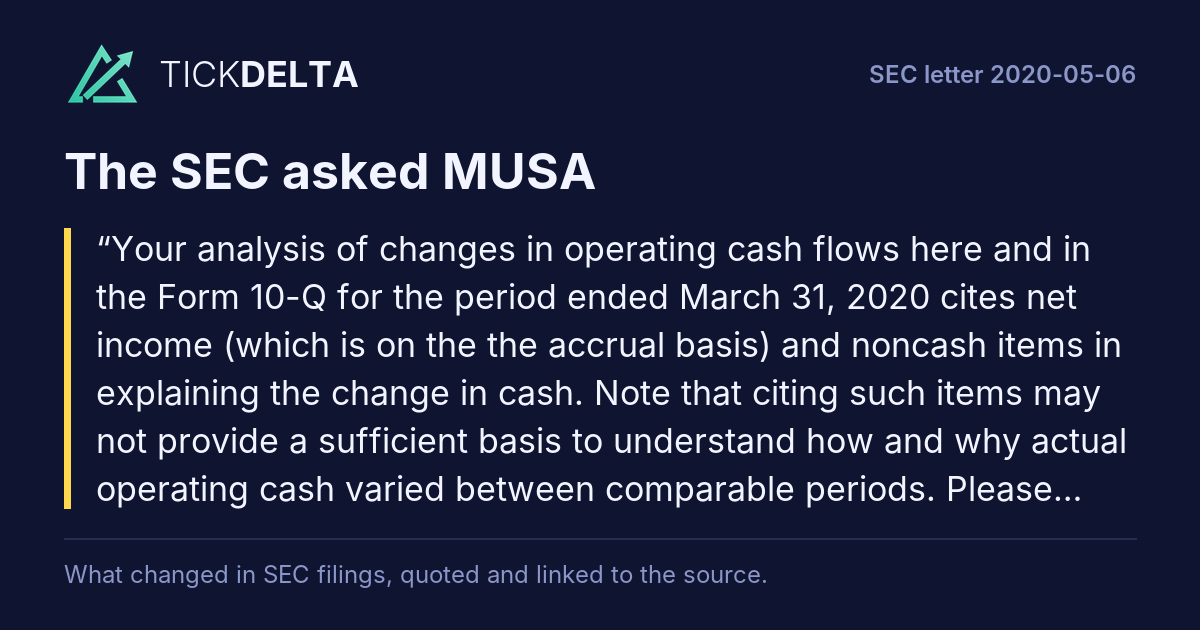
SEC asked
Your analysis of changes in operating cash flows here and in the Form 10-Q for the period ended March 31, 2020 cites net income (which is on the the accrual basis) and noncash items in explaining the change in cash. Note that citing such items may not provide a sufficient basis to understand how and why actual operating cash varied between comparable periods. Please refer to section IV.B.1 of SEC Release No.
Rest of the question

33-8350 for guidance and revise your disclosure as appropriate.

MUSA answered

No reply letter found.

In its next report

First report after the SEC's letter of May 6, 2020: 10-Q filed Jul 30, 2020 ↗, against the 10-Q filed Apr 30, 2020 ↗.

Tickdelta does not hold the text of both reports, so they are not compared here.
Also in this review: closing letter, 2020-05-14
Form 10-K for the Fiscal Year Ended December 31, 2018

2019-07-11 to 2019-08-06 · 5 questions · 1 letter from the SEC, 1 from the company
Review closed 2019-08-06
Key metricsSegmentsNon-GAAP measuresLiquidity and cash
Segment Results · Marketing Segment, page 31
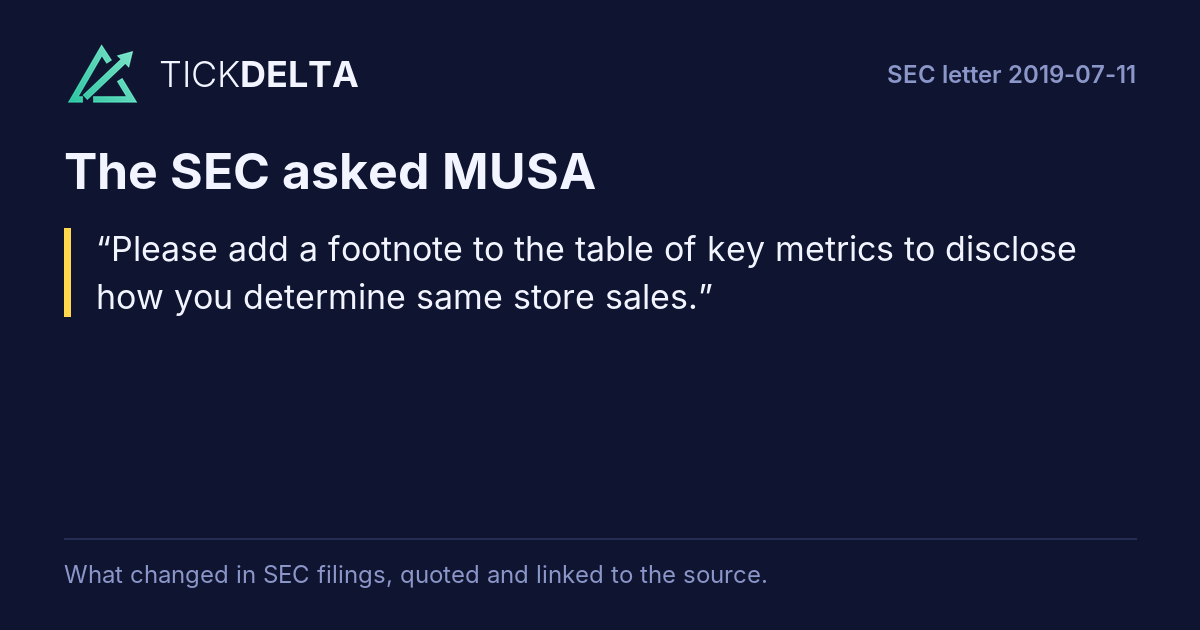
SEC asked (1)
Please add a footnote to the table of key metrics to disclose how you determine same store sales.
MUSA answered
In future filings, we will cross reference to a definition of the same store sales metric within MD&A.
Read in the reply
In its next report

First report after the company's reply of Jul 22, 2019: 10-Q filed Aug 8, 2019 ↗, against the 10-Q filed May 1, 2019 ↗.

Tickdelta does not hold the text of both reports, so they are not compared here.

Key Fuel Operating Metrics, page 32
SEC asked (2)
Please expand the items disclosed in the table so that readers are able to recompute the total fuel contribution and total retail fuel contribution metrics and reconcile them with amounts presented on the income statements. These amounts appear to include: 1) total cost of RINs, 2) PS&W volumes, 3) PS&W sales and 4) PS&W cost of sales.
MUSA answered
In our historical presentation, the difference between total fuel contribution and total retail fuel contribution is primarily the PS&W contribution and RINs as the items other than those that are needed to reconcile are immaterial to all periods presented. In future filings we will include the amounts in the Key Fuel Operating Metrics table as noted below.

We expect to reorder the items in the table related to the components of the total fuel contribution and provide a subtotal.
Rest of the answer

We propose to show the metrics as follows (using 2018 amounts as an example):

Total retail fuel contribution ($ Millions)

$

624.2

Total PS&W contribution ($ Millions)

(16.9

)

RINs and other (included in Other operating revenues on Consolidated Income Statement) ($ Millions)

78.3

Total fuel contribution ($ Millions)

685.6

In addition, below the Key Fuel Operating Metrics table we will provide a detail of the amounts from the Consolidated Income Statements that shows the components of total fuel contribution as reconciled to the Consolidated Income Statements, as follows (using 2018 amounts as an example):

(all amounts in $ Millions)

Petroleum product sales

11,858.4

Less Petroleum product cost of goods sold

(11,251.1

Plus RINs and other (included in Other Operating Revenues line)

Total fuel contribution

PS&W volumes are not considered to be a key metric as the cents per gallon (cpg) equivalent is calculated using retail fuel volumes.

Read in the reply
In its next report

First report after the company's reply of Jul 22, 2019: 10-Q filed Aug 8, 2019 ↗, against the 10-Q filed May 1, 2019 ↗.

Tickdelta does not hold the text of both reports, so they are not compared here.

Key Fuel Operating Metrics, page 32
SEC asked (3)
It appears Retail fuel margin (cpg excluding credit card fees) disclosed in the table is a non-GAAP measure that should be reconciled by disclosing the amount of credit card fees. Please revise and also provide the other required disclosures in Item 10(e)(i) of Regulation S-K.
MUSA answered
We do not believe the metric is non-GAAP. The retail fuel margin on a cpg basis is calculated as "Total retail fuel contribution" divided by "Retail fuel volumes — chain", as shown in the table. Credit card fees are presented on the Consolidated Statement of Income in the Station and Other Operating Expenses line and do not impact retail fuel margin as they cannot be separated between fuel and merchandise purchases. In future filings we will remove the reference "excluding credit card fees" from the line item in question in the fuel metrics table to clarify the calculation.
Read in the reply
In its next report

First report after the company's reply of Jul 22, 2019: 10-Q filed Aug 8, 2019 ↗, against the 10-Q filed May 1, 2019 ↗.

Tickdelta does not hold the text of both reports, so they are not compared here.

Consolidated Statements of Cash Flows, page F-6
SEC asked (4)
We note you recognized a decrease in restricted cash of $68.8 million classified as an investing activity for the year ended December 31, 2016. This presentation does not appear to comply with ASU 2016-18. Please refer to the transition guidance and revise your presentation or tell us how the presentation complies with ASU 2016-18.
MUSA answered
We acknowledge that we did not apply the transition guidance of ASU 2016-18 appropriately to the Consolidated Statement of Cash Flows for the year ended December 31, 2016 in our Form 10-K for the period ended December 31, 2018. We did properly apply ASU 2016-18 throughout interim periods in the year of adoption when we did have restricted cash activity.

The Company entered into like-kind exchange transactions in 2015 and 2016 that gave rise to the restricted cash balance of $68.6 million.
Rest of the answer

These discrete transactions began in 2015 and were fully completed prior to December 31, 2016, had no continuing impact in future periods, and were presented and disclosed in our filings at such time. The opening balance of restricted cash as of January 1, 2016 was shown properly on the balance sheet at December 31, 2015.

The Company has performed a comprehensive assessment of qualitative and quantitative factors in accordance with Staff Accounting Bulletin No. 99 to reach its conclusion that misapplication of the transition guidance of ASU 2016-18 to investing activity within the Consolidated Statement of Cash Flows for the year ended December 31, 2016 was immaterial. There was no quantitative impact to operating cash flows, net income, earnings per share, EBITDA and/or Adjusted EBITDA, store metrics as presented by the Company, or any other financial statement amounts presented. Furthermore, the Company believes that the qualitative factors surrounding this matter provide a sufficient basis to conclude that the misapplication of ASU 2016-18 is immaterial. The matter did not (a) mask a change in earnings or other trends, (b) hide a failure to meet research analysts' consensus expectations for the period, (c) change a loss into income or vice versa, (d) concern a segment or other portion of the Company's business that plays a significant role in the Company's operations or profitability, (e) impact compliance with regulatory requirements, (f) affect compliance with loan covenants or other contractual requirements, (g) have the effect of increasing management's compensation or (i) conceal an unlawful transaction. The qualitative assessment, combined with the lack of any quantitative impact on our key metrics, provides sufficient evidence to conclude that misapplication of the transition guidance of ASU 2016-18 to investing activity within the Consolidated Statement of Cash Flows for the year ended December 31, 2016 as presented in the December 31, 2018 Form 10-K was immaterial.

Read in the reply
In its next report

First report after the company's reply of Jul 22, 2019: 10-Q filed Aug 8, 2019 ↗, against the 10-Q filed May 1, 2019 ↗.

Tickdelta does not hold the text of both reports, so they are not compared here.

Notes to Consolidated Financial Statements · Note 10 - Incentive Plans, page F-18
SEC asked (5)
Please disclose the total fair value of restricted stock units and performance-based restricted stock units vested during each year presented and the intrinsic value of restricted share units as of year end. Refer to ASC 718-10-50-2d and ASC 718-10-50-2e.
MUSA answered
In future filings, we will disclose the fair value of restricted stock units and performance-based restricted stock units vested during each year presented and the intrinsic value of restricted share units as of year-end.

We trust that we have adequately responded to your requests with regard to the foregoing items. If you have any questions or desire further explanations, please call me at (870) 875-7514 or Donald Smith, VP and Controller at (870) 881-6878.
Read in the reply
In its next report

First report after the company's reply of Jul 22, 2019: 10-Q filed Aug 8, 2019 ↗, against the 10-Q filed May 1, 2019 ↗.

Tickdelta does not hold the text of both reports, so they are not compared here.

Also in this review: closing letter, 2019-08-06

Letters without questions

Other letters

UPLOAD and CORRESP
1 other letter: notices that a filing will not be reviewed, requests to declare a registration effective, and the like
  • May 14, 2020 · MUSA: letter to the SEC · Murphy USA Inc. · Form 10-K for Fiscal Year Ended December 31, 2019 · Filed February...

From the SEC's correspondence on EDGAR: staff letters (form UPLOAD) and company letters (form CORRESP), 6 letters filed since 2019-07-11. Questions and answers are matched by their numbers; topics come from words in each question. The reports are compared word for word (same form, before the first SEC letter against the first report after the company's reply). No AI.

Sources

The SEC's correspondence on EDGAR: staff letters (form UPLOAD) and company letters (form CORRESP), matched question by question. No AI.

Also

Filings: the letters in the filing list.

Work with it

Excel workbook · CSV. Google Sheet that stays up to date: paste =IMPORTDATA("https://tickdelta.com/company/MUSA/export.csv") into a cell.

Next in Owners and insiders:Insider trades
Esc

Type a ticker such as AAPL, a name, an investor such as Buffett, or a topic such as tariffs. ↑ ↓ to move, Enter to open.