Paragraph 85 · 45% changed
Every version of it
Screener
/
SEC EDGAR
/CIK 0000057515
/10-K filed Aug 25, 2026, compared with Aug 21, 2025
/Numbers from the XBRL of the 10-Ks
Nasdaq
Consumer staples · Packaged Foods
Marzetti Co MZTI
The 10-K against last year's
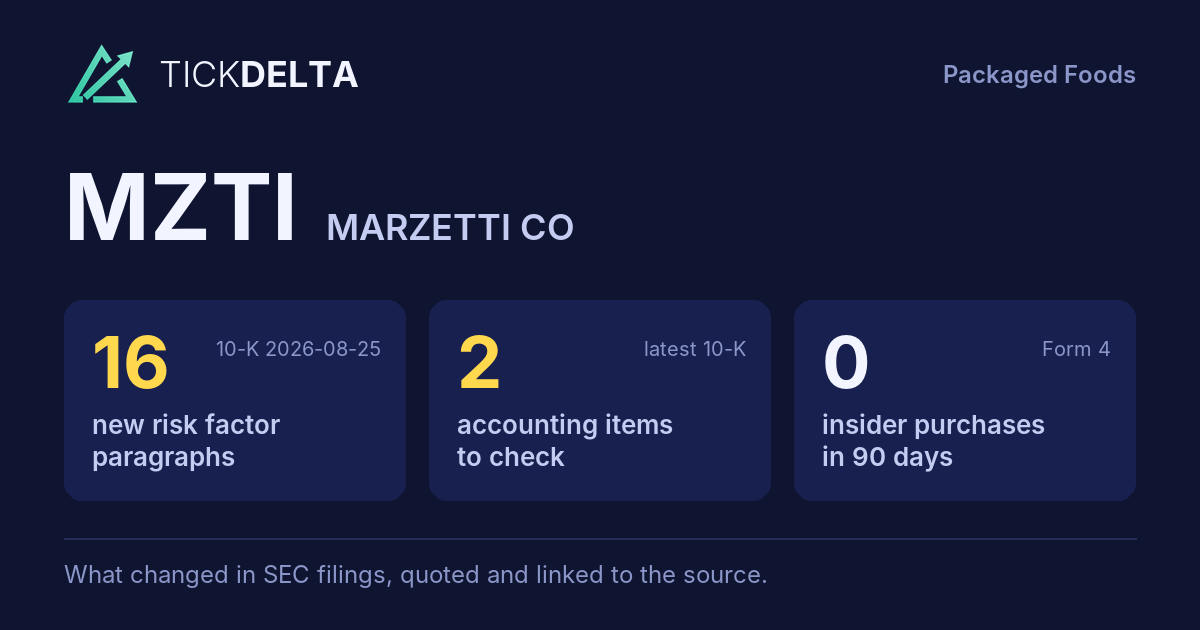
80 changes: 27 added, 11 removed, 42 reworded
10-K Aug 25, 2026 vs Aug 21, 2025
Risk Factors
11.1%
of the text changed · 10,188 words now · 16 new paragraphs, 1 gone
MD&A
31.4%
of the text changed · 5,420 words now · 11 new paragraphs, 10 gone
Accounting Policies
16.7%
of the text changed · 4,532 words now
10-K 0000057515-26-000019 (Aug 25, 2026) vs 10-K 0000057515-25-000020 (Aug 21, 2025) Not compared: Legal Proceedings.
Every paragraph, and how much of it changed
One bar per paragraph, in the order of the 10-K. Height and colour show the share of its words not in the closest paragraph a year earlier; the tallest bars are new paragraphs.
Risk Factors
112 paragraphs · 16 new · 18 reworded · 1 gone · 10-K Aug 25, 2026 against Aug 21, 2025
New paragraph
Reworded (5% of its words or more)
Same or nearly
Paragraph 15 · 42% changed
Every version of it
In addition, our retail partners and retail distributors may pressure us to rescind price increases we have announced or already implemented, whether through a change in list price or increased trade and promotional activity. We may experience further increases in the costs of raw materials and our ability to maintain prices or effectively implement price increases may be affected by several factors, including competition, effectiveness of our marketing programs, the continuing strength of our brands, market demand and general economic conditions, including broader inflationary pressures. If we cannot maintain or increase prices for our products or must increase trade and promotional activity, our margins may be adversely affected. Furthermore, price increases generally result in volume losses, as consumers tend to purchase fewer units at higher price points. If such losses are greater than expected or if we lose distribution due to price increases, our business, financial condition and results of operations may be materially and adversely affected.
Paragraph 93 · 38% changed
Every version of it
We increasingly rely on information technology systems to conduct and manage our business operations, including the processing, transmitting, and storing of electronic information. For example, our sales group and our production and distribution facilities utilize information technology to increase efficiencies and limit costs. Furthermore, a significant portion of the communications between our personnel, customers, and suppliers depends on information technology and an uninterrupted and functioning infrastructure, including telecommunications. Our information technology systems may be vulnerable to a variety of interruptions due to events beyond our control, including, but not limited to, natural disasters and other severe weather events, terrorist attacks, telecommunications failures, cyber attacks and other security issues. Furthermore, the rapid evolution and increased adoption of artificial intelligence technologies may intensify our cybersecurity risks. Our information technology systems could also be adversely affected by changes relating to remote work arrangements for our employees. If we are unable to adequately protect against these vulnerabilities, our operations could be disrupted, or we may suffer financial damage or loss because of lost or misappropriated information.
Paragraph 94 · 20% changed
Every version of it
Paragraph 2 · 17% changed
Every version of it
The following disclosures reflect the Company’s beliefs and opinions as to factors that could materially and adversely affect the Company and its securities in the future and are not intended to be a representation as to whether or not such factors have or have not previously occurred. If any of the following risks occur, our business, results of operations, financial condition and cash flows could be materially and adversely affected. These described risks are not the only risks facing us. Additional risks and uncertainties not known to us or that we deem to be immaterial also may materially adversely affect our business, results of operations, financial condition and cash flows. If any of these risks were to materialize, the value of our common stock could decline significantly.
Paragraph 89 · 15% changed
Every version of it
Hardware, software or applications we utilize on our networks and work-issued devices may contain defects in design or manufacture or other problems that could unexpectedly compromise information security, potentially resulting in the unauthorized disclosure and misappropriation of sensitive data, including intellectual property, proprietary business information, and personal data. Furthermore, our increased use of mobile and cloud technologies, including as a result of our transition to our current enterprise resource planning system, has heightened these cybersecurity and privacy risks. In addition, techniques used to obtain unauthorized access to information or to sabotage information technology systems change frequently. The rapid ongoing evolution and increased adoption of emerging technologies, such as artificial intelligence and machine learning, may make it more difficult to avoid unauthorized disclosure and misappropriation of proprietary information and to anticipate and implement protective measures to recognize, detect, and prevent the occurrence of any of the cyber attacks. Like most businesses, we have seen, and will likely continue to see, vulnerabilities which could affect our systems or those of our third-party service providers or other third parties with which we do business.
Paragraph 16 · 15% changed
Every version of it
Paragraph 61 · 11% changed
Every version of it
We believe that our labor relations with employees under collective bargaining contracts are satisfactory, but our inability to negotiate the renewal of any collective bargaining agreements, including the agreement at our Vineland, New Jersey facility, none of which is currently scheduled to will expire in December 2025, within one year, or any prolonged work stoppages or other types of labor unrest could in some cases impair our ability to supply our products to customers, which could result in reduced sales and may distract our management from focusing on other aspects of our business and strategic priorities. Any of these activities could have a material adverse effect on our business, results of operations, financial condition and cash flows.
Paragraph 85 · 45% changed
Every version of it
10-K Aug 21, 2025The loss of the services of one or more members of our senior management team could have a material adverse effect on our business, results of operations, financial condition and cash flows.
10-K Aug 25, 2026
their own branded products that compete directly with our products. Failure to maintain our retail shelf space or priority with these customers and foodservice distributors could have a material adverse effect on our business, results of operations, financial condition and cash flows.
Paragraph 15 · 42% changed
Every version of it
10-K Aug 21, 2025
In addition, our retail partners and retail distributors may pressure us to rescind price increases we have announced or already implemented, whether through a change in list price or increased trade and promotional activity. We may experience further increases in the costs of raw materials and our ability to maintain prices or effectively implement price increases may be affected by several factors, including competition, effectiveness of our marketing programs, the continuing strength of our brands, market demand and general economic conditions, including broader inflationary pressures. If we cannot maintain or increase prices for our products or must increase trade and promotional activity, our margins may be adversely affected. Furthermore, price increases generally result in volume losses, as consumers tend to purchase fewer units at higher price points. If such losses are greater than expected or if we lose distribution due to price increases, our business, financial condition and results of operations may be materially and adversely affected.
10-K Aug 25, 2026
In addition, our retail partners and retail distributors may pressure us to rescind price increases we have announced or already implemented, whether through a change in list price or increased trade and promotional activity. We may experience further increases in the costs of raw materials and our ability to maintain prices or effectively implement price increases may be
Paragraph 93 · 38% changed
Every version of it
10-K Aug 21, 2025
We increasingly rely on information technology systems to conduct and manage our business operations, including the processing, transmitting, and storing of electronic information. For example, our sales group and our production and distribution facilities utilize information technology to increase efficiencies and limit costs. Furthermore, a significant portion of the communications between our personnel, customers, and suppliers depends on information technology and an uninterrupted and functioning infrastructure, including telecommunications. Our information technology systems may be vulnerable to a variety of interruptions due to events beyond our control, including, but not limited to, natural disasters and other severe weather events, terrorist attacks, telecommunications failures, cyber attacks and other security issues. Furthermore, the rapid evolution and increased adoption of artificial intelligence technologies may intensify our cybersecurity risks. Our information technology systems could also be adversely affected by changes relating to remote work arrangements for our employees. If we are unable to adequately protect against these vulnerabilities, our operations could be disrupted, or we may suffer financial damage or loss because of lost or misappropriated information.
10-K Aug 25, 2026
We increasingly rely on information technology systems to conduct and manage our business operations, including the processing, transmitting, and storing of electronic information. For example, our sales group and our production and distribution facilities utilize information technology to increase efficiencies and limit costs. Furthermore, a significant portion of the communications between our personnel, customers, and suppliers depends on information technology and an uninterrupted and functioning infrastructure, including telecommunications. Our information technology systems may be vulnerable to a
Paragraph 94 · 20% changed
Every version of it
10-K Aug 21, 2025We increasingly rely on information technology systems to conduct and manage our business operations, including the processing, transmitting, and storing of electronic information. For example, our sales group and our production and distribution facilities utilize information technology to increase efficiencies and limit costs. Furthermore, a significant portion of the communications between our personnel, customers, and suppliers depends on information technology and an uninterrupted and functioning infrastructure, including telecommunications. Our information technology systems may be vulnerable to a variety of interruptions due to events beyond our control, including, but not limited to, natural disasters and other severe weather events, terrorist attacks, telecommunications failures, cyber attacks and other security issues. Furthermore, the rapid evolution and increased adoption of artificial intelligence technologies may intensify our cybersecurity risks. Our information technology systems could also be adversely affected by changes relating to remote work arrangements for our employees. If we are unable to adequately protect against these vulnerabilities, our operations could be disrupted, or we may suffer financial damage or loss because of lost or misappropriated information.
10-K Aug 25, 2026
variety of interruptions due to events beyond our control, including, but not limited to, natural disasters and other severe weather events, terrorist attacks, telecommunications failures, cyber attacks and other security issues. Furthermore, the rapid evolution and increased adoption of artificial intelligence technologies may intensify our cybersecurity risks. Our information technology systems could also be adversely affected by changes relating to remote work arrangements for our employees. If we are unable to adequately protect against these vulnerabilities, our operations could be disrupted, or we may suffer financial damage or loss because of lost or misappropriated information.
Paragraph 2 · 17% changed
Every version of it
10-K Aug 21, 2025
If any of the following risks occur, our business, results of operations, financial condition and cash flows could be materially and adversely affected. These described risks are not the only risks facing us. Additional risks and uncertainties not known to us or that we deem to be immaterial also may materially adversely affect our business, results of operations, financial condition and cash flows. If any of these risks were to materialize, the value of our common stock could decline significantly.
10-K Aug 25, 2026
The following disclosures reflect the Company’s beliefs and opinions as to factors that could materially and adversely affect the Company and its securities in the future and are not intended to be a representation as to whether or not such factors have or have not previously occurred. If any of the following risks occur, our business, results of operations, financial condition and cash flows could be materially and adversely affected. These described risks are not the only risks facing us. Additional risks and uncertainties not known to us or that we deem to be immaterial also may materially adversely affect our business, results of operations, financial condition and cash flows. If any of these risks were to materialize, the value of our common stock could decline significantly.
Paragraph 89 · 15% changed
Every version of it
10-K Aug 21, 2025
Hardware, software or applications we utilize on our networks and work-issued devices may contain defects in design or manufacture or other problems that could unexpectedly compromise information security, potentially resulting in the unauthorized disclosure and misappropriation of sensitive data, including intellectual property, proprietary business information, and personal data. Furthermore, our increased use of mobile and cloud technologies, including as a result of our transition to our current enterprise resource planning system, has heightened these cybersecurity and privacy risks. In addition, techniques used to obtain unauthorized access to information or to sabotage information technology systems change frequently. The rapid ongoing evolution and increased adoption of emerging technologies, such as artificial intelligence and machine learning, may make it more difficult to avoid unauthorized disclosure and misappropriation of proprietary information and to
10-K Aug 25, 2026
Hardware, software or applications we utilize on our networks and work-issued devices may contain defects in design or manufacture or other problems that could unexpectedly compromise information security, potentially resulting in the unauthorized disclosure and misappropriation of sensitive data, including intellectual property, proprietary business information, and personal data. Furthermore, our increased use of mobile and cloud technologies, including as a result of our transition to our current enterprise resource planning system, has heightened these cybersecurity and privacy risks. In addition, techniques used to obtain unauthorized access to information or to sabotage information technology systems change frequently. The rapid ongoing evolution and increased adoption of emerging technologies, such as artificial intelligence and machine learning, may make it more difficult to avoid unauthorized disclosure and misappropriation of proprietary information and to anticipate and implement protective measures to recognize, detect, and prevent the occurrence of any of the cyber attacks. Like most businesses, we have seen, and will likely continue to see, vulnerabilities which could affect our systems or those of our third-party service providers or other third parties with which we do business.
Paragraph 16 · 15% changed
Every version of it
10-K Aug 21, 2025In addition, our retail partners and retail distributors may pressure us to rescind price increases we have announced or already implemented, whether through a change in list price or increased trade and promotional activity. We may experience further increases in the costs of raw materials and our ability to maintain prices or effectively implement price increases may be affected by several factors, including competition, effectiveness of our marketing programs, the continuing strength of our brands, market demand and general economic conditions, including broader inflationary pressures. If we cannot maintain or increase prices for our products or must increase trade and promotional activity, our margins may be adversely affected. Furthermore, price increases generally result in volume losses, as consumers tend to purchase fewer units at higher price points. If such losses are greater than expected or if we lose distribution due to price increases, our business, financial condition and results of operations may be materially and adversely affected.
10-K Aug 25, 2026
affected by several factors, including competition, effectiveness of our marketing programs, the continuing strength of our brands, market demand and general economic conditions, including broader inflationary pressures. If we cannot maintain or increase prices for our products or must increase trade and promotional activity, our margins may be adversely affected. Furthermore, price increases generally result in volume losses, as consumers tend to purchase fewer units at higher price points. If such losses are greater than expected or if we lose distribution due to price increases, our business, financial condition and results of operations may be materially and adversely affected.
Paragraph 61 · 11% changed
Every version of it
10-K Aug 21, 2025
We believe that our labor relations with employees under collective bargaining contracts are satisfactory, but our inability to negotiate the renewal of any collective bargaining agreements, including the agreement at our Vineland, New Jersey facility, which is currently scheduled to expire in December 2025, or any prolonged work stoppages or other types of labor unrest could in some cases impair our ability to supply our products to customers, which could result in reduced sales and may distract our management from focusing on other aspects of our business and strategic priorities. Any of these activities could have a material adverse effect on our business, results of operations, financial condition and cash flows.
10-K Aug 25, 2026
We believe that our labor relations with employees under collective bargaining contracts are satisfactory, but our inability to negotiate the renewal of any collective bargaining agreements, none of which will expire within one year, or any prolonged work stoppages or other types of labor unrest could in some cases impair our ability to supply our products to customers, which could result in reduced sales and may distract our management from focusing on other aspects of our business and strategic priorities. Any of these activities could have a material adverse effect on our business, results of operations, financial condition and cash flows.
MD&A
88 paragraphs · 11 new · 35 reworded · 10 gone · 10-K Aug 25, 2026 against Aug 21, 2025
New paragraph
Reworded (5% of its words or more)
Same or nearly
Paragraph 41 · 50% changed
In 2025, 2026, net sales for the Retail segment reached a record $1,003.4 totaled $1,002.8 million, a 1.5% increase 0.1% decrease from the prior-year total record of $988.4 $1,003.4 million, reflecting higher due to a decline in sales volumes. Year-over-year comparisons volumes as partially offset by the incremental sales from Bachan’s and some inflationary pricing. Sales highlights for the Retail segment were unfavorably impacted by prior-year sales attributed to the perimeter-of-the-store bakery product lines we exited in March 2024. Excluding the exited product lines, Retail net sales increased 3.3%. Retail segment net sales current-year period included continued strong growth was driven by for our licensing program led by Texas RoadhouseTM dinner rolls, Chick-fil-A® sauces and Subway® sauces. Our new gluten-free category-leading New York BakeryTM frozen garlic bread also added to the growth in Retail net sales. products and expanding distribution for our recently introduced Texas Roadhouse® dinner rolls. Retail segment sales volumes, measured in pounds shipped, increased 1.6%. decreased 1.9%. Excluding Bachan’s, Retail segment sales volumes declined 3.2%, which includes the unfavorable impact of all reduced sales attributed to into the exited perimeter-of-the-store bakery product lines, Retail sales volumes increased 2.9%. club channel..
Paragraph 21 · 48% changed
Paragraph 75 · 44% changed
•the extent ability to which good-fitting successfully integrate the acquired Bachan’s business acquisitions are identified, acceptably integrated, and achieve operational and financial performance objectives;
Paragraph 18 · 43% changed
•the acquisition closure of a our sauce and dressing production facility in Milpitas, California during the Atlanta, Georgia area in February quarter ended September 30, 2025; and
Paragraph 26 · 42% changed
Consolidated gross profit increased 5.4% 4.7% to $477.3 million in 2026 compared to $455.6 million in 2025 compared to $432.3 million in 2024 driven by the positive impacts of 2025. Consolidated gross profit benefited from our cost savings programs, volume growth as partially offset by the unfavorable impacts of a less favorable sales mix and some modest cost deflation. lower core sales volumes. Reported gross margin improved 80 basis points while Adjusted Gross Margin increased 100 basis points.
Paragraph 3 · 41% changed
The following discussion should be read in conjunction with our consolidated financial statements and the notes thereto in Item 8 of this Annual Report on Form 10-K. The forward-looking statements in this section and other parts of this report involve risks, uncertainties and other factors, including statements regarding our plans, objectives, goals, strategies, and financial performance. Our actual results could differ materially from the results anticipated in these forward-looking statements as a result of factors set forth under the caption “Forward-Looking Statements” and those set forth in Item 1A of this Annual Report on Form 10-K.
Paragraph 45 · 40% changed
In 2025, 2026, corporate expenses totaled $97.9 $113.4 million as compared to $90.5 $97.9 million in 2024. This 2025. Excluding acquisition-related expenses, this increase was primarily reflects driven by increased investments in IT personnel and IT. Corporate expenses in the current year included $14.5 million in incremental expenditures attributed to support the continued growth of our business and Bachan’s acquisition. Corporate expenses in the prior year included $3.8 million in incremental expenditures attributed to the Atlanta plant acquisition, as partially offset by prior-year expenses for Project Ascent. acquisition.
Paragraph 20 · 37% changed
Consolidated net sales for the year ended June 30, 2025 2026 increased 2.0% 1.1% to a new record of $1,909.1 $1,929.8 million from the prior-year record total of $1,871.8 million, reflecting higher $1,909.1 million. The net sales for growth was driven by higher pricing in both segments in response to increased input costs, incremental sales resulting from the Retail and Foodservice segments driven primarily by increased volume and mix. Year-over-year comparisons for the Retail segment were unfavorably impacted by prior-year acquisition of Bachan’s that was completed on May 1, 2026, incremental sales attributed to the perimeter-of-the-store bakery product lines we exited in March 2024. Year-over-year comparisons for the Foodservice segment were favorably impacted by from a temporary supply agreement (“TSA”) resulting (“TSA”), and higher sales volumes in our Foodservice segment. These favorable factors were partially offset by the impact of lower sales volumes in our Retail segment. The TSA sales, all of which are reported in our Foodservice segment, resulted from our acquisition of a sauce and dressing production facility located in Atlanta, Georgia (“Atlanta plant”). The acquisition was completed in February 2025. The TSA sales commenced in March 2025 for a period of up to 12 months. Breaking down and concluded during the 2.0% increase in consolidated net sales as summarized in the table below, higher core volumes and product mix contributed approximately 220 basis points, as partially offset by approximately 90 basis points attributed to the exited perimeter-of-the-store bakery product lines. The incremental sales attributed to the TSA accounted for 80 basis points. quarter ended March 31, 2026.
Paragraph 41 · 50% changed
10-K Aug 21, 2025
In 2025, net sales for the Retail segment reached a record $1,003.4 million, a 1.5% increase from the prior-year total of $988.4 million, reflecting higher sales volumes. Year-over-year comparisons for the Retail segment were unfavorably impacted by prior-year sales attributed to the perimeter-of-the-store bakery product lines we exited in March 2024. Excluding the exited product lines, Retail net sales increased 3.3%. Retail segment net sales growth was driven by our licensing program led by Texas RoadhouseTM dinner rolls, Chick-fil-A® sauces and Subway® sauces. Our new gluten-free New York BakeryTM frozen garlic bread also added to the growth in Retail net sales. Retail segment sales volumes, measured in pounds shipped, increased 1.6%. Excluding the impact of all sales attributed to the exited perimeter-of-the-store bakery product lines, Retail sales volumes increased 2.9%.
10-K Aug 25, 2026
In 2026, net sales for the Retail segment totaled $1,002.8 million, a 0.1% decrease from the prior-year record of $1,003.4 million, due to a decline in sales volumes as partially offset by the incremental sales from Bachan’s and some inflationary pricing. Sales highlights for the current-year period included continued strong growth for our category-leading New York BakeryTM frozen garlic bread products and expanding distribution for our recently introduced Texas Roadhouse® dinner rolls. Retail segment sales volumes, measured in pounds shipped, decreased 1.9%. Excluding Bachan’s, Retail segment sales volumes declined 3.2%, which includes the unfavorable impact of reduced sales into the club channel..
Paragraph 21 · 48% changed
10-K Aug 21, 2025Consolidated net sales for the year ended June 30, 2025 increased 2.0% to a new record of $1,909.1 million from the prior-year record total of $1,871.8 million, reflecting higher net sales for both the Retail and Foodservice segments driven primarily by increased volume and mix. Year-over-year comparisons for the Retail segment were unfavorably impacted by prior-year sales attributed to the perimeter-of-the-store bakery product lines we exited in March 2024. Year-over-year comparisons for the Foodservice segment were favorably impacted by a temporary supply agreement (“TSA”) resulting from our acquisition of a sauce and dressing production facility located in Atlanta, Georgia (“Atlanta plant”). The acquisition was completed in February 2025. The TSA commenced in March 2025 for a period of up to 12 months. Breaking down the 2.0% increase in consolidated net sales as summarized in the table below, higher core volumes and product mix contributed approximately 220 basis points, as partially offset by approximately 90 basis points attributed to the exited perimeter-of-the-store bakery product lines. The incremental sales attributed to the TSA accounted for 80 basis points.
10-K Aug 25, 2026
Breaking down the 1.1% increase in consolidated net sales as summarized in the table below, lower core volumes and product mix accounted for a decrease of approximately 90 basis points, the net pricing impact accounted for an increase of approximately 90 basis points, incremental sales from Bachan’s contributed approximately 80 basis points, and incremental sales attributed to the TSA added approximately 30 basis points. Excluding all sales attributed to the TSA, Adjusted Consolidated Net Sales for the year ended June 30, 2026 increased 0.8% to $1,909.4 million.
Paragraph 75 · 44% changed
10-K Aug 21, 2025
•the extent to which good-fitting business acquisitions are identified, acceptably integrated, and achieve operational and financial performance objectives;
10-K Aug 25, 2026
•the ability to successfully integrate the acquired Bachan’s business and achieve operational and financial performance objectives;
Paragraph 18 · 43% changed
10-K Aug 21, 2025
•the acquisition of a sauce and dressing production facility in the Atlanta, Georgia area in February 2025;
10-K Aug 25, 2026
•the closure of our sauce and dressing production facility in Milpitas, California during the quarter ended September 30, 2025; and
Paragraph 26 · 42% changed
10-K Aug 21, 2025
Consolidated gross profit increased 5.4% to $455.6 million in 2025 compared to $432.3 million in 2024 driven by the positive impacts of our cost savings programs, volume growth and some modest cost deflation.
10-K Aug 25, 2026
Consolidated gross profit increased 4.7% to $477.3 million in 2026 compared to $455.6 million in 2025. Consolidated gross profit benefited from our cost savings programs, as partially offset by the unfavorable impacts of a less favorable sales mix and lower core sales volumes. Reported gross margin improved 80 basis points while Adjusted Gross Margin increased 100 basis points.
Paragraph 3 · 41% changed
10-K Aug 21, 2025
The following discussion should be read in conjunction with our consolidated financial statements and the notes thereto in Item 8 of this Annual Report on Form 10-K. The forward-looking statements in this section and other parts of this report involve risks, uncertainties and other factors, including statements regarding our plans, objectives, goals, strategies, and financial performance. Our actual results could differ materially from the results anticipated in these forward-looking statements as a result of factors set forth under the caption “Forward-Looking Statements” and those set forth in Item 1A of this Annual Report on Form 10-K.
10-K Aug 25, 2026
The following discussion should be read in conjunction with our consolidated financial statements and the notes thereto in Item 8 of this Annual Report on Form 10-K.
Paragraph 45 · 40% changed
10-K Aug 21, 2025
In 2025, corporate expenses totaled $97.9 million as compared to $90.5 million in 2024. This increase primarily reflects investments in IT to support the continued growth of our business and $3.8 million in incremental expenditures attributed to the Atlanta plant acquisition, as partially offset by prior-year expenses for Project Ascent.
10-K Aug 25, 2026
In 2026, corporate expenses totaled $113.4 million as compared to $97.9 million in 2025. Excluding acquisition-related expenses, this increase was primarily driven by increased investments in personnel and IT. Corporate expenses in the current year included $14.5 million in incremental expenditures attributed to the Bachan’s acquisition. Corporate expenses in the prior year included $3.8 million in incremental expenditures attributed to the Atlanta plant acquisition.
Paragraph 20 · 37% changed
10-K Aug 21, 2025
Consolidated net sales for the year ended June 30, 2025 increased 2.0% to a new record of $1,909.1 million from the prior-year record total of $1,871.8 million, reflecting higher net sales for both the Retail and Foodservice segments driven primarily by increased volume and mix. Year-over-year comparisons for the Retail segment were unfavorably impacted by prior-year sales attributed to the perimeter-of-the-store bakery product lines we exited in March 2024. Year-over-year comparisons for the Foodservice segment were favorably impacted by a temporary supply agreement (“TSA”) resulting from our acquisition of a sauce and dressing production facility located in Atlanta, Georgia (“Atlanta plant”). The acquisition was completed in February 2025. The TSA commenced in March 2025 for a period of up to 12 months. Breaking down the 2.0% increase in consolidated net sales as summarized in the table below, higher core volumes and product mix contributed approximately 220 basis points, as partially offset by approximately 90 basis points attributed to the exited perimeter-of-the-store bakery product lines. The incremental sales attributed to the TSA accounted for 80 basis points.
10-K Aug 25, 2026
Consolidated net sales for the year ended June 30, 2026 increased 1.1% to a new record of $1,929.8 million from the prior-year record total of $1,909.1 million. The net sales growth was driven by higher pricing in both segments in response to increased input costs, incremental sales resulting from the acquisition of Bachan’s that was completed on May 1, 2026, incremental sales from a temporary supply agreement (“TSA”), and higher sales volumes in our Foodservice segment. These favorable factors were partially offset by the impact of lower sales volumes in our Retail segment. The TSA sales, all of which are reported in our Foodservice segment, resulted from our acquisition of a sauce and dressing production facility located in Atlanta, Georgia (“Atlanta plant”). The acquisition was completed in February 2025. The TSA sales commenced in March 2025 and concluded during the quarter ended March 31, 2026.
A paragraph is matched with the one last year that shares the most of its words; under half in common makes it new. The paragraphs shown are the 8 reworded the most in each section.
The paragraph that changed most in each section
The redline
Marked against last year's 10-K: cut words struck through, new words highlighted.
MD&A189 words changed in this paragraph; it is 41% similar to last year's version.
Consolidated net sales for the year ended June 30, 2025 2026 increased 2.0% 1.1% to a new record of $1,909.1 $1,929.8 million from the prior-year record total of $1,871.8 million, reflecting higher $1,909.1 million. The net sales for growth was driven by higher pricing in both segments in response to increased input costs, incremental sales resulting from the Retail and Foodservice segments driven primarily by increased volume and mix. Year-over-year comparisons for the Retail segment were unfavorably impacted by prior-year acquisition of Bachan’s that was completed on May 1, 2026, incremental sales attributed to the perimeter-of-the-store bakery product lines we exited in March 2024. Year-over-year comparisons for the Foodservice segment were favorably impacted by from a temporary supply agreement (“TSA”) resulting (“TSA”), and higher sales volumes in our Foodservice segment. These favorable factors were partially offset by the impact of lower sales volumes in our Retail segment. The TSA sales, all of which are reported in our Foodservice segment, resulted from our acquisition of a sauce and dressing production facility located in Atlanta, Georgia (“Atlanta plant”). The acquisition was completed in February 2025. The TSA sales commenced in March 2025 for a period of up to 12 months. Breaking down and concluded during the 2.0% increase in consolidated net sales as summarized in the table below, higher core volumes and product mix contributed approximately 220 basis points, as partially offset by approximately 90 basis points attributed to the exited perimeter-of-the-store bakery product lines. The incremental sales attributed to the TSA accounted for 80 basis points. quarter ended March 31, 2026.
Source: Item 7, 10-K 0000057515-26-000019 vs Item 7, 10-K 0000057515-25-000020
Accounting Policies104 words changed in this paragraph; it is 44% similar to last year's version.
Our financial assets and liabilities subject to the three-level fair value hierarchy consist principally of cash and equivalents, accounts receivable, accounts payable and defined benefit pension plan assets. long-term debt. The estimated fair carrying value of cash and equivalents, accounts receivable and accounts payable approximates their carrying value. See Note 11 for fair value disclosures related due to the short-term nature of these instruments. At June 30, 2026, our defined benefit pension plan assets. long-term debt consists of a five-year term loan that bears interest at a variable rate tied to SOFR or an alternate base rate. The carrying value of the long-term debt approximates its fair value because the term loan bears interest at a variable rate that reprices periodically to reflect current market rates. The estimated fair value of the term loan is classified as Level 2 within the fair value hierarchy.
Source: Item 8, Note 1 – Summary of Significant Accounting Policies, 10-K 0000057515-26-000019 vs Item 8, Note 1 – Summary of Significant Accounting Policies, 10-K 0000057515-25-000020
Risk Factors99 words changed in this paragraph; it is 54% similar to last year's version.
In addition, our retail partners and retail distributors may pressure us to rescind price increases we have announced or already implemented, whether through a change in list price or increased trade and promotional activity. We may experience further increases in the costs of raw materials and our ability to maintain prices or effectively implement price increases may be affected by several factors, including competition, effectiveness of our marketing programs, the continuing strength of our brands, market demand and general economic conditions, including broader inflationary pressures. If we cannot maintain or increase prices for our products or must increase trade and promotional activity, our margins may be adversely affected. Furthermore, price increases generally result in volume losses, as consumers tend to purchase fewer units at higher price points. If such losses are greater than expected or if we lose distribution due to price increases, our business, financial condition and results of operations may be materially and adversely affected.
Source: Item 1A, 10-K 0000057515-26-000019 vs Item 1A, 10-K 0000057515-25-000020
Sentences and paragraphs added, removed or reworded
Every change, by type
Sentences and paragraphs of MZTI's Risk Factors and MD&A, 10-K Aug 25, 2026 against 10-K Aug 21, 2025. Each links to the text at sec.gov.
Quiet changes are sentences kept from last year with one to four words changed, at least one of them a hedge, a modal or a qualifier (may, could, will, not, significant, material…). A year or date rolling forward is not counted.
The full word list
adverse, adversely, all, although, anticipate, anticipates, any, approximately, believe, believes, can, cannot, certain, could, expect, expects, generally, however, if, intend, intends, largely, likely, many, material, materially, may, might, most, must, never, no, not, possible, primarily, probable, should, significant, significantly, some, substantial, substantially, unlikely, will, would
AddedRisk Factors
We may be adversely affected by actual or perceived food-safety incidents, including foodborne illness outbreaks, recalls, investigations or public health advisories involving products, ingredients, suppliers, customers, competitors or food categories that we do not manufacture or supply. Such events have adversely affected, and may in the future adversely affect, demand for our products, including by causing consumers to avoid affected restaurants, retailers, menu items or food categories; causing our customers to reduce orders, modify menus, temporarily close locations or otherwise alter their operations; disrupting supply chains; or resulting in adverse publicity affecting the food industry or categories in which we operate. Even when our products are not implicated, these events have reduced, and may in the future reduce, demand for our products and sales, increase our costs or otherwise have a material adverse effect on our business, results of operations, financial condition and cash flows.
Read it in 10-K Aug 25, 2026 at sec.gov
AddedRisk Factors
We may not realize the anticipated benefits of our acquisition of Bachan’s, Inc., and the integration of the acquired business may disrupt our operations, divert management attention, or result in unanticipated costs or liabilities.
Read it in 10-K Aug 25, 2026 at sec.gov
AddedRisk Factors
On May 1, 2026, we acquired Bachan’s, Inc. (“Bachan’s”) for approximately $400 million, subject to customary adjustments, in a transaction funded through a combination of cash on hand and borrowings under our credit facility. As the largest acquisition in our history, the success of this transaction depends on our ability to effectively integrate Bachan’s operations, products and personnel and to achieve the anticipated strategic and financial benefits.
Read it in 10-K Aug 25, 2026 at sec.gov
AddedRisk Factors
The integration process may be more difficult, costly, or time-consuming than expected and could result in the loss of key employees whose expertise and relationships were central to the brand's pre-acquisition growth, challenges in maintaining the strength and growth of the Bachan’s brand, operational or supply chain disruptions including those in connection with introductions of new products or new contract manufacturers, failure to achieve projected cost synergies, the diversion of management's attention from other business priorities, and the incurrence of significant integration, transaction, or other costs and liabilities that were not anticipated. In addition, Bachan’s future growth rates may not meet our expectations, which could adversely affect our ability to generate expected returns on the acquisition and lead to impairment charges related to the intangible assets recorded in connection with the transaction.
Read it in 10-K Aug 25, 2026 at sec.gov
AddedRisk Factors
If we are unable to successfully integrate Bachan’s or if the acquired business does not perform as anticipated, our results of operations, financial condition, cash flows, and return on our investment in the acquisition could be materially adversely affected.
Read it in 10-K Aug 25, 2026 at sec.gov
AddedRisk Factors
Our Credit Agreement requires us to comply with certain restrictive covenants that impose restrictions on our operations, which could adversely affect our business.
Read it in 10-K Aug 25, 2026 at sec.gov
AddedRisk Factors
The First Amendment to our Credit Agreement dated March 4, 2026 with The Huntington National Bank and Bank of America, N.A. as Co-Syndication Agents, JPMorgan Chase Bank, N.A. as Administrative Agent, and the other lenders named therein (as amended, the “Credit Agreement”) increased our revolving credit commitment and provided for an additional term loan in connection with our acquisition of Bachan’s Inc. The First Amendment did not materially change the restrictive covenants or financials covenant levels described below. The Credit Agreement imposes certain customary operating and financial covenants and restrictions on us, including our ability to incur additional indebtedness, sell assets, engage in acquisitions, grant liens on assets, and make certain other changes, subject to certain exceptions set forth therein. Our Credit Agreement also requires us to maintain a consolidated net leverage ratio not greater than 3.5 to 1 and an interest coverage ratio
Read it in 10-K Aug 25, 2026 at sec.gov
AddedRisk Factors
not less than 2.5 to 1 at the end of each fiscal quarter and limits investments and acquisitions over $150 million if our consolidated leverage ratio equals or exceeds 3.25 to 1. The covenant calculations are defined more specifically in the Credit Agreement.
Read it in 10-K Aug 25, 2026 at sec.gov
Show the other 50
AddedRisk Factors
Our Credit Agreement also contains customary events of default, including failure to comply with certain financial and other covenants. Upon a default that is not cured or waived within the applicable cure period, our outstanding obligations may be accelerated, in addition to other remedies that are available to our lenders. If the lenders accelerate payment of indebtedness, our assets may not be sufficient to repay in full our indebtedness, and we may need to reduce or curtail uses of cash, including dividend payments, share repurchases, acquisitions, or capital expenditures, which could limit our ability to respond to market conditions, pursue strategic opportunities, or otherwise conduct our operations.
Read it in 10-K Aug 25, 2026 at sec.gov
AddedRisk Factors
An increase in interest rates would have an adverse effect on our results of operations, as we have exposure to variable interest rates tied to SOFR or an alternate base rate defined in the Credit Agreement.
Read it in 10-K Aug 25, 2026 at sec.gov
AddedRisk Factors
Additionally, our capital resources may not be sufficient to satisfy our liquidity needs, and we may seek to obtain additional debt financing, which would result in increased expenses. We may not be able to obtain additional financing, if required, in amounts or on terms acceptable to us, or at all. If we are not able to obtain additional financing, we may be required to reduce discretionary spending; delay strategic initiatives; seek additional financing on less favorable terms; or take other actions to meet our liquidity needs. Any such developments could have a material adverse effect on our business, financial condition, results of operations, and cash flows.
Read it in 10-K Aug 25, 2026 at sec.gov
AddedRisk Factors
We may be required to incur significant costs or make operational changes to convert to more sustainable packaging, and our failure to do so effectively could adversely affect our business, reputation, results of operations, financial condition and cash flows.
Read it in 10-K Aug 25, 2026 at sec.gov
RemovedRisk Factors
RewordedRisk Factors
RewordedRisk Factors
We may experience further increases in the costs of raw materials and our ability to maintain prices or effectively implement price increases may be affected by several factors, including competition, effectiveness of our marketing programs, the continuing strength of our brands, market demand and general economic conditions, including broader inflationary pressures.
Read it in 10-K Aug 25, 2026 at sec.gov
RewordedRisk Factors
We have previously experienced labor shortages, increased labor costs and increased employee turnover, which were due in part to the COVID-19 pandemic and the related policies and mandates and exacerbated by inflationary costs. turnover.
Read it in 10-K Aug 25, 2026 at sec.gov
RewordedRisk Factors
Further, we may need to acquire new facilities or make significant investments to expand or improve a portion of our infrastructure and facilities may need to be improved or replaced to maintain or increase operational efficiency, sustain production capacity, or meet changing regulatory requirements.
Read it in 10-K Aug 25, 2026 at sec.gov
RewordedRisk Factors
We believe that our labor relations with employees under collective bargaining contracts are satisfactory, but our inability to negotiate the renewal of any collective bargaining agreements, including the agreement at our Vineland, New Jersey facility, none of which is currently scheduled to will expire in December 2025, within one year, or any prolonged work stoppages or other types of labor unrest could in some cases impair our ability to supply our products to customers, which could result in reduced sales and may distract our management from focusing on other aspects of our business and strategic priorities.
Read it in 10-K Aug 25, 2026 at sec.gov
RewordedRisk Factors
The rapid ongoing evolution and increased adoption of emerging technologies, such as artificial intelligence and machine learning, may make it more difficult to avoid unauthorized disclosure and misappropriation of proprietary information and to anticipate and implement protective measures to recognize, detect, and prevent the occurrence of any of the cyber attacks.
Read it in 10-K Aug 25, 2026 at sec.gov
RewordedRisk Factors
Delays in transportation, including weather-related delays and disruptions due to a pandemic or similar public health emergency, geopolitical conflict, armed hostilities or any related disruption to global energy markets, supply chains or transportation networks could have a material adverse effect on our business and results of operations.
Read it in 10-K Aug 25, 2026 at sec.gov
RewordedRisk Factors
If we require additional warehousing capacity or any of our warehouse capacity is unexpectedly decreased or compromised, particularly with respect to our frozen warehouse capacity, we could experience increased costs, decreased customer service levels, and lost revenue. revenue, which could reduce funds available for other business purposes.
Read it in 10-K Aug 25, 2026 at sec.gov
RewordedRisk Factors
A significant increase in maintenance costs and capital expenditures could limit our flexibility to fund or pursue other business operations and adversely affect our financial condition, results of operations and cash flows.
Read it in 10-K Aug 25, 2026 at sec.gov
RewordedRisk Factors
RewordedRisk Factors
Likewise, our foodservice distributors often offer their own branded products that compete directly with our products.
Read it in 10-K Aug 25, 2026 at sec.gov
RewordedRisk Factors
Sales to Chick-fil-A in our Foodservice segment, which are primarily made indirectly through several foodservice distributors, represented 23% and 21% of consolidated net sales for each of the years ended June 30, 2025 2026 and 2024. 2025, respectively.
Read it in 10-K Aug 25, 2026 at sec.gov
AddedMD&A
We prepare our consolidated financial statements in accordance with U.S. Generally Accepted Accounting Principles (“GAAP”). We have also presented Adjusted Consolidated Net Sales, Adjusted Foodservice Net Sales, Adjusted Cost of Sales, Adjusted Gross Profit, Adjusted Gross Margin, Adjusted Operating Income and Adjusted Net Income Per Diluted Share, each of which is considered a non-GAAP financial measure, to supplement the financial information included in this report. Refer to the “Reconciliation of GAAP to non-GAAP Financial Measures” section below for additional information and reconciliations of these non-GAAP financial measures to their most directly comparable GAAP financial measures.
Read it in 10-K Aug 25, 2026 at sec.gov
AddedMD&A
•the acquisition of Bachan’s, Inc. (“Bachan’s”), the rapidly growing Japanese Barbecue Sauce brand known for its authentic, clean-label products, in May 2026;
Read it in 10-K Aug 25, 2026 at sec.gov
AddedMD&A
Selling, general and administrative (“SG&A”) expenses increased 10.6% to $254.6 million in 2026 compared to $230.2 million in 2025. SG&A expenses in the current year included $14.5 million in incremental expenditures attributed to the Bachan’s acquisition transaction costs in addition to $1.6 million in incremental noncash amortization expense for Bachan’s intangible assets. SG&A expenses in the prior year included $3.8 million in incremental expenditures attributed to the Atlanta plant acquisition. Excluding these items, SG&A expenses grew 5.3%, or $12.0 million, in 2026 driven by $4.8 million in incremental core SG&A expenses for Bachan’s and increased investments in IT and personnel.
Read it in 10-K Aug 25, 2026 at sec.gov
AddedMD&A
In 2026, we also recorded a noncash impairment charge of $1.1 million related to manufacturing equipment, net of a recovery through an insurance claim. This amount was reflected in our Foodservice segment.
Read it in 10-K Aug 25, 2026 at sec.gov
AddedMD&A
Interest expense totaled $1.8 million in 2026 related to borrowings under our unsecured credit facility. See further discussion in Note 3 to the consolidated financial statements.
Read it in 10-K Aug 25, 2026 at sec.gov
AddedMD&A
Refer to the “Reconciliation of GAAP to non-GAAP Financial Measures” section below for additional information.
Read it in 10-K Aug 25, 2026 at sec.gov
AddedMD&A
On May 1, 2026, we completed the acquisition of Bachan’s. The purchase price of $399 million, net of cash acquired, is subject to future post-closing adjustments and was financed with cash on hand and a $200 million term loan.
Read it in 10-K Aug 25, 2026 at sec.gov
AddedMD&A
We prepare our consolidated financial statements in accordance with GAAP. However, from time to time, we may present in our public statements, press releases and SEC filings, non-GAAP financial measures such as Adjusted Consolidated Net Sales, Adjusted Foodservice Net Sales, Adjusted Cost of Sales, Adjusted Gross Profit, Adjusted Gross Margin, Adjusted Operating Income, and Adjusted Net Income Per Diluted Share (“Adjusted Diluted EPS”). Management considers such non-GAAP financial measures to provide useful supplemental information to investors in facilitating year-over-year comparisons by removing non-recurring items or other items that management believes do not directly reflect the underlying operations. Management uses these non-GAAP measures in the preparation of our annual operating plan and for our monthly analysis of operating results. Reconciliations of the non-GAAP measures to the most comparable GAAP financial measures are provided below. Our definitions of these non-GAAP measures may differ from similarly titled measures used by other companies. These non-GAAP measures should be considered supplemental to, and not a substitute for, financial information prepared in accordance with GAAP.
Read it in 10-K Aug 25, 2026 at sec.gov
AddedMD&A
Adjusted Consolidated Net Sales, Adjusted Foodservice Net Sales, Adjusted Cost of Sales, Adjusted Gross Profit and Adjusted Gross Margin are non-GAAP financial measures that exclude non-core sales and cost of sales attributed to the TSA made in connection with our February 2025 acquisition of Winland’s Atlanta-based sauce and dressing production facility. The TSA sales are included in the reported net sales for our Foodservice segment and did not contribute meaningfully to gross profit. The TSA sales commenced in March 2025 and concluded during the quarter ended March 31, 2026. The following tables present a reconciliation between net sales, cost of sales, gross profit and gross margin as reported in accordance with GAAP and Adjusted Consolidated Net Sales, Adjusted Foodservice Net Sales, Adjusted Cost of Sales, Adjusted Gross Profit and Adjusted Gross Margin for the years ended June 30, 2026 and 2025.
Read it in 10-K Aug 25, 2026 at sec.gov
AddedMD&A
Adjusted Operating Income and Adjusted Diluted EPS are non-GAAP financial measures that exclude certain items affecting comparability, which can impact the analysis of our underlying core business performance and trends. The following table presents a reconciliation between 1) operating income as reported in accordance with GAAP and Adjusted Operating Income and 2) diluted EPS as reported in accordance with GAAP and Adjusted Diluted EPS for the years ended June 30, 2026, 2025 and 2024. For 2026, the adjustments reflect incremental SG&A expenses attributed to the Bachan’s acquisition; incremental SG&A expenses attributed to the amortization of intangible assets resulting from the Bachan’s acquisition; and restructuring, impairment and other, net, which consists of restructuring and impairment charges resulting from the closure of our sauce and dressing production facility in Milpitas, California, the gain on the sale of the Milpitas real property, and charges related to the impairment of manufacturing equipment, net of a recovery through an insurance claim. For 2025, the adjustments reflect incremental SG&A expenses attributed to the Atlanta production facility acquisition; restructuring and impairment charges primarily related to the closure of our production facility in Milpitas, California; and the one-time noncash pension settlement charge. For 2024, the adjustments consist of a write-down of inventories and restructuring and impairment charges, both of which resulted from our decision to exit our perimeter-of-the-store bakery product lines.
Read it in 10-K Aug 25, 2026 at sec.gov
AddedMD&A
We account for business combinations using the acquisition method of accounting. Accordingly, the purchase price of an acquired business is allocated to the identifiable assets acquired and liabilities assumed based on their estimated fair values as of the acquisition date, with any excess purchase price recorded as goodwill. The determination of the fair values of assets acquired and liabilities assumed requires management to make significant estimates and assumptions, particularly with respect to acquired intangible assets. These estimates and assumptions may include forecasts of future revenues and cash flows, expected growth rates, customer attrition rates, royalty rates, useful lives, and discount rates. We generally estimate the fair value of acquired intangible assets using income-based valuation methodologies, including the relief-from-royalty method for tradenames and proprietary recipes and the multi-period excess earnings method for customer relationships.
Read it in 10-K Aug 25, 2026 at sec.gov
RemovedMD&A
RemovedMD&A
RemovedMD&A
RemovedMD&A
RemovedMD&A
RemovedMD&A
RemovedMD&A
RemovedMD&A
RemovedMD&A
RemovedMD&A
RewordedMD&A
In 2025, 2026, Foodservice segment operating income increased 14.9% 17.7% to $111.6 $131.3 million driven by the beneficial impact of our cost savings programs programs, inflationary pricing, a more favorable sales mix and cost deflation, the benefit of recent IT investments to support a more optimized trade spend system, as partially offset by higher supply chain inflationary costs.
Read it in 10-K Aug 25, 2026 at sec.gov
RewordedMD&A
In 2025, 2026, Foodservice segment net sales increased 2.5% 2.4% to a new record $905.7 of $927.1 million from the 2024 total last year’s record of $883.3 $905.7 million driven by increased demand from several of our national chain restaurant account customers customers, the benefit of inflationary pricing, and growth for our Marzetti® branded Foodservice products. the higher TSA sales.
Read it in 10-K Aug 25, 2026 at sec.gov
RewordedMD&A
Breakdown of Change in Consolidated Net Sales Year Ended June 30, 2025 2026 Change in Core Sales Volume / Mix $ 41,722 2.2% (17,901) (0.9)% Net Pricing Impact (1,485) (0.1)% Perimeter-of-the-Store Bakery Product Lines Exited March 2024 (17,111) (0.9)% 16,989 0.9% Incremental Sales from Bachan’s 15,435 0.8% Incremental Sales for Temporary Supply Agreement (TSA) 14,237 0.8% 6,178 0.3% Total Change in Net Sales $ 37,363 2.0% 20,701 1.1%
Read it in 10-K Aug 25, 2026 at sec.gov
RewordedMD&A
Under our unsecured revolving credit facility (“Facility”), which was amended in March 2026, we may borrow up to a maximum of $150 $200 million at any one time. time on a revolving credit basis, as well as an additional $200 million under a term loan to finance our acquisition of Bachan’s.
Read it in 10-K Aug 25, 2026 at sec.gov
RewordedMD&A
Operating income increased 10.5% 8.3% to $238.7 million in 2026 compared to $220.3 million in 2025 compared to $199.4 million in 2024 due to the increase in gross profit and lower restructuring the favorable year-over-year change in Restructuring, Impairment and impairment charges, as Other, which were partially offset by the higher SG&A expenses.
Read it in 10-K Aug 25, 2026 at sec.gov
RewordedMD&A
Consolidated net sales for the year ended June 30, 2025 2026 increased 2.0% 1.1% to a new record of $1,909.1 $1,929.8 million from the prior-year record total of $1,871.8 million, reflecting higher net sales for both the Retail and Foodservice segments driven primarily by increased volume and mix. $1,909.1 million.
Read it in 10-K Aug 25, 2026 at sec.gov
RewordedMD&A
RewordedMD&A
RewordedMD&A
Excluding all sales attributed to the TSA resulting from the February 2025 Atlanta plant acquisition, TSA, Adjusted Foodservice segment net sales Net Sales increased 0.9%. 1.7%.
Read it in 10-K Aug 25, 2026 at sec.gov
RewordedMD&A
In the Foodservice segment, we expect sales to be remain supported by select quick-service restaurant customers in our mix of national chain restaurant accounts, while external factors, including U.S. economic performance and consumer behavior, may impact demand. accounts.
Read it in 10-K Aug 25, 2026 at sec.gov
RewordedMD&A
Financing activities provided net cash totaling $49.8 million in 2026 and used net cash totaling $115.3 million and $109.2 million in 2025 and 2024, respectively. 2025.
Read it in 10-K Aug 25, 2026 at sec.gov
RewordedMD&A
Examples of such obligations are commitments to purchase raw materials or packaging inventory that has not yet been received as of June 30, 2025, 2026, lease commitments that have not yet commenced as well as of June 30, 2026, and purchase orders and longer-term purchase arrangements related to the procurement of services, including IT service agreements, and property, plant and equipment.
Read it in 10-K Aug 25, 2026 at sec.gov
Sources
The two latest 10-Ks on EDGAR, section by section. Each change links to the text at sec.gov.
Also
New risk factors: paragraphs with nothing like them last year, quoted in full.
Work with it
Excel workbook · CSV. Google Sheet that stays up to date: paste =IMPORTDATA("https://tickdelta.com/company/MZTI/export.csv") into a cell.