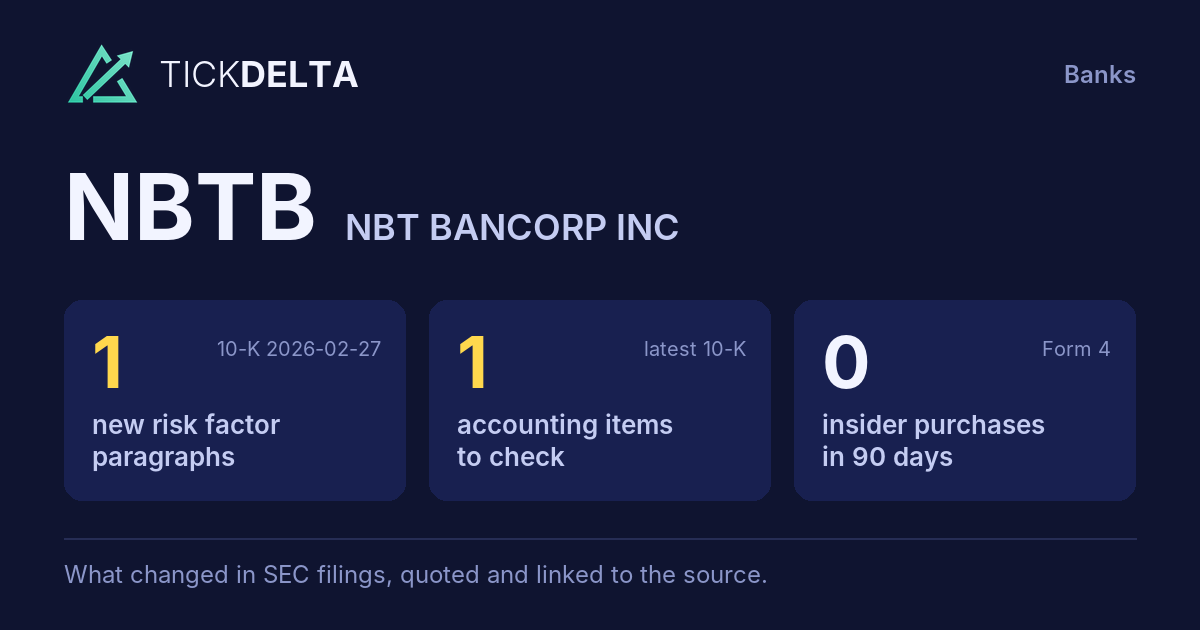
Screener / SEC EDGAR /CIK 0000790359 /10-K filed Feb 27, 2026, compared with Feb 28, 2025 /Numbers from the XBRL of the 10-Ks
Nasdaq Financials · Banks

NBT Bancorp Inc NBTB

Compare with peers Embed
The 10-K against last year's

172 changes: 10 added, 45 removed, 116 reworded, 1 quiet changes

10-K Feb 27, 2026 vs Feb 28, 2025

10-K 0001140361-26-007179 (Feb 27, 2026) vs 10-K 0001140361-25-006528 (Feb 28, 2025) Not compared: Legal Proceedings.

Every paragraph, and how much of it changed

One bar per paragraph, in the order of the 10-K. Height and colour show the share of its words not in the closest paragraph a year earlier; the tallest bars are new paragraphs.

Risk Factors

81 paragraphs · 1 new · 8 reworded · 30 gone · 10-K Feb 27, 2026 against Feb 28, 2025
New paragraph Reworded (5% of its words or more) Same or nearly
Paragraph 69 · 14% changed Every version of it
We or our third-party providers may develop or incorporate AI technology in certain business processes, services, or products. The development and use of AI poses a number of risks and challenges to our business. The legal and regulatory environment relating to AI is uncertain and rapidly evolving, and we may be subject to increasing regulations related to our use of these technologies, including regulations related to privacy, data security, and intellectual property rights, which could expose us to legal risks. AI models, particularly generative AI models, may produce incorrect, biased, or misleading results, expose confidential information, or infringe on intellectual property rights. Further, we may rely on AI models developed by third parties, and, to that extent, would be subject to additional risks, including limited oversight of how these models are developed and trained and potential exposure to unauthorized data usage. If our AI models, or those developed by third parties, produce inaccurate or controversial results, we could face legal liability, regulatory scrutiny, reputational harm, or operational inefficiencies. These risks could negatively impact our business, financial results, and the perception of our security measures. The Company’s use of AI currently varies across platforms, with certain third party systems incorporating AI capabilities into routine business operations. As our adoption and internal development of AI enabled tools continues to evolve, we evaluate these technologies through our established Solutions Development Lifecycle (SDLC), which includes model validation and other risk management controls.
Paragraph 47 · 12% changed Every version of it
The EGRRCPA, Economic Growth, Regulatory Reform and Consumer Protection Act (“EGRRCPA”), which was enacted in 2018, amended the Dodd-Frank Act to raise the $10 billion stress testing threshold to $250 billion, among other things. The federal financial regulators issued final rules in 2019 to increase the threshold for these stress testing requirements from $10 billion to $250 billion, consistent with the EGRRCPA.
Paragraph 75 · 8% changed Every version of it
the difficulty of integrating operations and personnel (including the operations and personnel of Evans) and the potential loss of key employees;

MD&A

128 paragraphs · 9 new · 63 reworded · 15 gone · 10-K Feb 27, 2026 against Feb 28, 2025
New paragraph Reworded (5% of its words or more) Same or nearly
Paragraph 97 · 46% changed
The allowance for credit losses was 224.73% 266.81% of nonperforming loans at December 31, 2024 2025 as compared to 302.05% at December 31, 2023. The allowance for credit losses was 253.17% of nonaccrual loans at December 31, 2024 as compared to 334.38% at December 31, 2023. The decline in the coverage of the allowance to nonperforming and nonaccrual loans from December 31, 2023 to December 31, 2024 largely relates to one nonperforming relationship with an amortized cost basis of $14.0 million that is individually evaluated for purposes of the allowance for credit losses which had no reserve established 224.73% at December 31, 2024.
Paragraph 125 · 43% changed
The On October 27, 2025, the Company’s Board of Directors authorized and approved an amendment to the Company’s stock repurchase program. Pursuant to the amended stock repurchase program, the Company purchased 7,600 may repurchase up to 2,000,000 shares of its the Company’s common stock during with all repurchases under the year ended stock repurchase program to be made by December 31, 2024 at an average price of $33.02 per share under its previously announced share repurchase program. 2027. The Company may repurchase shares of its common stock from time to time to mitigate the potential dilutive effect effects of stock-based incentive plans and other potential uses of common stock for corporate purposes. The Company did not purchase any shares of its common stock during the fourth quarter of 2024. As of December 31, 2024, there were 1,992,400 shares available for repurchase under this plan authorized on December 18, 2023, which is set to expire on December 31, 2025.
Paragraph 20 · 43% changed
On August 11, 2023, NBT May 2, 2025, the Company completed its the acquisition of Salisbury. Salisbury Bank Evans, through the merger of Evans with and into the Company, with the Company surviving the merger. Total consideration for the acquisition was $221.8 million in common stock. Evans, with assets of $2.19 billion at December 31, 2024, was headquartered in Williamsville, New York. Its primary subsidiary, Evans Bank, was a Connecticut-chartered commercial bank headquartered federally-chartered national banking association operating 18 banking locations in Lakeville, Connecticut, operating 13 banking offices Western New York. The acquisition enhances the Company’s presence in northwestern Connecticut, the Hudson Valley region of Western New York, including the Buffalo and southwestern Massachusetts. Rochester communities. In connection with the acquisition, the Company issued 4.32 5.1 million shares of common stock and acquired approximately $1.46 billion $131.2 million of identifiable net assets, including $1.18 $1.67 billion of loans, $122.7 $255.5 million in AFS investment securities securities, which were sold immediately after during the merger, $31.2 second quarter of 2025, $33.2 million of core deposit intangibles and $4.7 million in a wealth management customer intangible, as well as $1.31 $1.86 billion in deposits. As of the acquisition date, the fair value discount was $78.7 $95.2 million for loans, net of the reclassification of the purchase credit deteriorated allowance, PCD allowance and was $3.0 $0.6 million for subordinated net discount related to long-term debt. The Company established a $14.5 million allowance for acquired Salisbury loans which included both the $5.8 million allowance for PCD loans reclassified from loans and the $8.8 million allowance for non-PCD loans recognized through the provision for loan losses.
Paragraph 76 · 38% changed
Noninterest income for the year ended December 31, 2024 2025 was $176.8 $195.5 million, up $34.6 $18.7 million, or 24.4%, 10.6%, from the year ended December 31, 2023. 2024. Excluding net securities gains (losses), noninterest income for the year ended December 31, 2024 2025 was $174.0 $195.3 million, up $22.5 $21.3 million, or 14.9%, 12.2%, from the year ended December 31, 2023. 2024. The increase from the prior year was primarily due to an increase in retirement plan administration fees, wealth management fees and wealth management fees. bank owned life insurance income. The increase in retirement plan administration fees was driven by higher market level, values of assets under administration, organic growth and the acquisition of Retirement Direct, LLC and PACO, Inc., organic growth and higher activity-based fees. a small TPA business in the fourth quarter of 2024. The increase in wealth management fees was driven by market performance and growth in new customer accounts. Bank owned life insurance income increased due to $2.7 million in additional gains recognized in 2025. Service charges on deposit accounts, card services income and other noninterest income increased from 2024 primarily due to the addition Evans acquisition. Included in other noninterest income for the year ended December 31, 2025 was a $0.6 million gain related to the finalization of Salisbury revenues, organic growth and market performance. a third-party contractual arrangement.
Paragraph 101 · 38% changed
Total nonperforming assets were $52.1 million at December 31, 2025, compared to $51.8 million at December 31, 2024, compared to $37.9 million at December 31, 2023. 2024. Nonperforming loans at December 31, 2024 2025 were $51.7 million or 0.45% of total loans, compared with $51.6 million or 0.52% of total loans, compared with $37.9 loans at December 31, 2024. The increase in nonperforming assets from the prior year was primarily attributable to the addition of nonperforming loans acquired from the Evans acquisition, an increase in loans 90 days or more past due and an increase in OREO, partially offset by a decrease in nonaccrual loans. Total nonaccrual loans were $44.6 million or 0.39% 0.38% of total loans at December 31, 2023. The increase in nonperforming assets 2025, compared to $45.8 million or 0.46% of total loans at December 31, 2024. Past due loans as a percentage of total loans was 0.38% at December 31, 2025, up from 0.34% of total loans at December 31, 2024.
Paragraph 34 · 38% changed
Period end total deposits were $11.55 $13.50 billion, up $577.8 million, $1.95 billion, or 5.3%, 16.9%, from December 31, 2023. 2024, including $1.86 billion in deposits acquired from Evans. The loan to deposit ratio was 85.9% as of December 31, 2025 and 86.3% as of December 31, 2024.
Paragraph 115 · 37% changed
The Company records all derivatives at fair value on the consolidated balance sheet. sheet at fair value. The accounting for changes in the fair value of derivatives depends on the intended use of the derivative, whether the Company has elected to designate a derivative in a hedging relationship and apply hedge accounting and whether the hedging relationship has satisfied the criteria necessary to apply hedge accounting. Derivatives designated and qualifying as a hedge of the exposure to changes in the fair value of an asset, liability or firm commitment attributable to a particular risk, such as interest rate risk, are considered fair value hedges. The Company may enter into derivative contracts that are intended to economically hedge certain of its risks, even if hedge accounting does not apply or if the Company elects not to apply hedge accounting. For derivatives designated as fair value hedges, changes in the fair value of the derivative and the hedged item related to the hedged risk are recognized in earnings.
Paragraph 98 · 34% changed
The provision for loan losses was $32.3 million for the year ended December 31, 2025, compared to $19.6 million for the year ended December 31, 2024, compared to $25.3 million for the year ended December 31, 2023. 2024. Provision expense decreased increased from the prior year primarily due to the $8.8 $13.0 million of acquisition-related provision for loan losses due to the Salisbury acquisition recorded for non-PCD loans acquired from Evans and a deterioration in 2023, providing for current year loan growth, the slowing of prepayment speed assumptions in the current year, changes in model assumptions including the extension of the expected duration of the portfolio. economic forecasts. Net charge-offs totaled $18.0 million for 2024, up from $16.8 million in 2023. 2025 and 2024. Net charge-offs to average loans was 16 bps for 2025 compared to 18 bps for 2024 compared to 19 bps for 2023. 2024.

A paragraph is matched with the one last year that shares the most of its words; under half in common makes it new. The paragraphs shown are the 3 reworded the most in each section.

The paragraph that changed most in each section

The redline

Marked against last year's 10-K: cut words struck through, new words highlighted.

MD&A248 words changed in this paragraph; it is 65% similar to last year's version.
One of the most significant judgments involved in estimating the Company’s allowance for credit losses relates to the macroeconomic forecasts used to estimate expected credit losses over the forecast period. As of December 31, 2024, 2025, the quantitative model incorporated a baseline economic outlook along with an alternative upside scenario and two equally weighted downside scenario scenarios, recessionary conditions and stagflation, sourced from a reputable third-party to accommodate other potential economic conditions in the model. At December 31, 2024, 2025, the weightings were 80% 65%, 5% and 20% 30% for the baseline baseline, upside and downside economic forecasts, forecast scenarios, respectively. The baseline outlook reflected a Northeast an economic environment where the northeast unemployment rate environment starting at 4.1% and increasing slightly during increases from 4.5% in the first quarter of 2026 to 4.8% by the end of the forecast period to 4.2%. Northeast GDP’s period, with a peak northeast unemployment rate of 4.9% in the fourth quarter of 2026. National GDP annualized growth (on a quarterly basis) is expected to start the first quarter of 2025 2026 at approximately 3.8% before decreasing 2.55% and decrease to a low of 2.6% in the third quarter of 2025 and then increasing to 3.9% 1.8% by the end of the forecast period. Key assumptions in the baseline economic outlook included two the Federal Reserve cutting rates with one 25 basis point federal funds rate cuts in 2025, quantitative tightening ending in early 2025, a post-election fiscal outlook with lower spending, lower taxes, and higher tariffs, cut at the December meeting and the economy currently being near remaining at full employment. The alternative upside scenario assumes improved economic conditions from the baseline outlook. Under this scenario, northeast unemployment falls from 4.4% in the fourth quarter of 2025 to 4.0% in the second quarter of 2026 and eventually settles at 4.1% by the end of the forecast period. The alternative downside scenario assumed with recessionary conditions assumes deteriorated economic conditions from the baseline outlook. Under this scenario, Northeast northeast unemployment increases rises from 4.4% in the fourth quarter of 2025 to a peak of 7.5% 7.8% in the first quarter of 2026. 2027. The alternative downside stagflation scenario assumes deteriorated economic conditions from the baseline outlook. Under this scenario, northeast unemployment rises from 4.4% in the fourth quarter of 2025 to 6% by the end of the forecast period in the second quarter of 2027, with a peak northeast unemployment rate of 8.2% in the first quarter of 2028. These scenarios and their respective weightings are evaluated at each measurement date and reflect management’s expectations as of December 31, 2024. 2025. Additional qualitative adjustments were made for factors not incorporated in the forecasts or the model, such as loss rate expectations for certain loan pools, considerations reversion adjustments for inflation the stagflation scenario and recent trends in asset value indices. Additional monitoring for industry concentrations, loan growth and policy exceptions was also conducted.

Source: Item 7, 10-K 0001140361-26-007179 vs Item 7, 10-K 0001140361-25-006528

Accounting Policies203 words changed in this paragraph; it is 60% similar to last year's version.
Other Consumer – The Other Consumer loan segment consists primarily of unsecured consumer loans and direct consumer loans. The Company offers unsecured consumer loans across a national footprint originated through our relationships with national technology-driven consumer lending companies to finance such things as dental and medical procedures, K-12 tuition and other consumer purpose loans. Advances of credit through this business line are subject to the Company’s underwriting standards including criteria such as FICO score and debt to income thresholds. Advances of credit through this business line are to prime borrowers and are subject to the Company’s underwriting standards. Typically, the Company collects origination fees that are deferred and recognized into interest income over the estimated life of the loan. The Company offers a variety of direct consumer installment loans to finance various personal expenditures. In addition to installment loans, the Company also offers personal lines of credit, overdraft protection, debt consolidation, education and other uses. Direct consumer installment loans carry a fixed rate of interest with principal repayment terms typically ranging from one to fifteen years, based upon the nature of the collateral and the size of the loan. Consumer installment loans are often secured with collateral consisting of a perfected lien on the asset being purchased or a perfected lien on a consumer’s deposit account. Risk is reduced through underwriting criteria, which include credit verification, appraisals, a review of the borrower’s financial condition and personal cash flows. A security interest, with title insurance when necessary, is taken in the underlying real estate. The Company previously offered unsecured consumer loans across a national footprint originated through our relationships with national technology-driven consumer lending companies to finance such things as dental and medical procedures, K-12 tuition and other consumer purpose loans. Advances of credit through this business line were subject to the Company’s underwriting standards including criteria such as FICO score and debt to income thresholds. Advances of credit through this business line were to prime borrowers and are subject to the Company’s underwriting standards. Typically, the Company collects origination fees that are deferred and recognized into interest income over the estimated life of the loan.

Source: Item 8, Note 1 – Summary of Significant Accounting Policies, 10-K 0001140361-26-007179 vs Item 8, Note 1 – Summary of Significant Accounting Policies, 10-K 0001140361-25-006528

Risk Factors67 words changed in this paragraph; it is 43% similar to last year's version.
Given that climate change could impose systemic risks upon the financial sector, either via disruptions in economic activity resulting from the physical impacts of climate change or changes in policies as the economy transitions to a less carbon-intensive environment, the Company may face regulatory risk of increasing focus on the Company’s resilience to climate-related risks, including in the context of stress testing for various climate stress scenarios. Ongoing legislative or regulatory uncertainties and changes regarding climate risk management and practices may result in higher regulatory, compliance, credit and reputational risks and costs.

Source: Item 1A, 10-K 0001140361-26-007179 vs Item 1A, 10-K 0001140361-25-006528

Sentences and paragraphs added, removed or reworded

Every change, by type

Sentences and paragraphs of NBTB's Risk Factors and MD&A, 10-K Feb 27, 2026 against 10-K Feb 28, 2025. Each links to the text at sec.gov.

Quiet changes are sentences kept from last year with one to four words changed, at least one of them a hedge, a modal or a qualifier (may, could, will, not, significant, material…). A year or date rolling forward is not counted.

The full word list

adverse, adversely, all, although, anticipate, anticipates, any, approximately, believe, believes, can, cannot, certain, could, expect, expects, generally, however, if, intend, intends, largely, likely, many, material, materially, may, might, most, must, never, no, not, possible, primarily, probable, should, significant, significantly, some, substantial, substantially, unlikely, will, would

AddedRisk Factors
Ongoing legislative or regulatory uncertainties and changes regarding climate risk management and practices may result in higher regulatory, compliance, credit and reputational risks and costs.
Read it in 10-K Feb 27, 2026 at sec.gov
RemovedRisk Factors
Given that climate change could impose systemic risks upon the financial sector, either via disruptions in economic activity resulting from the physical impacts of climate change or changes in policies as the economy transitions to a less carbon-intensive environment, the Company may face regulatory risk of increasing focus on the Company’s resilience to climate-related risks, including in the context of stress testing for various climate stress scenarios. Ongoing legislative or regulatory uncertainties and changes regarding climate risk management and practices may result in higher regulatory, compliance, credit and reputational risks and costs.
Read it in 10-K Feb 28, 2025 at sec.gov
RemovedRisk Factors
The market price of the Company’s common stock may decline as a result of the Merger and the market price of the Company’s common stock after the consummation of the Merger may be affected by factors different from those affecting the price of the Company’s common stock before the Merger.
Read it in 10-K Feb 28, 2025 at sec.gov
RemovedRisk Factors
The market price of the Company’s common stock may decline as a result of the Merger if the Company does not achieve the perceived benefits of the Merger or the effect of the Merger on the Company’s financial results is not consistent with the expectations of financial or industry analysts.
Read it in 10-K Feb 28, 2025 at sec.gov
RemovedRisk Factors
In addition, the consummation of the Merger will result in the combination of two companies that currently operate as independent companies. The business of the Company and the business of Evans differ. As a result, while the Company expects to benefit from certain synergies following the Merger, the Company may also encounter new risks and liabilities associated with these differences. Following the Merger, shareholders of the Company and Evans will own interests in a combined company operating an expanded business and may not wish to continue to invest in the Company, or for other reasons may wish to dispose of some or all of the Company’s common stock. If, following the effective time of the Merger, large amounts of the Company’s common stock are sold, the price of the Company’s common stock could decline.
Read it in 10-K Feb 28, 2025 at sec.gov
RemovedRisk Factors
Further, the results of operations of the Company and the market price of the Company’s common stock after the Merger may be affected by factors different from those currently affecting the independent results of operations of each of the Company and Evans and the market price of the Company’s common stock. Accordingly, the Company’s historical market prices and financial results may not be indicative of these matters for the Company after the Merger.
Read it in 10-K Feb 28, 2025 at sec.gov
RemovedRisk Factors
The Company and Evans can mutually agree to terminate the Merger Agreement at any time before the Merger has been completed, and either company can terminate the Merger Agreement if:
Read it in 10-K Feb 28, 2025 at sec.gov
Show the other 44
RemovedRisk Factors
the other party materially breaches any of its representations, warranties, covenants or other agreements set forth in the Merger Agreement (provided that the terminating party is not then in material breach of any representation, warranty, covenant or other agreement contained in the Merger Agreement), which breach is not cured within 30 days of written notice of the breach, or by its nature cannot be cured prior to the closing of the Merger, and such breach would entitle the non-breaching party not to consummate the Merger; or
Read it in 10-K Feb 28, 2025 at sec.gov
RemovedRisk Factors
the Merger is not consummated by September 15, 2025, unless the failure to consummate the Merger by such date is due to a material breach of the Merger Agreement by the terminating party.
Read it in 10-K Feb 28, 2025 at sec.gov
RemovedRisk Factors
recommends, proposes or publicly announces its intention to recommend or propose to engage in an acquisition transaction with any person other than the Company or any of its subsidiaries.
Read it in 10-K Feb 28, 2025 at sec.gov
RewordedRisk Factors
Unlike larger national or other regional banks that are more geographically diversified, the Company provides banking and financial services to customers primarily in the upstate New York areas of Norwich, Syracuse, Oneonta, Albany, Amsterdam-Gloversville, Albany, Binghamton, Utica-Rome, Plattsburgh, Buffalo, Glens Falls, Hudson Valley Valley, Ogdensburg-Massena, Oneonta, Plattsburgh, Rochester, Syracuse and Ogdensburg-Massena, Utica-Rome, the northeastern Pennsylvania areas of Scranton and Wilkes-Barre, Berkshire County, Massachusetts, southern New Hampshire, Vermont, southern Maine and central and northwestern Connecticut.
Read it in 10-K Feb 27, 2026 at sec.gov
RewordedRisk Factors
Our branch locations and our customers’ properties may be adversely impacted by flooding, wildfires, high winds and other effects of severe weather conditions that may be caused or exacerbated by climate change. conditions.
Read it in 10-K Feb 27, 2026 at sec.gov
RewordedRisk Factors
The EGRRCPA, Economic Growth, Regulatory Reform and Consumer Protection Act (“EGRRCPA”), which was enacted in 2018, amended the Dodd-Frank Act to raise the $10 billion stress testing threshold to $250 billion, among other things.
Read it in 10-K Feb 27, 2026 at sec.gov
AddedMD&A
In July of 2025, the Company redeemed $118 million of subordinated debt that had a weighted average rate of 5.45% using existing liquidity sources. The $118 million of subordinated debt would have converted to a weighted average floating rate above 9%.
Read it in 10-K Feb 27, 2026 at sec.gov
AddedMD&A
The Company’s 2025 earnings reflected its continued ability to invest in the future while managing continued volatility in the current interest rate environment and overall economic conditions, which have presented challenges across the financial services industry. 2025 was marked by resilient economic growth and while improving modestly, persistent inflation.
Read it in 10-K Feb 27, 2026 at sec.gov
AddedMD&A
In 2025, the FOMC continued the easing cycle, which commenced in 2024, cutting the federal funds rate three times (September, October and December) by 25 bps each. Bringing the target range down from 4.25%-4.50% towards a more neutral stance of 3.50%-3.75% as inflation pressures eased but growth softened. Actions included rate cuts, open market operations to manage liquidity and adjustments to reinvestment policies for Treasury and mortgage-backed securities. The FOMC remained committed to its 2% inflation target and maximum employment goals, adjusting policy as economic data evolved. The cuts responded to a softening labor market and slowing economic growth, with rising tariffs posing inflationary risks that the FOMC aimed to manage.
Read it in 10-K Feb 27, 2026 at sec.gov
AddedMD&A
Deposit costs declined in 2025, but inversion in the midpoint of the yield curve continues to challenge interest rates for 2- to 5-year Treasuries and bank net interest margins. The good news is the long end of the Treasury maturities is currently higher than short-term rates. It is hoped that further monetary policy easing will cut short-term interest rates further. This is an encouraging sign that the interest rate environment may be finally returning to a “normal,” positively sloped yield curve.
Read it in 10-K Feb 27, 2026 at sec.gov
AddedMD&A
The rate environment in 2026 is expected to improve but remain challenging. The monetary policy pivot has begun and should continue throughout the year. Interest rates continue to normalize, and the return to a positively sloped yield curve is an encouraging sign. Deposit competition will remain fierce. The risk of recession is low. Overall, the rate environment is improving and is expected to benefit the banking industry. Future decreases in rates by the Fed will be determined by labor market conditions and the levels of inflation.
Read it in 10-K Feb 27, 2026 at sec.gov
AddedMD&A
The economic outlook for 2026 is generally positive with GDP growth in 2026 expected to be in the 2%-2.5% range driven by AI investment, strong consumer spending and potential tailwinds from loosened monetary policy. Continued heavy investment in AI and related infrastructure is expected to be a primary driver of business investment and overall growth. Despite previous headwinds, consumer spending remains strong, supported by a healthy labor market.
Read it in 10-K Feb 27, 2026 at sec.gov
AddedMD&A
On July 4, 2025, the One Big Beautiful Bill Act (the “Bill”) was enacted into law. The significant provisions of the Bill include the permanent extension and modification of certain provisions of the Tax Cuts and Jobs Act, including international tax provisions. The Bill also imposes a floor on tax deductions taken on charitable contributions. The legislation has multiple effective dates, with certain provisions effective in 2025 and others implemented in later years. The provisions of the Bill are not expected to have a material impact on our consolidated financial statements.
Read it in 10-K Feb 27, 2026 at sec.gov
AddedMD&A
During the first quarter of 2025, the Company performed an annual update to its econometric, PD/LGD models. Segment specific, multi-variate regression model inputs and assumptions were updated and recent period observed losses and behavior were incorporated into the models (“model refreshment”). The incorporation of recent observations did not have a material impact on most loan class segments except for the Auto class segment which resulted in an improvement in PD/LGD outcomes. The total allowance decreased by approximately 3% as of March 31, 2025 due to the model refreshment. Starting in the second quarter of 2025, the Company included an additional downside scenario with stagflation conditions, which is characterized as an economic environment where inflation rises alongside unemployment. Stagflation was identified as an emerging risk as tariff policies impacted the economy.
Read it in 10-K Feb 27, 2026 at sec.gov
RemovedMD&A
Subject to the terms and conditions of the Merger Agreement, which has been approved by the boards of directors of each party, Evans will merge with and into the Company, with the Company as the surviving entity, and immediately thereafter, Evans Bank will merge with and into the Bank, with the Bank as the surviving bank (the “Merger”).
Read it in 10-K Feb 28, 2025 at sec.gov
RemovedMD&A
Under the terms of the Merger Agreement, each outstanding share of Evans common stock will be converted into the right to receive 0.91 shares of the Company’s common stock. In December 2024, the Company announced that it had received the regulatory approval from the OCC and the waiver from Federal Reserve Bank of New York necessary to complete its acquisition of Evans. Also in December 2024, the shareholders of Evans voted to approve the Merger. Evans reported over 75% of the issued and outstanding shares of Evans were represented at a special shareholder meeting and over 96% of the votes cast were voted to approve the Merger. NBT and Evans anticipate closing the transaction in second quarter of 2025 in conjunction with the core system conversion, pending customary closing conditions.
Read it in 10-K Feb 28, 2025 at sec.gov
RemovedMD&A
Years Ended December 31, (In thousands, except per share data) 2024 2023 2022 Return on average tangible common equity: Net income $ 140,641 $118,782 $151,995 Amortization of intangible assets (net of tax) 6,332 3,551 1,698 Net income, excluding intangible amortization $ 146,973 $122,333 $153,693 Average stockholders’ equity $ 1,468,861 $1,272,333 $1,199,383 Less: average goodwill and other intangibles 399,989 332,667 289,238 Average tangible common equity $ 1,068,872 $939,666 $910,145 Return on average tangible common equity 13.75% 13.02% 16.89% Tangible equity ratio: Stockholders’ equity $ 1,526,141 $1,425,691 $1,173,554 Intangibles 399,023 402,294 288,545 Assets $ 13,786,666 $13,309,040 $11,739,296 Tangible equity ratio 8.42% 7.93% 7.73% Tangible book value: Stockholders’ equity $ 1,526,141 $1,425,691 $1,173,554 Intangibles 399,023 402,294 288,545 Tangible equity $ 1,127,118 $1,023,397 $885,009 Diluted common shares outstanding 47,195 47,110 42,858 Tangible book value per share $ 23.88 $21.72 $20.65 Operating net income: Net income $ 140,641 $118,782 $151,995 Acquisition expenses 1,531 9,978 967 Acquisition-related provision for credit losses - 8,750 - Acquisition-related reserve for unfunded loan commitments - 836 - Impairment of a minority interest equity investment - 4,750 - Securities (gains) losses (2,789) 9,315 1,131 Adjustment to net income $ (1,258) $33,629 $2,098 Adjustment to net income (net of tax) $ (984) $25,965 $1,623 Operating net income $ 139,657 $144,747 $153,618 Operating diluted earnings per share $ 2.94 $3.23 $3.56
Read it in 10-K Feb 28, 2025 at sec.gov
RemovedMD&A
The Company’s 2024 earnings reflected its continued ability to invest in the Company’s future while managing significant volatility in the interest rate environment and overall economic conditions, which have presented challenges across the financial services industry. 2024 was marked by resilience for both economic growth and inflation. Entering the year, forecasts called for a slowing economy and a moderation in inflation due to the rapid change in interest rates engineered by the FRB throughout 2022-2023. GDP growth rate of 1.6% in the first quarter of 2024 was weak, but growth strongly rebounded with 3.0% and 2.8% growth in the second and third quarters, respectively. Overall, 2024 annualized economic growth was 2.8%, a full percentage point higher than initial forecasts. At the same time, inflation continued to trend lower in the first half of 2024. However, that improvement stalled in the second half of the year, with the Core Personal Consumption Expenditure index increasing from 2.6% to 2.8% over the last 5 months of the year. The combination of stronger-than-expected GDP growth and stubborn inflation forced the FRB to delay their pivot to an easier monetary policy that was anticipated in 2024. The yield curve remained inverted through the majority of 2024. However, in September of 2024 the FOMC lowered the Federal Funds rate by 50 bps followed by consecutive 25 bps reductions in November and December of 2024. These rate cuts flattened the yield curve, and in some instances, led to a modestly upward-sloping yield curve at certain term points.
Read it in 10-K Feb 28, 2025 at sec.gov
RemovedMD&A
Economic indicators remained mixed, but trended toward an improved yet elevated level of inflation. While inflation has declined, continued economic resilience has lowered the probability of further Federal Funds rate reductions in 2025. The “higher for longer” interest rate environment is expected to persist, though strong consumer and corporate balance sheets suggest that any potential economic slowdown may be mild. Significant items that may have an impact on 2025 results include:
Read it in 10-K Feb 28, 2025 at sec.gov
RemovedMD&A
ο cost of deposits as well as overall cost of funds could continue to negatively impact NIM. While the recent decline to short-term interest rates may allow for some continued cost of funds reductions, the elevated level of relative interest rates and the bank failures in early 2023 continue to pressure competition for deposits as well as the associated cost of funds;
Read it in 10-K Feb 28, 2025 at sec.gov
RemovedMD&A
ο higher short-term interest rates as compared to recent history have continued to afford deposit customers investment opportunities outside the banking system resulting in deposit declines across the industry, however, a decline to short-term interest rates could potentially mitigate this;
Read it in 10-K Feb 28, 2025 at sec.gov
RewordedMD&A
Interest expense was up $67.0 decreased $2.1 million, or 46.3%, 1.0%, for the year ended December 31, 2024 2025 as compared to the year ended December 31, 2023, 2024 driven by interest-bearing deposit costs increasing 80 bps to 2.36% and a $1.22 billion increase in interest-bearing deposits as a result of the Salisbury acquisition, partly offset by a decrease of $346.4 million in the decreasing 27 bps, lower average balances of short-term borrowings and the 548 bps rate paid on those borrowings. lower average balances of subordinated debt.
Read it in 10-K Feb 27, 2026 at sec.gov
RewordedMD&A
These increases to In addition, the allowance for credit losses were increased due to deterioration in the economic forecast including the change in the forecast scenarios and weightings, partially offset by a change in forecast scenario weightings from 70% baseline and 30% downside to 80% baseline and 20% downside, and the shift in loan composition driven by other consumer and residential solar portfolios that are in a planned run-off status.
Read it in 10-K Feb 27, 2026 at sec.gov
RewordedMD&A
The average balance of Excluding the loans increased by approximately $1.01 billion, or 11.5%, acquired from 2023 to 2024 driven by Evans, the Salisbury acquisition and organic loan growth, with increases in C&I, CRE, C&I and indirect auto and residential mortgage portfolios being partially were offset by a reduction in the average balance of residential solar and other consumer loans.
Read it in 10-K Feb 27, 2026 at sec.gov
RewordedMD&A
In connection with the acquisition, the Company issued 4.32 5.1 million shares of common stock and acquired approximately $1.46 billion $131.2 million of identifiable net assets, including $1.18 $1.67 billion of loans, $122.7 $255.5 million in AFS investment securities securities, which were sold immediately after during the merger, $31.2 second quarter of 2025, $33.2 million of core deposit intangibles and $4.7 million in a wealth management customer intangible, as well as $1.31 $1.86 billion in deposits.
Read it in 10-K Feb 27, 2026 at sec.gov
RewordedMD&A
Northeast GDP’s National GDP annualized growth (on a quarterly basis) is expected to start the first quarter of 2025 2026 at approximately 3.8% before decreasing 2.55% and decrease to a low of 2.6% in the third quarter of 2025 and then increasing to 3.9% 1.8% by the end of the forecast period.
Read it in 10-K Feb 27, 2026 at sec.gov
RewordedMD&A
To demonstrate the sensitivity of the allowance for credit losses estimate to macroeconomic forecast weightings assumptions as of December 31, 2024, 2025, the Company attributed changed the change in scenario weightings to the change in the allowance for credit losses, weightings, with a 10% decrease increase to the downside scenario scenarios, equally weighted, and a 10% increase decrease to the baseline scenario causing a 4% decrease increase in the overall estimated allowance for credit losses.
Read it in 10-K Feb 27, 2026 at sec.gov
RewordedMD&A
The decrease increase in the effective tax rate from 2023 2024 was primarily due to a the higher level of tax-exempt pretax income as a percentage and the impact of total taxable income. certain nondeductible acquisition expenses related to the Evans acquisition.
Read it in 10-K Feb 27, 2026 at sec.gov
RewordedMD&A
The provision for loan losses was $32.3 million for the year ended December 31, 2025, compared to $19.6 million for the year ended December 31, 2024, compared to $25.3 million for the year ended December 31, 2023. 2024.
Read it in 10-K Feb 27, 2026 at sec.gov
RewordedMD&A
This increase decrease in rates caused an increase a decrease in interest expense of $67.0 $2.1 million, or 46.3%, 1.0%, from $144.6 million in 2023 to $211.5 million in 2024. 2024 to $209.4 million in 2025.
Read it in 10-K Feb 27, 2026 at sec.gov
RewordedMD&A
Nonperforming loans at December 31, 2024 2025 were $51.7 million or 0.45% of total loans, compared with $51.6 million or 0.52% of total loans, compared with $37.9 million or 0.39% of total loans at December 31, 2023. 2024.
Read it in 10-K Feb 27, 2026 at sec.gov
RewordedMD&A
At December 31, 2024, 2025, the Company’s Basic Surplus measurement was 17.0% 18.7% of total assets, or $2.34 $2.98 billion, as compared to the December 31, 2023 2024 Basic Surplus of 11.6%, 17.0%, or $1.54 $2.34 billion, and was above the Company’s minimum of 5% (calculated at $799.8 million and $689.3 million and $665.5 million, of period end total assets as of December 31, 2024 2025 and December 31, 2023, 2024, respectively) set forth in its liquidity policies.
Read it in 10-K Feb 27, 2026 at sec.gov
RewordedMD&A
The allowance for credit losses on unfunded commitments totaled $5.8 million as of December 31, 2025, compared to $4.4 million as of December 31, 2024, compared to $5.1 million as of December 31, 2023. 2024.
Read it in 10-K Feb 27, 2026 at sec.gov
Quiet changesMD&A
The Company may enter into derivative contracts that are intended to economically hedge certain of its risks, even if though hedge accounting does not apply or if the Company elects not to apply hedge accounting.
Read it in 10-K Feb 27, 2026 at sec.gov

Sources

The two latest 10-Ks on EDGAR, section by section. Each change links to the text at sec.gov.

Also

New risk factors: paragraphs with nothing like them last year, quoted in full.

Work with it

Excel workbook · CSV. Google Sheet that stays up to date: paste =IMPORTDATA("https://tickdelta.com/company/NBTB/export.csv") into a cell.

Next:Related parties
Esc

Type a ticker such as AAPL, a name, an investor such as Buffett, or a topic such as tariffs. ↑ ↓ to move, Enter to open.