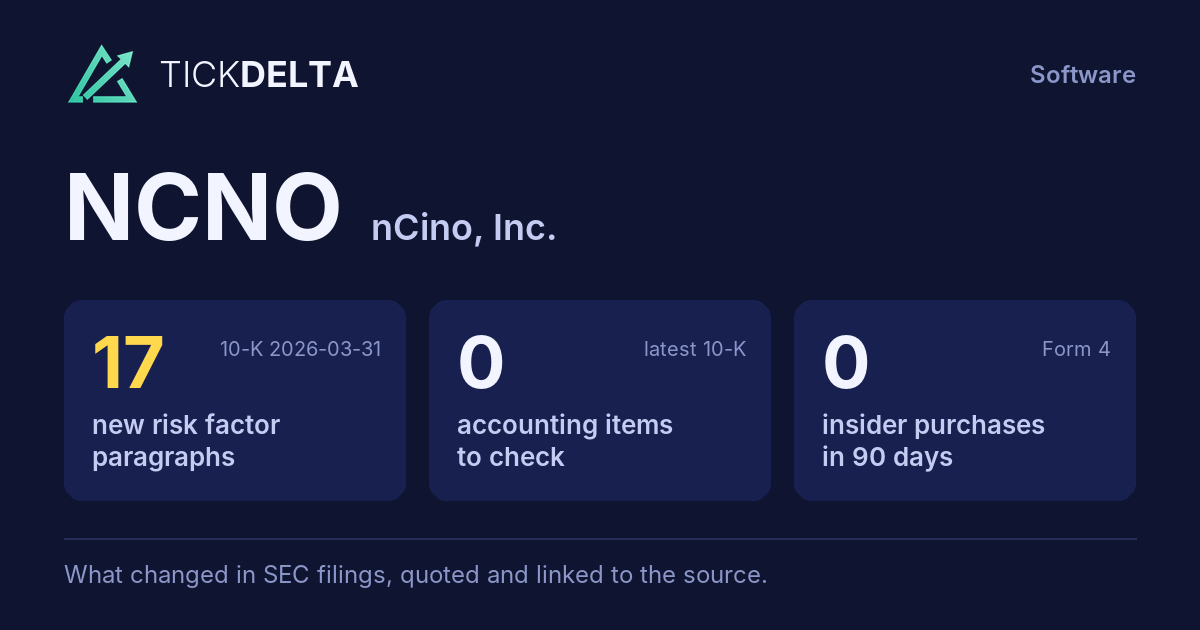
Screener / SEC EDGAR /CIK 0001902733 /10-K filed Mar 31, 2026, compared with Apr 1, 2025 /Numbers from the XBRL of the 10-Ks
Nasdaq Technology · Software

nCino, Inc. NCNO

Compare with peers Embed
The 10-K against last year's

208 changes: 52 added, 27 removed, 128 reworded, 1 quiet changes

10-K Mar 31, 2026 vs Apr 1, 2025

10-K 0001902733-26-000022 (Mar 31, 2026) vs 10-K 0001902733-25-000026 (Apr 1, 2025)

Every paragraph, and how much of it changed

One bar per paragraph, in the order of the 10-K. Height and colour show the share of its words not in the closest paragraph a year earlier; the tallest bars are new paragraphs.

Risk Factors

221 paragraphs · 17 new · 80 reworded · 13 gone · 10-K Mar 31, 2026 against Apr 1, 2025
New paragraph Reworded (5% of its words or more) Same or nearly
Paragraph 172 · 49% changed Every version of it
The rules dealing with U.S. federal, state, and local income taxation are constantly under review by persons involved in the legislative process and by the Internal Revenue Service and the U.S. Treasury Department. Changes to tax laws (which changes may have retroactive application) and new regulations or interpretations could adversely affect us or holders of our common stock. In recent years, many such changes have been made and changes are likely to continue to occur in the future. For example, the Tax Cuts United States Inflation Reduction Act, among other changes, introduced a 15% corporate minimum tax on certain United States corporations and Jobs a 1% excise tax on certain stock redemptions by certain publicly traded corporations. More recently, in July 2025, the U.S. enacted the One Big Beautiful Bill Act was enacted in 2017 and (“OBBBA”), which made a number of significant changes to the current U.S. federal income tax rules, including reducing Code. Among other provisions, the generally applicable corporate tax rate from 35% to 21%, imposing additional limitations on OBBBA restored the immediate deductibility of interest, placing limits on domestic research and experimental (“R&E”) expenditures for tax years beginning after December 31, 2024, while retaining the utilization of NOLs, requirement to capitalize and making substantial amortize foreign R&E expenditures. The OBBBA also introduced other complex tax provisions, including changes to provisions relating to income from non-U.S. subsidiaries. Although the international tax rules. In addition, on March 27, 2020, the CARES Act was signed into law, which included certain changes in tax law intended to stimulate the U.S. economy in light full impact of the COVID-19 pandemic, including temporary beneficial OBBBA will depend on future regulatory guidance and implementation, these changes to the treatment of net operating losses, interest deductibility limitations, may materially affect our effective tax rate, deferred tax balances, and payroll tax matters. Many of the provisions of the Tax Cuts and Jobs Act still require guidance through the issuance and/or finalization of regulations by the U.S. Treasury Department in order to fully assess their effects, and there may be substantial delays before such regulations are promulgated and/or finalized, increasing the uncertainty as to the ultimate effects of the Tax Cuts and Jobs Act on us and our stockholders. There also may be technical corrections cash taxes.
Paragraph 46 · 48% changed Every version of it
We have a history of losses, and while we have achieved profitability in a quarterly period, we may not be able to achieve sustain or sustain profitability on a GAAP basis increase our revenue growth rate in the future.
Paragraph 169 · 44% changed Every version of it
We have incurred substantial net operating losses (“NOLs”), (“NOLs”) during our history. U.S. federal and certain state NOLs generated in taxable years beginning after December 31, 2017 are not subject to expiration. Federal NOLs generally may not be carried back to prior taxable years except that, under the Coronavirus Aid, Relief and Economic Security (CARES) Act, federal NOLs generated in tax years 2018, 2019, and 2020 may be carried back to each of the five taxable years preceding the taxable year in which the loss arises. years. Additionally, for taxable years beginning after December 31, 2020, 2017, the deductibility of federal NOLs is limited to 80% of our taxable income in such taxable year. NOLs generated in tax years before 2018 may still be used to offset future taxable income without regard to the 80% limitation, although they have the potential to expire without being utilized if we do not achieve sustain profitability in the future. However, under the rules of Sections 382 and 383 of the Internal Revenue Code of 1986, as amended (the “Code”), if a corporation undergoes an “ownership change,” generally defined as a greater than 50% change (by value) in its equity ownership over a three-year period, the corporation’s ability to use its NOLs, pre-change tax attributes and any net unrealized built-in losses to offset its post-change taxable income or taxes may be limited. The applicable rules generally operate by focusing on changes in ownership among stockholders considered by the rules as owning, directly or indirectly, 5% or more of the stock of a company, as well as changes in ownership arising from new issuances of stock by the company. The rules of Section 382 are regularly being evaluated to determine any potential limitations. If we experience one or more ownership changes as a result of future transactions in our stock, then we may be limited in our ability to use our NOL carryforwards, pre-change tax attributes or deductions to offset our future taxable income, if any.
Paragraph 109 · 43% changed Every version of it
We have and may acquire or invest in companies, or pursue business partnerships, which may divert our management’s attention or result in dilution to our stockholders, and we may be unable to integrate acquired businesses and technologies successfully or achieve the expected benefits of such acquisitions, investments, partnerships, or partnerships. divestitures.
Paragraph 120 · 43% changed Every version of it
In the future, we may become subject, from time to time, to legal proceedings and claims that arise in the ordinary course of business, such as claims brought by our customers in connection with commercial disputes or employment claims made by current or former employees. Legal proceedings might result in damages and harm to our operations and prospects, reputational damage, substantial costs, and may divert management’s attention and resources, which might adversely impact our business, overall financial condition, and results of operations. Insurance might not cover such claims, might not provide sufficient payments to cover all the costs to resolve one or more such claims, and might not continue to be available on terms acceptable to us. Moreover, any negative impact to our reputation will not be adequately covered by any insurance recovery. A claim brought against us that is uninsured or underinsured could result in unanticipated costs, thereby reducing our results of operations and leading analysts or potential investors to reduce their expectations of our performance, which could reduce the value of our common stock.
Paragraph 45 · 41% changed Every version of it
The cloud-based financial services industry is subject to rapid change and the introduction of new technologies to meet the needs of this industry will continue to have a significant effect on competitive conditions in our market. The introduction of new technologies, including AI/ML, continues to significantly affect competitive conditions. Competitors may introduce new or alternative solutions, particularly AI-enabled offerings, that reduce demand for our platform or render aspects of our solutions less competitive. If we are unable to successfully expand our product offerings beyond our current solutions, offerings, enhance existing functionality or develop and commercialize new technologies in a timely and cost-effective manner, our customers could migrate to competitors who may offer a broader or more attractive range of products and services. For example, in fiscal 2025, we launched our Commercial Onboarding and Account Opening solution and we may fail to achieve the market acceptance we expect of this offering. Unexpected delays or other new offerings. Developing and integrating new technologies, particularly AI/ML-enabled capabilities, is complex, costly, and time-consuming and may require significant investment in releasing new or enhanced versions of our solutions, or errors following their release, could result in loss of sales, delay in market acceptance, or customer claims against us, any of which could adversely affect our business. The success of any new solution depends on several factors, including timely completion, adequate quality testing, specialized personnel, data, infrastructure, and market acceptance. We may not be able to enhance aspects of our solutions successfully or introduce and gain market acceptance of new solutions or improvements in a timely manner, or at all. Additionally, third-party technology. If we must continually modify and enhance our solutions fail to keep pace with changes in software solutions, database technology, industry and evolving technical standards and interfaces. Uncertainties related to technological developments, our ability to introduce and improve functionality, announcements or introductions of a new or updated solution, or modifications by our competitors could adversely affect our business business, financial condition, and results of operations. operations could be adversely affected.
Paragraph 59 · 40% changed Every version of it
We must attract and retain highly qualified personnel. In particular, we are dependent upon the services of our senior leadership team, and the loss of any member of this team could adversely affect our business. Competition for executive officers, software developers, sales personnel, and other key employees in our industry is intense. intense, particularly with AI/ML expertise. In particular, we compete with many other companies for software developers with high levels of experience in designing, developing, and managing cloud-based software, as well as for skilled sales and operations professionals. Our principal operations are As we continue to incorporate AI/ML capabilities into our platform, we face heightened competition for personnel with specialized expertise in Wilmington, North Carolina, where AI and competition for such talent is intense not only within the pool financial technology industry but also across large technology companies, financial institutions, and emerging AI-focused companies, many of potential employees with the skills we need is more limited than it may be in larger markets, which have substantially greater financial resources and we are sometimes required to induce prospective employees to relocate. Many of the companies with which we compete for experienced personnel have greater resources brand recognition than we do. If we fail to attract new personnel or fail to retain and motivate our current personnel, our growth prospects could be severely harmed. In addition, job candidates and existing employees often consider the actual and potential value of the equity awards they receive as part of their overall compensation. Thus, if the perceived value or future value of our stock declines, our ability to attract and retain highly skilled employees may be adversely affected.
Paragraph 67 · 37% changed Every version of it
•Because we recognize subscription revenues over in future quarters. Accordingly, the term effect of the contract, significant downturns in sales or upturns in market acceptance of our business solutions may not be apparent in our current-quarter revenues or reflected in our results of operations until future periods.

MD&A

141 paragraphs · 35 new · 69 reworded · 14 gone · 10-K Mar 31, 2026 against Apr 1, 2025
New paragraph Reworded (5% of its words or more) Same or nearly
Paragraph 18 · 48% changed
1Includes On May 27, 2025, we announced a workforce reduction of approximately 7% and office space reductions in certain markets (collectively, the operating results “2026 Restructuring Plan”) in furtherance of DocFox, ILT and FullCircl from our efforts to improve operational efficiencies. We incurred charges of $10.1 million for the DocFox Acquisition Date, year ended January 31, 2026, in connection with the ILT Acquisition Date and the FullCircl Acquisition Date, respectively, see 2026 Restructuring Plan. See Note 6 "Business Combinations" 16 “Restructuring” of the notes to our consolidated financial statements included in Part II, Item 8 of this Annual Report on Form 10-K for additional information.
Paragraph 58 · 46% changed
Cost of professional services and other subscription revenues increased $10.3 $14.6 million for fiscal 2025 compared to fiscal 2024, 2026, generating a gross margin for professional services and other revenues of (13.2)% 71.4% compared to a gross margin of (5.3)% 71.2% for fiscal 2024. For fiscal 2025, personnel costs increased $9.0 million for professional services and other revenues compared to the prior year period, mainly from an increase in headcount and a $2.6 million increase in stock-based compensation expense. The increase in cost of professional services and other revenue also included an increase of $1.2 million in third-party costs of 2025.
Paragraph 25 · 46% changed
For fiscal 2023, 2024, 2025, and 2025, 2026, we had subscription revenue net retention rates of 144%, 116%, 110%, and 110%, respectively. The most significant driver of changes in our subscription revenue net retention rate each year has historically been Historically, the number of new customers in prior years and the associated phased activation schedules for such customers. In addition, because larger FIs tend to make more sizable purchases, we expect variability customer were a significant driver of changes in our subscription revenue net retention rates based on rate. Upon transitioning to asset-based pricing, growth in FI assets supported by nCino, the timing of deal signatures in current and extent comparative periods, and the degree to which customers expand or contract their commitments upon renewal will be more significant drivers of our continued penetration of this portion of the market. Excluding our U.S. mortgage business, the changes in subscription revenue net retention rate for fiscal 2023 was 124%. The moderation in our subscription revenue net retention rate for fiscal 2024 was due to a decline in revenues from customers adversely affected by an increase in mortgage interest rates, from the expiration of licenses utilized for forgiveness monitoring of Paycheck Protection Program loans, and from the acquisition of certain customers by entities that do not currently use our solutions. The moderation in our subscription revenue net retention rate for fiscal 2025 was due primarily to a decline in revenues from customers adversely affected by an increase in mortgage interest rates, and from the acquisition of certain customers by entities that do not currently use our solutions. rate. Our use of subscription revenue net retention rate has limitations as an analytical tool, and investors should not consider it in isolation. Other companies in adjacent markets may calculate subscription revenue net retention rates or similar metrics differently, which reduces its usefulness as a comparative measure. For fiscal 2025, we refined our methodology for calculating subscription revenue net retention rate to align with the details disclosed in Item 7 of this Annual Report on Form 10-K, “Management’s Discussion and Analysis of Financial Condition and Results of Operations—Results of Operations regarding the change in subscription revenues. Using our prior calculation methodology, subscription revenue retention rate was 148%, 117%, 112% for fiscal 2023, 2024, and 2025, respectively.
Paragraph 107 · 46% changed
The volume, price, timing, and manner of repurchases were determined at our discretion, subject to general market conditions, as well as our management of capital, general business conditions, other investment opportunities, regulatory requirements and other factors. See Note 1 "Summary of Business 8 “Stockholders’ Equity and Significant Accounting Policies" Stock-Based Compensation” of the notes to our consolidated financial statements included in Part II, Item 8 of this Annual Report on Form 10-K for recently adopted accounting pronouncements and recently issued accounting pronouncements not yet adopted, if applicable. more information.
Paragraph 62 · 44% changed
Cost of professional services and other revenues increased $10.3 $4.1 million for fiscal 2025 compared to fiscal 2024, 2026, generating a gross margin for professional services and other revenues of (13.2)% (18.7)% compared to a gross margin of (5.3)% (13.2)% for fiscal 2024. For fiscal 2025, personnel costs increased $9.0 million for primarily attributable to strategic investments in expanding our professional services service capabilities, coupled with lower effective billing and other revenues compared to the prior year period, mainly from an increase in headcount and a $2.6 million increase in stock-based compensation expense. The increase in cost of professional services and other revenue also included an increase of $1.2 million in third-party costs of utilization rates.
Paragraph 135 · 42% changed
While we use our best estimates and assumptions, our estimates are inherently uncertain and subject to refinement. As a result, during the measurement period, which may be up to one year from the acquisition date, the Company may record adjustments to the fair value of these tangible and intangible assets acquired and liabilities assumed, with the corresponding offset to goodwill. Upon conclusion of the measurement period or final determination of the fair value of assets acquired or liabilities assumed, whichever comes first, any subsequent adjustments are recorded to the Company's Company’s consolidated statements of operations. Determining the useful life of an intangible asset also requires judgment as different types of intangible assets have different lives.
Paragraph 108 · 41% changed
1Includes the operating results of DocFox, ILT and FullCircl from the DocFox Acquisition Date, the ILT Acquisition Date and the FullCircl Acquisition Date, respectively, see Subsequent to January 31, 2026, we entered into an additional $100.0 million share repurchase program to be completed under an accelerated share repurchase program effective March 31, 2026. See Note 6 "Business Combinations" 18 “Subsequent Events” of the notes to our consolidated financial statements included in Part II, Item 8 of this Annual Report on Form 10-K for additional more information.
Paragraph 101 · 40% changed
repurchase shares of our common stock. As of January 31, 2026, the applicable interest rate under the 2024 Credit Facility was 5.68%. See Note 11 "Income Taxes" 12 “Revolving Credit Facility” of the notes to our consolidated financial statements included in Part II, Item 8 of this Annual Report on Form 10-K for further details on the components of income tax and a reconciliation of the U.S. federal statutory rate to the effective tax rate. more information.

A paragraph is matched with the one last year that shares the most of its words; under half in common makes it new. The paragraphs shown are the 8 reworded the most in each section.

The paragraph that changed most in each section

The redline

Marked against last year's 10-K: cut words struck through, new words highlighted.

MD&A283 words changed in this paragraph; it is 40% similar to last year's version.
For fiscal 2023, 2024, 2025, and 2025, 2026, we had subscription revenue net retention rates of 144%, 116%, 110%, and 110%, respectively. The most significant driver of changes in our subscription revenue net retention rate each year has historically been Historically, the number of new customers in prior years and the associated phased activation schedules for such customers. In addition, because larger FIs tend to make more sizable purchases, we expect variability customer were a significant driver of changes in our subscription revenue net retention rates based on rate. Upon transitioning to asset-based pricing, growth in FI assets supported by nCino, the timing of deal signatures in current and extent comparative periods, and the degree to which customers expand or contract their commitments upon renewal will be more significant drivers of our continued penetration of this portion of the market. Excluding our U.S. mortgage business, the changes in subscription revenue net retention rate for fiscal 2023 was 124%. The moderation in our subscription revenue net retention rate for fiscal 2024 was due to a decline in revenues from customers adversely affected by an increase in mortgage interest rates, from the expiration of licenses utilized for forgiveness monitoring of Paycheck Protection Program loans, and from the acquisition of certain customers by entities that do not currently use our solutions. The moderation in our subscription revenue net retention rate for fiscal 2025 was due primarily to a decline in revenues from customers adversely affected by an increase in mortgage interest rates, and from the acquisition of certain customers by entities that do not currently use our solutions. rate. Our use of subscription revenue net retention rate has limitations as an analytical tool, and investors should not consider it in isolation. Other companies in adjacent markets may calculate subscription revenue net retention rates or similar metrics differently, which reduces its usefulness as a comparative measure. For fiscal 2025, we refined our methodology for calculating subscription revenue net retention rate to align with the details disclosed in Item 7 of this Annual Report on Form 10-K, “Management’s Discussion and Analysis of Financial Condition and Results of Operations—Results of Operations regarding the change in subscription revenues. Using our prior calculation methodology, subscription revenue retention rate was 148%, 117%, 112% for fiscal 2023, 2024, and 2025, respectively.

Source: Item 7, 10-K 0001902733-26-000022 vs Item 7, 10-K 0001902733-25-000026

Risk Factors283 words changed in this paragraph; it is 41% similar to last year's version.
The rules dealing with U.S. federal, state, and local income taxation are constantly under review by persons involved in the legislative process and by the Internal Revenue Service and the U.S. Treasury Department. Changes to tax laws (which changes may have retroactive application) and new regulations or interpretations could adversely affect us or holders of our common stock. In recent years, many such changes have been made and changes are likely to continue to occur in the future. For example, the Tax Cuts United States Inflation Reduction Act, among other changes, introduced a 15% corporate minimum tax on certain United States corporations and Jobs a 1% excise tax on certain stock redemptions by certain publicly traded corporations. More recently, in July 2025, the U.S. enacted the One Big Beautiful Bill Act was enacted in 2017 and (“OBBBA”), which made a number of significant changes to the current U.S. federal income tax rules, including reducing Code. Among other provisions, the generally applicable corporate tax rate from 35% to 21%, imposing additional limitations on OBBBA restored the immediate deductibility of interest, placing limits on domestic research and experimental (“R&E”) expenditures for tax years beginning after December 31, 2024, while retaining the utilization of NOLs, requirement to capitalize and making substantial amortize foreign R&E expenditures. The OBBBA also introduced other complex tax provisions, including changes to provisions relating to income from non-U.S. subsidiaries. Although the international tax rules. In addition, on March 27, 2020, the CARES Act was signed into law, which included certain changes in tax law intended to stimulate the U.S. economy in light full impact of the COVID-19 pandemic, including temporary beneficial OBBBA will depend on future regulatory guidance and implementation, these changes to the treatment of net operating losses, interest deductibility limitations, may materially affect our effective tax rate, deferred tax balances, and payroll tax matters. Many of the provisions of the Tax Cuts and Jobs Act still require guidance through the issuance and/or finalization of regulations by the U.S. Treasury Department in order to fully assess their effects, and there may be substantial delays before such regulations are promulgated and/or finalized, increasing the uncertainty as to the ultimate effects of the Tax Cuts and Jobs Act on us and our stockholders. There also may be technical corrections cash taxes.

Source: Item 1A, 10-K 0001902733-26-000022 vs Item 1A, 10-K 0001902733-25-000026

Legal Proceedings165 words changed in this paragraph; it is 36% similar to last year's version.
In April 2021, the Company entered into a new lease agreement The Company’s financing obligations consist of leases for the construction of an additional office building that is on the same parcel of land as the Company's existing headquarters. Due to a purchase option contained Company’s headquarters and parking deck in that April 2021 lease, which the Company is also deemed to be the owner of the additional building for accounting purposes, the costs associated with the construction of the additional building were capitalized as construction purposes. The assets and corresponding financing obligation are included in progress with a corresponding construction liability through construction. Upon completion of the additional building in November 2022, for approximately $22.4 million, the costs of the construction in progress and the corresponding construction liability were reclassified to property and equipment, net and financing obligations on the consolidated balance sheets, respectively, and sheets. During fiscal 2026, the term terms of the Company's November 2020 lease for its headquarters and the related parking deck became coterminous with the April 2021 lease. The term of the April 2021 lease expires leases were amended to expire in October 2037 2039 with options to extend. The extend and the purchase option expires was extended and will expire if not exercised on or before November 30, 2026. 2028.

Source: Item 3, via Note 13 – Commitments and Contingencies, 10-K 0001902733-26-000022 vs Item 3, via Note 15 – Commitments and Contingencies, 10-K 0001902733-25-000026

Accounting Policies121 words changed in this paragraph; it is 76% similar to last year's version.
Goodwill: Goodwill represents the excess of the purchase price in a business combination over the fair value of net assets acquired. Goodwill is not amortized, but rather the carrying amounts of these assets are assessed for impairment at least annually or whenever events or changes in circumstances indicate that the carrying value of these assets may not be recoverable. Goodwill is tested for impairment annually on November 1, the first day of the fourth quarter of the fiscal year, or more frequently if circumstances indicate an impairment may have occurred between annual impairment tests. The Company has one reporting unit, therefore the Company evaluates goodwill for impairment at the entity level. To perform its impairment testing, the Company first assesses qualitative factors to determine whether it is more likely than not that the fair value of its single reporting unit is less than its carrying amount. The qualitative factors we consider include, but are not limited to, macroeconomic conditions, industry and market conditions, company-specific events, changes in circumstances, and our share price. If the qualitative factors indicate that the fair value of the reporting unit is greater than the carrying value of the net assets assigned to the reporting unit, then we do not consider the assigned goodwill to be impaired. If it is determined that it is more likely than not that the fair value of the Company is less than the carrying amount, a quantitative assessment is performed by comparing the fair value of a reporting unit with its carrying amount. The Company may elect to bypass the qualitative assessment and perform the quantitative assessment. An impairment loss is recognized in an amount equal to the excess of the reporting unit’s carrying value over its fair value, up to the amount of goodwill allocated to the reporting unit. There is no goodwill impairment for the fiscal years ended January 31, 2023, 2024, and 2025.

Source: Item 8, Note 1 – Summary of Business and Significant Accounting Policies, 10-K 0001902733-26-000022 vs Item 8, Note 1 – Summary of Business and Significant Accounting Policies, 10-K 0001902733-25-000026

Sentences and paragraphs added, removed or reworded

Every change, by type

Sentences and paragraphs of NCNO's Risk Factors and MD&A, 10-K Mar 31, 2026 against 10-K Apr 1, 2025. Each links to the text at sec.gov.

Quiet changes are sentences kept from last year with one to four words changed, at least one of them a hedge, a modal or a qualifier (may, could, will, not, significant, material…). A year or date rolling forward is not counted.

The full word list

adverse, adversely, all, although, anticipate, anticipates, any, approximately, believe, believes, can, cannot, certain, could, expect, expects, generally, however, if, intend, intends, largely, likely, many, material, materially, may, might, most, must, never, no, not, possible, primarily, probable, should, significant, significantly, some, substantial, substantially, unlikely, will, would

AddedRisk Factors
•Our growth strategy increasingly depends on the adoption and effective use of our AI capabilities by our customers, and if customer adoption rates or usage do not meet our expectations, our business, results of operations, and competitive position could be adversely affected.
Read it in 10-K Mar 31, 2026 at sec.gov
AddedRisk Factors
Our growth strategy increasingly depends on the adoption and effective use of our AI capabilities by our customers, and if customer adoption rates or usage do not meet our expectations, our business, results of operations, and competitive position could be adversely affected.
Read it in 10-K Mar 31, 2026 at sec.gov
AddedRisk Factors
We have invested, and expect to continue to invest, significant resources in developing and integrating AI-driven features and functionality into our platform. The success of these investments depends in part on our customers’ willingness and ability to adopt, implement, and utilize our AI capabilities in a manner that generates measurable operational efficiencies, enhanced decision-making, and other tangible benefits. If customers are slow to adopt our AI offerings, choose not to enable or fully deploy AI features, or limit their usage to pilot programs or narrow use cases, we may not realize the anticipated return on our investments.
Read it in 10-K Mar 31, 2026 at sec.gov
AddedRisk Factors
Even where customers adopt our AI capabilities, they may not use them in ways that generate meaningful value. Customers may lack the internal expertise, data quality, governance frameworks, management processes, or risk tolerance necessary to effectively leverage AI-driven tools. Regulatory uncertainty, data privacy concerns, model risk management requirements, or internal compliance policies may also restrict how customers use AI functionality. If customers fail to achieve expected productivity gains, cost savings, revenue enhancements, or other benefits from our AI offerings, they may reduce usage, decline to expand deployments, delay renewals, negotiate lower pricing, or elect not to purchase additional AI-enabled solutions. If we are unable to effectively quantify and communicate the benefits of our AI capabilities, our sales cycles may lengthen, expansion opportunities may decrease, and our ability to justify pricing or drive incremental AI-related revenue may be adversely affected.
Read it in 10-K Mar 31, 2026 at sec.gov
AddedRisk Factors
Our revenue growth and competitive positioning increasingly depend on our ability to differentiate our platform through AI-enabled innovation. If customers do not broadly embrace our AI capabilities, or if competing solutions offer AI features that are perceived as more effective, easier to deploy, more transparent, more compliant, less expensive, or better aligned with customer needs, we may experience reduced demand for our solutions. Competitors, including established financial technology providers, may be able to devote greater resources to AI research and development, respond more quickly to evolving customer expectations, or offer more compelling pricing models. Failure to achieve widespread, value-generating adoption of our AI offerings could diminish our brand perception as an innovation leader and negatively impact customer acquisition, retention, and expansion.
Read it in 10-K Mar 31, 2026 at sec.gov
AddedRisk Factors
Moreover, if anticipated AI-driven efficiencies do not materialize at the pace or scale we expect, our operating margins may be adversely affected, particularly if we continue to incur significant research and development, infrastructure, and compliance costs associated with AI initiatives without corresponding revenue growth. Any of the foregoing could materially and adversely affect our business, financial condition, results of operations, and long-term growth prospects.
Read it in 10-K Mar 31, 2026 at sec.gov
Show the other 65
AddedRisk Factors
In addition, some of our customers contractually require notification of data security compromises and include representations and warranties in their contracts with us that our solutions comply with certain legal and technical standards related to data security and privacy and meet certain service levels. In certain of our contracts, a data security compromise or
Read it in 10-K Mar 31, 2026 at sec.gov
AddedRisk Factors
In addition to serving as a data center provider, AWS provides cloud infrastructure and platform services that are integral to the operation of certain of our products. AWS also serves as the primary infrastructure layer for certain of our products including our U.S. mortgage business and our artificial intelligence and machine learning capabilities, including the cloud platform services that power our AI-driven features and our agentic AI platform. Any disruption to these services, including a prolonged outage or termination of our agreement with AWS, could impair our ability to deliver those products and AI capabilities to customers and could adversely affect our business and results of operations.
Read it in 10-K Mar 31, 2026 at sec.gov
RemovedRisk Factors
•As the market for cloud-based banking technology continues to develop, it may do so more slowly than we expect or changes in a way that we fail to anticipate, in which case our sales would suffer and our results of operations would be adversely affected.
Read it in 10-K Apr 1, 2025 at sec.gov
RemovedRisk Factors
As the market for cloud-based banking technology continues to develop, it may do so more slowly than we expect or changes in a way that we fail to anticipate. If that occurs, or we fail to market our solutions effectively, our sales would suffer and our results of operations would be adversely affected.
Read it in 10-K Apr 1, 2025 at sec.gov
RemovedRisk Factors
Use of, and reliance on, cloud-based banking technology continues to evolve and we do not know whether FIs will continue to adopt cloud-based banking technology such as the nCino Platform in the future, or whether the market will change in ways we do not anticipate. Many FIs have invested substantial personnel and financial resources in legacy software, and these FIs may be reluctant, unwilling, or unable to convert from their existing systems to our solutions. Furthermore, these FIs may be reluctant, unwilling, or unable to use cloud-based banking technology due to various concerns, such as the security of their data and reliability of the delivery model. These concerns or other considerations may cause FIs to choose not to adopt cloud-based banking technology such as ours or to adopt them more slowly than we anticipate, either of which would adversely affect us. Our future success also depends on our ability to sell additional solutions and functionality to our current and prospective customers. As we create new solutions and enhance our existing solutions, these solutions and enhancements may not be attractive to customers. In addition, promoting and selling new and enhanced functionality may require increasingly costly sales and marketing efforts and if customers choose not to adopt this functionality, our business and results of operations could suffer. If FIs are unwilling or unable to transition from their legacy systems, or if the demand for our solutions does not meet our expectations, our results of operations and financial condition will be adversely affected.
Read it in 10-K Apr 1, 2025 at sec.gov
RemovedRisk Factors
against and resolving legal and regulatory claims, all of which could be costly and divert resources and the attention of our management and key personnel away from our business operations.
Read it in 10-K Apr 1, 2025 at sec.gov
RemovedRisk Factors
internal processes and solutions as result of these regulations, we could be required to invest substantial additional time and funds and divert time and resources from other corporate purposes to remedy any identified deficiency.
Read it in 10-K Apr 1, 2025 at sec.gov
RemovedRisk Factors
Our board appointed Sean Desmond as our new Chief Executive Officer, effective February 1, 2025, and Pierre Naudé resigned as Chief Executive Officer, a position he had held since nCino's inception. Mr. Naudé continues to serve as Executive Chairman. As with any other company transitioning from a long-serving Chief Executive Officer, it will be important to maintain the innovation, creativity, teamwork and other elements essential to the continued growth of our business under new leadership. Any failure to do so may have an adverse impact on our results of operations and financial condition.
Read it in 10-K Apr 1, 2025 at sec.gov
RemovedRisk Factors
affect our ability to attract new customers. Any difficulties or delays in implementation processes could cause customers to delay or forego future purchases of our solutions.
Read it in 10-K Apr 1, 2025 at sec.gov
RemovedRisk Factors
legislation or other legislative changes proposed with respect to the Tax Cuts and Jobs Act, the effects of which cannot be predicted and may be adverse to us or our stockholders.
Read it in 10-K Apr 1, 2025 at sec.gov
RemovedRisk Factors
As a public company, we have incurred and will continue to incur substantial legal, accounting, and other expenses. For example, we are subject to the reporting requirements of the Exchange Act, the applicable requirements of the Sarbanes-Oxley Act and the Dodd-Frank Wall Street Reform and Consumer Protection Act, the rules and regulations of the SEC, and the rules and regulations of The Nasdaq Global Select Market. As part of these requirements, we established and maintain effective disclosure and financial controls and make changes to our corporate governance practices. Compliance with these requirements has and will continue to increase our legal and financial compliance costs and will make some activities more time-consuming.
Read it in 10-K Apr 1, 2025 at sec.gov
RewordedRisk Factors
On August 1, 2024 2024, the EU's EU’s standalone law to govern the offering and use of AI systems in the EU (the "AI Act") “AI Act”) entered into force - it will become which becomes enforceable in a gradual manner between 2025-2027 2025 and 2027 depending on the specific requirement and the UK has not to date adopted dedicated AI legislation instead looking to rely on a principles-based, sector-specific approach to AI regulation. requirements.
Read it in 10-K Mar 31, 2026 at sec.gov
RewordedRisk Factors
Our revenue growth may also slow or even reverse in future periods due to a number of factors, which may include slowing demand for our solutions, our ability to successfully sell and implement new solutions, such as our retail solutions, increasing competition, decreasing growth of our overall market, the adoption of our new asset-based pricing model, our inability to attract and retain a sufficient number of FI customers, concerns over data security, our failure, for any reason, to capitalize on growth opportunities, or general economic conditions. model we began implementing in
Read it in 10-K Mar 31, 2026 at sec.gov
RewordedRisk Factors
Moreover, states In the United States, several states, such as Colorado, Utah, and California, have passed or are considering legislation or regulation governing development or use of AI technologies, or supplementing the existing privacy, consumer protection and other regulatory guidance that may apply to the use of AI technologies in our business, and which may impact our use of technology.
Read it in 10-K Mar 31, 2026 at sec.gov
RewordedRisk Factors
Further, we could be forced to expend significant financial and operational resources in response to a security breach, including repairing system damage, increasing security protection costs by deploying additional personnel and protection technologies, and defending against and resolving legal and regulatory claims, all of which could be costly and divert resources and the attention of our management and key personnel away from our business operations.
Read it in 10-K Mar 31, 2026 at sec.gov
RewordedRisk Factors
In the past, recent years, some FIs have experienced consolidation, distress and failure, including notably recently in March 2023 when the FDIC took control of Silicon Valley Bank and Signature Bank due to liquidity concerns failure and a number of other FIs experienced turbulence and a precipitous decline in market value.
Read it in 10-K Mar 31, 2026 at sec.gov
RewordedRisk Factors
In certain cases (e.g. where transfers are made in reliance on SCCs) it is also necessary to carry out a transfer impact assessment ("TIA") (“TIA”) which, among other things, assesses laws governing access to personal data in the recipient country and considers whether supplementary measures that provide privacy protections additional to those provided under SCCs will need to be implemented to ensure an ‘essentially equivalent’ level of data protection to that afforded in the EEA.
Read it in 10-K Mar 31, 2026 at sec.gov
RewordedRisk Factors
If our assumptions regarding these risks and uncertainties are incorrect or change due to changes in our markets, or if we do not address these risks successfully, our operating and financial results may differ materially from our expectations and our business may suffer.
Read it in 10-K Mar 31, 2026 at sec.gov
RewordedRisk Factors
Our revenues increased from $408.3 million for fiscal 2023 to $476.5 million for fiscal 2024 and to $540.7 million for fiscal 2025. 2025 and to $594.8 million for fiscal 2026 which represents a declining rate of growth year over year.
Read it in 10-K Mar 31, 2026 at sec.gov
RewordedRisk Factors
Performance issues, errors and defects, or failure to successfully integrate or license necessary third-party software, content, or services, could cause delays, errors, or failures of our solutions, increases in our expenses, and reductions in our sales, which could materially and adversely affect our business and results of operations.
Read it in 10-K Mar 31, 2026 at sec.gov
RewordedRisk Factors
Legal proceedings might result in damages and harm to our operations and prospects, reputational damage, substantial costs, and may divert management’s attention and resources, which might adversely impact our business, overall financial condition, and results of operations.
Read it in 10-K Mar 31, 2026 at sec.gov
RewordedRisk Factors
The CCPA provides for potential civil penalties for violations, as well as a limited private right of action for data breaches caused as a result of unreasonable information security practices that is expected to increase data breach litigation. can heighten post-incident litigation risk.
Read it in 10-K Mar 31, 2026 at sec.gov
RewordedRisk Factors
The California Privacy Rights Act (the "CPRA"), “CPRA”), which expands the CCPA, passed in November 2020 and went into effect on January 1, 2023, potentially requiring still to be determined additional expands privacy rights further and expands compliance investment and potential business process changes. requirements.
Read it in 10-K Mar 31, 2026 at sec.gov
AddedMD&A
nCino helps FIs of all sizes optimize their operations by embedding banking intelligence directly into the tools FI employees already use. nCino’s data foundation, which was developed from the workflows, decisions, and outcomes of financial institutions, enables our platform to deliver AI-driven capabilities across our solutions. With the nCino Platform, FIs can:
Read it in 10-K Mar 31, 2026 at sec.gov
AddedMD&A
Effective February 1, 2025, Pierre Naudé retired as the Company’s Chairman and Chief Executive Officer and Sean Desmond was appointed to succeed Mr. Naudé as the Company’s new President and Chief Executive Officer and as a member of the Company’s Board of Directors. On the same date, Mr. Naudé was appointed Executive Chairman of the Board. On February 1, 2026, Mr. Naudé transitioned to serving as a non-employee director and Chairman of the Board.
Read it in 10-K Mar 31, 2026 at sec.gov
AddedMD&A
On the Sandbox Acquisition Date, we acquired Alphapack, Co. dba Sandbox Banking (“Sandbox Banking”), a digital transformation leader serving the financial services industry, for an aggregate purchase price of $62.9 million, inclusive
Read it in 10-K Mar 31, 2026 at sec.gov
AddedMD&A
In March 2025, our Board of Directors authorized a stock repurchase program of up to $100.0 million of our outstanding common stock (the “March 2025 Stock Repurchase Program”) which we completed in the third quarter of fiscal 2026. In December 2025, our Board of Directors authorized the December 2025 Stock Repurchase Program of up to $100.0 million of our outstanding common stock pursuant to which we repurchased 1.0 million shares of our outstanding common stock for $25.0 million, excluding transaction costs and excise tax associated with the repurchases, in fiscal 2026. As of January 31, 2026, $75.0 million remained available for future repurchases under the December 2025 Stock Repurchase Program. To date we have not repurchased any shares in fiscal 2027. See Note 8 “Stockholders’ Equity and Stock-Based Compensation” of the notes to our consolidated financial statements included in Part II, Item 8 of this Annual Report on Form 10-K for additional information.
Read it in 10-K Mar 31, 2026 at sec.gov
AddedMD&A
on the relative mix of revenues from our solutions, including the resale of Salesforce's CRM solution, and the utilization of support personnel. We expect the cost of subscription revenues will continue to increase in absolute dollars as we grow our business.
Read it in 10-K Mar 31, 2026 at sec.gov
AddedMD&A
•$2.8 million increase in personnel costs, primarily due to an increase in average headcount during the year due to acquisitions, compensation increases, and $0.5 million severance charges under the 2026 Restructuring Plan,
Read it in 10-K Mar 31, 2026 at sec.gov
RemovedMD&A
To solve the problem, FIs need technology that helps them reengineer every experience, intelligently and with agility as market needs shift, and a partner with the experience to help advise on best practices.
Read it in 10-K Apr 1, 2025 at sec.gov
RemovedMD&A
nCino's trusted platform enables FIs to consolidate vendors while optimizing operations by integrating AI and actionable insights to cohesively bring together people and data and thereby enhance strategic decision-making, risk management, and customer satisfaction.
Read it in 10-K Apr 1, 2025 at sec.gov
RemovedMD&A
From managing complex credit portfolios to streamlining account onboarding and originating loans, nCino helps FIs of all sizes globally deliver faster, intelligent, and more connected experiences. With the nCino Platform, FIs can:
Read it in 10-K Apr 1, 2025 at sec.gov
RemovedMD&A
On March 20, 2024 (the "DocFox Acquisition Date"), we acquired DocFox, Inc. ("DocFox") which provides a solution for automating onboarding experiences for commercial and business banking, for an aggregate preliminary purchase price of $74.3 million. We funded the purchase consideration with $75.0 million borrowed under our revolving credit facility. We acquired Integrated Lending Technologies, LLC ("ILT") on April 1, 2024 (the "ILT Acquisition Date"), which provides consumer loan origination software that streamlines direct and indirect lending operations, for an aggregate purchase price of $20.0 million in cash. On November 5, 2024 (the "FullCircl Acquisition Date"), we acquired Artesian Solutions Limited, operating as FullCircl ("FullCircl"), a UK-based SaaS platform built to help FIs automate and accelerate onboarding and improve client lifecycle management. We funded $129.2 million of the purchase consideration with borrowings made in October 2024 under our revolving credit facility. See Note 6 "Business Combinations" and Note 14 "Revolving Credit Facility" of the notes to our consolidated financial statements included in Part II, Item 8 of this Annual Report on Form 10-K for additional information. We have included the financial results of DocFox, ILT and FullCircl in the consolidated financial statements from the DocFox Acquisition Date, the ILT Acquisition Date, and the FullCircl Acquisition Date, respectively.
Read it in 10-K Apr 1, 2025 at sec.gov
RemovedMD&A
forgiveness monitoring of Paycheck Protection Program loans, and from the acquisition of customers by non-customers. The increase in our ACV net retention rate for fiscal 2025 was attributable to increased ACV from customers who expanded their adoption of our solutions, offset in part due to a decline in ACV from customers adversely affected by an increase in mortgage rates.
Read it in 10-K Apr 1, 2025 at sec.gov
RemovedMD&A
Cost of subscription revenues increased $14.1 million for fiscal 2025 compared to fiscal 2024, generating a gross margin for subscription revenues of 71.2% compared to a gross margin of 70.5% for fiscal 2024. Other costs of subscription revenues increased $6.3 million due to other data costs. Personnel costs, including stock-based compensation expense, increased $4.0 million, mainly from an increase in overall headcount. Costs related to Salesforce user fees increased $2.3 million as we continued to add new customers and sell additional functionality to existing customers. The increase in cost of subscription revenues also included an increase of $1.5 million in amortization expense related to acquired intangibles. We expect the cost of subscription revenues will continue to increase in absolute dollars as the number of users of the nCino Platform grows.
Read it in 10-K Apr 1, 2025 at sec.gov
RemovedMD&A
Sales and marketing expenses decreased $7.3 million for fiscal 2025 compared to fiscal 2024, primarily attributable to a decrease of $11.9 million due to no longer amortizing the SimpleNexus trade name intangible asset as a result of the rebranding of the SimpleNexus solution to nCino Mortgage during fiscal 2024, partially offset by an increase of $2.8 million in amortization expense for fiscal 2025 acquired intangible assets. The decrease in sales and marketing expenses also included a decrease of $0.5 million sales-related travel costs. The decrease in sales and marketing expenses was partially offset by an increase $1.2 million in personnel costs primarily due to an increase in stock-based compensation expense. The decrease in sales and marketing expenses was also partially offset by an increase of $1.1 million in marketing costs.
Read it in 10-K Apr 1, 2025 at sec.gov
RemovedMD&A
Our sales and marketing headcount increased by 54 from January 31, 2024 to January 31, 2025, primarily due to acquisitions. We expect sales and marketing expenses to increase as a percentage of revenues.
Read it in 10-K Apr 1, 2025 at sec.gov
RemovedMD&A
Research and development expenses increased $12.1 million for fiscal 2025 compared to fiscal 2024, primarily attributable to a $9.2 million increase in personnel cost, mainly from an increase in headcount due to acquisitions and an increase in stock-based compensation expense. The increase in research and development expenses also included an increase of $2.1 million in third-party professional fees as a result of increased contract research and development spend, and an increase of $0.5 million in allocated overhead costs due to growth supporting our continued business expansion.
Read it in 10-K Apr 1, 2025 at sec.gov
RemovedMD&A
General and administrative expenses increased $13.5 million for fiscal 2025 compared to fiscal 2024, primarily due to an increase of $9.8 million in personnel costs, mostly attributable to a $6.8 million increase in stock-based compensation expense, and an increase in headcount. The increase in general and administrative expenses also included an increase of $5.2 million in third-party professional fees, mostly attributable to an increase for acquisition-related expenses for fiscal 2025 acquisitions offset by a decrease in litigation expenses and other professional fees. The increase in general and administrative spend was partially offset by a decrease of $1.6 million in allocated overheard and other general and administrative costs.
Read it in 10-K Apr 1, 2025 at sec.gov
RemovedMD&A
companies, many of which use a similar non-GAAP financial measure to supplement their GAAP results in their public disclosures. This non-GAAP financial measure is non-GAAP operating income (loss), as discussed below.
Read it in 10-K Apr 1, 2025 at sec.gov
RewordedMD&A
Cash used in working capital accounts was principally a function of a $31.4 $25.1 million increase of capitalized costs to obtain revenue contracts, which consisted primarily of sales commissions, $16.2 million increase in accounts receivable due to the timing of billings and collections from customers, an increase of $21.5 $4.1 million of capitalized costs to obtain revenue contracts, which consisted primarily of sales commissions, a $7.1 million increase in prepaid expenses and other assets, a decrease of $3.8 million in operating lease liabilities, and a $0.2 $2.1 million decrease in accounts payable. accrued expenses and other current liabilities.
Read it in 10-K Mar 31, 2026 at sec.gov
RewordedMD&A
The $6.3 $54.1 million of net cash used in investing activities in fiscal 2024 2026 was comprised of $3.5 $50.3 million used for the acquisition of Sandbox Banking, $7.5 million for the purchase of property and equipment and leasehold improvements to support the expansion of our business, $2.5 million used business primarily for one of our international offices, partially offset by proceeds from the purchase sale of preferred stock in Rich Data Co, and $0.4 million for an asset acquisition completed in August 2022. investment of $3.7 million.
Read it in 10-K Mar 31, 2026 at sec.gov
RewordedMD&A
The $170.5 million of net cash provided by used in financing activities in fiscal 2025 was comprised principally of $241.0 partially offset by $112.5 million proceeds from borrowings on the 2022 and 2024 Credit Facility our credit facility to fund the acquisitions acquisition of DocFox Sandbox Banking and FullCircl, $4.5 to make repurchases of our common stock under the stock repurchase programs, $4.2 million of proceeds from stock issuances under the employee stock purchase plan, and $2.8 $2.0 million of proceeds from the exercise of stock options.
Read it in 10-K Mar 31, 2026 at sec.gov
RewordedMD&A
The $6.3 $219.2 million of net cash used in investing activities in fiscal 2024 2025 was comprised of $3.5 $216.9 million used for the acquisition of DocFox, ILT, and FullCircl, $1.8 million for the purchase of property and equipment and leasehold improvements to support the expansion of our business, $2.5 and $0.5 million used for the purchase acquisition of preferred stock in Rich Data Co, and $0.4 million for an asset acquisition completed in August 2022. certain technology.
Read it in 10-K Mar 31, 2026 at sec.gov
RewordedMD&A
Interest income 403 2,567 1,761 1,429 Interest expense (2,807) (4,135) (8,763) (17,457) Other expense, income (expense), net (1,356) (856) (10,427) Loss 19,008 Income (loss) before income taxes (97,773) (41,936) (35,560) 6,707 Income tax provision (benefit) 4,071 1,590 (2,511) (2,996) Net loss (101,844) income (loss) (43,526) (33,049) 9,703 Net loss income (loss) attributable to redeemable non-controlling interest (1,119) (1,109) (472) 141 Adjustment attributable to redeemable non-controlling interest 1,995 (71) 5,301 4,382 Net loss income (loss) attributable to nCino, Inc. $ (102,720) $ (42,346) $ (37,878) Net loss per share attributable to nCino, Inc.: $ 5,180
Read it in 10-K Mar 31, 2026 at sec.gov
RewordedMD&A
The cash Cash used in working capital accounts was partially offset by a $13.8 $10.9 million increase in deferred revenue, as we expanded continued to expand our customer base and renewed existing customers, a $10.2 $1.1 million increase in accrued expenses and other current liabilities primarily due to acquisition costs and compensation, and a $1.4 accounts payable, $0.6 million increase in other long-term liabilities. liabilities, and $0.2 million decrease in prepaid expenses and other assets.
Read it in 10-K Mar 31, 2026 at sec.gov
RewordedMD&A
For fiscal 2025, 2026, our financial results also include the operating results of our fiscal 2025 acquisitions of DocFox, ILT ILT, and FullCircl from the DocFox their acquisition dates of March 20, 2024 (the “DocFox Acquisition Date, the ILT Date”), April 1, 2024 (the “ILT Acquisition Date, Date”), and the FullCircl November 5, 2024 (the “FullCircl Acquisition Date, Date”), respectively.
Read it in 10-K Mar 31, 2026 at sec.gov
RewordedMD&A
Discussions of fiscal 2023 2024 items and year-to-year comparisons between fiscal 2024 2025 and fiscal 2023 2024 that are not included in this Form 10-K can be found in Part II, Item 7, “Management’s Discussion and Analysis of Financial Condition and Results of Operations” of our Annual Report on Form 10-K for the fiscal year ended January 31, 2025, filed with the SEC on April 1, 2025.
Read it in 10-K Mar 31, 2026 at sec.gov
RewordedMD&A
Cost of professional services and other revenues increased $10.3 $4.1 million for fiscal 2025 compared to fiscal 2024, 2026, generating a gross margin for professional services and other revenues of (13.2)% (18.7)% compared to a gross margin of (5.3)% (13.2)% for fiscal 2024. 2025, primarily attributable to strategic investments in expanding our professional service capabilities, coupled with lower effective billing and utilization rates.
Read it in 10-K Mar 31, 2026 at sec.gov
RewordedMD&A
The moderation In fiscal 2025, the increase in our ACV net retention rate for fiscal 2024 was attributable to increased ACV from customers who expanded their adoption of our solutions, offset in part due to a decline in ACV from customers adversely affected by an increase in mortgage interest rates, from the expiration of licenses utilized for rates.
Read it in 10-K Mar 31, 2026 at sec.gov
RewordedMD&A
The most significant driver of changes in our subscription revenue net retention rate each year has historically been Historically, the number of new customers in prior years and the associated phased activation schedules for such customers. customer were a significant driver of changes in our subscription revenue net retention rate.
Read it in 10-K Mar 31, 2026 at sec.gov
RewordedMD&A
Non-cash charges primarily consisted of stock-based compensation, depreciation and amortization, amortization of costs capitalized to obtain revenue contracts, non-cash operating lease costs, provision for bad debt, change in fair value of contingent consideration, loss on disposal of long-lived assets, partially offset by foreign currency losses gains related to intercompany loans and transactions, deferred income taxes, and non-cash operating lease costs. gains on investments.
Read it in 10-K Mar 31, 2026 at sec.gov
Quiet changesMD&A
Restructuring Costs. nCino excludes costs incurred related to bespoke restructuring plans and other one-time costs costs, if any, that are fundamentally different in strategic nature and frequency from ongoing initiatives.
Read it in 10-K Mar 31, 2026 at sec.gov

Sources

The two latest 10-Ks on EDGAR, section by section. Each change links to the text at sec.gov.

Also

New risk factors: paragraphs with nothing like them last year, quoted in full.

Work with it

Excel workbook · CSV. Google Sheet that stays up to date: paste =IMPORTDATA("https://tickdelta.com/company/NCNO/export.csv") into a cell.

Next:Related parties
Esc

Type a ticker such as AAPL, a name, an investor such as Buffett, or a topic such as tariffs. ↑ ↓ to move, Enter to open.