Form 10-K
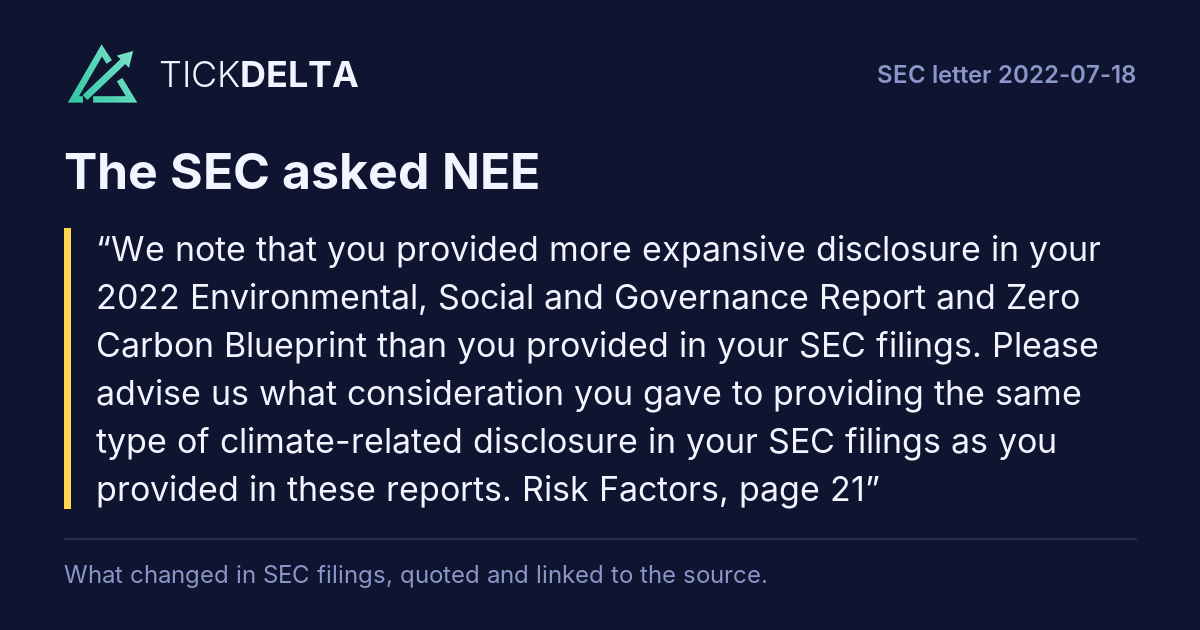
We note that you provided more expansive disclosure in your 2022 Environmental, Social and Governance Report and Zero Carbon Blueprint than you provided in your SEC filings. Please advise us what consideration you gave to providing the same type of climate-related disclosure in your SEC filings as you provided in these reports. Risk Factors, page 21
In response to the Staff’s comment, the Company respectfully advises the Staff that the Company provides disclosure in its SEC filings to comply with its obligations under the securities laws and provide material information to its security holders and the investing public. Additionally, the Company provides information on its website and in various other public disclosures, including the Company's 2022 Environmental, Social and Governance Report (“ESG Report”) and Zero Carbon Blueprint, that may be useful or of interest for a variety of reasons to a broad audience that includes employees,Read in the reply ↗Rest of the answer
customers, government/agency officials, investors, suppliers, consultants, business partners, environmental groups and other nonprofit organizations and the media. As a result, the ESG Report and Zero Carbon Blueprint may include detailed information that is beyond the scope of the
Page | 1 information that is required to be disclosed pursuant to applicable SEC rules or regulations or what is considered material information to its security holders and the investing public.
When determining whether and to what extent to include climate-related disclosure in its SEC filings, including the type of climate-related disclosure provided in the ESG Report and Zero Carbon Blueprint, the Company evaluates applicable SEC rules and regulations, including Items 101, 103, 105 and 303 of Regulation S-K, as well as the Staff’s Compliance and Disclosure Interpretations, available guidance from the Commission (including the 2010 Commission Guidance Regarding Disclosure Related to Climate Change), and Section 10(b) of the Exchange Act, Rule 10b-5 thereunder and applicable standards of materiality. It is in this context that the Company assesses whether and the extent to which any climate-related disclosure, including any of the information in the ESG Report or Zero Carbon Blueprint, should be included in its SEC filings such as risk factors related to environmental regulations and severe weather as discussed in response to comment #2. While the Company believes that certain climate-related information may be of interest to readers of the ESG Report or Zero Carbon Blueprint, such information may not be material to investors in the context of an SEC filing, which may otherwise include separate climate-related disclosure to satisfy the requirements identified above. The Company respectfully advises the Staff that it will, in response to the Staff’s comment, and consistent with historical practice, continue to evaluate its climate-related disclosure in SEC filings considering all applicable requirements, including the items identified above.
We note your 2022 Environmental, Social and Governance Report identifies climate related risks that may impact your business. Please revise to provide expanded disclosure regarding the material effects of transition risks related to climate change that may affect your business, financial condition, and results of operations, such as market trends that may alter business opportunities, credit risks or technologicalRest of the question
changes.
Of the Company’s two principal businesses, FPL’s business does not face any undisclosed material transition risks related to climate change because the key assumptions underpinning its goal to transition its remaining carbon-emitting electric generation facilities to carbon-free facilities (together with battery storage) are that FPL would only proceed to implement its goal to the extent that customer economics are favorable, the transmission grid can continue to perform reliably and government regulators are supportive, thereby enabling cost recovery under mechanisms such as its costRead in the reply ↗Rest of the answer
recovery clauses established by the Florida Public Service Commission. Because FPL is not subject to a renewable portfolio standard (“RPS”) or other requirements to expend capital to transition FPL to a partially or wholly carbon-free emissions power generation fleet, it is transitioning to carbon-free generation according to the foregoing key assumptions underpinning its goal. And, if any future requirement became applicable to FPL, it believes cost recovery mechanisms would be available. Ultimately, how and when FPL chooses to complete its transition is not currently expected to have a material impact on the Company’s or FPL’s business, financial condition or results of operations for the periods currently disclosed in the Company’s Form 10-K which include, for example, disclosure of FPL’s current base rates effective through 2025.
Page | 2
The same is true with respect to the Company’s other principal business, NEER. NEER's generation by fuel sources other than wind, solar and nuclear represented just 3% of NEER’s total generation in 2021, so, to the extent applicable, NEER’s transition is already materially complete. Said another way, the Company does not consider the transition risk associated with these remaining carbon-emitting generation assets to be material, because, quite simply, the Company could, if necessary (which is not the case), decommission these remaining assets entirely without incurring a material adverse impact on the Company’s business, financial condition or results of operations.
Within Risk Factors section of the Form 10-K, there is discussion around climate impacts, such as:
☐ Climate is listed as one factor among several that could impact environmental laws, regulations and other standards (page 22 - 23 of the Form 10-K);
☐ Impacts of weather conditions and severe weather (pages 25 - 26 of the Form 10-K); and
☐ Potential effects of greenhouse gas emission limits (page 23 of its Form 10-K).
With respect to future filings, the Company will continue to assess whether specific regulatory, technology, market or reputational risks attributable to climate-change related developments present unique risks that are material to its business, financial condition or results of operations. In addition, to the extent that the Company’s business plan or growth prospects become dependent upon a transition to carbon-free generation upon any specific terms or schedule, or upon any other material contingency related to climate change, the Company undertakes that its SEC filings will disclose the material risks associated with that dependency.
We note your statement in your 2022 Environmental, Social and Governance Report that “climate-related risks and opportunities have influenced our financial plan for capital expenditures, acquisitions and revenues.” Revise your disclosure to identify any material past and/or future capital expenditures for climate-related projects.Rest of the question
Please provide quantitative information for these types of expenditures for each of the periods for which financial statements are presented in your Form 10-K and for any future periods as part of your response.
In response to the Staff’s comment, the Company respectfully advises the Staff that in accordance with Item 303 of Regulation S-K, the Company provides disclosure in the Form 10-K regarding capital expenditures, including, where meaningful, quantitative information and information by category of expenditure, because the Company considers capital expenditures to be a significant use of liquidity and, in certain circumstances, investors consider capital expenditures by type to be a meaningful data point regarding NEER’s future growth prospects.
As described in the Company's response to commentRead in the reply ↗Rest of the answer
#2, FPL's capital investment decisions are driven by customer economics and service reliability. While FPL may build solar generation to serve new customer growth or replace older carbon-emitting generation assets or invest to make the grid more resilient to storms which has the added benefit of climate-related transition, FPL has made these
Page | 3 decisions primarily based on customer economics and service reliability rather than on state or federal RPS or other mandates. Further, the impacts of these decisions on the businesses, financial condition and results of operations of the Company are identical in all material respects to the impacts of FPL’s investments in any other form of new generation resource. This is because FPL's regulators approve cost recovery for all new generation resources and, accordingly, results in FPL being entitled to a return of, and on, its capital investment, regardless of technology or its impact on climate change, if any. Because of this and as noted within the Liquidity and Capital Resources section of the Management's Discussion and Analysis of Financial Condition and Results of Operations (“MD&A”) in the Form 10-K as well as Note 15, Commitments and Contingencies, to the Consolidated Financial Statements in the Form 10-K, FPL does not track its capital expenditures based on “climate-related projects,” but rather on whether the expenditure is for a new facility or for maintenance or upgrades to an existing facility. As noted within the Overview of the Business section under the heading FPL Sources of Generation of the Form 10-K, through 2025 FPL plans to add new solar generation through two separate programs approved by FPL's regulators.
With respect to NEER, the Company discloses not only historical capital expenditures (see Liquidity and Capital Resources section of MD&A in the Form 10-K) and expected future capital expenditures (see Note 15, Commitments and Contingencies, to the Consolidated Financial Statements in the Form 10-K), but it does so by breaking out the expenditures by broad categories, such as “Wind,” “Solar” and “Battery storage.” The Company breaks out the expenditures in this manner in part because the Company believes investors consider those expectations when assessing the future growth prospects of NEER’s core renewables business, regardless of whether climate change, competitive economics or other factors are driving those expectations for NEER. While the Company does not consider these planned investments to be “climate-related projects,” it anticipates that it will continue to provide such disclosure in its SEC filings.
First report after the company's reply of 2022-08-01: 10-Q filed 2022-11-03 ↗, against the 10-Q filed 2022-04-22 ↗.
Tickdelta does not hold the text of both reports, so they are not compared here.
To the extent material, discuss the indirect consequences of climate-related regulation or business trends, such as the following: • decreased demand for goods or services that produce significant greenhouse gas emissions or are related to carbon-based energy sources; • increased demand for goods that result in lower emissions than competing products; • increased competition to develop innovative new products thatRest of the question
result in lower emissions; • increased demand for generation and transmission of energy from alternative energy sources; and • any anticipated reputational risks resulting from operations or products that produce material greenhouse gas emissions.
The Company believes that its SEC filings disclose the indirect consequences of climate-related regulation or business trends or that those indirect consequences are so readily apparent that disclosure is unnecessary. For example, under Risk Factors in the Form 10-K, the Company leads with “Regulatory, Legislative and Legal Risks” and discusses, among the risks under that heading, that NEER depends heavily on government policies that support utility scale renewable energy and that the modification or loss of those policies could adversely impact NEER’s business.Read in the reply ↗Rest of the answer
Impacts of limits on the production of greenhouse gas emissions is also discussed in Risk Factors. The Company believes these are examples of disclosures in the Form 10-K that are responsive to Staff’s comment.
Page | 4
The Company also provided business drivers and insights into decreased demand for carbon-based forms of electric generation in its response to comment #2. The Company explained how NEER’s transition to carbon-free electric generation is already materially complete and FPL’s transition is not required by a RPS or federal mandate but has been occurring, and will continue to occur, when favorable to customer economics and service reliability as well as acceptable to the FPL's regulators.
Most importantly, NEE believes the regulatory and consumer focus on reducing greenhouse gas emissions is a driver for increased demand of renewable energy generation. As included in Overview in the Business section of the Form 10-K, the Company discusses its businesses and strategy including how it intends to focus investing in areas that, among other things, provide clean energy solutions for its customers. Further, the Company highlights how it plans to spend capital, including on renewable generation, in succeeding periods in Note 15, Commitments and Contingencies, to the Consolidated Financial Statements in the Form 10-K. As noted via the accomplishments listed in the ESG Report and as discussed throughout the Business section of the Form 10-K, NEE believes it has a reputation for considering and addressing its impact on greenhouse gas emissions in positive ways and is noted as a leader in this area. The Company undertakes to assess all future climate-related regulation and business trends for indirect consequences that may need to be disclosed in the Company’s SEC filings, to the extent material.
First report after the company's reply of 2022-08-01: 10-Q filed 2022-11-03 ↗, against the 10-Q filed 2022-04-22 ↗.
Tickdelta does not hold the text of both reports, so they are not compared here.
If material, discuss the physical effects of climate change on your operations and results. This disclosure may include the following: • potential for indirect weather-related impacts that have affected or may affect your major customers and suppliers; and • any weather-related impacts on the cost or availability of insurance.Rest of the question
Your response should include quantitative information for each of the periods for which financial statements are presented in your Form 10-K and explain whether changes are expected in future periods.
should include quantitative information for each of the periods for which financial statements are presented in your Form 10-K and explain whether changes are expected in future periods.
Response
The Company tracks the impacts of extreme weather-related damages (e.g., hurricanes and tropical storms) to its properties and operations as storm damage and storm restoration costs; however, the Company does not attempt to determine if such are related to climate change. Historically, the majority of such costs relate to damage to the FPL's electric transmission and distribution operations.Read in the reply ↗Rest of the answer
Under its regulatory framework, FPL has the ability to either expense restoration costs associated with extreme weather events or defer such costs to the balance sheet for future collection from customers. For the years ended December 31, 2021, 2020 and 2019, $28 million, $183 million and $234 million, respectively, of FPL costs were recognized in NEE's consolidated statements of income in the Form 10-K as “storm restoration costs”. However, as a result of the regulatory framework applicable to FPL, and as disclosed in Note 1, Summary of Significant Accounting and Reporting Policies, under the heading Storm Funds, Storm Reserves and Storm Cost Recovery, to the Consolidated Financial Statements in the Form 10-K, all such storm restorations costs were offset by the utilization of reserve amortization under its 2016 rate agreement resulting in no impact to net income. In addition, as further disclosed in Note 1, the Company also had recorded as regulatory assets (current and noncurrent) approximately $242 million and $347 million of storm restoration costs at December 31, 2021 and 2020, respectively.
Page | 5
Further, as severe weather events impact its operations and results, the Company discusses such in MD&A and elsewhere as appropriate. As noted in NEER’s Results of Operations in MD&A and as related to revenue also in Note 2, Revenue from Contracts with Customers, to the Consolidated Financial Statements in the Form 10-K, NEER’s operating revenues and operating expenses were impacted by severe prolonged winter weather in Texas in February 2021 ("February 2021 weather event"). Further, as disclosed in Note 1, Summary of Significant Accounting and Reporting Policies, to the Consolidated Financial Statements in the Form 10-K, bad debt expense and related allowances were impacted by the February 2021 weather event.
The most significant component of the Company’s insurance program relates to its nuclear operations, including associated property insurance programs. The insurance coverage and related premiums for its nuclear facilities are disclosed within Note 15, Commitments and Contingencies under the heading Insurance, to the Consolidated Financial Statements in the Form 10-K. As disclosed therein, NEE participates in more than one program and the nuclear property insurance maximum retrospective premium assessments for the most recent policy period were $963 million and $163 million for two separate programs.
In regard to weather-related impacts on the cost or availability of insurance, the Company has been able to access insurance programs and has not experienced material increases in such programs. While it is not possible for the Company to specifically quantify the amount, weather-related events are considered to be a component of the premiums. On this basis, the Company has not determined how climate change may impact insurance premiums in future periods.
First report after the company's reply of 2022-08-01: 10-Q filed 2022-11-03 ↗, against the 10-Q filed 2022-04-22 ↗.
Tickdelta does not hold the text of both reports, so they are not compared here.
We note your disclosure on page 23 of your Form 10-K indicating the incurrence of significant capital, operating and other costs associated with compliance with environmental statutes, rules and regulations. Please tell us about and quantify compliance costs related to climate change for each of the periods covered by your Form 10-K and whether increased amounts are expected to be incurred in future periods.
While NEE and its subsidiaries are subject to environmental laws, regulations and other standards, the Company respectfully notes that while climate change may be one factor, not all costs to comply with such laws and regulations are attributable to climate change. For example, as discussed in Part II, Item 1. Legal Proceedings of the Company’s March 31, 2022 Form 10-Q, a subsidiary of NEER voluntarily entered into an agreement with the U.S.Read in the reply ↗Rest of the answer
Department of Justice related to the accidental fatalities of eagles at certain wind facilities and the Company has concluded that it does not believe compliance with the agreement will have a material adverse impact to the Company. The Company does not believe accidental fatalities of eagles at wind facilities is due to climate change.
FPL's environmental cost recovery clause (“ECRC”) may contain compliance costs that could be attributable to climate change. For each of the years ended December 31, 2021, 2020 and 2019, expensed ECRC costs represented less than 1% of FPL's total operating costs. For each of the years ended December 31, 2021, 2020 and 2019, capitalized ECRC costs represented less than 2% of FPL's total capital expenditures. Currently, the Company expects these costs to decrease over the next several years, absent new regulations. While climate change may be one factor embedded in these
Page | 6 compliance costs, based on materiality for all ECRC costs, the Company has not investigated as to whether such costs are climate related. As materiality is assessed in connection with each periodic report, the Company will continue to consider disclosure of any increased environmental compliance costs if they become material to the Company and such disclosure is required or the Company otherwise determines such disclosure to be appropriate. The Company will also consider the impacts to these disclosures from any future environmental statutes, rules or regulations, such as a Florida RPS or federally mandated carbon emissions requirements.
First report after the company's reply of 2022-08-01: 10-Q filed 2022-11-03 ↗, against the 10-Q filed 2022-04-22 ↗.
Tickdelta does not hold the text of both reports, so they are not compared here.
We note your disclosures on pages 17 and 18 of your Form 10-K indicating that your NEER segment markets and trades energy-related commodity products, including renewable attributes and carbon offsets, and sells RECs and other environmental attributes.Rest of the question
Please provide us with quantitative information regarding these types of transactions for each of the periods for which financial statements are presented in your Form 10-K and for any future periods.
NEER’s customer supply and trading operation provides customers full requirements electricity as well as markets and trades renewable attributes and carbon offsets. Full requirements contracts are sales contracts to provide all of a customer’s electricity needs. When a customer resides in a state with a RPS, NEER will provide renewable attributes to satisfy its contractual obligation.Read in the reply ↗Rest of the answer
The purchases and sales associated with these full requirements contracts along with activity in NEER’s trading operation represented less than 1%, less than 1% and less than 2% of operating revenue for the years ended December 31, 2021, 2020 and 2019, respectively. As disclosed in Note 1, Summary of Significant Accounting and Reporting Policies, under the heading under Inventory, to the Consolidated Financial Statements in Form 10-K, NEER's materials, supplies and fuel inventories include emissions allowances and renewable energy credits. These emissions allowances and renewable energy credits represented approximately 2% and 4% of the Company’s total current assets at December 31, 2021 and 2020, respectively.
The Company expects these types of transactions in its customer supply and trading operation to grow moderately over the near term as more customers seek to achieve sustainability goals and state and federal RPS and emissions laws and regulations evolve; however, the Company also expects to grow the entire NEE business at a similar rate.
If you would like to discuss NEE's responses to the Staff's comments or any other matters, please contact me at 561-694-3228.
First report after the company's reply of 2022-08-01: 10-Q filed 2022-11-03 ↗, against the 10-Q filed 2022-04-22 ↗.
Tickdelta does not hold the text of both reports, so they are not compared here.
We note your response to prior comment 2 appears to focus on transition risks related to climate change laws and regulations and reflects that you do not believe undisclosed transition risks related to climate change are material to FPL. However, your response also states that FPL would only proceed to implement its goal to the extent that the transmission grid can continue to perform reliably.Rest of the question
Please expand your disclosure to discuss this risk and any other climate related technological risks that may affect FPL's operations and goal of transitioning its remaining carbon-emitting electric generation facilities to carbon-free facilities. In addition, please include disclosure regarding credit risks related to climate change.
When preparing risk factor disclosures, the Company considers the revisions to Item 105 of Regulation S-K issued by the SEC, which were intended to streamline risk factor disclosures. In particular, the revised Item 105 requires disclosure of “material” risk factors (replacing the previously
Page | 1 used “most significant” standard) that are tailored to each company’s circumstances and particular risk profile.Read in the reply ↗Rest of the answer
Further, Item 105 states that “[t]he presentation of risks that could apply generically to any registrant or any offering is discouraged...” Similarly, the SEC’s 2010 Climate Change Guidance, section IV.A. states that “[r]egistrants should consider specific risks they face as a result of climate change legislation or regulation and avoid generic risk factor disclosure that could apply to any company.”
When preparing the Form 10-K and performing the processes noted in response #3 below, among other processes, and considering applicable disclosure standards, the Company determined that the performance of the transmission grid is an operational risk that FPL faces regardless of any transition activities. The Company already discloses that its ability to sell and deliver power may be limited by unavailability or disruption of power transmission within the Risk Factors section of the Form 10-K (page 27). Further, the Company does consider the use of new or unproven technology to be a risk to the operations and maintenance of the Company's electric generation, transmission and distribution facilities, gas infrastructure facilities, retail gas distribution system in Florida and other facilities as disclosed within the Risk Factors section of the Form 10-K (pages 24-25).
The Company does consider credit and performance risk from customers, hedging counterparties and vendors as a risk as disclosed within the Risk Factors section of the Form 10-K (page 27). However, the Company does not believe it has incremental credit or performance risk related to climate change due to the nature of its revenue billing to collection cycle and immaterial bad debt expense for all periods presented. Generally, the Company's customer receivables have very short durations with its customers receiving a monthly billing cycle statement. Balances are due in the subsequent monthly period. The Company also respectfully advises the Staff that it recorded and disclosed in Note 1, Summary of Significant Accounting and Reporting Policies, to the Consolidated Financial Statements in the Form 10-K our bad debt expense for the three fiscal years ended December 31, 2021, 2020 and 2019 as $146 million, $94 million and $32 million, respectively. These bad debt amounts represent less than 1% of operating revenues for all of the periods presented and the Company believes these bad debt amounts will continue to be insignificant.
As a result of the foregoing, the Company respectfully submits that no additional disclosure is necessary.
First report after the company's reply of 2022-09-09: 10-Q filed 2022-11-03 ↗, against the 10-Q filed 2022-04-22 ↗.
Tickdelta does not hold the text of both reports, so they are not compared here.
We note your response to prior comment 4. Please explain in greater detail how you have disclosed the indirect consequences of climate-related regulation or business trends such as: • decreased demand for goods or services that produce significant greenhouse gas emissions or are related to carbon-based energy sources; • increased demand for goods that result in lower emissions than competing products; and •Rest of the question
increased competition to develop innovative new products that result in lower emissions. In addition, we note your response states that you believe you have a reputation for considering and addressing your impact on greenhouse gas emissions in positive ways. However, your risk factor disclosure on pages 22 and 23 discusses the potential negative impact of limits on greenhouse gas emissions on your operations. Please tell us how you have addressed reputational risks resulting from operations or products that produce material greenhouse gas emissions.
When preparing the Form 10-K and performing the processes noted in response to comment #3 below, among other processes, the Company considers how developments, events, trends and risks may affect our business, financial condition, or results of operation in light of applicable disclosure standards and applying materiality.Read in the reply ↗Rest of the answer
As materiality is assessed in connection with each filing, the Company will further disclose indirect consequences of climate-related regulation or business trends if they become material to the Company and such disclosure is required or the Company otherwise determines such disclosure to be appropriate. Below is our consideration for each indirect consequence or business trend listed by the Staff:
•decreased demand for goods or services that produce significant greenhouse gas emissions or are related to carbon-based energy sources
As discussed in our response to prior comment #2, of the Company's two principal businesses, NEER's net generation by fuel type other than wind, solar and nuclear represented just 3% of NEER's total generation in 2021. The Company could, if necessary (which is not the case), decommission these remaining fossil assets entirely without incurring a material adverse impact on the Company’s business, financial condition or results of operations. As such, the Company does not believe any decreased demand for goods or services that produce significant greenhouse gas (“GHG”) emissions to be material. Regarding FPL, although FPL has the sole right to deliver retail electricity in the areas it serves, as disclosed in Franchise Agreements and Competition within FPL’s Business section in Item 1 of the Form 10-K, any customer may elect to provide their own electric services. However, as a practical matter, few customers provide their own service at the present time since FPL’s cost of service is lower than the cost of self-generation for the vast majority of customers. As a rate-regulated electric utility in Florida (as discussed in FPL Regulation within FPL's Business section in Item 1 of the Form 10-K), the FPSC has jurisdiction over, among other things, planning, siting and construction of facilities. Although FPL is not presently subject to an RPS and it does not have other requirements to expend capital to transition to a partially or wholly carbon-free emission power generation fleet, FPL recognizes shifting demands could increase competition (as disclosed within the Risk Factors section of the Form 10-K (pages 24-25)). As such, FPL does pursue clean energy solutions through rate proceedings and approval from the FPSC. For instance, FPL seeks to provide customers options to participate in GHG emission reduction efforts through programs such as SolarTogetherTM a voluntary community solar program that gives certain FPL electric customers an opportunity to participate directly in the expansion of solar energy. Further, as discussed in FPL Regulation within FPL's Business section in Item 1 of the Form 10-K, the FPSC sets rates at a level that is intended to allow the utility the opportunity to collect from retail customers total revenues equal to its cost of providing service, including a reasonable rate of return on invested capital. To accomplish this, the FPSC uses various ratemaking mechanisms, including among other things, base rates and cost recovery clauses. For instance, as disclosed in Rate Regulation within Note 1, Summary of Significant Accounting and Reporting Policies, to the Consolidated Financial Statements
Page | 3 in the Form 10-K, FPL currently has regulatory assets recorded for the early retirement of generation facilities and transmission assets. FPL believes these mechanisms will continue to be available to recover any costs associated with shutting down GHG emitting generation facilities before the end of their useful lives.
•increased demand for goods that result in lower emissions than competing products
In regard to FPL, the Company refers the Staff to its response on decreased demand above. In regard to NEER, as discussed within NEER's Business section in Item 1 of the Form 10-K, NEER is a diversified clean energy business with a strategy that emphasizes the development, construction and operation of long-term contracted assets with a focus on renewable projects. Further addressing climate-related trends on demand, as discussed in Markets and Competition within NEER's Business section in Item 1 of the Form 10-K, NEER discusses that although competition is primarily on the basis of price, it believes the green attributes of NEER's generation assets is a competitive advantage.
•increased competition to develop innovative new products that result in lower emissions
In regard to NEER, as discussed within NEER's Business section in Item 1 of the Form 10-K, NEER is a diversified clean energy business with a strategy that emphasizes the development, construction and operation of long-term contracted assets with a focus on renewable projects. As part of that focus, the Company does explore new technologies for use in its production of electricity. NEER is the largest generator of renewable energy from the wind and sun. Further as battery storage has become more economic, NEER has become a leader in the use of this technology as well. Further, as discussed in Markets and Competition within NEER's Business section in Item 1 of the Form 10-K, although NEER's competition is primarily on the basis of price, the Company believes the green attributes of NEER's generation assets is a competitive advantage. Although FPL has the sole right to deliver retail electricity in the areas it serves, as disclosed in Franchise Agreements and Competition within FPL’s Business section in Item 1 of the Form 10-K, any customer may elect to provide their own electric services. As a practical matter, few customers provide their own service at the present time since FPL’s cost of service is lower than the cost of self-generation for the vast majority of customers. However, FPL continues to add solar and battery storage projects to its generation fleet. Further, nuclear generation (a carbon-free emissions technology) also represents approximately 20% of FPL’s net generation by fuel type. The Company is also pursuing green hydrogen technology. While the Company cannot predict what new technology may become available and how that use may impact the operations and maintenance of its facilities (as disclosed in the Risk Factors section of the Form 10-K (pages 24-25)), the Company does strive to maintain awareness of new technologies that could be employed to reduce GHG emissions from its operations. Further as noted in the Risk Factors section of the Form 10-K (pages 24-25), the Company does disclose that it could face increased competition due to, among other factors, shifting demand and regulatory changes. While the Company has not to date noted in its filings (through the processes noted in response to comment #3 below, among other processes) that increased competition in the industry has resulted in material changes to our business, financial condition, or results of operation, the Company will continue to assess changing pressure from competition particularly in light of the Inflation Reduction Act, for potential additional disclosure to the extent it perceives its existing risk factor disclosures have become insufficient or material trends warrant additional disclosures in Management’s
Page | 4
Discussion and Analysis of Financial Condition and Results of Operations (“MD&A”) regarding impacts to its results of operations.
•any anticipated reputational risks resulting from operations or products that produce material greenhouse gas emissions
The Company does not believe it has reputational risks resulting from operations and products that produce GHG. As noted within the Business section in Item 1 of the Form 10-K, the Company is a leader in the renewable energy industry and focused on delivering clean energy solutions to its customers. NEER's net generation by fuel type other than wind, solar and nuclear represented just 3% of NEER's total generation in 2021. As such, the Company does not believe there to be material reputational risks that could affect NEER’s business, financial condition, or results of operations resulting from operations or products that produce material GHG emissions. Further, in regard to FPL, as a rate-regulated electric utility in Florida (as discussed in FPL Regulation within FPL's Business section in Item 1 of the Form 10-K) the FPSC has jurisdiction over retail customer rates and sets rates at a level that is intended to allow the utility the opportunity to collect from retail customers total revenues equal to its cost of providing service, including a reasonable rate of return on invested capital. As discussed in FPL Sources of Generation within FPL’s Business section in Item 1 of the Form 10-K, FPL has requested and received approval to build and add solar and battery storage to its generation fleet as well as modernize an additional two generation units to high-efficiency, clean-burning natural gas. Also, nuclear generation (a carbon-free emissions technology) represents approximately 20% of FPL’s net generation by fuel type for 2021. FPL also seeks to provide customers options to participate in GHG emission reduction efforts through programs such as SolarTogetherTM. As such, the Company does not believe it has material reputational risks that could affect its business, financial condition, or results of operations resulting from operations or products that produce material GHG emissions. However, the Company does appreciate the risk inherent in negative publicity and discusses such in the Risk Factors section of the Form 10-K (page 29).
First report after the company's reply of 2022-09-09: 10-Q filed 2022-11-03 ↗, against the 10-Q filed 2022-04-22 ↗.
Tickdelta does not hold the text of both reports, so they are not compared here.
Your response to prior comment 5 discusses insurance premiums as it relates to your nuclear operations. Please provide us with quantitative information regarding the total cost of your property insurance for each of the periods for which financial statements are presented in your Form 10-K.Rest of the question
In addition, tell us how you considered providing disclosure discussing the potential for weather-related impacts that have affected or may affect your major customers and suppliers.
The annual premiums for total property insurance totaled approximately $95 million, $69 million and $53 million for the calendar years ended 2021, 2020 and 2019, respectively. This represented less than 1% of total operating expenses – net for each year presented.
The Company prepares its disclosures in accordance with applicable disclosure requirements under U.S.Read in the reply ↗Rest of the answer
securities laws and regulations, including with respect to qualitative and quantitative materiality factors, within the context of the Company’s business, operating results and financial condition.
In connection with the preparation of the Company’s annual reports on Form 10-K and quarterly reports on Form 10-Q, the Company engages in a number of processes to surface potentially material
Page | 5 developments, events, trends and risks for consideration for disclosure, including the following processes, among others:
•meetings of the accounting and business teams to discuss significant and/or unusual transactions and events for proper recording and disclosure;
•meetings of members of the Company’s legal, regulatory, environmental, compliance, operations, communications, systems, finance and tax teams (“Due Diligence Members”) among each other and with key business leaders throughout the Company to discuss potentially material developments, events, trends and risks and their potential impact on the Company’s business;
•review by the Due Diligence Members of the Company’s prior disclosures, including its business, legal and regulatory, and risk factor disclosures, and discussion of current developments in their areas of expertise to propose potential new disclosures for consideration to reflect developments in the quarter;
•meetings of the Disclosure Committee, which includes the Company’s chief accounting officer, chief legal officer, and other members of the Company’s senior leadership, to review and discuss any changes that may be appropriate as a result of potentially material events, trends and risks identified, and;
•review of the Company’s prior and proposed new disclosures by the Company’s Disclosure Committee as well as review by executive leadership including the chief executive officer, chief financial officer, and presidents of FPL and NEER.
When preparing the Form 10-K, the Company considered disclosure discussing the potential for weather-related impacts that have affected or may affect its major customers and suppliers following the processes noted above, among others.
Regarding major customers, neither FPL nor NEER have any major customers representing more than 10% of total operating revenue for their respective segments. However, the Company discloses how weather-related events could impact its operations and thus its ability to provide electricity to customers as well as the potential financial impacts weather-related events could cause within the Risk Factors section of the Form 10-K (pages 25-26). Further, as discussed in FPL Sources of Generation within FPL's Business section in Item 1 of the Form 10-K, customer usage and, thus operating revenues, are typically higher during the summer months, largely due to the prevalent use of air conditioning in its service area. Additionally, occasionally, unusually cold temperatures during the winter months result in significant increases in electricity usage for short periods of time.
Regarding suppliers, the Company has a diverse network of suppliers that provide the materials and services needed to support its businesses. Additionally, the Company continually monitors its supplier base for potential supply chain disruptions, including from weather-related impacts. When and if any such events are determined to be material to the Company, disclosure has been made. For instance, when preparing the Company’s March 31, 2022 Form 10-Q and performing the processes noted above, the Company determined that certain recent regulatory actions being taken regarding solar cells and panels could materially impact its estimated capital expenditures and disclosed such in Note 12, Commitments and Contingencies, to the Condensed Consolidated Financial Statements in the Form 10-K. The Company also discussed the potential impact to its solar panel supply chain in Results of Operations within MD&A in the Company’s March 31, 2022 Form 10-Q. To date, the
Page | 6
Company has not identified any weather-related impacts that have or may affect its suppliers in a way that would materially disrupt its business.
If you would like to discuss NEE's responses to the Staff's comments or any other matters, please contact me at 561-694-3228.
First report after the company's reply of 2022-09-09: 10-Q filed 2022-11-03 ↗, against the 10-Q filed 2022-04-22 ↗.
Tickdelta does not hold the text of both reports, so they are not compared here.
Also in this review: closing letter, 2022-09-21