tickdelta
Sign in

Tickdelta is free for now. Sign up and get Pro free

← Screener

Materials · Gold Mining · NYSE, OTC

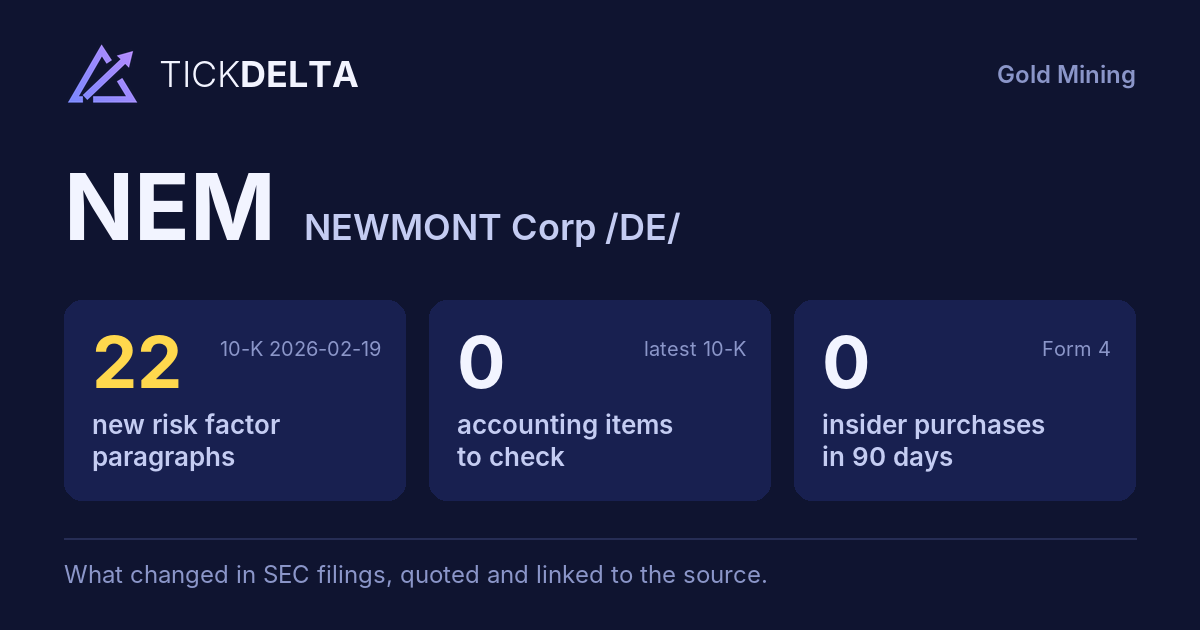
NEMNewmont

Compare with peers → Embed
The 10-K against last year's

340 changes: 52 added, 53 removed, 232 reworded, 3 quiet changes

10-K Feb 19, 2026 vs Feb 21, 2025
Risk FactorsRedline ↓
17.8%
of the text changed · 32,182 words now
29.9%
of the text changed · 20,865 words now
Legal ProceedingsRedline ↓
38.4%
of the text changed · 3,922 words now
Accounting PoliciesRedline ↓
14.9%
of the text changed · 9,586 words now

10-K 0001164727-26-000010 (2026-02-19) vs 10-K 0001164727-25-000011 (2025-02-21)

The redline

The paragraph that changed most in each section

Marked against last year's 10-K: cut words struck through, new words highlighted and underlined.

Risk Factors 406 words changed in this paragraph; it is 66% similar to last year's version.
We have operations and conduct business in a number of jurisdictions, which may increase our susceptibility to sudden tax changes. For instance, a 12% export duty was imposed by the Argentina government in 2018, revised down to 8% thereafter, however, with the election of new government in 2023, the rate is now currently 0%. The state of New South Wales, Australia, passed 2023 legislation that imposes an increased stamp duty which materially affected the Newcrest transaction. Also in Australia, the Debt Deduction Creation Rules, introduced during 2024 and which will first apply to the 2025 year, could have the potential to limit the tax deductibility of intercompany interest expense. In the State of Zacatecas, Mexico, environmental taxes became effective in 2017 with little clarity on how the taxes are to be calculated. An ecological Ecological tax agreement was ratified in 2021 agreements were executed which provides provided clarity for 2021 to 2024, after which, the Company, along with other companies in the State of Zacatecas, will continue to need to engage with governmental authorities to understand how the environmental tax would be levied year-over-year. The current governmental authorities are currently seeking to renegotiate the scope and manner of tax calculation for purposes of the 2025 to 2027 tax period, which includes request for expansion of taxable volumes of extracted materials. The Company continues to engage with the government to align renewal terms with the prior agreements. However, if the change to tax extraction volumes is imposed by the government, it would result in significantly higher tax obligations and would materially impact financial results. With the expected election of state governor in 2027, a change in government authorities will also result in more uncertainty of this environmental tax calculation in future years. Also, in Mexico, a 2021 tax reform bill proposed federal passed which eliminated the tax benefit to offset mining fees on revenue generated from with mining which could impact our operations if passed. tax. Furthermore, a new Economic Plan for 2022 (the "Proposal") was enacted. While the changes under the Proposal plan are not substantive in nature (in the sense that they do not create new taxes or increase applicable rates), they may increase the future cost of our compliance and pose additional uncertainties in application of the law. law and further reforms could be proposed in the future. Further, the Mexican government has increased the Mining Tax mining tax rate from 7.5% to 8.5% 8.5%, and 0.5% to 1% for gold, silver, platinum sales, both effective on January 1, 2025. 2025, which remains in effect but subject to potential change in the future. In Australia, the policy of allowing mining companies to benefit from fuel tax credits has been under increasing pressure, any changes to related regulations would impact the Company. In the United States, at the federal and state level, regulatory changes which may be implemented in the area of tax reform remain uncertain and may adversely affect companies in the mining sector. For example, NGM could be impacted by the resolutions brought to the State of Nevada Legislature to amend the State Constitution to increase mining taxes. An example of this was the passing of Assembly Bill 495 in 2021 that results in a new excise tax on mining companies engaged in the business of extracting gold and silver in the state of Nevada. In 2024, Pillar II has been enacted in a number of countries. The Pillar II agreement was signed by 138 countries with the intent to equalize corporate tax around the world by implementing a global minimum tax of 15%. As Newmont primarily does business in jurisdictions with a tax rate greater than 15%, the Company does not anticipate a material impact to its financial statements. A number of changes in the laws, regulations and policies in PNG have recently been proposed or are currently being considered. See the risk factor under the heading “Our operations at Lihir and project at Wafi-Golpu in PNG are subject to political and regulatory risks and other uncertainties”. Taxation laws and other regulations of the jurisdictions in which we operate are complex, subject to varying interpretations and applications by the relevant tax authorities and subject to changes and revisions in the ordinary course. It is difficult to predict whether proposed changes to regulations will be passed or to what extent they will impact the Company. Any additional and/or unexpected taxes imposed on us could have a material and adverse impact on our Company. See also the risk factor under the heading “Our operations and projects are subject to a range of risks related to transitioning the business to meet regulatory, societal and investor expectations for operating in a low-carbon economy” for a discussion of uncertainties and potential tax increases in connection with climate change considerations.

Source: Item 1A, 10-K 0001164727-26-000010 vs Item 1A, 10-K 0001164727-25-000011

MD&A 290 words changed in this paragraph; it is 32% similar to last year's version.
Akyem, Ghana. Peñasquito, Mexico. Gold production decreased 31% increased 39% primarily due to higher ore grade milled as a result of mine sequencing, higher mill recovery, and higher mill throughput. Gold equivalent ounces – other metals production decreased 27% primarily as a result of a change in GEO pricing, noted above, that had an unfavorable impact to the calculated gold equivalent ounces - other metals produced of 16%, as well as lower other metals produced of 11% as a result of lower ore grade milled, partially offset by higher mill throughput. milled due to mine sequencing. Costs applicable to sales per gold ounce increased 71% 19% primarily due to higher allocation of direct costs to gold as a drawdown result of stockpile inventory, the GEO price change, higher third-party workers participation costs, and higher third party and government royalties, partially offset by higher gold ounces sold and higher by-product credits. Costs applicable to sales per gold equivalent ounce – other metals increased 28% primarily due to lower gold equivalent ounces - other metals sold, higher workers participation costs and higher third party and government royalties, partially offset by lower allocation of direct costs to gold equivalent ounces - other metals as a result of the GEO price change and higher by-product credits. Depreciation and amortization per gold ounce increased 8% primarily due to higher allocation of costs to gold as a result of the GEO price change, partially offset by higher gold ounces sold. Depreciation and amortization per gold equivalent ounce decreased 34% – other metals increased 17% primarily due to cessation lower gold equivalent ounces - other metals sold, partially offset by lower allocation of depreciation and amortization costs to gold equivalent ounces - other metals as a result of classifying the asset as held for sale. GEO price change. All-in sustaining costs per gold ounce increased 50% 14% primarily due to higher costs applicable to sales per gold ounce, ounce. All-in sustaining costs per gold equivalent ounce – other metals increased 21% primarily due to higher costs applicable to sales per gold equivalent ounce - other metals, partially offset by lower reclamation spend treatment and lower sustaining capital spend. refining costs.

Source: Item 7, 10-K 0001164727-26-000010 vs Item 7, 10-K 0001164727-25-000011

Legal Proceedings 280 words changed in this paragraph; it is 57% similar to last year's version.
In December 2021, Cripple Creek & Victor Gold Mining Company LLC (“CC&V”, a wholly-owned subsidiary of the Company) entered into a Settlement Agreement (“Settlement Agreement”) with the Water Quality Control Division of the Colorado Department of Public Health and Environment (the “Division”) with a mutual objective of resolving issues associated with the new discharge permits issued by the Division in January 2021 for the Carlton Tunnel. The Carlton Tunnel was a historic tunnel completed in 1941 with the purpose of draining the southern portion of the mining district, subsequently consolidated by CC&V. CC&V has held discharge permits for the Carlton Tunnel since 1983, primarily to focus on monitoring, with the monitoring. The monitoring data accumulated since the mid-1970s indicating have indicated consistency in the water quality discharged from the Carlton Tunnel over time. In 2006, legal proceedings and work with the regulator confirmed that the water flowing out of the Carlton Tunnel portal is akin to natural spring water and did not constitute mine drainage. However, this changed with the January 2021 permit updates, when the regulator Water Quality Control Division of the Colorado Department of Public Health and Environment (the “Division”) issued new discharge permits in January 2021, the Division imposed new water quality limits. The A Settlement Agreement involves the evaluation of a reasonable and achievable timeline for treatment and permit compliance, acknowledging the lack of readily available technology, entered into by CC&V and the need to spend three years to study and select Division in December 2021 extended the technological solution, with three additional years to construct, bringing timeframe for full permit compliance to November 2027, and CC&V expressly reserved the November 2027 timeframe. right to challenge the need for a discharge permit in the first place. In 2022, the Company studied various interim passive water treatment options, reported the study results to the Division, and based on an evaluation of additional semi-passive options that involve the usage of power at the portal, updated the remediation liability to $20 in 2022. CC&V continues to study alternative long-term remediation plans for water discharged from the Carlton Tunnel, and is while also working continuing to work with regulators on to identify and implement the highest feasible alternative treatments. In June 2025, the Water Quality Control Commission agreed to site specific standards for CC&V and a Discharger Specific Variance ("DSV") for certain water quality standards. In January 2026, the Division issued a modification to identify highest feasible alternative treatment in the context, based on limits such as area topography. CC&V formally submitted its proposal CC&V's discharge permit to implement site specific standards for the certain water quality standards, and a DSV and compliance extension for certain other standards. Depending on the matter will plans that may ultimately be presented agreed with regulators, a material adjustment to the remediation liability may be required.

Source: Item 3, via Note 24 – COMMITMENTS AND CONTINGENCIES, 10-K 0001164727-26-000010 vs Item 3, via Note 25 – COMMITMENTS AND CONTINGENCIES, 10-K 0001164727-25-000011

Accounting Policies 222 words changed in this paragraph; it is 41% similar to last year's version.
As further response to the current market conditions, high inflation rates, the rising prices for commodities and raw materials, prolonged supply chain disruptions, competitive labor markets, and consideration of capital allocation, the The Company has chosen to continue deferring the investment decision for the Yanacocha Sulfides project. While the Company has had previously extended the timeline of the a full-funds decision, assessment of the project remains a priority in Peru as the Company continued to advance engineering and long-term procurement activities. decision for its Yanacocha Sulfides development project. The delay of the Yanacocha Sulfides project is was intended to focus funds on current operations and other capital commitments while management assesses assessed execution and project options, up to and including transitioning the Yanacocha operations into full closure. To During the extent that assessment determines that the project is no longer sufficiently profitable or economically feasible under the Company’s internal requirements, it would result in negative modifications to the Company's proven and probable reserves. Additionally, should year, the Company ultimately decide to forgo reassessed its strategy in Peru and is progressing mine closure activities while prioritizing other future development opportunities at Yanacocha ahead of any future re-evaluation of the Yanacocha Sulfides project, resulting in an indefinite deferral of the future development of Yanacocha Sulfides, this project and the current carrying value impairment of the balances included in assets under construction and other long-lived assets of deferred mine development for the Yanacocha operations could become impaired and the timing of certain closure activities would be accelerated. project. As of December 31, 2024, 2025, the Yanacocha operations have total long-lived assets of approximately $1,195, $374, inclusive of approximately $827 $78 of assets under construction related to Yanacocha Sulfides. the estimated sales value of project equipment. Refer to Note 7 for additional information on this impairment charge.

Source: Item 8, Note 2 – SUMMARY OF SIGNIFICANT ACCOUNTING POLICIES, 10-K 0001164727-26-000010 vs Item 8, Note 2 – SUMMARY OF SIGNIFICANT ACCOUNTING POLICIES, 10-K 0001164727-25-000011

Every change, by type

Sentences and paragraphs added, removed or reworded

Sentences and paragraphs of NEM's Risk Factors and MD&A, 10-K 2026-02-19 against 10-K 2025-02-21. Each links to the text at sec.gov.

AddedRisk Factors
At the beginning of the third quarter of 2025, management committed to a strategic plan designed to reduce operating costs and continue to advance the Company’s ongoing commitment to profitability, which included streamlining its organizational structure and a reduction of the Company’s workforce and office space in certain markets. Such initiatives involve expenses primarily relating to employee severance, consulting costs, and other restructuring charges. Cost saving estimates are based on a number of assumptions, including compliance with local legal requirements across jurisdictions. Actual costs, timing, and benefits may differ from current estimates as the Company continues to assess the full scope of the impact arising from, or related to, the workforce reduction and operating model changes. There can be no assurance that the expected cost reductions or operational efficiencies will be realized within the anticipated timeframe, or at all.

Read it in 10-K 2026-02-19 at sec.gov ↗

AddedRisk Factors
It is possible that certain of our other current or former operations, projects or exploration locations in the U.S. could be designated as a superfund site in the future, exposing us to potential liability under CERCLA.

Read it in 10-K 2026-02-19 at sec.gov ↗

AddedRisk Factors
Merian was able to obtain a Legal Title (the right of leasehold, which is a surface right) to facilitate the expansion of its tailings storage facility (TSF2). This title was granted by the Republic of Suriname in early 2025 under certain conditions as well as commitments to the local community in the area. To maintain this Legal Title in good legal standing, including its extension in due time, it remains important to adhere to the conditions related to the granting of this surface right as well as community commitments in relation to this surface right.

Read it in 10-K 2026-02-19 at sec.gov ↗

AddedRisk Factors
Although security measures have been implemented by the Company to protect employees, community members, property and assets, such measures will not guarantee that such civil disturbances and criminal activities will not continue to occur in the future, or result in harm to employees, community members or trespassers, decrease operational efficiency or construction delays, increase community tensions or result in liabilities or reputational harm to Newmont. Security incidents, in the future, may have a material adverse effect on our operations, development projects, exploration and reclamation activities, especially if criminal activity and violence escalate. Such incidents may halt or delay production, increase operating costs; result in harm to employees, contractors,

Read it in 10-K 2026-02-19 at sec.gov ↗

AddedRisk Factors
concentrations below the Australian Drinking Water Guidelines values. The majority of the instances of non-compliance from both Cadia Holdings’ and the NSW EPA’s sampling programs showed that such instances of non-compliance were influenced by building and plumbing materials.

Read it in 10-K 2026-02-19 at sec.gov ↗

AddedRisk Factors
Physical risks related to extreme weather events such as extreme precipitation, flooding, longer wet or dry seasons, flooding and drought conditions, increased temperatures, sea level rise, landslides, mine flooding, tsunami, geysers and outbursts, avalanches, landslides, wildfires or brushfires, or more severe storms may have financial implications for the business. In particular, the effects of

Read it in 10-K 2026-02-19 at sec.gov ↗

AddedRisk Factors
caving, although the likelihood of this is lower. Excessive water ingress, disturbance and the presence of fine materials may also give rise to unplanned releases of material of varying properties and of water through drawbells. Cadia recorded sudden unplanned releases of both dry fine ore material and wet mud material through drawbells in 2023. In addition, in June 2025 two fall of ground incidents occurred in the access way to the underground work area of a non-producing project at the Red Chris Mine in British Columbia, Canada.

Read it in 10-K 2026-02-19 at sec.gov ↗

AddedRisk Factors
The government of Suriname has amended its immigration laws such that business visas can no longer be used for rotational expatriates, and a residence permit will be required from Q4 2025 on. The process and requirements for approval of residence permits have also been heightened. The restrictions on expatriates may impact our ability to hire and retain skilled and experienced workers for core technical roles. Additionally, collective agreement negotiations has been protracted for eighteen months as at December 2025 and currently at the mediation board stage. Inability for both parties to reach agreement poses risk of labor unrest, strikes and business continuity. See "Risks Related to Our Workforce" for additional information on labor risks.

Read it in 10-K 2026-02-19 at sec.gov ↗

Show the other 16
AddedRisk Factors
Newmont operates in Ghana pursuant to a Revised Investment Agreement ratified by Ghana’s Parliament in 2015, which established a fixed fiscal and legal regime, including fixed royalty and tax rates, for Newmont operations in Ghana. The tenure of the Revised Investments Agreement is linked to the mining leases. The financial and tax stability periods established by such agreements expired on December 31, 2025 which results in loss of tax advantages and tax protection. Upcoming Regulatory changes in the mining law, the royalties, and the local content enhancement provides exposures for the future.

Read it in 10-K 2026-02-19 at sec.gov ↗

AddedRisk Factors
Ghana is showing signs of economic recovery from the worsening socioeconomic conditions in recent years. The recovery has been marked by decline in inflation from 23.8% in December 2024 to 5.4% in December 2025; the Ghana cedi has appreciated by 29% year-to-date as of December 2025; building up of international reserves and renewed investor confidence. Ghana’s sovereign credit ratings have recently been upgraded by Fitch, S&P, and Moody's reflecting the progress being made in its economic recovery. In spite of the positive economic recovery, the country continues to be under the IMF program for support, signaling progress but not completely out of the conditions that got Ghana to seek an IMF support program. The Government continues to be under pressure for more revenue generation, keeping in place levies such as the Growth and Sustainability Levy (introduced in 2023) and the Emissions Levy and VAT on electricity. The Government of Ghana has announced plans to amend the country’s mineral royalty regime by replacing the current maximum 5% royalty rate with a sliding scale ranging from 5% to 12%, linked to prevailing gold prices. The

Read it in 10-K 2026-02-19 at sec.gov ↗

AddedRisk Factors
proposed amendment was submitted to Parliament in December 2025, and is expected to be considered when parliamentary sessions resume in early February 2026. If enacted, the revised royalty framework could increase the Company’s operating costs at its Ghanaian operations, particularly during periods of higher gold prices. The timing, final structure, and implementation mechanisms of the proposed regime remain uncertain.

Read it in 10-K 2026-02-19 at sec.gov ↗

AddedRisk Factors
In January 2026 the Argentinian province of Santa Cruz enacted the 90/10 employment law with the goal to ensure that local residents receive the majority of jobs in key industries, including mining. If required to comply, Newmont’s operations in the Santa Cruz Province would be required to employ 90% of its workforce from the Santa Cruz Province. Exceptions may be provided, subject to government discretion, and there is no guarantee this requirement can be met due to the lack of local technical resources.

Read it in 10-K 2026-02-19 at sec.gov ↗

AddedMD&A
In October 2025, the Company declared commercial production at its Ahafo North project in Ghana resulting in classification as a reportable segment. Prior to declaration of commercial production, Ahafo North was classified as a development project and all activity was included in the Ahafo South reportable segment up to the date of commercial production. Although not a reportable segment until the fourth quarter of 2025, the amounts related to Ahafo North have been reported separately for comparability purposes. Refer to Note 4 to the Consolidated Financial Statements for further information.

Read it in 10-K 2026-02-19 at sec.gov ↗

AddedMD&A
One of our reportable segments, NGM, is a joint venture that combined our and Barrick Mining Corporation’s (“Barrick”) respective Nevada operations, pursuant to the operating agreement entered into on July 1, 2019 between Barrick, Newmont and their wholly-owned subsidiaries party thereto (the “Nevada JV Agreement”). Barrick operates NGM with overall management responsibility and is subject to the supervision and direction of NGM’s Board of Managers, which is comprised of three managers appointed by Barrick and two managers appointed by Newmont. On January 26, 2026, we informed Barrick and the NGM Board of Managers that we had identified evidence of mismanagement at NGM, including diversion of resources from NGM to the benefit of Barrick’s wholly-owned property Fourmile and Barrick, and that we were exercising our contractual inspection and audit rights. On February 3, 2026, we sent Barrick a notice of default under the Nevada JV Agreement related to this conduct. Although we continue to work with Barrick to improve the performance of NGM and will take appropriate steps to address this matter, any such disagreements could have a material adverse effect on NGM and the Company. Refer to Item 1A, Risk Factors, for a discussion of risk factors related to our joint ventures.

Read it in 10-K 2026-02-19 at sec.gov ↗

AddedMD&A
The Company completed the sale the assets of the Telfer reportable segment in the fourth quarter 2024, the sale of the CC&V, Musselwhite, and Éléonore reportable segments in the first quarter of 2025, the sale of the Akyem and Porcupine reportable segments in the second quarter of 2025, and the sale of the Coffee development project in the fourth quarter of 2025.

Read it in 10-K 2026-02-19 at sec.gov ↗

AddedMD&A
The Revised Investment Agreement, under which Newmont previously operated in Ghana, expired on December 31, 2025. As a result, the previous maximum corporate income tax rate of 32.5% is now subject to a maximum corporate income tax rate of 35% and customs duties on imported goods used in mining operations ranging from 5% to 20% of the value of such items. Additionally, royalties were previously paid to the Government of Ghana under a sliding‑scale system, based on average monthly gold prices and ranging up to 5% of revenues, plus an additional 0.6% on any production from forest reserve areas. The sliding-scale royalty regime also expired on December 31, 2025. Effective January 1, 2026, royalties transitioned to a fixed 5% rate on gold production, with the additional 0.6% forest reserve royalty continuing to apply where applicable.

Read it in 10-K 2026-02-19 at sec.gov ↗

AddedMD&A
The Government of Ghana is also entitled to receive 10% of a project’s net cash flow after reaching specific production milestones by receiving 1/9th of the total amount paid as dividends to Newmont parent. When the average quoted gold price exceeds $1,300 per ounce within a calendar year, an advance payment on these amounts of 0.6% of total revenues is required. Upon the expiration of the tax extension regime on December 31, 2025, dividends paid in addition to the carried interest will become subject to an 8% withholding tax. Also as a result of the agreement's expiration, Newmont is subject to a Growth and Sustainability Levy of 3% on gross revenue. As a result, the Company will also be exposed to future changes in fiscal, tax, and other related regulatory regimes in Ghana as they may be enacted from time to time. For instance, the Government of Ghana has announced plans to amend the country’s mineral royalty regime by replacing the flat 5% royalty rate, which became effective on January 1, 2026, with a sliding scale ranging from 5% to 12%, linked to prevailing gold prices. The proposed amendment was submitted to the Ghanaian Parliament on December 19, 2025, and is expected to be considered when parliamentary sessions resume in early February 2026. If enacted, the revised royalty framework could increase the Company’s operating costs at its Ghanaian operations, particularly during periods of higher gold prices. The timing, final structure, and implementation mechanisms of the proposed regime currently remain uncertain.

Read it in 10-K 2026-02-19 at sec.gov ↗

AddedMD&A
Advanced projects, research and development was $166, $197 and $200 for the years ended December 31, 2025, 2024, and 2023, respectively. Advanced projects, research and development decreased in 2025, compared to 2024, primarily due to the discontinuation of certain studies and lower consulting costs.

Read it in 10-K 2026-02-19 at sec.gov ↗

AddedMD&A
General and administrative was $382, $442, and $299 for the years ended December 31, 2025, 2024, and 2023, respectively. General and administrative decreased in 2025, compared to 2024, primarily due to lower salaries and benefits resulting from a strategic plan committed by management in the third quarter of 2025 to streamline organization structure and reduce the Company's workforce, lower consulting costs, and lower charges resulting from the Newcrest transaction. The strategic plan was designed to reduce operating costs and advance the Company’s ongoing commitment to profitability and included streamlining the Company’s organizational structure, a reduction in workforce, and a reduction in office space in certain markets. Refer to Note 8 of the Consolidated Financial Statements for further information.

Read it in 10-K 2026-02-19 at sec.gov ↗

AddedMD&A
On July 4, 2025, the One Big Beautiful Bill Act H.R. 1 was signed into law in the U.S. The legislation has multiple effective dates, with certain provisions effective in 2025 and others implemented through 2027. The Company does not anticipate the bill will have a material impact on the financial statements.

Read it in 10-K 2026-02-19 at sec.gov ↗

AddedMD&A
(1)Effective January 1 2025, the Company updated the metal prices utilized for the GEO calculation. Utilizing the updated 2025 pricing resulted in 317 thousand and 320 thousand fewer calculated "gold equivalent ounces - other metals" produced and sold, respectively, than would have been calculated using the 2024 pricing for the year ended December 31, 2025.

Read it in 10-K 2026-02-19 at sec.gov ↗

AddedMD&A
(5)During the first quarter of 2025, mining and processing operations at the site were temporarily suspended due to safety events (the "Cerro Negro shutdowns"). Full operations resumed in April 2025. In the second quarter of 2024, the Company suspended operations at Cerro Negro to conduct a full investigation into the tragic fatalities of two members of the Newmont workforce on April 9, 2024. The site ramped up to full operations in June 2024.

Read it in 10-K 2026-02-19 at sec.gov ↗

AddedMD&A
restrictions directly impact Cerro Negro's ability to repay intercompany debt to the Company. In the third quarter of 2024, certain restrictions were lifted or modified, allowing companies to repay intercompany debt in certain circumstances.

Read it in 10-K 2026-02-19 at sec.gov ↗
Next Related parties →