Rest of the answer
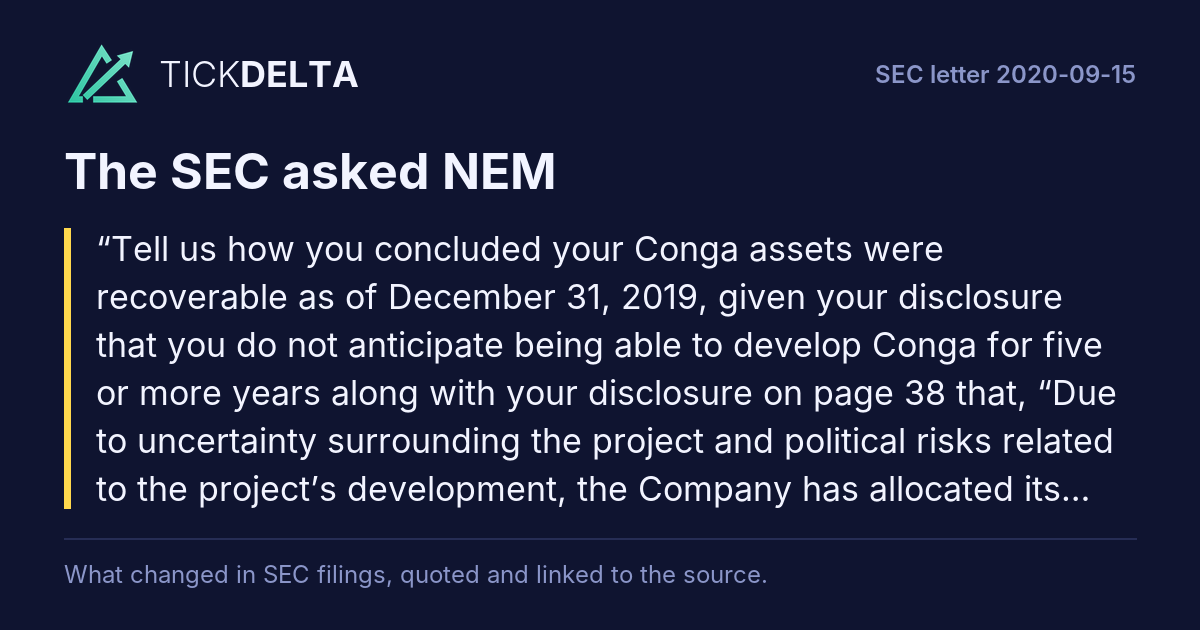
Project activities in the recent years have focused on the continued engagement with the local communities and maintaining and protecting existing project infrastructure and equipment. Consistent with other opportunities in the Company’s organic project pipeline, management continues to evaluate Conga’s (i) economic return and risk profile, among other investment criteria, (ii) long-term development options based on the level of social and political acceptance achieved, and (iii) the appropriate prioritization and sequencing in relation to other projects. The Company will review alternatives if technical, economic, social or political criteria are not met, such as a sale of the property or returning the mining concessions to the government. As of December 31, 2019, no such alternative decision had been made.
Although the Company has reallocated its exploration and development capital to other projects in prior years, the Company did not consider this an impairment indicator. Additionally, no impairment indicators were identified during the performance of controls supporting the
Company’s active care and maintenance program for the Conga project or the integrated mine planning and investment process as further described below. The Company’s project prioritization and capital allocation process has been influenced by the 2019 Goldcorp acquisition and Nevada joint venture transactions, which resulted in the acquisition of additional new mine development projects and a significant change in the Company’s production profile that shows stable production of approximately seven million gold equivalent ounces a year through 2029. In addition, as highlighted in the
Company’s second quarter 2020 earnings presentation, Newmont expects to advance the Yanacocha Sulfides project, which was reprioritized ahead of the Conga project, to full funding in 2021. The Company expects the successful development of the
Yanacocha Sulfides project to provide an improved path to the future development of the Conga project through improved social and political acceptance in the neighboring area and region. At December 31, 2019, we did not anticipate being able to develop the Conga project for five or more years. However, the Conga project continues to be in the Company’s project pipeline and is expected to be developed in the future. As part of our annual strategic planning and project prioritization work, which will be completed with the approval of our business plan by our Board of Directors in the fourth quarter of 2020, we are reevaluating the project development timeline for the Conga project based on the additional projects in the
Company’s portfolio as a result of the Goldcorp acquisition in 2019. To the extent there are changes to the Conga project’s timeline from this process, we will update our disclosures in the Company’s Form 10-K for the year ended December 31, 2020.
Additionally, as a result of the reallocation of exploration and development capital to other projects, the Company analyzed whether there was an event or change in circumstance under ASC 360-10-35-21 that would indicate that the carrying amount of the Conga project may not be recoverable and would require a test for recoverability. While events such as the reallocation of exploration or development capital to other projects can be considered adverse changes in the extent or manner in which a long-lived asset is currently being used under ASC 360-10-35-21(b) and the uncertainty related to social and political acceptance or the ability to obtain required permits can be considered adverse changes in business climate (i.e. social and political acceptance) or legal factors (i.e. permit uncertainty) under ASC 360-10-35-21(c), these events did not indicate that the Company’s carrying value for the Conga project may not be recoverable. This is because the Company continues to expect that social and political acceptance can be achieved and that all necessary permits will be renewed or obtained in the ordinary course of business to develop the Conga project at some point in the future. If an impairment indicator that required a recoverability test was identified, the Company would use estimates and assumptions that we believe a market participant would use, including gold and copper metal price assumptions, input commodity price assumptions, estimates of value beyond proven and probable reserves (including the estimated cost to develop and extract such value), etc., in estimating the future cash flows
(both discounted and undiscounted) as outlined in ASC 930-360-35.
As part of the Company’s integrated mine planning and investment process which reviews projects to evaluate technical, economic and social viability of its mine projects, the Company prepares and periodically updates the financial business case for its mine projects throughout the various stages of the investment evaluation process. Periodic updates to the business case for the Conga project which result in updates to future cash flow estimates for the project include revisions to project timing and prioritization, as well as changes in economic assumptions for gold and copper prices, input commodity prices, labor costs, and foreign exchange rates.
The updates also include changes to care and maintenance costs and capital costs of the project that may be required to address degradation of engineering and construction plans and the potential replacement of existing mill equipment in the event certain equipment is sold to a third party or eventually requires replacement upon project construction. Updates to the
Conga project financial business case were most recently completed in December 2018. As part of its periodic update to the
Conga project financial business case, the Company probability-weighted three different possible scenarios and the associated undiscounted future cash flows of each scenario for the Conga project: (i) the development and operation of the mine, (ii) a possible third-party sale of the mine, and (iii) the return of the mining concessions to the government of Peru. While the periodic update of the Conga project financial business case is not prepared as an impairment test of recoverability, the updates provide management with a process to monitor the economics and potential future cash flows of the Conga project to ensure it remains economically viable. Based on the update to the Conga project financial business case in December of 2018, the project continues to have probability-weighted undiscounted future cash flows significantly exceeding the carrying amount of the Conga long-lived assets. Since the completion of the 2018 study there have been no events or changes in circumstance that indicate that the carrying value of the Conga project is not recoverable.
In response to the comment from the Staff, the Company proposes to revise its future filings as follows, beginning with our 2020 Form 10-K (bolded and underlined language will be added)
(refer to the below excerpt from our Accounting Developments included in Part II, Item 7 in our annual report on Form 10-K for the year ended December 31, 2019 beginning on page 91):
Carrying value of long-lived assets, including goodwill
We review and evaluate our long-lived assets for impairment when events or changes in circumstances indicate that the related carrying amounts may not be recoverable.
Significant negative industry or economic trends, adverse social or political developments, declines in our market capitalization, geo-technical difficulties, reduced estimates of future cash flows from our reportable segments or other disruptions to our business are a few examples of events that we monitor, as they could indicate that the carrying value of the Company’s long-lived assets, including development projects, may not be recoverable. In such cases, a recoverability test may be necessary to determine if an impairment charge is required.
For development projects, including our Conga project which is discussed further below, we review and evaluate changes to project plans and timing to determine continued technical, economic and social viability of the projects. If the Company determines to sell or abandon a project due to uncertainty from changes in circumstances related to technical, economic, social, political or community factors, or other evolving circumstances indicate that the carrying value may not be recoverable, then a recoverability test is performed to determine if an impairment charge should be recorded.
An impairment loss is measured and recorded based on the estimated fair value of the long-lived assets being tested for impairment and their carrying amounts.
Fair value is typically determined through the use of an income approach utilizing estimates of discounted pre-tax future cash flows or a market approach utilizing recent transaction activity for comparable properties. These approaches are considered Level
3 fair value measurements. Occasionally, such as when an asset is held for sale, market prices are used. We believe our estimates and models used to determine fair value are similar to what a market participant would use.
The estimated undiscounted cash flows used to assess recoverability of long-lived assets and to measure the fair value of our mining operations are derived from current business plans, which are developed using short-term price forecasts reflective of the current price environment and our projections for long-term average metal prices. In addition to shortand long-term metal price assumptions, other assumptions include estimates of commodity-based and other input costs; proven and probable mineral reserves estimates, including the timing and cost to develop and produce the reserves; value beyond proven and probable estimates; estimated future closure costs; and the use of appropriate discount rates.
The significant assumption in determining the future cash flows for each mine site at December 31, 2019 is a long-term gold price of $1,300 per ounce1.
A decrease of $100 per ounce in the long-term gold price assumption could result in an impairment of our long lived assets of up to approximately $4.5 billion before consideration of other value beyond proven and probable reserves which may significantly decrease the amount of any potential impairment charge.
Other assumptions include proven and probable mineral reserve estimates, value beyond proven and probable reserve estimates, the timing and cost to develop and produce the reserves, commodity-based and other input costs, future closure costs and discount rates unique to each operation, as well as a long-term metal prices and applicable U.S. dollar long-term exchange rates. Refer to
Quantitative and Qualitative Disclosures.
1 The Company will update its long-term commodity price assumptions in its future filings including its 2020 Form 10-K to reflect the current long-term commodity price assumptions used in the Company’s analysis at that time.
As discussed above under Depreciation and amortization, various factors could impact our ability to achieve our forecasted production schedules from proven and probable reserves which could impact the carrying value of our long-lived assets. The ability to achieve the estimated quantities of recoverable minerals from exploration stage mineral interests involves further risks in addition to those factors applicable to mineral interests where proven and probable reserves have been identified, due to the lower level of confidence that the identified mineralized material could ultimately be mined economically. Assets classified as exploration potential have the highest level of risk that the carrying value of the asset can be ultimately realized, due to the still lower level of geological confidence and economic modeling.
Events that could result in additional impairment of our long-lived assets include, but are not limited to, decreases in future metal prices, unfavorable changes in foreign exchange.
Carrying value of Conga
We review and evaluate the Company’s
Conga development project for recoverability whenever events or changes in circumstances indicate that the carrying amount may not be recoverable. We have considered a variety of technical, economic, social and political developments related to the Conga project during our evaluation of impairment indicators since November 2011, when construction and development activities at the project were largely suspended. Project activities in recent years have focused on continued engagement with the local communities and maintaining and protecting existing project infrastructure and equipment through our active care and maintenance program.
Although we have reclassified Conga reserves to mineralized material and reallocated exploration and development capital to other projects, we continue to evaluate long-term options to progress development of the Conga project. We have reprioritized the Yanacocha
Sulfides project ahead of the Conga project and expect it to provide an improved path to the future development of the Conga project through improved social and political acceptance in the neighboring area and region. The Company also periodically updates the economic model for its Conga project to understand changes to the estimated capital costs, cash flows, and economic returns from the project. As of December 31, 20202, we have not identified events or changes in circumstances that indicate that the carrying value of the Conga project is not recoverable.
2 The Company will update this disclosure in its future filings including its Form 10-K for the year ended December 31, 2020 to reflect the Company’s analysis at that time.
To the extent the Company identifies events or changes in circumstances that negatively impact cash flows and indicate that the carrying value of the Conga project is no longer recoverable, such as a decrease in the likelihood of future social acceptance or a significant increase in capital costs, a test of recoverability would be performed. The Company includes a discussion of such risks, including risk of potential impairment, related to the development of the Conga project in its Item 1.A. Risk Factors, Item 2. Properties and Item 8 Financial Statements and Supplementary Data in the Company’s Form 10-K filed on February 20, 2020.