Form 10-K
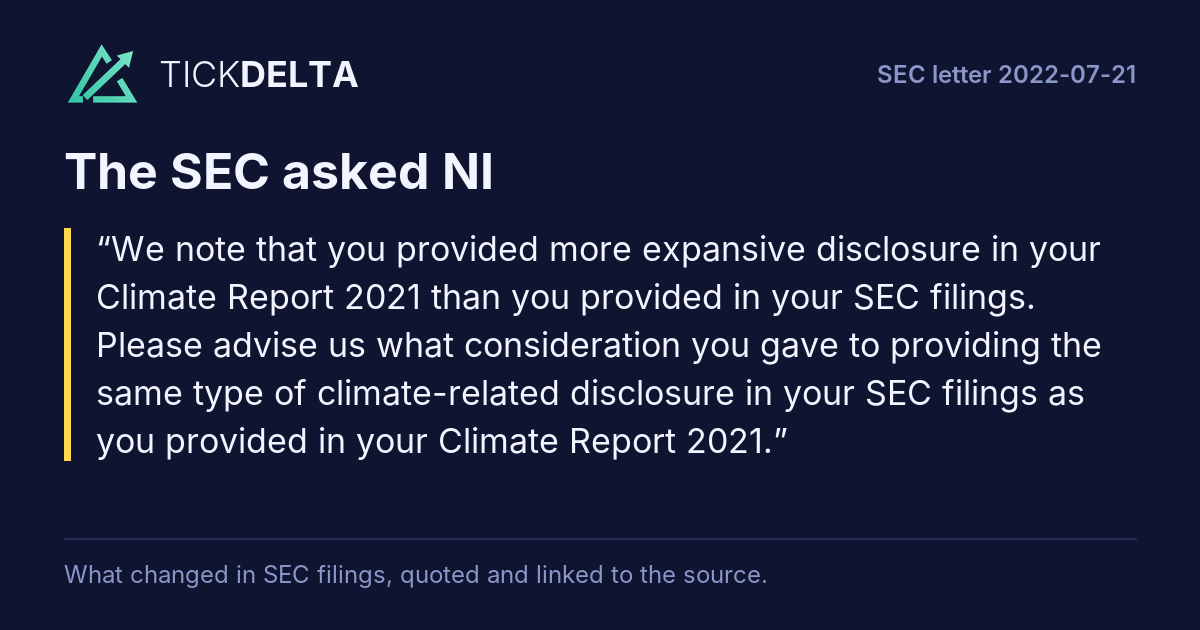
We note that you provided more expansive disclosure in your Climate Report 2021 than you provided in your SEC filings. Please advise us what consideration you gave to providing the same type of climate-related disclosure in your SEC filings as you provided in your Climate Report 2021.
The disclosure in our 2021 Climate Report (the “Climate Report”) and in our Form 10-K and other Commission filings has been based on the varying purposes of the documents and the evolving practices and stakeholder expectations relating to them.
In preparing the disclosures in our Form 10-K and other Commission filings with respect to climate-related matters, we have been guided by the requirements of Regulation S-K, the Commission’s general disclosure principle providing that, in addition to the disclosures expressly required to be included in Commission filings, registrants shall discloseRead in the reply ↗Rest of the answer
such further material information, if any, as may be necessary to make the required disclosures not misleading, and the Commission’s 2010 interpretive release providing guidance regarding disclosures relating to climate change. Thus guided, we provided disclosure in our Commission filings regarding a particular event, transaction, trend, uncertainty, impact or other matter if it was required by the applicable provisions of Regulation S-K or if it was material to, or is reasonably likely to have a material impact on, our business, financial condition or results of operations, taking into account the size, scope and nature of our business.
On the other hand, the disclosures in the Climate Report cover issues that we believe are of interest to our various stakeholders. Identification of an item for inclusion in the Climate Report is not meant to correspond with the concept of materiality. Stated otherwise, in developing the contents of the Climate Report, we apply a broad lens and do not limit disclosure to the Commission’s materiality requirements.
The content of the Climate Report was informed by, among other things, our review of the Task Force on Climate-Related Financial Disclosures (“TCFD”) framework and recommendations, as well as our review of the climate-related disclosures of various other public companies, including our peer companies. We expect stakeholders beyond the investment community — including our customers, communities, employees, and regulators — to find value in the more expansive disclosure presented in the Climate Report.
First report after the company's reply of 2022-08-30: 10-Q filed 2022-11-07 ↗, against the 10-Q filed 2022-05-04 ↗.
Tickdelta does not hold the text of both reports, so they are not compared here.
Disclosure in your Form 10-K appears to identify “evolving investor sentiment related to the use of fossil fuels” as a transition risk related to climate change. Please revise to more clearly describe the material effects of this transition risk beyond what is currently characterized as the “significant impact on our electric generation and natural gas businesses in the future.”
Some of our baseload generation is dependent on natural gas and coal, and we pass through the costs for these to our customers. In addition, in our gas distribution business, we procure natural gas on behalf of certain customers, and we pass through the actual cost of the gas consumed. Lower investor interest in funding fossil fuel development could reduce the amount of exploration and production of natural gas or coal, or investment in gas transmission pipelines.Read in the reply ↗Rest of the answer
Reduced production and transportation of natural gas could, in the long-term, lead to supply shortages leading to baseload generation outages. Given that we pass through commodity costs to customers, this could also create the potential for regulatory questions resulting from increased customer costs. We are unable to forecast the future of commodity markets, but we understand that reduced fossil fuel investment, due to evolving investor sentiment, could lead to higher commodity prices and shortages impacting our generation and our reputation with regulators. Given the expectation of continued pressure related to the use of fossil fuels, we intend to revise our risk factor to reflect the above considerations in our future Form 10-K filing. Below is the revised risk factor that will be included in the “Risk Factors” section of our next Form 10-K, subject to any changes in circumstance or events prior to filing:
The physical impacts of climate change and the transition to a lower carbon future are impacting our business and could materially adversely affect our results of operations.
Climate change is exacerbating the risks to our physical infrastructure by increasing the frequency of extreme weather, including heat stresses to power lines and storms and floods that damage infrastructure. In addition, climate change is likely to cause lake and river level changes that affect the manner in which services are currently provided and droughts or other stresses limits on water used to supply services, and other extreme weather conditions. We have adapted and will continue to evolve our infrastructure and operations to meet current and future needs of our stakeholders. With higher frequency of these and possibly other possible extreme weather events, it may become more costly for us to safely and reliably deliver certain products and services to our customers. Some of these costs may not be recovered. To the extent that we are unable to recover those costs, or if higher rates resulting arising from recovery of such costs result in reduced demand for services, our future financial results may be adversely impacted. Further, as the intensity and frequency of significant weather events increases, it may impact our ability result in increased costs to secure cost efficient insurance as described above for our operations.
Our strategy may be impacted by policy and legal, technology, market, and reputational risks and opportunities that are associated with the transition to a lower carbon economy, as disclosed in other risk factors in this section. As a result of increased awareness regarding climate change, coupled with adverse economic conditions, availability of alternative energy sources, including private solar, microturbines micro turbines, fuel cells, energy-efficient buildings and energy storage devices, and new regulations restricting emissions, including potential regulations of methane emissions, some consumers and companies may use less energy, meet their own energy needs through alternative energy sources or avoid expansions of their facilities, including natural gas facilities, resulting which may result in less demand for our services. As these technologies become a more cost-competitive option over time, whether through cost effectiveness or government incentives and subsidies, certain customers may choose to meet their own energy needs and subsequently decrease usage of our systems and services, which may result in, among other things, our generating facilities becoming less competitive and economical. Further, evolving investor sentiment related to the use of fossil fuels and initiatives to restrict continued production of fossil fuels could result in a significant impact on our electric generation and natural gas businesses in the future.
Some of our baseload generation is dependent on natural gas and coal, and we pass through the costs for these energy sources to our customers. In addition, in our gas distribution business, we procure natural gas on behalf of certain customers, and we pass through the actual cost of the gas consumed. Lower investor interest in funding fossil fuel development could reduce the amount of exploration and production of natural gas or coal, or investment in gas transmission pipelines. Reduced production and transportation of natural gas could, in the long-term, lead to supply shortages leading to baseload generation outages. Given that we pass through commodity costs to customers, this could also create the potential for regulatory questions resulting from increased customer costs. We are unable to forecast the future of commodity markets, but reduced fossil fuel investment, due to evolving investor sentiment, could lead to higher commodity prices and shortages impacting our generation and our reputation with regulators.
Conversely, demand for our services may increase as a result of customer changes in response to climate change. For example, as the utilization of electric vehicles increases, demand for electricity may increase, resulting in increased usage of our systems and services. Any negative opinions views with respect to our environmental practices or our ability to meet the challenges posed by climate change formed by from regulators, customers, investors or legislators could harm our reputation and change adversely affect the perceived value of our products and services. Changes in policy to combat climate change, and technology advancement, each of which can also accelerate the implications of a transition to a lower carbon economy, may materially adversely impact our business, financial position, results of operations, and cash flows.
First report after the company's reply of 2022-08-30: 10-Q filed 2022-11-07 ↗, against the 10-Q filed 2022-05-04 ↗.
Tickdelta does not hold the text of both reports, so they are not compared here.
Disclose any material litigation risks related to climate change and explain the potential impact to the company.
We consider the possibility of climate or environmental-related litigation and its potential impact in the preparation of the “Risk Factors” section of our Form 10-K. Our risk factors disclosure is reviewed regularly as a part of our disclosure controls and procedures, which are designed to include multi-tiered levels of involvement and review by multiple personnel within the disclosure process.
While we have identified and disclosed the potential risk of environmental-related litigation in the “Risk Factors” section of our Form 10-K, we have not identified a current and specific litigationRead in the reply ↗Rest of the answer
risk related to climate change. To date, we are not aware of any specific and targeted global warming or climate change litigation asserted or reasonably expected to be asserted against us. We will continue to closely monitor material climate and environmental litigation risks, including those related to climate change, for consideration for inclusion within our risk factor disclosures in future filings on Form 10-K or Form 10-Q, as applicable. To the extent the Company becomes a party to any material pending legal proceeding related to climate change, such litigation will be disclosed within “Other Commitments and Contingencies,” in the Notes to our Consolidated Financial Statements and in the “Legal Proceedings” sections of our future filings on Form 10-K or Form 10-Q, as applicable.
First report after the company's reply of 2022-08-30: 10-Q filed 2022-11-07 ↗, against the 10-Q filed 2022-05-04 ↗.
Tickdelta does not hold the text of both reports, so they are not compared here.
Please tell us about your disclosure considerations related to material past and future capital expenditures for climate-related projects. For example, disclosure in your Form 10-K refers to replacement projects that “reduce, or potentially reduce, greenhouse gas emissions.” Include quantitative information for the periods for which financial statements are presented in your Form 10-K and amounts budgeted for futureRest of the question
periods as part of your response.
Our Form 10-K disclosures do not specifically refer to any capital expenditure programs as climate-related projects. With respect to gas pipeline modernization, the purpose of such investments is to enhance safety and customer reliability, and reduce methane emissions. As such, we do not disclose these expenditures specifically as climate-related. We do disclose that our regulatory capital program investments—which primarily consist of pipeline replacement and gas infrastructure modernization spending—reduce greenhouse gas emissions.Read in the reply ↗Rest of the answer
Our generation transition initiative within our Electric Operations segment involves the retirement of coal-fired generation facilities to be replaced with renewable sources of generation, primarily wind and solar, with lower emissions. These investments include the necessary transmission upgrades to connect the generation facilities to the grid. Capital expenditures related to our transition towards renewable generation sources in our Electric Operations have only recently become material, and are disclosed as “Generation Transition Investments” on page 47 of our Form 10-K.
Capital expenditures for these gas infrastructure modernization and leak detection and electric generation transition projects are included below.
(in millions) 2021 2020 2019
Gas Distributions Operations $ 840.3 $ 729.9 $ 694.2
Electric Operations 62.5 0.7 7.4
Capital expenditures for these projects, which could be considered “climate-related,” are embedded in the “System Growth and Tracker” and “Generation Transition Investments” line items included in total capital expenditures of $1.9 billion, $1.7 billion and $1.9 billion for fiscal years 2021, 2020 and 2019, respectively (as disclosed on page 47 of our Form 10-K and page 41 of our Annual Report on Form 10-K for the fiscal year ended December 31, 2020). Certain of these modernization projects are recovered through trackers (as disclosed in the Regulatory Capital Programs table on page 48 of our Form 10-K).
We currently expect to make estimated investments of approximately $3.0 billion associated with gas modernization and leak detection and $2.0 billion associated with renewable generation transition investments between 2022 and 2024. Actual capital expenditures may vary from these estimates (as disclosed on page 47 of our Form 10-K).
First report after the company's reply of 2022-08-30: 10-Q filed 2022-11-07 ↗, against the 10-Q filed 2022-05-04 ↗.
Tickdelta does not hold the text of both reports, so they are not compared here.
On page 22 of your Form 10-K, you state that climate change is exacerbating the risks to your physical infrastructure by increasing the frequency of extreme weather. Please quantify for us weather-related damages to your property or operations during the periods covered by your Form 10-K and in subsequent periods.Rest of the question
In addition, please revise to discuss the potential for indirect weather-related impacts that have affected or may affect your major suppliers.
During the periods covered by our Form 10-K, we did not incur any material weather-related damages to our property or operations. We regularly track damages to our property and operations related to weather events, which are generally recoverable through capital expenditures and base rates, and have not increased significantly in recent years.Read in the reply ↗Rest of the answer
In 2021, 2020, and 2019, weather-related damages, comprised of capital expenditures and operations and maintenance expense, driven by named storms, were $15.7 million, $13.6 million, and $13.9 million, respectively, which represent less than 0.5% of our total operating revenue. Thus far in 2022, weather related damages have been consistent with historical experience and are similarly immaterial. To the extent we incur weather-related damages to our properties in the future that are material to our business, financial condition or results of operations, we will provide disclosure regarding such damages in accordance with applicable legal requirements.
As noted in the “Risk Factors” section of our Form 10-K, we have traditionally been sensitive to variations in weather. We have evaluated our major suppliers, and we are not aware of any material specific indirect weather-related impacts on major suppliers during the periods covered in our Form 10-K. If, in the future, we identify a material risk we will provide appropriate disclosure in the “Risk Factors” section of our Form 10-K, or Form 10-Q if applicable.
First report after the company's reply of 2022-08-30: 10-Q filed 2022-11-07 ↗, against the 10-Q filed 2022-05-04 ↗.
Tickdelta does not hold the text of both reports, so they are not compared here.
You disclose on page 17 that some insurers are moving away from underwriting certain carbon-intensive energy-related businesses such as those exposed to certain perils such as wildfires. Provide us with additional detail regarding weather-related impacts on the cost or availability of insurance (e.g., whether the premiums you pay for insurance coverage have significantly increased due to weather conditions).Rest of the question
Please include quantitative information with your response for the periods covered by your Form 10-K and explain whether you expect to incur increased amounts in future periods.
We have not experienced material weather-related impacts on the availability or the cost of the insurance coverage we have historically maintained. Insurance premiums paid for property damage coverage were less than $10 million per year in each of the years ended December 31, 2021, 2020 and 2019. Increases in premiums that we have paid over the past three years were not a result of weather-related impacts at NiSource, but resulted from industry factors and overall market-driven impacts, including general weather-related impacts to other companies in our industry.
We have observed insuranceRead in the reply ↗Rest of the answer
companies reevaluating their book of business and decreasing their support of companies who have coal assets or other fossil fuel emissions.
In this current year to date, we have lost $25 million in casualty coverage from a long-standing supportive insurer due to their change in appetite for entities that possess coal-fired power plants. In this current market, there was new carrier capacity available which allowed us to replace the lost capacity with little financial impact. While we are unable to forecast the future of insurance markets, we recognize the risk that capacity may not always be available for purchase at similar rates.
First report after the company's reply of 2022-08-30: 10-Q filed 2022-11-07 ↗, against the 10-Q filed 2022-05-04 ↗.
Tickdelta does not hold the text of both reports, so they are not compared here.
We note your disclosure on page 30 stating that revised or additional laws and regulations may result in increased compliance costs. Please tell us about and quantify compliance costs related to climate change for each of the periods for which financial statements are presented in your Form 10-K and whether increased amounts are expected to be incurred in future periods.
In fiscal year 2021 (and in prior fiscal years), we did not incur any material compliance costs related to climate change. At this time, the Company’s operations are not subject to requirements that limit greenhouse gas emissions, and the Company does not currently experience compliance costs related to climate change.Read in the reply ↗Rest of the answer
In future periods, compliance costs related to climate change could be incurred and increase.
The disclosure in the “Climate Change Issues” section of “Management’s Discussion and Analysis of Financial Condition and Results of Operations” in the Company’s Form 10-K and the disclosure in “Risk Factors” on page 30 of the Company’s Form 10-K discuss the possibility that proposed or future laws, regulations, and policies regarding climate change could have a material impact on our business, financial position, financial results, and cash flows. We continue to monitor the implementation of any final and proposed climate change-related legislation and regulations, including the Infrastructure Investment and Jobs Act, passed in November 2021, the Inflation Reduction Act of 2022 and the Environmental Protection Agency's proposed methane regulations for the oil and natural gas industry. We currently do not expect these existing and proposed requirements to result in compliance costs related to climate change that are material to our operations.
To the extent that in fiscal year 2022 (or a future fiscal year) we incur increased compliance costs related to climate change that are material, we will provide disclosure regarding such increased costs in future filings as appropriate.
First report after the company's reply of 2022-08-30: 10-Q filed 2022-11-07 ↗, against the 10-Q filed 2022-05-04 ↗.
Tickdelta does not hold the text of both reports, so they are not compared here.
If material, provide disclosure about your purchase or sale of carbon credits or offsets and any material effects on your business, financial condition, and the results of operations. To the extent applicable, provide quantitative information with your response for each of the periods for which financial statements are presented in your Form 10-K and for any future periods.
In 2021, 2020 and 2019, we have not purchased or sold any carbon credits or offsets either voluntarily or on behalf of our customers. In 2022, we filed for programs in many of the states in which we operate to purchase carbon offsets on behalf of our customers and are awaiting regulatory approval before the programs will be implemented. The programs would be voluntary in nature whereby customers would determine whether they would like to offset 50% or 100% of their carbon emissions through the purchase of carbon offsets.Read in the reply ↗Rest of the answer
We do not expect such programs to have a material impact to our operating income as the costs of the offsets would be fully borne by the customers purchasing them. We will continue to evaluate whether future disclosure is needed for this program or any other further purchase or sale of carbon credits or offsets based on the materiality to the financial statements.
First report after the company's reply of 2022-08-30: 10-Q filed 2022-11-07 ↗, against the 10-Q filed 2022-05-04 ↗.
Tickdelta does not hold the text of both reports, so they are not compared here.
We note the revised disclosure provided as part of your response to prior comment 2. Please further revise your disclosure to clarify how your use of fossil fuels may affect opinions with respect to your environmental practices (e.g., by increasing your cost of capital or limiting your access to capital markets).
We have identified and disclosed in our Financial, Economic and Market Risks “Risk Factors” section on page 25 of our Form 10-K that “a change in investor sentiment toward us or the utilities industry generally could adversely affect our ability to raise additional capital or refinance debt. For example, because NIPSCO’s current generating facilities substantially rely on coal for its operations, certain financial institutions may choose not to participate in our financing arrangements.Read in the reply ↗Rest of the answer
In addition, large institutional investors may choose to sell or choose not to purchase our stock due to environmental, social and governance (“ESG”) concerns or concerns regarding renewable energy supply chain challenges. Reduced access to capital markets, increased borrowing costs, and/or lower equity valuation levels could reduce future earnings per share and cash flows.” To date, we have not experienced any material impacts such as the ones described in the preceding sentences. However, to the extent we experience any such material impacts in the future, we will provide appropriate disclosure in our future filings.
First report after the company's reply of 2022-09-20: 10-Q filed 2022-11-07 ↗, against the 10-Q filed 2022-05-04 ↗.
Tickdelta does not hold the text of both reports, so they are not compared here.
From your response to prior comment 4, it appears that expenditures for projects that are considered “climate-related” are embedded in other disclosures regarding your capital expenditures. Please clarify for us how you considered providing disclosure that identifies capital expenditures for climate-related projects.
Our primary purpose for replacing pipe and modernizing our gas infrastructure is to enhance the safety and reliability of our system. These gas modernization projects have and are expected to continue to have an ancillary benefit of reducing emissions. As emissions reductions are only a byproduct of the modernization expenditures, we are unable to reasonably determine the allocation of our capital expenditures that are climate-related. Further, management does not view the safety and emissions reductions components separately when making decisions such as capital budget allocations.Read in the reply ↗Rest of the answer
In future filings, we intend to clarify that emissions reductions are an ancillary benefit of the modernization capital expenditures.
First report after the company's reply of 2022-09-20: 10-Q filed 2022-11-07 ↗, against the 10-Q filed 2022-05-04 ↗.
Tickdelta does not hold the text of both reports, so they are not compared here.
Your response to prior comment 5 states that you are not aware of any material specific indirect weather-related impacts on your suppliers. Please tell us how you considered providing disclosure regarding possible indirect financial and operational impacts to you from disruptions to the operations of your suppliers from severe weather.
We have quarterly business review meetings with critical suppliers to monitor potential impacts, including those related to weather. Through this process, we discuss emerging issues in the supply chain, which may include weather-related events (hurricanes, floods, fires, etc). Through this process, we have not identified or experienced any material financial or operational impacts from disruptions to the operations of our suppliers, as a result of severe weather, nor have we identified any new material risks to disclose.Read in the reply ↗Rest of the answer
To the extent we identify any material impacts in the future, we will provide appropriate disclosure in our future filings.
First report after the company's reply of 2022-09-20: 10-Q filed 2022-11-07 ↗, against the 10-Q filed 2022-05-04 ↗.
Tickdelta does not hold the text of both reports, so they are not compared here.
Also in this review: request for more time, 2022-07-29, closing letter, 2022-09-29