Form 10-K
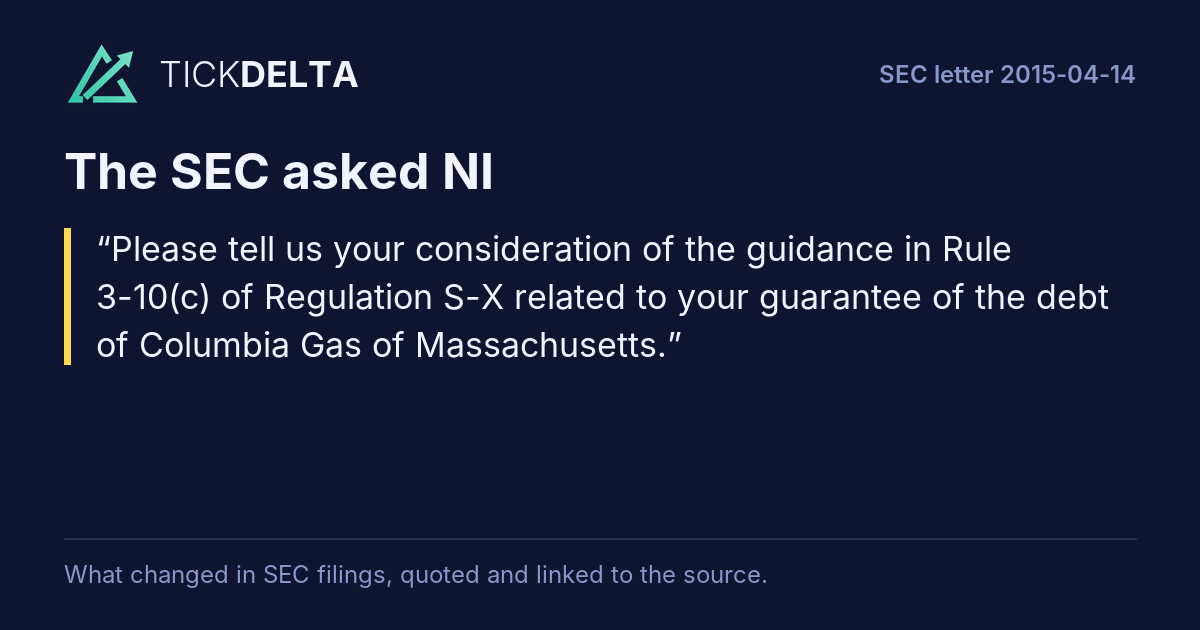
Please tell us your consideration of the guidance in Rule 3-10(c) of Regulation S-X related to your guarantee of the debt of Columbia Gas of Massachusetts.
We have reviewed the staff comment on our above-referenced filing contained in your letter dated April 14, 2015 to Stephen P. Smith and are submitting our response. For convenience of reference, the comment is set forth below in boldface type, followed by our response.
Note 18. Other Commitment and
Contingencies
Guarantees of Subsidiaries Debt,
Please tell us your consideration of the guidance in Rule 3-10(c) of Regulation S-X related to your guarantee of the debt of Columbia Gas of Massachusetts.
The debt in question consists of two series of medium-term notes, both of which were issuedRead in the reply ↗Rest of the answer
by Columbia Gas of Massachusetts (“CMA”) under its former name, Bay State Gas Company, before we bought Bay State in 1999. The notes were issued under Bay State’s 1991 shelf registration statement. To the best of our knowledge, for at least as long as CMA has been our subsidiary, one series of notes has been held of record by a single institutional investor, and the other has been held of record by three institutional investors.
In 2011, Moody’s
Investors Service advised us that they would downgrade the rating on CMA’s medium-term notes unless either NiSource guaranteed the notes or CMA became a voluntary filer. We opted for the NiSource guarantee and added it to the terms of the notes by means of a second supplemental indenture to CMA’s 1991 indenture. We determined that the transaction did not involve the offer or sale of a security for purposes of the Securities Act, since no consideration was given for the guarantee.
Rule 3-10(a) of
Regulation S-X sets forth a “general rule” that “Every issuer of a registered security that is guaranteed and every guarantor of a registered security must file the financial statements required for a registrant by Regulation S-X.”
At the time NiSource guaranteed the CMA notes in 2011, we determined that those notes did not then constitute “registered securities.” Consequently, the general rule in Rule 3-10(a) did not apply to CMA as issuer of the notes or to NiSource as guarantor of the notes, so there was no need to comply with the requirements of the exception in Rule 3-10(c).
The CMA notes constituted
“registered securities” at the time they were issued, because the issuance was pursuant to an effective registration statement and Exchange Act Section 15(d) imposed a duty on Bay State to file periodic reports under Section 13 (although that duty was automatically suspended because Bay State’s common stock was registered under Section 12). However, in connection with our purchase of the company, Bay State filed a Form 15 in 1999 certifying termination of registration under Section 12g-4(a)(1)(i) and suspension of duty to file reports under Rule 15d-6. Although the Form 15 listed only the common stock as the “title of each class of securities covered by this Form,” it certified that the “title of all other classes of securities for which a duty to file reports under section 13(a) and 15(d) remains” was “none.”
Bay State’s duty to file Exchange Act reports by reason of the registration of the notes was automatically suspended, pursuant to Section 15(d),
“…as to any fiscal year, other than the fiscal year within which such registration statement became effective, if, at the beginning of such fiscal year, the securities of each class, other than any class of asset-backed securities, to which the registration statement relates are held of record by less than 300 persons….” The CMA notes have been held of record by substantially fewer than 300 persons since at least 1999. The Division of Corporation Finance has stated “Under Rule 15d-6, if an issuer has fewer than 300 security holders of record at the beginning of the fiscal year, a Form 15 should be filed to notify the Commission of such suspension, but the suspension is granted by statute and is not contingent on filing the Form 15.”
(See Compliance and Disclosure Interpretations, Exchange Act Rules, Question 171.01.) So even if Bay State’s Form 15 failed to mention the notes by name, the duty to report had been suspended. Once Bay State/CMA no longer had a Section 15(d) duty to file reports with respect to the notes, the notes ceased to be “registered securities.” Accordingly, when NiSource guaranteed the notes in 2011, the guarantee was not “of a registered security” and Rule 3-10(a) did not apply to NiSource as guarantor of the notes or to CMA as issuer of the notes.
We hereby acknowledge that:
· the Company is responsible for the adequacy and accuracy of the disclosure in the filing;
· staff comments or changes to disclosure in response to staff comments do not foreclose the Commission from taking any action with respect to the filing; and
· the company may not assert staff comments as a defense in any proceeding initiated by the Commission or any person under the federal securities laws of the United States.
First report after the company's reply of 2015-04-17: 10-Q filed 2015-04-30 ↗.
No earlier 10-Q before the SEC's letter is in Tickdelta, so there is nothing to compare with.
We reviewed your response to our prior comment. It does not appear the Form 15 filed in 1999 deregistered the debt registered under the Securities Act of 1933. Refer to our Compliance and Disclosure Interpretations regarding Exchange Act Sections, specifically Question 153.01 available on our website at www.sec.gov/divisions/corpfin/guidance/exchangeactsectionsinterps.htm.Rest of the question
Additionally, the condensed consolidating financial information noted in Rule 310(c) is still required in your financial statements for as long as the registered security is outstanding. This is true even if a subsidiary issuer or guarantor properly suspends its reporting obligation with respect to the security and/or the guarantees under Section 15(d) of the Exchange Act. Please advise or revise. Refer to Section III.C.1 of Release No. 33-7878 available on our website at http://www.sec.gov/rules/final/33-7878.htm.
We have reviewed the staff comment on our above-referenced filing contained in your letter dated April 29, 2015 to Stephen P. Smith and are submitting our response. For convenience of reference, the comment is set forth below in italicized boldface type, followed by our response.
Note 18 Other Commitment and Contingencies
Guarantees of Subsidiaries Debt, page 110
We reviewed your response to our prior comment. It does not appear the Form 15 filed in 1999 deregistered the debt registered under the
Securities Act of 1933.Read in the reply ↗Rest of the answer
Refer to our Compliance and Disclosure Interpretations regarding Exchange Act Sections, specifically Question 153.01 available on our website at www.sec.gov/divisions/corpfin/guidance/exchangeactsections-interps.htm.
Additionally, the condensed consolidating financial information noted in Rule 3-10(c) is still required in your financial statements for as long as the registered security is outstanding. This is true even if a subsidiary issuer or guarantor properly suspends its reporting obligation with respect to the security and/or the guarantees under Section 15(d) of the Exchange Act. Please advise or revise. Refer to Section III.C.1 of Release No. 33-7878 available on our website at http://www.sec.gov/rules/final/33-7878.htm.
The guarantee relates to two series of medium-term notes (the “CMA notes”) issued by
Bay State Gas Company (“Bay State”). (Bay State does business as Columbia Gas of Massachusetts.) Bay State was acquired by NIPSCO Industries, a predecessor of NiSource Inc., in 1999. The guarantee was not included as part of the original debt issuance by Bay State, but was added without consideration in 2011 by NiSource, as described below.
The CMA notes were issued pursuant to a 1991 shelf registration statement. These notes are held by four institutional investors. Due to the difficulty in obtaining registration statements and related prospectus supplements that pre-date EDGAR, we cannot easily determine whether there were any securities remaining on Bay State’s shelf registration statement at the time it filed its last Form 10-K on January 13, 1999 for the fiscal year ended September 30, 1998 (the “1998 Form
10-K”). On February 16, 1999, Bay State filed a Form 15 to deregister its common stock pursuant to Exchange Act Rule 12g-4(a)(1)(i).
If the shelf registration statement had been “exhausted” prior to January 13, 1999 – that is, all securities registered on the Form S-3 had been sold – then the filing of the 1998 Form 10-K could not have served as a post-effective amendment to that Form S -3, thereby triggering a new Section 15(d) reporting obligation for fiscal year 1999. Also, it would not have been necessary to file a post-effective amendment to deregister any remaining unsold securities because there would not be any such securities.
Assuming Bay State had a Section 15(d) reporting obligation with respect to the CMA notes at the time it filed its 1998 Form 10-K, then Bay State should have filed a Form 10-K for the year ended September 30, 1999 (the “1999 Form 10-K”), and it should have deregistered any remaining securities on the shelf registration statement prior to the filing of the 1999 Form 10-K so as not to create a new Section 15(d) filing obligation for fiscal year 2000. Bay State did not file the 1999 Form 10-K because it was of the view that it no longer was subject to Exchange Act reporting obligations in light of the Form 15 filed on February 16, 1999.
Bay State’s failure to file the 1999 Form 10-K (assuming it was required to do so) does not mean that it has a Section 15(d) reporting obligation in 2015. Bay State did not and has not filed any periodic reports after being acquired by NIPSCO/NiSource in
1999. Assuming that Bay State’s 1998 Form 10-K served as a post-effective amendment to Bay State’s Form S-3, then Bay State’s Section 15(d) reporting obligation was suspended automatically by operation of law on
October 1, 1999, which is the first day of any fiscal year other than the year in which the registration statement became effective and there were fewer than 300 holders. There is no requirement that a registrant must be current in its Exchange Act reports in order for its Section 15(d) reporting obligation to be suspended automatically. Because no Form 10-K has been filed by Bay State since the 1998 Form 10-K, there is no shelf registration statement that has been updated/declared effective since that time.
Since acquiring Bay State in 1999, NiSource has never included separate financial statements for Bay State in NiSource’s periodic reports.
Section III.C.I of Release No. 33-7878 is not applicable here because Bay State is not relying on Rule 12h-5 under the
Exchange Act. The premise of Rule 12h-5 and of Rule 3-10 of Regulation S-X is that a subsidiary is otherwise subject to full Exchange Act reporting. Assuming this as its premise, these two rules operate together to relieve the subsidiary of the burden of full Exchange Act reporting. By October 1, 1999, Bay State’s Section 15(d) reporting obligation had been automatically suspended by operation of Section 15(d) of the Exchange Act. (Incidentally, Rule
12h-5 was adopted in August 2000, after Bay State’s Section 15(d) reporting obligation had been automatically suspended.)
In
2011, in response to credit rating agencies, NiSource issued a guarantee for the CMA notes. This is the first time that the CMA notes had a guarantee, which was added without consideration from the noteholders. This issuance was done pursuant to Section 4(a)(2) (there are only four institutional investors) or could be interpreted as a “no sale” issuance as no consideration was given for the guarantee. In any event, Rule 3-10 applies to “issuers of guaranteed securities registered or being registered.” Rule 3-10(a) provides that “every issuer of a registered security that is guaranteed and every guarantor of a registered security must file the financial statements required for a registrant by Regulation S-X.” There is no registered security here that would trigger Rule 3-10 reporting. Bay State’s Section 15(d) registration has been suspended since October 1, 1999 and the guarantee was not issued in a registered offering. Therefore, Rule 3-10 does not apply to the CMA notes or to NiSource’s guarantee of those notes.
We hereby acknowledge that:
• the Company is responsible for the adequacy and accuracy of the disclosure in the filing;
staff comments or changes to disclosure in response to staff comments do not foreclose the Commission from taking any action with respect to the filing; and the company may not assert staff comments as a defense in any proceeding initiated by the Commission or any person under the federal securities laws of the United States.
First report after the company's reply of 2015-04-30: 10-Q filed 2015-08-03 ↗.
No earlier 10-Q before the SEC's letter is in Tickdelta, so there is nothing to compare with.
Also in this review: closing letter, 2015-05-11