Paragraph 64 · 48% changed
Every version of it
Screener
/
SEC EDGAR
/CIK 0001174850
/10-K filed Feb 27, 2026, compared with Feb 25, 2025
/Numbers from the XBRL of the 10-Ks
NYSE
Financials · Banks
Nicolet Bankshares Inc NIC
The 10-K against last year's
107 changes: 15 added, 23 removed, 68 reworded, 1 quiet changes
10-K Feb 27, 2026 vs Feb 25, 2025
Risk Factors
10.3%
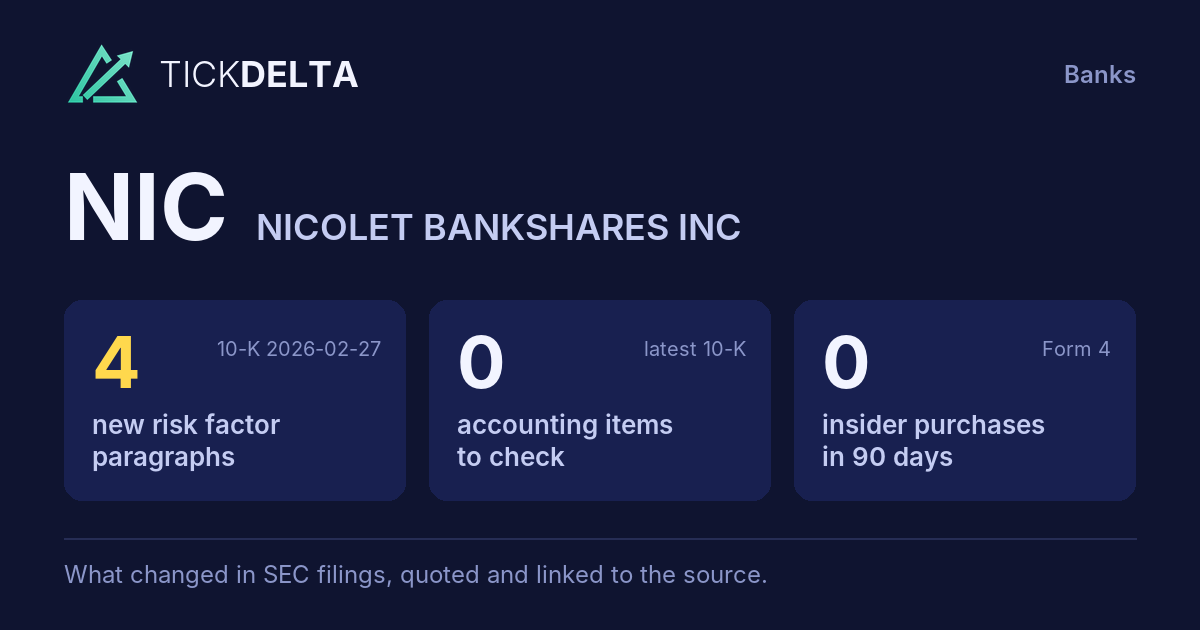
of the text changed · 11,725 words now · 4 new paragraphs, 7 gone
MD&A
24.3%
of the text changed · 9,540 words now · 11 new paragraphs, 16 gone
Legal Proceedings
7.9%
of the text changed · 876 words now
Accounting Policies
4.2%
of the text changed · 6,757 words now
10-K 0001174850-26-000077 (Feb 27, 2026) vs 10-K 0001174850-25-000008 (Feb 25, 2025)
Every paragraph, and how much of it changed
One bar per paragraph, in the order of the 10-K. Height and colour show the share of its words not in the closest paragraph a year earlier; the tallest bars are new paragraphs.
Risk Factors
148 paragraphs · 4 new · 42 reworded · 7 gone · 10-K Feb 27, 2026 against Feb 25, 2025
New paragraph
Reworded (5% of its words or more)
Same or nearly
Paragraph 113 · 42% changed
Every version of it
Paragraph 74 · 35% changed
Every version of it
If the communities in which we operate do not grow or if the prevailing economic conditions locally or nationally are less favorable than we have assumed, this may result in deterioration in the credit quality of our borrowers and the demand for our products and services, an increase in the number of loan delinquencies, defaults and charge-offs, foreclosures, additional provision for credit losses, adverse asset values of the collateral securing our loans, and an overall material adverse effect on the quality of our loan portfolio. These negative effects may cause us to incur losses and may adversely affect our capital, liquidity and financial condition.
Paragraph 62 · 34% changed
Every version of it
Paragraph 61 · 26% changed
Every version of it
Paragraph 75 · 22% changed
Every version of it
Paragraph 71 · 21% changed
Every version of it
Our credit risk and credit losses can increase if our loans become concentrated to borrowers engaged in the same or similar activities or to borrowers who as a group may be uniquely or disproportionately affected by economic or market conditions. As of December 31, 2025, approximately 77% of our loan portfolio consisted of commercial-related loans, including commercial and industrial loans, owner-occupied CRE, AG production and AG real estate, CRE investment, and construction and land-development loans. Our borrowers under these loans tend to be small to medium-sized businesses. These types of loans are typically larger than residential real estate loans or consumer loans. During periods of lower economic growth or challenging economic periods, small to medium-sized businesses may be impacted more severely and more quickly than larger businesses. Consequently, the ability of such businesses to repay their loans may deteriorate, and in some cases this deterioration may occur quickly, which would adversely affect our results of operations and financial condition. An increase in nonperforming loans could result in a net loss of earnings from these loans, an increase in the provision for credit losses and an increase in loan charge-offs, all of which could have a material adverse effect on our business, financial condition and results of operations.
Paragraph 98 · 20% changed
Every version of it
We anticipate we will continue to rely primarily on deposits, loan repayments, and cash flows from our investment securities to provide liquidity. Additionally, when necessary, the secondary sources of borrowed funds described above will be used to augment our primary funding sources. An inability to maintain or raise funds (including the inability to access secondary funding sources) in amounts necessary to meet our liquidity needs would have a substantial negative effect, individually or collectively, on our liquidity. Our access to funding sources in amounts adequate to finance our activities, or on terms attractive to us, could be impaired by factors that affect us specifically or the financial services industry in general. For example, factors that could detrimentally impact our access to liquidity sources include our financial results, a decrease in the level of our business activity due to a market downturn or adverse regulatory action against us, a reduction in our credit rating, any damage to our reputation, counterparty availability, changes in the activities of our business partners, changes affecting our loan portfolio or other assets, or any other event that could cause a decrease in depositor or investor confidence in our creditworthiness and business. Our Any such event or failure to manage our liquidity effectively could affect our competitive position, increase our borrowing costs and the interest rates we pay on deposits, limit our access to liquidity could also be impaired by factors that are not specific to us, such as general business conditions, the capital markets and have a material adverse effect on our results of operations or financial condition. Changes associated with interest rate fluctuations, severe volatility or disruption of the financial markets or negative views and expectations about the prospects for the financial services industry as a whole, or legal, regulatory, accounting, and tax environments governing benchmarks also may impact our funding transactions. In addition, our ability to raise funds is strongly affected by the general state of the U.S. ability; see Interest Rate and world economies and financial markets as well as the policies and Yield Curve Risks below.
Paragraph 64 · 48% changed
Every version of it
10-K Feb 25, 2025Effects on the yield curve often are most pronounced at the short end of the curve, which is of particular importance to us and other banks. Among other things, easing strategies are intended to lower interest rates, expand the money supply, and stimulate economic activity, while tightening strategies are intended to increase interest rates, tighten the money supply, and restrain economic activity. Many external factors may interfere with the effects of these plans or cause them to be changed, sometimes quickly. Such factors include significant economic trends or events as well as significant international monetary policies and events. Such strategies also can affect the U.S. and world-wide financial systems in ways that may be difficult to predict. Risks associated with interest rates and the yield curve are discussed in this Item 1A under the caption Interest Rate and Yield Curve Risks.
10-K Feb 27, 2026
can affect the U.S. and world-wide financial systems in ways that may be difficult to predict. Risks associated with interest rates and the yield curve are discussed in this Item 1A under the caption Interest Rate and Yield Curve Risks.
Paragraph 113 · 42% changed
Every version of it
10-K Feb 25, 2025Management must make significant assumptions and estimates and exercise significant judgment in selecting and applying accounting and reporting policies. In some cases, management must select a policy from two or more alternatives, any of which may be reasonable under the circumstances, which may result in reporting materially different results than would have been reported under a different alternative. The estimate that is consistently one of our most critical is the level of the allowance for credit losses. However, other estimates can be highly significant at discrete times or during periods of varying length, for example the valuation (or impairment) of our deferred tax assets. Estimates are made at specific points in time. As actual events unfold, estimates are adjusted accordingly. Due to the inherent nature of these estimates, it is possible that, at some time in the future, we may significantly increase the allowance for credit losses and/or sustain credit losses that are significantly higher than the provided allowance, or we may recognize a significant provision for impairment of assets, or we may make some other adjustment that will differ materially from the estimates that we make today. Moreover, in some cases, especially concerning litigation and other contingency matters where critical information is inadequate, often we are unable to make estimates until fairly late in a lengthy process.
10-K Feb 27, 2026
credit losses that are significantly higher than the provided allowance, or we may recognize a significant provision for impairment of assets, or we may make some other adjustment that will differ materially from the estimates that we make today. Moreover, in some cases, especially concerning litigation and other contingency matters where critical information is inadequate, often we are unable to make estimates until fairly late in a lengthy process.
Paragraph 74 · 35% changed
Every version of it
10-K Feb 25, 2025
If the communities in which we operate do not grow or if the prevailing economic conditions locally or nationally are less favorable than we have assumed, this may result in deterioration in the credit quality of our borrowers and the demand for our products and services, an increase in the number of loan delinquencies, defaults and charge-offs, foreclosures, additional provision for credit losses, adverse asset values of the collateral securing our loans, and an overall material adverse effect on the quality of our loan portfolio. These negative effects may cause us to incur losses and may adversely affect our capital, liquidity and financial condition.
10-K Feb 27, 2026
If the communities in which we operate do not grow or if the prevailing economic conditions locally or nationally are less favorable than we have assumed, this may result in deterioration in the credit quality of our borrowers and the demand for our products and
Paragraph 62 · 34% changed
Every version of it
10-K Feb 25, 2025In 2022 and much of 2023, in response to inflationary pressures, the Federal Reserve increased interest rates substantially. In 2024, in response to decreasing rates of inflation, the Federal Reserve decreased interest rates. Fluctuations in interest rates have had and can continue to have significant and sometimes adverse effects upon our business as well as the business of many of our customers.
10-K Feb 27, 2026
After substantially increasing interest rates in 2022 and much of 2023, in response to inflationary pressures, beginning with third quarter 2024, the Federal Reserve began to decrease interest rates. Expected changes in the composition of the Federal Reserve Board, including its chairman, and continuing volatility in the economy, increases the uncertainty of future Federal Reserve actions with respect to interest rates. Fluctuations in interest rates have had and may continue to have significant and sometimes adverse effects upon our business as well as the business of many of our customers.
Paragraph 61 · 26% changed
Every version of it
10-K Feb 25, 2025The Federal Reserve has implemented significant economic strategies that have affected interest rates, inflation, asset values, and the shape of the yield curve. These strategies have had, and will continue to have, a significant impact on our business and on many of our clients.
10-K Feb 27, 2026
Federal Reserve strategies can, and often are intended to, affect the domestic money supply, inflation, interest rates, and the shape of the yield curve. These strategies have had, and will continue to have, a significant impact on our business and on many of our customers.
Paragraph 75 · 22% changed
Every version of it
10-K Feb 25, 2025If the communities in which we operate do not grow or if the prevailing economic conditions locally or nationally are less favorable than we have assumed, this may result in deterioration in the credit quality of our borrowers and the demand for our products and services, an increase in the number of loan delinquencies, defaults and charge-offs, foreclosures, additional provision for credit losses, adverse asset values of the collateral securing our loans, and an overall material adverse effect on the quality of our loan portfolio. These negative effects may cause us to incur losses and may adversely affect our capital, liquidity and financial condition.
10-K Feb 27, 2026
services, an increase in the number of loan delinquencies, defaults and charge-offs, foreclosures, additional provision for credit losses, adverse asset values of the collateral securing our loans, and an overall material adverse effect on the quality of our loan portfolio. These negative effects may cause us to incur losses and may adversely affect our capital, liquidity and financial condition.
Paragraph 71 · 21% changed
Every version of it
10-K Feb 25, 2025
residential real estate loans or consumer loans. During periods of lower economic growth or challenging economic periods, small to medium-sized businesses may be impacted more severely and more quickly than larger businesses. Consequently, the ability of such businesses to repay their loans may deteriorate, and in some cases this deterioration may occur quickly, which would adversely affect our results of operations and financial condition. An increase in nonperforming loans could result in a net loss of earnings from these loans, an increase in the provision for credit losses and an increase in loan charge-offs, all of which could have a material adverse effect on our business, financial condition and results of operations.
10-K Feb 27, 2026
Our credit risk and credit losses can increase if our loans become concentrated to borrowers engaged in the same or similar activities or to borrowers who as a group may be uniquely or disproportionately affected by economic or market conditions. As of December 31, 2025, approximately 77% of our loan portfolio consisted of commercial-related loans, including commercial and industrial loans, owner-occupied CRE, AG production and AG real estate, CRE investment, and construction and land-development loans. Our borrowers under these loans tend to be small to medium-sized businesses. These types of loans are typically larger than residential real estate loans or consumer loans. During periods of lower economic growth or challenging economic periods, small to medium-sized businesses may be impacted more severely and more quickly than larger businesses. Consequently, the ability of such businesses to repay their loans may deteriorate, and in some cases this deterioration may occur quickly, which would adversely affect our results of operations and financial condition. An increase in nonperforming loans could result in a net loss of earnings from these loans, an increase in the provision for credit losses and an increase in loan charge-offs, all of which could have a material adverse effect on our business, financial condition and results of operations.
Paragraph 98 · 20% changed
Every version of it
10-K Feb 25, 2025
We anticipate we will continue to rely primarily on deposits, loan repayments, and cash flows from our investment securities to provide liquidity. Additionally, when necessary, the secondary sources of borrowed funds described above will be used to augment our primary funding sources. An inability to maintain or raise funds (including the inability to access secondary funding sources) in amounts necessary to meet our liquidity needs would have a substantial negative effect, individually or collectively, on our liquidity. Our access to funding sources in amounts adequate to finance our activities, or on terms attractive to us, could be impaired by factors that affect us specifically or the financial services industry in general. For example, factors that could detrimentally impact our access to liquidity sources include our financial results, a decrease in the level of our business activity due to a market downturn or adverse regulatory action against us, a reduction in our credit rating, any damage to our reputation, counterparty availability, changes in the activities of our business partners, changes affecting our loan portfolio or other assets, or any other event that could cause a decrease in depositor or investor confidence in our creditworthiness and business. Our access to liquidity could also be impaired by factors that are not specific to us, such as general business conditions, interest rate fluctuations, severe volatility or disruption of the financial markets or negative views and expectations about the prospects for the financial services industry as a whole, or legal, regulatory, accounting, and tax environments governing our funding transactions. In addition, our ability to raise funds is strongly affected by the general state of the U.S. and world economies and financial markets as well as the policies and
10-K Feb 27, 2026
We anticipate we will continue to rely primarily on deposits, loan repayments, and cash flows from our investment securities to provide liquidity. Additionally, when necessary, the secondary sources of borrowed funds described above will be used to augment our primary funding sources. An inability to maintain or raise funds (including the inability to access secondary funding sources) in amounts necessary to meet our liquidity needs would have a substantial negative effect, individually or collectively, on our liquidity. Our access to funding sources in amounts adequate to finance our activities, or on terms attractive to us, could be impaired by factors that affect us specifically or the financial services industry in general. For example, factors that could detrimentally impact our access to liquidity sources include our financial results, a decrease in the level of our business activity due to a market downturn or adverse regulatory action against us, a reduction in our credit rating, any damage to our reputation, counterparty availability, changes in the activities of our business partners, changes affecting our loan portfolio or other assets, or any other event that could cause a decrease in depositor or investor confidence in our creditworthiness and business. Any such event or failure to manage our liquidity effectively could affect our competitive position, increase our borrowing costs and the interest rates we pay on deposits, limit our access to the capital markets and have a material adverse effect on our results of operations or financial condition. Changes associated with interest rate benchmarks also may impact our funding ability; see Interest Rate and Yield Curve Risks below.
MD&A
106 paragraphs · 11 new · 41 reworded · 16 gone · 10-K Feb 27, 2026 against Feb 25, 2025
New paragraph
Reworded (5% of its words or more)
Same or nearly
Paragraph 44 · 42% changed
•Other income grew declined $1 million to $9 $8 million for 2024, 2025, largely due to timing of card incentive income, as well as lower swap and included increases in card incentives income and swap broker fees.
Paragraph 37 · 34% changed
Noninterest income was $82 $86 million for 2024, 2025, an increase of $46 $3 million from 2023, primarily due to the balance sheet repositioning 2024, with growth in 2023 (which included the sale of $500 million (par value) U.S. Treasury held to maturity securities for a pre-tax loss of $38 million). most core noninterest income categories, partly offset by lower net asset gains (losses). Excluding net asset gains (losses), noninterest income for 2024 2025 was $78 $84 million, a $9 $6 million (13%) (8%) increase over 2023. 2024. Notable contributions to the change in noninterest income were:
Paragraph 49 · 33% changed
•Data processing expense was $18 $19 million for 2025, up $1 million (5%) from 2024, down $2 million (11%) from 2023, mostly due to a $3 million early contract termination charge incurred volume-based increases in 2023. core and card processing charges.
Paragraph 8 · 32% changed
At December 31, 2024, 2025, Nicolet had total assets of $8.8 $9.2 billion, an increase of $328 $388 million (4%) from December 31, 2023. 2024. Total loans of $6.6 $6.8 billion at December 31, 2024 2025, increased $273 $210 million (3%) from December 31, 2024, while total deposits of $7.7 billion increased $327 million (4%) from December 31, 2023, while total deposits of $7.4 billion increased $206 million (3%) from December 31, 2023. 2024. Total stockholders’ equity was $1.2 $1.3 billion at December 31, 2025, an increase of $85 million since December 31, 2024, an with solid earnings and favorable movements in the securities portfolio market valuation, partly offset by payment of the quarterly common stock dividend and common stock repurchases.
Paragraph 53 · 32% changed
Paragraph 76 · 28% changed
Total deposits were $7.7 billion at December 31, 2025, a $327 million (4%) increase over year-end 2024, including a $497 million (7%) increase in customer deposits (core), partly offset by a $170 million reduction in brokered deposits. On average, deposits grew $128 $349 million (2%) (5%) between 2025 and 2024 and 2023 (as detailed in Table 2), primarily in brokered funding. 2). Average customer deposits (core) decreased $8 increased $386 million, while average brokered deposits increased $135 decreased $37 million (22%) over from the prior year.
Paragraph 102 · 28% changed
The preparation of financial statements in conformity with U.S. generally accepted accounting principles (“GAAP”) requires management to make estimates, assumptions or judgments that affect the amounts reported in the financial statements and accompanying notes. These estimates and assumptions are based on historical experience, current information, and other factors deemed to be relevant; accordingly, as this information changes, actual results could differ from those estimates. Nicolet considers accounting estimates to be critical to reported financial results if the accounting estimate requires management to make assumptions about matters that are highly uncertain and different estimates that management reasonably could have used for the accounting estimate in the current period, or changes in the accounting estimate that are reasonably likely to occur from period to period, could have a material impact on the financial statements. The accounting estimates we consider to be critical include the determination of the allowance for credit losses and income taxes. In addition to the discussion that follows, the accounting policies related to these critical estimates are included in Note 1, “Nature of Business and Significant Accounting Policies,” in the Notes to Consolidated Financial Statements, under Part II, Item 8.
Paragraph 51 · 28% changed
Income tax expense was $36 million (effective tax rate of 19.4%) for 2025, compared to $31 million (effective tax rate of 20.0%) for 2024, compared to $25 million (effective tax rate of 29.0%) for 2023. 2024. The change in income tax was mostly due to higher pretax earnings in 2024, as well as the $9 million charge to income tax expense during 2023 to establish a tax valuation allowance related to the Wisconsin tax law change noted in the “Overview” section. earnings.
Paragraph 44 · 42% changed
10-K Feb 25, 2025
•Other income grew $1 million to $9 million for 2024, and included increases in card incentives income and swap fees.
10-K Feb 27, 2026
•Other income declined $1 million to $8 million for 2025, largely due to timing of card incentive income, as well as lower swap and broker fees.
Paragraph 37 · 34% changed
10-K Feb 25, 2025
Noninterest income was $82 million for 2024, an increase of $46 million from 2023, primarily due to the balance sheet repositioning in 2023 (which included the sale of $500 million (par value) U.S. Treasury held to maturity securities for a pre-tax loss of $38 million). Excluding net asset gains (losses), noninterest income for 2024 was $78 million, a $9 million (13%) increase over 2023. Notable contributions to the change in noninterest income were:
10-K Feb 27, 2026
Noninterest income was $86 million for 2025, an increase of $3 million from 2024, with growth in most core noninterest income categories, partly offset by lower net asset gains (losses). Excluding net asset gains (losses), noninterest income for 2025 was $84 million, a $6 million (8%) increase over 2024. Notable contributions to the change in noninterest income were:
Paragraph 49 · 33% changed
10-K Feb 25, 2025
•Data processing expense was $18 million for 2024, down $2 million (11%) from 2023, mostly due to a $3 million early contract termination charge incurred in 2023.
10-K Feb 27, 2026
•Data processing expense was $19 million for 2025, up $1 million (5%) from 2024, mostly due to volume-based increases in core and card processing charges.
Paragraph 8 · 32% changed
10-K Feb 25, 2025
At December 31, 2024, Nicolet had total assets of $8.8 billion, an increase of $328 million (4%) from December 31, 2023. Total loans of $6.6 billion at December 31, 2024 increased $273 million (4%) from December 31, 2023, while total deposits of $7.4 billion increased $206 million (3%) from December 31, 2023. Total stockholders’ equity was $1.2 billion at December 31, 2024, an
10-K Feb 27, 2026
At December 31, 2025, Nicolet had total assets of $9.2 billion, an increase of $388 million (4%) from December 31, 2024. Total loans of $6.8 billion at December 31, 2025, increased $210 million (3%) from December 31, 2024, while total deposits of $7.7 billion increased $327 million (4%) from December 31, 2024. Total stockholders’ equity was $1.3 billion at December 31, 2025, an increase of $85 million since December 31, 2024, with solid earnings and favorable movements in the securities portfolio market valuation, partly offset by payment of the quarterly common stock dividend and common stock repurchases.
Paragraph 53 · 32% changed
10-K Feb 25, 2025In addition to the discussion that follows, accounting policies for the allowance for credit losses - loans are described in Note 1, “Nature of Business and Significant Accounting Policies,” and additional ACL-Loans disclosures are included in Note 4, “Loans, Allowance for Credit Losses - Loans, and Credit Quality,” in the Notes to Consolidated Financial Statements, under Part II, Item 8.
10-K Feb 27, 2026
December 31, 2024. The Company’s income taxes accounting policy is described in Note 1, “Nature of Business and Significant Accounting Policies,” and additional disclosures relative to income taxes are included in Note 13, “Income Taxes” in the Notes to Consolidated Financial Statements, under Part II, Item 8.
Paragraph 76 · 28% changed
10-K Feb 25, 2025
On average, deposits grew $128 million (2%) between 2024 and 2023 (as detailed in Table 2), primarily in brokered funding. Average customer deposits (core) decreased $8 million, while average brokered deposits increased $135 million (22%) over the prior year.
10-K Feb 27, 2026
Total deposits were $7.7 billion at December 31, 2025, a $327 million (4%) increase over year-end 2024, including a $497 million (7%) increase in customer deposits (core), partly offset by a $170 million reduction in brokered deposits. On average, deposits grew $349 million (5%) between 2025 and 2024 (as detailed in Table 2). Average customer deposits (core) increased $386 million, while average brokered deposits decreased $37 million from the prior year.
Paragraph 102 · 28% changed
10-K Feb 25, 2025
The preparation of financial statements in conformity with U.S. generally accepted accounting principles (“GAAP”) requires management to make estimates, assumptions or judgments that affect the amounts reported in the financial statements and accompanying notes. These estimates and assumptions are based on historical experience, current information, and other factors deemed to be relevant; accordingly, as this information changes, actual results could differ from those estimates. Nicolet considers accounting estimates to be critical to reported financial results if the accounting estimate requires management to make assumptions about matters that are highly uncertain and different estimates that management reasonably could have used for the accounting estimate in the current period, or changes in the accounting estimate that are reasonably likely to occur from period to period, could have a material impact on the financial statements. The accounting estimates we consider to be critical include the determination of the allowance for credit losses and income taxes. In addition to the discussion that follows, the accounting policies related to these critical estimates are included in Note 1, “Nature of Business and Significant Accounting Policies,” in the Notes to Consolidated Financial Statements, under Part II, Item 8.
10-K Feb 27, 2026
The preparation of financial statements in conformity with U.S. generally accepted accounting principles (“GAAP”) requires management to make estimates, assumptions or judgments that affect the amounts reported in the financial statements and accompanying notes. These estimates and assumptions are based on historical experience, current information, and other factors deemed to be relevant; accordingly, as this information changes, actual results could differ from those estimates. Nicolet considers accounting estimates to be critical to reported financial results if the accounting estimate requires management to make assumptions
Paragraph 51 · 28% changed
10-K Feb 25, 2025
Income tax expense was $31 million (effective tax rate of 20.0%) for 2024, compared to $25 million (effective tax rate of 29.0%) for 2023. The change in income tax was mostly due to higher pretax earnings in 2024, as well as the $9 million charge to income tax expense during 2023 to establish a tax valuation allowance related to the Wisconsin tax law change noted in the “Overview” section.
10-K Feb 27, 2026
Income tax expense was $36 million (effective tax rate of 19.4%) for 2025, compared to $31 million (effective tax rate of 20.0%) for 2024. The change in income tax was mostly due to higher pretax earnings.
A paragraph is matched with the one last year that shares the most of its words; under half in common makes it new. The paragraphs shown are the 8 reworded the most in each section.
The paragraph that changed most in each section
The redline
Marked against last year's 10-K: cut words struck through, new words highlighted.
Risk Factors140 words changed in this paragraph; it is 74% similar to last year's version.
We anticipate we will continue to rely primarily on deposits, loan repayments, and cash flows from our investment securities to provide liquidity. Additionally, when necessary, the secondary sources of borrowed funds described above will be used to augment our primary funding sources. An inability to maintain or raise funds (including the inability to access secondary funding sources) in amounts necessary to meet our liquidity needs would have a substantial negative effect, individually or collectively, on our liquidity. Our access to funding sources in amounts adequate to finance our activities, or on terms attractive to us, could be impaired by factors that affect us specifically or the financial services industry in general. For example, factors that could detrimentally impact our access to liquidity sources include our financial results, a decrease in the level of our business activity due to a market downturn or adverse regulatory action against us, a reduction in our credit rating, any damage to our reputation, counterparty availability, changes in the activities of our business partners, changes affecting our loan portfolio or other assets, or any other event that could cause a decrease in depositor or investor confidence in our creditworthiness and business. Our Any such event or failure to manage our liquidity effectively could affect our competitive position, increase our borrowing costs and the interest rates we pay on deposits, limit our access to liquidity could also be impaired by factors that are not specific to us, such as general business conditions, the capital markets and have a material adverse effect on our results of operations or financial condition. Changes associated with interest rate fluctuations, severe volatility or disruption of the financial markets or negative views and expectations about the prospects for the financial services industry as a whole, or legal, regulatory, accounting, and tax environments governing benchmarks also may impact our funding transactions. In addition, our ability to raise funds is strongly affected by the general state of the U.S. ability; see Interest Rate and world economies and financial markets as well as the policies and Yield Curve Risks below.
Source: Item 1A, 10-K 0001174850-26-000077 vs Item 1A, 10-K 0001174850-25-000008
Accounting Policies124 words changed in this paragraph; it is 36% similar to last year's version.
Source: Item 8, Note 1 – NATURE OF BUSINESS AND SIGNIFICANT ACCOUNTING POLICIES, 10-K 0001174850-26-000077 vs Item 8, Note 1 – NATURE OF BUSINESS AND SIGNIFICANT ACCOUNTING POLICIES, 10-K 0001174850-25-000008
MD&A107 words changed in this paragraph; it is 62% similar to last year's version.
The interest rate spread increased 26 37 bps between the years, as the repricing of liabilities slowed, while new and renewed loans continued to reprice in a higher interest rate environment. The interest-earning asset yield increased 64 bps to 5.66% for 2024, due to the changing mix of interest-earning assets (noted above), as well as the higher interest rate environment. years. The loan yield improved 57 14 bps to 6.05% 6.19% for 2024, largely due to 2025, mostly from the repricing of new and renewed loans, while loans and the yield on investment securities increased 62 30 bps to 2.98%. 3.28%, while the yield on other interest-earning assets (mostly cash) decreased 77 bps, consistent with the Federal Reserve interest rate cuts. The cost of funds increased 38 interest-bearing liabilities decreased 27 bps to 3.03% 2.76% for 2024, 2025, also reflecting the rising Federal Reserve interest rate environment and the migration of customer deposits into higher rate deposit products. cuts. The contribution from net free funds increased 3 decreased 8 bps, mostly due to the higher lower value in the current interest rate environment. As a result, the net interest margin was 3.47% 3.76% for 2024, 2025, up 29 bps compared to 3.18% 3.47% for 2023. 2024.
Source: Item 7, 10-K 0001174850-26-000077 vs Item 7, 10-K 0001174850-25-000008
Legal Proceedings56 words changed in this paragraph; it is 75% similar to last year's version.
Nicolet is party to various pending and threatened claims and legal proceedings arising in the normal course of business activities, some of which may involve claims for substantial amounts. Although Nicolet has developed policies and procedures to minimize legal noncompliance and the impact of claims and other proceedings and endeavored to procure reasonable amounts of insurance coverage, litigation and regulatory actions present an ongoing risk. With respect to all such claims, Nicolet continuously assesses its potential liability based on the allegations and evidence available. If the facts indicate that it is probable that Nicolet will incur a loss and the amount of such loss can be reasonably estimated, Nicolet will establish an accrual for the probable loss. For matters where a loss is not probable, or the amount of the loss cannot be reasonably estimated, Nicolet does not establish an accrual.
Source: Item 3, via Note 14 – COMMITMENTS AND CONTINGENCIES, 10-K 0001174850-26-000077 vs Item 3, via Note 14 – COMMITMENTS AND CONTINGENCIES, 10-K 0001174850-25-000008
Sentences and paragraphs added, removed or reworded
Every change, by type
Sentences and paragraphs of NIC's Risk Factors and MD&A, 10-K Feb 27, 2026 against 10-K Feb 25, 2025. Each links to the text at sec.gov.
Quiet changes are sentences kept from last year with one to four words changed, at least one of them a hedge, a modal or a qualifier (may, could, will, not, significant, material…). A year or date rolling forward is not counted.
The full word list
adverse, adversely, all, although, anticipate, anticipates, any, approximately, believe, believes, can, cannot, certain, could, expect, expects, generally, however, if, intend, intends, largely, likely, many, material, materially, may, might, most, must, never, no, not, possible, primarily, probable, should, significant, significantly, some, substantial, substantially, unlikely, will, would
AddedRisk Factors
•any inability to retain core clients and key associates of any business that we acquire.
Read it in 10-K Feb 27, 2026 at sec.gov
AddedRisk Factors
fraud measures are both preventive and, when necessary, responsive; however, some level of fraud loss is unavoidable, and the risk of a major loss cannot be eliminated.
Read it in 10-K Feb 27, 2026 at sec.gov
AddedRisk Factors
In addition, the current Presidential administration and Congress are expected to significantly change the priorities, scope, practices and/or staffing levels of various regulatory agencies, including the CFPB. As a result, state attorneys general and other state regulators may increase their enforcement activities to fill any actual or perceived “regulatory gap” at the federal level and seek to obtain remedies such as regulatory sanctions, customer rescission rights and civil money penalties. Such uncertainties may make it more difficult for us to comply with consumer protection laws, which may result in increased compliance costs and potential non-compliance and associated regulatory actions. Any regulatory actions against us could have a material adverse effect on our business, financial condition or results of operations.
Read it in 10-K Feb 27, 2026 at sec.gov
AddedRisk Factors
We invest a portion of our assets in investment securities. Interest rate increases have recently resulted in, and could in the future result in unrealized losses on our available for sale securities portfolio. Unrealized losses related to available for sale securities are
Read it in 10-K Feb 27, 2026 at sec.gov
RemovedRisk Factors
RemovedRisk Factors
RemovedRisk Factors
RemovedRisk Factors
Show the other 51
RemovedRisk Factors
RemovedRisk Factors
RemovedRisk Factors
RewordedRisk Factors
If the communities in which we operate do not grow or if the prevailing economic conditions locally or nationally are less favorable than we have assumed, this may result in deterioration in the credit quality of our borrowers and the demand for our products and services, an increase in the number of loan delinquencies, defaults and charge-offs, foreclosures, additional provision for credit losses, adverse asset values of the collateral securing our loans, and an overall material adverse effect on the quality of our loan portfolio.
Read it in 10-K Feb 27, 2026 at sec.gov
RewordedRisk Factors
Due to the inherent nature of these estimates, it is possible that, at some time in the future, we may significantly increase the allowance for credit losses and/or sustain credit losses that are significantly higher than the provided allowance, or we may recognize a significant provision for impairment of assets, or we may make some other adjustment that will differ materially from the estimates that we make today.
Read it in 10-K Feb 27, 2026 at sec.gov
RewordedRisk Factors
RewordedRisk Factors
RewordedRisk Factors
RewordedRisk Factors
Certain of our operations and customers are dependent on the regular operation of the federal or state government or programs they administer For example, our SBA lending program depends on interaction with the SBA, an independent agency of the federal government. administer.
Read it in 10-K Feb 27, 2026 at sec.gov
RewordedRisk Factors
If the models we use to measure the fair value of financial instruments are inadequate, the fair value of such financial instruments may fluctuate unexpectedly or may not accurately reflect what we could realize upon sale or settlement of such financial instruments.
Read it in 10-K Feb 27, 2026 at sec.gov
RewordedRisk Factors
RewordedRisk Factors
RewordedRisk Factors
If funding for these lending programs or federal spending generally is reduced as part of the appropriations process or by administrative decision, demand for our services may be reduced.
Read it in 10-K Feb 27, 2026 at sec.gov
RewordedRisk Factors
We could also issue additional equity securities directly as consideration in acquisitions of other financial institutions (such as we have done in the recent MidWestOne acquisition) or other investments that we may make that would be dilutive to stockholders in terms of voting power and share-of-ownership, and could be dilutive financially or economically.
Read it in 10-K Feb 27, 2026 at sec.gov
RewordedRisk Factors
Unlike banks that are more geographically diversified, we are a regional bank that provides services to customers primarily in Wisconsin, Michigan and Minnesota. Minnesota (and, following the acquisition of MidWestOne, Iowa).
Read it in 10-K Feb 27, 2026 at sec.gov
Quiet changesRisk Factors
Fluctuations in interest rates have had and can may continue to have significant and sometimes adverse effects upon our business as well as the business of many of our customers.
Read it in 10-K Feb 27, 2026 at sec.gov
AddedMD&A
The U.S. economy continued to demonstrate resilience through 2025, although growth moderated from the unexpectedly strong performance of 2024. Based on all indications, real GDP grew at just under 2% in 2025, reflecting a slight slowdown but still indicating a stable expansionary environment. Heading into 2026, GDP is expected to grow at a slightly slower pace than 2025, which is supported by tax policy, consumer spending, and productivity from advancements in artificial intelligence. Employment conditions softened somewhat in 2025, but the labor market remained fundamentally healthy. Nationwide unemployment is projected to rise only slightly in 2026 and stay below levels historically associated with recessionary conditions. Unemployment in our core markets in the Upper Midwest continue to remain below nationwide levels, which is driven by a strong base in manufacturing and healthcare, as well as a stronger labor participation rate than the rest of the country. Consumer spending in 2025 decelerated from 2024’s robust pace, influenced by higher borrowing costs and pockets of consumer caution, yet remained a key contributor to growth. Business investment continued to benefit from productivity gains—particularly in artificial intelligence and automation—though firms grew more selective amid policy uncertainty and tariff-related cost pressures.
Read it in 10-K Feb 27, 2026 at sec.gov
AddedMD&A
After cutting rates three times in the back half of 2024, the Federal Reserve entered 2025 with a more cautious posture. Market expectations early in the year centered on several additional 25 or 50 bps cuts; however, firmer inflation readings and policy volatility—particularly around trade—led the Federal Reserve to signal a more measured approach, cutting rates by 25 bps three times during the year. At this point, the market is expecting two 25 bps rate cuts in 2026. However, stubbornly high inflation and continued strong consumer spending weigh against potentially higher unemployment and slower GDP growth. Additionally, a new Fed Chairman is expected to be appointed in May, which may also have a significant influence on interest rate policy.
Read it in 10-K Feb 27, 2026 at sec.gov
AddedMD&A
The banking sector entered 2025 with renewed optimism. This bullish sentiment largely carried through 2025, though volatility persisted as policy details evolved. Credit losses did rise in 2025, particularly among institutions with heavy commercial real estate (“CRE”) exposure or concentrations in large urban markets. However, these pressures remained contained and did not pose systemic risk. Banks with diversified portfolios and limited investment CRE exposure, or that operate in non-major metro markets—such as Nicolet—were comparatively unaffected. Regulatory reform discussions gained momentum, with expectations of reduced compliance burdens and lower operating costs across the industry. M&A activity, which had been subdued for several years, began to accelerate as both regulatory signals and market conditions improved. Overall, the banking industry enters 2026 with improved sentiment, healthier balance sheets, robust capital levels, and a more favorable policy backdrop than in the years immediately following the regional banking stresses of years prior.
Read it in 10-K Feb 27, 2026 at sec.gov
AddedMD&A
Nicolet announced record net income of $151 million for the year ended December 31, 2025, and earnings per diluted common share of $9.78, compared to net income of $124 million and earnings per diluted common share of $8.05 for 2024.
Read it in 10-K Feb 27, 2026 at sec.gov
AddedMD&A
As noted last year, Nicolet’s Board and executive management viewed 2025 as a year of optionality for the Company. The financial performance of the core franchise placed Nicolet among the top decile of banks in the country, as measured by return on average
Read it in 10-K Feb 27, 2026 at sec.gov
AddedMD&A
assets and return on tangible common equity. This consistent performance kept all strategic options on the table throughout the year for Nicolet. The priorities, as laid out a year ago, and in no particular order, included (1) funding organic growth, (2) share repurchases, (3) increased dividends, and (4) M&A. We are pleased to say that all four of those priorities were accomplished in 2025, including (1) growth in our balance sheet by 4%, (2) repurchasing more than 646,000 shares in the open market, (3) increasing the dividend by 14%, and (4) capping off the year with the announced acquisition of MidWestOne.
Read it in 10-K Feb 27, 2026 at sec.gov
AddedMD&A
The MidWestOne acquisition (which closed on February 13, 2026) marked a pivotal moment for Nicolet. It doubled the branch footprint to over 100 locations, as well as expanded our footprint to the state of Iowa, increased our presence in Western Wisconsin, and significantly increased our market share in the greater Twin Cities market. Additionally, MidWestOne answered the “$10 billion question” that management has been asked for the past several years. Following the 2022 Charter acquisition, when we ended the year close to $9 billion in assets, people have questioned if and how we planned to cross the $10 billion threshold. As a result of the 2010 Dodd-Frank Act, any bank with assets more than $10 billion is subject to increased regulation, and to more intense scrutiny by the banking regulators. This typically means that those banks must make substantial additional investments in compliance and risk management resources. Also, those banks become subject to the Durbin amendment, which limits how much banks can charge merchants for debit card transaction fees (or “card interchange income” noted on our income statement). In our case, it would mean our interchange income would be reduced by more than $5 million simply because we crossed this asset threshold. Banks that cross that threshold organically, or with a small acquisition typically are less profitable immediately after due to the increased expense and reduced revenues. MidWestOne, and its size ($6 billion), allows Nicolet to leap over the $10 billion threshold, thus realizing many of the operating efficiencies that may allow Nicolet the ability to retain its top quartile, if not top decile profitability going forward.
Read it in 10-K Feb 27, 2026 at sec.gov
AddedMD&A
As we head into 2026, our primary focus will always remain on running a growing, highly profitable community bank that matters to the communities it serves. But following close behind will be what we expect to be the successful integration of MidWestOne. The legal closing of the merger was February 13, 2026 – only 113 days from the announcement. However, unlike each of the past acquisitions we have completed, the core system integration is purposely delayed by approximately six months. Due to the size of this acquisition, as well as working with Fiserv (our core processor), we made the decision to delay the systems conversion of MidWestOne until late summer 2026. Until then, MidWestOne locations will continue to operate under the same name, but as a division of Nicolet National Bank. Once the systems conversion is complete, all MidWestOne locations will carry the Nicolet Bank name and banner. In the interim, there is still much we can do, and have already done, to begin the cultural integration process with MidWestOne. Dozens of employees of both Nicolet and MidWestOne have been working for months on a number of fronts to prepare for the legal closing of the merger. These same people, as well as many more, will continue these efforts as we welcome the employees, customers, and communities of MidWestOne to Nicolet, and prepare for the systems integration later this year. The Board and executive management understand the importance of ensuring the integration efforts with MidWestOne are successful. One of the primary reasons why Nicolet carries the premium valuation it does is because we have been so successful with our past acquisitions – financially, culturally, and strategically. The MidWestOne merger is easily the largest Nicolet has completed in its 25 year history. In fact, the total assets of MidWestOne are approximately the same as Nicolet’s past nine bank acquisitions combined. Taking our time to ensure a successful integration is paramount to our future growth and success as a company.
Read it in 10-K Feb 27, 2026 at sec.gov
AddedMD&A
Nicolet generates capital through its net income and retained earnings. Since organic growth will likely remain in the mid-single digits, we anticipate building capital very quickly. Additional M&A is unlikely in 2026 as we focus on MidWestOne. However, the Board still needs to decide how to allocate that capital, or to simply let it build. Share repurchases and increased dividends are two considerations for the Board (in fact, Nicolet began repurchasing stock in late January following the approval of the merger by MidWestOne shareholders). The Board and executive management believe that the intrinsic value of Nicolet is higher than the current share price, and as a result, believe repurchasing stock is an effective way of deploying capital to benefit existing shareholders.
Read it in 10-K Feb 27, 2026 at sec.gov
AddedMD&A
The impact of the MidWestOne acquisition will certainly cause some additional noise in our financial results in 2026. The combination of merger accounting, one-time expenses, and some of the cost savings being delayed due to the systems integration mean the reported financial results may vary each quarter. However, we remain optimistic our core results (which remove the M&A noise) will continue to place us in the top quartile of publicly traded banks in the country. No matter which strategic paths Nicolet’s Board and executive team choose in 2026, the Company’s priority will always be to operate a highly profitable business that delivers meaningful value to its core stakeholders—customers, shareholders, and employees.
Read it in 10-K Feb 27, 2026 at sec.gov
AddedMD&A
•Occupancy, equipment and office expense was $37 million for 2025, up $1 million (4%) from 2024, due to higher occupancy-related costs (including increases in cleaning, snowplowing, building depreciation), and office expenses (mostly additional costs for software and technology solutions), as well as a $0.4 million lease termination charge.
Read it in 10-K Feb 27, 2026 at sec.gov
RemovedMD&A
RemovedMD&A
RemovedMD&A
RemovedMD&A
RemovedMD&A
RemovedMD&A
RemovedMD&A
RemovedMD&A
RemovedMD&A
RemovedMD&A
RemovedMD&A
RemovedMD&A
RewordedMD&A
RewordedMD&A
The loan yield improved 57 14 bps to 6.05% 6.19% for 2024, largely due to 2025, mostly from the repricing of new and renewed loans, while loans and the yield on investment securities increased 62 30 bps to 2.98%. 3.28%, while the yield on other interest-earning assets (mostly cash) decreased 77 bps, consistent with the Federal Reserve interest rate cuts.
Read it in 10-K Feb 27, 2026 at sec.gov
RewordedMD&A
The $45 $124 million increase in cash and cash equivalents since year-end 2023 2024 included $134 $154 million net cash provided by operating activities (mostly earnings) and $199 $201 million net cash provided by financing activities (mostly strong deposit growth), growth partly offset by repayments of borrowings, common stock repurchases and cash dividends), partially offset by $288 $231 million net cash used in investing activities (mostly to fund loan growth). growth and investment purchases).
Read it in 10-K Feb 27, 2026 at sec.gov
RewordedMD&A
(in millions) December 31, 2024 2025 Fed Funds Lines $ 175 Brokered Capacity 1,100 1,352 Total Uncollateralized Lines 1,275 1,527 Securities Collateral Available 512 FHLB Borrowing Availability (1) 629 624 Fed Discount Window 11 12 Total Collateralized Lines 640 1,148 Total Liquidity Funding Availability $ 1,915 (1) Excludes outstanding FHLB borrowings of $5 million at December 31, 2024. 2,675
Read it in 10-K Feb 27, 2026 at sec.gov
RewordedMD&A
The mix of average interest-bearing liabilities was 86% core deposits, 12% brokered deposits, and 2% other funding for 2025, compared to 84% core deposits, 13% brokered deposits, and 3% other funding for 2024, compared to 83% core deposits, 11% brokered deposits, and 6% other funding in 2023. 2024.
Read it in 10-K Feb 27, 2026 at sec.gov
RewordedMD&A
RewordedMD&A
Commercial & industrial 0.10 % 0.06 % (0.01) % 0.01 % Owner-occupied CRE — % (0.01) % 0.05 % 0.06 % Agricultural — % — % 0.01 % — % CRE investment — % — % (0.02) — % Construction & land development — % — % — % Residential construction — % — % — % Residential first mortgage 0.01 % — % — % 0.01 % Residential junior mortgage — % — % 0.05 % — % Retail & other 0.62 % 0.60 % 0.48 % 0.38 % Total net charge-offs to average loans 0.03 % 0.02 % 0.01 % 0.01 %
Read it in 10-K Feb 27, 2026 at sec.gov
RewordedMD&A
RewordedMD&A
Total risk-based capital $ 907,726 $ 864,090 $ 827,341 Tier 1 risk-based capital 835,920 798,691 768,726 Common equity Tier 1 capital 835,920 798,691 768,726 Total capital ratio 12.1 % 11.7 % 11.5 % Tier 1 capital ratio 11.2 % 10.8 % 10.7 % Common equity tier 1 capital ratio 11.2 % 10.8 % 10.7 % Tier 1 leverage ratio 9.5 % 9.4 9.5 % * Reflects only the common stock repurchased under board of director Board authorizations.
Read it in 10-K Feb 27, 2026 at sec.gov
RewordedMD&A
The next largest portions portion of the ACL-Loans were was allocated to commercial & industrial loans and CRE investment agricultural loans, representing 24%, 14% and 22%, respectively, 15%, of the ACL-Loans at December 31, 2024. 2025 and December 31, 2024, respectively.
Read it in 10-K Feb 27, 2026 at sec.gov
RewordedMD&A
Income tax expense was $36 million (effective tax rate of 19.4%) for 2025, compared to $31 million (effective tax rate of 20.0%) for 2024, compared to $25 million (effective tax rate of 29.0%) for 2023. 2024.
Read it in 10-K Feb 27, 2026 at sec.gov
RewordedMD&A
Commercial & industrial $ 10,314 $ 8,534 $ 4,046 $ 3,328 Owner-occupied CRE 6,938 4,547 4,399 5,647 Agricultural 10,476 9,969 12,185 20,416 CRE investment 497 1,688 1,453 3,832 Construction & land development — — 161 771 Residential construction — — — Residential first mortgage 3,022 3,370 4,059 3,780 Residential junior mortgage 311 185 150 224 Retail & other 121 126 172 82 Total nonaccrual loans 31,679 28,419 26,625 38,080 Accruing loans past due 90 days or more — — — Total nonperforming loans $ 31,679 $ 28,419 $ 26,625 $ 38,080 OREO:
Read it in 10-K Feb 27, 2026 at sec.gov
Sources
The two latest 10-Ks on EDGAR, section by section. Each change links to the text at sec.gov.
Also
New risk factors: paragraphs with nothing like them last year, quoted in full.
Work with it
Excel workbook · CSV. Google Sheet that stays up to date: paste =IMPORTDATA("https://tickdelta.com/company/NIC/export.csv") into a cell.