Screener / SEC EDGAR /CIK 0000356309 /Numbers from the XBRL of the 10-Ks
NYSE Utilities · Gas Utilities

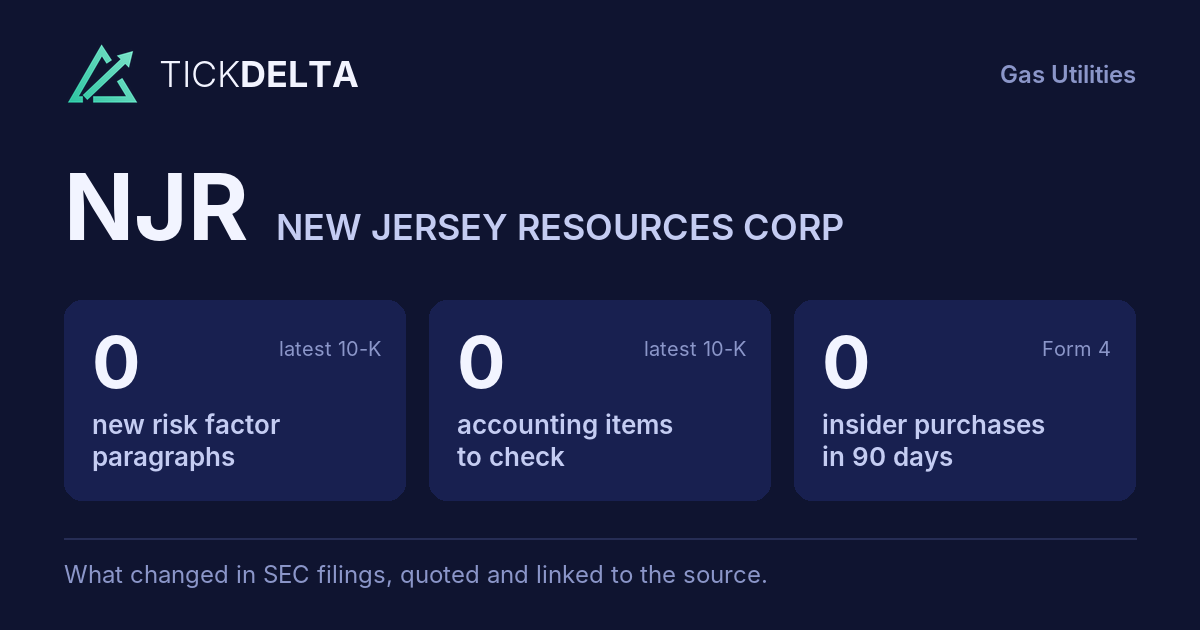
New Jersey Resources Corp NJR

Compare with peers Embed
SEC comment letters, last 20 years

3 reviews of NJR's filings by SEC staff

UPLOAD and CORRESP
Reviews 3 latest letter Mar 10, 2022
Questions asked 6 each answered in the company's own letter
No closing letter 0 reviews without a letter saying the staff completed it

When the SEC's staff reviews a filing, it writes to the company with numbered questions, and the company answers each one in a letter. SEC publishes the exchange once the review is over, at least 20 business days later. A question is not an accusation; most reviews end with the company adding detail to its next filing.

How the reviews went

Every review on EDGAR, from the first staff letter to the letter that closes it

  1. 1. Staff letters 5 UPLOAD
  2. 2. Questions in them 6 numbered comments
  3. 3. Company replies 3 CORRESP
  4. 4. Reviews closed 3 of 3 closing letter

Half the closed reviews took 40 days or less from the first letter to the closing letter.

Form 10-K for the year ended September 30, 2021

2022-03-10 to 2022-04-19 · 1 question · 1 letter from the SEC, 0 from the company
Review closed 2022-04-19
RevenueNon-GAAP measuresSegmentsResults discussion (MD&A)Derivatives and hedging
SEC letter of Mar 10, 2022 ↗ no reply letter on EDGAR
Item 7. Management's Discussion and Analysis of Financial Condition and Results of Operations · Non-GAAP Financial Measures, page 44
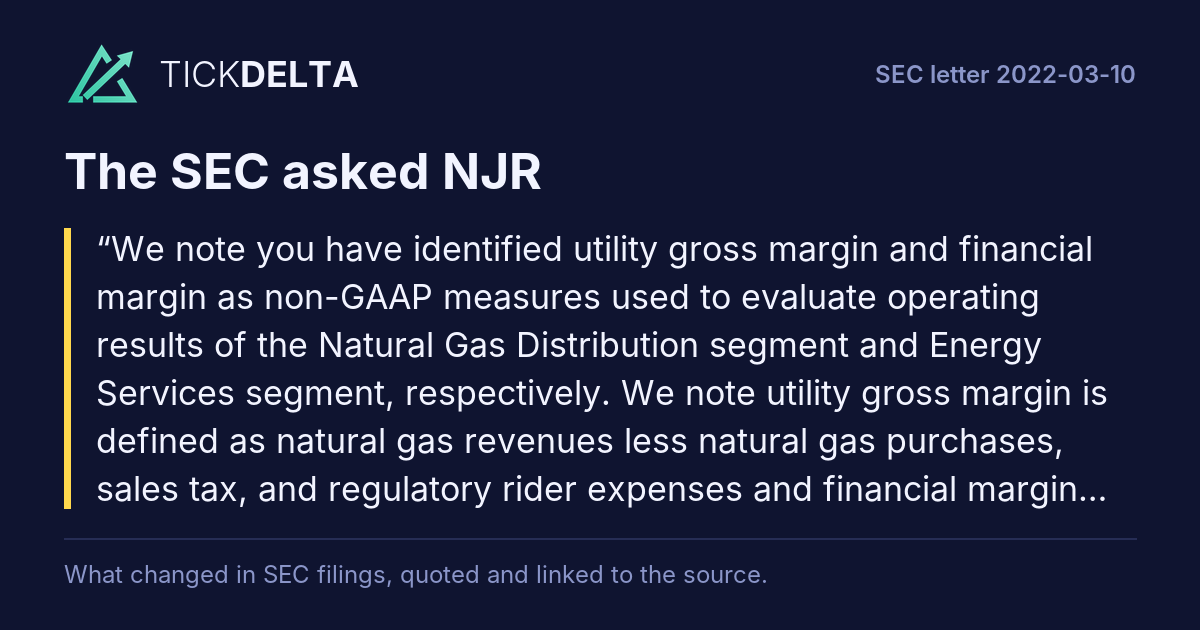
SEC asked
We note you have identified utility gross margin and financial margin as non-GAAP measures used to evaluate operating results of the Natural Gas Distribution segment and Energy Services segment, respectively. We note utility gross margin is defined as natural gas revenues less natural gas purchases, sales tax, and regulatory rider expenses and financial margin is defined as revenues earned from the sale of natural
Rest of the question

gas less costs of natural gas sold including any transportation and storage costs, and excludes any accounting impact from the change in the fair value of certain derivative instruments. Please tell us how you considered reconciling utility gross margin and financial margin to the most directly comparable segment GAAP measure, fully-loaded GAAP gross margin. Refer to Item 10(e)(1)(i)(B) of Regulation S-K.

NJR answered

No reply letter found.

In its next report

First report after the SEC's letter of Mar 10, 2022: 10-Q filed May 5, 2022 ↗, against the 10-Q filed Feb 3, 2022 ↗.

Tickdelta does not hold the text of both reports, so they are not compared here.

Also in this review: closing letter, 2022-04-19

Form 10-K

2016-03-09 to 2016-04-26 · 3 questions · 3 letters from the SEC, 2 from the company
Review closed 2016-04-26
Note 2. Summary of Significant Accounting Policies, page 73 · Available for Sale Securities, page 78
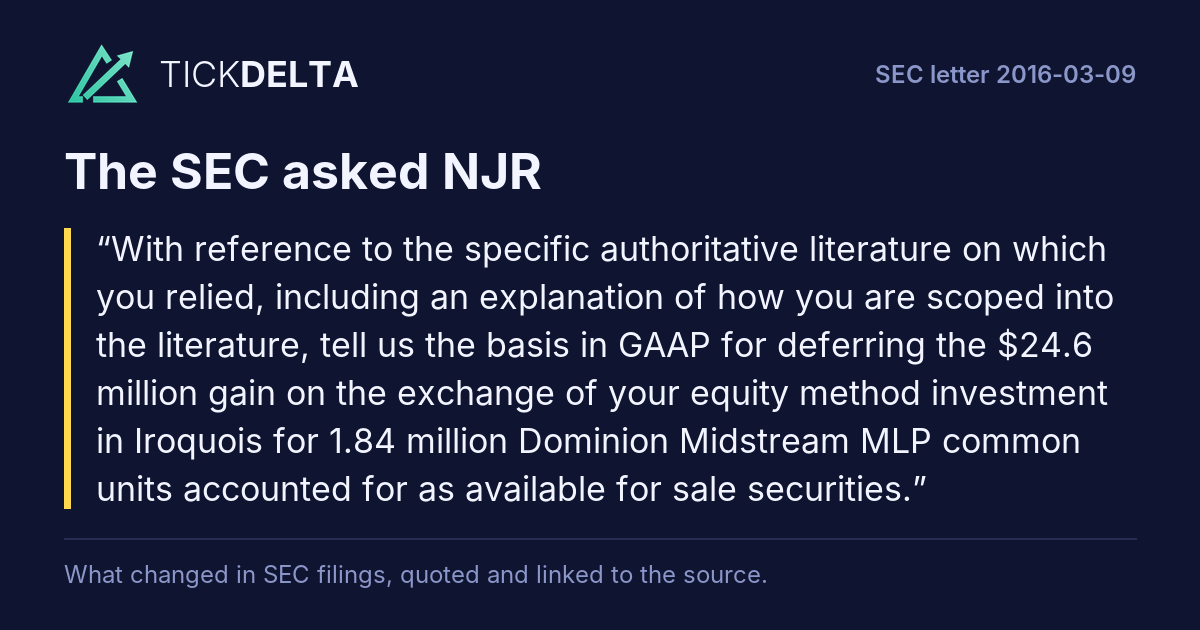
SEC asked
With reference to the specific authoritative literature on which you relied, including an explanation of how you are scoped into the literature, tell us the basis in GAAP for deferring the $24.6 million gain on the exchange of your equity method investment in Iroquois for 1.84 million Dominion Midstream MLP common units accounted for as available for sale securities.
NJR answered
We acknowledge the Staff’s comment and reply as follows. When evaluating the exchange of our equity method investment in Iroquois Gas Transmission System, LP (“Iroquois”), the

¹ The Company is a New Jersey corporation.

U.S. Securities and Exchange Commission

Company determined that the vast majority of the assets held within the investment comprised a natural gas pipeline, which qualifies as “integral equipment,” as defined by ASC 360-20-20 glossary.
Rest of the answer

Since the vast majority of assets within the equity method investment are integral equipment, we deemed the transaction to be an exchange of in-substance real estate in accordance with ASC 360-20-15-2, which states in part:

“Determining whether a transaction is in substance the sale of real estate requires judgment. However, in making that determination, one shall consider the nature of the entire real estate component being sold (that is, the land plus the property improvements and integral equipment), and not the land only, in relation to the entire transaction. Further, that determination shall not consider whether the operations in which the assets are involved are traditional or nontraditional real estate activities.”

In making our determination that the underlying pipeline asset was integral equipment and, therefore, in-substance real estate, we considered that the pipeline could not be removed and used separately without incurring significant cost.

Since we exchanged our investment in Iroquois for an investment in Dominion Midstream Partners, LP (“DMP”), which also holds midstream assets that make up a vast majority of the assets of that entity and which meet the definition of integral equipment, we determined that the transaction was a contribution of real estate into another real estate venture. ASC 970-323-30-3 states that:

“An investor that contributes real estate to the capital of a real estate venture generally should record its investment in the venture at the investor's cost (less related depreciation and valuation allowances) of the real estate contributed, regardless of whether the other investors contribute cash, property, or services. An investor shall not recognize profit on a transaction that in economic substance is a contribution to the capital of an entity, because a contribution to the capital of an entity is not the culmination of the earnings process.”

The Company did not receive any proceeds from the exchange; instead, it received an ownership interest in the transferred investment consisting of additional in-substance real estate assets. As a result, the earnings process has not culminated and, therefore, we deferred the $24.6 million gain.

In addition, the securities were acquired in a private transaction and are subject to contractual transfer restrictions, including a 12-month lock up of 90 percent of the acquired DMP common units. Accordingly, the Company was unable to sell the acquired DMP common units at closing. Gains will be recognized if and when the securities are sold after the lock-up period expires.

* * * *

In connection with the Company’s response to the comments of the Staff set forth herein, New Jersey Resources Corporation acknowledges that:

• the Company is responsible for the adequacy and accuracy of the disclosure in the filing;

Staff comments or changes to disclosure in response to Staff comments do not foreclose the Commission from taking any action with respect to the filing; and the Company may not assert Staff comments as a defense in any proceeding initiated by the Commission or any person under the federal securities laws of the United States.

We also acknowledge that the Division of Enforcement has access to all information we provide to the staff of the Division of Corporate Finance in your review of our filing or in response to your comments on our filing.
Read in the reply
In its next report

First report after the company's reply of Mar 21, 2016: 10-Q filed May 4, 2016 ↗, against the 10-Q filed Feb 3, 2016 ↗.

Tickdelta does not hold the text of both reports, so they are not compared here.

Note 2. Summary of Significant Accounting Policies, page 73 · Available for Sale Securities, page 78
SEC asked
We reviewed your response to our previous comment. Please provide additional support for your argument that the exchange represented the exchange of in-substance real estate that should be accounted for in accordance with ASC 970-323-30-3.
Rest of the question

Please address in particular the scope provisions of ASC 970 which indicate that this guidance applies, “to all entities with productive activities relating to real property, excluding property used primarily in the entity’s non-real estate operations.” Refer to ASC 970-10-15-3. Tell us how you have concluded that the natural gas pipeline and other midstream assets of both Iroquois Gas Transmission LP and Dominion Midstream MLP (DMP) are not scoped out of ASC 970 due to the property being used primarily in non-real estate energy related operations. Additionally, it appears your accounting does not exactly comply with the guidance you cite because this guidance requires you to record your investment in DMP at your cost, as opposed to fair value. Please advise. Finally, please tell us how the contractual transfer restrictions associated with the DMP common units received in the exchange were considered in determining the fair value of the common units received and the resulting gain on the exchange. Tell us your consideration of disclosing the contractual transfer restrictions as well.

NJR answered
We acknowledge the Staff’s request for additional information regarding our response to the Staff’s comment. In response to the Staff’s request for additional information we have provided additional analysis for the accounting related to the exchange of our investment in Iroquois Gas Transmission System, LP (“Iroquois”) for Dominion Midstream Partners, LP (“DM”) common units.

Evaluation of the Scope provisions of ASC 970 –

We considered the scoping in ASC 970-10-15-3 noting that the real estate guidance applies “to all entities with productive activities relating to real property, excluding
Rest of the answer

property used primarily in the entity’s non-real estate operations.” In our fact pattern, we held an equity method investment in Iroquois that's only asset is a natural gas pipeline. We exchanged this equity method investment for an equity investment in DM. DM's assets consist of an LNG facility and other natural gas pipeline assets. ASC 970-10-15-3 refers to “the entity’s non-real estate operations [emphasis added].” The Company, as the reporting entity, did not use the equity method investment in any of our operations, nor does it use the equity securities it received in the exchange in any of our operations. Said differently, we only hold these equity investments and do not use the underlying investee’s LNG facility or other natural gas pipeline assets in our operations. Therefore, we do not believe that this scope exception is applicable. Because the equity method investment in Iroquois and the equity investment in DM have substantially all assets that meet the definition of integral equipment, and are therefore viewed as in-substance real estate, we believe that the real estate rules within ASC 970 apply.

As part of our analysis we also traced the origination of ASC 970-10-15-3, and noted that this wording was not explicitly included in any pre-codified accounting guidance. The primary source of guidance in ASC 970-323 Investments—Equity Method and Joint Ventures (“ASC 970-323”) is Statement of Position 78-9 Accounting for Investments in Real Estate Ventures (“SOP 78-9”). SOP 78-9 does not scope out the transfer of real estate to a venture if that real estate was used in the non-real estate operations of the transferor. Rather, it appears that this scoping originates from Financial Accounting Standards No. 67, Accounting for Costs and Initial Rental Operations of Real Estate Projects (“FAS 67”), which has been codified within ASC 970-10 Real Estate General – Overall (“ASC 970-10”). Our understanding is that the Accounting Standards Codification was not intended to change existing GAAP, and therefore in analyzing and applying the guidance within Topic ASC 970, we did not believe that this scope exception applied to our fact pattern.

Evaluation of the Gain Deferral -

In exchange for the equity method investment interests in Iroquois, we received DM common units. We determined that the DM common units received met the definition of an available-for-sale security in accordance with ASC 320-10-25-1, because the DM common units are equity securities that have a readily determinable fair value and are not classified as trading or held-to-maturity securities. The DM common units are publicly traded on the New York Stock Exchange (“NYSE”) and therefore have a readily determinable fair value. We do not have an intent to sell the DM common units and therefore we do not believe classifying the DM common units as a trading security is appropriate.

For 90% of the DM common units received, we agreed to a contractual restriction to not sell the DM common units for a period of 12 months after closing. The remaining 10% of the DM common units were not subject to such contractual resale restriction and could be sold at any time after closing. We considered whether the contractual resale restrictions to sell the DM common units impact the conclusion that the securities have a readily determinable fair value, which would preclude us from classifying the securities as available for sale. In doing so we noted that the definition for readily determinable fair value in the ASC glossary states in part:

An equity security has a readily determinable fair value if it meets any of the following conditions:

a) The fair value of an equity security is readily determinable if sales prices or bid-and-asked quotations are currently available on a securities exchange registered with the U.S. Securities and Exchange Commission (“SEC”) or in the over-the-counter market, provided that those prices or quotations for the over-the-counter market are publicly reported by the National Association of Securities Dealers Automated Quotations systems or by OTC Markets Group Inc. Restricted stock meets that definition if the restriction terminates within one year.

Since the restriction to sell the DM common units terminates within one year and those securities can be reasonably expected to qualify for sale within one year, we believe that these securities have a readily determinable fair value and therefore are within the scope of ASC 320.

Our conclusion that the DM common units we received from DM are within the scope of ASC 320, ASC 320-10-35-1(b) requires that the securities be initially measured at fair value in the statement of financial position. Nevertheless, we believe the transaction would most appropriately be accounted for under either ASC 360-20 Real Estate Sales (“ASC 360-20”) or ASC 970-323 because the transferred interest is in-substance real estate and the consideration received is an interest in real estate.

ASC 970-323-30-3 states that:

An investor that contributes real estate to the capital of a real estate venture generally should record its investment in the venture at the investor's cost (less related depreciation and valuation allowances) of the real estate contributed, regardless of whether the other investors contribute cash, property, or services. An investor shall not recognize profit on a transaction that in economic substance is a contribution to the capital of an entity, because a contribution to the capital of an entity is not the culmination of the earnings process.

Since we received interests in the exchange that must be recorded at fair value in accordance with ASC 320, one could view that measurement to be in conflict with the ASC 970-323 requirement to record its investment at the investor’s cost. However, we believe that the principle set forth above in the excerpt from ASC 970-323-30-3 still applies (i.e., profit should not be recognized if the economic substance is a contribution of real estate in exchange for an interest in real estate).

Nonetheless, we believe this guidance does not override the requirement to carry the investment at fair value under ASC 320. Therefore, since this transaction was more representative of a contribution of in-substance real estate in return for an interest in an entity that holds in-substance real estate, we do not believe it would be appropriate to recognize the corresponding gain because the earnings process has not culminated.

In summary, we have utilized the guidance above to determine that the difference between the value of the available for sale securities and the carrying value should not result in gain recognition. Although there could be a perceived conflict between recognizing the equity interest received at historical cost and the required ASC 320 accounting at fair value, we believe the principle in ASC 970-323 is not to recognize a gain on the transfer because the earning process has not culminated.

Evaluation of transfer restriction impact on fair value -

When we are recording the equity securities at fair value in accordance with ASC 320, we believe the fair value is based on the observable market prices on the NYSE. We considered the guidance in ASC 320-10-30-1 on the 90% of the DM common units subject to the contractual resale restriction which states that “The fair value of restricted stock shall be measured initially based on the quoted price of an otherwise identical unrestricted security of the same issuer, adjusted for the effect of the restriction, in accordance with the provisions of Topic 820”. We believe that these restrictions are entity specific and not instrument specific, and therefore, would not transfer to a market participant upon ultimate sale. In making this determination, we note that we have the ability to dispose of up to 10% of the DM common units we acquired in the transaction during the twelve-month lock-up period. If we determined to dispose of any portion of the DM common units not subject to the contractual resale restrictions before such securities were registered with the SEC under the Registration Rights Agreement, we would be able to sell the securities under SEC Rule 144 which allows for the public resale of restricted and control securities, if certain conditions are met. Any restrictions on these DM common units would not transfer to the purchaser under a Rule 144 sale which supports the fact that the restrictions are not instrument-specific. Therefore, we have not adjusted the observable prices for this restriction. We also considered materiality in evaluating whether to apply a discount to the observable prices and believe that a market participant would not view this restriction of one year to be significant. We considered that the length of the restriction is only one year, the amount of the ownership percentage of the total ownership of the entity is small, the entity is already public with trading activity, the volatility of the DM common units is low, and the likely purchaser of the securities would be a large institutional investor which would require less of a discount.

Based upon several publicly available sources, we believe it is common for restricted stock with a two year restriction on resale to have up to a 25% reduction in stock value representing a lack of marketability adjustment. Given (i) that the length of the resale restriction on the DM common units is only one year, (ii) that the amount of the ownership percentage of the total ownership of the entity is small, (iii) that the entity is already public with trading activity, (iv) the volatility of the DM common units is low, and (v) that the likely purchaser of the securities would be a large institutional investor, we believe that any discount would be significantly smaller than the 25% and more likely between 10% and 15%. If we were to apply a 15% discount to the fair value of the 90% of DM common units that are subject to the resale restriction, the available for sale securities value and the deferred gain recorded would be reduced by approximately $6 million. We do not believe this difference would be material to our financial statements. It is also important to consider that subsequent changes in fair value are being recorded to accumulated other comprehensive income, which would eliminate the impact on recognition of the deferred gain on future financial statements. To illustrate this point, we have shown the future impact of recognition of a gain upon sale of the securities under both scenarios using the $6 million of deferred gain noted above. In the example below we have assumed a marketability discount of 15% and assumed that the observable market prices from transaction date to sale remains the same (in millions).

Without Marketability Discount

With Marketability Discount of 15%

Initial Recognition

$6

$0

Subsequent Change in FV as restriction goes away and recorded in AOCI

Recognition of Gain on Sale of Security

Due to the small time period associated with the resale restriction, the lack of adjustment related to the resale restriction and the disclosure that the DM common units are considered available for sale as a long term asset (not to be sold for one year), we considered disclosing the resale restriction on the sale, but concluded that it was not material enough to disclose.

* * * *

In connection with the Company’s response to the comments of the Staff set forth herein, New Jersey Resources Corporation acknowledges that:

• the Company is responsible for the adequacy and accuracy of the disclosure in the filing;

Staff comments or changes to disclosure in response to Staff comments do not foreclose the Commission from taking any action with respect to the filing; and

The Company may not assert Staff comments as a defense in any proceeding initiated by the Commission or any person under the federal securities laws of the United States.

We also acknowledge that the Division of Enforcement has access to all information we provide to the staff of the Division of Corporate Finance in your review of our filing or in response to your comments on our filing.
Read in the reply
In its next report

First report after the company's reply of Apr 1, 2016: 10-Q filed May 4, 2016 ↗, against the 10-Q filed Feb 3, 2016 ↗.

Tickdelta does not hold the text of both reports, so they are not compared here.

SEC letter of Apr 12, 2016 ↗ no reply letter on EDGAR
Note 2. Summary of Significant Accounting Policies, page 73 · Available for Sale Securities, page 78
SEC asked
We reviewed your response to our previous comment. We understand you believe the scope exception in ASC 970-10-15-3 for real property used primarily in an entity’s nonreal estate operations is not applicable because you only hold equity investments in Iroquois and DMP and the underlying investees’ pipeline or other midstream assets are not used in your (energy related or non-real estate) operations.
Rest of the question

However, we note the standard presumes you are engaged in “productive activities relating to real property.” If the investments in Iroquois and DMP represent mere equity investments from the standpoint of New Jersey Resources Corporation, as opposed to productive activities relating to real property, then it is unclear how ASC 970 or the notions of integral equipment and in-substance real estate in ASC 360-20-15-2 would apply. Please advise. Notwithstanding the preceding, we note you believe the specific guidance in ASC 970 applicable to accounting for the exchange transaction is ASC 970-323-30-3. But it appears this guidance applies when an investor “contributes real estate to the capital of a real estate venture… (emphasis added).” Please clarify whether Dominion Midstream MLP (DMP) is a real estate venture or a midstream energy company. If the latter, please tell us how you concluded that ASC 970-323-30-3 is applicable. In connection with responding to the points above, please also provide any additional information you may have in support of your accounting. Please also tell us any other authoritative guidance that was considered as being potentially applicable to accounting for the transaction and how you concluded the guidance was not applicable.

NJR answered

No reply letter found.

In its next report

First report after the SEC's letter of Apr 12, 2016: 10-Q filed May 4, 2016 ↗, against the 10-Q filed Feb 3, 2016 ↗.

Tickdelta does not hold the text of both reports, so they are not compared here.

Also in this review: closing letter, 2016-04-26

Form 10-K

2014-02-18 to 2014-03-10 · 2 questions · 1 letter from the SEC, 1 from the company
Review closed 2014-03-10
RevenueResults discussion (MD&A)
Item 8. Financial Statements and Supplementary Data, page 61 · Consolidated Statements of Operations, page 64
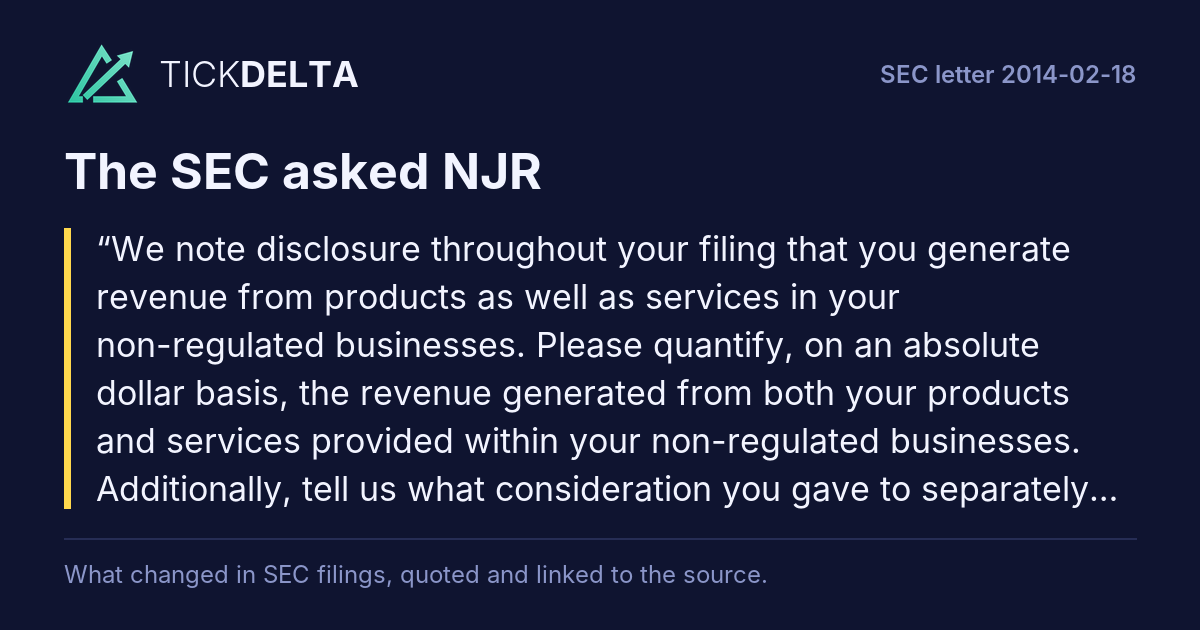
SEC asked (1)
We note disclosure throughout your filing that you generate revenue from products as well as services in your non-regulated businesses. Please quantify, on an absolute dollar basis, the revenue generated from both your products and services provided within your non-regulated businesses.
Rest of the question

Additionally, tell us what consideration you gave to separately disclosing revenues and cost of revenues by products and services pursuant to Rules 5-03(b)(1) and (2) of Regulation S-X for your non-regulated businesses.

NJR answered
We acknowledge the Staff’s comment. In response to the Staff’s comment, the table below provides our non-regulated revenues, by class, in accordance with Rule 5-03(b)(1) of Regulation

The Company is a New Jersey corporation.

U.S. Securities and Exchange Commission

Page

S-X, net of intercompany amounts eliminated in consolidation. Our non-regulated revenues are generated primarily from product sales, the largest component, of which, are sales of natural gas through our wholesale energy services subsidiary.
Rest of the answer

In addition, other non-regulated revenues consist of sales from services we provide, and rental income. During the past three fiscal years, revenues from services comprised less than 1.3 percent of total operating revenue and our rental income comprised less than .2 percent of total operating revenues. As allowed by Rule 5-03(b) of Regulation S-X, when these amounts represent 10 percent or less of total operating revenues, we elect to combine them with our product sales and present all non-regulated revenues within the Operating revenues Nonutility line item in our Consolidated Statements of Operations. Related cost of revenues are presented in Operating expenses within Gas Purchases

Nonutility and Operation and maintenance. We believe the amounts in operation and maintenance are not material to investors.

For further illustration, in the table below we also provide the percentage of each class of non-regulated revenue to total non-regulated revenues reported in our Form 10-K.

2013

2012

2011

Non-regulated revenue

% to Total

Non- regulated

Non-regulated product revenue

Energy Sales:

Natural gas

$

2,351,084

1,577,851

1,997,007

Electricity

1,388

728

117

Sales of solar renewable energy certificates

9,506

1,137

733

Appliance/HVAC equipment sales

17,183

11,625

10,943

Sub-total product revenue

2,379,161

98.7

1,591,341

98.1

2,008,800

98.6

Non-regulated service revenue

Appliance/HVAC service contracts

27,871

1.2

27,271

1.7

25,572

1.3

Rental income

3,049

0.1

2,598

0.2

3,113

Total non-regulated operating revenues

2,410,081

1,621,210

2,037,485

Total operating revenues

3,198,068

2,248,923

3,009,209

We continue to monitor the components of our revenues and cost of sales and will include additional disclosure, as required by

Rule 5-03 of Regulation S-X, when the 10% threshold is met.

Read in the reply
In its next report

First report after the company's reply of Feb 28, 2014: 10-Q filed May 7, 2014 ↗, against the 10-Q filed Feb 6, 2014 ↗.

Tickdelta does not hold the text of both reports, so they are not compared here.

Notes to the Financial Statements, page 70 · General
SEC asked (2)
We note that you recognize revenue on the sale of solar renewable energy certificates (SREC) upon delivery. Please tell us more about your accounting for production costs related to the SRECs you sell. We may have further comments after reviewing your response.
NJR answered
We acknowledge the Staff’s comment. Solar Renewable Energy Certificates (SRECs) are the renewable attribute associated with the generation of 1 megawatt hour of solar electricity. Our SRECs are sold to counterparties under a negotiated contract, and are not bundled with other products such as electricity. Many of our contracts require monthly delivery of SRECs.

All of our solar installations are photovoltaic solar panel arrays. The photovoltaic panels convert solar energy into electricity.
Rest of the answer

Since the technology uses solar energy as its “input” fuel and does not have any moving parts, there are no production costs associated with the generation of an SREC. Solar panel arrays involve minimal maintenance costs. For the year-ended 2013, Clean Energy

Ventures incurred approximately $600,000 of maintenance costs for its entire solar fleet. We expense maintenance costs as incurred and include such costs in the Operation and maintenance line item in our Consolidated Statements of Operations.

* * * *

In connection with the Company’s response to the comments of the Staff set forth herein, New Jersey Resources Corporation acknowledges that:

• the Company is responsible for the adequacy and accuracy of the disclosure in the filing;

Staff comments or changes to disclosure in response to Staff comments do not foreclose the Commission from taking any action with respect to the filing; and the Company may not assert Staff comments as a defense in any proceeding initiated by the Commission or any person under the federal securities laws of the United States.

We also acknowledge that the Division of Enforcement has access to all information we provide to the staff of the Division of Corporate Finance in your review of our filing or in response to your comments on our filing.
Read in the reply

Also in this review: closing letter, 2014-03-10

Letters without questions

Other letters

UPLOAD and CORRESP
2 other letters: notices that a filing will not be reviewed, requests to declare a registration effective, and the like
  • Sep 30, 2021 · NJR: letter to the SEC · New Jersey Resources Corporation · Form 10-K for Fiscal Year Ended September 30, 2021...
  • Sep 30, 2015 · NJR: letter to the SEC · New Jersey Resources Corporation · Form 10-K for Fiscal Year Ended September 30, 2015...

From the SEC's correspondence on EDGAR: staff letters (form UPLOAD) and company letters (form CORRESP), 13 letters filed since 2014-02-18. Questions and answers are matched by their numbers; topics come from words in each question. The reports are compared word for word (same form, before the first SEC letter against the first report after the company's reply). No AI.

Sources

The SEC's correspondence on EDGAR: staff letters (form UPLOAD) and company letters (form CORRESP), matched question by question. No AI.

Also

Filings: the letters in the filing list.

Work with it

Excel workbook · CSV. Google Sheet that stays up to date: paste =IMPORTDATA("https://tickdelta.com/company/NJR/export.csv") into a cell.

Next in Owners and insiders:Insider trades
Esc

Type a ticker such as AAPL, a name, an investor such as Buffett, or a topic such as tariffs. ↑ ↓ to move, Enter to open.