Screener / SEC EDGAR /CIK 0001690680 /10-K filed Mar 2, 2026, compared with Mar 3, 2025 /Numbers from the XBRL of the 10-Ks
Nasdaq Real estate · Real Estate Agents & Managers (For Others)

Newmark Group, Inc. NMRK

Compare with peers Embed
The 10-K against last year's

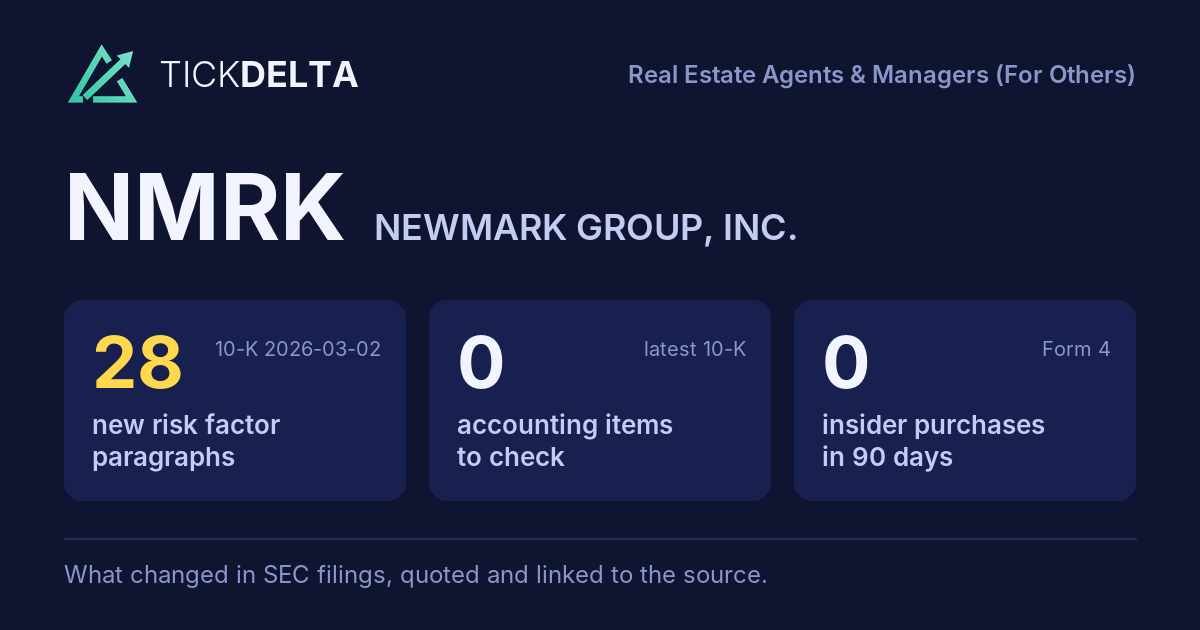
109 changes: 28 added, 18 removed, 58 reworded, 5 quiet changes

10-K Mar 2, 2026 vs Mar 3, 2025

10-K 0001628280-26-013160 (Mar 2, 2026) vs 10-K 0001628280-25-009332 (Mar 3, 2025) Not compared: Legal Proceedings, Accounting Policies.

Every paragraph, and how much of it changed

One bar per paragraph, in the order of the 10-K. Height and colour show the share of its words not in the closest paragraph a year earlier; the tallest bars are new paragraphs.

Risk Factors

268 paragraphs · 28 new · 90 reworded · 17 gone · 10-K Mar 2, 2026 against Mar 3, 2025
New paragraph Reworded (5% of its words or more) Same or nearly
Paragraph 59 · 50% changed Every version of it
We will need to successfully manage the integration of recent and future acquisitions and future growth opportunities effectively. Such integration and additional growth may place a significant strain upon our management, administrative, operational, financial reporting, internal control and compliance infrastructure. Our ability to grow depends upon our ability to successfully hire, train, supervise and manage additional employees, expand our management, administrative, operational, financial reporting, compliance and other control systems effectively, allocate our human resources optimally, maintain clear lines of communication between our transactional and management functions and our finance and accounting functions, and manage the pressure on our management, administrative, operational, financial reporting, compliance and other control infrastructure. Additionally, managing future growth due to geographic locations, markets and business lines may be difficult. We may not realize, or it may take an extended period of time to realize, the full benefits that we anticipate from strategic alliances, mergers, acquisitions, joint ventures or other growth opportunities. There can be no assurance that we will be able to accurately anticipate and respond to the changing demands we will face as we integrate recent or future acquisitions and continue to expand our operations, and we may not be able to manage growth effectively or to achieve growth at all.
Paragraph 233 · 48% changed Every version of it
Agreements between us and/or Cantor or and its affiliates are between related parties, and the may also provide different services to our clients. In such cases, it may appear that terms of these the applicable agreements may be are less favorable to us than those that we could negotiate have negotiated with third parties clients who do not receive services from Cantor or its affiliates, which could harm our business, operating results and may subject us to litigation. financial condition.
Paragraph 92 · 46% changed Every version of it
Under the Fannie Mae DUS program, we originate and service multifamily loans for Fannie Mae without having to obtain Fannie Mae’s prior approval for certain loans, as long as the loans meet the underwriting guidelines set forth by Fannie Mae. In return for the delegated authority from Fannie Mae to make loans and Fannie Mae’s commitment to purchase such loans, we must maintain minimum collateral and generally are required to share risk of loss on loans sold through Fannie Mae. With respect to most loans, we are generally required to absorb approximately one-third of any losses on the unpaid principal balance of a loan at the time of loss settlement. Some of the loans that we originate under the Fannie Mae DUS program are subject to reduced levels or no risk-sharing. However, we generally receive lower servicing fees with respect to such loans. Although our average annual losses from such risk-sharing programs have been a minimal percentage of the aggregate principal amount of such loans to date, if loan defaults increase, actual risk-sharing obligation payments under the Fannie Mae DUS program could increase, and such defaults could have a material adverse effect on our business, financial condition, results of operations and prospects. In addition, a material failure to pay our share of losses under the Fannie Mae satisfy DUS program requirements could result in the revocation of our license from Fannie Mae and the exercise of various remedies available to Fannie Mae under the Fannie Mae DUS program. heightened oversight, increased
Paragraph 229 · 46% changed Every version of it
The corporate opportunity policy that is included in our Certificate of Incorporation is designed to resolve potential conflicts of interest between us and our representatives and BGC Group, Cantor and their respective representatives. The Newmark Holdings and Newmark OpCo limited partnership agreements contain similar provisions with respect to us and/or BGC Group and Cantor and each of our respective representatives. This policy, however, could make it easier for BGC Group or Cantor to compete with us. If BGC Group or Cantor competes with us, it could materially harm our business, financial condition, results of operations and prospects.
Paragraph 76 · 43% changed Every version of it
In addition, because the size and scope of commercial real estate transactions have increased significantly during the past several years, both the difficulty of ensuring compliance with the numerous state licensing and regulatory regimes and the possible loss resulting from non-compliance have increased. Furthermore, the laws, rules and regulations applicable to our business lines also may change in ways that increase the costs of compliance. The failure Failure to comply with federal, state, local and foreign laws, rules and regulations could result in significant financial penalties that could have a material adverse effect on our business, financial condition, results of operations and prospects.
Paragraph 135 · 42% changed Every version of it
While we have had success in responding to challenges to certain of our non-compete provisions, there can be no assurance that our non-competition agreements will be found enforceable if challenged in certain states, jurisdictions, including states jurisdictions that generally do not enforce post-employment restrictive covenants. In 2024, covenants or in jurisdictions that have adopted or expanded restrictions on the Federal Trade Commission enacted a rule, which is currently under legal challenge, that would render non-competition clauses unenforceable in certain situations. If use of post-employment restrictive covenants, such a rule is upheld (in as California. More jurisdictions may adopt similar rules. A successful challenge to any form) by the courts, it could have a material adverse impact on any applicable of our post-employment restrictive covenants currently in place. may have business, financial condition, results of operations and prospects.
Paragraph 117 · 41% changed Every version of it
We may utilize use and continue to develop AI tools in our business business, including, without limitation, machine learning and generative AI tools, and may integrate AI into our platforms, products, offerings and services. services, including client-facing ones. Such use and integration of AI may present legal, regulatory and other challenges that could subject us to competitive harm, regulatory action, legal liability and brand or reputational harm. Our efforts to utilize these technological advancements AI may not be successful, may result in substantial integration and maintenance costs, and may expose us to additional risks. If the output of any AI integrated into our platforms, products, offerings or services are or are alleged to be deficient, inaccurate, infringing, violative of third-party rights or biased, our business, financial condition, and results of operations may be adversely affected. The content, analyses, or recommendations generated by AI programs, if deficient, inaccurate, or biased, could adversely impact our business, financial condition, and operational results, as well as our reputation. Moreover, ethical concerns associated with AI could lead to brand damage, competitive disadvantages, or legal repercussions. Any problems with our implementation or use of AI or other technological advancements could negatively impact our business or results of our operations.
Paragraph 80 · 38% changed Every version of it
Environmental regulations and evolving stakeholder expectations may adversely impact our commercial real estate business and/or cause us to incur compliance costs for cleanup of hazardous substances or wastes or other environmental liabilities. and reduce transaction volumes in the commercial real estate markets.

MD&A

7 paragraphs · 0 new · 2 reworded · 1 gone · 10-K Mar 2, 2026 against Mar 3, 2025
New paragraph Reworded (5% of its words or more) Same or nearly
Paragraph 2 · 12% changed
(1)Although these items have customers under contract, they were recorded as other sources of revenue as they were excluded from the scope of ASU No. 2014-9. ASC 606.
Paragraph 3 · 8% changed
Newmark’s chief operating decision-maker, regardless of geographic location, location and service line, evaluates the operating results, including revenues, of Newmark as total real estate services (see Note 3 — “Summary of Significant Accounting Policies” for further discussion).

A paragraph is matched with the one last year that shares the most of its words; under half in common makes it new. The paragraphs shown are the 8 reworded the most in each section.

The paragraph that changed most in each section

The redline

Marked against last year's 10-K: cut words struck through, new words highlighted.

Risk Factors175 words changed in this paragraph; it is 38% similar to last year's version.
To ensure that we and Newmark Holdings are not deemed “investment companies” under the Investment Company Act, we need to be primarily engaged, directly or indirectly, in the non-investment company businesses of our operating subsidiaries. If we were to cease participation in the management of Newmark Holdings, if Newmark Holdings, in turn, were to cease participation in the management of Newmark OpCo, or if Newmark OpCo, in turn, were to cease participation in the management of our operating subsidiaries, that would increase the possibility that we and Newmark Holdings could be deemed “investment companies.” Further, if we were deemed not to have a majority of the voting power of Newmark Holdings (including through our ownership of the Special Voting Limited Partnership Interest), if Newmark Holdings, in turn, were deemed not to have a majority of the voting power of Newmark OpCo (including through its ownership of the Special Voting Limited Partnership Interest), or if Newmark OpCo, in turn, were deemed not to have a majority of the voting power of our operating subsidiaries, that would increase the possibility that we and Newmark Holdings could be deemed “investment companies.” Finally, if any of our operating subsidiaries were deemed “investment companies,” our interests in Newmark Holdings and Newmark OpCo, and Newmark Holdings’ interests in Newmark OpCo, could be deemed “investment securities,” and we and Newmark Holdings could be deemed “investment companies.”

Source: Item 1A, 10-K 0001628280-26-013160 vs Item 1A, 10-K 0001628280-25-009332

MD&A13 words changed in this paragraph; it is 93% similar to last year's version.
Newmark’s deferred revenue primarily relates to customers paying in advance or billed in advance where the performance obligation has not yet been satisfied. Deferred revenue is recorded as a contract liability. Deferred revenue at December 31, 2024 2025 and December 31, 2023 2024 was $1.3 $1.4 million and $2.7 $1.3 million, respectively. During the years ended December 31, 2024, 2023 2025, 2024 and 2022, 2023, Newmark recorded deferred revenue of $0.9 million, $0.7 million and $0.0 million, respectively, and recognized revenue of $1.4 $1.0 million, $1.7 $2.1 million and $2.5 $1.7 million, respectively, that was recorded as deferred revenue at the beginning of the period.

Source: Item 7, 10-K 0001628280-26-013160 vs Item 7, 10-K 0001628280-25-009332

Sentences and paragraphs added, removed or reworded

Every change, by type

Sentences and paragraphs of NMRK's Risk Factors and MD&A, 10-K Mar 2, 2026 against 10-K Mar 3, 2025. Each links to the text at sec.gov.

Quiet changes are sentences kept from last year with one to four words changed, at least one of them a hedge, a modal or a qualifier (may, could, will, not, significant, material…). A year or date rolling forward is not counted.

The full word list

adverse, adversely, all, although, anticipate, anticipates, any, approximately, believe, believes, can, cannot, certain, could, expect, expects, generally, however, if, intend, intends, largely, likely, many, material, materially, may, might, most, must, never, no, not, possible, primarily, probable, should, significant, significantly, some, substantial, substantially, unlikely, will, would

AddedRisk Factors
•political opposition at the local level to new construction of certain property types, including apartments, warehouses, and data centers, including with respect to environmental impacts, increased automobile traffic, and energy and water usage, which may result in restrictive government zoning and other regulations, increased demand for environment studies, or otherwise delay or reduce make future construction. This could in turn reduce our ability to generate fees on behalf of clients owning and occupying such property types.
Read it in 10-K Mar 2, 2026 at sec.gov
AddedRisk Factors
•business continuity, physical security and disaster risk, including climate‑related physical risks such as extreme weather, floods, wildfires, heatwaves, power grid instability or other physical events affecting trading, staff commuting and insurance costs.
Read it in 10-K Mar 2, 2026 at sec.gov
AddedRisk Factors
increasingly concentrated. Having increasingly large and concentrated clients also can lead to greater or more concentrated risks if, among other possibilities, any such client:
Read it in 10-K Mar 2, 2026 at sec.gov
AddedRisk Factors
Some of the services we provide are subject to regulation by the SEC, Financial Industry Regulatory Authority (FINRA), the Financial Conduct Authority (FCA), or other self-regulatory organizations and regulators and compliance failures or regulatory action could adversely affect our business. We could be subject to disciplinary or other actions in the future due to claimed noncompliance with these regulations, which could have a material adverse effect on our operations and profitability.
Read it in 10-K Mar 2, 2026 at sec.gov
AddedRisk Factors
Many jurisdictions have adopted building performance standards, energy benchmarking and disclosure regimes, electrification and retrofit mandates, and restrictions on the use of certain materials. Compliance with these requirements can increase operating and capital costs for properties we manage or for our clients, may delay or deter transactions, and can reduce asset values or the availability of mortgage lending or insurance for affected properties. A decrease, delay or repricing of transaction activity may adversely affect our revenues, profitability and growth prospects.
Read it in 10-K Mar 2, 2026 at sec.gov
AddedRisk Factors
Further, regulators in the United States and internationally have adopted or proposed climate-related disclosure requirements and building decarbonization policies that may apply to us directly or indirectly through our clients. These include, for example, public-company climate disclosures, state-level emissions and climate risk reporting regimes, and municipal building energy performance and greenhouse gas emissions requirements. Although we primarily operate from leased offices and do not control most building systems at those locations, compliance with these requirements may increase our operating costs and require enhancements to data governance, measurement, verification and reporting systems across our service lines. Where we act on behalf of property owners, compliance with building performance standards, electrification mandates and retrofit or commissioning requirements could increase the costs and complexity of property management engagements and may expose us to operational or contractual risk.
Read it in 10-K Mar 2, 2026 at sec.gov
Show the other 38
AddedRisk Factors
collateral or reserve demands, program modifications, restrictions on our approvals or suspension or termination of our seller/servicer status. Any such actions could negatively impact our loan origination and servicing revenues, mortgage servicing rights, reputation, liquidity and overall financial condition.
Read it in 10-K Mar 2, 2026 at sec.gov
AddedRisk Factors
The GSEs can also pursue rights and remedies against Newmark any event of default, such as failing to satisfy any selling, servicing, and committing and delivery requirements, or if the GSEs determine that there was fraud, material misrepresentation or gross negligence. Upon the occurrence of such an event of default, the GSEs may require Newmark to repurchase the loan, indemnify them from losses with respect to the loan, or in certain cases adjust the loss sharing level of the loan.
Read it in 10-K Mar 2, 2026 at sec.gov
AddedRisk Factors
In addition, any reductions in annual caps, shifts in mission-driven allocations for multi-family purchases, changes in eligible collateral or loan terms, or other program or policy adjustments that are established by FHFA could constrain the availability and competitiveness of GSE executions, negatively impact borrower demand, and reduce the number and size of loans we originate and service. Furthermore, GSEs’ ability to originate, purchase or securitize loans could be materially impacted by the relationship between the GSEs and the U.S. government, market disruptions affecting the GSEs, or reduced or delayed federal appropriations or government operations, all of which could diminish our origination and servicing revenues.
Read it in 10-K Mar 2, 2026 at sec.gov
AddedRisk Factors
other laws and regulations relating to personal data could result in substantial financial penalties for non-compliance, expose us to litigation risk and could harm our reputation.
Read it in 10-K Mar 2, 2026 at sec.gov
RemovedRisk Factors
Mortgage interest rates for commercial and multifamily properties had been near historic lows for a number of years leading up to 2022. In response to domestic and international markets experiencing significant inflationary pressures, the Federal Reserve in the U.S. and other central banks in various countries raised interest rates rapidly between the first quarter of 2022 and the fourth quarter of 2023. These actions reduced credit and capital availability, particularly in the second half of 2022 and in 2023. Less available and more expensive credit and capital has had pronounced effects on the commercial mortgage origination and investment sales markets in which we operate and could cause acquisitions and dispositions of commercial real estate to become yet more difficult to finance for our clients, in turn affecting our ability to service them.
Read it in 10-K Mar 3, 2025 at sec.gov
RemovedRisk Factors
On January 31, 2020, the U.K. formally left the EU, and on January 1, 2021, U.K.-EU trade became subject to a new withdrawal agreement. The exit from the EU is commonly referred to as Brexit. In light of ongoing uncertainties, market participants are still adjusting. The long-term impact of Brexit on the U.K.-EU flow of services and on the economies of the U.K. and EU member states remains unknown.
Read it in 10-K Mar 3, 2025 at sec.gov
RemovedRisk Factors
Market access risks and uncertainties have had, and could continue to have, a material adverse effect on our customers, business, prospects, financial condition and results of operations. Furthermore, as the U.K. and EU amend legislation and regulations post-Brexit, there is a risk of increased divergence between the U.K.’s and EU’s regulatory regimes, which could disrupt and increase the costs of our operations, and result in a loss of existing levels of cross-border market access.
Read it in 10-K Mar 3, 2025 at sec.gov
RemovedRisk Factors
We are subject to tax risks inherent in operating a global business in various jurisdictions, including increased taxes and levies and future changes in income tax regulations. The authorities of countries in which we have offices or do business
Read it in 10-K Mar 3, 2025 at sec.gov
RemovedRisk Factors
Because our technology, products and services are complex and use or incorporate a variety of computer hardware, software and databases, both developed in-house and acquired from third-party vendors, our technology, products and services
Read it in 10-K Mar 3, 2025 at sec.gov
RemovedRisk Factors
Mr. Lutnick’s services may also result in disruptions to our operations and impact our ability to execute on our current strategy and pursue new strategic initiatives, which in turn could have an adverse effect on our business.
Read it in 10-K Mar 3, 2025 at sec.gov
RemovedRisk Factors
Certain of our key employees and officers are subject to post-employment restrictive covenants, including non-competition agreements, in connection with their employment agreements and/or the Newmark Holdings limited partnership
Read it in 10-K Mar 3, 2025 at sec.gov
RemovedRisk Factors
We expect that loan servicing fees will continue to constitute a significant portion of our revenues and/or earnings related to our multifamily business for the foreseeable future. A large majority of our fees with respect to servicing and asset management are derived from loans that we originate and that are sold through GSE/FHA programs or placed with institutional
Read it in 10-K Mar 3, 2025 at sec.gov
RemovedRisk Factors
In connection with his confirmation as the 41st Secretary of Commerce, Mr. Howard Lutnick has stated his intention to divest his interests in our company, Cantor and CFGM to comply with U.S. government ethics rules. We cannot predict the consequences of this divestiture.
Read it in 10-K Mar 3, 2025 at sec.gov
RemovedRisk Factors
In addition to the risks described under “—Risks Relating to Our Key Personnel and Employee Turnover,” there are various risks associated with Howard Lutnick’s intended upcoming divestment of his interests in our company, Cantor and CFGM. The consequences of these divestments will depend upon the manner in which they are accomplished, and we do not currently expect such divestments to trigger “change of control” provisions under any material agreements. That expectation may change and it may be difficult to predict the full consequences of such divestments, and there can be no assurance that these divestments will not trigger such “change of control” provisions.
Read it in 10-K Mar 3, 2025 at sec.gov
RemovedRisk Factors
Further changes in Cantor’s management may occur pursuant to Mr. Howard Lutnick’s divestiture of his interests, which may impact Cantor’s control over and relationship with us in ways that we cannot currently predict.
Read it in 10-K Mar 3, 2025 at sec.gov
RewordedRisk Factors
While the Federal Reserve has these central banks have not indicated whether the degree to which it will continue to lower interest rates or take other actions in 2025, it has 2026, they have generally stated that it continues they continue to view inflation in the U.S., UK, and E.U. as a concern, above their long-term target rates, which could lead the Federal Reserve and other central banks to hold interest rates steady or increase interest rates.
Read it in 10-K Mar 2, 2026 at sec.gov
RewordedRisk Factors
As Brandon Lutnick beneficially owned 4,391,380 shares of December 31, 2024, Cantor our Class A common stock and CFGM held 21,285,533 shares of our Class B common stock, which represented all collectively representing 57.8% of the outstanding shares total voting power of our Class B outstanding common stock.
Read it in 10-K Mar 2, 2026 at sec.gov
RewordedRisk Factors
If Cantor and CFGM were to exchange such units into shares of our Class B common stock, Cantor would have approximately 76.6% of our total voting power as of December 31, 2024 (61.7% if Cantor were to exchange such units into shares of our Class A common stock). Mr.
Read it in 10-K Mar 2, 2026 at sec.gov
RewordedRisk Factors
If Cantor and CFGM were to exchange such units into shares Brandon Lutnick, through his control of our Class B common stock, Cantor Cantor, would have approximately 76.6% 72.6% of our total voting power as of December 31, 2024 (61.7% 2025 (59.5% if Cantor were to exchange such units into shares of our Class A common stock).
Read it in 10-K Mar 2, 2026 at sec.gov
RewordedRisk Factors
We also face uncertain risks associated with potential changes in these factors as a result of the new actions taken by the current U.S. presidential administration, administration with respect to tariff policies, foreign relations, and military matters such as the recent actions taken in Venezuela, which could adversely affect our global business and results of operations.
Read it in 10-K Mar 2, 2026 at sec.gov
RewordedRisk Factors
However, the loss of Howard Lutnick as Executive Chairman, as well as his Lutnick’s deep institutional knowledge and industry relationships, may be inherently difficult to manage and may hamper impact our ability to meet our financial and operational goals as we and our management adapt, particularly in the short term. continue to adapt to his departure.
Read it in 10-K Mar 2, 2026 at sec.gov
RewordedRisk Factors
We may have liabilities in connection with our business activities, including appraisal and valuation, sales and leasing and property and facilities management activities, and such liabilities may exceed our insurance coverage. coverage or otherwise be time consuming and expensive to defend, all of which in turn could harm our business, financial condition, or results of operations.
Read it in 10-K Mar 2, 2026 at sec.gov
RewordedRisk Factors
Environmental regulations and evolving stakeholder expectations may adversely impact our commercial real estate business and/or cause us to incur compliance costs for cleanup of hazardous substances or wastes or other environmental liabilities. and reduce transaction volumes in the commercial real estate markets.
Read it in 10-K Mar 2, 2026 at sec.gov
RewordedRisk Factors
In addition to the increased cost of compliance, our failure to successfully implement or comply with appropriate processes to adhere to the GDPR and other laws and regulations relating to personal data could result in substantial financial penalties for non-compliance, expose us to litigation risk and could harm our reputation.
Read it in 10-K Mar 2, 2026 at sec.gov
RewordedRisk Factors
If we fail Failure to comply with laws, rules and regulations applicable to commercial real estate brokerage, valuation and advisory, mortgage transactions and our other business lines, we may incur result in significant financial penalties. penalties, loss or suspension of licenses, sanctions or other penalties that could adversely affect our operations.
Read it in 10-K Mar 2, 2026 at sec.gov
RewordedRisk Factors
We may utilize use and continue to develop AI tools in our business business, including, without limitation, machine learning and generative AI tools, and may integrate AI into our platforms, products, offerings and services. services, including client-facing ones.
Read it in 10-K Mar 2, 2026 at sec.gov
RewordedRisk Factors
While we have had success in responding to challenges to certain of our non-compete provisions, there can be no assurance that our non-competition agreements will be found enforceable if challenged in certain states, jurisdictions, including states jurisdictions that generally do not enforce post-employment restrictive covenants. covenants or in jurisdictions that have adopted or expanded restrictions on the use of post-employment restrictive covenants, such as California.
Read it in 10-K Mar 2, 2026 at sec.gov
RemovedMD&A
(2)Beginning in the first quarter of 2024, the portion of Spring11’s revenues associated with its servicing and asset management portfolio is no longer reported under “Management services” but is instead recorded as part of “Servicing fees” for all periods from the first quarter of 2023 onwards. For the year ended December 31, 2023, $8.6 million was reclassified from “Management services” to “Servicing fees.”
Read it in 10-K Mar 3, 2025 at sec.gov
RewordedMD&A
During the years ended December 31, 2024, 2023 2025, 2024 and 2022, 2023, Newmark recorded deferred revenue of $0.9 million, $0.7 million and $0.0 million, respectively, and recognized revenue of $1.4 $1.0 million, $1.7 $2.1 million and $2.5 $1.7 million, respectively, that was recorded as deferred revenue at the beginning of the period.
Read it in 10-K Mar 2, 2026 at sec.gov
RewordedMD&A
Newmark’s chief operating decision-maker, regardless of geographic location, location and service line, evaluates the operating results, including revenues, of Newmark as total real estate services (see Note 3 — “Summary of Significant Accounting Policies” for further discussion).
Read it in 10-K Mar 2, 2026 at sec.gov

Sources

The two latest 10-Ks on EDGAR, section by section. Each change links to the text at sec.gov.

Also

New risk factors: paragraphs with nothing like them last year, quoted in full.

Work with it

Excel workbook · CSV. Google Sheet that stays up to date: paste =IMPORTDATA("https://tickdelta.com/company/NMRK/export.csv") into a cell.

Next:Related parties
Esc

Type a ticker such as AAPL, a name, an investor such as Buffett, or a topic such as tariffs. ↑ ↓ to move, Enter to open.