Nextnav Inc. NN
New risk paragraphs, branching off last year
Each branch is a paragraph in Risk Factors with nothing like it in the 10-K filed Mar 12, 2025. A box jumps to the paragraph as filed, below.
Paragraphs with nothing like them in last year's 10-K
10 paragraphs in Risk Factors of the 10-K filed Mar 17, 2026 with nothing like them in the 10-K filed Mar 12, 2025. Quoted exactly. Paragraphs that were only edited are under 10-K change.
Our financial position, results of operations, liquidity, business and prospects are subject to various risks, many of which are not within our control, that could cause actual performance to differ materially from historical or projected future performance. You should consider carefully the risk factors described below in evaluating the information contained in this report as the occurrence of one or more of these risks could have a material adverse effect on our business.
Our NextGen business strategy is dependent on entering into partnerships with third-party wireless operators; failure to secure these partnerships could prevent us from deploying our 5G services.
Our NextGen technology plans are largely dependent upon our ability to enter into strategic partnerships with wireless operators to utilize our spectrum licenses for 5G broadband services in the manner set forth in our petition before the Federal Communications Commission ("FCC"). The process of negotiating and securing these partnerships is complex, time-consuming, and subject to factors beyond our control, including the strategic priorities of potential partners, competitive bidding for spectrum usage, and general economic conditions.
Even if we are successful with our FCC petition, there is no guarantee that wireless operators will be willing to partner with us on commercially reasonable terms, or at all. If we are unsuccessful in entering into such partnerships, we may be unable to deploy or operate our 5G PNT services. Furthermore, any inability to execute these partnerships could significantly diminish the value of our spectrum assets and impair our ability to generate revenue or achieve profitability. Any failure or significant delay in establishing these relationships could have a material adverse effect on our business, financial condition, and the long-term viability of our NextGen service.
Our inability to maintain access to third-party platforms, such as mobile application stores, could significantly impair our service distribution and revenue.
Through our wholly owned affiliate, Progeny LMS, LLC, we hold 354 licenses issued by the FCC to use radio spectrum for location services within the 902-928 MHz band, identified by the FCC as the Multilateration Location and Monitoring (“LMS”) Service licenses, including 128 LMS licenses that we acquired from a third party in 2025. When the FCC created the LMS service, it used an auction process to issue three LMS licenses in each of 176 Economic Areas (“EAs”) in the U.S. Progeny’s 354 LMS licenses provide coverage of most of the U.S. and the vast majority of populated areas within the U.S., but the amount of spectrum authorized by its licenses varies by location. Progeny holds all three LMS licenses authorizing the use of 12 megahertz of spectrum in 81 EAs, it holds two LMS licenses authorizing the use of 8 megahertz of spectrum in another 32 EAs, and it holds one LMS license authorizing the use of 4 megahertz of spectrum in another 47 EAs. The remaining LMS licenses are all held by the FCC in reserve.
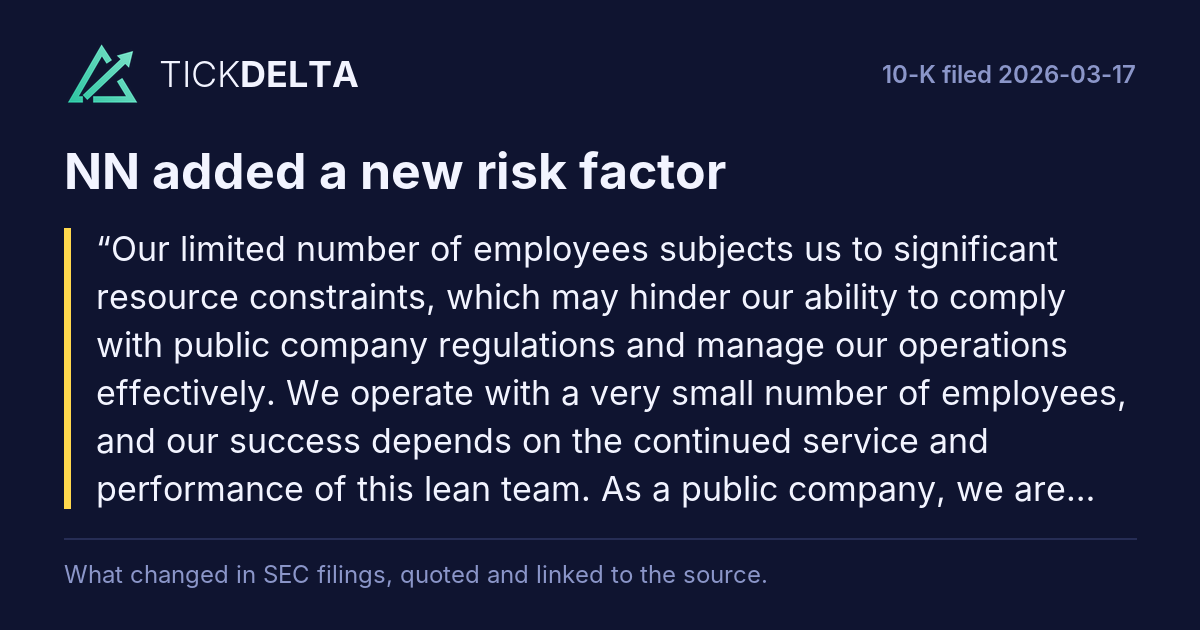
Our limited number of employees subjects us to significant resource constraints, which may hinder our ability to comply with public company regulations and manage our operations effectively.
We operate with a very small number of employees, and our success depends on the continued service and performance of this lean team. As a public company, we are subject to complex reporting, legal, and accounting requirements that demand significant time and attention. Because of our limited headcount, our executive officers must personally devote a substantial portion of their time to compliance and SEC reporting tasks. This diverts their attention away from our primary business objectives. Our small staff makes it difficult to maintain an ideal "segregation of duties" within our internal control over financial reporting. This increases the risk that errors or fraud could occur and not be detected in a timely manner. The loss of even one or two employees could disproportionately disrupt our operations, as we lack the "bench strength" or redundancy found in larger organizations to easily redistribute specialized tasks. To meet our public obligations, we rely on outside consultants, auditors, and legal counsel. This increases our operating costs and makes our compliance dependent on the availability and performance of these third-party providers.
If we are unable to effectively manage our limited human resources or if we fail to scale our staff as our strategy progresses, we may experience delays in our filings, weaknesses in our internal controls, or a failure to execute our business plan, any of which could materially and adversely affect our stock price.
Show the other 1
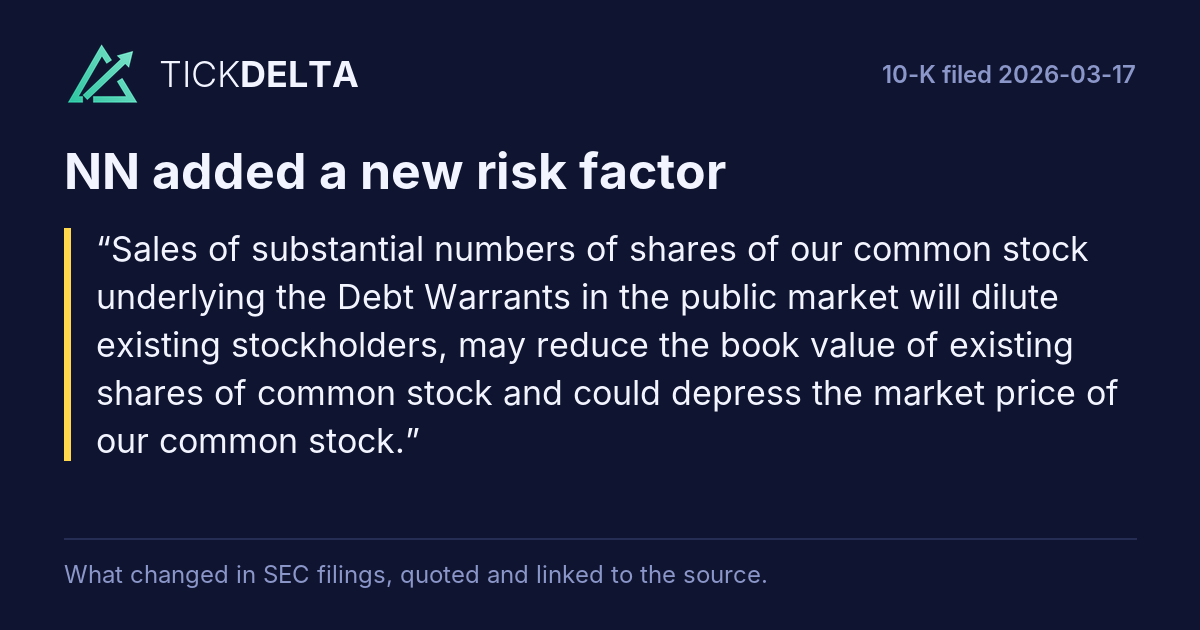
Sales of substantial numbers of shares of our common stock underlying the Debt Warrants in the public market will dilute existing stockholders, may reduce the book value of existing shares of common stock and could depress the market price of our common stock.
Paragraphs in the 10-Q filed Nov 12, 2026 that were not in the one before
New in the latest 10-Q
14 paragraphs in the 10-Q filed Nov 12, 2026 with nothing like them in the 10-Q filed Aug 11, 2026 (at least half the words must differ; new numbers alone do not count). Quoted exactly, grouped by the item heading above them. This is text that changed, not a judgement of how serious it is.
Financial statements and notes
Acquired finite-lived intangible assets primarily includes proprietary technology and software. See Note 4 - Intangibles.
Read in the 10-Q
NextNav assesses indefinite-lived intangible assets for potential impairment annually as of October 1 or during the year if an event or other circumstance indicates that NextNav may not be able to recover the carrying amount of the asset. In evaluating indefinite-lived intangible assets for impairment, NextNav first assesses qualitative factors to determine whether it is more likely than not that the fair value of the asset is less than its carrying amount. If NextNav concludes that it is not more likely than not that the fair value of the asset is less than its carrying value, then no further testing is required. However, if NextNav concludes that it is more likely than not that the fair value of the asset is less than its carrying value, then NextNav performs a two-step impairment test to identify potential impairment and measures the amount of impairment it will recognize, if any.
Read in the 10-Q
No impairment of indefinite-lived intangible assets was recorded during either the three and nine months ended September 30, 2026 and September 30, 2025.
Read in the 10-Q
The Private Placement Warrants are classified as a liability on the Company’s Condensed Consolidated Balance Sheet as of September 30, 2026. During the three months ended September 30, 2026, 3,200,000 Private Placement Warrants were exercised on a cashless basis, resulting in the issuance of 1,057,573 shares of common stock. Immediately prior to exercise, the warrants were remeasured to fair value, with the resulting change in fair value recognized in earnings. The aggregate fair value of the warrants at the time of exercise was $14.5 million. On October 7, 2026, the remaining 494,813 Private Placement Warrants outstanding as of September 30, 2026, were exercised on a cashless basis, resulting in the issuance of 100,908 shares of common stock. No Private Placement Warrants were exercised during the three months ended September 30, 2025.
Read in the 10-Q
NextNav operates as one operating segment. Information on the Company’s products and service offerings are included in Note 1 - Organization and Business. The accounting policies of the single operating segment are the same as those described in Note 2 - Summary of Significant Accounting Policies.
Read in the 10-Q
Show the other 9
The CODM assesses performance and decides how to allocate resources based on consolidated net loss that also is reported on the Consolidated Statements of Comprehensive Loss. Consolidated net loss is used to monitor budget versus actual results and in the annual budgeting and forecasting process. The measure of segment assets is reported on the Consolidated Balance Sheets as total consolidated assets. The CODM reviews cash flow forecasts in making capital and investment decisions. The CODM considers budget-to-actual variances in consolidated net loss monthly in determining performance and the compensation of employees.
Read in the 10-Q
NextNav did not have any intra-entity sales or transfers during the three and nine months ended September 30, 2026 and 2025.
Read in the 10-Q
The Company reclassified certain expenses between significant expense categories presented in the segment financial information below for all periods to align with the changes in the financial reporting presented to the CODM. Segment financial information for the three and nine months ended September 30, 2026 and 2025 is as follows:
Read in the 10-Q
Change in fair value of warrants and derivative liabilities 13,017 23,575 (6,109) (34,401)
Read in the 10-Q
1 Other segment items include equity-based compensation, debt extinguishment loss (gain), non-cash other loss, non-cash rent expense, capitalized labor costs, accretion expense on asset retirement obligations and other income (loss).
Read in the 10-Q
Research and development expenses remained relatively consistent at $5.2 million for the three months ended September 30, 2026 and 2025.
Read in the 10-Q
Other information
On September 23, 2026, Susan Insley, Chief Operating Officer, entered into a “Rule 10b5-1 trading arrangement” (as defined in Item 408 of Regulation S-K), intended to satisfy the affirmative defense of Rule 10b5-1(c) of the Securities Exchange Act of 1934. The sales plan applies to previously awarded grants of time-based vesting restricted stock units (“RSUs”) and provides for the automatic sales of a specific percentage of shares following the settlement of vested RSUs in an amount sufficient to satisfy the applicable tax withholding obligation of Ms. Insley. The sale proceeds will be delivered to the Company in satisfaction of the withholding obligation.
Read in the 10-Q
The exact number of shares that would be sold for withholding purposes under the plan currently is unknown as that number will vary based on the market price of Company common stock on the vesting date and other factors. Ms. Insley’s plan expires on December 31, 2027.
Read in the 10-Q
On November 11, 2026, we entered into amended and restated executive agreements with each of Mariam Sorond, Chief Executive Officer, Timothy Gray, Chief Financial Officer, and James Black, General Counsel. The amended agreements generally retain the terms of the executives’ existing agreements but revise certain severance benefits payable upon a termination by the Company without Cause or a resignation by the executive for Good Reason following a Change in Control (as defined in the agreements). Specifically, the amended agreements provide that (i) all outstanding unvested equity awards will become fully vested, rather than only those awards that otherwise would have vested during a specified timeframe following termination, and (ii) the executive will be entitled to a prorated annual bonus payment at target for the year of termination. In addition, Messrs. Black and Gray’s agreements were amended to delete a two-year term applicable to the Company’s obligation to pay severance benefits following a termination without Cause or resignation for Good Reason.
Read in the 10-Q
The 10-Q's risk factors against the 10-K
Item 1A of the 10-Q filed Nov 12, 2026 against Item 1A of the 10-K filed Mar 17, 2026.
A 10-Q repeats only the risks that changed, so a 10-K paragraph that is missing from it is not counted as removed.
Added is a paragraph with nothing like it in the 10-K, Reworded a sentence that is in both with several words changed,
Quiet changes a sentence in both where one to four words changed and one is a hedge or a modal
(cut words struck through, new words highlighted).
Text on the page, not a score; each links to the filing at sec.gov.
Show the other 11
Phrases used for the first time
Two-word phrases in Risk Factors of the 10-K filed Mar 17, 2026 that are in none of the 1 earlier 10-Ks stored, back to Mar 12, 2025
Where each one is used
- wireless operators: Our NextGen business strategy is dependent on entering into partnerships with third-party wireless operators; failure to secure these partnerships could prevent us from deploying our 5G services.
- buildout deadlines: With respect to 154 of Progeny’s 226 LMS licenses that are subject to end-of-term buildout deadlines, Progeny filed notifications with the FCC that the construction of the required networks was completed and operational by the buildout deadline or by an extended deadline that was requested by Progeny. On April 17...
- buildout showings: With respect to 154 of Progeny’s 226 LMS licenses that are subject to end-of-term buildout deadlines, Progeny filed notifications with the FCC that the construction of the required networks was completed and operational by the buildout deadline or by an extended deadline that was requested by Progeny. On April 17...
- debt securities: We believe that our cash and cash equivalents and marketable securities as of December 31, 2025 will be sufficient to meet our working capital and capital expenditure needs, including all contractual commitments, beyond the next 12 months from the date of filing this Annual Report on Form 10-K. We expect to meet...
- federal communications: In the event of certain non-ordinary course asset sales, including sales of certain intellectual property or spectrum licensed by the Federal Communications Commission to us or our subsidiaries, we must make a mandatory repurchase offer for a portion of the 2028 Notes outstanding with the proceeds of such sale, at...
- communications commission: In the event of certain non-ordinary course asset sales, including sales of certain intellectual property or spectrum licensed by the Federal Communications Commission to us or our subsidiaries, we must make a mandatory repurchase offer for a portion of the 2028 Notes outstanding with the proceeds of such sale, at...
- fundamental change: In addition, in the event of a Fundamental Change (as defined in the 2028 Indenture), each holder has the right, at such holder’s option and subject to the limitations set forth in the 2028 Indenture, to require us to repurchase for cash all of such holder’s 2028 Notes in an amount equal to the greater of (i) the...
- lms service: Through our wholly owned affiliate, Progeny LMS, LLC, we hold 354 licenses issued by the FCC to use radio spectrum for location services within the 902-928 MHz band, identified by the FCC as the Multilateration Location and Monitoring (“LMS”) Service licenses, including 128 LMS licenses that we acquired from a...
Used at least twice, small words left out. Counted, not picked: a phrase can be new because the company renamed something.
What was taken out
9 paragraphs of last year's Risk Factors with nothing like them now. The longest are quoted.
Sources
Item 1A of each 10-K and 10-Q on EDGAR, quoted exactly. Each paragraph links to the filing at sec.gov.
Also
10-K change: what was reworded or cut, section by section.
Work with it
Excel workbook · CSV. Google Sheet that stays up to date: paste =IMPORTDATA("https://tickdelta.com/company/NN/export.csv") into a cell.