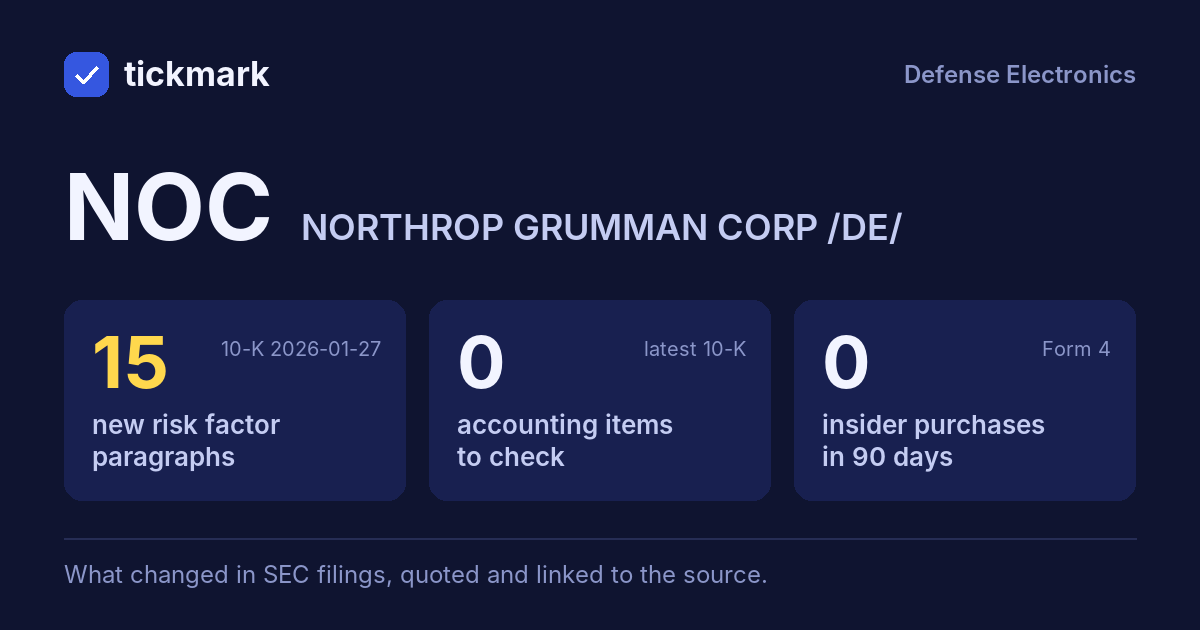
10-K 0001133421-26-000003 (2026-01-27) vs 10-K 0001133421-25-000006 (2025-01-30)
| Section | Compared text | Words now | Changed |
|---|
| Risk Factors | Item 1A | 10,893 |
29.7% |
| MD&A | Item 7 | 9,872 |
31.0% |
| Legal Proceedings | Item 3 | 232 |
0.0% |
| Accounting Policies | Item 8, Note 1 – SUMMARY OF SIGNIFICANT ACCOUNTING POLICIES | 5,524 |
20.0% |
The redline: what was cut and what was added
In each section, the paragraph that changed most, marked against last year's 10-K:
cut words struck through, new words highlighted and underlined.
Risk Factors 357 words changed in this paragraph; it is 32% similar to last year's version.
We operate in highly competitive markets and our competitors may have more financial capacity or more extensive or specialized engineering, technical, manufacturing, marketing or servicing capabilities. They may be willing to accept more risk or lower profitability in competing for contracts. We have seen, and anticipate we will continue to see, increased competition competition, including in some of our core markets, especially as a result of our customers’ budget pressures, pressures and their focus on speed, affordability and competition, competition. The U.S. government’s continued emphasis on reforming its acquisition processes, including procuring commercial products and our own success in winning business. We are facing increasing competition services and utilizing non-Federal Acquisition Regulation-based procurement methods, such as Other Transaction Authority (OTA) agreements and other contract types, has facilitated, and may continue to facilitate, participation by new and emerging market entrants, which has increased and may in the U.S. and outside the U.S. from U.S., foreign and multinational firms, including new entrants, and anticipate that mergers or acquisitions within our industry could future further increase competition for the programs we pursue, which could result in reduced contract opportunities, increased pricing pressure, and/or demands to accept less favorable terms. In certain circumstances, these alternative contracting models may place increased risk on the contractor, such as the potential for greater assumption of development costs or could limit our access for limited reimbursement recourse in certain situations. Further, certain non-Federal Acquisition Regulation-based procurement methods, such as OTA awards, are not subject to certain suppliers without appropriate remedies all of the procurement requirements that typically apply to protect our interests. We are also facing increasing competition for, DoW contracts and rights to protest such awards may be more limited access to various critical products, services and than for other supplies. In some instances, foreign companies may receive loans, subsidies and other assistance from their governments that may not be available to U.S. companies and foreign companies may be subject to fewer restrictions on technology transfer. For some products and services, some customers, including the DoD, are turning to commercial contractors, newer entrants to markets and non-traditional defense contractors, which may have lower cost or more agile operating structures and the ability to leverage changes in customer acquisition strategies (e.g., multiple awardees, short lifecycles). In addition, some customers continue to utilize small business contractors or determine to source work internally. Our success in competing depends, in part, on our ability to remain cost-competitive, respond to changes in customer acquisition strategies, accurately anticipate our customers’ needs and successfully effect our digital transformation strategy and adopt and integrate new digital technologies into our manufacturing, operations, and products and services. contracts.
Source: Item 1A, 10-K 0001133421-26-000003 vs Item 1A, 10-K 0001133421-25-000006
MD&A 133 words changed in this paragraph; it is 34% similar to last year's version.
Impairment Testing – We test for impairment of goodwill annually as of December 31 at each of our reporting units, which comprise our operating segments. The results of our annual segments, or more frequently if events occur or circumstances change such that it is more likely than not an impairment may exist. When testing for goodwill impairment tests as of December 31, 2024 impairment, we may perform both qualitative and 2023, respectively, indicated quantitative assessments. If we perform a qualitative assessment and conclude that it is more likely than not that the estimated fair value of a reporting unit is less than the carrying value, then a quantitative assessment is performed. When a quantitative assessment is performed, we compare the carrying value of each reporting unit significantly exceeded to its respective fair value and recognize an impairment loss to the extent that the fair value is less than the carrying value. There were no impairment charges recorded in the years ended December 31, 2024, 2023 and 2022.
Source: Item 7, 10-K 0001133421-26-000003 vs Item 7, 10-K 0001133421-25-000006
Accounting Policies 123 words changed in this paragraph; it is 38% similar to last year's version.
On November 27, 2023, September 18, 2025, the Financial Accounting Standards Board (FASB) FASB issued Accounting Standards Update (ASU) ASU No. 2023-07 Segment Reporting (Topic 280): 2025-06 Targeted Improvements to Reportable Segment Disclosures. Among other new disclosure requirements, the Accounting for Internal-Use Software (Subtopic 350-40). ASU 2023-07 requires 2025-06 removes references to prescriptive and sequential software development stages, requiring companies to disclose significant segment expenses that are regularly provided capitalize internal-use software costs when management commits to funding the chief operating decision maker. We adopted software project and it is probable the standard project will be completed. ASU 2025-06 will be effective for annual and interim periods beginning January 1, 2024 2028, and can be applied on a prospective, modified prospective, or retrospective basis. We are currently evaluating the disclosure requirements retrospectively to all prior periods presented in the financial statements. Adoption potential impact of ASU 2023-07 did not have an impact 2025-06 on the company’s consolidated financial position, results of operations and/or and cash flows.
Source: Item 8, Note 1 – SUMMARY OF SIGNIFICANT ACCOUNTING POLICIES, 10-K 0001133421-26-000003 vs Item 8, Note 1 – SUMMARY OF SIGNIFICANT ACCOUNTING POLICIES, 10-K 0001133421-25-000006
Every change, by type
Sentences and paragraphs of NOC's Risk Factors and MD&A, 10-K 2026-01-27 against 10-K 2025-01-30.
Each links to the text at sec.gov.
Quiet changes are sentences kept from last year with one to four words changed, at least one of them a hedge, a modal or a qualifier
(may, could, will, not, significant, material…). A year or date rolling forward is not counted.
The full word list
adverse, adversely, all, although, anticipate, anticipates, any, approximately, believe, believes, can, cannot, certain, could, expect, expects, generally, however, if, intend, intends, largely, likely, many, material, materially, may, might, most, must, never, no, not, possible, primarily, probable, should, significant, significantly, some, substantial, substantially, unlikely, will, would
AddedRisk Factors
The U.S. government can also introduce new contract terms that could impact and/or restrict our capital deployment strategy under certain circumstances related to contractor underperformance, noncompliance, insufficient prioritization of a particular contract, insufficient investment or insufficient production speed. If our contracts with the U.S. government include such terms and we are determined to have triggered any of the foregoing circumstances, we may be prohibited from engaging in share repurchases or dividends for a period of time.
Read it in 10-K 2026-01-27 at sec.gov ↗
AddedRisk Factors
In addition, high deficit levels and high debt servicing costs could drive cuts to federal spending. If the statutory debt limit is reached and not increased adequately, we could be obligated to work without receiving timely payments, and a prolonged breach could have far-reaching adverse consequences.
Read it in 10-K 2026-01-27 at sec.gov ↗
AddedRisk Factors
We operate in highly competitive markets and our competitors may have more financial capacity or more extensive or specialized engineering, technical, manufacturing, marketing or servicing capabilities. They may be willing to accept more risk or lower profitability in competing for contracts. We have seen, and anticipate we will continue to see, increased competition, including in some of our core markets, especially as a result of our customers’ budget pressures and their focus on speed, affordability and competition. The U.S. government’s continued emphasis on reforming its acquisition processes, including procuring commercial products and services and utilizing non-Federal Acquisition Regulation-based procurement methods, such as Other Transaction Authority (OTA) agreements and other contract types, has facilitated, and may continue to facilitate, participation by new and emerging market entrants, which has increased and may in the future further increase competition for the programs we pursue, which could result in reduced contract opportunities, increased pricing pressure, and/or demands to accept less favorable terms. In certain circumstances, these alternative contracting models may place increased risk on the contractor, such as the potential for greater assumption of development costs or for limited reimbursement recourse in certain situations. Further, certain non-Federal Acquisition Regulation-based procurement methods, such as OTA awards, are not subject to all of the procurement requirements that typically apply to DoW contracts and rights to protest such awards may be more limited than for other contracts.
Read it in 10-K 2026-01-27 at sec.gov ↗
AddedRisk Factors
Our customers are increasingly working with commercial contractors as well as newer entrants and startups in the defense industry for some products and services. Such contractors may have lower cost, more agile operating structures and access to capital and talent, a greater ability to leverage changes in the customer’s acquisition
Read it in 10-K 2026-01-27 at sec.gov ↗
AddedRisk Factors
strategies (e.g., multiple awardees, short lifecycles) or be more inclined to take on increased risk. In addition, some customers continue to utilize small business contractors or determine to source work internally.
Read it in 10-K 2026-01-27 at sec.gov ↗
AddedRisk Factors
Our success in competing depends, in part, on our ability to remain price- and cost-competitive, respond to changes in customer acquisition strategies and preferences, accurately anticipate our customers’ needs, successfully effect our digital transformation strategy and identify, adopt and integrate new digital technologies, including artificial intelligence, into our manufacturing, operations, business processes, products and services.
Read it in 10-K 2026-01-27 at sec.gov ↗
AddedRisk Factors
We expect that the increasing competition in the U.S. and outside the U.S. from U.S., foreign and multinational firms, including new entrants, could further increase due to mergers or acquisitions within our industry and could limit our access to certain suppliers, absent appropriate remedies to protect our interests. We are also facing increasing competition for, and more limited access to, various critical products, services and other supplies.
Read it in 10-K 2026-01-27 at sec.gov ↗
AddedRisk Factors
Additionally, in some instances, companies both inside and outside the U.S. may receive loans, investments, subsidies, preferential treatment and other assistance from their governments or customers that may not be provided or available to other companies. Such assistance may increase the competitiveness of such companies in certain opportunities. Certain foreign companies may also be subject to fewer restrictions on technology transfer.
Read it in 10-K 2026-01-27 at sec.gov ↗
AddedRisk Factors
adequate funding for our programs or obtain adequate supplies or insurance in the future. See Note 10 to the consolidated financial statements for information regarding the company’s investigations, claims and litigation.
Read it in 10-K 2026-01-27 at sec.gov ↗
AddedRisk Factors
Environmental impacts create short and long-term financial risks to our business globally. We have significant operations located in regions that have been, and may in the future be, exposed to significant weather events and other natural disasters. These events could damage our and our suppliers’ facilities, products, and other assets, and cause disruptions to our business operations and supply chain as well as the operations of our customers, and require an increase in expenditures to improve climate resiliency. The costs of our efforts to develop and implement sustainability initiatives and comply with environmental regulations where we operate may be greater than expected, which could affect our ability to achieve our goals. Additionally, we may be the subject of criticism or other actions by government officials, private groups or influential individuals who disagree with our actions with respect to sustainability and/or environmental matters.
Read it in 10-K 2026-01-27 at sec.gov ↗
AddedRisk Factors
operations can enhance our performance and enable our workforce to meet the needs of the customer. Our business may be adversely affected if we cannot continue to successfully integrate artificial intelligence into our business processes, products and services in a cost-effective, efficient, compliant and responsible manner. In addition, the advancement and integration of artificial intelligence technologies into our business are transforming the nature of work and the skills required within our workforce and may lead to workforce displacement. This could require us to invest in additional employee training, manage impacts on morale and retention and compete for candidates who possess more advanced technological skills. If we are unsuccessful in managing such risks to our workforce, it could negatively impact our operations. Additionally, emerging and potential regulations governing the use of artificial intelligence could impose additional requirements that may increase our costs or adversely impact our speed of delivery. Further, improper use of, or failure to adequately integrate, artificial intelligence could increase costs and lead to data breaches, reputational risks and otherwise negatively impact our business.
Read it in 10-K 2026-01-27 at sec.gov ↗
AddedRisk Factors
If we are unable to continue to develop new products and technologies in a timely fashion, and progress successfully to identify, develop and integrate new technologies and effect digital solutions and transformation, or if we fail to achieve market acceptance and scale production more rapidly than our competitors, we may be unable to maintain our competitive position and our future success could be materially adversely affected.
Read it in 10-K 2026-01-27 at sec.gov ↗
RemovedRisk Factors
Future funding for certain programs in which we participate may be reduced, delayed or cancelled. Budget cuts globally could adversely affect the viability of our subcontractors and suppliers. While we believe that our business is well-positioned in areas for future defense spending, changing priorities, budget pressures, defense spending cuts, challenges in the appropriations process, the possibility of a long-term continuing resolution (or series of continuing resolutions) and breach of the debt ceiling, ongoing fiscal debates and the global economic and security environment increase uncertainties and risk.
Read it in 10-K 2025-01-30 at sec.gov ↗
RemovedRisk Factors
We operate in highly competitive markets and our competitors may have more financial capacity or more extensive or specialized engineering, technical, manufacturing, marketing or servicing capabilities. They may be willing to accept more risk or lower profitability in competing for contracts. We have seen, and anticipate we will continue to see, increased competition in some of our core markets, especially as a result of our customers’ budget pressures, their focus on affordability and competition, and our own success in winning business. We are facing increasing competition in the U.S. and outside the U.S. from U.S., foreign and multinational firms, including new entrants, and anticipate that mergers or acquisitions within our industry could further increase competition or could limit our access to certain suppliers without appropriate remedies to protect our interests. We are also facing increasing competition for, and more limited access to various critical products, services and other supplies. In some instances, foreign companies may receive loans, subsidies and other assistance from their governments that may not be available to U.S. companies and foreign companies may be subject to fewer restrictions on technology transfer. For some products and services, some customers, including the DoD, are turning to commercial contractors, newer entrants to markets and non-traditional defense contractors, which may have lower cost or more agile operating structures and the ability to leverage changes in customer acquisition strategies (e.g., multiple awardees, short lifecycles). In addition, some customers continue to utilize small business contractors or determine to source work internally. Our success in competing depends, in part, on our ability to remain cost-competitive, respond to changes in customer acquisition strategies, accurately anticipate our customers’ needs and successfully effect our digital transformation strategy and adopt and integrate new digital technologies into our manufacturing, operations, and products and services.
Read it in 10-K 2025-01-30 at sec.gov ↗
RemovedRisk Factors
incentive-based fee arrangements; fixed price development or long-term production programs; different award criteria; and non-traditional contract provisions have affected and may in the future affect our profitability and predictability.
Read it in 10-K 2025-01-30 at sec.gov ↗
RemovedRisk Factors
We (including our subcontractors and others with whom we do business) also are subject to, and expected to perform in compliance with, a vast array of federal, state and local laws, regulations, contract terms and requirements related to our industry, our products and the businesses we operate, as well as those more broadly applicable to industry, such as securities laws and regulations. These requirements, whether specific to our industry or broadly applicable, can limit our ability to achieve our goals. If we are found to have violated any such requirements, or are found not to have acted responsibly, we may be subject to a wide array of actions, including contract modifications or termination; payment withholds; the loss of export/import privileges; administrative, civil or criminal judgments or penalties (including convictions, agreements, fines, damages and non-monetary relief); or suspension or debarment.
Read it in 10-K 2025-01-30 at sec.gov ↗
RemovedRisk Factors
Environmental matters may significantly impact our business and operations and present evolving risks and challenges. Environmental impacts, including climate change specifically, create short and long-term financial risks to our business globally. We have significant operations located in regions that have been, and may in the future be, exposed to significant weather events and other natural disasters. Increased worldwide focus on climate change has
Read it in 10-K 2025-01-30 at sec.gov ↗
RemovedRisk Factors
led to legislative and regulatory efforts to combat both potential causes and adverse impacts of climate change, including regulation of greenhouse gas emissions. New or more stringent laws and regulations related to greenhouse gas emissions and other climate change related concerns have affected and will likely continue to affect us, our suppliers and our customers. The company has set a goal to achieve net zero greenhouse gas emissions in our operations by 2035 and is committed to working to achieve its climate change and other sustainability goals. We are working to identify opportunities to utilize alternatives to fossil-based energy sources, to decrease our greenhouse gas emissions, to reduce our consumption of water and generation of waste, and to ensure our compliance with environmental regulations where we operate, enhancing our record of environmental sustainability. However, the costs of doing so may be greater than expected, which could affect our ability to achieve our goals.
Read it in 10-K 2025-01-30 at sec.gov ↗
RemovedRisk Factors
Cyber threats, both on premises and in the cloud, are complex, continuous and evolving and include, but are not limited to: malicious software, destructive malware, ransomware, targeting by more advanced and persistent
Read it in 10-K 2025-01-30 at sec.gov ↗
RewordedRisk Factors
We cannot predict the impact on existing, follow-on, replacement or future programs from potential Potential changes in the threat and global security environment, environment; defense spending levels, levels; government and budgetary priorities, priorities; political leadership, leadership; procurement laws, practices and strategy, strategy; inflation and other macroeconomic trends, trends; military strategy; strategy, including changes in DoW priorities, preferences or regulations; or broader changes in social, economic, security or political demands and priorities. priorities could adversely affect existing, follow-on, replacement or future programs.
Read it in 10-K 2026-01-27 at sec.gov ↗
RewordedRisk Factors
Problems and delays in that could limit the successful development and delivery of our solutions, including as a result of prevent us from meeting requirements and/or create risk and liabilities include issues with design, technology technology, operations or operations, digital transformation, inability to achieve learning curve assumptions, inability to integrate emerging and rapidly developing technologies like artificial intelligence, manufacturing materials or components, or subcontractor (or other supplier) performance can prevent us from meeting requirements and create significant risk and liabilities. performance.
Read it in 10-K 2026-01-27 at sec.gov ↗
RewordedRisk Factors
We also have experienced, and may experience continue to experience, financial or other performance challenges performing if we are unable to use or obtain certain raw materials, chemicals chemicals, parts, components or other substances in a timely and/or cost-efficient manner due to laws or other regulations that restrict or prohibit the use or import of such items items, or cause suppliers to be unwilling or unable to supply them them, and we cannot obtain a reasonable substitute on a timely or cost-effective basis. basis, including as a result of tariffs or other trade restrictions.
Read it in 10-K 2026-01-27 at sec.gov ↗
RewordedRisk Factors
For example, fixed-price contracts for such contracts can create programs have increased performance and financial risks, whether risks due to a number of factors, including the estimates of following challenges: estimating costs required to complete such contracts being contracts, which are subject to potentially significant variability or because of the challenge of variability, particularly with respect to development programs, starting and stabilizing manufacturing production and test lines while concurrently validating final design design, and managing changes in requirements or capabilities requested by the customer.
Read it in 10-K 2026-01-27 at sec.gov ↗
RewordedRisk Factors
New laws or other requirements, or changes to existing ones (including, for example, related to cybersecurity, information and data protection, cost accounting, environment, sustainability, securities, competition, compensation costs, employment, taxes, counterfeit parts, pensions, and use of certain non-US equipment) equipment or acquisitions more expansive interpretations or other changes in how government agencies construe existing ones, broadly), can significantly increase our costs (including compliance costs) and risks and risks, create operational challenges, potentially limit our ability to return cash to shareholders, reduce our profitability. profitability and/or adversely affect our competitiveness.
Read it in 10-K 2026-01-27 at sec.gov ↗
RewordedRisk Factors
We continue to work proactively to mitigate the challenges caused by the macroeconomic environment, including, in some cases, hedging foreign exchange, interest rate and commodity price risk, and seeking the inclusion of economic price adjustment clauses or seeking to recover on requests for equitable adjustments, engineering change proposals REAs, ECPs or other claims. claims, but the impacts of these challenges are uncertain and our efforts to mitigate them may not be successful.
Read it in 10-K 2026-01-27 at sec.gov ↗
RewordedRisk Factors
We expect our facilities, operations, employees and communities in the future, to continue to be at risk for future natural disasters or other weather events, particularly at facilities prone to extreme weather events, such as in Florida and California, to continue to be at risk for future natural disasters or other weather events (which may be exacerbated by climate change). California.
Read it in 10-K 2026-01-27 at sec.gov ↗
RewordedRisk Factors
Our business, financial position, results of operations and/or cash flows have been and may in the future be adversely impacted by the global macroeconomic environment, which impacts have included and may in the future include high rates of inflation; inflation, increased interest rates; rates, tight credit conditions in financial markets; markets, widespread disruptions in supply chains; chains, workforce challenges, including labor shortages; shortages, changes in trade policies, such as tariffs, and market volatility, including exchange rate volatility. volatility, all of which may affect material costs and supplier pricing.
Read it in 10-K 2026-01-27 at sec.gov ↗
RewordedRisk Factors
When there is sufficient information to assess expected future performance, we consider performance related performance-related incentives, awards and penalties penalties, as well as the expected performance of our suppliers and the availability and cost of labor, materials and components in estimating contract revenue and profit rates. profitability.
Read it in 10-K 2026-01-27 at sec.gov ↗
RewordedRisk Factors
Disruptions or Disruptions, performance problems or other issues with our subcontractors or other suppliers (referred to inclusively as suppliers), suppliers, including unanticipated cost growth for the products and services they provide, growth, failure to meet regulatory or contractual requirements, and/or unethical or illegal behavior, or a misalignment between our contractual obligations to our customers and our agreements with our suppliers, have had and may continue to have various adverse impacts on the company, including on our ability to meet our commitments to customers and financial expectations.
Read it in 10-K 2026-01-27 at sec.gov ↗
RewordedRisk Factors
These and other activities subject us to various extraordinary risks, including those associated with (1) nuclear-related or non-nuclear launch activities and operations, including failed launches, (2) unintended release or initiation of energetic materials and explosions, whether in the development, test or use of such energetic materials; materials, and (3) the storage, handling and disposal of radioactive and other hazardous or flammable materials and any changes in related regulations.
Read it in 10-K 2026-01-27 at sec.gov ↗
RewordedRisk Factors
In addition, pressures on, as well as laws and plans relating to the federal budget, potential certain changes in priorities and defense spending, the timing and substance of the appropriations process, use of continuing resolutions (with (which may carry restrictions, e.g., including on new contract contracts and program starts) and the federal debt limit (including a breach of the federal debt ceiling), have adversely affected and could in the future adversely affect the amount and timing of funding for individual programs and delay purchasing or payments by our customers.
Read it in 10-K 2026-01-27 at sec.gov ↗
Quiet changesRisk Factors
Given the size and nature of our many contracts, estimating total revenues and costs at completion is complex and subject to many variables.
Read it in 10-K 2026-01-27 at sec.gov ↗
Quiet changesRisk Factors
We have safety and loss prevention programs, which provide for pre-construction reviews, along with safety audits of operations involving explosive materials, to attempt to avoid or mitigate some such incidents, as well as potentially potential insurance coverage and indemnification to address resulting liabilities, but they may not be successful.
Read it in 10-K 2026-01-27 at sec.gov ↗
AddedMD&A
On May 24, 2025 (the “Divestiture date”), the company completed its previously announced sale of substantially all
Read it in 10-K 2026-01-27 at sec.gov ↗
AddedMD&A
of the Immersive Mission Solutions (IMS) operating unit of Defense Systems (the “training services” business or
Read it in 10-K 2026-01-27 at sec.gov ↗
AddedMD&A
“divestiture”) for $333 million in cash and recorded a pre-tax gain on sale of $231 million. IMS is a provider of mission training and satellite ground network communications software for U.S. government customers. Operating results include sales and operating income for the training services business prior to the Divestiture date.
Read it in 10-K 2026-01-27 at sec.gov ↗
AddedMD&A
reversal or temporary suspension of announced tariffs, the availability of exemptions, changes in the amount and scope of tariffs, the imposition of new tariffs and other measures that target countries may take in response to U.S. trade policies, and possible resulting general inflationary pressures in the global economy. We are continuing to monitor the impact on our business, suppliers and customers, but do not believe that the tariffs in effect at this time will have a material adverse effect on our business.
Read it in 10-K 2026-01-27 at sec.gov ↗
AddedMD&A
On July 4, 2025, the FY 2025 reconciliation bill titled the One Big Beautiful Bill Act (the “OBBBA”) was enacted. The OBBBA allocates approximately $150 billion in funds for defense spending, including funding for air and missile defense, munitions, strategic deterrence, shipbuilding and supply chains and other military capabilities, and the appropriated funds will remain available to be obligated until September 30, 2029 and expended through FY 2034. The OBBBA is expected to result in increased investments by the DoW in defense modernization projects and Pacific region deterrence, among other programs. See Note 6 to the financial statements for additional information on key income tax provisions of the OBBBA.
Read it in 10-K 2026-01-27 at sec.gov ↗
AddedMD&A
The Presidential Administration (the “Administration”) has issued numerous executive orders, including orders to undertake a comprehensive overhaul of the Federal Acquisition Regulation, to reform the DoW defense acquisition process and, more recently, to address underperformance and insufficient prioritization of government contracts, insufficient investment in production and production speed and incentive compensation metrics applicable to defense contractors. See “Risk factors” for further discussion regarding risks associated with executive orders and regulatory changes. Some of the Administration’s executive orders are subject to ongoing court challenges. Implementation of certain of these executive orders could adversely affect our business or create a more challenging or costly regulatory, operating and economic environment.
Read it in 10-K 2026-01-27 at sec.gov ↗
AddedMD&A
In light of the ongoing conflicts and heightened global instability as well as political tensions and related legal challenges, we expect continued uncertainty in the global security, U.S. political, budget and regulatory environment. Initiatives to reduce governmental spending, federal budget and debt ceiling action, and further changes in U.S. government policy positions, including trade and foreign policy, tax policy and DoW policies or priorities, could materially impact defense spending broadly and the company’s programs in particular.
Read it in 10-K 2026-01-27 at sec.gov ↗
AddedMD&A
company to expand production capacity along with the opportunity to earn improved returns on the LRIP and NTE phases of the program.
Read it in 10-K 2026-01-27 at sec.gov ↗
AddedMD&A
During the second quarter of 2025, we partnered with the U.S. Air Force in defining the preliminary execution framework necessary for successful restructure of the program. The program restructure will include a revision to the acquisition strategy, joint establishment of a new program baseline, and other critical preparation activities necessary to re-accomplish Milestone B approval. Based on this preliminary execution framework, we updated our estimated profitability on the program and recognized a $76 million favorable estimate-at-completion (EAC) adjustment during the second quarter of 2025 largely related to our expectations for achieving certain contract incentives.
Read it in 10-K 2026-01-27 at sec.gov ↗
AddedMD&A
of contract type and/or life cycle (e.g., cost-type, fixed-price, development, production, and/or sustainment). Contract mix can also refer to differences in the profitability of the programs that drive changes in sales (e.g., sales growth or decreases on programs with accretive or dilutive margin rates).
Read it in 10-K 2026-01-27 at sec.gov ↗
AddedMD&A
•Organic sales is defined as total sales excluding sales attributable to the company's former training services business. This measure may be useful to investors and other users of our financial statements as a supplemental measure in evaluating the company’s underlying sales growth as well as in understanding our ongoing business and future sales trends by presenting the company’s sales adjusted for the impact of the divestiture.
Read it in 10-K 2026-01-27 at sec.gov ↗
AddedMD&A
In July 2025, the OBBBA was enacted. Key income tax-related provisions of the OBBBA include the repeal of mandatory capitalization of research and development expenditures under Internal Revenue Code (IRC) Section 174 (reinstating full expensing beginning in 2025), extension of bonus depreciation, and revisions to international tax regimes. The company recognized the income tax effects of the OBBBA in its 2025 financial statements.
Read it in 10-K 2026-01-27 at sec.gov ↗
RemovedMD&A
government spending more broadly. We anticipate that issues related to budgetary priorities and defense spending levels, the debt ceiling, and the spending caps imposed by the Fiscal Responsibility Act of 2023 (FRA), particularly with respect to discretionary spending, will continue to be a subject of considerable debate, with a potentially significant impact on our programs and the company.
Read it in 10-K 2025-01-30 at sec.gov ↗
RemovedMD&A
The political environment, federal budget, debt ceiling and regulatory environment, including potential tax reform, are expected to continue to be the subject of considerable debate, especially in light of the ongoing conflicts and heightened global tensions, the macroeconomic environment and political tensions. The results of those debates could have material impacts on defense spending broadly and the company’s programs in particular.
Read it in 10-K 2025-01-30 at sec.gov ↗
RemovedMD&A
recognized in the prior year upon the sale of our minority investment in an Australian business, and $76 million of higher interest expense on our long-term debt.
Read it in 10-K 2025-01-30 at sec.gov ↗
RemovedMD&A
The increase in 2024 unallocated corporate expense is primarily due to a $127 million increase in deferred state taxes associated with the prior year B-21 charge and the MTM adjustment, partially offset by lower intangible asset amortization and PP&E step-up depreciation and a loss recognized in the prior year in connection with the divestiture of a small international subsidiary.
Read it in 10-K 2025-01-30 at sec.gov ↗
RemovedMD&A
During 2024, the company reduced unfunded backlog by $1.6 billion and $0.7 billion related to terminations for convenience in our restricted space business and on the NGI program at Space Systems, respectively.
Read it in 10-K 2025-01-30 at sec.gov ↗
RemovedMD&A
During the fourth quarter of 2024, the company entered into an agreed Revenue Agent’s Report (“RAR”) for certain matters related to the company’s 2018-2020 federal income tax returns, largely related to our methods of accounting associated with the timing of revenue recognition and related costs under IRC Section 451(b). The company made a $956 million payment in December 2024, inclusive of associated interest, in connection with the agreed RAR. Refer to Note 6 to the financial statements for further information about our unrecognized tax benefits.
Read it in 10-K 2025-01-30 at sec.gov ↗
RemovedMD&A
Beginning in 2022, the Tax Cuts and Jobs Act of 2017 (“TCJA”) eliminated the option to deduct research and development expenditures in the current year and requires taxpayers to amortize them over five years pursuant to IRC Section 174. Our 2024 and 2023 cash from operations were reduced for federal estimated tax payments we made related to Section 174 of approximately $350 million and $500 million, respectively. In the future, Congress may consider legislation that would defer the amortization requirement to later years, possibly with retroactive effect. In the meantime, we expect to continue to make additional federal tax payments based on the current Section 174 tax law, which we estimate will reduce our 2025 cash from operations by approximately $230 million. The impact of Section 174 on our cash from operations depends on the amount of research and development expenditures incurred by the company and whether the IRS issues guidance on the provision which differs from our current interpretation, among other things.
Read it in 10-K 2025-01-30 at sec.gov ↗
RemovedMD&A
(1)Includes depreciation and amortization, non-cash lease expense, MTM benefit (expense), stock based compensation expense, deferred income taxes and net periodic pension and OPB income.
Read it in 10-K 2025-01-30 at sec.gov ↗
RemovedMD&A
Adjusted free cash flow, as reconciled in the table below, is a non-GAAP measure defined as net cash provided by or used in operating activities, less capital expenditures, plus proceeds from the sale of equipment to a customer (not otherwise included in net cash provided by or used in operating activities) and the after-tax impact of discretionary pension contributions, if any. Adjusted free cash flow includes proceeds from the sale of equipment to a customer as
Read it in 10-K 2025-01-30 at sec.gov ↗
RemovedMD&A
Environmental Matters – We are subject to environmental laws and regulations in the jurisdictions in which we do or have done business. Factors that could result in changes to the assessment of probability, range of reasonably estimated costs and environmental accruals include: modification of planned remedial actions; changes in the estimated time required to conduct remedial actions; discovery of more or less extensive (or different) contamination
Read it in 10-K 2025-01-30 at sec.gov ↗
RemovedMD&A
In addition to performing an annual goodwill impairment test, we may perform an interim impairment test if events occur or circumstances change that suggest goodwill in any of our reporting units may be impaired. Such indicators may include, but are not limited to, the loss of significant business, significant reductions in federal government appropriations or other significant adverse changes in industry or market conditions. During 2024, we determined there were no impairment indicators requiring us to perform an interim goodwill impairment test.
Read it in 10-K 2025-01-30 at sec.gov ↗
RemovedMD&A
spending and cash flows for the reporting units over a multi-year period, as well as to determine the weighted-average cost of capital (WACC) used as a discount rate and terminal value assumptions. The WACC takes into account the relative weights of each component of our consolidated capital structure (equity and debt) and represents the expected cost of new capital adjusted as appropriate to consider lower risk profiles associated with longer-term contracts and barriers to market entry. The terminal value assumptions are applied to the final year of the discounted cash flow model. We use industry multiples (including relevant control premiums) of operating earnings to corroborate the fair values of our reporting units determined under the market valuation method of the income approach.
Read it in 10-K 2025-01-30 at sec.gov ↗
RewordedMD&A
CAS pension expense (475) (279) (154) (167) 70% 81% (8)% FAS pension service expense 217 239 236 367 (9)% 1% (36)% FAS/CAS operating adjustment (258) (40) 82 200 545% NM (59)% Gain on sale of business (231) — — NM —% Training services divestiture - unallowable state taxes and transaction costs 20 5 — 300% NM Intangible asset amortization and PP&E step-up depreciation 84 97 122 242 (13)% (20)% (50)% Deferred state tax expense (benefit)(1) (benefit) of MTM adjustment adjustment(1) 28 23 (22) 65 22% NM (134)% Deferred state tax benefit of B-21 charge(1) loss provisions(1) (25) — (82) — NM NM Other unallocated corporate expense 94 248 89 123 145 (24)% (15)% 179% (28)% Unallocated corporate expense 124 214 141 452 (42)% 52% (69)% Segment operating income $ 4,377 $ 4,544 $ 2,760 $ 4,253 (4)% 65% (35)% Segment operating margin rate 10.4 % 11.1 % 7.0 % 11.6 %
Read it in 10-K 2026-01-27 at sec.gov ↗
RewordedMD&A
The 2024 2025 MTM benefit of $443 $527 million was primarily driven by a 58 basis point increase in the discount rate from year end 2023, partially offset by actual net plan asset returns of 4.7 11.3 percent compared to our 7.5 percent asset return assumption. assumption, partially offset by a 15 basis point decrease in the discount rate from year end 2024.
Read it in 10-K 2026-01-27 at sec.gov ↗
RewordedMD&A
Economic tensions and changes in international trade policies, including including, for example, the widespread tariffs announced since last year by the U.S. on its major trading partners, higher tariffs on imported goods and materials, the imposition of materials and actions taken in response (such as retaliatory tariffs or other trade protection protectionist measures and or the renegotiation of free trade agreements, agreements), could also further impact the global market for defense products, services and solutions.
Read it in 10-K 2026-01-27 at sec.gov ↗
RewordedMD&A
As such, after considering the information released by the RPEC in October 2021 as well as the company’s recent mortality experience, we adopted the full MP-2021 projection scale while continuing to use the Pri-2012 White Collar table, supplemented with 50% of the Gradual Wear-Off illustration as outlined in the RPEC’s 2022 Mortality Improvement Update paper to reflect the future impacts of COVID-19, to develop our mortality assumptions used in calculating our pension and OPB obligations recognized at December 31, 2024, and the amounts estimated for our 2025 pension and OPB expense. COVID-19.
Read it in 10-K 2026-01-27 at sec.gov ↗
RewordedMD&A
In addition, an overall If rates increase in interest rates in recent years has raised the cost of borrowing for governments, and if rates further increase, or remain elevated, it could impact government spending priorities (in the U.S. and allied countries, in particular), including their the demand for defense products.
Read it in 10-K 2026-01-27 at sec.gov ↗
RewordedMD&A
Major products include strategic long-range strike aircraft; tactical fighter and air dominance aircraft; airborne battle management and command and control systems; and unmanned uncrewed autonomous aircraft systems, including high-altitude long-endurance (HALE) strategic intelligence, surveillance and reconnaissance (ISR) systems.Year Ended December 31 % Change in $ in millions 2025 2024 2023 2022 2025 2024 2023 Sales $ 12,030 12,992 $ 10,786 12,396 $ 10,531 12% 2% 11,164 5% 11% Operating income (loss) 1,182 (473) 1,116 NM 813 1,236 (416) (34)% NM Operating margin rate 9.8 6.3 % (4.4) 10.0 % 10.6 (3.7) %
Read it in 10-K 2026-01-27 at sec.gov ↗
RewordedMD&A
Operating margin rate increased to 10.7 10.9 percent from 9.5 9.7 percent primarily due to higher net EAC adjustments largely driven by adjustments, including a $76 million favorable EAC adjustment on the HALO Sentinel program as previously disclosed. during the second quarter of 2025.
Read it in 10-K 2026-01-27 at sec.gov ↗
RewordedMD&A
Impairment Testing – We test for impairment of goodwill annually as of December 31 at each of our reporting units, which comprise our operating segments. segments, or more frequently if events occur or circumstances change such that it is more likely than not an impairment may exist.
Read it in 10-K 2026-01-27 at sec.gov ↗
RewordedMD&A
The conflicts ongoing conflict in Ukraine and the Middle East Ukraine, recent events in Venezuela and threats elsewhere, particularly in the Middle East and the Western Pacific region, have increased global tensions and instability and highlighted security requirements globally, including in Europe, the Middle East and East, the Pacific region, region and Latin America, as well as the U.S.
Read it in 10-K 2026-01-27 at sec.gov ↗
RewordedMD&A
The Sentinel EAC incorporates If our best estimate of costs estimated cost to complete the restructured EMD effort; however, if the outcome is effort or our expectations for achieving contract incentives are more or less favorable than what we have estimated, our financial position, results of operations and/or cash flows could be materially affected.
Read it in 10-K 2026-01-27 at sec.gov ↗
RewordedMD&A
Net EAC adjustments by segment are presented in the table below:Year Ended December 31 $ in millions 2025 2024 2023 2022 Aeronautics Systems $ 151 (186) $ (44) 157 $ 174 (38) Defense Systems 96 91 104 168 90 82 Mission Systems 192 59 149 138 Space Systems 47 42 (101) (31) Eliminations (12) 2 (11) (25) (8) Net EAC adjustments $ 209 $ 350 $ 84 $ 360
Read it in 10-K 2026-01-27 at sec.gov ↗
RewordedMD&A
We are focused on the efficient conversion of operating income into cash to provide for the company’s material cash requirements, including working capital needs, satisfaction of contractual commitments, investment in our business through capital expenditures, funding of our pension and OPB plans, investment in our business through capital expenditures, and shareholder return through dividend payments and share repurchases. returns.
Read it in 10-K 2026-01-27 at sec.gov ↗
Quiet changesMD&A
Since our contracts often span a period of several years, estimation of revenue, cost, and progress toward completion requires the use of significant judgment.
Read it in 10-K 2026-01-27 at sec.gov ↗