Screener / SEC EDGAR /CIK 0001021860 /10-K filed Feb 12, 2026, compared with Feb 14, 2025 /Numbers from the XBRL of the 10-Ks
NYSE Industrials · Oilfield Equipment

NOV Inc. NOV

Compare with peers Embed
SEC comment letters, last 20 years

11 reviews of NOV's filings by SEC staff

UPLOAD and CORRESP
Reviews 11 latest letter Mar 18, 2026
Questions asked 68 each answered in the company's own letter
No closing letter 1 reviews without a letter saying the staff completed it

When the SEC's staff reviews a filing, it writes to the company with numbered questions, and the company answers each one in a letter. SEC publishes the exchange once the review is over, at least 20 business days later. A question is not an accusation; most reviews end with the company adding detail to its next filing.

How the reviews went

Every review on EDGAR, from the first staff letter to the letter that closes it

  1. 1. Staff letters 17 UPLOAD
  2. 2. Questions in them 68 numbered comments
  3. 3. Company replies 20 CORRESP
  4. 4. Reviews closed 10 of 11 closing letter

Half the closed reviews took 37 days or less from the first letter to the closing letter.

Form 10-K for the Fiscal Year ended December 31, 2025

2026-03-18 to 2026-04-02 · 1 question · 1 letter from the SEC, 1 from the company
Review closed 2026-04-02
RevenueSegments
SEC asked
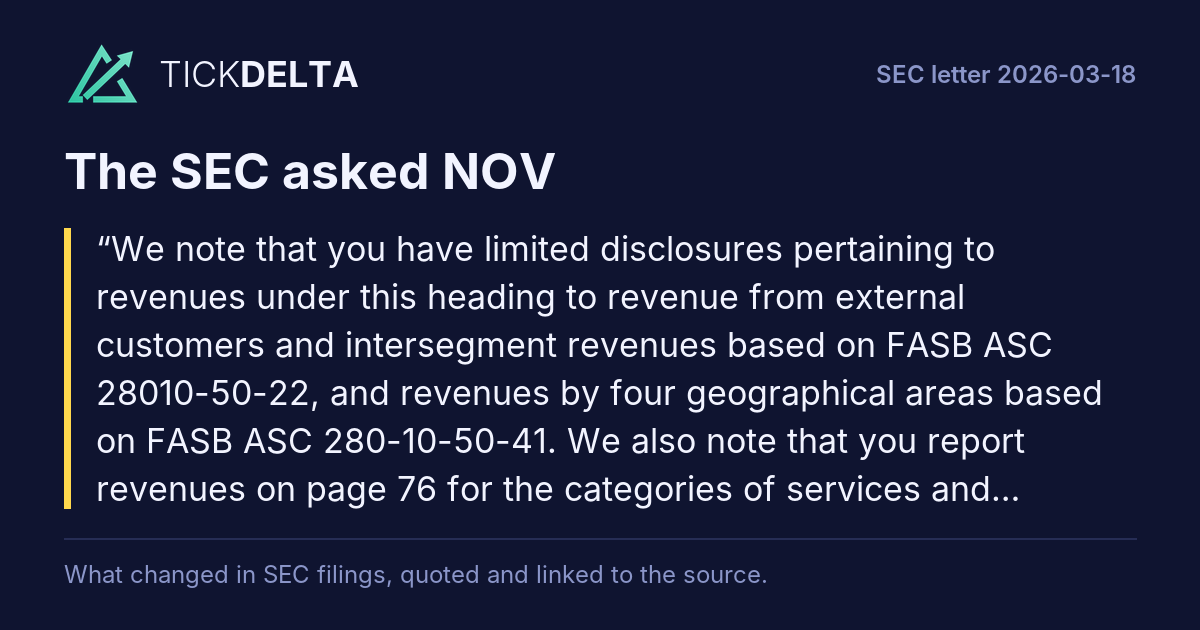
We note that you have limited disclosures pertaining to revenues under this heading to revenue from external customers and intersegment revenues based on FASB ASC 28010-50-22, and revenues by four geographical areas based on FASB ASC 280-10-50-41.
Rest of the question

We also note that you report revenues on page 76 for the categories of services and rentals, sales of shorter-lived capital equipment, sales of consumable products, sales of long-lived capital equipment, and aftermarket sales and services. However, on page 3 you indicate that you manufacture a diverse line of products and on pages 4 through 6, you identify about 17 product and service offerings in describing your reportable operating segments. Please expand your disclosures under this heading as necessary to address the requirement in FASB ASC 280-10-50-40, to report revenues for each product and service, or each group of similar products and services. If you believe that revenues for some categories of products and services should be combined because they are similar, or if believe that providing the information is impracticable, provide us with details of your assessments in this regard.

NOV answered
The Company respectfully acknowledges the Staff’s comment regarding the level of revenue disaggregation.

The Company’s current disclosures include revenues from external customers and intersegment revenues for each reportable segment in accordance with ASC 280-10-50-22, as well as revenues by geographic area in accordance with ASC 280-10-50-41.
Rest of the answer

The Company also considered the requirements of ASC 280-10-50-40, which requires disclosure of revenues for each product and service, or each group of similar products and services.

In applying this guidance, the Company evaluated whether its product and service offerings represent distinct groupings with materially different characteristics and also considered the illustrative guidance in ASC 606-10-55-89 through 55-91 in determining the appropriate level of disaggregation.

This assessment included both qualitative and quantitative factors, including the nature of our products and services, the manner in which revenues are generated, the types of customers, and how management evaluates operating performance. The Company also considered how revenue information is presented in other communications, including earnings releases, investor presentations, and information regularly reviewed by the CODM.

Based on this assessment, the Company determined that its current revenue categories represent appropriate groupings of similar products and services. For the Energy Products and Services segment, revenues are disaggregated into (i) services and rentals, (ii) sales of shorter-lived capital equipment, and (iii) sales of consumable products. For the Energy Equipment segment, revenues are disaggregated between (i) capital equipment and (ii) aftermarket sales and services. These groupings reflect differences in the nature of the offerings and underlying economic characteristics, including demand drivers, customer purchasing patterns, pricing structures, and revenue timing.

While the Company offers a broad range of individual products and services within each segment, the Company evaluated whether further disaggregation would result in additional categories with materially different economic characteristics and determined that such additional disaggregation would not meaningfully enhance an investor’s understanding of the nature, amount, timing, and uncertainty of our revenues because such further categories would not reflect materially different economic characteristics relative to the categories already presented.

The Company believes its current disclosures comply with ASC 280-10-50-40 and ASC 606. If, in future periods, management begins to regularly review revenue at a more granular product/service level (or if additional product/service groupings become more material or exhibit materially different economic characteristics, the Company will expand its ASC 280-10-50-40 disclosures accordingly).

In providing this response letter to the Staff, the Company acknowledges that (i) the Company and its management are responsible for the adequacy and accuracy of the disclosure in the above-referenced filing, (ii) Staff comments or changes to disclosure in response to Staff comments do not foreclose the Commission from taking any action with respect to the above-referenced filing, and (iii) the Company may not assert Staff comments as a defense in any proceeding initiated by the Commission or any person under the federal securities laws of the United States.

If you or any member of the Staff has any questions regarding the responses set forth in this letter, please contact Megan Foscaldi of Troutman Pepper Locke LLP at (617) 239-0282.
Read in the reply

Also in this review: closing letter, 2026-04-02
Form 10-K for the Year Ended December 31, 2023

2024-07-25 to 2024-08-12 · 4 questions · 1 letter from the SEC, 1 from the company
Review closed 2024-08-12
SegmentsResults discussion (MD&A)RevenueNon-GAAP measures
Management's Discussion and Analysis of Financial Condition and Results of Operations · Executive Summary, page 36
SEC asked (1)
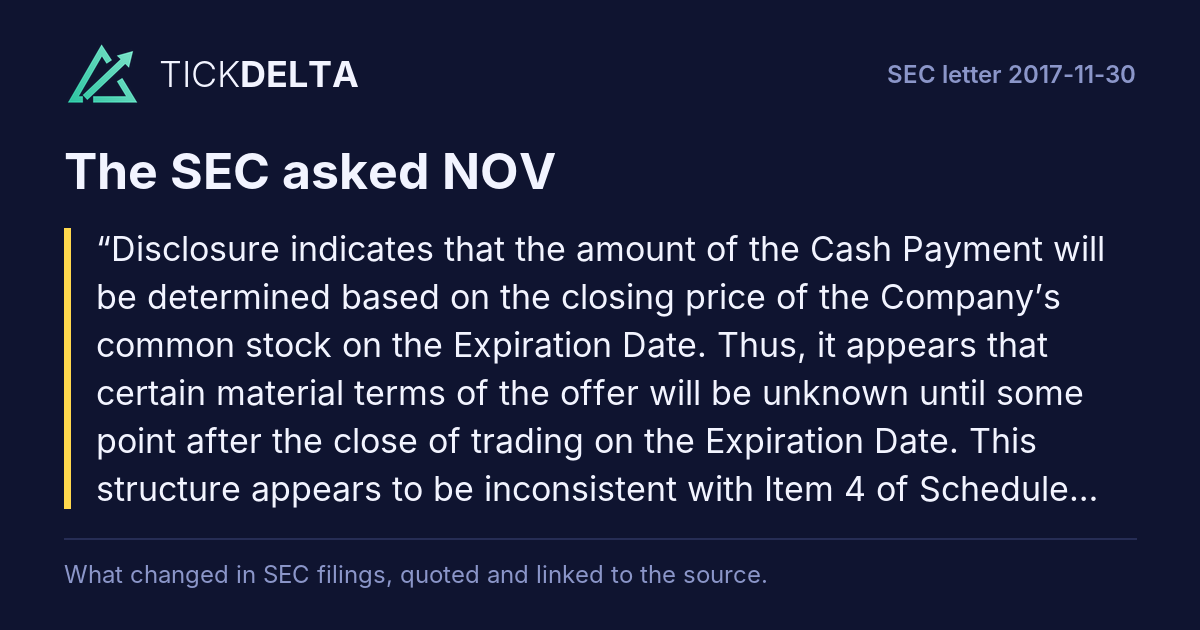
When providing a discussion and analysis of a non-GAAP measure, please ensure such disclosure is accompanied by a similar discussion and analysis of the corresponding GAAP measure with equal or greater prominence. For example, you disclose the decrease in segment Adjusted EBITDA YoY and Q4 over Q3 fiscal 2023 without providing similar information for the corresponding GAAP measure.
Rest of the question

In addition, you disclose total adjusted EBITDA for Q3 fiscal 2023 and Q4 fiscal 2022 without providing similar GAAP information for net income. Refer to Item 10(e)(1)(i)(A) of Regulation S-K and Question 102.10(a) of the non-GAAP C&DIs.

NOV answered
The Company acknowledges the Staff’s comment and advises the Staff that in future filings, we will endeavor to fully comply with Item 10(e)(1)(i)(A) of Regulation S-K and the related Staff guidance. Specifically, the Company will not present Adjusted EBITDA

(or a discussion and analysis of the changes therein) for any periods where the comparable GAAP information is not presented with equal or greater prominence. In addition, the Company respectfully advises the Staff that it has already reflected the foregoing in its Form 10-Q for the second quarter ended June 30, 2024.
Read in the reply
In its next report

First report after the company's reply of Aug 6, 2024: 10-Q filed Oct 25, 2024 ↗, against the 10-Q filed Apr 26, 2024 ↗.

Tickdelta does not hold the text of both reports, so they are not compared here.

Management's Discussion and Analysis of Financial Condition and Results of Operations · Executive Summary, page 36
SEC asked (2)
We note that you include various measures for the most recent quarter, including new orders booked, book to bill ratio, and orders shipped on an individual segment basis. In order to provide context to your current measure, please revise to include comparative information for the periods presented in the filing. Refer to SEC Release No. 33-10751. Results of Operations, page 37
NOV answered
The Company advises the Staff that in future filings, where such measures are presented for a current period, we will provide comparative information for the relevant prior period. In addition, the Company respectfully advises the Staff that it has already reflected the foregoing in its Form 10-Q for the second quarter ended June 30, 2024.
Read in the reply
In its next report

First report after the company's reply of Aug 6, 2024: 10-Q filed Oct 25, 2024 ↗, against the 10-Q filed Apr 26, 2024 ↗.

Tickdelta does not hold the text of both reports, so they are not compared here.

Management's Discussion and Analysis of Financial Condition and Results of Operations · Executive Summary, page 36
SEC asked (3)
Please revise to explain in sufficient detail the reasons driving changes in your financial statement line items on a consolidated and segment basis. When you discuss revenue fluctuations, specifically describe the extent to which changes are attributable to changes in prices, changes in the volume or amount of goods or services being sold, or to the introduction of new products or services.
Rest of the question

Where you describe two or more business reasons that contributed to a material change in a financial statement line item between periods, please quantify, where possible, the extent to which each factor contributed to the overall change in that line item, including any off-setting factors. Also, revise to include a separate discussion of the company's consolidated results based on the line items in your consolidated statements of income. Refer to Item 303(a) and (b) of Regulation S-K and SEC Release No. 33-8350.

NOV answered
We acknowledge the Staff’s comment. We confirm that in future filings, we will endeavor to provide greater detail of the reasons driving changes in financial statement line items and, where we describe two or more business reasons that contributed to a material change in a financial statement line item, we will quantify, where possible, the extent to which each factor contributed to the overall change in that line item, including any off-setting factors.
Rest of the answer

In situations where it is not practical to quantify such changes, we will provide a qualitative discussion of the relative significance of each factor that contributed to the overall change in that line item where possible. We will also include a separate discussion of the Company’s consolidated results based on the line items in its consolidated statements of income.

With respect to specifically describing the extent to which revenue fluctuations are attributable to changes in prices, changes in the volume or amount of goods or services being sold, or to the introduction of new products or services, we note that the Company’s revenues are significantly impacted by factors other than price and volume. Sales mix often varies considerably period to period, so unit price and volume comparisons for products are often of limited utility. One of the biggest drivers in the change of sales mix and volumes relates to changes in activity and demand from different markets. We provide that information as part of our disaggregated revenue disclosures in the notes to the financial statements, and will provide narrative discussion of this information in the Management’s Discussion and Analysis section of future periodic and annual reports, to the extent relevant. Management has also historically provided comparative data on key energy services industry drivers, most notably, changes in oil prices and rig counts, as those items have a material impact on demand for our products and services, and also indirectly impact pricing. Furthermore, we offer many products that are sold at varying prices to different customers in different regions. Therefore, we do not quantify aggregate price and volume for our product lines or segments and believe it would not be practical to do so. However, if there are material changes to overall volume or pricing that impact our financial results, we will describe those changes.

In addition, the Company respectfully advises the Staff that it has already reflected the foregoing in its Form 10-Q for the second quarter ended June 30, 2024.

Read in the reply
In its next report

First report after the company's reply of Aug 6, 2024: 10-Q filed Oct 25, 2024 ↗, against the 10-Q filed Apr 26, 2024 ↗.

Tickdelta does not hold the text of both reports, so they are not compared here.

Note 2. Summary of Significant Accounting Policies · Remaining Performance Obligations, page 64
SEC asked (4)
You disclose that the company expects to recognize as revenue over the next 12 months approximately $1.5 billion of the unsatisfied or partially satisfied performance obligations with the remainder being recognized thereafter.
Rest of the question

Please revise to disclose when the remaining $3 billion will be recognized on a quantitative basis using time bands that would be most appropriate for the duration of the remaining performance obligations or by providing qualitative information. Refer to ASC 606-10-50-13.

NOV answered
In response to the Staff’s comment, the Company will revise the disclosure in its future annual and quarterly reports to disclose the amount of its unsatisfied or partially satisfied performance obligations expected to be recognized on a quantitative basis, using the time bands that would be most appropriate for the duration of the remaining performance obligations.
Rest of the answer

In addition, the Company respectfully advises the Staff that it has already reflected the foregoing in its Form 10-Q for the second quarter ended June 30, 2024.

The information below illustrates what the Company’s remaining performance obligations disclosure in Note 2 to its consolidated financial statements would have been if the changes were incorporated into the Form 10-K for the year ended December 31, 2023.

Remaining Performance Obligations

Remaining performance obligations represent the transaction price of firm orders for all revenue streams for which work has not been performed on contracts with an original expected duration of one year or more. We do not disclose the remaining performance obligations of royalty contracts, service contracts for which there is a right to invoice, and short-term contracts that are expected to have a duration of one year or less.

As of December 31, 2023, the aggregate amount of the transaction price allocated to remaining performance obligations was $4,492 million. The Company expects to recognize approximately $1,491 million in revenue for the remaining performance obligations in 2024, $885 million in 2025, $431 million in 2026, and

$1,685 million thereafter.

In providing this response letter to the Staff, the Company acknowledges that (i) the Company and its management are responsible for the adequacy and accuracy of the disclosure in the above-referenced filing, (ii) Staff comments or changes to disclosure in response to Staff comments do not foreclose the Commission from taking any action with respect to the above-referenced filing, and (iii) the Company may not assert Staff comments as a defense in any proceeding initiated by the Commission or any person under the federal securities laws of the United States.

If you or any member of the Staff has any questions regarding the responses set forth herein, please contact Megan Foscaldi of Locke Lord LLP at (617) 239-0282.

Read in the reply
In its next report

First report after the company's reply of Aug 6, 2024: 10-Q filed Oct 25, 2024 ↗, against the 10-Q filed Apr 26, 2024 ↗.

Tickdelta does not hold the text of both reports, so they are not compared here.

Also in this review: closing letter, 2024-08-12

Schedule TO-I

2017-11-30 to 2017-12-04 · 5 questions · 1 letter from the SEC, 1 from the company
No closing letter
Offering Memorandum · How will the amount of the Cash Payment be determined? page 9
SEC asked (1)
Disclosure indicates that the amount of the Cash Payment will be determined based on the closing price of the Company’s common stock on the Expiration Date. Thus, it appears that certain material terms of the offer will be unknown until some point after the close of trading on the Expiration Date. This structure appears to be inconsistent with Item 4 of Schedule TO and corresponding Item 1004(a) of Regulation M-A.
Rest of the question

Please advise.

NOV answered
To ensure the

Eligible Holders that tender their Eligible SARs Awards in the Exchange Program receive equivalent value through the New Awards, we must determine the “spread” for calculating the Cash Payment on the vested, in-the-money SARs using the closing price of our common stock on the Expiration Date (the “Expiration Date Stock Price”).

U.S Securities and Exchange Commission

Page

The New Options offered in the Exchange Program will be granted as of the Expiration Date with a per share exercise price equal to the Expiration Date Stock Price.
Rest of the answer

The New Options provide the Eligible Holders with the upside that is forfeited in connection with the exchange of their Eligible SARs Awards. Therefore, to avoid any gap in value, we must calculate the spread for the Cash Payment on their vested, in-the-money SARs using the same Expiration Date Stock Price that sets the exercise price for the New Options.

If we fixed the Cash Payment amount at the launch of the Exchange Program based on an estimate of our Expiration Date Stock Price or otherwise, we could not provide Eligible Holders with any assurance they would actually receive equivalent value in the Exchange Program.

To allow Eligible Holders to understand and determine the amount of the Cash Payment offered to them, we are providing them with three sets of information. First, in the Questions and Answers section and certain other sections of the Offering Memorandum (Exhibit (a)(1)(i) to our original Schedule TO), we have provided detailed explanations of the Cash Payment together with examples of how to calculate the Cash Payment. Using these examples, an Eligible Holder can calculate, during the Offer, his or her Cash Payment amount based on our common stock price. Second, in Schedule B to the Offering Memorandum and in the

Highlights of the National Oilwell Varco, Inc. Stock Appreciation Right Exchange Program document (Exhibit (a)(1)(iii) to our original Schedule TO), we have provided Eligible Holders with illustrative tables setting forth the spread and the amount of the Cash Payment based on a range of hypothetical common stock prices. This allows Eligible Holders to see, during the Offer, how the Cash Payment amount adjusts as our common stock price moves up and down. Finally, promptly after market close on the Expiration Date, we will send to each Eligible Holder an Update on the Exchange Program (Exhibit (a)(1)(v) to our original Schedule TO), which update sets forth, among other things, the actual closing price of our common stock on the Expiration

Date and, based thereon, the actual spread for calculating the amount of the Cash Payment.

Because (i) the formula itself for calculating the amount of the Cash Payment is set and will remain constant throughout the Offer, (ii) the Cash Payment amount is determinable based on the readily observable trading price of our common stock listed on the NYSE, which price is easily accessed over the internet on any computer, tablet, cell phone or other similar device, (iii) the Offer documents provide Eligible SARs Holders with detailed examples on how to calculate the Cash Payment amount as well as illustrative tables showing the calculation of Cash Payment amount at various hypothetical common stock prices and (iv) promptly after market close on the Expiration Date, we will send via email to each Eligible Holder our closing stock price and the actual spread for calculating the Cash Payment, providing the Eligible Holder with several hours to then determine whether or not they want to participate in the Offer before it expires at 9:00 p.m. Central time, we believe that our Exchange Program clearly states the terms of the Offer, including the type and amount of consideration offered, as required by Item 1004(a) of Regulation M-A.

We believe our approach is consistent with other issuers that have used formulaic pricing mechanisms for determining the offer consideration at or near the expiration of the offer period (often based on VWAP, Black Scholes and other similar models, which are significantly more complicated and difficult to understand than our simple “spread” calculation) and provided similar hypotheticals and supplemental information in connection with their exchange offers (See, e.g., the discussion in the PHH Corporation No-Action Letter, June 12, 2015, and the related PHH Corporation Schedule TO-I originally filed on May 6, 2015).

Read in the reply
May the Company cancel this Offer, page 14
SEC asked (2)
The Company appears to be asserting its absolute right to terminate the Offer. Please revise to clarify that the Offer may only be terminated or withdrawn upon the occurrence of stated conditions on or prior to the Expiration Date.
NOV answered
We have revised our Schedule TO-I and the relevant exhibits thereto to clarify that the Offer may only be terminated or withdrawn upon the occurrence of the stated conditions on or prior to the Expiration Date. See also our response to your comment no. 4.
Read in the reply
When will I receive my Cash Payment and my Amended SARs and New Options grant documents? page 16
SEC asked (3)
Disclosure indicates that you will make the Cash Payment to Eligible Holders on December 29, 2017, nine calendar days following expiration of the Offer. Please advise us how this complies with the prompt payment requirement under Rule 13e-4(f)(5).
NOV answered
We have revised the Schedule TO-I and the relevant exhibits thereto to provide that the Cash Payment will be paid on December 26, 2017. To process the

Cash Payment, we must determine, for each Eligible Holder that tendered Eligible SARs Awards in the Exchange Program (which could be as many as 625 Eligible Holders), the actual Cash Payment amount due and the applicable tax withholding amount required to be withheld (which tax withholding amount will be based on each Eligible Holder’s individual year to date income, whether or not they are subject to state and/or local income tax and other
Rest of the answer

relevant circumstances). To ensure each

Cash Payment amount, and the tax withholding amount, is correctly calculated for each Holder will take significant time. Based on our internal payroll department resources immediately preceding Christmas weekend, we believe the earliest date by which the Cash Payment amount could be accurately processed and paid is December 26, 2017. We believe in light of the Christmas holiday (including that Christmas falls on Monday this year) that payment of the Cash Payment on December 26,

2017 is prompt payment consistent with Rule 13e-4(f)(5).

Read in the reply
Section 7. Conditions of this Offer, page 25
SEC asked (4)
Disclosure indicates that the board of directors may determine in its sole discretion to withdraw or terminate the Offer. The inclusion of offer conditions that enable the issuer to terminate the tender offer or its obligation to purchase based on events within its control could render the offer illusory and in contravention of Exchange Act Section 14(e).
Rest of the question

Please revise to avoid the implication that the Offer may be terminated based on actions or inactions completely within the issuer’s control.

NOV answered
We have revised our Schedule TO-I and the relevant exhibits thereto to avoid any implication that the Offer may be terminated based on actions or inactions completely within the issuer’s control.
Read in the reply
Section 9. Information Concerning National Oilwell Varco, Inc., page 30
SEC asked (5)
We note that you incorporated your financial statements by reference to your annual report on Form 10-K and quarterly reports on Form 10-Q. Please revise your disclosure to include all of the summarized financial information required by Item 1010(c) of Regulation M-A. See Instruction 6 to Item 10 of Schedule TO.
NOV answered
We have revised our Schedule TO-I and the relevant exhibits thereto to include the summarized financial information.

In providing this response letter to the Staff, the Company acknowledges that (i) the Company is responsible for the adequacy and accuracy of the disclosure in the above-referenced filing, (ii) Staff comments or changes to disclosure in response to

Staff comments do not foreclose the Commission from taking any action with respect to the above-referenced filing, and (iii) the Company may not assert Staff comments as a defense in any proceeding initiated by the Commission or
Rest of the answer

any person under the federal securities laws of the United States.

If you or any member of the Staff has any questions regarding the responses set forth herein, please contact Eric Johnson of Locke Lord LLP at (713) 226-1249.

Read in the reply

Form 10-K for the Fiscal Year Ended December 31, 2016

2017-09-22 to 2017-10-13 · 2 questions · 1 letter from the SEC, 1 from the company
Review closed 2017-10-13
Russia and UkraineRevenue
General
SEC asked (1)
In your letter to us dated July 2, 2014, you discussed contacts with Syria. As you are aware, Syria is designated by the State Department as a state sponsor of terrorism and is subject to U.S. economic sanctions and export controls. You do not provide disclosure about Syria in your Form 20-F.
Rest of the question

Please describe to us the nature and extent of any past, current, and anticipated contacts with Syria since your 2014 letter, whether through subsidiaries, distributors, resellers, affiliates, or other direct or indirect arrangements. You should describe any services, technology, products, equipment or components you have provided to Syria, directly or indirectly, and any agreements, commercial arrangements, or other contacts with the government of Syria or entities that it controls.

NOV answered
As noted in our July 2, 2014 response to the Staff’s comments (the “2014 Response Letter”), from and after 2011 through

July 2, 2014, NOV was in the process of winding down its business in Syria. The Company no longer conducts business in Syria through subsidiaries, distributors or agents, and has had no recorded sales for the period 2014 to current. The Company has implemented compliance procedures to screen against sales to Syria, and is not aware of any indirect sales to Syria.
Read in the reply
General
SEC asked (2)
Please discuss the materiality of any contacts with Syria you describe in response to the comment above, and whether those contacts constitute a material investment risk for your security holders. You should address materiality in quantitative terms, including the approximate dollar amounts of any associated revenues, assets, and liabilities for the last three fiscal years and the subsequent interim period.
Rest of the question

Also, address materiality in terms of qualitative factors that a reasonable investor would deem important in making an investment decision, including the potential impact of corporate activities upon a company’s reputation and share value. As you know, various state and municipal governments, universities, and other investors have proposed or adopted divestment or similar initiatives regarding investment in companies that do business with U.S.- designated state sponsors of terrorism. You should address the potential impact of the investor sentiment evidenced by such actions directed toward companies that have operations associated with Syria.

NOV answered
As noted in our 2014 Response Letter:

The Company’s current limited business contacts in Syria are winding down. The Company does not intend to engage in any activities in any of these countries in the future [including Syria]. Therefore, the Company does not believe its current limited contacts in Syria. . . are material on a qualitative basis.”

Response No. 1 describes NOV’s winding down actions, as noted above in response to comment No. 1. In winding down its Syria business, NOV, NOVDEL and NOVUK obtained a license from the OFAC to collect $141,543.00.
Rest of the answer

NOVDEL applied in the UK for a license to collect other funds, but HM Treasury determined that no license was required. Collectively the revenue from winding down sales in Syria was not material to NOV from a quantitative point of view. Furthermore, in view of the license applications, the immaterial amount of sales revenue and other relevant factors, NOV believes its disclosures provide appropriate information to investors in making their investment decisions.

Since our 2014 Response Letter, the Company completed its winding down process and its sales directed into Syria are zero.

In providing this response letter to the Staff, the Company acknowledges that (i) the Company is responsible for the adequacy and accuracy of the disclosure in the above-referenced filings, (ii) Staff comments or changes to disclosure in response to Staff comments do not foreclose the Commission from taking any action with respect to the above-referenced filings, and (iii) the Company may not assert Staff comments as a defense in any proceeding initiated by the Commission or any person under the federal securities laws of the United States.

If you or any member of the Staff has any questions regarding the responses set forth herein, please contact the undersigned at (713) 375-3965.

Read in the reply

Also in this review: closing letter, 2017-10-13

Form 10-K

2016-07-19 to 2016-12-14 · 14 questions · 2 letters from the SEC, 2 from the company
Review closed 2016-12-14
Goodwill and impairmentCritical estimatesSegmentsResults discussion (MD&A)Executive payRevenueLiquidity and cashNon-GAAP measures
Management’s Discussion and Analysis of Financial Condition and Results of Operations, page · Results of Operations, page 42
SEC asked (1)
We note the restructuring charges during the year ended December 31, 2015. Please provide a discussion and analysis of the anticipated future cost savings related to your 2015 Realignment at both the consolidated and reportable segment levels.
Rest of the question

Include in this discussion the periods over which cost savings are expected to be realized, the extent to which you have realized the anticipated savings and whether any cost savings are expected to be offset by anticipated increases in other expenses or reduced revenues. To the extent actual savings by the plan are not achieved as expected or achieved in periods other than those expected this should also be disclosed. Please refer to SAB Topic 5-P.4 and Item 303(a)(3) of Regulation S-K for guidance.

NOV answered
The “2015 Realignment” described in Item 1, Part

1, page 14 of our Form 10-K is not the source of the restructure charges in our segments detailed on pages 42, 43, and 44, and is not part of an exit plan as referenced in SAB Topic 5-P.4. The 2015 Realignment enhanced the efficiency of our US legal entity structure and provided strategic benefits, but will not produce material operational cost savings.

The restructuring and other items costs identified in each segment on pages 42, 43 and 44 are not part of a discrete plan to exit a reporting unit or significant business.
Rest of the answer

These costs are reactive and stem from reducing the size of our continuing businesses’ headcount and facilities

(as mentioned in the last paragraph of the MD&A Outlook section on page 41) in many individual circumstances in response to the market declines described in detail in the MD&A on pages 37 through 41. This is a continuous activity carried out by numerous managers across the world in response to, and guided by, market conditions changing over time.

Read in the reply
In its next report

First report after the company's reply of Aug 2, 2016: 10-Q filed Aug 3, 2016 ↗, against the 10-Q filed May 5, 2016 ↗.

Tickdelta does not hold the text of both reports, so they are not compared here.

Liquidity and Capital Resources, page 49
SEC asked (2)
We note that you had $8,187 million of undistributed earnings related to your foreign subsidiaries at December 31, 2015 and that you consider these earnings to be permanently reinvested. Please provide liquidity disclosures to discuss the potential tax impact associated with the repatriation of undistributed earnings of foreign subsidiaries in future periodic filings.
Rest of the question

In this regard, please disclose the amount of cash that is currently held by your foreign subsidiaries and disclose the impact of repatriating the undistributed earnings of foreign subsidiaries. Refer to Item 303(a)(1) of Regulation S-K and Section IV of our Release 33-8350.

NOV answered
We will add the dollar amount of cash held overseas and the potential tax cost to repatriate foreign cash to the MD&A Liquidity and Capital

Resources section of our second quarter 2016 Form 10-Q and future periodic filings which, based on current facts and circumstances, we expect to be similar to:

At June 30, 2016, the Company had cash and cash equivalents of $1,661 million and total debt of $3,280 million. At December 31, 2015, cash and cash equivalents were $2,080 million and total debt was $3,909 million.
Rest of the answer

As of June 30, 2016, approximately $1,614 million of the $1,661 million of cash and cash equivalents was held by our foreign subsidiaries, of which $1,459 million would be subject to a 35% U.S. income tax rate, offset by any available foreign tax credits, if repatriated. However, our current plans are to permanently reinvest these funds outside of the U.S. If opportunities to invest in the U.S. are greater than available cash balances that are not subject to income tax, rather than repatriating cash the Company may choose to borrow against its revolving credit facility.

Read in the reply
In its next report

First report after the company's reply of Aug 2, 2016: 10-Q filed Aug 3, 2016 ↗, against the 10-Q filed May 5, 2016 ↗.

Tickdelta does not hold the text of both reports, so they are not compared here.

Critical Accounting Policies, page 52 · Goodwill and Other Indefinite-Lived Intangible Assets, page 54
SEC asked (3)
We note your disclosure regarding the goodwill impairment test performed during the fourth quarter of 2015. For the reporting units not specifically addressed by your disclosure, confirm for us that you have concluded that the fair values of the reporting units are substantially in excess their carrying value.
NOV answered
We confirm that we have concluded the fair values of the reporting units not specifically addressed in our disclosure are substantially in excess of their carrying values.
Read in the reply
In its next report

First report after the company's reply of Aug 2, 2016: 10-Q filed Aug 3, 2016 ↗, against the 10-Q filed May 5, 2016 ↗.

Tickdelta does not hold the text of both reports, so they are not compared here.

Critical Accounting Policies, page 52 · Goodwill and Other Indefinite-Lived Intangible Assets, page 54
SEC asked (4)
Based on the disclosure under this section, we understand that you have concluded that the fair values of the Rig Offshore, Dynamic Drilling Solutions, Process and Flow Technologies and Fiberglass reporting units are not substantially in excess of their carrying values. If our understanding is not correct, please clarify this for us.
Rest of the question

Otherwise, expand your disclosure to describe, for each reporting unit, the factors that would contribute to a potential impairment situation and how you view the likelihood of those factors affecting the reporting units.

NOV answered
For informational purposes, our Form 10-K disclosed the fair value in excess of carrying value percentage for the four reporting units with the lowest excess percentages in our test: Rig Offshore, Dynamic Drilling Solutions, Process and Flow Technologies and

Fiberglass, all falling within a range of 15% to 30%. We concluded the fair values were substantially in excess of their carrying values.
Rest of the answer

Factors supporting our conclusion included:

•

Our industry is and has always been strongly cyclical, and lower fair-value over carrying-value excesses were expected during a deep down cycle;

The reporting unit listed above with the lowest excess fair value percentage, Fiberglass, obtained the bulk of its goodwill in a Q4 2012 transaction, and therefore had a limited amount of time to grow fair value before the down cycle began in late 2014.

We engaged third-party valuation experts to assist in the impairment testing process and have a high degree of confidence in the results.

If in the future the facts and circumstances underlying our valuation assumptions were to change and these changes would lead us to conclude that resulting fair values would not be substantially in excess of reporting unit carrying values, or would require potential impairments, we will make appropriate disclosures in our periodic filings.

Read in the reply
In its next report

First report after the company's reply of Aug 2, 2016: 10-Q filed Aug 3, 2016 ↗, against the 10-Q filed May 5, 2016 ↗.

Tickdelta does not hold the text of both reports, so they are not compared here.

Critical Accounting Policies, page 52 · Goodwill and Other Indefinite-Lived Intangible Assets, page 54
SEC asked (5)
For the reporting units for which you have concluded that the fair values of the reporting units are not substantially in excess of their carrying values, tell us and disclose the amount of goodwill allocated to the reporting unit.
NOV answered
We believe the fair values of all reporting units are substantially in excess of their carrying values.
Read in the reply
In its next report

First report after the company's reply of Aug 2, 2016: 10-Q filed Aug 3, 2016 ↗, against the 10-Q filed May 5, 2016 ↗.

Tickdelta does not hold the text of both reports, so they are not compared here.

Critical Accounting Policies, page 52 · Goodwill and Other Indefinite-Lived Intangible Assets, page 54
SEC asked (6)
Please provide us with a reasonably detailed summary of the fair value estimates underlying your goodwill impairment testing performed during the fourth quarter of 2015. The summary should address the methodologies, significant assumptions and conclusions for each reporting unit.
Rest of the question

Additionally, explain to us why you believe the enterprise value implied by those fair value estimates is consistent with the enterprise value implied by the trading prices of your common stock during the fourth quarter and through subsequent months.

NOV answered
The following table and text provides a detailed summary of the fair value estimates underlying our goodwill impairment testing performed during the fourth quarter of 2015. The table provides competitively sensitive information the Company does not disclose publicly which has been redacted in our

EDGAR filing of this letter.

Rule 83 confidential treatment request made by National Oilwell Varco, Inc., Request Number 1.

SEG dollars in millions (000,000)

Reporting Unit

Risk adjusted

DCF

Book

Value

10/1/15

Excess

$

Value %

Step 1

Conclusion

Rig Systems

Rig
Rest of the answer

Offshore

[***]

Pass

Rig Land

Rig Aftermarket

Wellbore Technologies

Dynamic Drilling Solutions

Drilling and Intervention

Fail

Drillpipe (Grant Prideco)

Tuboscope

Wellsite Services

Completion & Production

Intervention and Stimulation

Floating Production

XL Systems

Subsea

Fiberglass

Process and Flow

Risk adjusted DCF by BU

Less: Corp Overhead and Elims

Less: Corporate Debt

Implied enterprise value:

National Oilwell Varco, Inc. requests that the information contained in

Request Number 1 be treated as confidential information and that the Commission provide notice to the contact person identified in the introductory paragraphs to this letter before it permits any disclosure of such confidential information.

We engaged a large, well respected firm to assist with our ASC 350 Impairment of Goodwill Analysis project to ensure our analysis, conclusions and calculations were in conformity with the Statement on Standards for Valuation Services No. 1 of the American Institute of Certified Public Accountants.

Significant assumptions in the testing were as follows:

Cash flow from operations were based on NOV’s detailed 2016 plan which considers worldwide rig activity, inflationary forces, pricing strategies, customer analysis, operational issues, competitor analysis, capital spending requirements, working capital needs, customer needs to replace aging equipment, increased complexity of drilling, new technology, and existing backlog, among other items which impact the individual reporting unit projections. Early year growth rates anticipated both continued market declines through 2016 and a moderate pace of recovery thereafter.

Weighted average cost of capital were estimated for each reporting unit individually using a comparable guideline public company set, ranging from 8.2% to 12.9%. Using observable market participant inputs and published databases, the following capital asset pricing model inputs were calculated for each reporting unit: capital structure, beta, size premium, country risk premium, tax rate, and long term growth rate. Country risk premiums and tax rates were developed using the weighted average historical revenue by country for each reporting segment and the specific country risk premiums and effective tax rates for those countries, respectively. Capital structure and beta were calculated using the median observable inputs of the comparable guideline public company set.

Long-term growth rates reflected the Company’s conservative long term expectations within the oil and gas services industry. Overall, the rates were based on a combination of the Company’s and its Industry’s historical and potential growth rates, and the overall anticipated economic environment given macro trends for energy demand.

As part of our impairment testing we considered the reasonableness of NOV’s implied enterprise value. Taking into account a control premium that would be paid for the Company based on reported transactions in our industry, we believe the enterprise value implied by the fair value estimates is consistent with the enterprise value implied by the trading prices of NOV’s common stock during the fourth quarter and through subsequent months.

Read in the reply
In its next report

First report after the company's reply of Aug 2, 2016: 10-Q filed Aug 3, 2016 ↗, against the 10-Q filed May 5, 2016 ↗.

Tickdelta does not hold the text of both reports, so they are not compared here.

Definitive Proxy Statement on Schedule 14A filed April 11, 2016 · Compensation Discussion and Analysis, page 37
SEC asked (7)
In future filings, please disclose how you determined the mix of stock option and performance awards for the long-term equity incentive compensation granted to each of your named executive officers, including Mr. Williams, and specify the criteria used to determine award amounts for such option awards.
NOV answered
In future filings, the

Company will include more details on how the Compensation Committee determines the mix of stock option, restricted stock and performance awards granted to each of the named executive officers and the criteria used to determine award amounts.
Read in the reply
In its next report

First report after the company's reply of Aug 2, 2016: 10-Q filed Aug 3, 2016 ↗, against the 10-Q filed May 5, 2016 ↗.

Tickdelta does not hold the text of both reports, so they are not compared here.

Definitive Proxy Statement on Schedule 14A filed April 11, 2016 · Compensation Discussion and Analysis, page 37
SEC asked (8)
We note you indicate that you award long-term incentive compensation, in part, based on performance metrics. In particular, your disclosure states that you grant performance share awards pursuant to performance against a TSR (total shareholder return) goal and ROC (return on capital) goal.
Rest of the question

In future filings, please ensure you disclose your specific TSR and ROC goals as well as your actual performance against such goals, including the TSR performance of the members of the OSX index. Please also discuss the financial and operational performance goals you considered in issuing Mr. William’s performance share awards as well as how actual performance compared to such goals.

NOV answered
In future filings, the Company will disclose the goals of the performance share awards and the actual results of awards against the goals, including the TSR performance of the members of the OSX index. The financial and operational performance goals considered by the Compensation Committee when issuing Mr. William’s performance share awards will also be discussed.
Read in the reply
In its next report

First report after the company's reply of Aug 2, 2016: 10-Q filed Aug 3, 2016 ↗, against the 10-Q filed May 5, 2016 ↗.

Tickdelta does not hold the text of both reports, so they are not compared here.

Form 8-K furnished April 28, 2016
SEC asked (9)
The earnings release included as an exhibit to your Form 8-K includes a discussion of segment operating results excluding other items without a corresponding discussion of amounts determined in accordance with GAAP. This is inconsistent with the updated Compliance and Disclosure Interpretations the Division issued on May 17, 2016, specifically C&DI 102.10.
Rest of the question

Please review this guidance when preparing your next earnings release.

NOV answered
We reviewed and followed the referenced guidance in preparing our Q2, 2016 earnings release which we filed in Form 8-K on July 28, 2016. Based on current facts and circumstances we plan to make similar revised presentations in future earnings releases.
Read in the reply
Form 8-K furnished April 28, 2016
SEC asked (10)
You disclose various non-GAAP measures, including Adjusted EBITDA and operating profit (loss) excluding other items by segment. Each of these represents a separate non- GAAP measure which requires reconciliation to the most directly comparable financial measure calculated in accordance with GAAP. See Item 100(a) of Regulation G and revise your presentation accordingly.
NOV answered
We reviewed and followed Regulation G in preparing our Q2, 2016 earnings release which we filed in Form 8-K on July 28, 2016. Based on current facts and circumstances we plan to make similar revised presentations in future earnings releases.

In providing this response to the Staff, the Company acknowledges that (i) the Company is responsible for the adequacy and accuracy of the disclosure in the above-referenced filing, (ii) Staff comments or changes to disclosures in response to Staff comments do not foreclose the Commission from taking any action with respect to the above-referenced
Rest of the answer

filing, and (iii) the Company may not assert Staff comments as a defense in any proceeding initiated by the Commission or any person under the federal securities laws of the United

States.

If you or any member of the Staff has any question regarding the responses set forth herein, please contact me by telephone at

(713) 815-3437 or by email at [email protected].

Read in the reply
Critical Accounting Policies, page 52 · Goodwill and Other Indefinite-Lived Intangible Assets, page 54
SEC asked (1)
Based on your response to our prior comment number 4, we understand that you have concluded that the fair values of your Rig Offshore, Dynamic Drilling Solutions, Process and Flow Technologies and Fiberglass reporting units are substantially in excess of their carrying values and that the reporting units are therefore not at risk of failing step one of a goodwill impairment test.
Rest of the question

Given this, and to provide context, revise your disclosure to clarify your conclusions and to explain why the disclosure has been provided.

NOV answered
Based upon the information available at the time of the filing of our 2015 Form 10-K, we believed the fair values of our Rig Offshore, Dynamic

Drilling Solutions, Process and Flow Technologies and Fiberglass reporting units were substantially in excess of their carrying values. We believed the additional disclosures in our 2015 Form 10-K, which stated that four of our reporting units had calculated fair values that were 15% to 30% over their respective carrying values, provided useful information to investors.

In future filings, if we determine that additional detail regarding our
Rest of the answer

assessments of goodwill for specific reporting units that have fair values substantially in excess of their carrying values is useful information for investors, we will provide an explanation of why such additional disclosure is being provided and state that the fair values are substantially in excess of carrying values. If we determine one or more reporting units do not have fair values substantially in excess of carrying values, we will make all required disclosures and state that fair values were not substantially in excess of carrying values.

Furthermore, if, subsequent to an initial goodwill assessment disclosure, information becomes available that would change our assessment of the risk for a goodwill impairment, we will timely disclose the change in our assessment.

Read in the reply
In its next report

First report after the company's reply of Oct 19, 2016: 10-Q filed Oct 28, 2016 ↗, against the 10-Q filed May 5, 2016 ↗.

Tickdelta does not hold the text of both reports, so they are not compared here.

Critical Accounting Policies, page 52 · Goodwill and Other Indefinite-Lived Intangible Assets, page 54
SEC asked (2)
We note your response to prior comment 5. Tell us the amount of goodwill and total book value allocated to your the Drilling & Intervention and Drill Pipe reporting units as of December 31, 2015.
NOV answered
At December 31, 2015, the amount of goodwill and total book value allocated to our Drilling and Intervention and Drill Pipe reporting units was as follows:

National Oilwell Varco, Inc. requests that the information contained in Request Number 1 be treated as confidential information and that the

Commission provide notice to the contact person identified in the introductory paragraphs to this letter before it permits any disclosure of such confidential information.

(USD $ millions)

Reporting Unit

Goodwill Balance

Book Value

Drilling and Intervention

$

[***]

Drillpipe

Rule 83
Rest of the answer

confidential treatment request made by National Oilwell Varco, Inc., Request Number 1.

Read in the reply
In its next report

First report after the company's reply of Oct 19, 2016: 10-Q filed Oct 28, 2016 ↗, against the 10-Q filed May 5, 2016 ↗.

Tickdelta does not hold the text of both reports, so they are not compared here.

Critical Accounting Policies, page 52 · Goodwill and Other Indefinite-Lived Intangible Assets, page 54
SEC asked (3)
We note your response to prior comment 6. Provide us with a reasonably detailed summary of the step two analyses performed in connection with the goodwill impairment testing for your Drilling & Intervention and Drill Pipe reporting units. Include in your response the methodologies, significant assumptions, fair value allocations and amount of impairment recorded for each reporting unit.
Rest of the question

If any of the assumptions in your step two analyses are different than those used in your step one analyses, please explain the underlying reasons for these differences.

NOV answered
For step two of the goodwill impairment testing we allocated the fair values of the Drilling & Intervention (D&I) and Drill Pipe reporting units to all their respective assets and liabilities (including any previously unrecognized intangible assets) as if the reporting unit had been acquired in a business combination and the fair value of the reporting unit under step one was the price paid to acquire the reporting unit. The excess of the fair value of a reporting unit over the amounts assigned to its assets and liabilities is the implied fair value of goodwill.
Rest of the answer

The fair value estimates of the individual assets of the reporting unit were compared to the step one fair value estimate of the respective reporting unit to determine the implied goodwill of the reporting unit at the measurement date.

In our estimate of fair value for the underlying assets of each reporting unit we utilized a combination of the market approach, cost approach, and the income approach. We valued tangible fixed assets using the cost and market approach, and assumed that book value for financial reporting approximated fair value for current assets and liabilities, except for inventory, for which we used the cost and income approach. The relief from royalty rate method, which considers both the market approach and the income approach, was used to value the trade names and patented technologies. The multi-period excess earnings method, a form of the income approach, was used to value the customer relationships.

We determined that the reporting units, if sold, would be done so as a nontaxable transaction, or an equity transaction. To make this determination we considered: a) whether the assumed structure is consistent with those that hypothetical market participants would incorporate into their estimates of fair value, b) the feasibility of the assumed structure, and c) whether the assumed structure results in the highest economic value to the seller for the reporting unit, including consideration of related tax implications.

For those assumptions relevant to both the step one and step two goodwill impairment tests, we made the same assumptions in both tests. We utilized the same valuation specialists from a large, well respected firm to assist us with both step one and step two testing. The valuation specialists also assisted us with long lived asset impairment testing under ASC 360 in accordance with goodwill impairment testing.

The fair value allocation and impairment recorded for each reporting unit are presented in the following table:

National Oilwell Varco, Inc. requests that the information contained in Request Number 2 be treated as confidential information and that the

Commission provide notice to the contact person identified in the introductory paragraphs to this letter before it permits any disclosure of such confidential information.

Fair Value Allocation and Recorded Impairment:

(in millions)

Drilling and Intervention (D&I)

Working Capital

Fixed Assets

Other Assets

Intangibles

Implied Goodwill

Deferred taxes

Total Enterprise Value

Less: Goodwill Book Value

Impairment Charge

Rule 83 confidential treatment request made by National Oilwell Varco, Inc.,

Request Number 2.

Read in the reply
In its next report

First report after the company's reply of Oct 19, 2016: 10-Q filed Oct 28, 2016 ↗, against the 10-Q filed May 5, 2016 ↗.

Tickdelta does not hold the text of both reports, so they are not compared here.

Critical Accounting Policies, page 52 · Goodwill and Other Indefinite-Lived Intangible Assets, page 54
SEC asked (4)
Your response to comment 6 indicates that, as part of your impairment testing, you considered the reasonableness of your implied enterprise value and that, taking into account a control premium that would be paid based on reported transactions in your industry, you believe the enterprise value implied by your fair value estimates is consistent with the enterprise value implied by the trading prices of your common
Rest of the question

stock during the fourth quarter and through subsequent months. Describe for us, in reasonable detail, the process or analysis through which you considered the reasonableness of your implied enterprise value. As part of your response, tell us how you determined the amount of any control premium and describe the qualitative or quantitative factors considered in connection with determining the control premium. Additionally, explain how you considered values implied by the trading prices of your common stock during the fourth quarter and subsequent months and the relationship of those values to your net book values during those periods.

NOV answered
National Oilwell Varco, Inc. requests that the information contained in Request Number 3 be treated as confidential information and that the

Commission provide notice to the contact person identified in the introductory paragraphs to this letter before it permits any disclosure of such confidential information.

The total fair value of the reporting units was reconciled to the Company’s market capitalization to test for reasonableness. Total debt and unallocated corporate overhead was subtracted from the total fair value of the reporting units resulting in an implied equity value of $[***].
Rest of the answer

Compared to the Company’s market capitalization as of the

Valuation Date of $13,545 million, there was an implied control premium of [***]%. The implied control premium was compared to a sample of eighteen guideline public transactions closed during the years 2010 through 2015 in the oil and gas field services industry which had control premiums ranging from 2.3% to 91.2%, with a 25th percentile control premium of 17.4% and a 75th percentile control premium of 36.1%. We also considered two relevant, large public-company transactions that had been announced, but not closed, as of our reporting date with control premiums in excess of 50%. Considering the guideline transaction sample, the two large announced transactions, and industry conditions, including the strongly-cyclical nature and current down-cycle position, we believe the implied control premium to be reasonable.

During the fourth quarter of 2015 and through the date of the Company’s 2015 Form 10-K, holding the implied equity value for the Business

Segments constant at $[***], the implied control premium began at [***]% on October 1, 2015, ended at [***]% on February 18, 2016, and ranged from a low of [***]% to a high of [***]% with an average of [***]%. Considering the range, the average and the ending value, the factors mentioned in the paragraph above, NOV’s historical stock price volatility and NOV’s market leadership, we did not view the changes in market capitalization as compared to the implied equity value over this period as indicating impairment.

The Company’s net book value (as book equity) was $18,206 million at September 30,

2015; $16,460 million at December 31, 2015; and $16,433 million at March 31, 2016. The Company’s market capitalization began at $14,146 million on September 30, 2015, ended at $11,727 million on March 31, 2016; and ranged from a low of $9,898 million to a high of $15,330 million during that period, with an average of $12,753 million. Considering the factors mentioned above, we did not view the changes in market capitalization as compared to net book value over this period as indicating impairment.

Rule 83 confidential treatment request made by National Oilwell Varco, Inc., Request Number 3.

In providing this response to the Staff, the Company acknowledges that (i) the Company is responsible for the adequacy and accuracy of the disclosure in the above-referenced filing, (ii) Staff comments or changes to disclosures in response to Staff comments do not foreclose the Commission from taking any action with respect to the above-referenced filing, and

(iii) the Company may not assert Staff comments as a defense in any proceeding initiated by the Commission or any person under the federal securities laws of the United States.

If you or any member of the Staff has any question regarding the responses set forth herein, please contact me by telephone at (713) 815-3437 or by email at [email protected].

Read in the reply
In its next report

First report after the company's reply of Oct 19, 2016: 10-Q filed Oct 28, 2016 ↗, against the 10-Q filed May 5, 2016 ↗.

Tickdelta does not hold the text of both reports, so they are not compared here.

Also in this review: closing letter, 2016-12-14

Form 10-K

2015-07-31 to 2015-09-01 · 2 questions · 1 letter from the SEC, 1 from the company
Review closed 2015-09-01
Results discussion (MD&A)Goodwill and impairmentCritical estimates
Business, page 1 · Backlog, page 16
SEC asked (1)
We note your disclosure of contract backlog. Tell us how you considered disclosing the amount or percentage of backlog not reasonably expected to be filled within the current fiscal year as required by Item 101(c)(1)(viii) of Regulation S-K.
NOV answered
Our form 10-K for the year ended December 31, 2014 did not disclose the amount of the ending backlog not reasonably expected to be recognized in revenue in 2015.

In our second quarter 2015 Form 10-Q filed with the SEC on August 5, 2015, we added the following additional disclosures in Management’s Discussion and Analysis of Financial Condition and Results of Operations, pages 27 (Rig Systems) and 28 (Completion & Production Solutions) regarding backlog not reasonably expected to be filled during the remainder of the current fiscal year:

Results of Operations

Rig Systems

The Rig Systems
Rest of the answer

segment monitors its capital equipment backlog to plan its business. New orders are added to backlog only when the Company receives a firm written order for major drilling rig components or a signed contract related to a construction project. The capital equipment backlog was

$9.0 billion at June 30, 2015, a decrease of $6.4 billion, or 42%, from backlog of $15.4 billion at June 30, 2014. Numerous factors may affect the timing of revenue out of backlog. Considering the factors, the Company reasonably expects approximately $2.4 billion of revenue out of backlog in the last six months of 2015 and approximately $6.6 billion of revenue out of backlog in 2016 and thereafter. At June 30, 2015, approximately 91% of the capital equipment backlog was for offshore products and approximately 92% of the capital equipment backlog was destined for international markets.

Completion & Production Solutions

The

Completion & Productions Solutions segment monitors its capital equipment backlog to plan its business. New orders are added to backlog only when the Company receives a firm written order for major drilling rig components or a signed contract related to a construction project. The capital equipment backlog was $1,189 million at June 30, 2015, a decrease of $956 million, or 45% from backlog of $2,145 million at June 30, 2014. Numerous factors may affect the timing of revenue out of backlog. Considering the factors, the Company reasonably expects approximately $800 million of revenue out of backlog in the last six months of 2015 and approximately $389 million of revenue out of backlog in 2016 and thereafter. At

June 30, 2015, approximately 71% of the capital equipment backlog was for offshore products and approximately 82% of the capital equipment backlog was destined for international markets.

We will include similar disclosure in each of our future filings.

Read in the reply
Critical accounting Policies and Estimates, page 47 · Goodwill and Other Indefinite-Lived Intangible Assets, page 48
SEC asked (2)
We note your disclosure that you performed your annual impairment test in the fourth quarter and that goodwill was not impaired. Confirm to us, if true, that no reporting units are at risk of failing step one in the goodwill impairment test under ASC 350-20-35-4 through 8.
Rest of the question

Otherwise, for reporting units with material goodwill that are at risk of failing step one in the goodwill impairment test, disclose the following:  The percentage by which fair value exceeded carrying value as of the date of the most recent test;  A description of how the main valuation assumptions were determined;  A discussion of the degree of uncertainty associated with the main assumptions. The discussion regarding uncertainty should provide specifics to the extent possible; and  A description of potential events and/or changes in circumstances that could reasonably be expected to negatively affect the main assumptions. Refer to Item 303(a)(3)(ii) of Regulation S-K and Section V of Release 33-8350.

NOV answered
We confirm that no reporting units of NOV were at risk of failing step one in the goodwill impairment test under ASC 350-20-35-4 through 8 when we last conducted an impairment test in the fourth quarter of 2014. Our conclusion during the fourth quarter of 2014 was based on our market view at the time.

In our second quarter 2015 Form 10-Q, filed with the SEC on August 5, 2015, we added the following additional disclosures in Management’s Discussion and Analysis of Financial Condition and Critical Accounting Policies and Estimates.
Rest of the answer

We did so due to continued deterioration in market conditions and the risk that the evolving cyclical downturn in the oil and gas industry may become more severe and of longer duration than expected. In addition to causing lower revenues for a longer period, an extended, more-severe downturn could cause our business leaders to make capital and resource allocation/reduction decisions, as well as decisions to pursue or not pursue various strategies, which could impact the value of certain of our intangible assets. We will continue to monitor our reporting units and will update the below disclosure in our future filings as appropriate. Please see below for disclosure:

Critical Accounting Policies and Estimates

Goodwill and Other Indefinite-Lived Intangible Assets

Company has approximately $8.5 billion of goodwill and $0.5 billion of other intangible assets with indefinite lives as of June 30, 2015. Generally accepted accounting principles require the Company to test goodwill and other indefinite-lived intangible assets for impairment at least annually or more frequently whenever events or circumstances occur indicating that goodwill or other indefinite-lived intangible assets might be impaired. Events or circumstances which, over a sustained period, could indicate a potential impairment include (but are not limited to) a significant reduction in worldwide oil and gas prices or drilling; a significant reduction in profitability or cash flow of oil and gas companies or drilling contractors; a significant reduction in worldwide well remediation activity; a significant reduction in capital investment by other oilfield service companies; or a significant increase in worldwide inventories of oil or gas.

The implied fair value of goodwill is determined by deducting the fair value of a reporting unit’s identifiable assets and liabilities from the fair value of that reporting unit as a whole. Fair value of the reporting units is determined in accordance with ASC Topic 820 “Fair Value Measurements and

Disclosures” using significant unobservable inputs, or level 3 in the fair value hierarchy. These inputs are based on internal management estimates, forecasts and judgments, using a combination of three methods: discounted cash flow, comparable companies, and representative transactions. While the Company primarily uses the discounted cash flow method to assess fair value, the Company uses the comparable companies and representative transaction methods to validate the discounted cash flow analysis and further support management’s expectations, where possible.

discounted cash flow is based on management’s short-term and long-term forecast of operating performance for each reporting unit. The two main assumptions used in measuring goodwill impairment, which bear the risk of change and could impact the

Company’s goodwill impairment analysis, include the cash flow from operations from each of the Company’s individual business units and the weighted average cost of capital. The starting point for each of the reporting unit’s cash flow from operations is the detailed annual plan or updated forecast. The detailed planning and forecasting process takes into consideration a multitude of factors including worldwide rig activity, inflationary forces, pricing strategies, customer analysis, operational issues, competitor analysis, capital spending requirements, working capital needs, customer needs to replace aging equipment, increased complexity of drilling, new technology, and existing backlog among other items which impact the individual reporting unit projections. Cash flows beyond the specific operating plans were estimated using a terminal value calculation, which incorporated historical and forecasted financial cyclical trends for each reporting unit and considered long-term earnings growth rates. The financial and credit market volatility directly impacts our fair value measurement through our weighted average cost of capital that we use to determine our discount rate. During times of volatility, significant judgment must be applied to determine whether credit changes are a short-term or long-term trend.

The annual impairment test is performed during the fourth quarter of each year. The valuation techniques used in the annual test were consistent with those used during previous testing. The inputs used in the annual test were updated for current market conditions and forecasts. The fair value for all of the Company’s intangible assets with indefinite lives were in excess of the respective asset carrying values, with two exceptions. These intangible assets, which represent indefinite-lived trade names within the Company’s

Wellbore Technologies segment, had a calculated fair value approximately $104 million below carrying value. The fourth-quarter 2014 impairment charge was primarily the result of the substantial decline in oil prices during the fourth quarter of

2014, declines in forecasts in rig activity for 2015, and a decline in the revenue forecast for the segment for 2015 and future periods. During the review of its 2014 annual goodwill impairment test, the calculated fair values for all of the

Company’s reporting units significantly exceeded the respective reporting units carrying value. Twelve of the Company’s 15 reporting units had fair values in excess of 50% of the respective reporting unit’s carrying value. The

Company’s Drilling and Intervention, Grant Prideco and Fiberglass reporting units each had calculated fair values that were between 25% and 50% in excess of the respective carrying values. We continue to monitor the cash flows for these reporting units as they each contain material goodwill.

Based on its analysis, the Company did not report any impairment of goodwill and other indefinite-lived intangible assets, other than those mentioned above, for the years ended December 31, 2014, 2013 and 2012.

In the first half of 2015, commodity prices have remained at low levels and the active rig count has continued to decline resulting in a significant decline in the Company’s market capitalization. While the Company incorporated a downturn into its forecasts in our previous annual test, should current conditions worsen, or continue for an extended period of time, we may identify and record an impairment charge related to the reporting units previously identified or other intangible assets as a result of our annual test or as a result of a trigger and interim impairment test.

In providing this response to the Staff, the Company acknowledges that (i) the Company is responsible for the adequacy and accuracy of the disclosure in the above-referenced filing, (ii) Staff comments or changes to disclosures in response to Staff comments do not foreclose the Commission from taking any action with respect to the above-referenced filing, and (iii) the Company may not assert Staff comments as a defense in any proceeding initiated by the Commission or any person under the federal securities laws of the United States.

If you or any member of the Staff has any question regarding the responses set forth herein, please contact me by telephone at (713) 766-4002 or by email at [email protected].

Read in the reply
In its next report

First report after the company's reply of Aug 10, 2015: 10-Q filed Oct 30, 2015 ↗, against the 10-Q filed May 5, 2015 ↗.

Tickdelta does not hold the text of both reports, so they are not compared here.

Also in this review: closing letter, 2015-09-01

Form 10-K for the Fiscal Year Ended December 31, 2013

2014-06-25 to 2014-07-17 · 2 questions · 1 letter from the SEC, 1 from the company
Review closed 2014-07-17
Risk factorsRussia and UkraineRevenue
Risk Factors, page 21 · There are risks associated with our presence in international markets, page 23 General
SEC asked (1)
In your letters to us dated May 23, 2011 and June 23, 2011, you discussed contacts with Syria, Sudan and Cuba. We are aware of a third party environmental website which lists National Oilwell Varco among drilling fluids companies in Sudan, and we are aware of recent news articles reporting that two rigs located offshore Cuba include your blowout preventers.
Rest of the question

Syria, Sudan and Cuba are designated by the State Department as state sponsors of terrorism, and are subject to U.S. economic sanctions and export controls. We note that your Form 10-K does not include disclosure about contacts with these countries except for the information on page 91 regarding federal investigations of Robbins & Myers. We also note that you do not identify the countries involved in the Office of Foreign Assets and Control’s investigation of Ameron International Corporation. Please describe to us the nature and extent of your past, current, and anticipated contacts with Syria, Sudan and Cuba since your 2011 letters, including through subsidiaries, affiliates, distributors, resellers, customers, joint venture partners, or other direct or indirect arrangements. In this regard, we note disclosure in your Form 10-K about Samsung Heavy Industries and Schlumberger. Each of these companies is reported to have contacts with Syria, Sudan, and/or Cuba. Your response should describe any products, equipment, components, technology or services you have provided to the referenced countries, and any agreements, commercial arrangements, or other contacts with the governments of those countries or entities controlled by those governments.

NOV answered
As noted in our prior response, the Company does not presently conduct any business with Iran, Sudan, or Cuba.

After its correspondence of May 23, 2011 and June 23, 2011 to the Staff, National Oilwell Varco (“NOV”), and its non-U.S. affiliates,

National Oilwell Varco Downhole Eurasian Ltd. (“NOVDEL”) and National Oilwell Varco (U.K.) Ltd (“NOVUK”) applied for and received a license from Office of Foreign Assets Control (“OFAC”) to wind down its business in

Syria. In addition, OFAC issued General License 7 governing winding down business in Syria, which also applied to NOV.
Rest of the answer

The amount of funds collected by NOV, NOVDEL and NOVUK related to the licenses granted by OFAC was approximately $141,543.00.

Furthermore, NOVDEL applied to the HM Treasury Department in the UK for a license to collect funds in connection with winding down other business in Syria. In response to NOVDEL’s application, HM Treasure advised that no license was required.

In response to Staff’s inquiry about web-based information related to drilling fluids sales in Sudan, NOV has not identified evidence to corroborate this web rumor.

As to your inquiry regarding Cuba, we note your comment; “We are aware of recent news articles reporting that two rigs located offshore Cuba include your blowout preventers.” NOV did provide BOPs for the two rigs (Songa Mercur and Scarabeo 9) prior to their operations in Cuban waters. NOV stopped providing goods and services to these rigs once it became known that they were going to conduct operations offshore Cuba.

Read in the reply
In its next report

First report after the company's reply of Jul 2, 2014: 10-Q filed Aug 4, 2014 ↗, against the 10-Q filed May 5, 2014 ↗.

Tickdelta does not hold the text of both reports, so they are not compared here.

Risk Factors, page 21 · There are risks associated with our presence in international markets, page 23 General
SEC asked (2)
Please discuss the materiality of any contacts with Syria, Sudan and Cuba described in response to the foregoing comment, and whether those contacts constitute a material investment risk for your security holders.
Rest of the question

You should address materiality in quantitative terms, including the approximate dollar amounts of any associated revenues, assets, and liabilities for the last three fiscal years and the subsequent interim period. Also, address materiality in terms of qualitative factors that a reasonable investor would deem important in making an investment decision, including the potential impact of corporate activities upon a company’s reputation and share value. As you know, various state and municipal governments, universities, and other investors have proposed or adopted divestment or similar initiatives regarding investment in companies that do business with U.S.-designated state sponsors of terrorism. Your materiality analysis should address the potential impact of the investor sentiment evidenced by such actions directed toward companies that have operations associated with Syria, Sudan and Cuba.

NOV answered
As noted in our response in our May 23, 2011 response to Staff’s comments “Company does not currently engage in any business activities in

Sudan, Iran or Cuba. The Company’s current limited business contacts in Syria are winding down. The Company does not intend to engage in any activities in any of these countries in the future. Therefore, the Company does not believe its current limited contacts in Syria or its prior limited contacts in any of the four countries in question based on contracts entered into before 2007 are material on a qualitative basis.”

Response No.
Rest of the answer

1 describes NOV’s winding down actions, as noted above in response to comment No. 1. In winding down its Syria business, NOV,

NOVDEL and NOVUK obtained a license from the OFAC to collect $141,543.00. NOVDEL applied in the UK for a license to collect other funds, but HM Treasury determined that no license was required. Collectively the revenue from winding down sales in

Syria were not material to NOV from a quantitative point of view. Furthermore, in view of the license applications, the immaterial amount of sales revenue and other relevant factors, NOV believes its disclosures provide appropriate information to investors in making their investment decisions.

In providing this response letter to the Staff, the Company acknowledges that (i) the Company is responsible for the adequacy and accuracy of the disclosure in the above-referenced filings, (ii) Staff comments or changes to disclosure in response to Staff comments do not foreclose the Commission from taking any action with respect to the above-referenced filings, and (iii) the Company may not assert Staff comments as a defense in any proceeding initiated by the Commission or any person under the federal securities laws of the United States.

If you or any member of the Staff has any questions regarding the responses set forth herein, please contact the undersigned at (713) 346-7550.

Read in the reply
In its next report

First report after the company's reply of Jul 2, 2014: 10-Q filed Aug 4, 2014 ↗, against the 10-Q filed May 5, 2014 ↗.

Tickdelta does not hold the text of both reports, so they are not compared here.

Also in this review: closing letter, 2014-07-17

Form 10-K

2013-06-11 to 2013-07-18 · 4 questions · 1 letter from the SEC, 1 from the company
Review closed 2013-07-18
Income taxesRevenueRisk factorsSegments
Form 10-K for Fiscal Year Ended December 31, 2012 · Risk Factors, page 19
SEC asked (1)
We note your disclosure on page 23 under “—We had revenues of 10% of total revenue…” that Samsung Heavy Industries’ purchases reflect a significant portion of your revenues. Please tell us whether you have an agreement memorializing this arrangement and, if so, please provide your analysis as to why it is not filed. See Item 601(b)(10) of Regulation S-K.
NOV answered
The Company believes it has filed all of its material contracts as required under Item 601(b)(10) of

Regulation S-K. As stated in the Company’s 2012 Form 10-K, one of the Company’s customers—Samsung Heavy Industries—accounted for 10% of the Company’s total revenues for the year ended December 31, 2012. This customer is a shipyard serving as the general contractor for the construction of drillships for numerous, unaffiliated drillship owners and drilling contractors, who have required the shipyard to contract directly with the Company for the provision of the

Company’s drilling equipment.
Rest of the answer

Company revenues attributed to the shipyard are evidenced by numerous contracts, each of which is ordinary course in nature and relates to the provision of

Page drilling equipment for a separate drillship to be delivered to individual owners or drilling contractors. None of these contracts, on an individual basis, are material to the Company. Because these contracts are made in the ordinary course of the Company’s business and the Company’s business is not substantially dependent upon any of these contracts, they do not fall within the purview of Item 601(b)(10) of Regulation S-K.

Read in the reply
In its next report

First report after the company's reply of Jun 24, 2013: 10-Q filed Aug 5, 2013 ↗, against the 10-Q filed May 7, 2013 ↗.

Tickdelta does not hold the text of both reports, so they are not compared here.

Notes to Consolidated Financial Statements · Note 14 – Income Taxes, page 92
SEC asked (2)
We note the disclosure per page 94 of your Form 10-K regarding the expiration of net operating loss carryforwards. Please revise to more clearly indicate the specific periods in which your net operating loss carryforwards expire. Refer to FASB ASC 740-10-503a.
NOV answered
In the

United States, the Company has $20 million of net operating loss carryforwards as of December 31, 2012, of which $4 million will expire in 2025, $13 million will expire in 2026, $1 million will expire in 2027, $1 million will expire in 2029 and

$1 million will expire in 2030.

Outside the United States, the Company has $76 million of net operating loss carryforwards as of

December 31, 2012, of which $1 million will expire in 2014, $9 million will expire in 2015, $4 million will expire in 2017, $12 million will expire in 2020, $21 million will expire in 2021, $7 million will expire
Rest of the answer

in 2022 and $22 million will carry forward indefinitely.

As of December 31, 2012, the amount of net operating loss carryforwards against which no valuation allowance has been provided is $7 million.

We will disclose these details to more clearly indicate the specific periods in which these net operating loss carryforwards will expire in the 2013 Form 10-K.

Read in the reply
In its next report

First report after the company's reply of Jun 24, 2013: 10-Q filed Aug 5, 2013 ↗, against the 10-Q filed May 7, 2013 ↗.

Tickdelta does not hold the text of both reports, so they are not compared here.

Notes to Consolidated Financial Statements · Note 14 – Income Taxes, page 92
SEC asked (3)
We note the disclosure per page 94 of your Form 10-K stating that you repatriated non- U.S. earnings during the fiscal year ended December 31, 2012. Please describe the nature of the non-U.S. earnings that were repatriated.
Rest of the question

For example, tell us the country from which these earnings were repatriated and explain why management decided this was an appropriate course of action during the fiscal year ended December 31, 2012. In addition, we note the disclosure stating that the undistributed earnings of certain of your foreign subsidiaries are considered to be permanently reinvested. In light of the recent repatriation of non-U.S. earnings, please tell us about the specific reinvestment plans in place supporting this conclusion. Refer to FASB ASC 740-30-25-17.

NOV answered
During the fiscal year ended December 31, 2012, we executed a transaction for a non-cash internal sale from our US group of companies to one of our foreign subsidiaries located in the Netherlands of certain foreign subsidiaries located in Singapore and Malaysia that had been acquired in 2011. This transaction was undertaken to better position the ownership of recently acquired subsidiaries for integration within our international corporate legal structure.
Rest of the answer

A gain on this internal sale was recognized for US tax purposes and was not a result of the payment by the Company of a cash dividend from our foreign subsidiaries to our US group. As a result of this transaction, earnings from the acquiring subsidiaries were considered for US tax purposes as being repatriated to the US group.

At December 31, 2012, the Company’s subsidiaries had cumulative earnings of $4,620 million that are considered permanently reinvested in working capital and long term assets which are required to maintain its level of business. In addition, cumulative earnings of $1,534 million have not been reinvested and are considered available for distribution to the US group. At

December 31, 2012, the Company’s combined international operations had a cash balance of $1,765 million. Expenditures for capital improvements of approximately $392 million are budgeted for 2013, leaving $1,373 million to support ongoing operations and fund expansion into new markets through the acquisition of new businesses and further growth of existing international operations. Since 2010, the Company’s international subsidiaries have closed acquisitions for approximately

$2,000 million. Opportunities for expansion into international markets are being driven by increasing local content requirements of local governments (e.g., Saudi Arabia, Russia and Brazil), pressure from customers to shorten supply chains to speed product delivery and reduce costs, and growing demand for products used in offshore production activities, especially for deep-water applications, and pressure control (i.e., Blowout Prevention and Well Control).

Read in the reply
In its next report

First report after the company's reply of Jun 24, 2013: 10-Q filed Aug 5, 2013 ↗, against the 10-Q filed May 7, 2013 ↗.

Tickdelta does not hold the text of both reports, so they are not compared here.

Note 15 – Business Segments and Geographic Areas, page 95
SEC asked (4)
We note that you identify numerous products and services offered by each of your operating segments as part of this footnote, in the forepart of your Form 10-K, and on your website. Please tell us how you evaluated your products and services for the disclosure required by FASB ASC 280-10-50-40.
NOV answered
We believe our reported segments disclose the information required by ASC 280-10-50-40 because our segments are aligned by groups of similar products and services. We considered the similarity of the products and services for each of our three segments as follows:

Rig Technology

Rig Technology primarily sells capital equipment units (drilling rigs, coiled tubing units, pressure pumping units, cranes, FPSO products, wireline units and rig instrumentation sets) to other oilfield service providers to expand their fleets of equipment, or upgrade their existing fleets.
Rest of the answer

Substantially all of the products provided by Rig Technology are used in oil and gas well drilling and remediation activities.

Petroleum Service & Supplies

Petroleum Services & Supplies manufactures, rents and sells equipment and services used to perform drilling operations and remediation activities, including drill pipe, wired drill pipe, coiled tubing pipe, inspection and coating services, fiberglass products, transfer pumps, solids control systems, drilling motors, drilling fluids, drill bits, reamers and other downhole tools, and mud pump consumables. The products and services in this segment contain significant intellectual property and technology.

Distribution & Transmission

Distribution & Transmission provides pipe, maintenance, repair and operating supplies and spare parts to drill sites and production locations, pipeline operations, and processing plants worldwide. Products and services in this segment contain limited intellectual property and technology.

In providing this response letter to the Staff, the Company acknowledges that (i) the Company is responsible for the adequacy and accuracy of the disclosure in the above-referenced filing,

(ii) Staff comments or changes to disclosure in response to Staff comments do not foreclose the Commission from taking any action with respect to the above-referenced filing, and (iii) the Company may not assert Staff comments as a defense in any proceeding initiated by the Commission or any person under the federal securities laws of the United States.

If you or any member of the Staff has any questions regarding the responses set forth herein, please contact the undersigned at (713) 346-7550.

Read in the reply
In its next report

First report after the company's reply of Jun 24, 2013: 10-Q filed Aug 5, 2013 ↗, against the 10-Q filed May 7, 2013 ↗.

Tickdelta does not hold the text of both reports, so they are not compared here.

Also in this review: closing letter, 2013-07-18

Form 10-K

2011-05-02 to 2011-07-08 · 10 questions · 2 letters from the SEC, 2 from the company
Review closed 2011-07-08
RevenueNon-GAAP measuresResults discussion (MD&A)Legal and contingenciesRussia and UkraineGoodwill and impairmentLiquidity and cash
General
SEC asked (1)
We note from publicly available company profiles and analyst reports that you have conducted business in and exported to Iran. We also note publicly available profiles for managers for your company in the Syria, Turkey and Jordan region. We note from an October 2010 news article that your company may have supplied a blowout preventer to a rig in Cuba.
Rest of the question

Finally, we note from pages 16 and 20 of your Form 10-K that you have operations in Africa. Sudan, located in Africa, and Iran, Syria and Cuba are identified by the State Department as state sponsors of terrorism and are subject to U.S. economic sanctions and export controls. We note that your Form 10-K does not include disclosure about business contacts with these countries. Please describe to us the nature and extent of your past, current, and anticipated contacts with Iran, Syria, Sudan and Cuba, whether through subsidiaries or other direct or indirect arrangements. Your response should also describe any services or products you have provided to Iran, Syria, Sudan or Cuba and any agreements, commercial arrangements, or other contacts you have had with the governments of Iran, Syria, Sudan or Cuba, or entities controlled by these governments.

NOV answered
Prior to 2007, the Company, through independent foreign subsidiaries, conducted some business in Syria and Iran, but the total sales were immaterial. The Company has also disclosed, in a separate inquiry with the SEC’s Division of Enforcement, certain direct and indirect activities, including those by the Company’s independent foreign subsidiaries, in which goods may have had a final destination in Sudan or Cuba. These sales were also immaterial.
Rest of the answer

In late 2007, the Company implemented a new policy prohibiting new sales, either direct or indirect, to Iran.

The Company has not engaged in any activities in Iran, Sudan or Cuba since 2009 and does not intend to engage in any activities in these countries in the future.

One of the Company’s independent foreign subsidiaries is currently engaged in a very limited number of projects in Syria. The total sales for these few projects are immaterial. The Company is not accepting any new business related to Syria and, as soon as the current projects are complete, will have no further business contacts with Syria. The contracts for the current Syrian projects are in compliance with US and local law.

Read in the reply
General
SEC asked (2)
Please discuss the materiality of your contacts with Iran, Syria, Sudan or Cuba described in response to our foregoing comment and whether those contacts constitute a material investment risk for your security holders.
Rest of the question

You should address materiality in quantitative terms, including the approximate dollar amounts of any associated revenues, assets, and liabilities for the last three fiscal years and subsequent interim period. Also, address materiality in terms of qualitative factors that a reasonable investor would deem important in making an investment decision, including the potential impact of corporate activities upon a company’s reputation and share value. Various state and municipal governments, universities, and other investors have proposed or adopted divestment or similar initiatives regarding investment in companies that do business with U.S.- designated state sponsors of terrorism. Your materiality analysis should address the potential impact of the investor sentiment evidenced by such actions directed toward companies that have operations associated with Iran, Syria, Sudan and Cuba, and should discuss the possibility for reputational harm from your joint venture with Schlumberger and your relationship Samsung Heavy Industries. In this regard, we note that your joint venture partner Schlumberger states on its website that it has operations in Iran, Syria, Sudan and Cuba. We note also that your significant customer Samsung Heavy Industries’ parent has an office in and conducts business in Iran.

NOV answered
From January 1, 2008 to December 31, 2010, (during which time period the Company’s independent foreign subsidiaries were winding down any remaining activities in Iran and Syria) as disclosed to the SEC’s Division of Enforcement, through the Company’s internal investigation, in addition to sales described in number 1 above to Iran, Sudan or Syria, the Company identified certain other sales for which the Company’s customer may have shipped or used goods in Cuba.
Rest of the answer

For the period January 1, 2008 to December 31, 2010, direct sales identified to date to these countries were less than 0.3% of total revenues. Therefore, on a quantitative basis, the Company’s direct contacts with these countries are immaterial.

As noted in our response to comment no. 1, the Company does not currently engage in any business activities in Sudan, Iran or Cuba. The Company’s current limited business contacts in Syria are winding down. The Company does not intend to engage in any activities in any of these countries in the future. Therefore, the Company does not believe its current limited contacts in Syria or its prior limited contacts in any of the four countries in question based on contracts entered into before 2007 are material on a qualitative basis.

As to Schlumberger and Samsung Heavy Industries, we have disclosed these relationships in our Form

10-K and have not received any indication from any investor or potential investor that these relationships are problematic nor are we aware of any information or market data that indicates the

Company has, or could possibly suffer, any reputational harm as a result of these relationships.

Read in the reply
General
SEC asked (3)
We note the disclosure on page 20 regarding government inquiries related to compliance with export trade laws and regulations and your subsequent internal review. Please tell us the nature of the actions underlying the inquiries and the countries involved.
NOV answered
The SEC’s Division of Enforcement is familiar with these inquiries. The review concerned the extent to which the Company had conducted business with Iran, Cuba, and Sudan through foreign subsidiaries and information related to any such business. Ms. Tracy Price can provide information regarding the nature of the inquiries and the countries involved.
Read in the reply
Management’s Discussion and Analysis of Financial Condition and Results of Operations · Executive Summary, page 36
SEC asked (4)
We note you have presented certain non-GAAP measures in your filing such as diluted earnings per share excluding intangible asset impairment and transaction, devaluation and voluntary retirement charges and operating profit excluding transaction charges.
Rest of the question

However, it does not appear that the presentation of these non-GAAP measures is accompanied by a clearly understandable reconciliation to the most directly comparable GAAP measures. Please confirm that you will provide this type of reconciliation in connection with the future presentation of any non-GAAP measures. Refer to Item 10(e)(1)(i) of Regulation S-K.

NOV answered
The Company will provide this type of reconciliation in connection with the future presentation of any non-GAAP measures.
Read in the reply
In its next report

First report after the company's reply of May 23, 2011: 10-Q filed Aug 5, 2011 ↗, against the 10-Q filed Nov 5, 2010 ↗.

Tickdelta does not hold the text of both reports, so they are not compared here.

Notes to Consolidated Financial Statements · Note 10 – Employee Benefit Plans, page 81
SEC asked (5)
It does not appear that you have provided all of the required disclosures regarding your defined-contribution benefit plans. For example, it does not appear that you have provided the required disclosures regarding amounts recorded in accumulated other comprehensive income related to these plans.
Rest of the question

It also does not appear that you have provided disclosure regarding the assumed health care cost trend rate used to measure your benefit costs. Please revise to provide the disclosures prescribed by FASB ASC 715-20-50.

NOV answered
The total liability for defined-contribution benefit plans as well as the amount related to these plans recorded in accumulated other comprehensive income at December 31, 2010, was not material to the Company’s financial position, cash flow or results of operations. Specifically, the estimated liability represented by the funded status of the Company’s plans at December 31, 2011 was $102 million (0.4% of total assets).
Rest of the answer

A one percentage point increase in the assumed health care cost trend rate for 2011 will increase the obligation by $2.2 million (0.09% of total operating profit), and a one percentage point reduction will decrease the obligation by $1.9 million (0.08% of total operating profit). In addition, the cumulative loss related to defined benefit plans recorded in Other Comprehensive Income at December 31, 2011 was $48 million (0.2% of total assets). Due to the immateriality of our defined-contribution benefit plans, the Company does not believe additional disclosure is necessary.

Read in the reply
In its next report

First report after the company's reply of May 23, 2011: 10-Q filed Aug 5, 2011 ↗, against the 10-Q filed Nov 5, 2010 ↗.

Tickdelta does not hold the text of both reports, so they are not compared here.

Note 12 – Commitments and Contingencies, page 85
SEC asked (6)
We note your disclosure stating that your total liability related to claims, regulatory agency audits, and pending or threatened legal actions cannot be determined at December 31, 2010. Your disclosure also states that any ultimate liability related to these matters, to the extent not otherwise provided for, will not materially affect your financial position, cash flow, or results of operations.
Rest of the question

Please describe any matters for which you have recorded a contingent liability (i.e., the amounts that have been provided for, as indicated in your footnote) pursuant to FASB ASC 450-20-25. In addition, with regard to contingencies for which you have not recognized a liability, please provide disclosure regarding management’s assessment of the probability that a liability has been incurred and the related possible loss or range of loss. Refer to FASB ASC 450-20-50-3 through 450-20-50-4.

NOV answered
The Company has assessed all contingencies it believes to be probable or reasonably possible, and determined that the estimated liability for those matters individually and in aggregate will not materially affect the Company’s financial position, cash flow or results of operations. These estimated liabilities are based on the Company’s assessment of the nature of these matters, their progress toward resolution, the advice of legal counsel and outside experts, as well as management’s intention and experience. The Company will address the foregoing in its future disclosures.
Read in the reply
In its next report

First report after the company's reply of May 23, 2011: 10-Q filed Aug 5, 2011 ↗, against the 10-Q filed Nov 5, 2010 ↗.

Tickdelta does not hold the text of both reports, so they are not compared here.

Form 8-K filed April 27, 2011
SEC asked (7)
We note you present an EBITDA measure and a corresponding reconciliation to net income. However, your reconciliation and definition of EBITDA presented includes an additional adjustment for transaction and devaluation costs, the inclusion of which does not conform to the specifically defined measure, EBITDA, as described in Item 10(e)(1)(ii)(a) of Regulation S-K.
Rest of the question

Please confirm that you will revise future public disclosures to reflect the proper measure for EBITDA or that you will revise your disclosures to more accurately depict the non-GAAP measure you are presenting.

NOV answered
The Company will revise future public disclosures to reflect the proper measure for

EBITDA and revise its disclosures to more accurately depict the non-GAAP measure it is presenting.

In providing this response letter to the Staff, the Company acknowledges that (i) the Company is responsible for the adequacy and accuracy of the disclosure in the above-referenced filings, (ii)

Staff comments or changes to disclosure in response to Staff comments do not foreclose the

Commission from taking any action with respect to the above-referenced filings, and (iii) the

Company may not assert Staff
Rest of the answer

comments as a defense in any proceeding initiated by the Commission or any person under the federal securities laws of the United States.

If you or any member of the Staff has any questions regarding the responses set forth herein, please contact the undersigned at (713) 346-7550.

Read in the reply
In its next report

First report after the company's reply of May 23, 2011: 10-Q filed Aug 5, 2011 ↗, against the 10-Q filed Nov 5, 2010 ↗.

Tickdelta does not hold the text of both reports, so they are not compared here.

General
SEC asked (1)
We note your response to prior comment one in your May 23, 2011 letter. Please describe the products or services that you have provided and those which you continue to provide, directly or indirectly, through subsidiaries or other arrangements, to Iran, Syria and Cuba.
Rest of the question

Describe in your response the sales you reference in your response to prior comment two in which your customer may have shipped or used goods in Cuba. Please clarify whether any of your contacts involved the governments of Iran, Syria or Sudan or entities controlled by these governments, including whether any such entities were coparties on projects or to agreements.

NOV answered
As noted in our prior response, the Company does not presently conduct any business with Iran,

Sudan, or Cuba. The Company is in the process of completing its current business in Syria and is no longer accepting any new business in Syria. In the past, a number of independent foreign subsidiaries of the Company have provided products and/or services such as drilling mud motors, down hole fishing tools and spare parts for drilling rigs.
Rest of the answer

As to our comment that a “customer may have shipped or used goods in Cuba,” we have identified sales or rentals of drilling mud motors.

Typically, the sales by the Company’s independent foreign subsidiaries were to state-owned oil companies or an affiliated company.

Read in the reply
General
SEC asked (2)
We note the information in your response to prior comment two in your May 23, 2011 letter regarding the percentage of direct sales to Iran, Syria, Sudan and Cuba from January 1, 2008 to December 31, 2010. Please provide the approximate dollar amount of revenue from all sales, direct and indirect, to these countries during each of the referenced fiscal years.
Rest of the question

Please also provide the approximate dollar amount of revenue from sales to these countries during the subsequent interim period.

NOV answered
For each of the referenced periods, the direct sales identified by the Company during its investigation made by independent foreign subsidiaries to the referenced countries was not material. The percentage of the Company’s revenue from such sales was less than one half of one percent of the Company’s revenue for each year.
Read in the reply
Notes to Consolidated Financial Statements · Note 12 – Commitments and Contingencies, page 85
SEC asked (3)
We note your response to our prior comment six in your May 23, 2011 letter. As requested in our prior comment, please describe any matters for which you have recorded a contingent liability pursuant to FASB ASC 450-20-25.
Rest of the question

In addition, with regard to any contingencies for which there is a reasonable possibility of a loss, please disclose an estimate of the amount of the reasonably possible loss or range of loss for which you have not recognized a liability. In connection with your response, please provide us with your proposed disclosure.

NOV answered
The Company’s recorded contingent liabilities at December 31, 2010 represent less than 0.25% of the

Company’s total assets. The majority of this amount has to do with the export trade issue previously questioned, which Ms. Tracy Price of the SEC’s Division of Enforcement is familiar with.

The remainder is comprised of litigation claims and environmental cleanup costs. The Company has also assessed the potential for additional losses above the amounts accrued as well as potential losses for matters that are not probable but are reasonably possible.
Rest of the answer

The total potential loss on these matters cannot be determined; however, in our opinion, any ultimate liability, to the extent not otherwise provided for, will not materially affect our financial position, cash flow or results of operations.

Proposed future disclosure:

We have received federal grand jury subpoenas and subsequent inquiries from governmental agencies requesting records related to our compliance with export trade laws and regulations. We have cooperated fully with agents from the Department of Justice, the Bureau of Industry and Security, the Office of Foreign Assets Control, and U.S. Immigration and Customs Enforcement in responding to the inquiries. We have also cooperated with an informal inquiry from the Securities and Exchange

Commission in connection with the inquiries previously made by the aforementioned federal agencies.

We have conducted our own internal review of this matter. At the conclusion of our internal review in the fourth quarter of 2009, we identified possible areas of concern and discussed these areas of concern with the relevant agencies. We are currently negotiating a potential resolution with the agencies involved related to these matters.

In addition, we are involved in various other claims, regulatory agency audits and pending or threatened legal actions involving a variety of matters. At December 31, 2010, the Company recorded an immaterial amount for contingent liabilities representing all contingencies believed to be probable. The Company has also assessed the potential for additional losses above the amounts accrued as well as potential losses for matters that are not probable but are reasonably possible.

The total potential loss on these matters cannot be determined; however, in our opinion, any ultimate liability, to the extent not otherwise provided for and except for the specific case referred to above, will not materially affect our financial position, cash flow or results of operations. As it relates to the specific case referred to above we currently anticipate that any administrative fine or penalty agreed to as part of a resolution would be within established accruals, and would not have a material effect on our financial position or results of operations.

To the extent a resolution is not negotiated as anticipated, we cannot predict the timing or effect that any resulting government actions may have on our financial position, cash flow or results of operations. These estimated liabilities are based on the Company’s assessment of the nature of these matters, their progress toward resolution, the advice of legal counsel and outside experts as well as management’s intention and experience.

Our business is affected both directly and indirectly by governmental laws and regulations relating to the oilfield service industry in general, as well as by environmental and safety regulations that specifically apply to our business. Although we have not incurred material costs in connection with our compliance with such laws, there can be no assurance that other developments, such as new environmental laws, regulations and enforcement policies hereunder may not result in additional, presently unquantifiable, costs or liabilities to us.

In providing this response letter to the Staff, the Company acknowledges that (i) the Company is responsible for the adequacy and accuracy of the disclosure in the above-referenced filings, (ii)

Staff comments or changes to disclosure in response to Staff comments do not foreclose the

Commission from taking any action with respect to the above-referenced filings, and (iii) the

Company may not assert Staff comments as a defense in any proceeding initiated by the Commission or any person under the federal securities laws of the United States.

If you or any member of the Staff has any questions regarding the responses set forth herein, please contact the undersigned at (713) 346-7550.

Read in the reply
In its next report

First report after the company's reply of Jun 23, 2011: 10-Q filed Aug 5, 2011 ↗, against the 10-Q filed Nov 5, 2010 ↗.

Tickdelta does not hold the text of both reports, so they are not compared here.

Also in this review: closing letter, 2011-07-08

Form 10-K for the Fiscal Year Ended December 31, 2009

2010-05-25 to 2011-02-15 · 14 questions · 4 letters from the SEC, 7 from the company
Review closed 2011-02-15
RevenueRisk factors
General
SEC asked (1)
We direct your attention to Item 601(b)(10) of Regulation S-K. Please confirm that all material contracts have been filed. We note, in particular, that it does not appear that you have filed the agreements with your customer from whom you derive 10 percent or more of your total revenue. If you do not believe that such contracts fall within the purview of Item 601(b)(10), please explain why.
NOV answered
The Company believes it has filed all of its material contracts as required under Item

601(b)(10) of Regulation S-K. As stated in the Company’s 2009 Form 10-K, one of the Company’s customers accounted for 16.6% of the Company’s total revenues for the year ended December 31, 2009.

This customer is a shipyard serving as the general contractor for the construction of drillships for numerous, unaffiliated drillship owners and drilling contractors, who have required the shipyard to contract directly with the Company for the provision of the

U. S.
Rest of the answer

Securities and Exchange Commission

Company’s drilling equipment. Company revenues attributed to the shipyard are evidenced by numerous contracts, each of which is ordinary course in nature and relates to the provision of drilling equipment for a separate drillship to be delivered to individual owners or drilling contractors. None of these contracts, on an individual basis, are material to the Company.

Because these contracts are made in the ordinary course of the Company’s business and the Company’s business is not substantially dependent upon any of these contracts, they do not fall within the purview of Item 601(b)(10) of Regulation S-K.

Read in the reply
General
SEC asked (2)
We note you had one customer in 2009 from which you derived more than 10% of your total revenue. Please expand your disclosure to provide the name of this major customer, or tell us why you believe this disclosure is not required. See Item 101(c)(1)(vii) of Regulation S-K.
NOV answered
We have not disclosed the name of the shipyard referenced in response to Comment No. 1 above because of the unique nature of this relationship. Under our contracts with the shipyard, the true purchasers of our drilling equipment are the drillship owners and drilling contractors.

Instead of contracting with the Company directly, the drillship owners and drilling contractors have required the shipyard, as their general contractor, to contract with us. As previously noted, none of these contracts, on an individual basis, are material to the Company.
Rest of the answer

As a result, if the drillship owners and drilling contractors had elected to contract with us directly, the Company would not be required to provide their names under Item 101 of Regulation S-K. Therefore, we do not believe disclosure of the name of the shipyard is required under Item 101 of Regulation S-K, nor would such information be meaningful or useful to investors.

Read in the reply
General
SEC asked (3)
In light of recent events in the Gulf of Mexico, please review your disclosure to ensure that you have disclosed all material information regarding your potential liability in the event that your employees or any of your products are involved in an event that leads to property damage, personal injury, death or the discharge of hazardous materials into the environment.
Rest of the question

For example, and without limitation, please address the following: • Disclose your insurance coverage with respect to any liability related to any such event. Such disclosure should address the types of claims covered, and the applicable policy limits and deductibles. For example, and without limitation, you should expand your disclosure regarding your insurance coverage for potential environmental liabilities. • Disclose the material terms of your related indemnification obligations and those of your customers, if applicable. For example, we note your statement at page 22 regarding your contractual agreement to indemnify your customers in the normal course of business. Such disclosure should be set forth in the “Business” section of your annual report and in the “Risk Factors” section, as applicable. Please provide a sample of your proposed disclosure for our review. In responding to this comment, please consider all your products and services, not just those involved in offshore operations.

NOV answered
We have reviewed our disclosure and believe that we have disclosed all material information regarding our potential liability in the event our employees or any of our drilling equipment or other products are involved in an event that leads to property damage, personal injury, death or the discharge of hazardous material into the environment.
Rest of the answer

As part of this review, we have considered the requirements and related interpretations of Item 101 of Regulation S-K,

Description of Business; Item 103 of Regulation S-K, Legal Proceedings; Item 303 of Regulation S-K,

Management’s Discussion and Analysis of Financial Condition and Results of Operations; and Item

503(c) of Regulation S-K, Risk Factors.

We disclose in Part I, Item 1A of our 2009 Form 10-K that our businesses expose us to the risk that harmful substances may escape into the environment, which could result in personal injury, loss of life, and property damage. We also disclose that, as a result of our current and past activities, we could face significant environmental and regulatory liabilities, including the costs of cleaning up contaminated properties, and that these liabilities could arise through our normal indemnification obligations with our customers, and which may vary from customer to customer. We maintain liability insurance for these potential liabilities, but disclose that this insurance is subject to various coverage limitations, including, in some cases, exclusions for environmental contamination. We also disclose the risk that the dollar amount of any such liabilities could exceed our policy limits and that our insurance carriers may not be able to meet their obligations under the policies.

We believe that these existing disclosures adequately describe the material risks facing the

Company in connection with an event similar to that currently occurring in the Gulf of Mexico or an onshore environmental event of similar magnitude. The Company is continuing to monitor the events in the Gulf of Mexico, including the efforts of each of the parties involved to stop the spill and contain its effects, and their respective costs and liabilities associated therewith. To the extent these events result in (i) material changes to our costs to comply with existing or future federal, state or local environmental or other regulations; (ii) material changes in the availability, cost, or coverage of liability insurance; (iii) material changes in the scope or dollar amount of any contractual indemnification obligations required by our customers; or (iv) any other trends or uncertainties that we believe will materially affect our financial condition or results of operations, the Company will revise its disclosures to fully address such matters.

Read in the reply
Definitive Proxy Statement on Schedule 14A filed on April 1, 2010 · Board Role in Risk Oversight, page 20
SEC asked (4)
We note your disclosure that the responsibilities of the compensation committee allow the committee to work with you to make sure that compensation does not pose undue risks to you. Please describe the process you undertook to reach the conclusion that disclosure under Item 402(s) of Regulation S-K is not necessary.
NOV answered
The Compensation Committee generally reviews the Company’s compensation programs on at least an annual basis. The Compensation Committee, with the assistance of its independent compensation consultant, reviews each component of the Company’s compensation programs to ensure that they are reasonably consistent with the Company’s peers and industry practice, but also to ensure that each such component, whether it be base salary, bonus, or long-term equity incentives, will not encourage excessive risk-taking.
Rest of the answer

The variable forms of compensation, namely the bonus program and long-term equity incentives, have structural limitations and other mitigating controls, which are designed to prevent the Company from being exposed to unexpected or unbudgeted materially adverse events. For example, bonus payments to an employee under our bonus program are capped at a certain percentage of the employee’s base salary (highest percentage currently being 2.2 times base salary), and the number of shares of restricted stock and stock options granted under our Long-Term

Equity Incentive Plan are fixed amounts of shares.

Following its review, the Compensation Committee concluded that the Company’s compensation programs foster cooperation, discourage excessive risk-taking behaviors, and focus our employees on award opportunities that are aligned with the Company’s overall business strategy and the interests of the Company’s stockholders. As a result, the Company determined that no disclosure under Item

402(s) of Regulation S-K was necessary.

Read in the reply
In its next report

First report after the company's reply of Jun 8, 2010: 10-Q filed Aug 6, 2010 ↗, against the 10-Q filed May 7, 2010 ↗.

Tickdelta does not hold the text of both reports, so they are not compared here.

Competitive Positioning, page 28
SEC asked (5)
We note your disclosure that your compensation committee’s February 2009 review of its compensation program for its senior executives was “consistent with its practice in prior years.” Please revise your disclosure to provide all material information regarding the February 2009 review.
Rest of the question

For example, and without limitation, please disclose the material differences in such review from the January 2008 review that you describe in your filing. For example, and without limitation, it would appear that Grant Prideco, Inc. would no longer be part of your designated peer group in February 2009.

NOV answered
Except for a few minor differences, noted in the draft disclosure below, the review conducted in 2009 was consistent with the review conducted in 2008. The Company chose to disclose the competitive positioning review starting in 2008 to provide its shareholders with an understanding of how the Compensation Committee has historically conducted such reviews. The

Company did not disclose all the same detail from the 2008 review in the 2009 review disclosure as much of it would be repetitive in nature.
Rest of the answer

Additionally, detailed discussion of the Compensation

Committee’s review of executive compensation, by type of compensation (i.e., base salary, bonus, long-term incentive), is provided in the CD&A section entitled “Components of Compensation.”

In future proxy statements, the Company will fully disclose any year-to-year differences in the

Compensation Committee’s review process, which disclosure will be modeled on the following draft disclosure provided for your reference: “In February 2009, the Committee reviewed the

Company’s compensation program for its senior executives, consistent with its practice in prior years. The Company used the same peer group used in the January 2008 review against which to compare executive pay, excluding Grant Prideco, Inc. since it no longer existed as an independent company at the end of 2008. This peer group was used to benchmark executive compensation levels against companies that have executive positions with responsibilities similar in breadth and scope to those of the Company and have businesses that compete with the Company for executive talent.

The Company analyzed and compared each position’s responsibilities and job title to develop competitive market data from proxy statements. The Company’s proxy analysis focused on the top five executives. Based on the compiled data and the comparisons prepared by the Company, the

Read in the reply
In its next report

First report after the company's reply of Jun 8, 2010: 10-Q filed Aug 6, 2010 ↗, against the 10-Q filed May 7, 2010 ↗.

Tickdelta does not hold the text of both reports, so they are not compared here.

Annual Incentive Award, page 30
SEC asked (6)
Please clarify how the capital employed modifier affected bonus payments made for 2009 performance.
NOV answered
The predetermined capital employed modifier for 2009 was not exceeded by the actual capital employed number calculated for 2009. As a result of the capital employed modifier adjustment, bonus payouts were increased by 6.7%. The level/percentage of increase was determined based on the interpolated, or sliding scale, difference between the actual capital employed modifier for 2009 and the predetermined capital employed modifier.
Rest of the answer

The capital employed modifier applied to bonus payouts can only increase or decrease the payout by up to 25%; provided that in no event may the 200% maximum target incentive amount be exceeded. The Company will include supplemental disclosure consistent with the foregoing in its future proxy statements.

Read in the reply
In its next report

First report after the company's reply of Jun 8, 2010: 10-Q filed Aug 6, 2010 ↗, against the 10-Q filed May 7, 2010 ↗.

Tickdelta does not hold the text of both reports, so they are not compared here.

Annual Incentive Award, page 30
SEC asked (7)
We note that you have not disclosed the operating profit and capital employed targets applicable to the awards made under your annual incentive plan for 2009 performance. We also note your statements regarding the difficulty of achieving each of the relevant thresholds with respect to your target operating profit.
Rest of the question

Please provide similar disclosure regarding your capital employed target, and revise your disclosure to provide support for the level of difficulty that you assert with respect to each target, such as a discussion of the correlation between historical and future achievement of the relevant performance metric. Closing Comments Please respond to these comments within 10 business days or tell us when you will provide us with a response. Please furnish a letter that keys your responses to our comments and provides any requested information. Detailed letters greatly facilitate our review. Please understand that we may have additional comments after reviewing your responses to our comments.

NOV answered
The predetermined capital employed modifier is set at the level provided under the

Company’s annual financial plan approved by the Board. For the Company’s actual capital employed modifier not to exceed the predetermined capital employed modifier, and thus result in an increased bonus payment, the Company must efficiently and properly utilize and deploy the

Company’s assets. If the Company does not properly and efficiently deploy its assets, the actual capital employed modifier will exceed the predetermined capital employed modifier, and thus result in a reduced bonus payment.
Rest of the answer

Results falling above or below the stated predetermined capital employed modifier will result in an interpolated, or sliding scale, percentage reduction or increase in the bonus payout.

Historically, the actual operating profit for the Company has fallen above and below the “target” objective, and the actual capital employed modifier has increased and decreased bonus payments. In years where market conditions were very favorable and the Company efficiently executed its operational plan, the Company’s actual operating profit exceeded the “target” objective and the capital employed modifier increased bonus payments. In years where market conditions were not as favorable and the Company was not able to efficiently execute its operational plan, the Company’s actual operating profit fell below the “target” objective (and in certain instances, the capital employed modifier reduced bonus payments). In the past eight years under the Company’s bonus program, actual operating profit has exceeded the “target” objective four times, while actual operating profit has been below the “target” objective four times. During that same period, the capital employed modifier has resulted in a positive bonus payment adjustment three times, a negative bonus adjustment two times, and no adjustment three times.

In future proxy statements, the Company will provide disclosure regarding the difficulty of achieving the predetermined capital employed target, similar to the Company’s prior disclosure regarding achievement of target operating profit.

In providing this response letter to the Staff, the Company acknowledges that (i) the Company is responsible for the adequacy and accuracy of the disclosure in the above-referenced filings, (ii)

Staff comments or changes to disclosure in response to comments do not foreclose the Commission from taking any action with respect to the above-referenced filings, and (iii) the Company may not assert Staff comments as a defense in any proceeding initiated by the Commission or any person under the federal securities laws of the United States.

If you or any member of the Staff has any questions regarding the responses set forth herein, please contact the undersigned at (713) 346-7550.

Read in the reply
In its next report

First report after the company's reply of Jun 8, 2010: 10-Q filed Aug 6, 2010 ↗, against the 10-Q filed May 7, 2010 ↗.

Tickdelta does not hold the text of both reports, so they are not compared here.

General
SEC asked (1)
We note your response to our prior comments 1 and 2 in which you clarify that your “one customer” is actually a shipyard. Revise your disclosure to clarify this situation as put forth in your responses. Identify the shipyard or tell us why that is either not required or would cause you competitive harm.
NOV answered
We do not believe that disclosure of the shipyard is required under Item 101 of

Regulation S-K. As noted in our Initial Response Letter, none of the contracts, on an individual basis, are material to the company. We also noted that our contracting with the shipyard, rather than our direct customers, is a function of the general contractor arrangements. Since disclosure of the direct customers (i.e., the true purchasers) would not be required under Item 101 of

U. S.
Rest of the answer

Securities and Exchange Commission

Regulation S-K if the general contractor shipyard were removed from the middle of these contracting arrangements, we do not believe disclosure of the name of the shipyard is required.

Read in the reply
General
SEC asked (2)
We note your response to comment 1 from our letter dated May 25, 2010 with respect to information regarding potential liability in the event that your employees or any of your products are involved in an event that leads to property damage, personal injury, death or the discharge of hazardous materials into the environment.
Rest of the question

Please describe to us in more detail your insurance coverage with respect to any liability related to any such event. Your response should describe the types of claims covered, and the applicable policy limits and deductibles and should address, without limitation, your insurance coverage with respect to any liability related to any resulting negative environmental effects. In addition, please describe to us the allocation of liability and related indemnification obligations set forth in your customer contracts.

NOV answered
The Company maintains general commercial liability insurance, including excess liability coverage, with coverage limits and deductibles the Company believes are reasonable in light of its business operations and the nature of its products and services. The Company’s insurance coverage also includes certain liability protections for pollution/environmental contamination.
Rest of the answer

The above coverages are designed to be comprehensive in nature and to protect the Company against potential liability arising out of its products and services that may result in property damage, personal injury, death or environmental damage. While most potential claims should be covered under the

Company’s policies, the Company’s insurance policies are subject to certain exclusions — the applicability of such exclusions will depend mostly on the facts and circumstances of each event.

Thus, not all events resulting in potential liability to the Company are necessarily covered under the Company’s existing insurance program. Furthermore, the dollar amount of any liabilities covered by the policies may exceed our policy limits. Obtaining additional insurance coverage amounts designed to cover the maximum amount of any potential claim that could be brought against the Company, however, is not commercially feasible, as the Company cannot anticipate the maximum dollar value of a claim it may become subject to in the future. The Company has set the coverage limits for its insurance program based on a variety of factors, including its historical operating experience, claims history, standard industry practice and the commercial feasibility of obtaining such coverage.

Our contracts are separately negotiated with each of our customers. For the Company’s larger orders, each customer has its own form agreement that is often used as the starting point of the negotiation. As a result, the allocation of liability and related indemnification obligations vary from contract to contract, since each of these contracts is separately negotiated. We generally request certain damage limitations and the exclusion of certain types of damages (such as consequential damages); however, the resulting allocation of liability and indemnification obligations is varied from contact to contract. Further, the types of contracts the Company enters into are different in nature and structure, depending on which business group/product it is for.

As the Company has thousands of contracts in place, with each providing for different allocations of liability and indemnification, the Company does not believe it would be feasible to discuss such allocation for each contract, nor would it be meaningful to investors.

Read in the reply
Definitive Proxy Statement on Schedule 14A filed on April 1, 2010 · Annual Incentive Award, page 30
SEC asked (3)
We note your response to comment 7 from our letter dated May 25, 2010. Please confirm that, in future filings, you will include the historical information you provided in the first full paragraph on page 6 of your response letter.
NOV answered
We will include in future proxy statements the historical information provided in the first full paragraph on page 6 of our Initial Response Letter.

In providing this response letter to the Staff, the Company acknowledges that (i) the Company is responsible for the adequacy and accuracy of the disclosure in the above-referenced filings, (ii)

Staff comments or changes to disclosure in response to comments do not foreclose the Commission from taking any action with respect to the above-referenced filings, and (iii) the Company may not assert Staff comments as a defense in any proceeding
Rest of the answer

initiated by the Commission or any person under the federal securities laws of the United States.

If you or any member of the Staff has any questions regarding the responses set forth herein, please contact the undersigned at (713) 346-7550.

Read in the reply
In its next report

First report after the company's reply of Aug 5, 2010: 10-Q filed Aug 6, 2010 ↗, against the 10-Q filed May 7, 2010 ↗.

Tickdelta does not hold the text of both reports, so they are not compared here.

General
SEC asked (1)
We note your response to comment 1 from our letter dated July 23, 2010, and reissue the comment. Please revise your disclosure to clarify your relationship with the shipyard as described in your response dated June 8, 2010. In addition, please identify the shipyard.
Rest of the question

In that regard, we note your disclosure at page 22 of your annual report that you had revenues of 16.6% of total revenue from this customer for the year ended December 31, 2009, and that the loss of this customer or a significant reduction in its purchases could adversely affect your future revenues or earnings. See Item 101(c)(vii) of Regulation S- K.

NOV answered
We will include disclosure regarding our shipyard customer in our upcoming Quarterly

Report on Form 10-Q for the quarterly period ended September 30, 2010, and in each of our future filings when appropriate.
Read in the reply
General
SEC asked (2)
We note your response to comment 2 from our letter dated July 23, 2010. Please provide the information requested in our prior comment 2 with respect to the applicable policy limits and deductibles, and briefly describe the exclusions referenced in your response.
NOV answered
We maintain liability insurance that includes coverage for our products and operations.

We purchase in excess of $[*] million in limits to respond to bodily injury and property damage claims, including damage to the environment. We maintain deductibles and self insured retentions ranging from [*] million per occurrence depending on the type of coverage and geographic location of the loss. We believe that our total insurance coverage is within the range that is customary for companies of our size in our industry.
Rest of the answer

Our insurance policies contain various common conditions and exclusions and may not be sufficient to cover any particular loss, or our insurance policies may not cover all losses. Insurance coverage can be subject to uncertainties and, particularly in the event of large claims, potential disputes with insurance carriers.

Insurance rates are volatile and some forms of insurance may not be available or may not be available at rates that are economically acceptable. Reductions in coverage, changes in the insurance markets and accidents affecting our industry may result in further increases in our cost and higher deductibles and retentions in future years.

We have disclosed the above information on a supplemental basis to the Staff in our good faith effort to comply with the Staff’s request for further information on the Company’s insurance.

However, as previously discussed, we do not believe this type of disclosure is required by the

Company in its quarterly and annual reports under current SEC rules. Furthermore, we believe that this information is not only commercially sensitive and could be harmful to the Company if publicly disclosed, but that the disclosure of such information would be misleading to investors.

In providing this response letter to the Staff, the Company acknowledges that (i) the Company is responsible for the adequacy and accuracy of the disclosure in the above-referenced filings, (ii)

Staff comments or changes to disclosure in response to comments do not foreclose the Commission from taking any action with respect to the above-referenced filings, and (iii) the

Company may not assert Staff comments as a defense in any proceeding initiated by the Commission or any person under the federal securities laws of the United States.

If you or any member of the Staff has any questions regarding the responses set forth herein, please contact the undersigned at (713) 346-7550.

Read in the reply
General
SEC asked (1)
We note your response to comment 2 from our letter dated September 10, 2010, and your statement that you believe that certain information that you provided is commercially sensitive and could be harmful to you if publicly disclosed. Please provide to us your basis for such belief.
Rest of the question

In addition, please provide to us an expanded discussion of the “various common conditions and exclusions” that you reference in your response. In that regard, please tell us the nature of such conditions and exclusions, and provide relevant examples.

NOV answered
The information redacted from our prior response could be used by the Company’s competitors to better understand the Company’s cost structure, which could have an adverse effect on the Company’s ability to successfully bid for new projects. Therefore, public disclosure of this commercially sensitive information could be harmful to the Company.
Rest of the answer

The Company’s insurance policies include common conditions and exclusions for insurance policies written to cover a multistate and multinational manufacturer of large capital equipment, including exclusions for bodily injury or property damage arising out of the use of asbestos in products, the ownership or use of aircraft and watercraft, or property damage to the Company’s own equipment as a result of equipment failure.

Read in the reply
General
SEC asked (2)
We note the article published by Reuters on December 6, 2010 regarding your role in the White House Oil Spill Commission’s probe of the Deepwater Horizon incident. Please tell us what consideration you gave to providing disclosure regarding your involvement in the Deepwater Horizon incident, in your filings.
Rest of the question

For example, and without limitation, please tell us what consideration you gave to providing related legal proceeding or risk factor disclosure.

NOV answered
The Company’s equipment was not involved in the Deepwater Horizon incident and the

Company has not been sued in any of the related litigation. Therefore, the Company does not believe any disclosure regarding the incident in its filings is necessary or useful to investors.

In providing this response letter to the Staff, the Company acknowledges that (i) the Company is responsible for the adequacy and accuracy of the disclosure in the above-referenced filings, (ii)

Staff comments or changes to disclosure in response to comments do not foreclose the Commission from taking any action with
Rest of the answer

respect to the above-referenced filings, and (iii) the Company may not assert Staff comments as a defense in any proceeding initiated by the Commission or any person under the federal securities laws of the United States.

If you or any member of the Staff has any questions regarding the responses set forth herein, please contact the undersigned at (713) 346-7550.

Read in the reply

Also in this review: company letter, Sep 23, 2010, company letter, Oct 6, 2010, company letter, Oct 14, 2010, closing letter, 2011-02-15

Form 10-K

2008-12-31 to 2009-03-03 · 10 questions · 2 letters from the SEC, 2 from the company
Review closed 2009-03-03
Goodwill and impairmentLegal and contingenciesResults discussion (MD&A)Derivatives and hedgingReserves and insuranceRevenueLiquidity and cash
Form 10-K for the Fiscal Year Ended December 31, 2007 · Goodwill Impairment, page 44
SEC asked (1)
Please expand your discussion of how you use the three methods identified to determine the fair value of your reporting units.
NOV answered
While the Company primarily uses the discounted cash flow method to assess fair value, the Company uses the comparable companies and representative transaction methods to validate the discounted cash flow analysis and further support management’s expectations. The

U. S. Securities and Exchange Commission discounted cash flow is based on management’s short-term and long-term forecast of operating performance for each reporting unit. The Company proposes to expand its 2008 Form 10-K describing the above methodology.
Read in the reply
In its next report

First report after the company's reply of Jan 12, 2009: 10-K filed Mar 2, 2009 ↗.

No earlier 10-K before the SEC's letter is in Tickdelta, so there is nothing to compare with.

Form 10-K for the Fiscal Year Ended December 31, 2007 · Goodwill Impairment, page 44
SEC asked (2)
In discussing the changes in assumptions used in the fair value calculation, include an analysis of the uncertainties involved or the variability of results from its application over time, why the estimate bears the risk of change, and whether it is reasonably likely to change in the future. Please refer to Financial Reporting Codification 501.14.
NOV answered
The Company’s business is affected by numerous macroeconomic factors that are highly volatile and uncertain. As disclosed in the Company’s MD&A, oil and gas prices have been and the

Company expects that they will continue to be volatile. The Company’s revenues and operating results are directionally related to the level of worldwide oil and gas drilling and production activities which in turn are affected by current and anticipated prices of oil and gas. Given the cyclical industry, we revise our forecasts as events or market conditions occur.
Rest of the answer

Based on these facts, it is not practical to determine quantitatively the movement of each uncertainty and the related impact on the financial statements.

Read in the reply
In its next report

First report after the company's reply of Jan 12, 2009: 10-K filed Mar 2, 2009 ↗.

No earlier 10-K before the SEC's letter is in Tickdelta, so there is nothing to compare with.

Quantitative and Qualitative Disclosures About Market Risk, page 47
SEC asked (3)
For each market risk you have identified, provide quantitative information about the market risk as of the end of the fiscal year in accordance with one of the three disclosure alternatives required by Regulation S-K Item 305(a)(1). Such information should be updated for any interim periods as required by Regulation S-K Item 305(c).
NOV answered
The Company currently includes the tabular presentation of information related to the

Company’s foreign currency exchange rate risk which includes substantially all of the material information required by Regulation S-K Item 305(a)(1). The presentation is grouped by contract currency for each type of foreign currency derivative, including contract terms for the next five years or maturity period, as appropriate, and notional values.
Rest of the answer

While the tabular presentation does not include the fair value of each foreign currency, the fair values of the respective types of derivatives are included in the Company’s narrative preceding the table. The Company proposes to expand its 2008 Form 10-K tabular presentation to include the fair values of each type of derivative by foreign currency.

The Company includes a description of the Company’s fixed rate debt and interest rate swaps relating to the Company’s interest rate risk. At December 31, 2007, the fair value of the Company’s fixed rate debt was approximately $922.3 million compared to the book value of $890.7 million, a difference of $31.6 million. The fair value of the interest rate swaps at December 31, 2007 was

$0.2 million. The Company has not included a sensitivity analysis as set forth by Regulation S-K

Item 305(a)(1) as such amounts were not material as of and for the period ended December 31, 2007.

The Company will include the required disclosures in future filings to the extent such amounts become material.

Read in the reply
In its next report

First report after the company's reply of Jan 12, 2009: 10-K filed Mar 2, 2009 ↗.

No earlier 10-K before the SEC's letter is in Tickdelta, so there is nothing to compare with.

Note 2 – Summary of Significant Accounting Policies · Contingencies, page 68
SEC asked (4)
We note your policy where revisions of contingent liability reserves are reflected in income based on updated facts or as information becomes known. Tell us how this policy conforms to the requirements of Statement of Financial Accounting Standards 5 and FASB Interpretation 14.
Rest of the question

In particular, address whether you have adjusted reserves recorded as income prior to the ultimate resolution of a contingent liability, and if so, how such policy conforms to the above standards.

NOV answered
The Company reserves for contingencies when amounts become probable and are reasonably estimable. When circumstances change, or better information becomes available in a period, the reserve is revised to reflect management’s best estimate of the amount of the loss. While revisions to contingent liabilities have not resulted in material adjustments to income, revisions are made as new information becomes available. We believe the Company’s policy conforms to

Statement of Financial Accounting Standard No. 5.
Read in the reply
In its next report

First report after the company's reply of Jan 12, 2009: 10-K filed Mar 2, 2009 ↗.

No earlier 10-K before the SEC's letter is in Tickdelta, so there is nothing to compare with.

Form 10-Q for the Quarter Ended September 30, 2008 · Note 1 – Basis of Presentation, page 5
SEC asked (5)
Please tell us the facts and circumstances you considered to conclude that it was not at least reasonably possible to have a near term severe impact from impairment of your goodwill as of September 30, 2008. Refer to Statement of Position 94-6.
NOV answered
We discussed overall economic considerations regarding the recent serious credit crisis and the prospects for an emerging global recession in both the outlook section of Item “2.

Management’s Discussion and Analysis of Financial Condition and Results of Operations” and Item

“1A. Risk Factors” and the possibility that a prolonged reduction in oil and gas prices and drilling activity could adversely impact our operating results and financial condition.
Rest of the answer

In our view, these changes did not require additional disclosure on goodwill impairment in the footnotes to our financial statements or to our MD&A section due to the following Company specific facts: 1) the Company reported record revenue and net income for the third quarter of 2008 of $3.6 billion and $547.7 million, respectively, and for the first nine months of 2008 of $9.6 billion and $1.4 billion, respectively; 2) the Company reported record backlog of $11.8 billion at September 2008;

3) the Company reported a record $1.7 billion in net cash provided by operating activities for the first nine months of 2008; and, 4) the Company reported a cash position of $1.8 billion at

September 30, 2008 and total debt of $1.5 billion. In addition, on the filing date of our third quarter 2008 Form 10-Q (November 4, 2008), Worldwide Rig Count was strong at 3,533 rigs, and the price of West Texas Intermediate Crude was at $70.41 per barrel and

Natural Gas Prices were at $6.79 mmbtu, both very high prices over a historical 30 year period.

Based on all of these factors we do not believe there were any events that had occurred as of the filing date of our third quarter 2008 Form 10-Q to warrant a separate discussion on goodwill impairment.

Read in the reply
In its next report

First report after the company's reply of Jan 12, 2009: 10-K filed Mar 2, 2009 ↗.

No earlier 10-K before the SEC's letter is in Tickdelta, so there is nothing to compare with.

Outlook, page 20
SEC asked (6)
The discussion to be provided under Regulation S-K Item 303(a)(3)(ii) requires a description of any uncertainties that may reasonably be expected to have a material favorable or unfavorable impact on results from operations. Given the outlook you have presented in this section, tell us why you have not described any uncertainties related to the value of your goodwill.
Rest of the question

Closing Comments As appropriate, please amend your filing and respond to these comments within 10 business days or tell us when you will provide us with a response. You may wish to provide us with marked copies of the amendment to expedite our review. Please furnish a cover letter with your amendment that keys your responses to our comments and provides any requested information. Detailed cover letters greatly facilitate our review. Please understand that we may have additional comments after reviewing your amendment and responses to our comments.

NOV answered
We disclosed that we are more cautious in our outlook for 2009, and believe we are likely to see orders for new rigs slow and drilling activity, particularly by independent gas producers reliant on external financing, decline as we enter 2009. As described in detail in question 5 above, the Company is well positioned to manage through this uncertain period, and should benefit from its strong balance sheet and capitalization, access to credit, record high level of contracted orders, strong cash flows from operations and results of operations.
Rest of the answer

Based on all of these factors we do not believe there were any events that had occurred as of the filing date of our third quarter 2008 Form 10-Q to warrant a discussion on goodwill impairment.

In providing this response letter to the Staff, the Company acknowledges that (i) the Company is responsible for the adequacy and accuracy of the disclosure in the above-referenced filing, (ii)

Staff comments or changes to disclosure in response to comments do not foreclose the Commission from taking any action with respect to the above-referenced filing, and (iii) the Company may not assert Staff comments as a defense in any proceeding initiated by the Commission or any person under the federal securities laws of the United States.

If you or any member of the Staff has any questions regarding the responses set forth herein, please contact the undersigned at (713) 346-7606.

Read in the reply
Form 10-K for the Fiscal Year Ended December 31, 2007 · Goodwill Impairment, page 44
SEC asked (1)
We have considered your response to our prior comment number two in our letter of December 31, 2008. The disclosures you cite in your response appear to be factors that will impact your revenues and results of operations.
Rest of the question

With regard to the disclosure of the critical policy for measuring goodwill impairment, we believe this discussion should specifically address why the assumptions used with the various models cited bear risk of change. We reissue our prior comment number two.

NOV answered
We will include disclosures consistent with the following under Critical Accounting

Estimates in our 2008 Form 10-K:

The Company has approximately $5.2 billion of goodwill and $0.8 billion of other intangible assets with indefinite lives on its consolidated balance sheet as of December 31, 2008. Generally accepted accounting principles require the Company to test goodwill and other indefinite-lived intangible assets for impairment at least annually or more frequently whenever events or circumstances occur indicating that goodwill or other indefinite-lived intangible assets might be
Rest of the answer

impaired. Events or circumstances which could indicate a potential impairment include, but not limited to: further sustained declines in worldwide rig counts below current analysts’ forecasts, further collapse of spot and futures prices for oil and gas, significant additional deterioration of external financing for our customers, higher risk premiums or higher cost of equity. The timing and magnitude of any goodwill impairment charge, which could be material, would depend on the timing and severity of the event or events triggering the charge and would require a high degree of management judgment.

The Company performs a review of goodwill for impairment annually or earlier if indicators of potential impairment exist. The annual impairment tests are performed during the fourth quarter of each year. If it is determined that goodwill is impaired the impairment is measured based on the amount by which the book value of goodwill exceeds its implied fair value. The implied fair value of goodwill is determined by deducting the fair value of a reporting unit’s identifiable assets and liabilities from the fair value of that reporting unit as a whole. Additional impairment assessments may be performed on an interim basis if the Company encounters events or changes in circumstances that would indicate that the carrying amount of goodwill and identified intangibles has been impaired.

Fair value of the reporting units is determined based on internal management estimates, forecasts and judgments, using a combination of three methods: discounted cash flow, comparable companies, and representative transactions. While the Company primarily uses the discounted cash flow method to assess fair value, the Company uses the comparable companies and representative transaction methods to validate the discounted cash flow analysis and further support management’s expectations where possible. The discounted cash flow is based on management’s short-term and long-term forecast of operating performance for each reporting unit. The two main assumptions used in measuring goodwill impairment which bears the risk of change and could impact the Company’s goodwill impairment analysis include the cash flow from operations from each of the Company’s individual business units and the weighted average costs of capital for the discount rate. The starting point for each of the fourteen reporting unit’s cash flow from operations is the detailed annual plan. The detailed planning process takes into consideration a multitude of factors including worldwide rig activity, inflationary forces, pricing strategies, customer analysis, operational issues, competitor analysis, capital spending requirements, working capital needs, customer needs to replacing aging equipment, increased complexity of drilling, new technology, and existing backlog among other items which impact the individual reporting unit projections. Cash flows beyond the specific operating plans were estimated using a terminal value calculation, which incorporated historical and forecasted financial cyclical trends for each reporting unit and considered long-term earnings growth rates.

The financial and credit market volatility directly impacts our fair value measurement through our weighted-average cost of capital that we use to determine our discount rate. During times of volatility, significant judgment must be applied to determine whether credit changes are a short term or long-term trend.

In the fourth quarter of 2008 and in the early stages of 2009, both commodity prices and rig activity dropped significantly and as a result, projections for the remainder of 2009 also reflected substantial declines compared to 2008. The Company updated its operating plans and discounted cash flows based on this information. The goodwill impairment analysis which we performed during the fourth quarter of 2008 and updated as of December 31, 2008, did not result in an impairment in the current year. The Company had no impairment of goodwill for the years ended

December 31, 2007 and 2006.

The Company performed a sensitivity analysis on the projected results and goodwill impairment analysis assuming revenue for each individual reporting unit decreased an additional 20% from the current projections for each of the next three years (2009, 2010, and 2011), while holding all other factors constant, and no goodwill impairment was identified for any of the reporting units.

The Company believes that such a 20% drop approximately corresponds to a three-year worldwide average rig count in the range of 2,300 to 2,400 active drilling rigs, a level of activity last seen approximately five years ago. The worldwide rig count has been volatile, is reasonably likely to continue to be so in the future, and has varied from a low of 1,458 rigs in 1999 to a high of

5,624 rigs in 1981. In 2008 worldwide rig activity averaged 3,336 active rigs. Additionally, if the Company were to increase their discount rate 200 basis points, while keeping all other assumptions constant, there would be no impairments in any of the reporting units. Inherent in our projections are key assumptions relative to how long the current downward cycle might last. While we believe these assumptions are reasonable and appropriate, we will continue to monitor these, and update our impairment analysis if the cycle downturn continues for longer than expected. While the

Company does not believe that these events or changes are likely to occur, it is reasonably possible these events could transpire if market conditions worsen and if the market fails to recover in 2010 and/or 2011. Any significant changes to these assumptions and factors could have a material impact on the Company’s goodwill impairment analysis.

Other indefinite-lived intangible assets, representing trade names management intends to use indefinitely, were valued and are tested for impairment using the Relief from Royalty Method, a form of the Income Approach. An impairment is measured and recognized based on the amount the book value of the indefinite-lived intangible assets exceeds its calculated fair value as of the date of the impairment test. Included in the impairment test are assumptions, for each trade name, regarding the related revenue streams attributable to the trade names, the royalty rate, and the discount rate applied. Based on the Company’s indefinite-lived intangible asset impairment analysis performed during the fourth quarter of 2008, the Company had no impairment of other indefinite-lived intangible assets for the years ended December 31, 2008, 2007 and 2006.

If any of the above assumptions change, including in some cases insignificantly, or fails to materialize, the resulting decline in our trade name’s estimated fair value could result in a material impairment charge. The Company performed a sensitivity analysis on the projected results and indefinite-lived intangible asset impairment assuming revenue for each individual trade name decreased an additional 20% from the current projections for each of the next three years

(2009, 2010, and 2011), while holding all other factors constant, and a pre-tax non-cash impairment charge of approximately $39 million would be incurred under those assumptions. If the discount rate applied to the fair value calculation increased by 200 basis points, and all other assumptions remained constant, a pre-tax, non-cash impairment charge of approximately $94 million would be incurred under those assumptions.

Read in the reply
In its next report

First report after the company's reply of Feb 20, 2009: 10-K filed Mar 2, 2009 ↗.

No earlier 10-K before the SEC's letter is in Tickdelta, so there is nothing to compare with.

Quantitative and Qualitative Disclosures About Market Risk, page 47
SEC asked (2)
We have considered your response to our prior comment number three. In providing your expanded disclosures for Fiscal Year 2008 required by Regulation S-K Item 305(a)(1), please include the following items and revisions: • Your tabular presentation should be by risk category as defined in the Item cited, not by hedge designation, • Contract terms, including weighted average settlement prices, should be provided as
Rest of the question

required by Regulation S-K Item 305(a)(1)(i)(A)(2) and instruction 2.A.ii of instructions to paragraph 305(a), • Foreign currency exchange risk should be grouped by functional currency as required by Regulation S-K Item 305(a)(1)(i)(A)(3), and • Summarized risk information for the previous fiscal year and a discussion of material changes should be provided as required by Regulation S-K Item 305(a)(3).

NOV answered
We hereby confirm that in providing our expanded disclosures for Fiscal Year 2008, we will address and include the items and revisions you have requested in the bullet points above.
Read in the reply
In its next report

First report after the company's reply of Feb 20, 2009: 10-K filed Mar 2, 2009 ↗.

No earlier 10-K before the SEC's letter is in Tickdelta, so there is nothing to compare with.

Quantitative and Qualitative Disclosures About Market Risk, page 47
SEC asked (3)
We note you have disclosed cash flow, fair value and balance sheet hedges in U.S. dollars, which are described in the preceding narrative as a foreign currency exposure. As your reporting and primary functional currency appears to the U.S.
Rest of the question

dollar, please provide further explanation as to what is being hedged, what market risk exposure category it represents and how it will be presented in your revised tabular disclosure.

NOV answered
The Company’s primary market risk exposure is foreign currency exchange rate risk associated with net assets, liabilities, revenues and costs denominated in currencies other than the functional currency of our foreign operation at risk. In order to mitigate this risk, we utilize foreign currency forward contracts to offset exposures to currency fluctuations of nonfunctional currency amounts. Our tabular disclosure included in our 2008 Form 10-K will present contract amounts and rates grouped by functional currency.
Read in the reply
In its next report

First report after the company's reply of Feb 20, 2009: 10-K filed Mar 2, 2009 ↗.

No earlier 10-K before the SEC's letter is in Tickdelta, so there is nothing to compare with.

Note 2 – Summary of Significant Accounting Policies · Contingencies, page 68
SEC asked (4)
We have considered your response to our prior comment number four. Please confirm that, in addition to conforming to Statement of Financial Accounting Standards (FASB) 5, your policy also conforms to FASB Interpretation 14, and revise your disclosure as appropriate. Closing Comments Please respond to these comments within 10 business days or tell us when you will provide us with a response.
Rest of the question

Please furnish a letter that keys your responses to our comments and provides any requested information. Detailed letters greatly facilitate our review. Please understand that we may have additional comments after reviewing your responses to our comments.

NOV answered
Our policy related to contingencies conforms to Statement of Financial Accounting

Standard No. 5 and FASB Interpretation 14. The Company will include the following additional disclosure in future filings, including its 2008 Form 10-K:

“In circumstances where the most likely outcome of a contingency can be reasonably estimated, we accrue a liability for that amount.
Rest of the answer

Where the most likely outcome cannot be estimated, a range of potential losses is established and if no one amount in that range is more likely than any other, the low end of the range is accrued.”

In providing this response letter to the Staff, the Company acknowledges that (i) the Company is responsible for the adequacy and accuracy of the disclosure in the above-referenced filing, (ii)

Staff comments or changes to disclosure in response to comments do not foreclose the Commission from taking any action with respect to the above-referenced filing, and (iii) the Company may not assert Staff comments as a defense in any proceeding initiated by the Commission or any person under the federal securities laws of the United States.

If you or any member of the Staff has any questions regarding the responses set forth herein, please contact the undersigned at (713) 346-7606.

Read in the reply
In its next report

First report after the company's reply of Feb 20, 2009: 10-K filed Mar 2, 2009 ↗.

No earlier 10-K before the SEC's letter is in Tickdelta, so there is nothing to compare with.

Also in this review: closing letter, 2009-03-03

From the SEC's correspondence on EDGAR: staff letters (form UPLOAD) and company letters (form CORRESP), 47 letters filed since 2008-12-31. Questions and answers are matched by their numbers; topics come from words in each question. The reports are compared word for word (same form, before the first SEC letter against the first report after the company's reply). No AI.

Sources

The SEC's correspondence on EDGAR: staff letters (form UPLOAD) and company letters (form CORRESP), matched question by question. No AI.

Also

Filings: the letters in the filing list.

Work with it

Excel workbook · CSV. Google Sheet that stays up to date: paste =IMPORTDATA("https://tickdelta.com/company/NOV/export.csv") into a cell.

Next in Owners and insiders:Insider trades
Esc

Type a ticker such as AAPL, a name, an investor such as Buffett, or a topic such as tariffs. ↑ ↓ to move, Enter to open.