Paragraph 54 · 46% changed
Every version of it
Screener
/
SEC EDGAR
/CIK 0001000753
/10-K filed Feb 11, 2026, compared with Feb 11, 2025
/Numbers from the XBRL of the 10-Ks
NYSE
Industrials · Help Supply Services
Insperity, Inc. NSP
The 10-K against last year's
84 changes: 10 added, 7 removed, 65 reworded, 2 quiet changes
10-K Feb 11, 2026 vs Feb 11, 2025
Risk Factors
14.1%
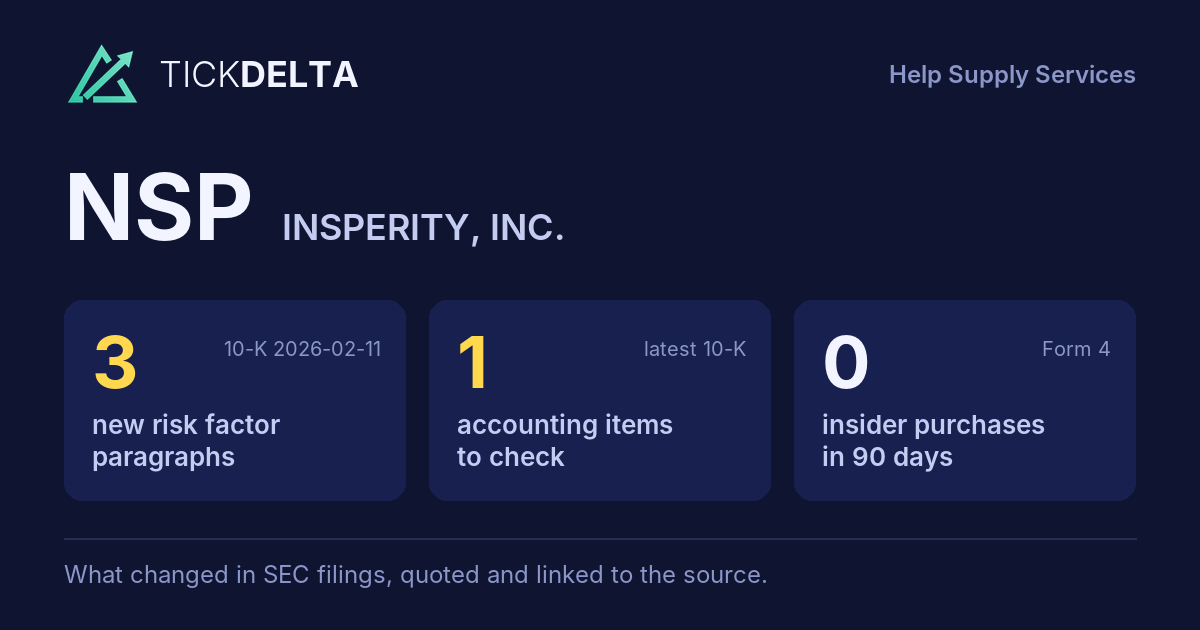
of the text changed · 9,463 words now · 3 new paragraphs, 5 gone
MD&A
16.2%
of the text changed · 7,154 words now · 7 new paragraphs, 2 gone
Accounting Policies
12.5%
of the text changed · 4,865 words now
10-K 0001000753-26-000011 (Feb 11, 2026) vs 10-K 0001000753-25-000008 (Feb 11, 2025) Not compared: Legal Proceedings.
Every paragraph, and how much of it changed
One bar per paragraph, in the order of the 10-K. Height and colour show the share of its words not in the closest paragraph a year earlier; the tallest bars are new paragraphs.
Risk Factors
93 paragraphs · 3 new · 43 reworded · 5 gone · 10-K Feb 11, 2026 against Feb 11, 2025
New paragraph
Reworded (5% of its words or more)
Same or nearly
Paragraph 5 · 42% changed
Every version of it
If the claims that we made for employee retention tax credits under COVID relief programs are unable to comply with or meet client expectations regarding certain COVID-19 relief programs, disallowed, our business, financial condition, and results of operations could be materially adversely affected.
Paragraph 9 · 42% changed
Every version of it
Paragraph 75 · 37% changed
Every version of it
third parties and with our proprietary systems for our PEO HR Solutions. We also continue to monitor and make changes to our proprietary system for our PEO HR Solutions for compliance and modernization. Any delays or failures resulting from network outages; planned upgrades, enhancements, or replacements of software, hardware, or other systems, including in connection with our HRScale offering or any updated for compliance and modernization of systems; or other data processing disruptions, even for a brief period of time, could result in our inability to timely process transactions. The speed with which we, or third-party vendors, are able to address significant cybersecurity incidents may be influenced by the cooperation of certain government agencies. We may also incur significant costs in the future to protect against damage or disruptions that could be caused by cybersecurity incidents. incidents or to address privacy violations. If such failures cause us to not meet client service expectations or to breach our obligations to our clients, we may lose existing clients, have difficulty attracting new clients, incur regulatory penalties or liability to our clients, or suffer other financial losses, which may have a material adverse effect on our business and financial condition.
Paragraph 64 · 36% changed
Every version of it
Paragraph 74 · 29% changed
Every version of it
Many of the HR services offerings we provide to clients are conducted through a technology infrastructure using both internally developed and purchased commercial software, a wide variety of hardware infrastructure technologies, and a multi-carrier wide area network. The processing of payroll, benefits and other transactions is dependent upon this complex infrastructure, some of which is provided by third-party vendors. We must manage all of these systems, and are dependent on third parties to manage the systems that we obtain from them, including any upgrades, replacements or enhancements, to ensure that they continue to support our services. For example, in connection with our strategic partnership with Workday, Inc. (“Workday”), HRScale offering, we are currently working to develop developed a joint solution that utilizes a proprietary instance of Workday’s HCM solution that is integrated with Workday that requires integrations with third parties and with our proprietary systems for our PEO HR Outsourcing Solutions. We also continue to monitor and make changes to our proprietary system for our PEO HR Outsourcing Solutions for compliance and modernization. Any delays or failures resulting from network outages; planned upgrades, enhancements, or replacements of software, hardware, or other systems, including in connection with our project with Workday or any updated for compliance and modernization of systems; or other data processing disruptions, even for a brief period of time, could result in our inability to timely process transactions. The speed with which we, or third-party vendors, are able to address significant cybersecurity incidents may be influenced by the cooperation of certain government agencies. We may also
Paragraph 63 · 29% changed
Every version of it
As a major employer, our operations are affected by numerous federal, state and local laws and regulations relating to labor, tax, benefit, insurance and employment matters. By entering into a co-employer relationship with employees assigned to work at client locations, we assume certain obligations and responsibilities of an employer under these laws. However, many of these current laws (such as the Act, ERISA, and some state insurance codes and employment tax laws) do not specifically address the obligations and responsibilities of non-traditional employers such as PEOs, and the definition of “employer” under these laws is not uniform despite the SBEA having provided clarification under federal employment tax laws for CPEOs. In addition, many of the states Some governmental programs and incentives designed to assist businesses and employees require us to make changes to our processes and systems in which we operate have not addressed the PEO relationship for purposes of compliance with applicable state laws governing the employer/employee relationship order to comply as an employer or PEO health insurance plans. Any adverse application of, or adverse legislative/regulatory response to, new or existing federal or state laws to the PEO relationship with enable our clients and our WSEEs to benefit from these programs. For example, during the COVID pandemic, the CARES Act allowed companies to defer certain payroll taxes, which were reflected in the payrolls we processed for those clients and required us to make certain changes, without clear regulatory guidance. If we are unable to meet these requirements or make these changes, we could be subject to governmental fines or penalties or we may not meet client companies expectations, any of which could have a material adverse effect on our business, financial condition or results of operations or financial condition. operations.
Paragraph 61 · 28% changed
Every version of it
Because we act as a co-employer, we may be subject to liability for violations of various employment, payroll, discrimination, privacy and biometric consent, and workplace safety laws despite these contractual provisions, even if we do not participate in such violations. AI-based technologies may also facilitate the ability of WSEEs, either on their own or with the assistance of counsel, to bring claims, which could impact the cost of the employment practices liability insurance that we provide or result in increased costs to us if we are also named in any such claims. Although the CSA generally requires the client to indemnify us for certain liabilities attributable to the client’s conduct, conduct and for the deductible under our employment practices liability insurance policy that we maintain on their behalf, we may not be able to collect on such a contractual indemnification claim and thus may be responsible for satisfying such liabilities to the extent that such liabilities are not covered or insured against under our insurance policies. In addition, WSEEs may These amounts could be deemed to be significant and could result in increased insurance premiums for us, any of which could impact our agents, which may subject us to liability for the actions business, financial condition or results of such WSEEs. operations.
Paragraph 54 · 46% changed
Every version of it
10-K Feb 11, 2025Increases in health insurance costs or our inability to secure replacement health insurance coverage on competitive terms could have a material adverse effect on our business, financial condition or results of operations.
10-K Feb 11, 2026
coverage limits continue to decrease we would have increased exposure with respect to costs and insurance claims, which could have a material adverse effect on our business and results of operations.
Paragraph 5 · 42% changed
Every version of it
10-K Feb 11, 2025
If we are unable to comply with or meet client expectations regarding certain COVID-19 relief programs, our business, financial condition, and results of operations could be materially adversely affected.
10-K Feb 11, 2026
If the claims that we made for employee retention tax credits under COVID relief programs are disallowed, our business, financial condition, and results of operations could be materially adversely affected.
Paragraph 9 · 42% changed
Every version of it
10-K Feb 11, 2025We use a U.S.-based global systemically important bank (or G-SIB) for our PEO operations, including our cash balances associated with that portion of our business. All of our cash deposits are held by Federal Deposit Insurance Corporation (“FDIC”) insured banks, which amounts exceed the FDIC insurance limits. Through various overnight “sweep account” programs, we also invest a significant portion of our cash balances in U.S. Treasury-based funds, which are invested through brokerage firms affiliated with the banks at which our deposits are held. The failure of a bank or related brokerage firm that we use, or events involving limited liquidity, non-performance or other adverse conditions in the financial or credit markets impacting financial institutions at which we maintain balances, or concerns or rumors about such events, may lead to disruptions in access to our cash balances, adversely impact our liquidity, including our ability to borrow under our credit facility, or limit our ability to process transactions related to our clients. In the event of a failure of a bank or other financial institution that holds our cash deposits, there can be no assurance that our deposits in excess of the FDIC or other comparable insurance limits will be recoverable or, even if ultimately recoverable, there may be significant delays in our ability to access those funds. Furthermore, bank failures, non-performance, or other adverse developments that affect financial institutions could impair the ability of one or more of the banks participating in our credit facility from honoring their commitments. Such events could have a material adverse effect on our financial condition or results of operations.
10-K Feb 11, 2026
the FDIC or other comparable insurance limits will be recoverable or, even if ultimately recoverable, there may be significant delays in our ability to access those funds. Furthermore, bank failures, non-performance, or other adverse developments that affect financial institutions could impair the ability of one or more of the banks participating in our credit facility from honoring their commitments. Such events could have a material adverse effect on our financial condition or results of operations.
Paragraph 75 · 37% changed
Every version of it
10-K Feb 11, 2025
incur significant costs in the future to protect against damage or disruptions that could be caused by cybersecurity incidents. If such failures cause us to not meet client service expectations or to breach our obligations to our clients, we may lose existing clients, have difficulty attracting new clients, incur regulatory penalties or liability to our clients, or suffer other financial losses, which may have a material adverse effect on our business and financial condition.
10-K Feb 11, 2026
third parties and with our proprietary systems for our PEO HR Solutions. We also continue to monitor and make changes to our proprietary system for our PEO HR Solutions for compliance and modernization. Any delays or failures resulting from network outages; planned upgrades, enhancements, or replacements of software, hardware, or other systems, including in connection with our HRScale offering or any updated for compliance and modernization of systems; or other data processing disruptions, even for a brief period of time, could result in our inability to timely process transactions. The speed with which we, or third-party vendors, are able to address significant cybersecurity incidents may be influenced by the cooperation of certain government agencies. We may also incur significant costs in the future to protect against damage or disruptions that could be caused by cybersecurity incidents or to address privacy violations. If such failures cause us to not meet client service expectations or to breach our obligations to our clients, we may lose existing clients, have difficulty attracting new clients, incur regulatory penalties or liability to our clients, or suffer other financial losses, which may have a material adverse effect on our business and financial condition.
Paragraph 64 · 36% changed
Every version of it
10-K Feb 11, 2025As a major employer, our operations are affected by numerous federal, state and local laws and regulations relating to labor, tax, benefit, insurance and employment matters. By entering into a co-employer relationship with employees assigned to work at client locations, we assume certain obligations and responsibilities of an employer under these laws. However, many of these current laws (such as the Act, ERISA, and some state insurance codes and employment tax laws) do not specifically address the obligations and responsibilities of non-traditional employers such as PEOs, and the definition of “employer” under these laws is not uniform despite the SBEA having provided clarification under federal employment tax laws for CPEOs. In addition, many of the states in which we operate have not addressed the PEO relationship for purposes of compliance with applicable state laws governing the employer/employee relationship or PEO health insurance plans. Any adverse application of, or adverse legislative/regulatory response to, new or existing federal or state laws to the PEO relationship with our WSEEs and client companies could have a material adverse effect on our results of operations or financial condition.
10-K Feb 11, 2026
In addition, many of the states in which we operate have not addressed the PEO relationship for purposes of compliance with applicable state laws governing the employer/employee relationship or PEO health insurance plans. Any adverse application of, or adverse legislative/regulatory response to, new or existing federal or state laws to the PEO relationship with our WSEEs and client companies could have a material adverse effect on our results of operations or financial condition.
Paragraph 74 · 29% changed
Every version of it
10-K Feb 11, 2025
Many of the HR services offerings we provide to clients are conducted through a technology infrastructure using both internally developed and purchased commercial software, a wide variety of hardware infrastructure technologies, and a multi-carrier wide area network. The processing of payroll, benefits and other transactions is dependent upon this complex infrastructure, some of which is provided by third-party vendors. We must manage all of these systems, and are dependent on third parties to manage the systems that we obtain from them, including any upgrades, replacements or enhancements, to ensure that they continue to support our services. For example, in connection with our strategic partnership with Workday, Inc. (“Workday”), we are currently working to develop a joint solution with Workday that requires integrations with third parties and with our proprietary systems for our PEO HR Outsourcing Solutions. We also continue to monitor and make changes to our proprietary system for our PEO HR Outsourcing Solutions for compliance and modernization. Any delays or failures resulting from network outages; planned upgrades, enhancements, or replacements of software, hardware, or other systems, including in connection with our project with Workday or any updated for compliance and modernization of systems; or other data processing disruptions, even for a brief period of time, could result in our inability to timely process transactions. The speed with which we, or third-party vendors, are able to address significant cybersecurity incidents may be influenced by the cooperation of certain government agencies. We may also
10-K Feb 11, 2026
Many of the HR services offerings we provide to clients are conducted through a technology infrastructure using both internally developed and purchased commercial software, a wide variety of hardware infrastructure technologies, and a multi-carrier wide area network. The processing of payroll, benefits and other transactions is dependent upon this complex infrastructure, some of which is provided by third-party vendors. We must manage all of these systems, and are dependent on third parties to manage the systems that we obtain from them, including any upgrades, replacements or enhancements, to ensure that they continue to support our services. For example, in connection with our HRScale offering, we developed a joint solution that utilizes a proprietary instance of Workday’s HCM solution that is integrated with
Paragraph 63 · 29% changed
Every version of it
10-K Feb 11, 2025
As a major employer, our operations are affected by numerous federal, state and local laws and regulations relating to labor, tax, benefit, insurance and employment matters. By entering into a co-employer relationship with employees assigned to work at client locations, we assume certain obligations and responsibilities of an employer under these laws. However, many of these current laws (such as the Act, ERISA, and some state insurance codes and employment tax laws) do not specifically address the obligations and responsibilities of non-traditional employers such as PEOs, and the definition of “employer” under these laws is not uniform despite the SBEA having provided clarification under federal employment tax laws for CPEOs. In addition, many of the states in which we operate have not addressed the PEO relationship for purposes of compliance with applicable state laws governing the employer/employee relationship or PEO health insurance plans. Any adverse application of, or adverse legislative/regulatory response to, new or existing federal or state laws to the PEO relationship with our WSEEs and client companies could have a material adverse effect on our results of operations or financial condition.
10-K Feb 11, 2026
As a major employer, our operations are affected by numerous federal, state and local laws and regulations relating to labor, tax, benefit, insurance and employment matters. By entering into a co-employer relationship with employees assigned to work at client locations, we assume certain obligations and responsibilities of an employer under these laws. However, many of these current laws (such as the Act, ERISA, and some state insurance codes and employment tax laws) do not specifically address the obligations and responsibilities of non-traditional employers such as PEOs, and the definition of “employer” under these laws is not uniform despite the SBEA having provided clarification under federal employment tax laws for CPEOs. Some governmental programs and incentives designed to assist businesses and employees require us to make changes to our processes and systems in order to comply as an employer or to enable our clients and our WSEEs to benefit from these programs. For example, during the COVID pandemic, the CARES Act allowed companies to defer certain payroll taxes, which were reflected in the payrolls we processed for those clients and required us to make certain changes, without clear regulatory guidance. If we are unable to meet these requirements or make these changes, we could be subject to governmental fines or penalties or we may not meet client expectations, any of which could have a material adverse effect on our business, financial condition or results of operations.
Paragraph 61 · 28% changed
Every version of it
10-K Feb 11, 2025
Because we act as a co-employer, we may be subject to liability for violations of various employment, payroll, discrimination, and workplace safety laws despite these contractual provisions, even if we do not participate in such violations. Although the CSA generally requires the client to indemnify us for certain liabilities attributable to the client’s conduct, we may not be able to collect on such a contractual indemnification claim and thus may be responsible for satisfying such liabilities to the extent that such liabilities are not covered or insured against under our insurance policies. In addition, WSEEs may be deemed to be our agents, which may subject us to liability for the actions of such WSEEs.
10-K Feb 11, 2026
Because we act as a co-employer, we may be subject to liability for violations of various employment, payroll, discrimination, privacy and biometric consent, and workplace safety laws despite these contractual provisions, even if we do not participate in such violations. AI-based technologies may also facilitate the ability of WSEEs, either on their own or with the assistance of counsel, to bring claims, which could impact the cost of the employment practices liability insurance that we provide or result in increased costs to us if we are also named in any such claims. Although the CSA generally requires the client to indemnify us for certain liabilities attributable to the client’s conduct and for the deductible under our employment practices liability insurance policy that we maintain on their behalf, we may not be able to collect on such a contractual indemnification claim and thus may be responsible for satisfying such liabilities to the extent that such liabilities are not covered or insured against under our insurance policies. These amounts could be significant and could result in increased insurance premiums for us, any of which could impact our business, financial condition or results of operations.
MD&A
155 paragraphs · 7 new · 47 reworded · 2 gone · 10-K Feb 11, 2026 against Feb 11, 2025
New paragraph
Reworded (5% of its words or more)
Same or nearly
Paragraph 10 · 49% changed
Paragraph 11 · 40% changed
Paragraph 154 · 37% changed
Paragraph 50 · 36% changed
Paragraph 112 · 35% changed
•General and administrative expenses for 2024 increased 27% 2025 decreased 9% to $224 $203 million, or $12 $4 per WSEE per month, compared to 2023. 2024. The increase decrease was primarily due to increased lower professional services fees, which includes resulting from the capitalization in 2025 of a portion of the expenses related to the implementation development of our Workday strategic partnership, software licensing HRScale solution. Additionally, we incurred lower travel and maintenance costs, training costs and amortization of SaaS implementation costs, partially offset by accelerated lease costs associated with the consolidation of sales offices in 2025 and software licensing and maintenance costs.
Paragraph 48 · 31% changed
Paragraph 128 · 30% changed
Bonus payroll cost varies from period to period, but has no direct impact to our ultimate workers’ compensation costs under the current program. We include these non-GAAP financial measures because we believe they are useful to investors in allowing for greater transparency related to the costs incurred under our current workers’ compensation program.
Paragraph 17 · 25% changed
•Operating expenses increased 14% decreased 3% in 2024 2025 to $935 $910 million, and included increases decreases in professional services, travel and event costs, and salary and wages, and the implementation of our Workday strategic partnership. wages. On a per WSEE per month basis, operating expenses increased decreased from $219 in 2023 to $253 in 2024. 2024 to $245 in 2025.
Paragraph 10 · 49% changed
10-K Feb 11, 2025In addition to our PEO HR Outsourcing Solutions, we offer a comprehensive traditional payroll and human capital management solution, known as our Workforce AccelerationTM solution, our traditional payroll solution. We also offer a number of other business performance solutions, including Recruiting Services, Employment Screening, Retirement Services, and Insurance Services. These other products or services generally are offered only with our other solutions.
10-K Feb 11, 2026
HRCore. We also offer a comprehensive traditional payroll and human capital management solution, known as Insperity HRCoreTM (formerly Workforce AccelerationTM), which we refer to as our “Traditional HR Solution” as discussed in Item 1. Business — Other Product and Services Offerings — Comprehensive Traditional Payroll and Human Capital Management Solution”.
Paragraph 11 · 40% changed
10-K Feb 11, 2025In addition to our PEO HR Outsourcing Solutions, we offer a comprehensive traditional payroll and human capital management solution, known as our Workforce AccelerationTM solution, our traditional payroll solution. We also offer a number of other business performance solutions, including Recruiting Services, Employment Screening, Retirement Services, and Insurance Services. These other products or services generally are offered only with our other solutions.
10-K Feb 11, 2026
We also offer a number of other business performance solutions, including Talent Acquisition Services, Retirement Services, Insurance Services, Contractor Management, and Perks+. These other products and services generally are offered only with our other solutions as discussed in Item 1. Business — Other Product and Services Offerings.
Paragraph 154 · 37% changed
10-K Feb 11, 2025Please read “—Critical Accounting Policies and Estimates—Benefits Costs” for a discussion of our accounting for health insurance costs.
10-K Feb 11, 2026
the future. For further information related to our health insurance costs, please read “—Critical Accounting Policies and Estimates—Benefits Costs.”
Paragraph 50 · 36% changed
10-K Feb 11, 2025Our financial responsibility with United is limited to the first $1 million of paid claims per claimant per year. Additionally, since the plan’s inception, under the terms of the contract, United establishes cash funding rates 90 days in advance of the beginning of a reporting quarter. If the Plan Costs for a reporting quarter are greater than the premiums paid and owed to United, a deficit in the plan would be incurred and we would accrue a liability for the excess costs on our Consolidated Balance Sheets. On the other hand, if the Plan Costs for the reporting quarter are less than the premiums paid and owed to United, a surplus in the plan would be incurred and we would record an asset for the excess premiums in our Consolidated Balance Sheets. The terms of the arrangement with United require us to maintain an accumulated cash surplus in the plan of $9 million, which is reported as long-term prepaid insurance. As of December 31, 2024, Plan Costs were more than the net premiums paid and owed to United by $5 million. As this amount is less than the agreed-upon $9 million surplus maintenance level, the $14 million difference is included in accrued health insurance costs, a current liability, in our Consolidated Balance Sheets. In addition, the premiums owed to United at December 31, 2024, were less than $1 million, which is also included in accrued health insurance costs, a current liability, on our Consolidated Balance Sheets.
10-K Feb 11, 2026
United require us to maintain an accumulated cash surplus in the program of $9 million, which is reported as long-term prepaid insurance. As of December 31, 2025, Program Costs were more than the net premiums paid and owed to United by $18 million, which is included in accrued health insurance costs, a current liability on our Consolidated Balance Sheets. In addition, the premiums owed to United at December 31, 2025, were $7 million, which is also included in accrued health insurance costs, a current liability, on our Consolidated Balance Sheets. Our benefits costs incurred included an increase of $11 million in 2025 and a decrease of $29 million in 2024 for changes in estimated run-off related to prior periods, net of Individual Claims Limit.
Paragraph 112 · 35% changed
10-K Feb 11, 2025
•General and administrative expenses for 2024 increased 27% to $224 million, or $12 per WSEE per month, compared to 2023. The increase was primarily due to increased professional services fees, which includes expenses related to the implementation of our Workday strategic partnership, software licensing and maintenance costs, and amortization of SaaS implementation costs.
10-K Feb 11, 2026
•General and administrative expenses for 2025 decreased 9% to $203 million, or $4 per WSEE per month, compared to 2024. The decrease was primarily due to lower professional services fees, resulting from the capitalization in 2025 of a portion of the expenses related to the development of our HRScale solution. Additionally, we incurred lower travel and training costs and amortization of SaaS implementation costs, partially offset by accelerated lease costs associated with the consolidation of sales offices in 2025 and software licensing and maintenance costs.
Paragraph 48 · 31% changed
10-K Feb 11, 2025Our financial responsibility with United is limited to the first $1 million of paid claims per claimant per year. Additionally, since the plan’s inception, under the terms of the contract, United establishes cash funding rates 90 days in advance of the beginning of a reporting quarter. If the Plan Costs for a reporting quarter are greater than the premiums paid and owed to United, a deficit in the plan would be incurred and we would accrue a liability for the excess costs on our Consolidated Balance Sheets. On the other hand, if the Plan Costs for the reporting quarter are less than the premiums paid and owed to United, a surplus in the plan would be incurred and we would record an asset for the excess premiums in our Consolidated Balance Sheets. The terms of the arrangement with United require us to maintain an accumulated cash surplus in the plan of $9 million, which is reported as long-term prepaid insurance. As of December 31, 2024, Plan Costs were more than the net premiums paid and owed to United by $5 million. As this amount is less than the agreed-upon $9 million surplus maintenance level, the $14 million difference is included in accrued health insurance costs, a current liability, in our Consolidated Balance Sheets. In addition, the premiums owed to United at December 31, 2024, were less than $1 million, which is also included in accrued health insurance costs, a current liability, on our Consolidated Balance Sheets.
10-K Feb 11, 2026
Since the program’s inception, under the terms of the contract, United establishes cash funding rates 90 days in advance of the beginning of a reporting quarter. If the Program Costs for a reporting quarter are greater than the premiums paid and owed to United, a deficit in the program would be incurred and we would accrue a liability for the excess costs on our Consolidated Balance Sheets. On the other hand, if the Program Costs for the reporting quarter are less than the premiums paid and owed to United, a surplus in the program would be incurred and we would record an asset for the excess premiums in our Consolidated Balance Sheets. The terms of the arrangement with
Paragraph 128 · 30% changed
10-K Feb 11, 2025
Bonus payroll cost varies from period to period, but has no direct impact to our ultimate workers’ compensation costs under the current program. We include these non-GAAP financial measures because we believe they are useful to investors in allowing for greater transparency related to the costs incurred under our current workers’ compensation program.
10-K Feb 11, 2026
Bonus payroll cost varies from period to period, but has no direct impact to our ultimate workers’ compensation costs under the current program.
Paragraph 17 · 25% changed
10-K Feb 11, 2025
•Operating expenses increased 14% in 2024 to $935 million, and included increases in travel and event costs, salary and wages, and the implementation of our Workday strategic partnership. On a per WSEE per month basis, operating expenses increased from $219 in 2023 to $253 in 2024.
10-K Feb 11, 2026
•Operating expenses decreased 3% in 2025 to $910 million, and included decreases in professional services, travel and event costs, and salary and wages. On a per WSEE per month basis, operating expenses decreased from $253 in 2024 to $245 in 2025.
A paragraph is matched with the one last year that shares the most of its words; under half in common makes it new. The paragraphs shown are the 8 reworded the most in each section.
The paragraph that changed most in each section
The redline
Marked against last year's 10-K: cut words struck through, new words highlighted.
Risk Factors207 words changed in this paragraph; it is 71% similar to last year's version.
We are subject to various laws, rules and regulations relating to the collection, use, transmission and security and privacy of personal and business information. Most states and the District of Columbia have enacted notification rules that may require notification to regulators, clients or employees in the event of a privacy breach. In addition, new laws and regulations governing data privacy and the unauthorized disclosure of confidential information pose increasingly complex compliance challenges and potentially elevate our costs. It is possible that these laws and regulations may be interpreted and applied in a manner that is inconsistent with our data practices. If so, in addition to the possibility of fines, this could result in an order requiring that we change our data practices, which could have a material adverse effect on our business. Complying with these various laws and regulations could cause us to incur substantial costs or require us to change our business practices in a manner adverse to our business. For example, we incurred additional costs and reallocated internal resources in order to comply with the requirements of the California Privacy Rights Act (“CPRA”), which amended the California Consumer Privacy Act of 2018 (“CCPA”) and became effective on January 1, 2023, which has required us to reallocate additional resources in order to manage compliance in light of the changes implemented by the CPRA. Other states have adopted or are currently contemplating additional privacy requirements. Some states have also adopted laws regarding the use of biometric data, which laws may be applicable to us or our clients that use timeclocks or other HR technology with biometric scanners. Also, in recent years, legislation that creates obligations with respect to the development and/or use of AI has been adopted or is under consideration in the U.S. at both the federal and state level. As a result, current or future laws (including product liability regimes), regulatory or self-regulatory requirements or ethical considerations, including our own published, guiding ethical principles regarding AI and machine learning, could restrict or impose burdensome and costly requirements on our ability to leverage data and/or these technologies in innovative ways. Generally, these laws do not address the coemployment co-employment relationship, which requires us to make determinations as to the requirements applicable to our WSEEs and our PEO HR Solutions clients. The future enactment of similar laws, rules or regulations, or an adverse determination as to the applicability of these laws, rules, or regulations to us, could have a material adverse impact on us through increased costs or restrictions on our businesses and noncompliance could result in regulatory penalties and significant liability. Additionally, any failure by us to comply with these laws and regulations, including as a result of a security or privacy breach, could result in significant penalties and liabilities for us.
Source: Item 1A, 10-K 0001000753-26-000011 vs Item 1A, 10-K 0001000753-25-000008
MD&A197 words changed in this paragraph; it is 40% similar to last year's version.
Source: Item 7, 10-K 0001000753-26-000011 vs Item 7, 10-K 0001000753-25-000008
Accounting Policies102 words changed in this paragraph; it is 78% similar to last year's version.
Approximately 86 85 % of our costs related to health insurance coverage are provided incurred under our policy with United. While the policy with United is a fully insured plan, as a result of certain contractual terms, we have accounted for this plan since its inception using a partially self-funded insurance accounting model. Effective January 1, 2020, under the amended agreement with United, we no longer have 2020 up through December 31, 2025, our financial responsibilities responsibility for a participant’s annual claim costs that exceed was limited to $1 million (“Individual Claims Limit”). Beginning January 1, 2026, we have the option to annually elect to limit our responsibility for each participant’s claim costs to $500,000, $750,000, or $1,000,000 per year, which we elect based on the cost of the limit and our estimate of the benefit of that level of limit. For 2026, we have elected to limit our financial responsibility with United to the first $500,000 of paid claims per claimant per year. Accordingly, we record the cost of the United plan, including an estimate of the incurred claims, taxes and administrative fees (collectively the “Plan “Program Costs”), as benefits expense, which is a component of direct costs, in our Consolidated Statements of Income. Operations. The estimated incurred but not reported claims are based upon: (1) the level of claims processed during each quarter; (2) estimated completion rates based upon recent claim development patterns under the plan; and (3) the number of participants in the plan, program, including both active and COBRA enrollees. Each reporting period, changes in the estimated ultimate costs resulting from claim trends, plan design and migration, participant demographics, and other factors are incorporated into the benefits costs, which requires a significant level of judgment.
Source: 10-K text, Note 1 – Accounting Policies, 10-K 0001000753-26-000011 vs 10-K text, Note 1 – Accounting Policies, 10-K 0001000753-25-000008
Sentences and paragraphs added, removed or reworded
Every change, by type
Sentences and paragraphs of NSP's Risk Factors and MD&A, 10-K Feb 11, 2026 against 10-K Feb 11, 2025. Each links to the text at sec.gov.
Quiet changes are sentences kept from last year with one to four words changed, at least one of them a hedge, a modal or a qualifier (may, could, will, not, significant, material…). A year or date rolling forward is not counted.
The full word list
adverse, adversely, all, although, anticipate, anticipates, any, approximately, believe, believes, can, cannot, certain, could, expect, expects, generally, however, if, intend, intends, largely, likely, many, material, materially, may, might, most, must, never, no, not, possible, primarily, probable, should, significant, significantly, some, substantial, substantially, unlikely, will, would
AddedRisk Factors
In addition, our growth is impacted by the hiring and termination of employees by our existing clients. Emerging technologies, including AI, may reduce the need for our clients to hire for certain roles or lead to automation of tasks previously performed by clients’ employees. As a result, our clients may hire fewer employees or replace existing positions with AI-driven solutions, which would impact the growth of our worksite employees. Such developments could adversely impact our business, financial condition, and results of operations.
Read it in 10-K Feb 11, 2026 at sec.gov
AddedRisk Factors
We also use a variety of tools to assist with our targeted digital marketing efforts, which is one of our principal means of identifying and engaging with prospective clients. Evolving and expanding privacy laws may limit our ability to attract new clients and our violation of these laws could subject us to litigation, fines and penalties, which could be substantial.
Read it in 10-K Feb 11, 2026 at sec.gov
AddedRisk Factors
Further, we increasingly rely on third-party hosted solutions as part of our operations. We have limited ability to ensure that these parties are maintaining adequate cybersecurity safeguards or that they are using our data, which could include personal information of WSEEs, in accordance with our contract and their privacy policy. In the event of a misappropriation of private WSEE information in possession of the third parties, we may be liable to the WSEEs and subject to governmental fines and penalties, any of which could be material, and we may be limited in our ability to seek indemnity or reimbursement from the third party.
Read it in 10-K Feb 11, 2026 at sec.gov
RemovedRisk Factors
RemovedRisk Factors
RemovedRisk Factors
RemovedRisk Factors
RemovedRisk Factors
Show the other 35
RewordedRisk Factors
If the claims that we made for employee retention tax credits under COVID relief programs are unable to comply with or meet client expectations regarding certain COVID-19 relief programs, disallowed, our business, financial condition, and results of operations could be materially adversely affected.
Read it in 10-K Feb 11, 2026 at sec.gov
RewordedRisk Factors
In the event of a failure of a bank or other financial institution that holds our cash deposits, there can be no assurance that our deposits in excess of the FDIC or other comparable insurance limits will be recoverable or, even if ultimately recoverable, there may be significant delays in our ability to access those funds.
Read it in 10-K Feb 11, 2026 at sec.gov
RewordedRisk Factors
RewordedRisk Factors
The strategic partnership and plans to develop a joint solution development of Insperity HRScale involve numerous risks, including that we may be unable to complete the development and implementation of the joint solution, Insperity HRScale, or that development and implementation of the joint solution Insperity HRScale may be more difficult, time-consuming, or costly than expected, including due to difficulties with integrations with third party vendors.
Read it in 10-K Feb 11, 2026 at sec.gov
RewordedRisk Factors
Under our current arrangement with Chubb for claims incurred on or before September 30, 2019, we have a financial responsibility to Chubb for the first $1 million layer of claims per occurrence and for claims over $1 million, up to a maximum aggregate amount of $6 million per policy year for claims that exceed the first $1 million.
Read it in 10-K Feb 11, 2026 at sec.gov
RewordedRisk Factors
These costs are further impacted by a number of factors, including coverage options elected by employees, macro-economic changes, proposed and enacted regulatory changes and changes, wide-spread health-related outbreaks. outbreaks, increased utilization of new pharmaceuticals, and the use of AI-based billing solutions by healthcare providers.
Read it in 10-K Feb 11, 2026 at sec.gov
RewordedRisk Factors
In addition, as if a larger portion of our client base falls within the middle market segment, we must also develop different technology and services to meet the more complex needs and demands of this key group. group, including by developing our new HRScale solution that is based on our proprietary Workday-based client tenant.
Read it in 10-K Feb 11, 2026 at sec.gov
RewordedRisk Factors
Although the CSA generally requires the client to indemnify us for certain liabilities attributable to the client’s conduct, conduct and for the deductible under our employment practices liability insurance policy that we maintain on their behalf, we may not be able to collect on such a contractual indemnification claim and thus may be responsible for satisfying such liabilities to the extent that such liabilities are not covered or insured against under our insurance policies.
Read it in 10-K Feb 11, 2026 at sec.gov
RewordedRisk Factors
RewordedRisk Factors
If we were to experience an unexpected large increase in the number or severity of claims, our workers’ compensation costs could increase, which could have a material adverse effect on our results of operations or financial condition.
Read it in 10-K Feb 11, 2026 at sec.gov
RewordedRisk Factors
The initiatives related to the strategic partnership, including the development partnership and implementation of the joint solution, Insperity HRScale, may divert the attention of our technology, service, compliance, marketing, sales, management, and other teams away from our existing business solutions, which could result in the loss of existing or prospective clients or fines, penalties, or other liabilities if our existing business solutions and compliance are disrupted.
Read it in 10-K Feb 11, 2026 at sec.gov
RewordedRisk Factors
The occurrence of one or more of these events could result in our failure to achieve anticipated growth or revenues, or require us to devote additional resources to the strategic partnership or the development of the joint solution, to Insperity HRScale, or to lose the investments made relating to the development of the joint solution, Insperity HRScale, any of which could result in a material adverse effect on our business, financial condition, and results of operations, as well as reputational damage that could negatively impact our sales and retention efforts.
Read it in 10-K Feb 11, 2026 at sec.gov
Quiet changesRisk Factors
All of our cash deposits are held by Federal Deposit Insurance Corporation (“FDIC”) insured banks, which amounts deposits may exceed the FDIC insurance limits.
Read it in 10-K Feb 11, 2026 at sec.gov
Quiet changesRisk Factors
In addition, some many of our systems and services rely upon third-party technology.
Read it in 10-K Feb 11, 2026 at sec.gov
AddedMD&A
Our long-term strategy is to provide the best small and medium-sized businesses in the United States with our specialized human resources service offerings and to leverage our buying power and expertise to provide additional valuable services to clients.
Read it in 10-K Feb 11, 2026 at sec.gov
AddedMD&A
Our comprehensive HR services offerings are provided through our Insperity® HR360 solution (formerly Workforce Optimization®), our Insperity® HR360 Select Edition solution (formerly Workforce SynchronizationTM), and our Insperity® HRScale solution (together, our “PEO HR Solutions”) which encompass a broad range of HR functions as discussed in Item 1. Business — Service Offerings — PEO HR Solutions.
Read it in 10-K Feb 11, 2026 at sec.gov
AddedMD&A
HR360. Insperity’s HR360 solution, our largest source of revenue, is offered to small and medium-sized businesses seeking a comprehensive people strategy. From payroll and employment administration, employee benefits, workers’ compensation, government compliance, performance management to training and development, our HR360 solution offers a full range of services empowering clients to achieve a sophisticated HR function. HR360 provides access to our web-based human capital management platform, Insperity PremierTM.
Read it in 10-K Feb 11, 2026 at sec.gov
AddedMD&A
HR360 Select Edition. Insperity’s HR360 Select Edition solution, which generally is offered only to our middle market client segment, is a lower cost offering with a typically longer commitment that includes the same compliance and administrative services as HR360 and allows those clients to select, for an additional fee, from the strategic HR products and services that are included with HR360. HR360 Select Edition provides access to our web-based human capital management platform, Insperity Premier.
Read it in 10-K Feb 11, 2026 at sec.gov
AddedMD&A
HRScale. Insperity’s HRScale solution is our newest service offering that we jointly developed through our strategic partnership with Workday, Inc. (“Workday”). Insperity’s HRScale solution is intended for growing and middle market companies and provides access to the advanced capabilities of Workday Human Capital Management (“HCM”). Our HRScale solution, which is priced higher than our HR360 offering, is designed to combine the HR expertise of our HR360 solution with the advanced capabilities of Workday HCM, with a focus on affordability, ease and speed of deployment, and agility as companies scale. Insperity’s HRScale solution is under development and we expect an initial group of clients to begin using our HRScale solution in the first quarter of 2026.
Read it in 10-K Feb 11, 2026 at sec.gov
AddedMD&A
Effective January 1, 2020 through December 31, 2025, our financial responsibility with United was limited to the first $1 million of paid claims per claimant per year. Beginning January 1, 2026, we have the option to annually elect to limit our responsibility for each participant’s claim costs to $500,000, $750,000, or $1,000,000 per year, which we elect based on the cost of the limit and our estimate of the benefit of that level of limit. For 2026, we have elected to limit our financial responsibility with United to the first $500,000 of paid claims per claimant per year.
Read it in 10-K Feb 11, 2026 at sec.gov
AddedMD&A
On July 4, 2025, H.R.1, which is known as the “One Big Beautiful Bill Act,” was signed into federal law. This law includes significant changes to federal tax law and other regulatory provisions that may impact us. ASC 740, “Income Taxes”, requires the effect of changes in tax rates and laws on deferred tax balances to be recognized in the period in which the legislation is enacted. We have evaluated the provisions of H.R.1 and the potential effects on our financial position, results of operations, and cash flows. Although there is no impact to our effective tax rate, we are accelerating tax deductions for unamortized software development costs.
Read it in 10-K Feb 11, 2026 at sec.gov
RemovedMD&A
RemovedMD&A
RewordedMD&A
We had $1.1 billion $660 million in cash, cash equivalents and marketable securities at December 31, 2024, 2025, of which approximately $390 $468 million was payable in early January 2025 2026 for withheld federal and state income taxes, employment taxes and other payroll deductions, approximately $91 million represented client prepayments that were payable in January 2025, and $440 million of funds we received in late December 2024 from the Internal Revenue Service related to employee retention tax credits claimed by our PEO clients under COVID relief programs that are expected to be distributed to clients in early 2025. deductions.
Read it in 10-K Feb 11, 2026 at sec.gov
RewordedMD&A
Amortization of SaaS implementation costs 5 11 6 83% (55)% 1 3 2 50% (67)% Workday SaaS licensing and implementation expenses 20 29 — — (31)% 5 8 — — (38)% All other general and administrative 178 184 171 8% (3)% 50 49 46 7% 2% Total general and administrative 203 224 177 27% (9)% 56 60 48 25% (7)% Depreciation and amortization 45 44 43 2% 12 11 9% 12 — Total operating expenses $ 910 $ 935 (3)% $ 818 14% 245 $ 253 $ 219 16% (3)%
Read it in 10-K Feb 11, 2026 at sec.gov
RewordedMD&A
RewordedMD&A
Year Ended December 31, per WSEE (in millions, except per WSEE) 2025 2024 2023 % Change 2025 2024 2023 % Change Salaries $ 518 $ 521 (1)% $ 461 13% 139 $ 141 $ 123 15% (1)% Stock-based compensation 61 53 15% 61 — 16 17 14 21% (6)% Commissions 45 47 47 — (4)% 12 13 13 — (8)% Advertising 38 37 3% 38 — 10 10 — General and administrative:
Read it in 10-K Feb 11, 2026 at sec.gov
RewordedMD&A
Our provision for income taxes differed from the U.S. statutory rate of 21% primarily due to state income taxes and taxes, non-deductible expenses, offset by and excess tax expense of $2 million associated with the vesting of equity compensation in 2025, and excess tax benefits associated with the vesting of equity compensation of less than $1 million, $5 million and less than $1 $5 million, in 2024, 2023 2024 and 2022, 2023, respectively.
Read it in 10-K Feb 11, 2026 at sec.gov
RewordedMD&A
RewordedMD&A
RewordedMD&A
Our net income (loss) and adjusted net income decreased 47% 108% and 36% 71% to $(7) million and $39 million in 2025, respectively, compared to $91 million and $135 million in 2024, respectively, compared to $171 million and $212 million in 2023, respectively.
Read it in 10-K Feb 11, 2026 at sec.gov
RewordedMD&A
Stock-based compensation 61 61 53 50 Tax effect (15) (17) (12) (13) Total non-GAAP adjustments, net 46 44 41 37 Adjusted net income $ 39 $ 135 $ 212 $ 216 Net income (loss) % change year over year (108) % (47) % (4) % 44 % Adjusted net income % change year over year (71) % (36) % (2) % 40 %
Read it in 10-K Feb 11, 2026 at sec.gov
RewordedMD&A
Other income (expense) was net income of $6 million, $9 million million, and $6 million in 2025, 2024 and 2023, respectively, and net expense of $5 million in 2022. respectively.
Read it in 10-K Feb 11, 2026 at sec.gov
RewordedMD&A
Revenues increased 1% 4% on a 3% increase in revenue per WSEE, partially offset by the 2% decrease in average WSEEs paid. WSEE.
Read it in 10-K Feb 11, 2026 at sec.gov
RewordedMD&A
We also offer a number of other business performance solutions, including Recruiting Talent Acquisition Services, Employment Screening, Retirement Services, Insurance Services, Contractor Management, and Insurance Services. Perks+.
Read it in 10-K Feb 11, 2026 at sec.gov
Sources
The two latest 10-Ks on EDGAR, section by section. Each change links to the text at sec.gov.
Also
New risk factors: paragraphs with nothing like them last year, quoted in full.
Work with it
Excel workbook · CSV. Google Sheet that stays up to date: paste =IMPORTDATA("https://tickdelta.com/company/NSP/export.csv") into a cell.