tickdelta
Sign in

Tickdelta is free for now. Sign up and get Pro free

← Screener

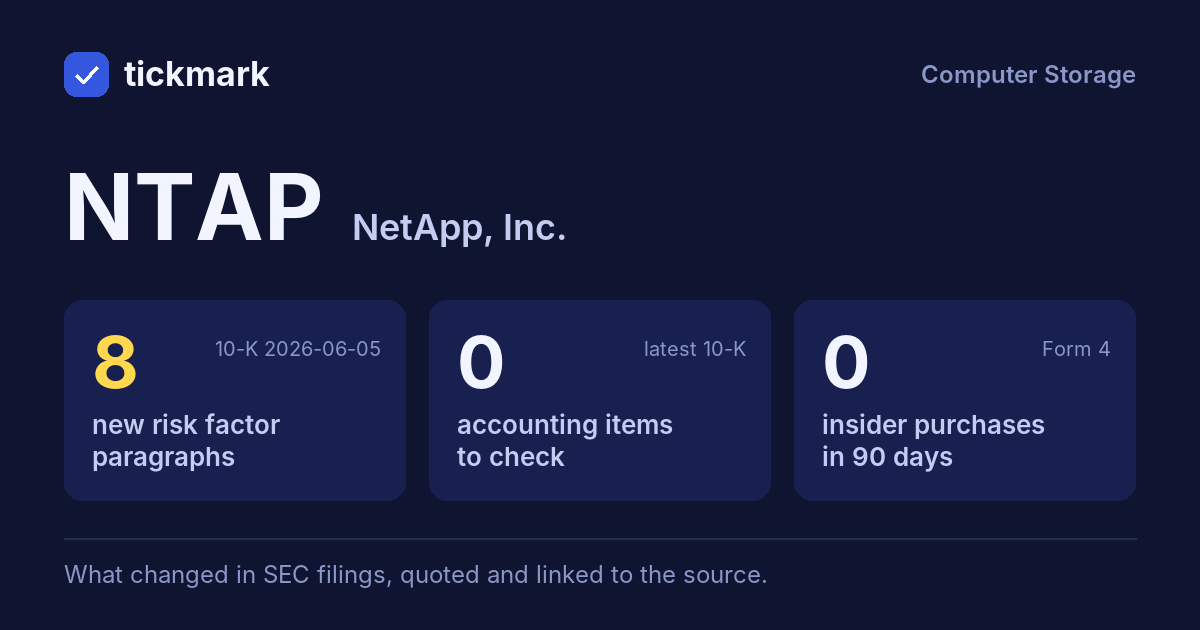
NTAPNetApp

Technology · Computer Storage · Nasdaq
Compare with peers → Embed

When the SEC's staff reviews a filing, it writes to the company with numbered questions, and the company answers each one in a letter. SEC publishes the exchange once the review is over, at least 20 business days later. Below: what the staff asked NTAP, and the company's answer to each question, quoted from the letters. A question is not an accusation; most reviews end with the company adding detail to its next filing.

Form 10-K for the Year Ended April 25, 2025

2026-03-09 to 2026-04-23 · 1 question · 1 letter from the SEC, 1 from the company
Review closed 2026-04-23
RevenueSegmentsResults discussion (MD&A)Liquidity and cashIncome taxesRisk factors
After reviewing your response to this letter, we may have additional comments. Risk Factors, page 21
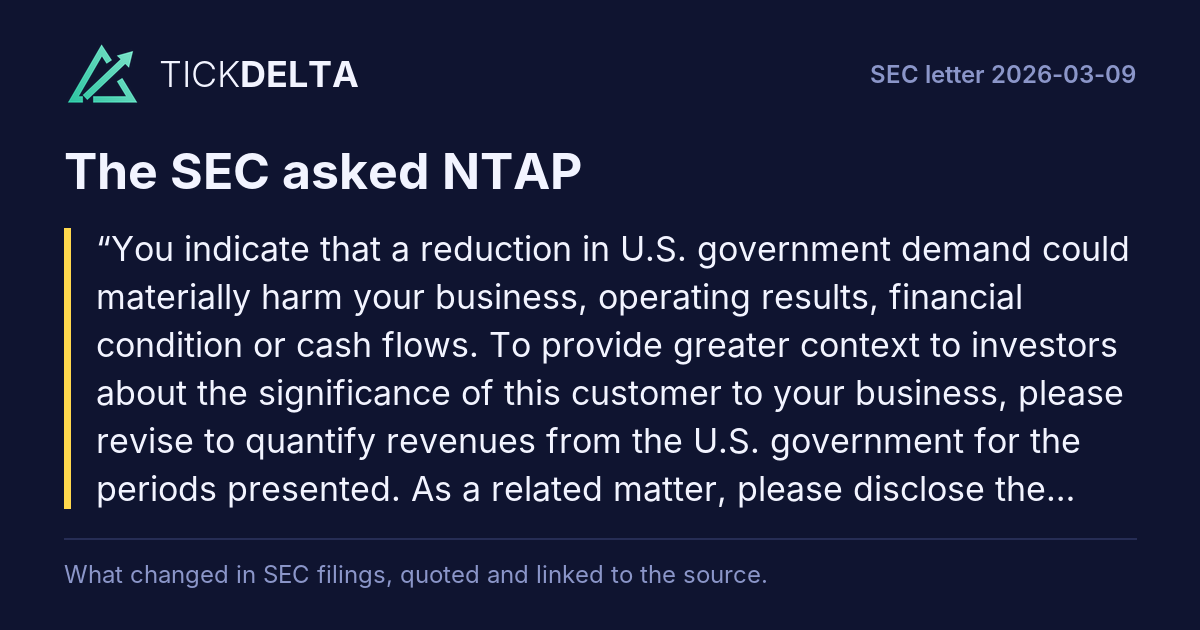
SEC asked
You indicate that a reduction in U.S. government demand could materially harm your business, operating results, financial condition or cash flows. To provide greater context to investors about the significance of this customer to your business, please revise to quantify revenues from the U.S. government for the periods presented. As a related matter, please disclose the amount of revenue attributed to U.S.
Rest of the question

public sector markets for each period presented as part of your Management's Discussion and Analysis on page 40. We note that you provided this information in Exhibit 99.1 to your Form 8-Ks filed on May 29, 2025 and February 26, 2026. Audited Financial Statements 15. Segment, Geographic, and Significant Customer Information, page 83 It appears that your Hybrid Cloud segment offers several subcategories of products including all-flash arrays and hybrid flash products. We note the similarities in your storage infrastructure products as outlined in your March 10, 2023 correspondence 2. to us. However, since that time, it appears that differences between your product offerings in the Hybrid Cloud segment have become more meaningful. For example, in your May 29, 2025 earnings call, management noted that all-flash products comprised approximately two-thirds of segment revenue and highlighted the importance of this product to customers seeking AI-ready infrastructure. In August 2025, management announced that you had taken the lead position in all-flash storage market share. Further, in your February 26, 2026 earnings call, management noted "unlike our all-flash-only competitors, we have a broad portfolio that includes hybrid flash arrays giving us the opportunity to better service price-sensitive workloads". Considering that on page 17 and in earnings calls, management cites product mix as a factor impacting gross margins and ultimately, earnings per share, please disclose revenues from external customers for each of your product lines with the Hybrid Cloud segment. Please also quantify changes in product mix as part of MD&A and provide more substantial analysis to explain how changes in product mix impacted your segment revenue and cost of sales for each period presented. Please supplementally show us what your revised disclosures will look like. Refer to ASC 280-10-50-40 and Item 303(b) of Regulation S-K. 3. Please refer to ASC 280-10-50-30(b) and revise to provide a reconciliation of your total segment gross profit to consolidated income before income taxes and discontinued operations. In addition, please tell us if there are any significant expense categories (for example, components of cost of product revenues, cost of support revenues, cost of professional and other services revenues, or cost of public cloud revenues) that are regularly provided to the CODM and included in segment gross profit. If so, please refer to ASC 280-10-50-26A and tell us how you considered the need to separately disclose these amounts. Management's Discussion and Analysis of Financial Condition and Results of Operations Discussion and Analysis of Result of Operations, page 27 4. In your February 26, 2026 earnings call, management discussed industry wide conditions such as inflationary pressures and a tight supply environment and indicated that they do not expect this to be a short-term issue. Please revise your MD&A to describe any known trends or uncertainties that had or are reasonably likely to have a material impact on operating results and disclose any actions planned or taken by management to address these challenges. For example, we note that you raised prices at the start of the fourth quarter. Refer to Items 303(b) and (c) of Regulation S-K.

NTAP answered
to the Staff’s comment, beginning with the Company’s Form 10-K for the fiscal year ending April 24, 2026 (“FY26”), the Company will revise its disclosure in the Risk Factors and Management's Discussion and Analysis to quantify revenues attributed to U.S. public sector markets for each period presented.

Audited Financial Statements

15. Segment, Geographic and Significant Customer Information, page 83 Read in the reply ↗
In its next report

First report after the company's reply of 2026-04-02: 10-K filed 2026-06-05 ↗, against the 10-K filed 2025-06-09 ↗.

Item 1A, Risk Factors: 49 paragraphs changed; the 3 closest in words to the question are below.

Reworded

As customers transition from older products to newer ones, delays or decisions to postpone the transition could lead to non-renewal reduce customer uptake of new offerings, impacting our ability to manage and forecast customer churn and expansion rates. Additionally, uncertainties related to the price-performance of new products compared to competitors, competitors’ responses to our new products, extended evaluation periods by customers, and our partners’ investment in selling our new products add to the inherent risks. If we do not manage these risks effectively, our business, operating results, financial condition, and cash flows could face significant adverse impacts. Furthermore, entering new or emerging markets will likely increase demands on our service and support operations and expose us to additional competition. We may struggle to provide competitive products, services and support for these market opportunities.

3 words cut, 3 added sec.gov ↗
Reworded

Our future growth relies on the successful development and introduction of new hardware and software products and services. The complexity of storage and data management software, subsystems and appliances, as well as the challenges in estimating the engineering effort required to produce new products and services, pose significant technical and quality control risks for these new products and services. If we encounter technological challenges, customer reluctance, or other obstacles that prevent us from developing, introducing and gaining market acceptance for new products and services, or if we fail to provide the expected level of product and support quality, our business, operating results, financial condition and cash flows could be materially and adversely affected. Introducing new products and features exposes us to additional financial and operational risks. These include risks, including the ability to forecast customer preferences and demand, managing production capacity to meet the demand for new products and services and avoid excessive inventories of older products and components, manage managing the transition from older products and solutions, and handle handling the impact of customer demand for new offerings versus those being replaced.

6 words cut, 4 added sec.gov ↗
Reworded

We continuously strive to make our cost structure and business processes more efficient, including by which includes relocating our business activities from higher-cost to lower-cost locations, outsourcing certain business processes and functions, and implementing changes to our business information systems. These efforts require significant investment of financial and human resources and substantial changes to our current operations. For example, in fiscal 2025, we continued our implementation of continue to implement certain new business information systems, including which included implementing the final phase of a new enterprise resource planning (ERP) system in the third quarter of fiscal 2026 to enhance and standardize our processes, improve oversight, and better serve our customers. However, any disruption Disruptions during this transition could have impacted and may continue to impact our ability to send efficiently process customer orders and track issue invoices, and may impact our ability to process vendor payments, pay employees, fulfill contractual obligations, report financial results, maintain effective internal controls, or operate our business effectively.

17 words cut, 56 added sec.gov ↗

Paragraphs where only numbers, dates or period words changed are not shown. Cut words struck through, new words highlighted and underlined.
Also in this review: closing letter, 2026-04-23
Form 10-K for the Fiscal Year Ended April 29, 2022

2023-01-23 to 2023-04-10 · 2 questions · 2 letters from the SEC, 2 from the company
Review closed 2023-04-10
RevenueSegmentsResults discussion (MD&A)
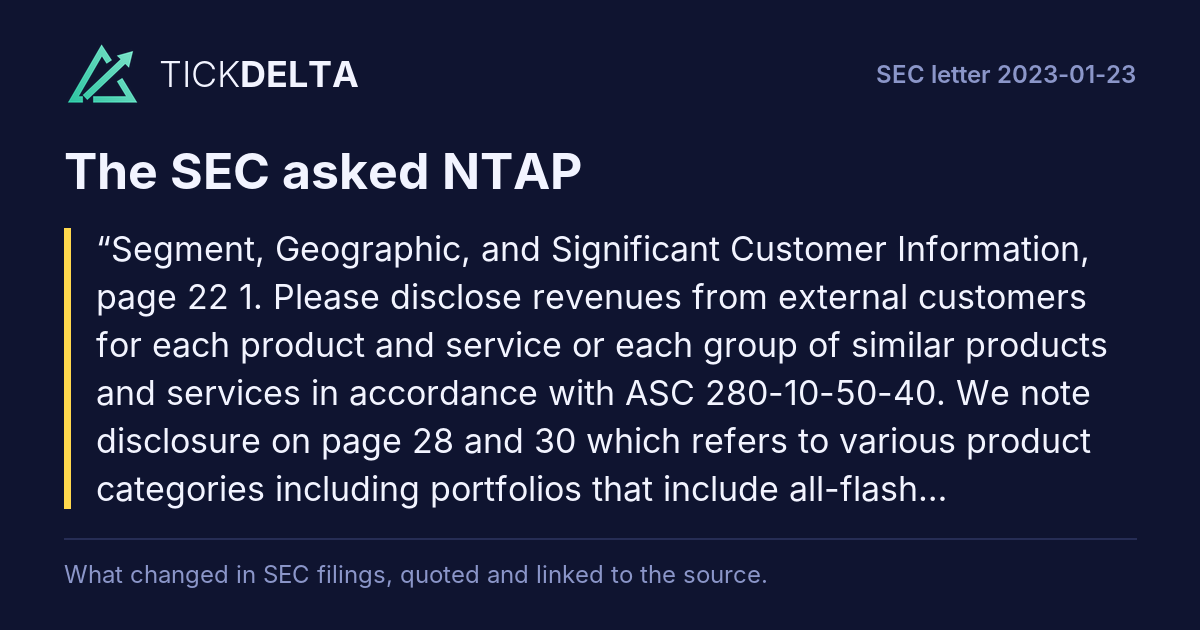
SEC asked
Segment, Geographic, and Significant Customer Information, page 22 1. Please disclose revenues from external customers for each product and service or each group of similar products and services in accordance with ASC 280-10-50-40. We note disclosure on page 28 and 30 which refers to various product categories including portfolios that include all-flash, hybrid-flash, and object storage systems.
NTAP answered
The Company respectfully acknowledges the

Staff’s comment and advises the Staff of the following. In connection with the preparation of our segment financial statement disclosures, we considered ASC-280-10-50-40, which requires disclosure of “revenues from external customers of each product and service or each group of similar products and services unless it is impracticable to do so.” As the guidance does not provide a definition of “similar,” we have relied on an analysis of the facts and circumstances in each of our segments to determine whether the respective products and services
Rest of the answer

revenues in those segments should be combined. In connection with this analysis, we concluded that the revenue line items in our existing reportable segments disclosure reflect appropriate groupings for the purposes of ASC 280-10-50-40. In reaching this conclusion, we analyzed the criteria outlined in ASC 280-10-50-11, and determined that, for the product revenues grouped and services revenues grouped in each segment, the nature of the products or services, the nature of their production processes, the type and class of customers for each, and the methods used to distribute the products and provide the services were similar and therefore should be grouped. For example, all Hybrid Cloud segment products, including all-flash, hybrid-flash and object storage, are storage systems that are regularly sold to customers across the same industries, and are subject to similar manufacturing and research and development processes, sales efforts, and distribution methods. Based on our analysis, we concluded that our segment disclosures provide investors meaningful information about groups of similar products and services in accordance with ASC 280-10-50-40.

* * * * *

We hope that you will find the foregoing responsive to the Staff’s comments. If you have any further questions or comments, please direct those to me at (408) 822-4599 or mike.berry@netapp.com. Thank you for your assistance.

Read in the reply ↗
SEC asked
Segment, Geographic, and Significant Customer Information, page 22 1. We note your response to our prior comment one. However, we also note that your business section and MD&A both have qualitative discussions as to the different subcategories of products.
Rest of the question

In addition, on page 30 you state "support revenues increased in the second quarter and first six months of fiscal 2023 compared to the corresponding periods of the prior year, primarily due to growth in sales of all-flash systems (which carry a higher support dollar content than our other products)." Furthermore, you highlight allflash array business growth of 2% in your Earnings Slides and Earnings Summary. Given your own disaggregation of revenue streams, please further clarify why you believe these product lines are similar. Your analysis should be detailed and discuss what makes these product lines similar as well as what makes them different.

NTAP answered
The Company respectfully acknowledges the Staff’s comment. We included a qualitative discussion of our subcategories of products in the business section and MD&A, as we believe this information helps investors and other readers obtain a general understanding of our products, including the types of workloads each product subcategory is best suited to address. These descriptions may also be helpful to investors and other readers in allowing them to compare our products to those of competitors.
Rest of the answer

Despite this qualitative discussion, we believe our subcategories of products to be similar in accordance with ASC 280-10-50-40, based on our analysis below.

As stated in the business section of our Annual Report on Form 10-K for the fiscal year ended April 29, 2022

(FY’22), the primary subcategories of our storage infrastructure products are (i) NetApp All-Flash FAS (AFF) series, which are all-flash array products

(“AFF”), (ii) NetApp Fabric Attached Storage (FAS) series, which are hybrid flash products (“FAS”), (iii) NetApp StorageGRID, which are object storage systems, (iv) NetApp E/EF series, (v) NetApp SolidFire and

(vi) NetApp FlexPod.

Most of our all-flash array product revenues are derived from the sale of our AFF products, while most of our hybrid flash product revenues are derived from the sale of FAS products. For FY’22 and the first nine months of the fiscal year ending April 28, 2023 (FY’23), over 85% of our total product revenues line item was generated from the sale of AFF products and FAS products. Accordingly, though we consider all our products to be similar in accordance with ASC

280-10-50-40, for simplicity, we have focused our detailed analysis on our AFF and FAS products.

1)

Nature of the products

Our AFF products and FAS products are similar in nature in the following ways:

•

Both AFF products and FAS products are configured storage solutions, comprised of hardware and operating system software, which are both fundamentally designed to fulfill customer data storage and data management needs. (International Data Corporation, a global publisher of market research and analysis, includes both all flash products and hybrid flash products in the same market, i.e. the enterprise external storage systems market.)

The storage system hardware for both AFF and FAS products is comprised of substantially the same types of hardware components. Specifically, all our AFF products and FAS products are both comprised of a chassis, controllers, drive shelves, storage (i.e., comprising hard disk drives (“HDDs”), solid state drives (“SSDs”), or a combination of HDDs and SSDs), switches and other hardware components.

Both AFF products and FAS products leverage the same proprietary NetApp ONTAP data management operating system software, which is essential to their functionality, to deliver customers the data management capabilities of the storage solution.

Our AFF products contain storage comprised of SSDs (also referred to as flash drives), while our FAS products contain storage comprised of both

SSDs and HDDs, or in certain cases only HDDs. SSDs have been, and currently are, more expensive than HDDs, and accordingly, we incur a higher cost to manufacture AFF products than FAS products, and we typically sell AFF products at higher prices than FAS products. The inclusion of only SSDs in our AFF products makes them preferred for managing data workload types where low latency performance (i.e., ability to process data with minimal delay) is important. FAS products are designed to provide a balance of performance and capacity, and their lower price make them preferred for managing workload types where low latency is not as important. Note, while both AFF products and FAS products use the exact same ONTAP operating system software, AFF products leverage certain ONTAP software features and functionalities to a greater extent than FAS products, which supports their ability to address more demanding data management activities with higher levels of performance and efficiency.

Importantly, AFF products and FAS products are designed to be compatible, which is supported by their use of the same ONTAP operating system software. Specifically, AFF and FAS products can be clustered together in different combinations to allow customers to run and manage mixed workloads on the same storage infrastructure.

Given that both AFF products and FAS products are storage solutions used for the same fundamental purpose (i.e. data storage and data management), are comprised of substantially the same types of hardware components, leverage the same operating system software, and are designed to work together, we consider them to be similar in nature. We believe these key similarities outweigh the differences related to latency performance and the extent to which certain ONTAP features and functionalities are leveraged.

2)

Nature of the production processes for the products

We do not manufacture any of our storage products at NetApp-owned or operated facilities, but rather outsource manufacturing to a limited number of third-party contract manufacturers. AFF products and FAS products are manufactured via the same manufacturing process (which consists of assembling the various hardware components of the storage infrastructure product and loading the ONTAP software onto the product), by the same contract manufacturers (i.e. each contract manufacturer we use supports the production of both product subcategories).

As noted above, both AFF products and FAS products run on the same ONTAP operating system software, which was developed by, and continues to be enhanced by, a single team of NetApp software engineers.

Based on the factors above, we consider the nature of the production process for our AFF products and FAS products to be the same.

3)

The type and class of customers for the products

As noted above, AFF products are designed for more demanding workloads, while FAS products are generally appropriate for less-demanding ones.

While this distinction may mean certain customer types have a greater percentage of workloads better suited to either AFF products or FAS products, the vast majority of our customers, across all industries and geographies, manage a variety of different types of data and related workloads in running their businesses. Accordingly, both AFF products and FAS products, rather than just one or the other, are viable storage solutions for most of our customers, as evidenced by our sales trends.

During FY’22 and the first nine months of FY’23, the majority of individual customers who purchased our AFF or FAS storage infrastructure products purchased both AFF products and FAS products (as opposed to just one subcategory), including almost all of our largest customers.

In addition, while there is variation in the relative product subcategory sales split across customers in different industries (e.g., sales to customers in certain industries are more heavily weighted to AFF, while sales to customers in other industries are more evenly split between AFF and FAS), during FY’22 and the first nine months of FY’23, we have made sales of both AFF products and FAS products (as opposed to only one subcategory) to customers in each major industry, including: Reseller and Integrator, Education, Energy, Entertainment and Media, Financial Services,

Healthcare, Technology, Internet, Life Sciences, Manufacturing, Professional Services, Retail and Wholesale, Telecommunications, Transportation and Logistics, and Government.

Based on the factors above, we consider the customer bases for our AFF products and FAS products to be similar.

4)

The methods used to distribute the products

The methods used to distribute both AFF products and FAS products are the same. Hardware systems for both product lines are generally shipped directly to the end customer from our third-party contract manufacturers. The ONTAP operating system software used by both AFF products and FAS products is included on the hardware systems shipped.

Both AFF products and FAS products are sold both 1) directly to end customers and 2) indirectly through channel partners, including distributors, value-added resellers, and system integrators. NetApp also maintains a global salesforce, that reports under one sales leader, that is responsible for selling both AFF products and FAS products.

Based on the factors above, we consider the methods used to distribute our AFF and FAS products to be the same.

5)

Nature of the regulatory environment

The nature of the regulatory environment is the same for both our AFF products and FAS products. For instance, the various laws and regulations that govern the manufacturing, sourcing, distribution and use of our products as referenced in the “Risk Factors” section of our Annual Report on Form 10-K apply to both AFF products and FAS products, and similarly both subcategories of products are subject to various environmental laws and local regulations relating to carbon emissions, the use and discharge of hazardous materials, the use of certain minerals originating from identified conflict zones, and other requirements.

Conclusion regarding similarity of products

Based on all the factors above, we consider our AFF products and FAS products to be similar. We also consider our other more minor products to be similar to our AFF and FAS products, on the basis that most of the characteristics described above also apply to such products. We therefore believe that the single product revenues line item in our existing reportable segments disclosure reflects the appropriate grouping of our products in accordance with ASC 280-10-50-40.

Support

We sell support contracts for our products, and consider all support contracts to be similar, regardless of the subcategory of product to which they relate. Consistent with product revenues, for FY’22 and the first nine months of FY’23, over 85% of our total support revenues line item was derived from support contracts related to AFF products and FAS products. Therefore, for simplicity, we have focused our detailed analysis below on support contracts pertaining AFF products and to FAS products.

Support contracts for AFF products and FAS products provide customers with remote technical support for the product, replacement parts delivery services, and certain other support-related services. Customers have the option to buy several different levels of support contracts, with higher level contracts generally providing faster technical support response times and faster parts replacement than more basic contracts.

Any level of support contract may be purchased by a customer for any of our AFF products or FAS products. For a particular-level support contract, the nature of the contractual support services are the same regardless of whether the contract pertains to an AFF product or FAS product. Additionally, the support services are delivered in the same manner (e.g., via technical support phone calls, physical shipment of replacement parts), and by the same NetApp personnel, regardless of the subcategory of product. Further, since support contract sales are driven by the sales of the respective products to which they relate, consistent with our analysis in the Products section above, the support contracts for both AFF products and FAS products have similar customer bases. They are also both sold by the same global salesforce. As noted above, we generally sell our AFF products at a higher price than our FAS products, and accordingly the support dollars associated with AFF products are typically higher, given we price support based on product list price.

Conclusion regarding similarity of support

Based on all the factors above, we consider our support contracts related to AFF products and to FAS products to be similar. The similarities outlined above are also substantially consistent for support contracts related to our other more minor products. We therefore believe that the single support revenue line item in our existing reportable segment disclosure reflects an appropriate grouping of support services in accordance with ASC 280-10-50-40.

Other Considerations

We considered your comment about our disclosure of all flash array business annual run rate in our Earnings Slides and Earnings Summary. As defined in those materials, the all-flash net revenue run rate we reference is meant to be a forward-looking indicator of revenue and is computed as our all-flash array product revenues (mostly derived from AFF products) plus associated services (primarily support) revenues in a particular quarter multiplied by four. We introduced this run rate measure several years ago as we believed it may assist investors with evaluating our AFF revenue prospects as compared to certain competitors that, unlike NetApp, only sell all-flash storage systems. While we believe this measure and growth rate may aid investors in this specific instance, we continue to consider our AFF products to be similar to our FAS and other products (and consider all our support contracts to be similar) in accordance with ASC 280-10-50-40, based on our analysis above.

* * * * *

We hope that you will find the foregoing responsive to the Staff’s comments. If you have any further questions or comments, please direct those to me at (408) 822-4599 or mike.berry@netapp.com. Thank you for your assistance.

Read in the reply ↗

Also in this review: closing letter, 2023-04-10

From the SEC's correspondence on EDGAR: staff letters (form UPLOAD) and company letters (form CORRESP), 8 letters filed since 2023-01-23. Questions and answers are matched by their numbers; topics come from words in each question. The reports are compared word for word (same form, before the first SEC letter against the first report after the company's reply). No AI.

Next in Owners and insiders Insider trades →

Work on NTAP in a spreadsheet: Excel workbook (a sheet per section, ten years by column, charts, links to the filings) · CSV. For a Google Sheet that stays up to date, paste =IMPORTDATA("https://tickdelta.com/company/NTAP/export.csv") into a cell.