Paragraph 177 · 50% changed
Every version of it
Screener
/
SEC EDGAR
/CIK 0001078075
/10-K filed May 14, 2026, compared with May 15, 2025
/Numbers from the XBRL of the 10-Ks
Nasdaq
Technology · IT Services
Netscout Systems Inc NTCT
The 10-K against last year's
167 changes: 38 added, 31 removed, 93 reworded, 5 quiet changes
10-K May 14, 2026 vs May 15, 2025
Risk Factors
26.6%
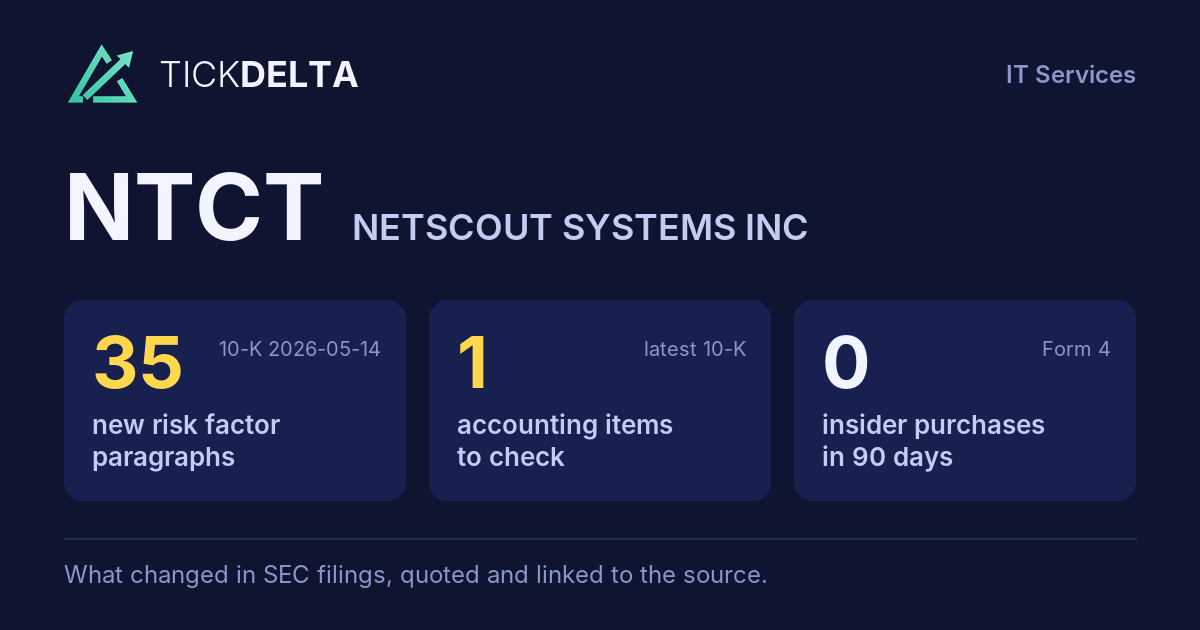
of the text changed · 13,148 words now · 35 new paragraphs, 9 gone
MD&A
40.7%
of the text changed · 6,639 words now · 3 new paragraphs, 22 gone
Accounting Policies
27.3%
of the text changed · 3,053 words now
10-K 0001078075-26-000050 (May 14, 2026) vs 10-K 0001628280-25-025982 (May 15, 2025) Not compared: Legal Proceedings.
Every paragraph, and how much of it changed
One bar per paragraph, in the order of the 10-K. Height and colour show the share of its words not in the closest paragraph a year earlier; the tallest bars are new paragraphs.
Risk Factors
188 paragraphs · 35 new · 84 reworded · 9 gone · 10-K May 14, 2026 against May 15, 2025
New paragraph
Reworded (5% of its words or more)
Same or nearly
Paragraph 99 · 48% changed
Every version of it
We have been and may continue to be subject to claims by others, whether valid or not, that our products infringe on their intellectual property rights, patents, copyrights, or trademarks. Further, intellectual property issues, such as ownership, copyright, and patentability, have not been fully settled with respect to AI technology. These claims, whether valid Inventions or not, could require us works of authorship created through the use of AI technology may be based or rely on, or contain, materials that were used in the training of such technologies and which are subject to spend significant sums in litigation, pay damages or royalties, delay product shipments, reengineer our products, rename our products and rebuild name recognition or acquire licenses to such third-party intellectual property. We may not be able to secure any required licenses on commercially reasonable terms or secure them at all, property, which could force further limit our customers ability to stop using our products, or in the case of resellers and others, stop selling our products. In some instances, we have defended against specious patent infringement claims by non-practicing or patent assertion entities, which ultimately achieved successful outcomes. In some cases, we have agreed to contract terms that indemnify our customers and partners if our products or technology infringe or misappropriate third party obtain intellectual property rights; therefore, we could become involved protection in litigation such inventions or works of authorship.
Paragraph 92 · 44% changed
Every version of it
We face risks related to epidemics, pandemics, public health crises, natural disasters, acts of war or terrorism, and other outbreaks significant business continuity events that could disrupt our operations and the operations of communicable diseases that adversely affect the commercial activity, economies, financial markets, and communities in which we and our customers, suppliers and other business partners partners. Such events may impair or prevent normal business activities for uncertain periods of time and could adversely affect commercial activity, supply chains, financial markets and the communities in which we operate. An epidemic, pandemic, or other outbreak of communicable diseases poses the risk that we, our
Paragraph 68 · 43% changed
Every version of it
Paragraph 111 · 36% changed
Every version of it
We operate in global markets where there is intense competition for experienced personnel. We depend on our ability to identify, recruit, hire, train, develop and retain qualified and effective professionals and to attract and retain talent needed to execute our business strategy. Our future success depends in large part upon our ability to attract, train, motivate and retain highly skilled employees, particularly executives, sales and marketing personnel, software engineers, and technical support personnel. The complexity of our products, software systems and services require highly trained professionals. The labor market for these individuals has historically been very competitive due to the limited number of people available with the necessary technical skills and understanding. If we are unable to attract and retain the highly skilled technical personnel that are integral to our sales, marketing, product development and technical support teams, the rate at which we can generate sales and develop new products or product enhancements may be limited. This inability could have a material and adverse impact on our business, operating results, and financial condition.
Paragraph 135 · 34% changed
Every version of it
Paragraph 44 · 34% changed
Every version of it
We have experienced cyber incidents in the past, and we expect to continue to face such risks that could cause us to experience cyber incidents in the future. We and the third parties with whom we work are have been, and continue to be, subject to a variety of evolving threats, including but not limited to social-engineering attacks (including phishing attacks), malicious code (such as viruses and worms), malware (including advanced persistent threat intrusions), denial-of-service attacks, credential stuffing, credential harvesting, personnel misconduct or human error, ransomware attacks, supply-chain attacks, software bugs, server malfunctions, software or hardware failures, loss of data or other IT assets, telecommunications failures, and other similar threats, including attacks enhanced or facilitated through the use of AI, such as AI-enabled social engineering attacks. Severe ransomware attacks are also prevalent and could lead to significant interruptions in our operations, ability to provide our products or services, loss of sensitive data and income, reputational harm, and diversion of funds for us and our customers.
Paragraph 20 · 30% changed
Every version of it
Paragraph 177 · 50% changed
Every version of it
10-K May 15, 2025this provision requires management's attention and expense. Management's assessment of our internal control over financial reporting may or may not identify weaknesses that need to be addressed in our internal control system. If we are unable to conclude that our internal control over financial reporting is effective, investors could lose confidence in our reported financial information which could have an adverse effect on the market price of our stock or impact our borrowing ability. In addition, changes in operating conditions and changes in compliance with policies and procedures currently in place may result in inadequate disclosure controls and procedures and internal control over financial reporting in the future.
10-K May 14, 2026
Under Section 404 of the Sarbanes-Oxley Act, management is required to evaluate and determine the effectiveness of our internal control over financial reporting, which requires significant management attention and resources. As our business, operations, systems and regulatory requirements evolve, we may be required to modify or enhance our disclosure controls and procedures and internal control over financial reporting to address new or increased complexity. If we are unable to adapt our controls to such changes in the future, or if control deficiencies arise that are not adequately remediated, investor confidence in our reported financial information could decline, which could negatively impact the market price of our stock or our ability to access capital.
Paragraph 99 · 48% changed
Every version of it
10-K May 15, 2025
We have and may continue to be subject to claims by others, whether valid or not, that our products infringe on their intellectual property rights, patents, copyrights, or trademarks. Further, intellectual property issues, such as ownership, copyright, and patentability, have not been fully settled with respect to AI technology. These claims, whether valid or not, could require us to spend significant sums in litigation, pay damages or royalties, delay product shipments, reengineer our products, rename our products and rebuild name recognition or acquire licenses to such third-party intellectual property. We may not be able to secure any required licenses on commercially reasonable terms or secure them at all, which could force our customers to stop using our products, or in the case of resellers and others, stop selling our products. In some instances, we have defended against specious patent infringement claims by non-practicing or patent assertion entities, which ultimately achieved successful outcomes. In some cases, we have agreed to contract terms that indemnify our customers and partners if our products or technology infringe or misappropriate third party intellectual property rights; therefore, we could become involved in litigation
10-K May 14, 2026
We have been and may continue to be subject to claims by others, whether valid or not, that our products infringe on their intellectual property rights, patents, copyrights, or trademarks. Further, intellectual property issues, such as ownership, copyright, and patentability, have not been fully settled with respect to AI technology. Inventions or works of authorship created through the use of AI technology may be based or rely on, or contain, materials that were used in the training of such technologies and which are subject to third-party intellectual property, which could further limit our ability to obtain intellectual property protection in such inventions or works of authorship.
Paragraph 92 · 44% changed
Every version of it
10-K May 15, 2025
We face risks related to epidemics, pandemics, and other outbreaks of communicable diseases that adversely affect the commercial activity, economies, financial markets, and communities in which we and our customers, suppliers and other business partners operate. An epidemic, pandemic, or other outbreak of communicable diseases poses the risk that we, our
10-K May 14, 2026
We face risks related to epidemics, pandemics, public health crises, natural disasters, acts of war or terrorism, and other significant business continuity events that could disrupt our operations and the operations of our customers, suppliers and other business partners. Such events may impair or prevent normal business activities for uncertain periods of time and could adversely affect commercial activity, supply chains, financial markets and the communities in which we operate.
Paragraph 68 · 43% changed
Every version of it
10-K May 15, 2025Specific components that are necessary for the hardware assembly of our instruments are obtained from separate sole source suppliers or a limited group of suppliers, including some with operations in locations with geopolitical uncertainty. These components include our network interface cards and proprietary hardware. Our reliance on sole or limited suppliers involves several risks, a lack of control over the manufacturing process and inventory management, potential inability to obtain an adequate supply of required components, and the inability to exercise control over pricing, quality and timely delivery of components. For most of our products, we do not have the internal manufacturing capabilities to meet our customers' demands so we rely on third parties to supplement our capabilities. It is our practice to mitigate these risks by partnering with key suppliers, including distributors, to establish a variety of supply continuity practices. These practices may include, among other approaches, establishing buffer supply requiring suppliers to maintain adequate stocks of materials and use-based and kanban programs to set supply thresholds. We also maintain escrow arrangements for certain technologies. Where possible, we use widely available off-the-shelf hardware and work with large suppliers with multiple factories in diverse geographies. However, failure of supply, including because of a public health crisis, geopolitical conflicts, terrorism or war, tariffs and associated trade wars, sanctions or embargoes, or failure to execute effectively on any of our risk mitigation practices could result in our inability to obtain adequate supply or deliveries or to ship our products on a timely basis or at all. Moreover, if we are unable to continue to acquire from these suppliers on acceptable terms or should any of these suppliers cease to supply us with components for any reason, we may not be able to identify and integrate an alternative source of supply in a timely fashion or at the same costs. Any transition to one or more alternate manufacturers could result in significant delays, operational problems, and increased costs, and may limit our ability to deliver our products to our customers on time for such transition period or, in extreme circumstances, at all. These risks could damage relationships with our current and prospective customers, cause shortfalls in expected revenue, and could materially and adversely impact our business, operating results and financial condition.
10-K May 14, 2026
at all. Moreover, if we are unable to continue to acquire from these suppliers on acceptable terms or should any of these suppliers cease to supply us with components for any reason, we may not be able to identify and integrate an alternative source of supply in a timely fashion or at the same costs. Any transition to one or more alternate manufacturers could result in significant delays, operational problems, and increased costs, and may limit our ability to deliver our products to our customers on time for such transition period or, in extreme circumstances, at all. These risks could damage relationships with our current and prospective customers, cause shortfalls in expected revenue, and could materially and adversely impact our business, operating results and financial condition.
Paragraph 111 · 36% changed
Every version of it
10-K May 15, 2025
We operate in global markets where there is intense competition for experienced personnel. We depend on our ability to identify, recruit, hire, train, develop and retain qualified and effective professionals and to attract and retain talent needed to execute our business strategy. Our future success depends in large part upon our ability to attract, train, motivate and retain highly skilled employees, particularly executives, sales and marketing personnel, software engineers, and technical support personnel. The complexity of our products, software systems and services require highly trained professionals. The labor market for these individuals has historically been very competitive due to the limited number of people available with the necessary technical skills and understanding. If we are unable to attract and retain the highly skilled technical personnel that are integral to our sales, marketing, product development and technical support teams, the rate at which we can generate sales and develop new products or product enhancements may be limited. This inability could have a material and adverse impact on our business, operating results, and financial condition.
10-K May 14, 2026
We operate in global markets where there is intense competition for experienced personnel. We depend on our ability to identify, recruit, hire, train, develop and retain qualified and effective professionals and to attract and retain talent needed to execute our business strategy. Our future success depends in large part upon our ability to attract, train, motivate and retain highly skilled employees, particularly executives, sales and marketing personnel, software engineers, and technical support personnel. The
Paragraph 135 · 34% changed
Every version of it
10-K May 15, 2025We could be materially adversely affected by increased regulation of the Internet and Internet commerce in any country where we operate, as well as access to or commerce conducted on the Internet. Further, governments may change or increase regulation or restriction of sales, licensing, distribution, and exporting or importing of certain technologies to certain countries. The adoption of additional regulation of the Internet and Internet commerce could decrease demand for our products, and, at the same time, increase the cost of selling our products, which could have a material and adverse effect on our financial condition and results of operations. Failure to comply with governmental laws and regulations related to evolving technologies, such as AI, could harm our business. Our business is subject to regulation by various federal, state, local and foreign governments. In certain jurisdictions, these regulatory requirements may be more stringent than those in the United States. These laws and regulations may also impact our innovation and business drivers in developing or using new and emerging technologies, including those related to AI and machine learning. Noncompliance with applicable regulations or requirements could subject us to investigations, sanctions, enforcement actions, lost profits, fines, damages, civil and criminal penalties, injunctions or other consequences. If any governmental sanctions are imposed, or if we do not prevail in any possible civil or criminal litigation, our business, reputation, results of operations, and financial condition could be materially adversely affected. In addition, responding to any action will likely result in a significant diversion of management’s attention and resources.
10-K May 14, 2026
The adoption of additional regulations of the Internet could decrease demand for our products, and, at the same time, increase the cost of selling our products, which could have a material and adverse effect on our financial condition and results of operations. Our business is subject to regulation by various federal, state, local and foreign governments. In certain jurisdictions, these regulatory requirements may be more stringent than those in the United States. These laws and regulations may also impact our innovation and business drivers in developing or using new and emerging technologies, including those related to AI and machine learning.
Paragraph 44 · 34% changed
Every version of it
10-K May 15, 2025
We and the third parties with whom we work are subject to a variety of evolving threats, including but not limited to social-engineering attacks (including phishing attacks), malicious code (such as viruses and worms), malware (including advanced persistent threat intrusions), denial-of-service attacks, credential stuffing, credential harvesting, personnel misconduct or human error, ransomware attacks, supply-chain attacks, software bugs, server malfunctions, software or hardware failures,
10-K May 14, 2026
We have experienced cyber incidents in the past, and we expect to continue to face such risks that could cause us to experience cyber incidents in the future. We and the third parties with whom we work have been, and continue to be, subject to a variety of evolving threats, including but not limited to social-engineering attacks (including phishing attacks), malicious code (such as viruses and worms), malware (including advanced persistent threat intrusions), denial-of-service attacks, credential stuffing, credential harvesting, personnel misconduct or human error, ransomware attacks, supply-chain attacks, software bugs, server malfunctions, software or hardware failures, loss of data or other IT assets, telecommunications failures, and other similar threats, including attacks enhanced or facilitated through the use of AI, such as AI-enabled social engineering attacks. Severe ransomware attacks are also prevalent and could lead to significant interruptions in our operations, ability to provide our products or services, loss of sensitive data and income, reputational harm, and diversion of funds for us and our customers.
Paragraph 20 · 30% changed
Every version of it
10-K May 15, 2025Any current or future indebtedness may limit our operations and our use of our cash flow, and any failure to comply with the covenants that apply to any indebtedness could adversely affect our liquidity and financial condition.
10-K May 14, 2026
the covenants that apply to any indebtedness could adversely affect our liquidity and financial condition.
MD&A
73 paragraphs · 3 new · 48 reworded · 22 gone · 10-K May 14, 2026 against May 15, 2025
New paragraph
Reworded (5% of its words or more)
Same or nearly
Paragraph 7 · 50% changed
Paragraph 66 · 49% changed
The Third Amended and Restated Credit Agreement requires us to maintain credit agreement contains customary covenants, including a certain consolidated net leverage ratio. Our consolidated net leverage ratio is the ratio of our Consolidated Total Debt minus the lesser of unrestricted cash requirement and 125% of adjusted consolidated EBITDA compared to its adjusted consolidated EBITDA. Our maximum consolidated net leverage ratio is 4.00 to 1.00. These covenants certain limitations on additional indebtedness, liens, investments, dividends, and limitations are more fully described in the Third Amended and Restated Credit Agreement. At March 31, 2025, we other matters. We were in compliance with all covenants, including the specified total consolidated net leverage ratio range covenants as of 4.00 to 1.00. March 31, 2026.
Paragraph 14 · 46% changed
The following table reconciles gross profit, income (loss) from operations, net income (loss) and net income (loss) per share on a GAAP and non-GAAP basis for the fiscal years ended March 31, 2026, 2025, 2024 and 2023, 2024, respectively (dollars in thousands, except for per share data):Fiscal Year Ended March 31, 2025 2024 2023 Revenue $ 822,679 $ 829,455 $ 914,530 GAAP gross profit $ 643,944 $ 642,043 $ 691,432 Share-based compensation expense 9,806 10,229 8,415 Amortization of acquired intangible assets 3,978 6,549 9,284 Acquisition related depreciation expense 6 12 22 Non-GAAP gross profit $ 657,734 $ 658,833 $ 709,153 GAAP income (loss) from operations $ (367,602) $ (149,826) $ 77,664 Share-based compensation expense 64,785 70,799 61,986 Amortization of acquired intangible assets 50,418 56,886 64,674 Restructuring charges 20,500 — 1,782 Goodwill impairment 426,967 217,260 — Acquisition related depreciation expense 47 119 241 Gain on divestiture of a business — (3,806) — Legal (benefit) expense related to civil judgments — (4,380) 476 Non-GAAP income from operations $ 195,115 $ 187,052 $ 206,823 GAAP net income (loss) $ (366,922) $ (147,734) $ 59,648 Share-based compensation expense 64,785 70,799 61,986 Amortization of acquired intangible assets 50,418 56,886 64,674 Restructuring charges 20,500 — 1,782 Goodwill impairment 426,967 217,260 — Acquisition-related depreciation expense 47 119 241 Gain on divestiture of a business — (3,806) — Loss on extinguishment of debt 1,134 — — Legal (benefit) expense related to civil judgments — (4,380) 476 Change in fair value of derivative instrument — (206) 1,380 Income tax adjustments (36,503) (29,828) (30,626) Non-GAAP net income $ 160,426 $ 159,110 $ 159,561 GAAP diluted net income (loss) per share $ (5.12) $ (2.07) $ 0.82 Per share impact of non-GAAP adjustments identified above 7.34 4.27 1.36 Non-GAAP diluted net income per share $ 2.22 $ 2.20 $ 2.18 GAAP income (loss) from operations $ (367,602) $ (149,826) $ 77,664 Previous adjustments to determine non-GAAP income from operations 562,717 336,878 129,159 Non-GAAP income from operations 195,115 187,052 206,823 Depreciation excluding acquisition related 13,321 17,981 21,003 Non-GAAP EBITDA from operations $ 208,436 $ 205,033 $ 227,826 data):
Paragraph 45 · 46% changed
Paragraph 9 · 43% changed
Paragraph 47 · 41% changed
Legal - From -From time to time, we are may be subject to legal proceedings and claims in the ordinary course of business. In the opinion of management, the amount none of ultimate expense with respect to any our current legal proceedings and claims, if determined adversely, will not have a material adverse effect adversely and based on our financial condition, results of operations or cash flows. the information known to the
Paragraph 41 · 40% changed
Paragraph 58 · 40% changed
Net cash provided by operating activities was $217.7 of $294.5 million during the fiscal for year ended March 31, 2025, compared 2026, was primarily attributable to $58.8 net income, as adjusted for share-based compensation expense, depreciation and amortization, deferred income taxes, operating lease right-of-use assets, and a $99.8 million during the fiscal year ended March 31, 2024. This $158.9 working capital inflow. The working capital inflow was primarily driven by a $49.2 million increase in net cash provided by operating activities was due in part to deferred revenue, a $209.7 $35.1 million increase from goodwill impairment charges recorded during the fiscal year ended March 31, 2025 as compared to the fiscal year ended March 31, 2024, in accrued compensation, a $77.0 $12.4 million increase from decrease in accounts receivable, a $54.2 $10.9 million decrease in prepaid expenses, a $4.7 million increase from accrued compensation and other expenses, a $24.5 million increase from deferred revenue, an $8.4 million increase from deferred income taxes, a $5.1 million increase from in accounts payable, a $5.0 million increase from the change in the fair value of an equity investment, a $3.8 million increase related to the gain recorded in the fiscal year ended March 31, 2024 for the divestiture of a business, a $3.7 million increase from income taxes payable, a $3.6 million increase from prepaid expenses and other assets, and a $1.1 million increase from the loss on extinguishment of debt. These increases were partially offset by a $219.2 $11.6 million decrease from the change in net loss, an $11.2 million decrease from depreciation and amortization expense, and a $6.0 million decrease from share-based compensation expense during the fiscal year ended March 31, 2025 as compared with the fiscal year ended March 31, 2024. Accounts receivable days sales outstanding was 68 days at March 31, 2025 compared to 81 days at March 31, 2024. operating lease liabilities.
Paragraph 7 · 50% changed
10-K May 15, 2025The 10%, or $39.5 million, decrease in revenue from the service provider customer vertical was due to a decrease in product and service revenue from both the service assurance and cybersecurity product lines. The 7%, or $32.7 million, increase in revenue from the enterprise customer vertical was due to an increase in product and service revenue from the cybersecurity product line, partially offset by a decrease in the service assurance product line.
10-K May 14, 2026
Total revenue increased $36.8 million, or 4% for the fiscal year ended March 31, 2026, compared to the fiscal year ended March 31, 2025, driven by increases in both product and service revenue. Growth was supported by higher demand for service assurance and cybersecurity offerings across enterprise and service provider customer verticals. International revenue increased 8% and U.S. revenue increased 2%.
Paragraph 66 · 49% changed
10-K May 15, 2025
The Third Amended and Restated Credit Agreement requires us to maintain a certain consolidated net leverage ratio. Our consolidated net leverage ratio is the ratio of our Consolidated Total Debt minus the lesser of unrestricted cash and 125% of adjusted consolidated EBITDA compared to its adjusted consolidated EBITDA. Our maximum consolidated net leverage ratio is 4.00 to 1.00. These covenants and limitations are more fully described in the Third Amended and Restated Credit Agreement. At March 31, 2025, we were in compliance with all covenants, including the specified total consolidated net leverage ratio range of 4.00 to 1.00.
10-K May 14, 2026
The credit agreement contains customary covenants, including a consolidated net leverage ratio requirement and certain limitations on additional indebtedness, liens, investments, dividends, and other matters. We were in compliance with all covenants as of March 31, 2026.
Paragraph 14 · 46% changed
10-K May 15, 2025
The following table reconciles gross profit, income (loss) from operations, net income (loss) and net income (loss) per share on a GAAP and non-GAAP basis for the fiscal years ended March 31, 2025, 2024 and 2023, respectively (dollars in thousands, except for per share data):Fiscal Year Ended March 31, 2025 2024 2023 Revenue $ 822,679 $ 829,455 $ 914,530 GAAP gross profit $ 643,944 $ 642,043 $ 691,432 Share-based compensation expense 9,806 10,229 8,415 Amortization of acquired intangible assets 3,978 6,549 9,284 Acquisition related depreciation expense 6 12 22 Non-GAAP gross profit $ 657,734 $ 658,833 $ 709,153 GAAP income (loss) from operations $ (367,602) $ (149,826) $ 77,664 Share-based compensation expense 64,785 70,799 61,986 Amortization of acquired intangible assets 50,418 56,886 64,674 Restructuring charges 20,500 — 1,782 Goodwill impairment 426,967 217,260 — Acquisition related depreciation expense 47 119 241 Gain on divestiture of a business — (3,806) — Legal (benefit) expense related to civil judgments — (4,380) 476 Non-GAAP income from operations $ 195,115 $ 187,052 $ 206,823 GAAP net income (loss) $ (366,922) $ (147,734) $ 59,648 Share-based compensation expense 64,785 70,799 61,986 Amortization of acquired intangible assets 50,418 56,886 64,674 Restructuring charges 20,500 — 1,782 Goodwill impairment 426,967 217,260 — Acquisition-related depreciation expense 47 119 241 Gain on divestiture of a business — (3,806) — Loss on extinguishment of debt 1,134 — — Legal (benefit) expense related to civil judgments — (4,380) 476 Change in fair value of derivative instrument — (206) 1,380 Income tax adjustments (36,503) (29,828) (30,626) Non-GAAP net income $ 160,426 $ 159,110 $ 159,561 GAAP diluted net income (loss) per share $ (5.12) $ (2.07) $ 0.82 Per share impact of non-GAAP adjustments identified above 7.34 4.27 1.36 Non-GAAP diluted net income per share $ 2.22 $ 2.20 $ 2.18 GAAP income (loss) from operations $ (367,602) $ (149,826) $ 77,664 Previous adjustments to determine non-GAAP income from operations 562,717 336,878 129,159 Non-GAAP income from operations 195,115 187,052 206,823 Depreciation excluding acquisition related 13,321 17,981 21,003 Non-GAAP EBITDA from operations $ 208,436 $ 205,033 $ 227,826
10-K May 14, 2026
The following table reconciles gross profit, income (loss) from operations, net income (loss) and net income (loss) per share on a GAAP and non-GAAP basis for the fiscal years ended March 31, 2026, 2025, and 2024, respectively (dollars in thousands, except for per share data):
Paragraph 45 · 46% changed
10-K May 15, 2025Interest and other income (expense), net includes interest earned on our cash, cash equivalents and marketable securities, interest expense and other non-operating gains or losses.Fiscal Year Ended March 31, Change (Dollars in Thousands) 2025 2024 % of % of $ % Revenue Revenue Interest and other income (expense), net $ 1,808 —% $5,316 1% $ (3,508) (66)%
10-K May 14, 2026
Fiscal Years Ended March 31, (Dollars in Thousands) 2026 2025 Change % of % of $ % Revenue Revenue Income tax expense $ 22,977 3% $1,128 % $ 21,849 1937%
Paragraph 9 · 43% changed
10-K May 15, 2025The 1%, or $2.9 million, decrease in sales and marketing expenses for the fiscal year ended March 31, 2025 compared to the same period last year was primarily due to an $11.4 million decrease in employee-related expenses as a result of a decrease in headcount and a decrease in variable incentive compensation, a $1.9 million decrease in advertising expense, a $0.5 million decrease in travel expense, and a $0.5 million decrease in rent expense. These decreases were partially offset by a $6.7 million increase related to trade shows, user conferences and other events, a $2.5 million increase in commissions expense, a $1.6 million increase in other marketing related costs, and a $0.9 million increase in contractor fees.
10-K May 14, 2026
Net income for the fiscal year ended March 31, 2026 was $95.5 million as compared with net loss for the fiscal year ended March 31, 2025 of $366.9 million. The increase of $462.5 million in net income was primarily due to the absence of goodwill impairment charges in 2026, compared to $427.0 million in goodwill impairment charges in fiscal year 2025, as well as a $36.8 million increase in revenue, a $19.6 million decrease in restructuring charges, a $5.5 million decrease in interest expense, and a $3.1 million increase in interest income. The increases to net income were partially offset by a $21.8 million increase in income tax expense, and a $17.9 million increase in employee-related expenses primarily due to an increase in variable incentive compensation.
Paragraph 47 · 41% changed
10-K May 15, 2025
Legal - From time to time, we are subject to legal proceedings and claims in the ordinary course of business. In the opinion of management, the amount of ultimate expense with respect to any current legal proceedings and claims, if determined adversely, will not have a material adverse effect on our financial condition, results of operations or cash flows.
10-K May 14, 2026
Legal -From time to time, we may be subject to legal proceedings and claims in the ordinary course of business. In the opinion of management, none of our current legal proceedings and claims, if determined adversely and based on the information known to the
Paragraph 41 · 40% changed
10-K May 15, 2025Interest and other income (expense), net includes interest earned on our cash, cash equivalents and marketable securities, interest expense and other non-operating gains or losses.Fiscal Year Ended March 31, Change (Dollars in Thousands) 2025 2024 % of % of $ % Revenue Revenue Interest and other income (expense), net $ 1,808 —% $5,316 1% $ (3,508) (66)%
10-K May 14, 2026
Fiscal Years Ended March 31, (Dollars in Thousands) 2026 2025 Change % of % of $ % Revenue Revenue Interest and other income, net $ 8,683 1% $1,808 % $ 6,875 380%
Paragraph 58 · 40% changed
10-K May 15, 2025
Net cash provided by operating activities was $217.7 million during the fiscal year ended March 31, 2025, compared to $58.8 million during the fiscal year ended March 31, 2024. This $158.9 million increase in net cash provided by operating activities was due in part to a $209.7 million increase from goodwill impairment charges recorded during the fiscal year ended March 31, 2025 as compared to the fiscal year ended March 31, 2024, a $77.0 million increase from accounts receivable, a $54.2 million increase from accrued compensation and other expenses, a $24.5 million increase from deferred revenue, an $8.4 million increase from deferred income taxes, a $5.1 million increase from accounts payable, a $5.0 million increase from the change in the fair value of an equity investment, a $3.8 million increase related to the gain recorded in the fiscal year ended March 31, 2024 for the divestiture of a business, a $3.7 million increase from income taxes payable, a $3.6 million increase from prepaid expenses and other assets, and a $1.1 million increase from the loss on extinguishment of debt. These increases were partially offset by a $219.2 million decrease from the change in net loss, an $11.2 million decrease from depreciation and amortization expense, and a $6.0 million decrease from share-based compensation expense during the fiscal year ended March 31, 2025 as compared with the fiscal year ended March 31, 2024. Accounts receivable days sales outstanding was 68 days at March 31, 2025 compared to 81 days at March 31, 2024.
10-K May 14, 2026
Net cash provided by operating activities of $294.5 million for year ended March 31, 2026, was primarily attributable to net income, as adjusted for share-based compensation expense, depreciation and amortization, deferred income taxes, operating lease right-of-use assets, and a $99.8 million working capital inflow. The working capital inflow was primarily driven by a $49.2 million increase in deferred revenue, a $35.1 million increase in accrued compensation, a $12.4 million decrease in accounts receivable, a $10.9 million decrease in prepaid expenses, a $4.7 million increase in accounts payable, partially offset by a $11.6 million decrease in operating lease liabilities.
A paragraph is matched with the one last year that shares the most of its words; under half in common makes it new. The paragraphs shown are the 8 reworded the most in each section.
The paragraph that changed most in each section
The redline
Marked against last year's 10-K: cut words struck through, new words highlighted.
Accounting Policies392 words changed in this paragraph; it is 36% similar to last year's version.
NOTE 2 - SUMMARY OF SIGNIFICANT ACCOUNTING POLICIES Principles of Consolidation The consolidated financial statements include the accounts of NetScout and its wholly owned subsidiaries. Inter-company transactions and balances have been eliminated in consolidation. Segment Reporting The Company's operating segments are determined based on the units that constitute a business for which discrete financial information is available and for which operating results are regularly reviewed by the chief operating decision maker (CODM). The Company's President and CEO is the CODM. Operating results are reviewed by the CODM primarily at the consolidated entity level for the purpose of making resource allocation decisions and for evaluating financial performance, primarily by monitoring actual results compared to forecasted results as well as by reviewing year-over-year results. The Company's CODM evaluates company-wide performance and determines allocation of resources based on multiple performance measures, including, but not limited to net income (loss). The Company has determined it operates as a single operating segment and has one reportable segment which includes product and service revenue related to the sale of enterprise observability, carrier service assurance, cybersecurity, and DDoS protection solutions. The Company's results for the one reportable segment are the same as presented in the Company's consolidated statements of operations and there is no expense information that is supplemental to those disclosed in these consolidated financial statements, which are regularly provided to the CODM. The measure of segment assets is reported on the Company's consolidated balance sheet as total assets. Segment asset information is not used by the CODM to allocate resources. Use of Estimates The preparation of financial statements in conformity with generally accepted accounting principles (GAAP) requires management to make estimates and assumptions that affect the reported amounts of assets and liabilities and disclosures of contingent assets and liabilities at the date of the consolidated financial statements and the reported amounts of revenues and expenses during the reporting period. Significant estimates in these financial statements include those involving revenue recognition and expenses, valuation of goodwill and acquired assets and liabilities, valuation of pension obligations, valuation of derivative instruments, valuation of contingent consideration and share-based compensation. These estimates and assumptions are monitored and analyzed by management for changes in facts and circumstances and material changes in these estimates could occur in the future. Cash and Cash Equivalents and Marketable Securities Under authoritative guidance, NetScout has classified its investments as "available-for-sale" which are carried at fair value associated unrealized gains or losses are recorded as a separate component of stockholders' equity until realized. NetScout considers all highly liquid investments purchased with an original maturity of three months or less to be cash equivalents and those investments with original maturities greater than three months to be marketable securities. At March 31, 2026 and periodically throughout the year, NetScout has maintained cash balances in various operating accounts in excess of federally insured limits. NetScout limits the amount of credit exposure by investing only with credit worthy institutions which the Company believes are those institutions with an investment grade rating for deposits.
Source: 10-K text, Note 2 – SUMMARY OF SIGNIFICANT ACCOUNTING POLICIES, 10-K 0001078075-26-000050 vs 10-K text, Note 2 – SUMMARY OF SIGNIFICANT ACCOUNTING POLICIES, 10-K 0001628280-25-025982
MD&A226 words changed in this paragraph; it is 43% similar to last year's version.
Goodwill impairment. During fiscal year 2024, we recorded $217.3 million in goodwill impairment charges as a result of the sustained decrease in our stock price and overall market capitalization. During the first quarter of fiscal year 2025, due to the continued a decrease in our stock price and overall market capitalization, along with other qualitative considerations including the continued impact from the conditions in the macroeconomic environment, it was determined a Triggering Event occurred, indicating goodwill may be impaired. Accordingly, we conducted a an interim quantitative impairment test of our goodwill at June 30, 2024. We estimated 2024 using the implied market approach to estimate the fair value of our goodwill using a market approach. its reporting unit. As a result of the quantitative that interim impairment test performed during the first quarter of fiscal year 2025, test, we determined goodwill was impaired and recorded a $427.0 million goodwill impairment charge of $427.0 million during the three months ended June 30, 2024. The additional impairment charge recorded in the first quarter of fiscal year 2025 was primarily due to the continued decrease in our stock price from ended March 31, 2024 to June 30, 2024, an increase in our weighted-average cost of capital, and the refinement to the expected cost synergies that could be realized by a hypothetical buyer as a result of the VSP we implemented in the first quarter of fiscal year 2025, which impacted the company-specific control premium used to determine the fair value of the reporting unit under the market approach. During fiscal year 2025, our annual impairment test was completed as of January 31, 2025 using the qualitative assessment, which indicated that goodwill was not impaired. At September 30, 2024, December 31, 2024, and March 31, 2025, we performed a Triggering Event assessment and concluded no event or circumstances occurred that indicated goodwill was further impaired. 2025.
Source: Item 7, 10-K 0001078075-26-000050 vs Item 7, 10-K 0001628280-25-025982
Risk Factors213 words changed in this paragraph; it is 31% similar to last year's version.
We could be materially adversely affected by increased regulation of the Internet and Internet commerce in any country where we operate, as well as access to or commerce conducted on the Internet. Further, governments Governments may change or increase regulation regulations or restriction of impose restrictions on sales, licensing, distribution, and the exporting or importing of certain technologies to or from certain countries. The adoption of additional regulation of the Internet and Internet commerce could decrease demand for our products, and, at the same time, increase the cost of selling our products, which could have a material and adverse effect on our financial condition and results of operations. Failure to comply with governmental laws and regulations related to evolving technologies, such as AI, could harm our business. Our business is subject to regulation by various federal, state, local and foreign governments. In certain jurisdictions, these regulatory requirements may be more stringent than those in the United States. These laws and regulations may also impact our innovation and business drivers in developing or using new and emerging technologies, including those related to AI and machine learning. Noncompliance with applicable regulations or requirements could subject us to investigations, sanctions, enforcement actions, lost profits, fines, damages, civil and criminal penalties, injunctions or other consequences. If any governmental sanctions are imposed, or if we do not prevail in any possible civil or criminal litigation, our business, reputation, results of operations, and financial condition could be materially adversely affected. In addition, responding to any action will likely result in a significant diversion of management’s attention and resources.
Source: Item 1A, 10-K 0001078075-26-000050 vs Item 1A, 10-K 0001628280-25-025982
Sentences and paragraphs added, removed or reworded
Every change, by type
Sentences and paragraphs of NTCT's Risk Factors and MD&A, 10-K May 14, 2026 against 10-K May 15, 2025. Each links to the text at sec.gov.
Quiet changes are sentences kept from last year with one to four words changed, at least one of them a hedge, a modal or a qualifier (may, could, will, not, significant, material…). A year or date rolling forward is not counted.
The full word list
adverse, adversely, all, although, anticipate, anticipates, any, approximately, believe, believes, can, cannot, certain, could, expect, expects, generally, however, if, intend, intends, largely, likely, many, material, materially, may, might, most, must, never, no, not, possible, primarily, probable, should, significant, significantly, some, substantial, substantially, unlikely, will, would
AddedRisk Factors
•If we are unable to effectively use or integrate AI, or if our use of AI exposes us to significant risks, we may not achieve intended benefits and our results of operations could be adversely affected.
Read it in 10-K May 14, 2026 at sec.gov
AddedRisk Factors
•Disruptions in our global supply chain and our reliance on sole or limited source suppliers could adversely impact our business.
Read it in 10-K May 14, 2026 at sec.gov
AddedRisk Factors
•A portion of our revenue is generated by sales to government entities, which are subject to a number of challenges and risks.
Read it in 10-K May 14, 2026 at sec.gov
AddedRisk Factors
•Our success depends on our ability to protect our intellectual property rights.
Read it in 10-K May 14, 2026 at sec.gov
AddedRisk Factors
•Our business is subject to laws, regulations and expectations relating to sustainability, human capital, governance and other corporate responsibility matters, which could increase costs and expose us to additional risks.
Read it in 10-K May 14, 2026 at sec.gov
AddedRisk Factors
•If we fail to maintain effective disclosure controls and procedures and internal control over financial reporting, investor confidence in our financial statements could decline, which could negatively impact the market price of our stock or our ability to raise capital.
Read it in 10-K May 14, 2026 at sec.gov
AddedRisk Factors
In addition, advances in tools and automation, including artificial intelligence (“AI”), may both increase the speed and sophistication with which vulnerabilities are identified or exploited and influence how vulnerabilities are detected, prioritized, and remediated.
Read it in 10-K May 14, 2026 at sec.gov
AddedRisk Factors
If we are unable to effectively use or integrate AI, or if our use of AI exposes us to significant risks, we may not achieve intended benefits and our results of operations could be adversely affected.
Read it in 10-K May 14, 2026 at sec.gov
Show the other 57
AddedRisk Factors
We have integrated, and plan to further integrate, AI technologies developed by third parties and open-source communities into our products, services, and internal operations. These AI-related initiatives, whether successful or not, could require us to incur substantial costs and could result in delays in developing, enhancing, or releasing products and services.
Read it in 10-K May 14, 2026 at sec.gov
AddedRisk Factors
In addition, AI algorithms and models may be flawed, and the datasets underlying them may be insufficient, outdated, or contain biased or otherwise problematic information. If AI tools that we develop, integrate, or use, including AI systems that operate with varying levels of autonomy and may interact with other systems or tools, generate outputs, analyses, or recommendations that are or are alleged to be deficient, inaccurate, or biased, our reputation, business, financial condition, and results of operations may be adversely affected.
Read it in 10-K May 14, 2026 at sec.gov
AddedRisk Factors
AI technologies, including those integrated into our products, services or operations or used by our workforce or vendors, are subject to evolving laws and regulations and increased scrutiny, including with respect to data privacy, cybersecurity and intellectual property.
Read it in 10-K May 14, 2026 at sec.gov
AddedRisk Factors
The use of AI by third parties or us may increase the risk of cybersecurity incidents or unauthorized access and could expose sensitive, confidential, proprietary, or personal data. In addition, while we have policies, protocols, and procedures in place, our use of AI may increase the risk of claims that our use of data, training materials, or outputs violates contractual, legal, or ethical standards, including with respect to intellectual property. Any legislation or regulatory requirements concerning AI adopted domestically or globally may require us to expend significant resources to comply, lead to regulatory investigations, fines, or penalties, require changes to our products, services, or business practices, or prevent or limit our use of AI. In addition, our use of third-party AI services may subject us to risks related to service availability, performance, and cost volatility.
Read it in 10-K May 14, 2026 at sec.gov
RemovedRisk Factors
RemovedRisk Factors
RemovedRisk Factors
RemovedRisk Factors
RemovedRisk Factors
RemovedRisk Factors
RemovedRisk Factors
RemovedRisk Factors
RemovedRisk Factors
RewordedRisk Factors
If we are unable to conclude adapt our controls to such changes in the future, or if control deficiencies arise that our internal control over financial reporting is effective, investors could lose are not adequately remediated, investor confidence in our reported financial information could decline, which could have an adverse effect on negatively impact the market price of our stock or impact our borrowing ability. ability to access capital.
Read it in 10-K May 14, 2026 at sec.gov
RewordedRisk Factors
We and the third parties with whom we work are have been, and continue to be, subject to a variety of evolving threats, including but not limited to social-engineering attacks (including phishing attacks), malicious code (such as viruses and worms), malware (including advanced persistent threat intrusions), denial-of-service attacks, credential stuffing, credential harvesting, personnel misconduct or human error, ransomware attacks, supply-chain attacks, software bugs, server malfunctions, software or hardware failures, loss of data or other IT assets, telecommunications failures, and other similar threats, including attacks enhanced or facilitated through the use of AI, such as AI-enabled social engineering attacks.
Read it in 10-K May 14, 2026 at sec.gov
RewordedRisk Factors
Data Privacy Framework and the UK extension thereto (which allows for transfers to relevant U.S.-based organizations who self-certify compliance and participate in the Framework), these mechanisms Framework, are subject to legal challenges, and there is no assurance that in the future we can satisfy or will be able to rely on these measures to lawfully transfer personal information to the United States.
Read it in 10-K May 14, 2026 at sec.gov
RewordedRisk Factors
Unfavorable and uncertain conditions in the economy both in the United States and abroad, including conditions resulting from financial and credit market fluctuations, high interest rates, inflation, bank failures, international trade policies (including trade protection measures, such as tariffs, sanctions sanctions, and other trade barriers), political domestic and international geopolitical unrest and turmoil, a shifting regulatory landscape, changes in government spending patterns, natural catastrophes, outbreaks of contagious diseases, armed conflicts or warfare, including in Ukraine, and terrorist attacks on the United States, Europe, the Asia Pacific region or elsewhere, attacks, could cause a decrease in business investments, including spending on information technology, technology (IT), and negatively affect the growth of our business and our results of operations.
Read it in 10-K May 14, 2026 at sec.gov
RewordedRisk Factors
Trade disputes, trade restrictions, tariffs, restrictions (including export control laws and other regulations and tariffs) and political tensions between the U.S. and other countries may also exacerbate unfavorable macroeconomic conditions conditions, including inflationary pressures, foreign exchange volatility, financial market instability, instability and economic recessions or downturns, which may also in turn negatively impact customer demand for our products and services, delay renewals renewals, or limit expansion opportunities with existing customers, limit our access to capital, customers or otherwise negatively impact our business and operations.
Read it in 10-K May 14, 2026 at sec.gov
RewordedRisk Factors
RewordedRisk Factors
If we are unable to develop, introduce and communicate new enterprise network observability, carrier service assurance, cybersecurity, and application performance management and service assurance products, network security products, business intelligence products, and DDoS protection solutions or products ,or enhancements to existing solutions or products in a timely and successful manner, this inability could have a material and adverse impact on our business, operating results and financial condition.
Read it in 10-K May 14, 2026 at sec.gov
RewordedRisk Factors
These strategies may not be effective in fully protecting us against the effects of fluctuations from movements in foreign exchange rates, including the increased volatility in foreign exchange rates relating to the war in Ukraine, future global pandemics and other events. armed conflicts or wars, related geopolitical tensions, as well as public health crises.
Read it in 10-K May 14, 2026 at sec.gov
RewordedRisk Factors
In addition, if we are unable to make payments as may be required under the Third Amended and Restated Credit Agreement, we would be in default under the terms of the loans, which could result in the acceleration of our indebtedness, restrictions on our operations, or the exercise of remedies by the lenders, and seriously harm our business.
Read it in 10-K May 14, 2026 at sec.gov
RewordedRisk Factors
RewordedRisk Factors
RewordedRisk Factors
In some cases, we have agreed to contract terms that indemnify our customers and partners if our products or technology infringe or misappropriate third party intellectual property rights; therefore, we could become involved in litigation or claims brought against our customers or partners if our products or technology are the subject of such allegations.
Read it in 10-K May 14, 2026 at sec.gov
Quiet changesRisk Factors
Such disclosures and related actions can could be costly, and the disclosure or the failure to comply with such applicable requirements could lead to adverse consequences.
Read it in 10-K May 14, 2026 at sec.gov
Quiet changesRisk Factors
However, failure of supply, including because of a public health crisis, geopolitical conflicts, terrorism or war, tariffs and associated trade wars, sanctions or embargoes, or failure to execute effectively on any of our risk mitigation practices could result in our inability to obtain adequate supply or deliveries or to ship our products on a timely basis or at all.
Read it in 10-K May 14, 2026 at sec.gov
Quiet changesRisk Factors
We may not be able to secure any required licenses on commercially reasonable terms or secure them at all, which could force our customers to stop using our products, or in the case of resellers and others, stop selling our products.
Read it in 10-K May 14, 2026 at sec.gov
Quiet changesRisk Factors
Our ability to meet our obligations obligations, if any, under the Third Amended and Restated Credit Agreement will depend on market conditions and our future performance, which is subject to economic, financial, competitive, and other factors beyond our control.
Read it in 10-K May 14, 2026 at sec.gov
AddedMD&A
to a customer as a reduction of revenue to the extent we have recorded revenue from the customer. With limited exceptions, our return policy does not allow product returns for a refund. Returns have been insignificant to date.
Read it in 10-K May 14, 2026 at sec.gov
AddedMD&A
management as of the date of this Annual Report, is expected to have a material adverse effect on our financial condition, results of operations or cash flows.
Read it in 10-K May 14, 2026 at sec.gov
AddedMD&A
We had no outstanding borrowings under the facility at March 31, 2026 or March 31, 2025, and the full commitment was available. Borrowings under the facility bear interest at variable rates based on term SOFR or an alternate base rate, plus an applicable margin. We also pay commitment fees on the unused portion of the facility.
Read it in 10-K May 14, 2026 at sec.gov
RemovedMD&A
RemovedMD&A
RemovedMD&A
RemovedMD&A
RemovedMD&A
RemovedMD&A
RemovedMD&A
RemovedMD&A
RemovedMD&A
RemovedMD&A
RemovedMD&A
RemovedMD&A
RewordedMD&A
RewordedMD&A
This increase was primarily due to $217.7 $294.5 million of net cash provided by operations, $67.9 million proceeds from maturity of marketable securities, $11.8 million proceeds from sale of an equity investment, partially offset by a net $100.0 $163.4 million used to repay long-term debt, $25.3 purchase of marketable securities, $60.8 million used to repurchase shares of our common stock, $13.9 $15.9 million used for tax withholdings on restricted stock units, $5.4 and $9.1 million used for capital expenditures, $2.8 million used for the payment of debt issuance costs, and $1.3 million used to acquire technology licenses during the fiscal year ended March 31, 2025. 2026.
Read it in 10-K May 14, 2026 at sec.gov
RewordedMD&A
The 1%, 7%, or $2.9 $6.5 million, decrease increase in sales general and marketing administrative expenses for the fiscal year ended March 31, 2025 2026 compared to the same period last year was primarily due to an $11.4 million decrease increase in employee-related expenses as a result of a decrease in headcount and a decrease in variable incentive compensation, a $1.9 $1.8 million decrease increase in advertising expense, professional services, a $0.5 $1.0 million decrease increase in travel expense, and software expenses, partially offset by a $0.5 $2.3 million decrease increase in rent expense. software capitalization.
Read it in 10-K May 14, 2026 at sec.gov
RewordedMD&A
This increase was primarily due to $217.7 $294.5 million of net cash provided by operations, $67.9 million proceeds from maturity of marketable securities, $11.8 million proceeds from sale of equity investment, partially offset by a net $100.0 $163.4 million used to repay long-term debt, $25.3 purchase marketable securities, $60.8 million used to repurchase shares of our common stock, $13.9 $15.9 million used for tax withholdings on restricted stock units, $5.4 and $9.1 million used for capital expenditures, $2.8 million used for the payment of debt issuance costs, and $1.3 million used to acquire technology licenses expenditures during the fiscal year ended March 31, 2025. 2026.
Read it in 10-K May 14, 2026 at sec.gov
RewordedMD&A
The 5%, 1%, or $8.3 $3.5 million, decrease in research sales and development marketing expenses for the fiscal year ended March 31, 2025 2026 compared to the same period last year was primarily due to a $6.6 $1.9 million decrease in expenses associated with events and a $1.8 million decrease in employee-related expense largely as a result of expenses due to a reduction in headcount, a $2.2 million decrease from depreciation expense, and a $0.8 million decrease partially offset by an increase in contractor fees. employee-related variable incentive compensation.
Read it in 10-K May 14, 2026 at sec.gov
RewordedMD&A
The effective tax rate for the fiscal year ended March 31, 2025 2026 is lower different than the effective rate for the fiscal year ended March 31, 2024, 2025, primarily due to a significant nondeductible goodwill impairment charge, a discrete benefit related to the finalization of our tax return filings, and a charge related to stock compensation, and a significant nondeductible goodwill impairment charge.Fiscal Year Ended March 31, Change (Dollars in Thousands) 2025 2024 % of % of $ % Revenue Revenue Income tax expense $ 1,128 —% $3,224 —% $ (2,096) (65)% compensation.
Read it in 10-K May 14, 2026 at sec.gov
RewordedMD&A
Net cash (used in) provided by used in investing activities decreased increased by $20.4 $85.8 million to $92.8 million of net cash used in investing activities during the fiscal year ended March 31, 2026, compared to $7.0 million of net cash used in investing activities during the fiscal year ended March 31, 2025, compared to $13.4 million of net cash provided by investing activities during the fiscal year ended March 31, 2024. 2025.
Read it in 10-K May 14, 2026 at sec.gov
RewordedMD&A
Our contractual obligations at March 31, 2025 2026 consisted mainly of (i) principal and interest related to our long-term debt obligations (see Long-Term Debt, Note 12 to the Consolidated Financial Statements), (ii) operating lease obligations (see Leases, Note 18 to the Consolidated Financial Statements), (iii) unconditional purchase obligations, primarily under purchase orders to purchase inventory as well as commitments for products and services used in the normal course of business (see Commitments and Contingencies, Note 19 to the Consolidated Financial Statements), (ii) operating lease obligations (see Leases, Note 18 to the Consolidated Financial Statements), and (iv) (iii) pension benefit plan (see Pension Benefit Plans, Note 16 to the Consolidated Financial Statements).
Read it in 10-K May 14, 2026 at sec.gov
RewordedMD&A
RewordedMD&A
The 5%, 4%, or $8.3 $6.6 million, decrease increase in research and development expenses for the fiscal year ended March 31, 2025 2026 compared to the same period last year was primarily due to an increase in employee-related variable incentive compensation, partially offset by a $6.6 $1.4 million decrease in employee-related depreciation expense largely as a result of a reduction in headcount, a $2.2 million decrease from depreciation expense, and a $0.8 $1.2 million decrease increase in contractor fees. software capitalization.
Read it in 10-K May 14, 2026 at sec.gov
RewordedMD&A
RewordedMD&A
Our gross profit percentage increased by one percentage point to 78% 79% during the fiscal year ended March 31, 2025 2026 as compared with the fiscal year ended March 31, 2024 2025 primarily driven by a two percentage point increase to 86% in product gross profit percentage due to lower employee-related expenses in fiscal year 2025. a more favorable product mix associated with increased licensing of our software products.
Read it in 10-K May 14, 2026 at sec.gov
Quiet changesMD&A
During the fiscal year ended March 31, 2025, we repurchased a total of 1,362,205 approximately 1.4 million shares of our common stock for $25.3 million in the open market under our 2022 Share Repurchase Program.
Read it in 10-K May 14, 2026 at sec.gov
Sources
The two latest 10-Ks on EDGAR, section by section. Each change links to the text at sec.gov.
Also
New risk factors: paragraphs with nothing like them last year, quoted in full.
Work with it
Excel workbook · CSV. Google Sheet that stays up to date: paste =IMPORTDATA("https://tickdelta.com/company/NTCT/export.csv") into a cell.