Screener / SEC EDGAR /CIK 0001618732 /10-K filed Sep 18, 2026, compared with Sep 24, 2025 /Numbers from the XBRL of the 10-Ks
Nasdaq Technology · Software

Nutanix, Inc. NTNX

Compare with peers Embed
SEC comment letters, last 20 years

3 reviews of NTNX's filings by SEC staff

UPLOAD and CORRESP
Reviews 3 latest letter Apr 8, 2025
Questions asked 6 each answered in the company's own letter
No closing letter 1 reviews without a letter saying the staff completed it

When the SEC's staff reviews a filing, it writes to the company with numbered questions, and the company answers each one in a letter. SEC publishes the exchange once the review is over, at least 20 business days later. A question is not an accusation; most reviews end with the company adding detail to its next filing.

How the reviews went

Every review on EDGAR, from the first staff letter to the letter that closes it

  1. 1. Staff letters 3 UPLOAD
  2. 2. Questions in them 6 numbered comments
  3. 3. Company replies 3 CORRESP
  4. 4. Reviews closed 2 of 3 closing letter

Half the closed reviews took 32 days or less from the first letter to the closing letter.

Form 8-K

2025-04-08 to 2025-04-18 · 1 question · 1 letter from the SEC, 1 from the company
No closing letter
Non-GAAP measuresIncome taxes
Exhibit 99.1, page 7
SEC asked
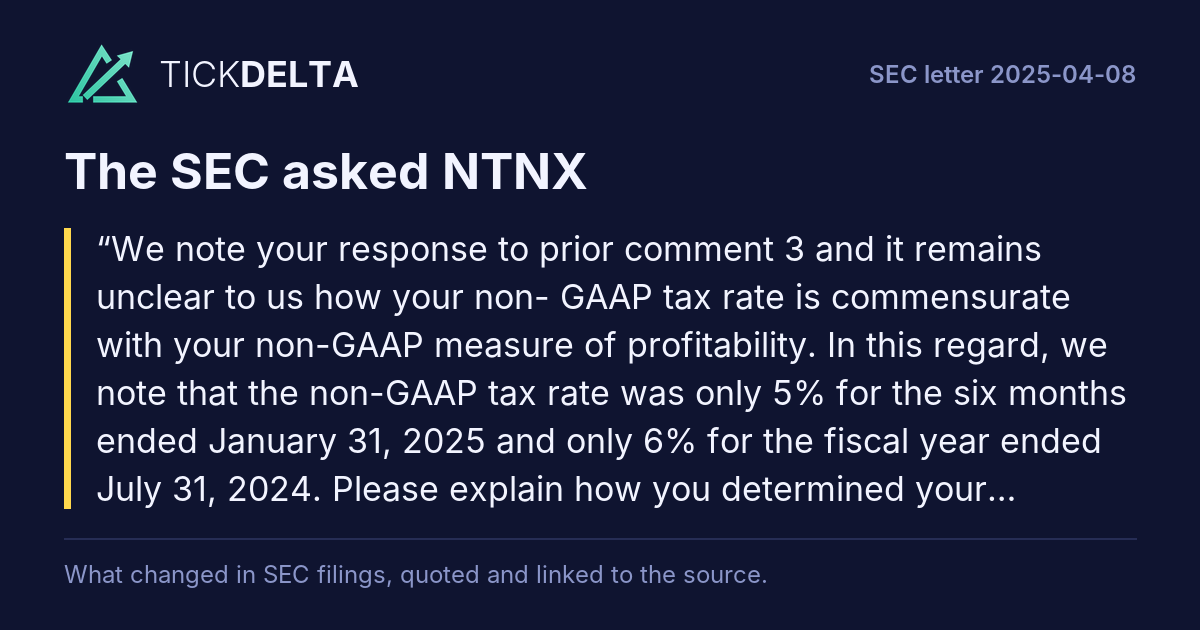
We note your response to prior comment 3 and it remains unclear to us how your non- GAAP tax rate is commensurate with your non-GAAP measure of profitability. In this regard, we note that the non-GAAP tax rate was only 5% for the six months ended January 31, 2025 and only 6% for the fiscal year ended July 31, 2024.
Rest of the question

Please explain how you determined your non-GAAP tax rate and how you concluded that it was commensurate with your non-GAAP measure of profitability. Refer to Question 102.11 of the Non-GAAP C&DIs.

NTNX answered
The Company respectfully acknowledges the Staff’s comment. Historically, the Company has calculated the non-GAAP effective tax rate in each of the periods presented by taking into account the sizable U.S. net operating loss carryforwards and tax credit carryforwards. The Company had approximately $2.4 billion of U.S. federal net operating loss carryforwards and $177.1 million of U.S. federal research tax credit carryforwards as of July 31, 2024. As such, the Company had adequate prior year tax attributes to offset income tax liabilities in the U.S. The foreign tax and minimal U.S.
Rest of the answer

tax expense drove the 5% and 6% non-GAAP tax rate for the six-month period ended January 31, 2025 and the fiscal year ended July 31, 2024, respectively.

Going forward, the Company respectfully advises the Staff that the Company plans to transition its disclosures in future filings to reflect a long-term projected non-GAAP tax rate, which we currently estimate to be 19%-25%. We believe a long-term projected tax rate better aligns with the non-GAAP measure of profitability, better reflects our long-term tax structure, reduces volatility of the non-GAAP tax rate, and provides better consistency across reporting periods. The non-GAAP long-term projected tax rate will be computed inclusive of both current and deferred income taxes consistent with Question 102.11 of the Non-GAAP C&DIs. We will disclose the use of a long-term projected tax rate in future filings, and the filings will include an explanation with respect to the long-term rate.

* * *

If the Staff has any further questions or comments concerning the Company’s response, please do not hesitate to contact me at [email protected].
Read in the reply

Form 10-K for the fiscal year ended July 31, 2024

2025-03-21 to 2025-04-22 · 3 questions · 1 letter from the SEC, 1 from the company
Review closed 2025-04-22
AcquisitionsRevenueNon-GAAP measuresIncome taxes
Factors Affecting Our Performance · Customer Acquisition, Retention and Expansion, page 71
SEC asked (1)
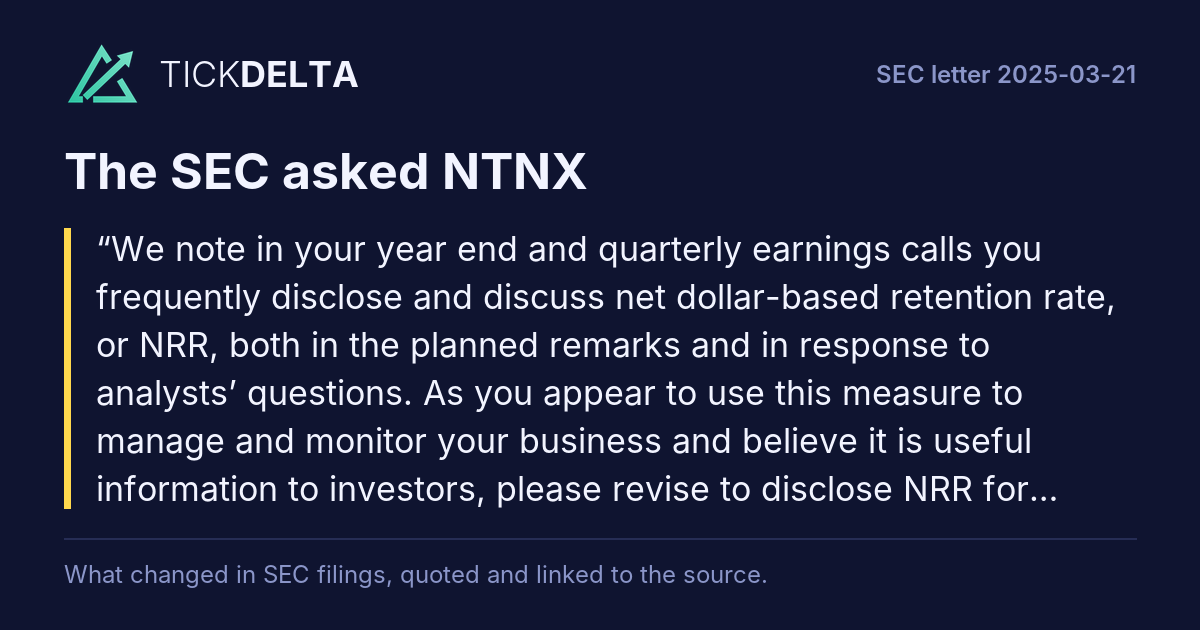
We note in your year end and quarterly earnings calls you frequently disclose and discuss net dollar-based retention rate, or NRR, both in the planned remarks and in response to analysts’ questions. As you appear to use this measure to manage and monitor your business and believe it is useful information to investors, please revise to disclose NRR for each period presented.
Rest of the question

Ensure your disclosures include a clear definition of the measure and how it is calculated and include a draft of your proposed revisions in your response. Refer to SEC Release 33-10751.

NTNX answered
The Company respectfully acknowledges the Staff’s comment and, in response to the Staff’s comment, in future filings, we will add the following disclosure:

Customer Acquisition, Retention and Expansion

As of July 31, 2024, our net dollar-based retention rate (“NRR”) was 114%, compared to 123% as of July 31, 2023. NRR is calculated as of the end of a twelve-month period. We calculate NRR by starting with the ARR for all customers with subscription contracts at the beginning of the period. We then divide end-of-the-period ARR for the same customer group by the beginning-of-the-period ARR.
Rest of the answer

NRR is a performance measure that we believe provides useful information to our management and investors as it provides an indication of our ability to retain and expand ARR from our existing customer base.

Read in the reply
In its next report

First report after the company's reply of Apr 3, 2025: 10-Q filed Jun 3, 2025 ↗, against the 10-Q filed Mar 6, 2025 ↗.

Tickdelta does not hold the text of both reports, so they are not compared here.

Consolidated Financial Statements · Note 2. Revenue, Deferred Revenue and Deferred Commissions, page 107
SEC asked (2)
You disclose that contracted not recognized revenue was approximately $2.1 billion, of which you expect to recognize approximately 52% over the next 12 months and the remaining thereafter. Please revise to further explain when the remaining 48% will be recognized as revenue, on a quantitative basis using time bands that would be most appropriate or by using qualitative information.
Rest of the question

Please include proposed draft disclosure in your response. Refer to ASC 606-10-50-13b.

NTNX answered
The Company respectfully acknowledges the Staff’s comment and, in response to the Staff’s comment, in future filings, we will expand the disclosure as follows with additions in bold and underlined and deletions in strikethrough:

NOTE 2. REVENUE, DEFERRED REVENUE AND DEFERRED COMMISSIONS

Disaggregation of Revenue and Revenue Recognition

Contracted not recognized revenue was approximately $2.1 billion as of July 31, 2024, of which we expect to recognize approximately 52% withinover the next 12 months, approximately 38% over the subsequent 13-to-36 month period, and the remainder thereafter.
Read in the reply
In its next report

First report after the company's reply of Apr 3, 2025: 10-Q filed Jun 3, 2025 ↗, against the 10-Q filed Mar 6, 2025 ↗.

Tickdelta does not hold the text of both reports, so they are not compared here.

Exhibit 99.1, page 7
SEC asked (3)
We note your measure of non-GAAP net income includes the income tax effect primarily related to stock-based compensation expense. However, it is unclear how such amount is calculated and how it results in an income tax expense that is commensurate with your non-GAAP measure of profit. Please advise or revise and include proposed revisions in your response. Refer to Non-GAAP C&DI Question 102.11.
NTNX answered
The Company respectfully acknowledges the Staff’s comment. The comment notes that the Company’s non-GAAP net income includes the income tax effect primarily related to stock-based compensation expense. To clarify the Company’s approach to calculating non-GAAP net income, the Company makes an adjustment to exclude the income tax effects of non-GAAP adjustments from its calculation of non-GAAP net income. The exclusion of stock-based compensation is one of the Company’s adjustments to pretax income to arrive at non-GAAP net income.
Rest of the answer

Therefore, the income tax impact of stock-based compensation is also excluded from non-GAAP net income.

To further clarify the approach to non-GAAP income tax, the Company uses a non-GAAP performance measure and therefore includes current and deferred income tax expense commensurate with the non-GAAP measure of profitability. The Company determines its non-GAAP income tax adjustment by excluding the impacts of material non-GAAP adjustments and recomputes tax expense without those items. The income tax impacts from stock-based compensation are primarily driven by windfalls and shortfalls for jurisdictions that allow the deduction of stock-based compensation expense for tax purposes, which is affected by fluctuations in the market price of the Company’s Class A common stock. In addition, for jurisdictions that are reimbursed for stock-based compensation expense, the tax on that reimbursement is excluded from non-GAAP net income.

In response to the Staff’s comment, we will revise the non-GAAP adjustment disclosure in our next earnings press release to describe the adjustment as income tax effects of non-GAAP items.

* * *

If the Staff has any further questions or comments concerning the Company’s response, please do not hesitate to contact me at [email protected].
Read in the reply
In its next report

First report after the company's reply of Apr 3, 2025: 10-Q filed Jun 3, 2025 ↗, against the 10-Q filed Mar 6, 2025 ↗.

Tickdelta does not hold the text of both reports, so they are not compared here.

Also in this review: closing letter, 2025-04-22

Form 10-K for the Fiscal Year Ended July 31, 2017

2018-03-09 to 2018-04-04 · 2 questions · 1 letter from the SEC, 1 from the company
Review closed 2018-04-04
Revenue
Note 3. Revenue, Deferred Revenue and Deferred Commissions · Costs to obtain and fulfill a contract, page 16
SEC asked (1)
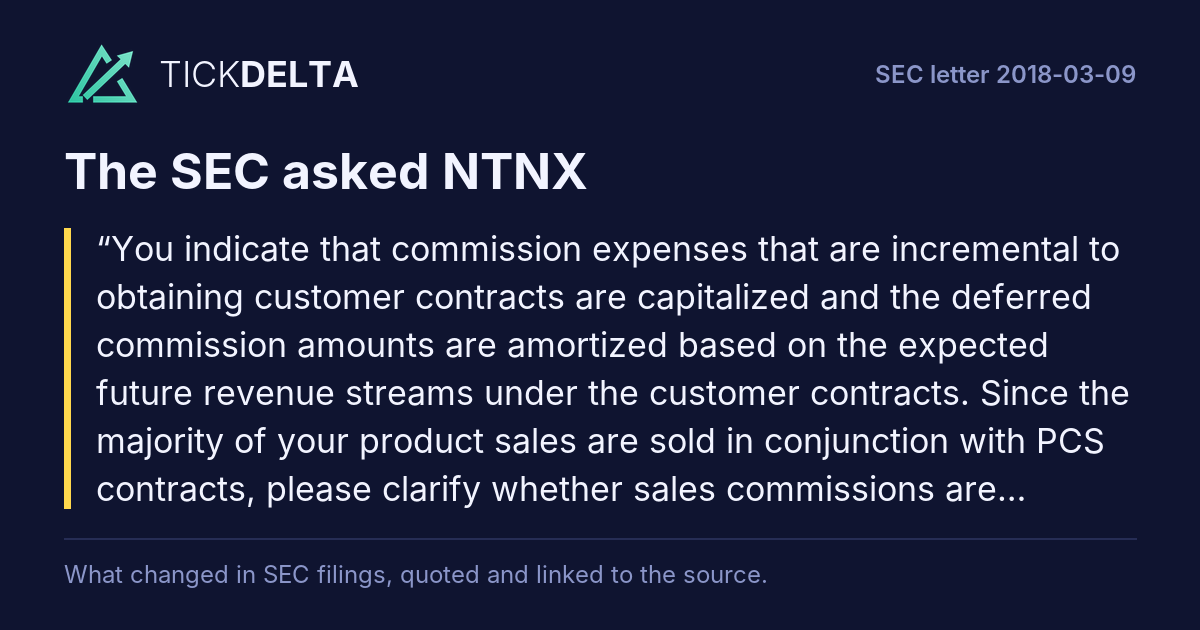
You indicate that commission expenses that are incremental to obtaining customer contracts are capitalized and the deferred commission amounts are amortized based on the expected future revenue streams under the customer contracts.
Rest of the question

Since the majority of your product sales are sold in conjunction with PCS contracts, please clarify whether sales commissions are earned or allocated to different performance obligations in a contract and how the amortization period and expense reflects the transfer of the applicable product and service. Refer to ASC 340-40-35-1 and 340-40-50-2(b).

NTNX answered
We acknowledge the Staff’s comment and respectfully advise the Staff that we do allocate commissions paid to each material stream of revenue, including PCS. Any incremental amounts which are capitalized and deferred are recognized in the statement of operations in a manner which is consistent with the corresponding revenue stream.
Rest of the answer

The commissions are allocated on a relative fair value basis to each of the performance obligations identified in the contract, including consideration of future PCS revenue, and such amounts are amortized as the related performance obligations are recognized as revenue.

We will revise future filings, commencing with our Form 10-Q filing for the quarter ended January 31, 2018, to clarify our policy regarding deferred commissions. Below is an illustration of the proposed disclosure that we have included in our Form 10-Q for the quarter ended January 31, 2018:

“Costs to obtain and fulfill a contract - We capitalize commissions paid to sales personnel and the related payroll taxes when customer contracts are signed. These costs are recorded as deferred commission expense in the condensed consolidated balance sheets, current and non-current. We determine whether costs should be deferred based on our sales compensation plans, if the commissions are incremental and would not have been incurred absent the execution of the customer contract. Sales commissions for renewals of customer contracts are not commensurate with the commissions paid for the acquisition of the initial contract given the substantive difference in commission rates in proportion to their respective contract values. Commissions paid upon the initial acquisition of a contract are amortized over the estimated period of benefit, which may exceed the term of the initial contract. Accordingly, amortization of deferred costs is recognized on a systematic basis that is consistent with the pattern of revenue recognition allocated to each performance obligation and included in sales and marketing expense in the condensed consolidated statements of operations. We determine the estimated period of benefit by evaluating the expected renewals of our customer contracts, the duration of our relationships with our customers, customer retention data, our technology development lifecycle and other factors. Deferred costs are periodically reviewed for impairment.”

Read in the reply
In its next report

First report after the company's reply of Mar 22, 2018: 10-Q filed Jun 12, 2018 ↗, against the 10-Q filed Dec 13, 2017 ↗.

Tickdelta does not hold the text of both reports, so they are not compared here.

Note 3. Revenue, Deferred Revenue and Deferred Commissions · Costs to obtain and fulfill a contract, page 16
SEC asked (2)
Please tell us, and disclose as appropriate, whether additional sales commissions are paid upon renewal of PCS contracts and, if so, whether such amounts are commensurate with the initial commissions. Further, if applicable, disclose how commissions paid for renewals are considered in your amortization period, which is based on the expected future revenue streams. Refer to ASC 340-40-35-1 and 340-40-50-2(b).
NTNX answered
We acknowledge the Staff’s comment and respectfully advise the Staff that we do pay additional sales commissions upon the renewal of PCS contracts by our customers and we have determined that such commissions are not commensurate with the amounts paid for the initial sale given the substantive difference in commission rates in proportion to their respective contract values. We consider expected renewals in determining the period of benefit to amortize the initial commissions paid in connection with obtaining an initial customer contract.
Rest of the answer

We have revised our disclosure accordingly as noted in our response to the first question above.

Further, we advise the Staff that commissions paid on renewals are not material to the financial statements taken as a whole for any given period.

* * * * * * * *

The Company acknowledges that:

•The Company is responsible for the adequacy and accuracy of the disclosure in the filing;

•Staff comments or changes to disclosure in response to staff comments do not foreclose the Commission from taking any action with respect to the filing; and

•The Company may not assert staff comments as a defense in any proceeding initiated by the Commission or any person under the federal securities laws of the United States.

The Company requests that any future comments be addressed to the undersigned at [email protected]. You may also contact me via telephone with questions or comments at (408) 216-8360, or you may contact Tyler Wall, the Company’s Chief Legal Officer, at (408) 596-5072 or [email protected].

Read in the reply
In its next report

First report after the company's reply of Mar 22, 2018: 10-Q filed Jun 12, 2018 ↗, against the 10-Q filed Dec 13, 2017 ↗.

Tickdelta does not hold the text of both reports, so they are not compared here.

Also in this review: closing letter, 2018-04-04

From the SEC's correspondence on EDGAR: staff letters (form UPLOAD) and company letters (form CORRESP), 8 letters filed since 2018-03-09. Questions and answers are matched by their numbers; topics come from words in each question. The reports are compared word for word (same form, before the first SEC letter against the first report after the company's reply). No AI.

Sources

The SEC's correspondence on EDGAR: staff letters (form UPLOAD) and company letters (form CORRESP), matched question by question. No AI.

Also

Filings: the letters in the filing list.

Work with it

Excel workbook · CSV. Google Sheet that stays up to date: paste =IMPORTDATA("https://tickdelta.com/company/NTNX/export.csv") into a cell.

Next in Owners and insiders:Insider trades
Esc

Type a ticker such as AAPL, a name, an investor such as Buffett, or a topic such as tariffs. ↑ ↓ to move, Enter to open.