Reworded10-Q Nov 5, 2026 vs 10-K Feb 27, 2026
Screener
/
SEC EDGAR
/CIK 0001604821
/10-K filed Feb 27, 2026, compared with Feb 28, 2025
/Numbers from the XBRL of the 10-Ks
Nasdaq
Health care · Medical Labs
Natera, Inc. NTRA
New risk paragraphs, branching off last year
Each branch is a paragraph in Risk Factors with nothing like it in the 10-K filed Feb 28, 2025. A box jumps to the paragraph as filed, below.
Paragraphs with nothing like them in last year's 10-K
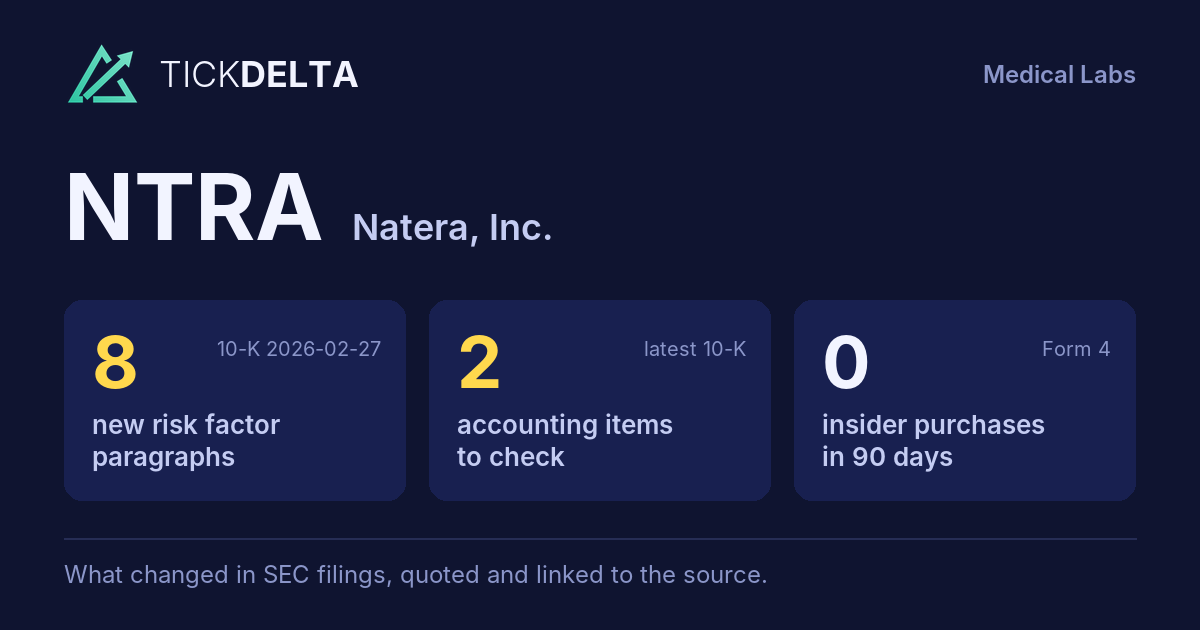
8 paragraphs in Risk Factors of the 10-K filed Feb 27, 2026 with nothing like them in the 10-K filed Feb 28, 2025. Quoted exactly. Paragraphs that were only edited are under 10-K change.
We are incorporating artificial intelligence across various areas of our business, which presents risks that could adversely affect our business and results of operations.
We are incorporating artificial intelligence, or AI, and machine learning, or ML, technologies into aspects of our business. The development and use of these technologies involve operational, regulatory, legal, and reputational risks that could adversely affect our business, results of operations, and financial condition.
AI and ML systems are complex and may generate inaccurate or unintended outputs due to design limitations, algorithmic flaws, or deficiencies in training data. Reliance on such outputs could result in errors in judgment or operational inefficiencies. These technologies may also introduce information security risks, including vulnerabilities to cyberattacks, unauthorized access, or system disruptions affecting the confidentiality, integrity, or availability of data.
Our use of AI and ML may increase data privacy and intellectual property risks. Inadequate governance, controls, or training could result in data breaches, loss of confidential and proprietary information, unauthorized disclosure of personal data, including PHI, or other misuse of our proprietary information, leading to regulatory investigations, litigation, or reputational harm.
The regulatory landscape for AI is evolving rapidly. Compliance with emerging laws and guidance, including the European Union’s Artificial Intelligence Act, evolving FDA guidance, and state privacy laws, may increase costs, require operational changes, or limit certain AI applications. Regulatory developments or shifts in enforcement priorities could restrict our ability to deploy or modify AI systems. Any failure to comply with applicable requirements could result in enforcement actions, fines, operational restrictions, or other adverse effects on our business and results of operations.
We may not be able to obtain approval from the FDA for Signatera PMAs currently under review or for applications that we may submit to FDA in the future.
We have submitted PMAs for Signatera for approval as a companion diagnostic. We may face difficulties in obtaining approval of these PMAs for a variety of reasons, including failure to demonstrate the safety and/or effectiveness of our tests to FDA’s satisfaction. If approval of any of our pending Signatera PMAs is delayed or denied our business could be adversely affected.
Moreover, our clinical trials to support PMA approval must be conducted under an FDA-approved IDE. FDA has the authority to deny IDE submissions, or to suspend or revoke IDEs once granted, under certain conditions, including noncompliance with FDA requirements or undue risks to subjects. If we are unable to maintain our current IDEs or to obtain IDEs that we may seek in the future, our continued ability to conduct clinical trials could be adversely affected, which could delay or prevent FDA approval. Furthermore, we cannot assure you that these studies, or studies of other tests that we may conduct in the future, will be successful or that they will be sufficient to support FDA approval If approval of any future PMAs for Signatera or any tests we develop in the future is delayed or if we are unable to obtain approval of any such PMAs, our business could be adversely affected.
Paragraphs in the 10-Q filed Nov 5, 2026 that were not in the one before
New in the latest 10-Q
39 paragraphs in the 10-Q filed Nov 5, 2026 with nothing like them in the 10-Q filed Aug 7, 2026 (at least half the words must differ; new numbers alone do not count). Quoted exactly, grouped by the item heading above them. This is text that changed, not a judgement of how serious it is.
Financial statements and notes
Subsequently, during the nine months ended September 30, 2026, the Company recorded immaterial measurement period adjustments. The related 1,087 escrow shares were returned to the Company in the second quarter of 2026.
Read in the 10-Q
revenues through agreements with pharmaceutical companies in support of potential clinical trials managed by the pharmaceutical companies, data analytics, and research assistance.
Read in the 10-Q
each subsequent period. Accordingly, future business and economic conditions, as well as changes in any of the assumptions described above, can materially impact the fair value of the contingent consideration obligation.
Read in the 10-Q
Operating Leases (in thousands) As of September 30, 2026 2026 (remaining 3 months) $ 6,549 2027 25,810 2028 28,673 2029 28,743 2030 28,959 2031 and thereafter 81,063 Total future minimum lease payments 199,797 Less: imputed interest (41,248) Operating lease liabilities $ 158,549
Read in the 10-Q
In August 2026, a putative class action was filed against the Company and Baylor Genetics (“Baylor”) in the United States District Court for the Northern District of California on behalf of certain patients whose testing was ordered through the Company, asserting claims for negligence, breach of implied contract, unjust enrichment, and violation of the California Confidentiality of Medical Information Act (“CMIA”), as a result of a cybersecurity incident experienced by Baylor in June 2026 (the “Baylor Incident”). A second putative class action was filed against the Company in August 2026 in the same court on behalf of patients whose information was allegedly affected by the Baylor Incident, asserting claims for negligence, breach of implied contract, unjust enrichment, and violations of the CMIA, the California Unfair Competition Law, and the California Consumer Legal Remedies Act. The complaints seek, among other relief, class certification, actual, statutory and nominal damages, restitution, injunctive relief, and attorneys’ fees and costs. In September 2026, the Company tendered the defense of both actions to Baylor and demanded indemnification under the parties’ Laboratory Services Agreement.
Read in the 10-Q
Show the other 34
making purposes. Additionally, gross profit and gross margin percentage are regularly provided to the CODM and are derived based on the condensed consolidated statements of operations and comprehensive loss as follows:
Read in the 10-Q
On November 2, 2026, the Company acquired one of its strategic partners, pursuant to an Agreement and Plan of Merger. The total purchase price consideration is up to $ 30.0 million, which includes up to $ 5.0 million in performance milestones. Due to the proximity of the acquisition to the filing of this Form 10-Q, the accounting for the acquisition is incomplete. As a result, the Company has not yet completed the allocation of the purchase price, including determining the fair value of consideration transferred, assets acquired, and liabilities assumed, and has not provided acquisition-related costs. Pro forma financial information and results of the acquiree’s operations since the acquisition date are not material.
Read in the 10-Q
On November 4, 2026, Steve Chapman resigned from service as the Company’s Chief Executive Officer and President and as a director on the Company’s Board of Directors, effective November 5, 2026. On November 4, 2026, the Board appointed Solomon Moshkevich as Chief Executive Officer and President of the Company, effective November 5, 2026. As Chief Executive Officer, Mr. Moshkevich will serve as the Company’s principal executive officer, and as a Class III director filling the vacancy created by Mr. Chapman’s resignation.
Read in the 10-Q
The Company entered into a Transition and Consulting Agreement with Mr. Chapman. Subject to the Transition and Consulting Agreement, Mr. Chapman will be entitled to receive:
Read in the 10-Q
• a lump-sum transition payment of $ 1,000,000, payable within 10 days after the Transition Agreement becomes effective;
Read in the 10-Q
• a 2026 annual bonus with a target of $ 1,500,000 payable consistently with other employees no later than March 15, 2027;
Read in the 10-Q
• 92,933 Time-Based RSUs that are unvested as of November 5, 2026 will vest between the date the Transition Agreement becomes effective through November 5, 2027.
Read in the 10-Q
• 2024, 2025 and 2026 Performance-Based RSUs will remain outstanding and will vest, subject to certain conditions, based on actual achievement of the applicable performance goals for each respective award, and will be settled at the same time that the corresponding performance-based RSU awards held by the Company’s other executive officers are settled, provided the Consulting Agreement service period is completed.
Read in the 10-Q
Other information
(a) Departure of Directors or Certain Officers; Election of Directors; Appointment of Certain Officers; Compensatory Arrangements of Certain Officers
Read in the 10-Q
On November 4, 2026, Steve Chapman resigned from service as the Company’s Chief Executive Officer and President and as a director on the Company’s Board of Directors (the “Board”), effective November 5, 2026. Mr. Chapman’s departure and resignation from the Board were not the result of any disagreement with the Company on any matter relating to the Company’s operations, policies or practices. Mr. Chapman was in good standing throughout his career with the Company, and he will remain as an advisor to the Company.
Read in the 10-Q
On November 4, 2026, the Board appointed Solomon Moshkevich as Chief Executive Officer and President of the Company, effective November 5, 2026. As Chief Executive Officer, Mr. Moshkevich will serve as the Company’s principal executive officer.
Read in the 10-Q
Mr. Moshkevich, age 44, served as the Company’s President, Clinical Diagnostics from September 2023 until his appointment as Chief Executive Officer, overseeing productization, clinical validation, commercialization and quality across the Company. From January 2019 to September 2023, he served as the Company’s Senior Vice President and General Manager of Oncology, where he led the Company’s efforts to achieve Medicare coverage for Signatera across multiple cancer types. Since joining the Company in 2011, Mr. Moshkevich has built and led multiple teams, including global marketing, product management, medical and scientific affairs, commercial operations, clinical trial operations, business development, international sales, program management and portfolio strategy, and has played a leading role in the development, clinical validation and commercialization of the Company’s cell-free DNA products, including Panorama, Prospera and Signatera. Prior to joining the Company, Mr. Moshkevich was a consultant with Bain & Company in New York and was a member of the private equity investment team at Parthenon Capital in Boston. He currently serves on the board of directors of Ronald McDonald House Charities of the Bay Area. Mr. Moshkevich holds a B.A. in Economics and Mathematics, summa cum laude, from Columbia University and an M.B.A. from Stanford University.
Read in the 10-Q
There are no family relationships between Mr. Moshkevich and any director or executive officer of the Company. Other than the Moshkevich Employment Agreement (as defined below), there is no arrangement or understanding between Mr. Moshkevich and any other person pursuant to which he was selected as an officer or director of the Company. Mr. Moshkevich has no direct or indirect material interest in any transaction or proposed transaction required to be disclosed pursuant to Item 404(a) of Regulation S-K.
Read in the 10-Q
In connection with his appointment, the Company and Mr. Moshkevich entered into an employment agreement, effective as of November 5, 2026 (the “Moshkevich Employment Agreement”), which supersedes Mr. Moshkevich’s prior employment agreement with the Company. Mr. Moshkevich’s employment is at will.
Read in the 10-Q
Under the Moshkevich Employment Agreement, Mr. Moshkevich will receive an initial annual base salary of $900,000, subject to adjustment in accordance with the Company’s compensation policies. Mr. Moshkevich will be eligible for an annual incentive bonus under the Company’s annual cash incentive program with a target of 110% of his base salary. His target bonus for fiscal 2026 will be prorated, equal to the sum of (i) his target bonus percentage in effect immediately before November 5, 2026 multiplied by his base salary for the portion of fiscal 2026 before that date, plus (ii) 110% multiplied by his new base salary for the portion of fiscal 2026 on and after that date. His fiscal 2026 bonus will be determined based on the achievement of Company performance goals previously approved by the Human Capital Committee for fiscal 2026.
Read in the 10-Q
Mr. Moshkevich is also eligible to receive annual equity awards under the Company’s 2015 Equity Incentive Plan (the “Plan”) in connection with the Company’s annual equity award process, subject to approval by the Board or its Human Capital Committee. The Moshkevich Employment Agreement provides that Mr. Moshkevich’s 2027 annual equity award will have a target grant date value of $10,500,000, delivered 50% in performance-based restricted stock units and 50% in time-based restricted stock units, and will be granted at the same time as the Company’s 2027 annual equity grants to the
Read in the 10-Q
Company’s other executive officers (currently expected to occur in January 2027), subject to approval by the Board or its Human Capital Committee at the time of grant. The performance-based restricted stock units will be subject to the terms of the Company’s 2027-2029 performance-based restricted stock unit program, as approved by the Human Capital Committee. In connection with his promotion, the Board, upon the recommendation of the Human Capital Committee, also approved a grant to Mr. Moshkevich of time-based restricted stock units under the Plan with a grant date value of $1,750,000, which will vest over four years, with 25% vesting on November 5, 2027 and the remainder vesting in 12 substantially equal quarterly installments thereafter, subject to his continued service with the Company. He will continue to participate in the Company’s employee benefit plans available to its employees generally.
Read in the 10-Q
If Mr. Moshkevich’s employment is terminated by the Company without “cause” or he resigns for “good reason” (each as defined in the Moshkevich Employment Agreement, and each such termination, an “involuntary termination”), then, subject to his return of Company property, resignation from all officer and director positions with the Company and its subsidiaries, and execution and non-revocation of separation agreement, which will include a general release of claims, in a form prescribed by the Company, Mr. Moshkevich will be eligible to receive the following:
Read in the 10-Q
• Involuntary termination not in connection with a change in control: (i) a lump-sum payment equal to 12 months of his base salary; (ii) payment of COBRA premiums for up to 12 months; (iii) accelerated vesting of his time-based equity awards equal to the greater of 50% of the then-unvested portion of such awards or the portion that would have vested had he completed an additional 18 months of service; and (iv) with respect to his performance-based equity awards, vesting in the number of shares eligible to vest based on actual performance through the end of the applicable measurement period, multiplied by the greater of 50% or the portion of the measurement period during which he would have provided service had he completed an additional 18 months of service (with full vesting of the earned shares under any award that would vest within that 18-month period, and no vesting unless the minimum performance condition is achieved).
Read in the 10-Q
• Involuntary termination at the time of or within 18 months following a change in control: (i) a lump-sum payment equal to the sum of 18 months of his base salary plus his target annual bonus for the year of termination; (ii) payment of COBRA premiums for up to 18 months; and (iii) full accelerated vesting of all outstanding time-based and performance-based equity awards, with performance-based awards vesting based on the greater of actual achievement as of the change in control or 100% achievement.
Read in the 10-Q
The foregoing description of the Moshkevich Employment Agreement does not purport to be complete and is qualified in its entirety by reference to the full text of the Moshkevich Employment Agreement, a copy of which will be filed as an exhibit to the Company’s Annual Report on Form 10-K for the fiscal year ending December 31, 2026.
Read in the 10-Q
On November 4, 2026, the Board appointed Mr. Moshkevich as a Class III director to fill the vacancy created by Mr. Chapman’s resignation, effective November 5, 2026. Mr. Moshkevich will serve for a term expiring at the Company’s 2027 annual meeting of stockholders and until his successor is duly elected and qualified, or until his earlier death, resignation or removal. Mr. Moshkevich was appointed to the Board pursuant to the Moshkevich Employment Agreement, which also provides that the Company will nominate him for re-election to the Board at each annual meeting of stockholders at which his term as a director expires during his service as Chief Executive Officer. Mr. Moshkevich has not been appointed to, and is not expected to be appointed to, any committee of the Board. As an employee director, Mr. Moshkevich will not receive any additional compensation for his service on the Board. Mr. Moshkevich is party to the Company’s standard form of indemnification agreement for its directors and executive officers, the form of which was filed as Exhibit 10.9 to the Company’s Form 10-K for the fiscal year ending December 31, 2016, filed with the Securities and Exchange Commission on March 16, 2017.
Read in the 10-Q
On November 4, 2026, the Company and Mr. Chapman entered into a Transition and Consulting Agreement (the “Transition Agreement”), which provides Mr. Chapman with the benefits described below in lieu of any severance payments or benefits under his Amended and Restated Employment Agreement with the Company, effective as of August 1, 2024. Subject to the Transition Agreement (which includes a mutual release of claims) becoming effective, Mr. Chapman’s delivery of his Board resignation and his return of Company property, Mr. Chapman will be entitled to receive:
Read in the 10-Q
• a lump-sum transition payment of $1,000,000, equal to 12 months of his base salary, payable within 10 days after the Transition Agreement becomes effective;
Read in the 10-Q
• a 2026 annual bonus (with a target of $1,500,000) determined based on the fiscal 2026 performance criteria previously approved by the Human Capital Committee, using the same determination of the achievement of such performance criteria used for the Company’s other executive officers, and payable at the same time that fiscal 2026 annual bonuses are paid to the Company’s other executive officers (and in any event no later than March 15, 2027);
Read in the 10-Q
• payment or reimbursement of COBRA premiums for Mr. Chapman and his eligible dependents for up to 12 months; and
Read in the 10-Q
Pursuant to the Transition Agreement, the Company and Mr. Chapman entered into a consulting agreement (the “Consulting Agreement”), under which Mr. Chapman will provide transition and advisory services to the Company’s Chief Executive Officer and the Board, as reasonably requested (the “Consulting Period”), which may be extended by mutual written agreement. Mr. Chapman will be paid $500 per hour for up to eight hours of requested services per month. Either party may terminate the Consulting Agreement on five days’ written notice, and the Company may terminate it immediately for “Cause” (as defined in the Consulting Agreement).
Read in the 10-Q
Mr. Chapman’s consulting services will constitute continuous service under the Plan, and his outstanding restricted stock unit (“RSU”) awards will be treated as follows:
Read in the 10-Q
• Time-Based RSUs that are unvested as of November 5, 2026 will vest as to 35,000 RSUs on the date the Transition Agreement becomes effective, and as to the remaining 57,933 RSUs in 12 substantially equal monthly installments from December 5, 2026 through November 5, 2027, subject to Mr. Chapman’s continued service through each monthly vesting date.
Read in the 10-Q
• 2024 and 2025 Performance-Based RSUs will remain outstanding and will vest in the number of shares earned based on actual achievement of the applicable three-year cumulative revenue goals, multiplied by a service credit percentage. The service credit percentage will reflect Mr. Chapman’s service completed through November 5, 2026, plus the remaining service credit, which accrues ratably over the Consulting Period, and will equal 100% if Mr. Chapman provides services through the end of the Consulting Period. Vested shares will be settled at the same time that the corresponding performance-based RSU awards held by the Company’s other executive officers are settled.
Read in the 10-Q
• 2026 Performance-Based RSU award will be amended to provide that, if Mr. Chapman provides consulting services through the end of the Consulting Period, executes and does not revoke a bring-down release of claims thereafter, he will be deemed to have satisfied 100% of the service requirement under the award, and the award will remain outstanding following the end of the Consulting Period and will vest based on the Company’s actual achievement of the performance goals for fiscal years 2026 through 2028. Vested shares will be settled at the same time that the corresponding performance-based RSU awards held by the Company’s other executive officers are settled.
Read in the 10-Q
No performance-based RSUs will vest unless the minimum performance condition under the applicable award is achieved. The number of shares earned under each performance-based RSU award will be based on the Company’s actual performance as of the end of the applicable measurement period. If the Company terminates the Consulting Agreement before the end of the Consulting Period other than for Cause, then, subject to Mr. Chapman’s execution and non-revocation of a bring-down release of claims, his RSU awards will be treated as though he had continued to provide services through the end of the Consulting Period, such that his unvested time-based RSUs will vest in full and he will be deemed to have satisfied 100% of the service requirement under his 2024, 2025 and 2026 performance-based RSU awards, with vesting remaining subject to the Company’s actual performance at the end of the respective performance period for each award. If the Company terminates the Consulting Agreement for Cause before the end of the Consulting Period, or if Mr. Chapman’s service terminates due to his death or disability before the end of the Consulting Period, then, subject to Mr. Chapman’s (or his estate’s) execution and non-revocation of a bring-down release of claims, he will vest in 67,354 time-based RSUs, plus 2,132 time-based RSUs for each month of service he provides under the Consulting Agreement before his termination, death or disability, 100% of the earned shares under his 2024 and 2025 performance-based RSU awards and 77.78% of the earned shares under his 2026 performance-based RSU award.
Read in the 10-Q
The Transition Agreement and the Consulting Agreement also include customary provisions regarding cooperation, confidentiality and continued compliance with Mr. Chapman’s Proprietary Information and Inventions Agreement; a covenant by Mr. Chapman not to provide services to certain named competitors of the Company for six months following November 5, 2026; a covenant by Mr. Chapman not to solicit Company employees for 12 months; and mutual non-disparagement covenants by Mr. Chapman and the Company.
Read in the 10-Q
The foregoing description of the Transition Agreement and the Consulting Agreement does not purport to be complete and is qualified in its entirety by reference to the full text of the Transition Agreement and the Consulting Agreement, copies of which will be filed as exhibits to the Company’s Annual Report on Form 10-K for the fiscal year ending December 31, 2026.
Read in the 10-Q
The 10-Q's risk factors against the 10-K
Item 1A of the 10-Q filed Nov 5, 2026 against Item 1A of the 10-K filed Feb 27, 2026.
A 10-Q repeats only the risks that changed, so a 10-K paragraph that is missing from it is not counted as removed.
Added is a paragraph with nothing like it in the 10-K, Reworded a sentence that is in both with several words changed,
Quiet changes a sentence in both where one to four words changed and one is a hedge or a modal
(cut words struck through, new words highlighted).
Text on the page, not a score; each links to the filing at sec.gov.
Phrases used for the first time
Two-word phrases in Risk Factors of the 10-K filed Feb 27, 2026 that are in none of the 1 earlier 10-Ks stored, back to Feb 28, 2025
artificial intelligence ×3premarket authorization ×3cloud based ×2aws healthomics ×2texas san ×2boulder colorado ×2incorporating artificial ×2obtain approval ×2signatera pmas ×2fda approval ×2
Where each one is used
- artificial intelligence: We are incorporating artificial intelligence across various areas of our business, which presents risks that could adversely affect our business and results of operations.
- premarket authorization: We currently offer a number of genetic tests, and each of those tests is an LDT. The FDA considers an LDT to be a test that is designed, developed, validated and used within a single laboratory. Our laboratories are currently regulated under CLIA and must comply with CAP requirements, and we are subject to...
- cloud based: We currently maintain a data center at our laboratory facilities in San Carlos, California. In addition, our proprietary bioinformatics algorithms are a crucial component of our test processing, and combine information derived from our assay workflows with publicly available data from the broader scientific...
- aws healthomics: We currently maintain a data center at our laboratory facilities in San Carlos, California. In addition, our proprietary bioinformatics algorithms are a crucial component of our test processing, and combine information derived from our assay workflows with publicly available data from the broader scientific...
- texas san: We currently operate laboratory facilities in Austin, Texas, San Carlos, California, and Boulder, Colorado. Our laboratory facilities in Austin and San Carlos process Panorama, Horizon, and Signatera tests, which together represent the significant majority of our revenues. Our other tests that we perform are...
- boulder colorado: We currently operate laboratory facilities in Austin, Texas, San Carlos, California, and Boulder, Colorado. Our laboratory facilities in Austin and San Carlos process Panorama, Horizon, and Signatera tests, which together represent the significant majority of our revenues. Our other tests that we perform are...
- incorporating artificial: We are incorporating artificial intelligence across various areas of our business, which presents risks that could adversely affect our business and results of operations.
- obtain approval: We may not be able to obtain approval from the FDA for Signatera PMAs currently under review or for applications that we may submit to FDA in the future.
Used at least twice, small words left out. Counted, not picked: a phrase can be new because the company renamed something.
What was taken out
7 paragraphs of last year's Risk Factors with nothing like them now. The longest are quoted.
Sources
Item 1A of each 10-K and 10-Q on EDGAR, quoted exactly. Each paragraph links to the filing at sec.gov.
Also
10-K change: what was reworded or cut, section by section.
Work with it
Excel workbook · CSV. Google Sheet that stays up to date: paste =IMPORTDATA("https://tickdelta.com/company/NTRA/export.csv") into a cell.