Form 10-K for the Year Ended December 31, 2020
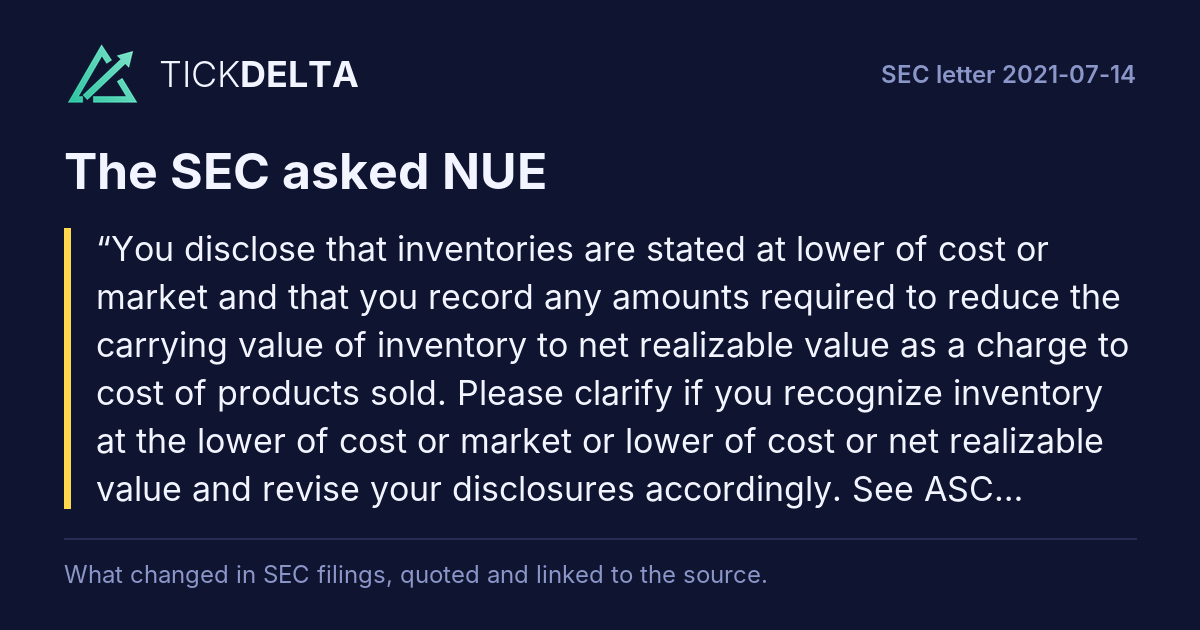
You disclose that inventories are stated at lower of cost or market and that you record any amounts required to reduce the carrying value of inventory to net realizable value as a charge to cost of products sold. Please clarify if you recognize inventory at the lower of cost or market or lower of cost or net realizable value and revise your disclosures accordingly. See ASC 330-10-35-1B.Rest of the question
Financial Statements Notes to Consolidated Financial Statements 11. Debt and Other Financing Arrangements, page 65
The Company recognizes inventory at the lower of cost or net realizable value. It is the Company’s practice to disclose its critical accounting policies annually in our Annual Report on Form 10-K unless there are material changes during the year, in which case we would make the appropriate updated disclosures in the next Quarterly Report on
Form 10-Q. In this case
Page there was no change to our inventory valuation methodology as it relates to recognizing inventory at the lower of cost or net realizable value.Read in the reply ↗Rest of the answer
Therefore, we acknowledge the Staff’s comment and will revise accordingly to clarify our disclosure beginning with our Annual Report on Form 10-K for the year ended December 31, 2021.
Financial Statements
Notes to Consolidated Financial Statements
11. Debt and Other Financing Arrangements, page 65
We note your disclosure on page 66 that you exchanged three outstanding notes for a cash payment of $180.3 million and $439.3 million of new notes due 2055. Please tell us how you determined the exchange transaction qualified as a debt modification under the guidance in ASC 470-50-40-6 through -12.Rest of the question
In doing so, provide us with your cash flow present value calculations for the original and new notes under ASC 470-50-40-12. Confirm that you performed your 10% test on a lender-by-lender basis and clarify how you treated put and call options on the underlying debt. 23. Revenue
In the fourth fiscal quarter of 2020, the Company consummated an offer to exchange (the “Exchange Offer”) certain existing series of the Company’s notes (the “Existing Notes”) for a new issuance of notes due 2055 (the “New Notes”) and cash. Pursuant to the terms of the Exchange Offer, the exchange was made available only to eligible holders of the
Existing Notes and all holders of the Existing Notes were offered the same amount of cash and New Notes as consideration.
As noted in ASC 470-50-40-10, the Company determined the Exchange Offer was a debt modification by first ensuring that theRead in the reply ↗Rest of the answer
Exchange Offer would not be considered a troubled debt restructuring in accordance with ASC 470-60-55-5. In management’s judgment the Company was not experiencing financial difficulties at the time of the exchange per ASC 470-60-55-7 through 9.
As noted above, the Exchange Offer was structured so that only existing bond holders could participate in the exchange and all the participants were offered the same terms. The Company evaluated the guidance of ASC 470-50-40-12 and calculated the change in the present value of the cash flows under the Existing Notes and New Notes. This analysis considered the cash premium paid to each lender, which was specified in the terms of the Exchange Offer and was paid based on the relative amount of Existing Notes exchanged. The Company noted that each lender’s principal remained the same before and after the exchange in all material respects. Given these facts, in performing the 10% test, the Company determined that the percentage change in net present value for each lender would not be greater than the percentage change in net present value of the cash flows of the Existing Notes exchanged for New Notes.
The following table summarizes the key inputs and detailed calculation of the cash flow present value for the Existing Notes exchanged for the $439.3 million aggregate principal amount of New Notes (in millions):
Key Inputs
Existing
Notes
New
(2.979% due
2055)
Discount
Rate
Cash
Premium
Paid
Present
Value of New
Notes, 6.400% Due 2037
$
106.7
6.56
%
56.7
54.5
Notes, 5.200% Due 2043
161.8
5.28
69.5
102.7
Notes, 4.400% Due 2048
170.8
4.51
54.1
125.0
Present Value Calculations of
Value of and
Difference
104.9
111.2
6.00
163.1
175.2
7.39
168.6
179.9
6.68
The differences in net present value of the cash flows of the Existing Notes compared to the New Notes were below the 10% threshold. Accordingly, the Company concluded that the Exchange Offer did not result in a substantial change of cash flows and should be accounted for as a modification.
The Existing Notes and New Notes had no material call options (i.e., the call option six months before the contractual maturity date was not material to the 10% test analysis) and no put options with a defined exercisable date. The Company performed the net present value calculations using the contractual maturity dates of the Existing Notes and New Notes. Per ASC 470-50-44-10c, the cash flow assumptions that generate the smaller change would be the basis for determining whether the 10% test is met. As the Company performed the test noted above and calculated a change in net present value of less than 10%, the Company did not perform further tests considering call or put options.
23. Revenue
We note that in your fiscal year 2019 Form 10-K, you disclosed that you recognized revenue from rebar product sales at a point in time upon shipment or delivery to customers and recognized related installation revenues when the delivered material was installed.Rest of the question
You currently disclose, however, that you recognize rebar product and installation revenues over time based on amounts shipped or installed relative to the total expected amounts required to complete jobs. Please provide further details on the nature of this apparent change, including whether your prior accounting was in error and whether the change resulted in any material changes in revenue recognized. Also clarify for us how the amount of rebar shipped represents an "input method."
There was no change in how we recognize revenue related to our rebar fabrication operations in 2020 as compared to 2019, and, accordingly, there was no error. The change in disclosure in the 2020 Form 10-K was meant to enhance the description of how our rebar fabrication operations recognize revenue.
The majority of our rebar fabrication operations’ contracts with customers are fixed price contracts, according to which the aggregate price associated with the contract is fixed but the quantity of fabricated rebar to be supplied and installed under the contract is not fixed.Read in the reply ↗Rest of the answer
As it relates to the supply of fabricated rebar performance obligation, we use the input method because the rebar shipped is an input relative to the total amount of fabricated rebar expected to be needed to complete the job. For that performance obligation, the timing of when we recognize revenue is when the fabricated rebar is shipped from our operating location.
* * * *
The Company acknowledges that:
• the Company is responsible for the adequacy and accuracy of the disclosure in the filing;
Staff comments or changes to disclosure in response to Staff comments do not foreclose the Commission from taking any action with respect to the filing; and the Company may not assert Staff comments as a defense in any proceeding initiated by the Commission or any person under the federal securities laws of the United States.
First report after the company's reply of 2021-09-10: 10-Q filed 2021-11-10 ↗, against the 10-Q filed 2021-05-12 ↗.
Tickdelta does not hold the text of both reports, so they are not compared here.
Also in this review: closing letter, 2021-09-17