Form 10-K for the Year Ended December 31, 2012
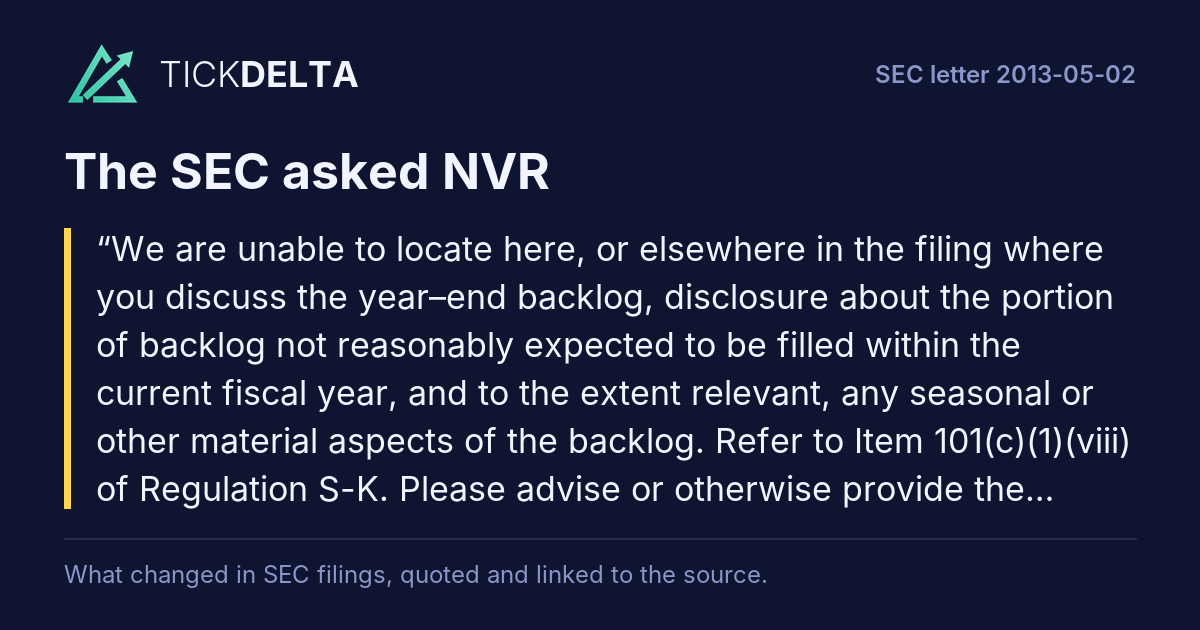
We are unable to locate here, or elsewhere in the filing where you discuss the year–end backlog, disclosure about the portion of backlog not reasonably expected to be filled within the current fiscal year, and to the extent relevant, any seasonal or other material aspects of the backlog. Refer to Item 101(c)(1)(viii) of Regulation S-K. Please advise or otherwise provide the noted disclosure in your future filings.
May 2, 2013 providing comments on the above referenced report. We have responded to each of your comments below. Where we have proposed to revise our disclosure in future reports, we have provided that disclosure, with our proposed additions to our prior disclosure underlined, and our proposed deletions marked by strikethrough. FORM 10-K FOR THE YEAR ENDED DECEMBER 31, 2012 Staff Comment: 1. We are unable to locate here, or elsewhere in the filing where you discuss the year-end backlog, disclosure about the portion of backlog not reasonably expected to be filled within the current fiscal year, and to the extent relevant, any seasonal or other material aspects of the backlog.One letter for all the questions, without numbered answers. Read the reply ↗Rest of the letter
Refer to Item 101(c)(1)(viii) of Regulation S-K. Please advise or otherwise provide the noted disclosure in your future filings. In the “Backlog” section of Item 1 on page 4, we provide disclosure regarding the historical percentage of a quarter’s opening backlog that is cancelled in the subsequent quarter. As the staff notes, we have not provided disclosure regarding the portion of backlog not reasonably expected to be filled within the current fiscal year. Other than those units that are cancelled, substantially all of our backlog generally settles within twelve months. As of each of December 31, 2012, 2011 and 2010, less than 20 backlog units from the previous year-end remained in backlog as of the end of the following year. The units remaining in backlog represented 0.1%-0.6% of the previous year-end backlog balance. Our disclosure at the bottom of page 30 in Item 7, “Management’s Discussion and Analysis of Financial Condition and Results of Operations,” discloses the effect of seasonality on our business. Disclosure of the immaterial amount of year-end backlog that remains in backlog at the end of the following year would not enhance an investor’s understanding of the sales cycle for our homes. Nevertheless, in future filings, we will revise our disclosure in the “Backlog” section in Item 1 consistent with this example from our 2012 Form 10-K: “Backlog totaled 4,979 units and approximately $1.7 billion at December 31, 2012 compared to backlog of 3,676 units and approximately $1.2 billion at December 31, 2011. Backlog, which represents homes sold but not yet settled with the customer, may be impacted by customer cancellations for various reasons that are beyond our control, such as failure to obtain mortgage financing, inability to sell an existing home, job loss, or a variety of other reasons. In any period, a portion of the cancellations that we experience are related to new sales that occurred during the same period, and a portion are related to sales that occurred in prior periods and therefore appeared in the opening backlog for the current period. Expressed as the total of all cancellations during the period as a percentage of gross sales during the period, our cancellation rate was approximately 15% in 2012 and 14% in both 2011 and 2010. During each of 2012, 2011 and 2010, approximately 6% of a quarter’s opening backlog balance cancelled during the fiscal quarter. We can provide no assurance that our historical cancellation rates are indicative of the actual cancellation rate that may occur in future periods. Other than those units that are cancelled, we expect to settle substantially all of our December 31, 2012 backlog during 2013. See “Risk Factors” in Item 1A and “Seasonality” in Item 7 of this Form 10-K. Further discussion of settlements, new orders and backlog activity by homebuilding reportable segment for each of the last three years can be found in “Management’s Discussion and Analysis of Financial Condition and Results of Operations” in Item 7 of this Form 10-K.” Consolidated Homebuilding Revenues, page 18 Staff Comment: 2. You state here and throughout your discussion of the results of operations that there was a lower backlog turnover rate in 2012 compared to 2011, which appears to have also been in trend during 2011. However, you provide no discussion of the reason(s) for this lower turnover rate, or of management’s assessment of how this trend may affect future performance. Please provide us supplementally with this information, and to the extent material, include a similar discussion in your future filings. Our average quarterly backlog turnover rate during the 10 years ended December 31, 2012 was 50%. During this same period, our average quarterly backlog turnover rate for each year ranged from 41% to 64%. During a period of increasing new orders, backlog turnover tends to decrease as construction capacity lags new order growth. This was the situation during 2012 as the homebuilding market continued to recover. Our average quarterly backlog turnover rate for 2012 was 53%, which decreased from 59% for 2011. The cyclical nature of the homebuilding business will result in fluctuations in the backlog turnover rate quarter to quarter. We confirm that, to the extent material, we will include a discussion in future filings if our average quarterly backlog turnover rate is outside of our historical range. We also confirm that, in future filings, we will revise the disclosure regarding our backlog turnover rate in the “Consolidated Homebuilding Backlog” section in Item 7 consistent with this example from our 2012 Form 10-K: Backlog units and dollars increased approximately 35% to 4,979 and 49% to $1,723,914, respectively, as of December 31, 2012, compared to 3,676 and $1,160,879 as of December 31, 2011. The increase in backlog units was primarily attributable to new orders being approximately 800 units higher for the six month period ended December 31, 2012 compared to the same period in 2011, coupled with a slower backlog turnover rate in 2012. In addition, as mentioned in the Overview section above, the December 31, 2012 acquisition of Heartland Homes added approximately 200 units and $81,600 to our current year-end backlog. The increase in backlog dollars is attributable to the increase in units and to a 9% higher average selling price for new orders for the six month period ended December 31, 2012. Backlog, which represents homes sold but not yet settled with the customer, may be impacted by customer cancellations for various reasons that are beyond our control, such as failure to obtain mortgage financing, inability to sell an existing home, job loss, or a variety of other reasons. In any period, a portion of the cancellations that we experience are related to new sales that occurred during the same period, and a portion are related to sales that occurred in prior periods and therefore appeared in the opening backlog for the current period. Expressed as the total of all cancellations during the period as a percentage of gross sales during the period, our cancellation rate was 14.5%, 13.6% and 13.8% in each of 2012, 2011 and 2010, respectively. During each of 2012, 2011 and 2010, approximately 6% of a reporting quarter’s opening backlog cancelled during the fiscal quarter. We can provide no assurance that our historical cancellation rates are indicative of the actual cancellation rate that may occur in future periods. See “Risk The backlog turnover rate is impacted by various factors, including, but not limited to, changes in new order activity, internal production capacity, external subcontractor capacity and other external factors over which we do not exercise control. Backlog units and dollars increased approximately 26% to 3,676 and 21% to $1,160,879, respectively, as of December 31, 2011 compared to 2,916 and $958,287 as of December 31, 2010. The increase in backlog units was primarily attributable to the decreased settlement activity in 2011. Backlog dollars were favorably impacted by the backlog unit increase, offset partially by a 4% decline in the average price of homes in backlog in 2011 compared to 2010.” Reportable Homebuilding Segments, page 20 Staff comment: 3. Your current presentations of total gross profit margin and total segment profit outside of the ASC 280 note to the financial statements results in the presentation of non-GAAP financial measures. Please provide the disclosures required by Item 10(e) of Regulation S-K. Refer to Compliance and Disclosures Interpretation 104.04 which is available on our website at http://www.sec.gov/divisions/corpfin/guidance/nongaapinterp.htm. Alternatively, you may remove these total amounts and provide reconciliations similar to those provided on pages 27 and 28. Please show us in your supplemental response what the revisions will looks like in future filings. The disclosure of segment gross profit margin and segment profit on page 21 in the “Selected Segment Financial Data” tables is intended to provide summary overview information regarding the segments. The reconciliation of segment gross profit margin to consolidated homebuilding gross profit is provided in the table on page 27. The reconciliation of segment profit to consolidated homebuilding profit before tax is provided on page 28. We confirm that, in future filings, we will revise the disclosure of our MD&A “Selected Segment Financial Data” tables in Item 7 by removing the totals, consistent with this example from our 2012 Form 10-K: In connection with our response, we acknowledge that: We are responsible for the adequacy and accuracy of the disclosure in our filings; Staff comments or changes to disclosure in response to staff comments do not foreclose the Commission from taking action with respect to the filing; We may not assert staff comments as a defense in any proceeding initiated by the Commission or any person under the federal securities laws of the
You state here and throughout your discussion of the results of operations that there was a lower backlog turnover rate in 2012 compared to 2011, which appears to have also been in trend during 2011. However, you provide no discussion of the reason(s) for this lower turnover rate, or of management’s assessment of how this trend may affect future performance.Rest of the question
Please provide us supplementally with this information, and to the extent material, include a similar discussion in your future filings.
See the reply above.
First report after the company's reply of 2013-05-10: 10-Q filed 2013-07-30 ↗, against the 10-Q filed 2013-04-29 ↗.
Tickdelta does not hold the text of both reports, so they are not compared here.
Your current presentations of total gross profit margin and total segment profit outside of the ASC 280 note to the financial statements results in the presentation of non-GAAP financial measures. Please provide the disclosures required by Item 10(e) of Regulation S-K.Rest of the question
Refer to Compliance and Disclosures Interpretation 104.04 which is available on our website at http://www.sec.gov/divisions/corpfin/guidance/nongaapinterp.htm. Alternatively, you may remove these total amounts and provide reconciliations similar to those provided on pages 27 and 28. Please show us in your supplemental response what the revisions will look like in future filings.
See the reply above.
First report after the company's reply of 2013-05-10: 10-Q filed 2013-07-30 ↗, against the 10-Q filed 2013-04-29 ↗.
Tickdelta does not hold the text of both reports, so they are not compared here.
Also in this review: closing letter, 2013-05-16