Paragraph 21 · 50% changed
Every version of it
Screener
/
SEC EDGAR
/CIK 0001720635
/10-K filed Feb 17, 2026, compared with Feb 18, 2025
/Numbers from the XBRL of the 10-Ks
NYSE
Industrials · Industrial Machinery
nVent Electric plc NVT
The 10-K against last year's
90 changes: 19 added, 14 removed, 57 reworded
10-K Feb 17, 2026 vs Feb 18, 2025
Risk Factors
14.1%
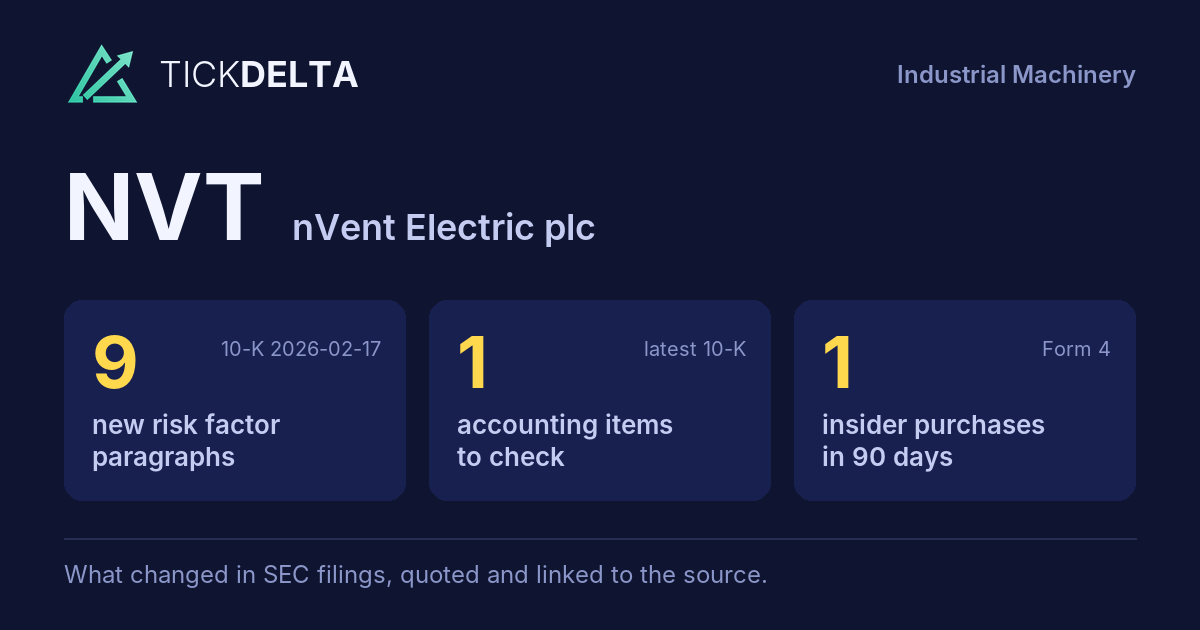
of the text changed · 9,063 words now · 9 new paragraphs, 5 gone
MD&A
18.3%
of the text changed · 7,713 words now · 10 new paragraphs, 9 gone
Legal Proceedings
0.0%
of the text changed · 555 words now
Accounting Policies
2.4%
of the text changed · 3,963 words now
10-K 0001628280-26-008608 (Feb 17, 2026) vs 10-K 0001720635-25-000018 (Feb 18, 2025)
Every paragraph, and how much of it changed
One bar per paragraph, in the order of the 10-K. Height and colour show the share of its words not in the closest paragraph a year earlier; the tallest bars are new paragraphs.
Risk Factors
115 paragraphs · 9 new · 17 reworded · 5 gone · 10-K Feb 17, 2026 against Feb 18, 2025
New paragraph
Reworded (5% of its words or more)
Same or nearly
Paragraph 48 · 46% changed
Every version of it
As a result of changes to U.S. and foreign government administrative policy, there may be changes to existing trade agreements, greater restrictions on free trade generally, the imposition of or significant increases in tariffs on goods imported into the U.S. particularly tariffs on steel, aluminum and copper and products manufactured in China, Canada and Mexico, and adverse responses by foreign governments to U.S. trade policies, among other possible changes. The U.S. administration has Beginning in the second quarter of 2025, new tariffs were announced it intends on imports to implement or increase tariffs and it remains unclear what the U.S. administration (“U.S. Tariffs”), including additional tariffs on imports from China, Mexico and the European Union (“EU”), among others. In response, several countries have imposed, or foreign governments will or will not do with respect threatened to impose, reciprocal tariffs or trade agreements on imports from the U.S. and policies. A trade war, other governmental action related retaliatory measures. Various modifications to tariffs or trade agreements, the U.S. Tariffs have been announced and further changes in U.S. social, political, regulatory and economic conditions or in laws and policies governing foreign trade, manufacturing, development and investment could be made in the territories and countries where we currently purchase, manufacture and sell products, and any resulting negative sentiments towards the U.S. as a result future. The ultimate impact of such changes, could have a material adverse effect on our business, financial condition, results of operations and cash flows. changes remains uncertain
Paragraph 49 · 43% changed
Every version of it
Paragraph 7 · 36% changed
Every version of it
Paragraph 63 · 29% changed
Every version of it
Cybersecurity threats from user error to attacks designed to gain unauthorized access to our systems, networks and data are increasing in frequency and sophistication. sophistication, including the risk that threat actors will leverage emerging technology, such as artificial intelligence, to exploit vulnerabilities. These threats pose a risk to the security of our systems and networks and the confidentiality, availability and integrity of the data we process and maintain and pose a risk of theft to our assets. The risk of cybersecurity attacks may increase as artificial intelligence capabilities improve and are increasingly used to identify vulnerabilities and construct increasingly sophisticated cybersecurity attacks, with the possibility of additional vulnerabilities being introduced through our own use of artificial intelligence and its use by our stakeholders, including vendors and customers. Establishing systems and processes to address these threats and changes in legal requirements relating to data collection and storage may increase our costs. Previous cybersecurity incidents have not materially affected us, including our business strategy, results of operations or financial condition. There can be no assurance of similar results in the future. Should future attacks succeed, it could expose us and our employees, customers, distributors and suppliers to the theft of assets, misuse of information or systems, the compromising of confidential information, manipulation and destruction of data, product failures, production downtimes and operations disruptions. The occurrence of any of these events could have a material adverse effect on our reputation, business, financial condition, results of operations and cash flows. In addition, such cybersecurity
Paragraph 6 · 25% changed
Every version of it
We operate in global markets that are characterized by customer demand that is often global in scope but localized in delivery. We compete with thousands of smaller regional and local companies that may be positioned to offer products produced at lower cost than ours, or to capitalize on highly localized relationships. Also, in several emerging markets potential customers prefer local suppliers, in some cases because of existing relationships and in other cases because of local legal restrictions or incentives that favor local businesses. In addition, we need to be flexible to adapt our products to ever changing customer preferences, including those relating to regulatory, climate change sustainability and social responsibility matters. Accordingly, our future success depends upon a number of factors, including our ability to adapt our products, services, organization, workforce and sales strategies to fit localities throughout the world, particularly in high-growth emerging markets; identify emerging technological and other trends in our target end markets; and develop or acquire competitive products and services and bring them to market quickly and cost-effectively. The failure to effectively adapt our products or services could have a material adverse effect on our business, financial condition, results of operations and cash flows.
Paragraph 4 · 24% changed
Every version of it
The markets for our products and services are geographically diverse and highly competitive. We compete against large and well-established national and global companies, as well as regional and local companies and lower-cost manufacturers. Competition may also result from new entrants into the markets we serve offering products and/or services that compete with ours. We compete based on technical expertise, reputation for quality and reliability, timeliness of delivery, previous installation history, contractual terms and price. Some of our competitors attempt to compete based primarily on price, localized expertise and local relationships. In addition, economic downturns could adversely affect pricing as market participants compete more aggressively on price. If we are unable to continue to differentiate our products, services and solutions, or if our pricing is adversely impacted or we incur additional costs to remain competitive, it could have a material adverse effect on our business, financial condition, results of operations and cash flows.
Paragraph 18 · 11% changed
Every version of it
In 2024 2025 and 2023, 2024, we experienced inflationary increases of raw materials, logistics and labor costs. We strive for productivity improvements and implement increases in selling prices to help mitigate cost increases in raw materials, freight, energy, wage and other costs such as pension, health care and insurance. We continue to implement operational initiatives in order to mitigate the impact of this inflation and continuously reduce our costs. However, these actions may not be successful in managing our costs or increasing our productivity. Continued cost inflation or failure of our initiatives to increase prices, generate cost savings or improve productivity could have a material adverse effect on our business, financial condition, results of operations and cash flows.
Paragraph 21 · 50% changed
Every version of it
10-K Feb 18, 2025Our business is subject to risks associated with global manufacturing and sourcing. We use a variety of raw materials in the production of our products including steel, copper, aluminum and paints. We also purchase certain electronic components, electrical and packaging materials from a number of suppliers. Although we regularly monitor the financial health and operations of companies in our supply chain, and use alternative suppliers when necessary and available, supply chain constraints could cause a disruption in our ability to obtain raw materials or components required to manufacture our products and adversely affect our operations. Significant shortages in the availability of these materials or price increases could increase our operating costs and adversely impact the competitive positions of our products. We rely on materials, components and finished goods that are sourced from or manufactured in locations outside the U.S., including Mexico, China and other countries, and these countries may experience political or trade instability, which could disrupt our supply of products or materials. We rely on our suppliers to produce high quality materials, components and finished goods according to our specifications. Although we have quality control procedures in place, there is a risk that products may not meet our specifications which could impact our ability to ship quality products to our customers on a timely basis.
10-K Feb 17, 2026
materials. We rely on our suppliers to produce high quality materials, components and finished goods according to our specifications. Although we have quality control procedures in place, there is a risk that products may not meet our specifications which could impact our ability to ship quality products to our customers on a timely basis.
Paragraph 48 · 46% changed
Every version of it
10-K Feb 18, 2025
As a result of changes to U.S. and foreign government administrative policy, there may be changes to existing trade agreements, greater restrictions on free trade generally, the imposition of or significant increases in tariffs on goods imported into the U.S. particularly tariffs on products manufactured in China, Canada and Mexico, and adverse responses by foreign governments to U.S. trade policies, among other possible changes. The U.S. administration has announced it intends to implement or increase tariffs and it remains unclear what the U.S. administration or foreign governments will or will not do with respect to tariffs or trade agreements and policies. A trade war, other governmental action related to tariffs or trade agreements, changes in U.S. social, political, regulatory and economic conditions or in laws and policies governing foreign trade, manufacturing, development and investment in the territories and countries where we currently purchase, manufacture and sell products, and any resulting negative sentiments towards the U.S. as a result of such changes, could have a material adverse effect on our business, financial condition, results of operations and cash flows.
10-K Feb 17, 2026
As a result of changes to U.S. and foreign government administrative policy, there may be changes to existing trade agreements, greater restrictions on free trade generally, the imposition of or significant increases in tariffs on goods imported into the U.S. particularly tariffs on steel, aluminum and copper and products manufactured in China, Canada and Mexico, and adverse responses by foreign governments to U.S. trade policies, among other possible changes. Beginning in the second quarter of 2025, new tariffs were announced on imports to the U.S. (“U.S. Tariffs”), including additional tariffs on imports from China, Mexico and the European Union (“EU”), among others. In response, several countries have imposed, or threatened to impose, reciprocal tariffs on imports from the U.S. and other retaliatory measures. Various modifications to the U.S. Tariffs have been announced and further changes could be made in the future. The ultimate impact of such changes remains uncertain
Paragraph 49 · 43% changed
Every version of it
10-K Feb 18, 2025As a result of changes to U.S. and foreign government administrative policy, there may be changes to existing trade agreements, greater restrictions on free trade generally, the imposition of or significant increases in tariffs on goods imported into the U.S. particularly tariffs on products manufactured in China, Canada and Mexico, and adverse responses by foreign governments to U.S. trade policies, among other possible changes. The U.S. administration has announced it intends to implement or increase tariffs and it remains unclear what the U.S. administration or foreign governments will or will not do with respect to tariffs or trade agreements and policies. A trade war, other governmental action related to tariffs or trade agreements, changes in U.S. social, political, regulatory and economic conditions or in laws and policies governing foreign trade, manufacturing, development and investment in the territories and countries where we currently purchase, manufacture and sell products, and any resulting negative sentiments towards the U.S. as a result of such changes, could have a material adverse effect on our business, financial condition, results of operations and cash flows.
10-K Feb 17, 2026
and will depend on several factors, including whether additional or incremental U.S. Tariffs or other measures are announced or imposed, to what extent other countries implement tariffs or other retaliatory measures in response, and the overall magnitude and duration of these measures. Additionally, the U.S. government has announced enhanced focus on customs enforcement, including through the creation of a Trade Fraud Task Force, a cross-agency initiative of the U.S. Departments of Justice and Homeland Security to address trade fraud, tariff evasion, and customs violations. This heightened enforcement paradigm, along with the ongoing litigation regarding tariffs imposed under the International Emergency Economic Powers Act (IEEPA) that was recently heard by the U.S. Supreme Court, have created additional uncertainty as to the scale and short and long-term effect these tariffs will have. A trade war, other governmental action related to tariffs or trade agreements, changes in U.S. social, political, regulatory and economic conditions or in laws and policies governing foreign trade, manufacturing, development and investment in the territories and countries where we currently purchase, manufacture and sell products, and any resulting negative sentiments towards the U.S. as a result of such changes, could have a material adverse effect on our business, financial condition, results of operations and cash flows.
Paragraph 7 · 36% changed
Every version of it
10-K Feb 18, 2025We operate in global markets that are characterized by customer demand that is often global in scope but localized in delivery. We compete with thousands of smaller regional and local companies that may be positioned to offer products produced at lower cost than ours, or to capitalize on highly localized relationships. Also, in several emerging markets potential customers prefer local suppliers, in some cases because of existing relationships and in other cases because of local legal restrictions or incentives that favor local businesses. In addition, we need to be flexible to adapt our products to ever changing customer preferences, including those relating to regulatory, climate change and social responsibility matters. Accordingly, our future success depends upon a number of factors, including our ability to adapt our products, services, organization, workforce and sales strategies to fit localities throughout the world, particularly in high-growth emerging markets; identify emerging technological and other trends in our target end markets; and develop or acquire competitive products and services and bring them to market quickly and cost-effectively. The failure to effectively adapt our products or services could have a material adverse effect on our business, financial condition, results of operations and cash flows.
10-K Feb 17, 2026
success depends upon a number of factors, including our ability to adapt our products, services, organization, workforce and sales strategies to fit localities throughout the world, particularly in high-growth emerging markets; identify emerging technological and other trends in our target end markets; and develop or acquire competitive products and services and bring them to market quickly and cost-effectively. The failure to effectively adapt our products or services could have a material adverse effect on our business, financial condition, results of operations and cash flows.
Paragraph 63 · 29% changed
Every version of it
10-K Feb 18, 2025
Cybersecurity threats from user error to attacks designed to gain unauthorized access to our systems, networks and data are increasing in frequency and sophistication. These threats pose a risk to the security of our systems and networks and the confidentiality, availability and integrity of the data we process and maintain and pose a risk of theft to our assets. The risk of cybersecurity attacks may increase as artificial intelligence capabilities improve and are increasingly used to identify vulnerabilities and construct increasingly sophisticated cybersecurity attacks, with the possibility of additional vulnerabilities being introduced through our own use of artificial intelligence and its use by our stakeholders, including vendors and customers. Establishing systems and processes to address these threats and changes in legal requirements relating to data collection and storage may increase our costs. Previous cybersecurity incidents have not materially affected us, including our
10-K Feb 17, 2026
Cybersecurity threats from user error to attacks designed to gain unauthorized access to our systems, networks and data are increasing in frequency and sophistication, including the risk that threat actors will leverage emerging technology, such as artificial intelligence, to exploit vulnerabilities. These threats pose a risk to the security of our systems and networks and the confidentiality, availability and integrity of the data we process and maintain and pose a risk of theft to our assets. The risk of cybersecurity attacks may increase as artificial intelligence capabilities improve and are increasingly used to identify vulnerabilities and construct increasingly sophisticated cybersecurity attacks, with the possibility of additional vulnerabilities being introduced through our own use of artificial intelligence and its use by our stakeholders, including vendors and customers. Establishing systems and processes to address these threats and changes in legal requirements relating to data collection and storage may increase our costs. Previous cybersecurity incidents have not materially affected us, including our business strategy, results of operations or financial condition. There can be no assurance of similar results in the future. Should future attacks succeed, it could expose us and our employees, customers, distributors and suppliers to the theft of assets, misuse of information or systems, the compromising of confidential information, manipulation and destruction of data, product failures, production downtimes and operations disruptions. The occurrence of any of these events could have a material adverse effect on our reputation, business, financial condition, results of operations and cash flows. In addition, such cybersecurity
Paragraph 6 · 25% changed
Every version of it
10-K Feb 18, 2025
We operate in global markets that are characterized by customer demand that is often global in scope but localized in delivery. We compete with thousands of smaller regional and local companies that may be positioned to offer products produced at lower cost than ours, or to capitalize on highly localized relationships. Also, in several emerging markets potential customers prefer local suppliers, in some cases because of existing relationships and in other cases because of local legal restrictions or incentives that favor local businesses. In addition, we need to be flexible to adapt our products to ever changing customer preferences, including those relating to regulatory, climate change and social responsibility matters. Accordingly, our future success depends upon a number of factors, including our ability to adapt our products, services, organization, workforce and sales strategies to fit localities throughout the world, particularly in high-growth emerging markets; identify emerging technological and other trends in our target end markets; and develop or acquire competitive products and services and bring them to market quickly and cost-effectively. The failure to effectively adapt our products or services could have a material adverse effect on our business, financial condition, results of operations and cash flows.
10-K Feb 17, 2026
We operate in global markets that are characterized by customer demand that is often global in scope but localized in delivery. We compete with thousands of smaller regional and local companies that may be positioned to offer products produced at lower cost than ours, or to capitalize on highly localized relationships. Also, in several emerging markets potential customers prefer local suppliers, in some cases because of existing relationships and in other cases because of local legal restrictions or incentives that favor local businesses. In addition, we need to be flexible to adapt our products to ever changing customer preferences, including those relating to regulatory, sustainability and social responsibility matters. Accordingly, our future
Paragraph 4 · 24% changed
Every version of it
10-K Feb 18, 2025
installation history, contractual terms and price. Some of our competitors attempt to compete based primarily on price, localized expertise and local relationships. In addition, economic downturns could adversely affect pricing as market participants compete more aggressively on price. If we are unable to continue to differentiate our products, services and solutions, or if our pricing is adversely impacted or we incur additional costs to remain competitive, it could have a material adverse effect on our business, financial condition, results of operations and cash flows.
10-K Feb 17, 2026
The markets for our products and services are geographically diverse and highly competitive. We compete against large and well-established national and global companies, as well as regional and local companies and lower-cost manufacturers. Competition may also result from new entrants into the markets we serve offering products and/or services that compete with ours. We compete based on technical expertise, reputation for quality and reliability, timeliness of delivery, previous installation history, contractual terms and price. Some of our competitors attempt to compete based primarily on price, localized expertise and local relationships. In addition, economic downturns could adversely affect pricing as market participants compete more aggressively on price. If we are unable to continue to differentiate our products, services and solutions, or if our pricing is adversely impacted or we incur additional costs to remain competitive, it could have a material adverse effect on our business, financial condition, results of operations and cash flows.
Paragraph 18 · 11% changed
Every version of it
10-K Feb 18, 2025
In 2024 and 2023, we experienced inflationary increases of raw materials, logistics and labor costs. We strive for productivity improvements and implement increases in selling prices to help mitigate cost increases in raw materials, freight, energy, wage and other costs such as pension, health care and insurance. We continue to implement operational initiatives in order to mitigate the impact of this inflation and continuously reduce our costs. However, these actions may not be successful in managing our costs or increasing our productivity. Continued cost inflation or failure of our initiatives to increase prices, generate cost savings
10-K Feb 17, 2026
In 2025 and 2024, we experienced inflationary increases of raw materials, logistics and labor costs. We strive for productivity improvements and implement increases in selling prices to help mitigate cost increases in raw materials, freight, energy, wage and other costs such as pension, health care and insurance. We continue to implement operational initiatives in order to mitigate the impact of this inflation and continuously reduce our costs. However, these actions may not be successful in managing our costs or increasing our productivity. Continued cost inflation or failure of our initiatives to increase prices, generate cost savings or improve productivity could have a material adverse effect on our business, financial condition, results of operations and cash flows.
MD&A
133 paragraphs · 10 new · 65 reworded · 9 gone · 10-K Feb 17, 2026 against Feb 18, 2025
New paragraph
Reworded (5% of its words or more)
Same or nearly
Paragraph 14 · 46% changed
•During 2023 2024 and 2024, 2025, we experienced general inflationary increases, primarily related to labor labor, transportation and raw material costs. In addition, we continue to monitor and evaluate recently implemented tariffs, and the potential imposition of modified or additional tariffs. We may experience increased supply chain challenges, inflationary cost increases, and economic uncertainty due to the rapid changes in global trade policies. The effects from new tariffs imposed in 2025 did not have a material impact on our financial results in 2025 due to mitigating actions. We have taken pricing actions, and may take additional pricing actions going forward, and implemented implemented, and plan to continue to implement, supply chain optimization and other productivity improvements that have helped, and could help continue to help, offset these expected cost increases. We Given the uncertainty regarding the scope and duration of tariffs and other changes in trade policies, the potential impact remains uncertain, but we expect inflationary cost increases, including the impacts of related to tariffs, to continue into 2025, in 2026 and beyond, which could negatively impact our results of operations.
Paragraph 37 · 36% changed
Paragraph 79 · 35% changed
In September 2021, the Company nVent and its subsidiaries nVent Finance and Hoffman Schroff Holdings, Inc. entered into an amended and restated credit agreement (the "Credit "2021 Credit Agreement") with a syndicate of banks providing for a five-year $300.0 million senior unsecured term loan facility (the "2021 Term Loan Facility") and a five-year $600.0 million senior unsecured revolving credit facility (the "Revolving Credit Facility" and, together with facility. In 2025, nVent repaid the remainder of the borrowings on the 2021 Term Loan Facility, the "Senior Credit Facilities"). Borrowings under the 2021 Term Loan Facility were permitted on a delayed draw basis during the first year of the five-year term of the 2021 Term Loan Facility, and borrowings under the Revolving Credit Facility are permitted from time to time during the full five-year term of the Revolving Credit Facility. In September 2022, nVent exercised the delayed draw provision of the 2021 Term Loan Facility, increasing the total borrowings under the 2021 Term Loan Facility by $200.0 million to $300.0 million. nVent Finance has the option to request to increase the Revolving Credit Facility in an aggregate amount of up to $300.0 million, subject to customary conditions, including the commitment of the participating lenders.
Paragraph 100 · 34% changed
Paragraph 83 · 33% changed
In April 2023, nVent and nVent Finance entered into a loan agreement providing for another senior unsecured term loan facility of $300.0 million for five years (the "2023 Term Loan Facility"), which was used to fund the acquisition of ECM Industries. The In 2025, nVent repaid the remainder of the borrowings on the 2023 Term Loan Facility bears interest at a rate equal to an adjusted base rate or adjusted term SOFR plus, in each case, an applicable margin. The applicable margin will be based on, at nVent Finance’s election, the Company's leverage level or public credit rating. Facility.
Paragraph 84 · 31% changed
In June 2024, nVent and nVent Finance entered into a new loan agreement providing for an additional senior unsecured term loan facility of $500.0 million for two years (the "2024 Term Loan Facility"). In July 2024, we partially financed the acquisition of Trachte using the 2024 Term Loan Facility. The In 2025, nVent repaid the remainder of the borrowings on the 2024 Term Loan Facility bears interest at a rate equal to an adjusted base rate or adjusted term SOFR plus, in each case, an applicable margin. The applicable margin will be based on, at nVent Finance's election, the Company's leverage level or public credit rating. Facility.
Paragraph 26 · 29% changed
•inflationary increases, including the impacts related to tariffs, primarily related to raw materials and labor costs and raw materials, costs, compared to 2023; 2024; and
Paragraph 55 · 29% changed
•sales of $240.7 $46.0 million in 2023 2025 as a result of the ECM Industries acquisition; and Electrical Products Group acquisition.
Paragraph 14 · 46% changed
10-K Feb 18, 2025
•During 2023 and 2024, we experienced inflationary increases, primarily related to labor and raw material costs. We have taken pricing actions and implemented productivity improvements that could help offset these cost increases. We expect inflationary cost increases, including the impacts of tariffs, to continue into 2025, which could negatively impact our results of operations.
10-K Feb 17, 2026
•During 2024 and 2025, we experienced general inflationary increases, primarily related to labor, transportation and raw material costs. In addition, we continue to monitor and evaluate recently implemented tariffs, and the potential imposition of modified or additional tariffs. We may experience increased supply chain challenges, inflationary cost increases, and economic uncertainty due to the rapid changes in global trade policies. The effects from new tariffs imposed in 2025 did not have a material impact on our financial results in 2025 due to mitigating actions. We have taken pricing actions, and may take additional pricing actions going forward, and implemented, and plan to continue to implement, supply chain optimization and other productivity improvements that have helped, and could continue to help, offset expected cost increases. Given the uncertainty regarding the scope and duration of tariffs and other changes in trade policies, the potential impact remains uncertain, but we expect inflationary cost increases, including impacts related to tariffs, to continue in 2026 and beyond, which could negatively impact our results of operations.
Paragraph 37 · 36% changed
10-K Feb 18, 2025The 12.6 percent increase in net sales in 2024 from 2023 was primarily the result of:
10-K Feb 17, 2026
Income from discontinued operations, net of tax, of $281.7 million in 2025 was primarily the result of:
Paragraph 79 · 35% changed
10-K Feb 18, 2025
In September 2021, the Company and its subsidiaries nVent Finance and Hoffman Schroff Holdings, Inc. entered into an amended and restated credit agreement (the "Credit Agreement") with a syndicate of banks providing for a five-year $300.0 million senior unsecured term loan facility (the "2021 Term Loan Facility") and a five-year $600.0 million senior unsecured revolving credit facility (the "Revolving Credit Facility" and, together with the 2021 Term Loan Facility, the "Senior Credit Facilities"). Borrowings under the 2021 Term Loan Facility were permitted on a delayed draw basis during the first year of the five-year term of the 2021 Term Loan Facility, and borrowings under the Revolving Credit Facility are permitted from time to time during the full five-year term of the Revolving Credit Facility. In September 2022, nVent exercised the delayed draw provision of the 2021 Term Loan Facility, increasing the total borrowings under the 2021 Term Loan Facility by $200.0 million to $300.0 million. nVent Finance has the option to request to increase the Revolving Credit Facility in an aggregate amount of up to $300.0 million, subject to customary conditions, including the commitment of the participating lenders.
10-K Feb 17, 2026
In September 2021, nVent and its subsidiaries nVent Finance and Hoffman Schroff Holdings, Inc. entered into an amended and restated credit agreement (the "2021 Credit Agreement") with a syndicate of banks providing for a five-year $300.0 million senior unsecured term loan facility (the "2021 Term Loan Facility") and a five-year $600.0 million senior unsecured revolving credit facility. In 2025, nVent repaid the remainder of the borrowings on the 2021 Term Loan Facility.
Paragraph 100 · 34% changed
10-K Feb 18, 2025In addition to measuring our cash flow generation or usage based upon operating, investing and financing classifications included in the Consolidated Statements of Cash Flows, we also measure our free cash flow. Free cash flow is a non-GAAP financial measure that we use to assess our cash flow performance. We believe free cash flow is an important measure of liquidity because it provides us and our investors a measurement of cash generated from operations that is available to pay dividends, make acquisitions, repay debt and repurchase shares. In addition, free cash flow is used as a criterion to measure and pay annual incentive compensation. Our measure of free cash flow may not be comparable to similarly titled measures reported by other companies.
10-K Feb 17, 2026
dividends, make acquisitions, repay debt and repurchase shares. In addition, free cash flow is used as a criterion to measure and pay annual incentive compensation. Our measure of free cash flow may not be comparable to similarly titled measures reported by other companies.
Paragraph 83 · 33% changed
10-K Feb 18, 2025
In April 2023, nVent and nVent Finance entered into a loan agreement providing for another senior unsecured term loan facility of $300.0 million for five years (the "2023 Term Loan Facility"), which was used to fund the acquisition of ECM Industries. The 2023 Term Loan Facility bears interest at a rate equal to an adjusted base rate or adjusted term SOFR plus, in each case, an applicable margin. The applicable margin will be based on, at nVent Finance’s election, the Company's leverage level or public credit rating.
10-K Feb 17, 2026
In April 2023, nVent and nVent Finance entered into a loan agreement providing for another unsecured term loan facility of $300.0 million for five years (the "2023 Term Loan Facility"), which was used to fund the acquisition of ECM Industries. In 2025, nVent repaid the remainder of the borrowings on the 2023 Term Loan Facility.
Paragraph 84 · 31% changed
10-K Feb 18, 2025
In June 2024, nVent and nVent Finance entered into a new loan agreement providing for an additional senior unsecured term loan facility of $500.0 million for two years (the "2024 Term Loan Facility"). In July 2024, we partially financed the acquisition of Trachte using the 2024 Term Loan Facility. The 2024 Term Loan Facility bears interest at a rate equal to an adjusted base rate or adjusted term SOFR plus, in each case, an applicable margin. The applicable margin will be based on, at nVent Finance's election, the Company's leverage level or public credit rating.
10-K Feb 17, 2026
In June 2024, nVent and nVent Finance entered into a loan agreement providing for an additional senior unsecured term loan facility of $500.0 million for two years (the "2024 Term Loan Facility"). In July 2024, we partially financed the acquisition of Trachte using the 2024 Term Loan Facility. In 2025, nVent repaid the remainder of the borrowings on the 2024 Term Loan Facility.
Paragraph 26 · 29% changed
10-K Feb 18, 2025
•inflationary increases, primarily related to labor costs and raw materials, compared to 2023; and
10-K Feb 17, 2026
•inflationary increases, including the impacts related to tariffs, primarily related to raw materials and labor costs, compared to 2024; and
Paragraph 55 · 29% changed
10-K Feb 18, 2025
•sales of $240.7 million in 2023 as a result of the ECM Industries acquisition; and
10-K Feb 17, 2026
•sales of $46.0 million in 2025 as a result of the Electrical Products Group acquisition.
A paragraph is matched with the one last year that shares the most of its words; under half in common makes it new. The paragraphs shown are the 8 reworded the most in each section.
The paragraph that changed most in each section
The redline
Marked against last year's 10-K: cut words struck through, new words highlighted.
Risk Factors208 words changed in this paragraph; it is 37% similar to last year's version.
Further, concern over climate change has led to legislative and regulatory initiatives across various jurisdictions in which we are subject to additional federal, state, international and national European and U.S. regulations relating to climate and environmental risk, which are continually evolving. Regulators in Europe and the U.S. have focused efforts on increased disclosure operate related to climate change disclosures and mitigation efforts. The European Union adopted reporting, including for example the European Sustainability Reporting Standards and the Corporate Sustainability Reporting Directive ("CSRD") Directive. Proposals that imposes would impose mandatory disclosure of the risks requirements on sustainability matters and opportunities arising from social and environmental issues, and on the impact of companies’ activities on people and the environment. Similarly, the State of California recently passed the Climate Corporate Data Accountability Act and the Climate-Related Financial Risk Act that will impose broad climate-related disclosure obligations on certain companies doing business in California, including us, starting in 2026. We will likely need greenhouse gas emissions continue to be prepared considered by policy makers and regulators. We cannot predict what climate change related legislation or regulations will be enacted in the future or how existing or future laws or regulations will be administered or interpreted, or if and to contend with overlapping, yet distinct, climate-related disclosure requirements in multiple jurisdictions. what extent existing or future laws or regulations may be subsequently rolled back. Compliance may significantly increase compliance burdens and associated regulatory costs and complexity, and the failure to comply with such legislation and regulations could result in fines to us, and could affect our business, financial condition, results of operations and cash flows.
Source: Item 1A, 10-K 0001628280-26-008608 vs Item 1A, 10-K 0001720635-25-000018
MD&A204 words changed in this paragraph; it is 64% similar to last year's version.
Source: Item 7, 10-K 0001628280-26-008608 vs Item 7, 10-K 0001720635-25-000018
Accounting Policies65 words changed in this paragraph; it is 82% similar to last year's version.
On July 31, 2024, we entered into a definitive agreement to sell our Thermal Management business to BCP VI Summit Holdings LP (as assignee of BCP Acquisitions LLC), an affiliate of funds managed by Brookfield Asset Management, for a purchase price Management. We completed the sale of $1.7 the Thermal Management business on January 30, 2025, which resulted in $1.6 billion in cash, net cash proceeds, subject to certain customary purchase price adjustments. As a result of the agreement, the Thermal Management business met the criteria set forth in Accounting Standards Codification ("ASC") 205-20 to be presented as a discontinued operation and the related assets and liabilities have been reclassified presented as held for sale for all periods presented. The Thermal Management business was previously disclosed as a stand-alone reporting segment. sale. The Thermal Management business' results of operations and the related cash flows have been reclassified to are reflected in Income from discontinued operations, net of tax in the Consolidated Statements of Operations and Comprehensive Income and cash flows from discontinued operations in the Consolidated Statements of Cash Flows, respectively, for all periods presented. We completed the sale of the Thermal Management business on January 30, 2025. For additional information regarding this transaction and its effect on our financial reporting, see Note 6 below.
Source: Item 8, Note 1 – Basis of Presentation and Summary of Significant Accounting Policies, 10-K 0001628280-26-008608 vs Item 8, Note 1 – Basis of Presentation and Summary of Significant Accounting Policies, 10-K 0001720635-25-000018
Sentences and paragraphs added, removed or reworded
Every change, by type
Sentences and paragraphs of NVT's Risk Factors and MD&A, 10-K Feb 17, 2026 against 10-K Feb 18, 2025. Each links to the text at sec.gov.
Quiet changes are sentences kept from last year with one to four words changed, at least one of them a hedge, a modal or a qualifier (may, could, will, not, significant, material…). A year or date rolling forward is not counted.
The full word list
adverse, adversely, all, although, anticipate, anticipates, any, approximately, believe, believes, can, cannot, certain, could, expect, expects, generally, however, if, intend, intends, largely, likely, many, material, materially, may, might, most, must, never, no, not, possible, primarily, probable, should, significant, significantly, some, substantial, substantially, unlikely, will, would
AddedRisk Factors
A loss of, or material cancellation, reduction, or delay in purchases by or delivery of products to, one or more of our largest customers could harm our business.
Read it in 10-K Feb 17, 2026 at sec.gov
AddedRisk Factors
Our net sales to our largest customer represented approximately 11% of our consolidated net sales in 2025. While we do not have any other customers that accounted for more than 10% of our consolidated net sales in 2025, we have other customers that are key to the success of our business. Our concentration of sales to a number of larger customers makes our relationship with each of these customers important to our business. Our success is dependent on retaining these customers, which requires us to successfully manage relationships and anticipate the needs of our customers in the channels in which we sell our products. Our customers also may be impacted by economic conditions in the industries of those customers, which could result in reduced demand for or a delay in purchases of our products. In addition, our customers may cancel orders for purchases of our products or may not order products at rates consistent with past order levels, or we may not be able to timely deliver products to our largest customers due to supply chain interruptions or otherwise. We cannot provide assurance that we will be able to retain our largest customers. In addition, some of our customers may shift their purchases to our competitors in the future. The loss of one or more of our largest customers, any material cancellation, reduction, or delay in purchases by or delivery of products to these customers, or our inability to successfully develop relationships with additional customers could have a material adverse effect on our business, financial condition, results of operations and cash flows.
Read it in 10-K Feb 17, 2026 at sec.gov
AddedRisk Factors
Growing concerns over climate change have resulted in, and may continue to result in, new laws, regulations and accords intended to reduce or limit emissions of certain greenhouse gases. Existing and new laws, regulations and accords relating to emissions of certain greenhouse gases may be difficult and costly to comply with, may adversely impact certain aspects of our operations (including but not limited to the manufacture and distribution of our products), may adversely impact certain industries in which we operate, may result in increased energy, input, compliance and other costs, and may decrease demand for certain of our products. Because it is uncertain what laws will be enacted, we cannot predict the potential impact of such laws on our future financial condition, results of operations and cash flows.
Read it in 10-K Feb 17, 2026 at sec.gov
AddedRisk Factors
Further, concern over climate change has led to legislative and regulatory initiatives across various jurisdictions in which we operate related to disclosures and reporting, including for example the European Sustainability Reporting Standards and the Corporate Sustainability Reporting Directive. Proposals that would impose mandatory disclosure requirements on sustainability matters and greenhouse gas emissions continue to be considered by policy makers and regulators. We cannot predict what climate change related legislation or regulations will be enacted in the future or how existing or future laws or regulations will be administered or interpreted, or if and to what extent existing or future laws or regulations may be subsequently rolled back. Compliance may significantly increase compliance burdens and associated regulatory costs and complexity, and the failure to comply with such legislation and regulations could result in fines to us, and could affect our business, financial condition, results of operations and cash flows.
Read it in 10-K Feb 17, 2026 at sec.gov
AddedRisk Factors
We may make public statements about various sustainability-related matters and initiatives from time to time, including on our website, in our press releases, in our sustainability report, and in other communications. Addressing stakeholder expectations and regulatory requirements relating to sustainability matters requires an investment of time, money and other resources, any or all of which may increase our cost of doing business. As investor and other stakeholder expectations relating to sustainability matters change and evolve over time, any failure or perceived failure by us to adequately address those expectations may damage our reputation , which could adversely impact the perception of our brands and our products and services by current and potential investors and customers, which could in turn adversely impact our business, results of operations or financial condition.
Read it in 10-K Feb 17, 2026 at sec.gov
AddedRisk Factors
incidents could result in litigation, regulatory action and potential liability and the costs and operational consequences of implementing further cybersecurity measures.
Read it in 10-K Feb 17, 2026 at sec.gov
AddedRisk Factors
We may use artificial intelligence in our business, and challenges with properly managing its use could result in potential regulatory, financial and reputational risks.
Read it in 10-K Feb 17, 2026 at sec.gov
AddedRisk Factors
We may use artificial intelligence in our business operations. Challenges associated with developing, deploying and governing such technologies could adversely affect our business, reputation and competitive position. The development and use of artificial intelligence involve risks, including the potential for inaccurate, incomplete or biased outputs, that could lead to errors in our decision-making and adversely impact business operations. In addition, employee use of artificial intelligence tools could result in the inadvertent disclosure of confidential or proprietary information to third parties, the misuse of our intellectual property or claims that we have violated third party intellectual property rights.
Read it in 10-K Feb 17, 2026 at sec.gov
Show the other 45
AddedRisk Factors
The rapid evolution of artificial intelligence technologies, together with emerging and potentially divergent governmental regulations and industry standards, may require ongoing investment in governance, monitoring, data security, training and compliance. Failure to appropriately develop, manage, secure and oversee our artificial intelligence activities could expose us to legal liability, operational disruptions, reputational harm and other adverse effects on our business and results of operations.
Read it in 10-K Feb 17, 2026 at sec.gov
RemovedRisk Factors
RemovedRisk Factors
RemovedRisk Factors
RemovedRisk Factors
RemovedRisk Factors
RewordedRisk Factors
Continued cost inflation or failure of our initiatives to increase prices, generate cost savings or improve productivity could have a material adverse effect on our business, financial condition, results of operations and cash flows.
Read it in 10-K Feb 17, 2026 at sec.gov
RewordedRisk Factors
Cybersecurity threats from user error to attacks designed to gain unauthorized access to our systems, networks and data are increasing in frequency and sophistication. sophistication, including the risk that threat actors will leverage emerging technology, such as artificial intelligence, to exploit vulnerabilities.
Read it in 10-K Feb 17, 2026 at sec.gov
RewordedRisk Factors
The Pillar II framework has been implemented by several jurisdictions, including jurisdictions in which we operate, with effect from January 1, 2024, which resulted in an increase to our effective tax rate in 2024.
Read it in 10-K Feb 17, 2026 at sec.gov
RewordedRisk Factors
It may be difficult for us to complete transactions quickly and to integrate acquired operations efficiently into our business operations. operations or realize expected financial benefits of acquired businesses.
Read it in 10-K Feb 17, 2026 at sec.gov
RewordedRisk Factors
Previous cybersecurity incidents have not materially affected us, including our business strategy, results of operations or financial condition.
Read it in 10-K Feb 17, 2026 at sec.gov
RewordedRisk Factors
The dollar amount of backlog as of December 31, 2024 2025 was $749.3 million. $2.3 billion.
Read it in 10-K Feb 17, 2026 at sec.gov
RewordedRisk Factors
Our evolution into smart connected products and Internet of Things subjects us to increased cyber and technology risks.
Read it in 10-K Feb 17, 2026 at sec.gov
RewordedRisk Factors
As a result of changes to U.S. and foreign government administrative policy, there may be changes to existing trade agreements, greater restrictions on free trade generally, the imposition of or significant increases in tariffs on goods imported into the U.S. particularly tariffs on steel, aluminum and copper and products manufactured in China, Canada and Mexico, and adverse responses by foreign governments to U.S. trade policies, among other possible changes.
Read it in 10-K Feb 17, 2026 at sec.gov
AddedMD&A
The following is the discussion and analysis of changes in the financial condition and results of operations for fiscal year 2025 compared to fiscal year 2024. The discussion and analysis of fiscal year 2023 and changes in the financial condition and results of operations for fiscal year 2024 compared to fiscal year 2023 that are not included in this Form 10-K may be found in Part II, ITEM 7 of our Annual Report on Form 10-K for the fiscal year ended December 31, 2024, filed with the SEC on February 18, 2025.
Read it in 10-K Feb 17, 2026 at sec.gov
AddedMD&A
On May 1, 2025, we completed the acquisition of the enclosures, switchgear and bus systems businesses of Avail Infrastructure Solutions (the "Electrical Products Group") for approximately $1.0 billion. We funded the purchase price for the acquisition with available cash on hand. The Electrical Products Group is a leading provider of infrastructure solutions, designed to help ensure safe and reliable electrical operations primarily in the infrastructure vertical, including power utilities and data centers. We operate the Electrical Products Group predominantly within our Systems Protection reporting segment.
Read it in 10-K Feb 17, 2026 at sec.gov
AddedMD&A
•interest income earned on the cash proceeds from the sale of the Thermal Management business.
Read it in 10-K Feb 17, 2026 at sec.gov
AddedMD&A
•the gain on the sale of the Thermal Management business, net of transaction costs, of $435.3 million, partially offset by tax expense recorded as a result of the sale of $152.7 million.
Read it in 10-K Feb 17, 2026 at sec.gov
AddedMD&A
2025 vs 2024 Price/growth/acquisition 3.4 pts Net productivity (4.8) Total (1.4) pts
Read it in 10-K Feb 17, 2026 at sec.gov
AddedMD&A
2025 vs 2024 Price/growth/acquisition 1.6 pts Net productivity (2.9) Total (1.3) pts
Read it in 10-K Feb 17, 2026 at sec.gov
AddedMD&A
The following table presents summarized financial information as of December 31, 2025 for the Obligor Group on a combined basis after elimination of (i) intercompany transactions and balances among the guarantors and issuer and (ii) equity in earnings from and investments in any subsidiary that is a non-Guarantor or issuer.
Read it in 10-K Feb 17, 2026 at sec.gov
AddedMD&A
In millions December 31, 2025 Current assets(1) $ 9.2 Noncurrent assets(2) 1,599.5 Current liabilities(3) 60.4 Noncurrent liabilities(4) 1,579.2
Read it in 10-K Feb 17, 2026 at sec.gov
AddedMD&A
The Obligor Group does not have material results of operations on a combined basis.
Read it in 10-K Feb 17, 2026 at sec.gov
AddedMD&A
a possible impairment of the intangible assets and goodwill or require acceleration of the amortization expense of finite-lived intangible assets.
Read it in 10-K Feb 17, 2026 at sec.gov
RemovedMD&A
RemovedMD&A
RemovedMD&A
RemovedMD&A
RemovedMD&A
RemovedMD&A
RemovedMD&A
RemovedMD&A
RemovedMD&A
RewordedMD&A
Years ended December 31 In millions 2025 2024 2023 2022 Net cash provided by (used for) operating activities of continuing operations $ 649.0 $ 501.0 $ 422.2 $ 273.3 Capital expenditures (93.3) (74.0) (65.6) (40.5) Proceeds from sale of property and equipment 5.3 0.5 0.1 2.0 Free cash flow of continuing operations $ 561.0 $ 427.5 356.7 234.8 Net cash provided by (used for) operating activities of discontinued operations 142.1 105.9 121.3 Capital expenditures of discontinued operations (7.8) (5.4) (5.4) Proceeds from sale of property and equipment of discontinued operations 0.2 7.4 — Total free cash flow $ 562.0 $ 464.6 $ 350.7
Read it in 10-K Feb 17, 2026 at sec.gov
RewordedMD&A
RewordedMD&A
RewordedMD&A
We have taken pricing actions, and may take additional pricing actions going forward, and implemented implemented, and plan to continue to implement, supply chain optimization and other productivity improvements that have helped, and could help continue to help, offset these expected cost increases.
Read it in 10-K Feb 17, 2026 at sec.gov
RewordedMD&A
On July 31, 2024, January 30, 2025, we entered into a definitive agreement to sell our completed the sale of the Thermal Management business to BCP VI Summit Holdings LP (as assignee of BCP Acquisitions LLC), an affiliate of funds managed by Brookfield Asset Management, for a purchase price of $1.7 $1.6 billion in cash, net cash proceeds, subject to certain customary purchase price adjustments.
Read it in 10-K Feb 17, 2026 at sec.gov
RewordedMD&A
In September 2021, the Company nVent and its subsidiaries nVent Finance and Hoffman Schroff Holdings, Inc. entered into an amended and restated credit agreement (the "Credit "2021 Credit Agreement") with a syndicate of banks providing for a five-year $300.0 million senior unsecured term loan facility (the "2021 Term Loan Facility") and a five-year $600.0 million senior unsecured revolving credit facility (the "Revolving Credit Facility" and, together with the 2021 Term Loan Facility, the "Senior Credit Facilities"). facility.
Read it in 10-K Feb 17, 2026 at sec.gov
RewordedMD&A
The guarantees of the Notes by the Parent Company Guarantor nVent Electric plc and Hoffman Schroff Holdings, Inc. constitute general unsecured obligations of the Parent Company Guarantor and rank equally in right of payment with all existing and future unsubordinated and unsecured indebtedness and liabilities of the Subsidiary Issuer. nVent Finance.
Read it in 10-K Feb 17, 2026 at sec.gov
RewordedMD&A
In evaluating our ability to recover our deferred tax assets we consider all available positive and negative evidence including our past operating results, the existence of cumulative losses in the most recent years and our forecast of future taxable income.
Read it in 10-K Feb 17, 2026 at sec.gov
RewordedMD&A
Borrowings under the Senior Credit Facilities bear interest at a rate equal to an adjusted base rate, the Term Secured Overnight Financing Rate ("SOFR"), Euro Interbank Offer Rate (“EURIBOR”) or (“EURIBOR”), Sterling Overnight Index Average (“SONIA”), (“SONIA”) or, solely for swingline loans denominated in Euros, the Euro Short Term Rate ("ESTR"), plus, in each case, an applicable margin.
Read it in 10-K Feb 17, 2026 at sec.gov
RewordedMD&A
If the actual results differ from the estimates and judgments used in these fair values, the amounts recorded in the consolidated financial statements could result in a possible impairment of the intangible assets and goodwill or require acceleration of the amortization expense of finite-lived intangible assets.
Read it in 10-K Feb 17, 2026 at sec.gov
RewordedMD&A
Mark-to-market adjustments resulted in a pre-tax gain of $12.9 million in 2025, a pre-tax gain of $0.1 million in 2024, and a pre-tax loss of $13.4 million in 2023, and a pre-tax gain of $61.9 million in 2022. 2023.
Read it in 10-K Feb 17, 2026 at sec.gov
RewordedMD&A
In 2025 and 2024, 2023 and 2022, we recognized a pre-tax, non-cash pension and other post-retirement mark-to-market gain of $12.9 million and $0.1 million, a loss of $13.4 million and a gain of $61.9 million, respectively.
Read it in 10-K Feb 17, 2026 at sec.gov
Sources
The two latest 10-Ks on EDGAR, section by section. Each change links to the text at sec.gov.
Also
New risk factors: paragraphs with nothing like them last year, quoted in full.
Work with it
Excel workbook · CSV. Google Sheet that stays up to date: paste =IMPORTDATA("https://tickdelta.com/company/NVT/export.csv") into a cell.