Screener / SEC EDGAR /CIK 0001471265 /10-K filed Feb 25, 2026, compared with Feb 25, 2025 /Numbers from the XBRL of the 10-Ks
Nasdaq Financials · Banks

Northwest Bancshares, Inc. NWBI

Compare with peers Embed
The 10-K against last year's

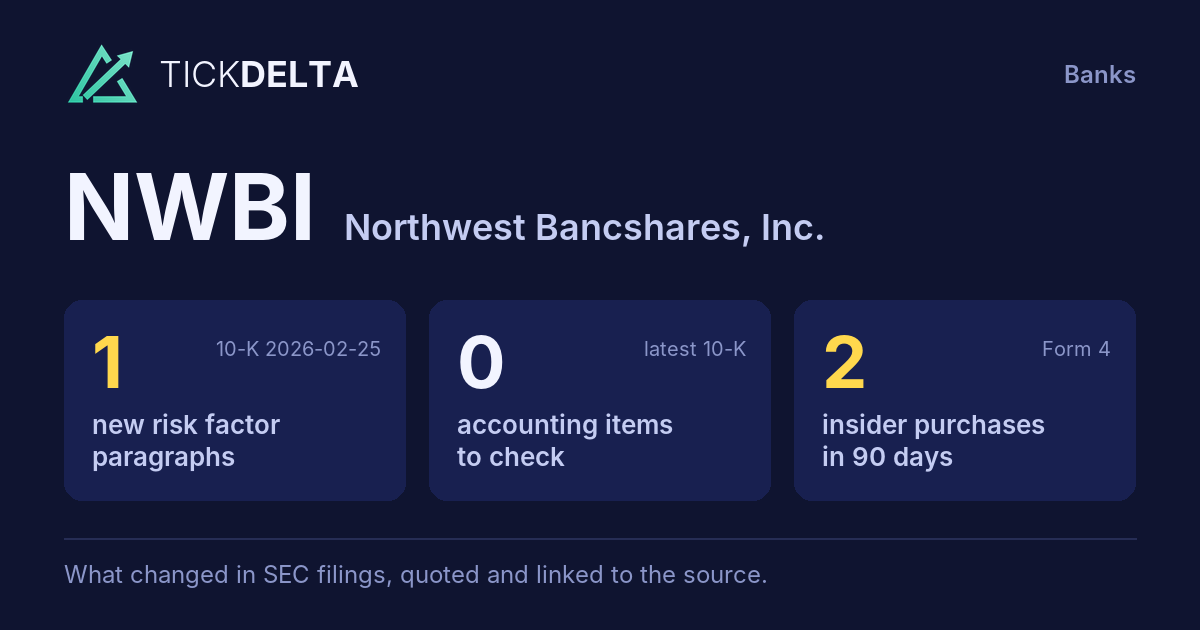
95 changes: 9 added, 7 removed, 77 reworded, 2 quiet changes

10-K Feb 25, 2026 vs Feb 25, 2025

10-K 0001471265-26-000008 (Feb 25, 2026) vs 10-K 0001471265-25-000016 (Feb 25, 2025) Not compared: Legal Proceedings, Accounting Policies.

Every paragraph, and how much of it changed

One bar per paragraph, in the order of the 10-K. Height and colour show the share of its words not in the closest paragraph a year earlier; the tallest bars are new paragraphs.

Risk Factors

139 paragraphs · 1 new · 37 reworded · 3 gone · 10-K Feb 25, 2026 against Feb 25, 2025
New paragraph Reworded (5% of its words or more) Same or nearly
Paragraph 3 · 49% changed Every version of it
Commercial loans generally expose a lender to greater risk of non-payment and loss than one- to four-family residential mortgage loans because repayment of the loans often depends on the successful operation of the business and the income stream of the borrowers. Such loans typically involve larger loan balances to single borrowers or groups of related borrowers compared to one- to four-family residential mortgage loans. Also, many of our commercial borrowers have more than one loan outstanding with us. Consequently, an adverse development with respect to one loan or one credit relationship can expose us to a significantly greater risk of loss compared to an adverse development with respect to a one- to four-family residential mortgage loan. Commercial business loans expose us to additional risk since they typically are dependent on the borrower’s ability to make repayments from the cash flows of the business and are secured by non-real estate collateral that may depreciate over time. Further, our commercial business loans may be secured by collateral other than real estate, such as inventory and accounts receivable, the value of which may be more difficult to appraise, control or collect and may be more susceptible to fluctuation in value at the time of default. In addition, if we foreclose on these loans, our holding period for the collateral may be longer than for a single or multi-family residential property if there are fewer potential purchasers of the collateral.
Paragraph 124 · 45% changed Every version of it
A deterioration in economic conditions could result in the following consequences, any of which management solutions to or through our customers, and could have a material adverse effect on our business, financial condition, liquidity condition and results of operations: operations.
Paragraph 103 · 42% changed Every version of it
The economy is subject to worldwide events, such as the COVID-19 pandemic and geopolitical tensions in Europe, the Middle East East, and Europe, Latin America, as well as domestic events, any or all of which could impact inflationary pressures and interest rates to dampen demand. The current U.S. administration has implemented rapid shifts in macroeconomic policies, such as those relating to trade restrictions and tariffs, which have created concerns over an increase in inflation and a slowdown in economic growth. These and other political and market developments are affecting and could continue to affect consumer confidence levels and cause adverse changes in loan payment patterns, causing increases in delinquencies and default rates, which may impact our charge-offs and the provision for credit losses. Changes in the financial services industry and the effects of current and future law and regulations that may be imposed in response to future market developments also could negatively affect us by restricting our business operations, including our ability to originate or sell loans, and adversely impact our financial performance.
Paragraph 40 · 37% changed Every version of it
On occasion we have employed various financial methodologies that limit, or “hedge,” the adverse effects of rising or decreasing interest rates on our loan portfolios and short-term liabilities. We also engage in hedging strategies with respect to arrangements with our customers. Our hedging activity varies based on the level and volatility of interest rates and other changing market conditions. Hedging strategies can be imperfect and may fail to protect us from loss. Moreover, hedging activities could result in costs if the hedge proves to be ineffective. Additionally, hedging activities could fail to protect us or adversely affect us because, among other things:
Paragraph 14 · 36% changed Every version of it
The Company and Northwest Bank operate in a highly regulated industry and are subject to extensive laws, regulation, supervision and examination by the Federal Reserve Board, the Department of Banking, the FDIC FDIC, the CFPB and the CFPB. SEC. These laws and regulations are imposed primarily for the protection and benefit of depositors and other customers, the DIF the U.S. banking and financial system, and the broader economy, not for the protection or benefit of the Company’s investors or non-deposit creditors. These regulatory authorities have extensive discretion in connection with their supervisory and enforcement activities, including the ability to impose restrictions on Northwest Bank’s operations, reclassify assets, determine the adequacy of Northwest Bank’s allowance for credit losses and determine the level of deposit insurance premiums assessed. The laws and regulations applicable to us are subject to frequent change and interpretations and the supervisory environment may be heightened at the regulators’ discretion. For example, the Company is unable to predict what, if any, changes to the regulatory environment may be enacted by Congress, or the presidential administration and what the impact of any changes will be on the Company. The current U.S. administration has implemented significant changes in federal priorities and has taken steps to change the operations, structure, and policy focus of various federal agencies, as well as regulatory priorities, policy approaches and interpretations of existing laws by those federal agencies. Future changes in these regulations and oversight, whether in the form of regulatory policy, new regulations or legislation, presidential executive orders, or new interpretation or application of existing statutes and regulations by courts and government agencies, or additional deposit insurance premiums could have a material impact on our operations. It is also possible the expected changes in regulation do not occur or are reversed by a subsequent administration, or the regulatory measures that are ultimately enacted deliver significant competitive advantages to financial services that are structured differently or serve different markets than the Company and Northwest Bank
Paragraph 115 · 31% changed Every version of it
In preparing this annual report as well as periodic reports we are required to file under the Exchange Act, including our Consolidated Financial Statements, our management is and will be required under applicable rules and regulations to make estimates and assumptions as of a specified date. These estimates and assumptions are based on management’s best estimates and experience as of that date and are subject to substantial risk and uncertainty. Materially different results may occur as circumstances change and additional information becomes known. Areas requiring significant estimates and assumptions by management include our evaluation of the adequacy of our allowance for credit losses.
Paragraph 31 · 26% changed Every version of it
Ensuring that our collection, use, transfer, storage, disclosure and other processing of personal information complies with increasingly stringent and evolving data privacy and cybersecurity laws and regulations, as well as our contractual commitments and other obligations related to data privacy and cybersecurity, can increase our costs, expose us to increased liability and regulatory risk, and result in other adverse effects. We also may be adversely affected if we become subject to new data privacy or cybersecurity laws and regulations or if existing laws and regulations are amended or interpreted in such a manner that requires us to change our business practices, policies or systems or otherwise incur significant additional costs in order to comply. Any failure to address data privacy and cybersecurity concerns or to comply with applicable data privacy or cybersecurity laws, regulations, contractual commitments or other obligations, or any perceived failure with respect to the foregoing, even if unfounded, could result in litigation, liability, regulatory action, fines, penalties, sanctions, claims, orders to cease or change our processing of personal information, changes to our business practices, reputational harm or other adverse effects.
Paragraph 104 · 26% changed Every version of it
The economy is subject to worldwide events, such as the COVID-19 pandemic and geopolitical tensions in the Middle East and Europe, as well as domestic events, any or all of which could impact inflationary pressures and interest rates to dampen demand. These and other political and market developments are affecting and could continue to affect consumer confidence levels and cause adverse changes in loan payment patterns, causing increases in delinquencies and default rates, which may impact our charge-offs and the provision for credit losses. Changes in the financial services industry and the effects of current and future law and regulations that may be imposed in response to future market developments also could negatively affect us by restricting our business operations, including our ability to originate or sell loans, and adversely impact our financial performance.

MD&A

135 paragraphs · 8 new · 32 reworded · 4 gone · 10-K Feb 25, 2026 against Feb 25, 2025
New paragraph Reworded (5% of its words or more) Same or nearly
Paragraph 58 · 49% changed
Borrowings. Borrowings decreased increased by $198 $246 million, or 39%, 78%, to $561 million at December 31, 2025 from $315 million at December 31, 2024 from $513 million at December 31, 2023. 2024. This decrease increase was a result of growth in lower cost deposits which enabled primarily attributable to the paydown of FHLB advances during the year. acquired long term borrowings and additional short term borrowings to fund loan and securities growth.
Paragraph 38 · 47% changed
Loans Receivable. Gross loans receivable decreased increased by $226 million, $1.8 billion, or 2%, 16%, to $13.0 billion at December 31, 2025, from $11.2 billion at December 31, 2024, from $11.4 billion at December 31, 2023. 2024. Our personal banking loan portfolio decreased increased by $451 $849 million, or 7%, 13%, to $7.2 billion at December 31, 2025 from $6.3 billion at December 31, 2024 from $6.8 2024. Commercial banking increased by $978 million, or 20%, to $5.8 billion at December 31, 2023. Cash flows 2025 from our personal banking portfolio were partially redirected to fund commercial banking growth, which increased by $225 million, or 5%, to $4.9 billion at December 31, 2024 from $4.6 2024. These increases are primarily driven by the Penns Woods acquisition of $1.8 billion at December 31, 2023. This represents organic loan growth resulting from the new commercial lending verticals that we implemented during the prior year. Specifically, our commercial and industrial (C&I) loan portfolio increased by $349 million, or 21% compared to December 31, 2023. in loans.
Paragraph 31 · 46% changed
Marketable securities. Marketable securities remained flat increased to $2.3 billion at December 31, 2025 from $1.9 billion at both December 31, 2024 and December 31, 2023. 2024. Available-for-sale marketable securities increased $66 $477 million driven by the acquisition of Penns Woods which included $160 million in marketable securities, of which, $82 million were immediately sold. Additional increases were driven by the purchase of additional securities portfolio restructure in and the current year, while held-to-maturity improvement of our unrealized loss position. Held-to-maturity securities decreased $64 $67 million drive driven by maturities and regular monthly cash flows. During the second quarter the Company restructured our security portfolio by selling 15% of available-for-sale securities during the year in order to reallocate these funds into higher interest-earning products.
Paragraph 65 · 44% changed
Average loans receivable increased $185 $715 million, or 2%, 6%, from the year ended December 31, 2023. 2024. This increase was driven by commercial loans, the acquisition of Penns Woods which grew by $433 million, as we have continued to build-out our commercial lending verticals, and commercial real estate loans, which grew by $119 million from the same period. These increases were offset partially by a $368 million decrease resulted in personal banking loans from the year ended December 31, 2023. an additional $1.8 billion in loans. Interest income on loans receivable increased by $72 $66 million, or 13%, 11%, from 2023 as 2024 driven by the result Penns Woods acquisition and a loan mix shift towards higher yielding commercial loans, including the accretion of increases in both loan fair value marks from the average yield acquisition, and an interest recovery of $13.1 million on a non-accrual commercial real estate loan payoff during the average balance on loans receivable. The average yield on loans receivable increased due to the elevated market interest rates as well as a change in mix to higher yield loan products. first quarter of 2025.
Paragraph 30 · 41% changed
Cash and cash equivalents. Cash and cash equivalents increased decreased by $166 $55 million, or 136%, 19%, to $234 million at December 31, 2025, from $288 million at December 31, 2024, from $122 million at December 31, 2023. 2024. This increase decrease was primarily due to growth these funds being invested in our deposits coupled with a focus on profitability higher yielding loans and credit discipline while investing these cash flows into commercial loans. marketable securities.
Paragraph 29 · 37% changed
Assets. Total assets at December 31, 2024 2025 were flat at $14.4 $16.8 billion, a decreasing slightly increasing by $11 million $2.4 billion from December 31, 2023. 2024. This decrease increase in assets was driven by decreases in personal banking loans receivable, partially offset by increases in cash and cash equivalents and commercial banking loans receivable. the addition of the Penns Woods assets. A discussion of significant changes follows.
Paragraph 79 · 35% changed
The provision for credit losses increased by $2 $31 million, or 7.1%, 127%, compared to the year ended December 31, 2023. 2024. This increase included a $9 $29 million increase in the provision for credit losses - loans, which was partly offset by loans and a $7 $2 million decrease increase in the provision for credit losses - unfunded commitments. This increase is due to the initial Day 1 provision from the Penns Woods merger of $21 million. Excluding the Day 1 provision for credit losses from the acquisition, the provision for credit losses for the year ended December 31, 2025 was $36 million, which increased from the prior year end primarily due to growth within our commercial lending portfolio and an increase in net charge-offs.
Paragraph 80 · 34% changed
The changes in the provision noted above is driven by growth within our commercial lending portfolio and changes in the economic forecasts coupled with a decline increase in our reserves provision for unfunded commitments in is due to the current period. This Penns Woods acquisition offset by a decline is based on the timing of organic origination and funding of commercial construction loans and lines of credit.

A paragraph is matched with the one last year that shares the most of its words; under half in common makes it new. The paragraphs shown are the 8 reworded the most in each section.

The paragraph that changed most in each section

The redline

Marked against last year's 10-K: cut words struck through, new words highlighted.

Risk Factors197 words changed in this paragraph; it is 57% similar to last year's version.
The Company and Northwest Bank operate in a highly regulated industry and are subject to extensive laws, regulation, supervision and examination by the Federal Reserve Board, the Department of Banking, the FDIC FDIC, the CFPB and the CFPB. SEC. These laws and regulations are imposed primarily for the protection and benefit of depositors and other customers, the DIF the U.S. banking and financial system, and the broader economy, not for the protection or benefit of the Company’s investors or non-deposit creditors. These regulatory authorities have extensive discretion in connection with their supervisory and enforcement activities, including the ability to impose restrictions on Northwest Bank’s operations, reclassify assets, determine the adequacy of Northwest Bank’s allowance for credit losses and determine the level of deposit insurance premiums assessed. The laws and regulations applicable to us are subject to frequent change and interpretations and the supervisory environment may be heightened at the regulators’ discretion. For example, the Company is unable to predict what, if any, changes to the regulatory environment may be enacted by Congress, or the presidential administration and what the impact of any changes will be on the Company. The current U.S. administration has implemented significant changes in federal priorities and has taken steps to change the operations, structure, and policy focus of various federal agencies, as well as regulatory priorities, policy approaches and interpretations of existing laws by those federal agencies. Future changes in these regulations and oversight, whether in the form of regulatory policy, new regulations or legislation, presidential executive orders, or new interpretation or application of existing statutes and regulations by courts and government agencies, or additional deposit insurance premiums could have a material impact on our operations. It is also possible the expected changes in regulation do not occur or are reversed by a subsequent administration, or the regulatory measures that are ultimately enacted deliver significant competitive advantages to financial services that are structured differently or serve different markets than the Company and Northwest Bank

Source: Item 1A, 10-K 0001471265-26-000008 vs Item 1A, 10-K 0001471265-25-000016

MD&A150 words changed in this paragraph; it is 35% similar to last year's version.
In December 2023, September 2025, the FASB issued ASU No. 2023-09, “Improvements 2025-06, "Intangibles-Goodwill and Other-Internal-Use Software (Subtopic 350-40): Targeted Improvements to Income Tax Disclosures.” the Accounting for Internal-Use Software”. This ASU requires additional disaggregated disclosures on entity’s effective tax rate reconciliation addresses the challenges of applying current internal-use software accounting requirements due to the evolution of software development since the original guidance was issued. The ASU removes all references to project stages. The amendments require an entity to start capitalizing software costs when management has authorized and additional details on income taxes paid. This guidance committed to funding the software project, and it is probable that the project will be completed and the software will be used to perform the function intended. The amendments in the ASU are effective for annual reporting periods beginning after December 15, 2025, with early 2027, and for interim reporting periods beginning after December 15, 2027. Early adoption permitted. This ASU is applied prospectively with permitted as of the option to apply the ASU retrospectively. beginning of an annual reporting period. We do not believe this guidance will have a material impact on the Company’s Company's financial statements.

Source: Item 7, 10-K 0001471265-26-000008 vs Item 7, 10-K 0001471265-25-000016

Sentences and paragraphs added, removed or reworded

Every change, by type

Sentences and paragraphs of NWBI's Risk Factors and MD&A, 10-K Feb 25, 2026 against 10-K Feb 25, 2025. Each links to the text at sec.gov.

Quiet changes are sentences kept from last year with one to four words changed, at least one of them a hedge, a modal or a qualifier (may, could, will, not, significant, material…). A year or date rolling forward is not counted.

The full word list

adverse, adversely, all, although, anticipate, anticipates, any, approximately, believe, believes, can, cannot, certain, could, expect, expects, generally, however, if, intend, intends, largely, likely, many, material, materially, may, might, most, must, never, no, not, possible, primarily, probable, should, significant, significantly, some, substantial, substantially, unlikely, will, would

AddedRisk Factors
result in an increase in loan delinquencies and non-performing assets, decreases in loan collateral values and a decrease in demand for our products and services, all of which, in turn, would adversely affect our business, financial condition and results of operations.
Read it in 10-K Feb 25, 2026 at sec.gov
RemovedRisk Factors
change and interpretations and the supervisory environment may be heightened at the regulators’ discretion. For example, the Company is unable to predict what, if any, changes to the regulatory environment may be enacted by Congress, both chambers of which became under Republican control beginning in 2025, or the new presidential administration and what the impact of any changes will be on the Company. We expect the Trump administration will seek to implement a regulatory reform agenda that is significantly different than that of the Biden administration, impacting the rulemaking, supervision, examination, and enforcement priorities of the federal banking agencies. Any change in these regulations and oversight, whether in the form of regulatory policy, new regulations or legislation or additional deposit insurance premiums could have a material impact on our operations.
Read it in 10-K Feb 25, 2025 at sec.gov
RemovedRisk Factors
The Board of the Company has an Innovation and Technology Sub-Committee, consisting of wholly independent directors chartered, among other items, with a focus on cybersecurity risk. Additionally, the Company’s Board has a designated Risk Management Sub-Committee with the responsibility of monitoring enterprise level risks, including those related to cybersecurity. Furthermore, management of the Company has both an Enterprise Risk Management Committee and an Information Technology Steering
Read it in 10-K Feb 25, 2025 at sec.gov
RewordedRisk Factors
The termination of our membership or any changes in card network rules or standards, including interpretation and implementation of existing rules or standards, could increase the cost of operating our merchant services business or limit our ability to provide debit card and cash management solutions to or through our customers, and could have a material adverse effect on our business, financial condition and results of operations.
Read it in 10-K Feb 25, 2026 at sec.gov
RewordedRisk Factors
Furthermore, management of the Company has both an Enterprise Risk Management Committee (“ITSC”), and an Operational Risk Management Committee, both of which are comprised of the most senior members of management, including the Chief Executive Officer, Chief Information Officer (“CIO”), and Chief Operating Information Security Officer.
Read it in 10-K Feb 25, 2026 at sec.gov
RewordedRisk Factors
These and other political and market developments are affecting and could continue to affect consumer confidence levels and cause adverse changes in loan payment patterns, causing increases in delinquencies and default rates, which may impact our charge-offs and the provision for credit losses.
Read it in 10-K Feb 25, 2026 at sec.gov
Show the other 34
RewordedRisk Factors
We also may be adversely affected if we become subject to new data privacy or cybersecurity laws and regulations or if existing laws and regulations are amended or interpreted in such a manner that requires us to change our business practices, policies or systems or otherwise incur significant additional costs in order to comply.
Read it in 10-K Feb 25, 2026 at sec.gov
RewordedRisk Factors
We compete with commercial banks, savings institutions, mortgage brokerage firms, credit unions, finance companies, fintech companies, including those related to digital currencies or cryptocurrencies (including stablecoins), money market funds and other mutual funds, insurance companies, and brokerage and investment banking firms operating locally and elsewhere.
Read it in 10-K Feb 25, 2026 at sec.gov
RewordedRisk Factors
The economy is subject to worldwide events, such as the COVID-19 pandemic and geopolitical tensions in Europe, the Middle East East, and Europe, Latin America, as well as domestic events, any or all of which could impact inflationary pressures and interest rates to dampen demand.
Read it in 10-K Feb 25, 2026 at sec.gov
RewordedRisk Factors
Based on these factors, we have a concentration in multi-family residential and commercial real estate lending, as such loans represent 357% a combined 342% of total bank capital as of December 31, 2024. 2025.
Read it in 10-K Feb 25, 2026 at sec.gov
Quiet changesRisk Factors
The directors of the Company do not have significant modest experience in cybersecurity risk management in other business entities comparable to the Company and rely on members of management, including, but not limited to, the CISO, CIO, Chief Operational Risk Management Officer, Chief Technology Officer and Chief Data Officer, for cybersecurity guidance.
Read it in 10-K Feb 25, 2026 at sec.gov
AddedMD&A
adopt the guidance in annual reporting periods beginning after December 15, 2026, and interim periods within annual reporting periods beginning after December 15, 2027. Early adoption is permitted.
Read it in 10-K Feb 25, 2026 at sec.gov
AddedMD&A
In September 2025, the FASB issued ASU 2025-06, "Intangibles-Goodwill and Other-Internal-Use Software (Subtopic 350-40): Targeted Improvements to the Accounting for Internal-Use Software”. This ASU addresses the challenges of applying current internal-use software accounting requirements due to the evolution of software development since the original guidance was issued. The ASU removes all references to project stages. The amendments require an entity to start capitalizing software costs when management has authorized and committed to funding the software project, and it is probable that the project will be completed and the software will be used to perform the function intended. The amendments in the ASU are effective for annual reporting periods beginning after December 15, 2027, and for interim reporting periods beginning after December 15, 2027. Early adoption is permitted as of the beginning of an annual reporting period. We do not believe this guidance will have a material impact on the Company's financial statements.
Read it in 10-K Feb 25, 2026 at sec.gov
AddedMD&A
In November 2025, the FASB issued ASU 2025-08, "Financial Instruments - Credit Losses (Topic 326): Purchased Loans". This ASU amends the accounting for acquired loans (excluding credit cards) by expanding the scope of acquired financial assets subject to the gross-up approach under ASC 326, for assets that meet certain criteria at acquisition referred to as purchased seasoned loans. The ASU also provides for an irrevocable accounting policy election to measure the ACL on purchased seasoned loans using the amortized cost basis, rather than unpaid principal balance, if a method other than a discounted cash flow method is utilized to estimate expected credit losses. This guidance is effective for annual reporting periods beginning after December 15, 2026 and interim reporting periods within those annual reporting periods. Early adoption is permitted. This guidance will impact our Consolidated Financial Statements on a prospective basis only when loans are acquired.
Read it in 10-K Feb 25, 2026 at sec.gov
AddedMD&A
In November 2025, the FASB issued ASU 2025-09. "Derivatives and Hedging (Topic 815): Hedge Accounting Improvements." This ASU more closely aligns hedge accounting with the economics of an entity’s risk management activities. The revised guidance allows for individually forecasts transactions with similar risk exposure to be hedged in a group, enables the hedging of the variable price components of forecasted purchases or sales of nonfinancial assets, introduces a model for hedging interest payments on debt instruments with multiple rate options and allows a borrower to select a documented interest rate index and/or tenor without automatically discontinuing hedge accounting. This guidance is effective for annual reporting periods beginning after December 15, 2026 and interim reporting periods within those annual reporting periods on a prospective basis. Early adoption is permitted. We do not believe this guidance will have a material impact on the Company's financial statements.
Read it in 10-K Feb 25, 2026 at sec.gov
AddedMD&A
On July 4, 2025, President Trump signed into law the legislation formally titled “An Act to Provide for Reconciliation Pursuant to Title II of H. Con. Res. 14” and commonly referred to as the One Big Beautiful Bill Act(“the Act”). The enactment of the Act did not have a material impact on the company's financial statements.
Read it in 10-K Feb 25, 2026 at sec.gov
AddedMD&A
On July 25, 2025, the Company completed its acquisition of Penns Woods, pursuant to the Merger Agreement. In accordance with the Merger Agreement, the Company and Penns Woods completed the Merger. Immediately after the Effective Time, Penns Woods’ wholly-owned subsidiary banks, Luzerne Bank, a Pennsylvania-chartered state bank, and Jersey Shore State Bank, a Pennsylvania-chartered state bank, merged with and into Northwest Bank, with Northwest Bank as the surviving bank in the subsidiary bank mergers. Under the terms and subject to the conditions of the Merger Agreement, at the Effective Time, each share of Penns Woods’ common stock, $5.55 par value, issued and outstanding immediately prior to the Effective Time (except for Treasury Shares (as provided for in the Merger Agreement), converted, in accordance with the procedures set forth in the Merger Agreement, into a right to receive 2.385 shares of common stock, $0.01 par value, of the Company.
Read it in 10-K Feb 25, 2026 at sec.gov
AddedMD&A
The Penns Woods results of operations are included in the Company’s consolidated results since the date of acquisition. Therefore, the Company’s year to date 2025 results reflect increased levels of average balances, net interest income, and noninterest expense compared to the prior year results. After purchase accounting fair value adjustments, the acquisition added $2.2 billion of total assets, including $1.8 billion of loans, $160 million of investments, of which $82 million were immediately sold, as well as $2.0 billion of total liabilities, primarily consisting of $1.6 billion in deposits. The Company recorded preliminary goodwill of $63 million and core deposit intangibles of $42 million related to the acquisition.
Read it in 10-K Feb 25, 2026 at sec.gov
AddedMD&A
Deposits. Total deposits increased by $1.8 billion, or 15%, to $13.9 billion at December 31, 2025 from $12.1 billion at December 31, 2024. This increase was driven by the Penns Woods acquisition which resulted in an additional $1.6 billion in deposits.
Read it in 10-K Feb 25, 2026 at sec.gov
RemovedMD&A
In December 2023, the FASB issued ASU No. 2023-09, “Improvements to Income Tax Disclosures.” This ASU requires additional disaggregated disclosures on entity’s effective tax rate reconciliation and additional details on income taxes paid. This guidance is effective for annual periods beginning after December 15, 2025, with early adoption permitted. This ASU is applied prospectively with the option to apply the ASU retrospectively. We do not believe this guidance will have a material impact on the Company’s financial statements.
Read it in 10-K Feb 25, 2025 at sec.gov
RemovedMD&A
In November 2024, the FASB issued ASU 2024-03, “Income Statement-Reporting Comprehensive Income—Expense Disaggregation Disclosures (Subtopic 220-40): Disaggregation of Income Statement Expenses”. The guidance requires disaggregated disclosure of
Read it in 10-K Feb 25, 2025 at sec.gov
RemovedMD&A
During the year ended quarter December 31, 2024 the Company took several steps to de-risk our loan portfolio and reduce our levels of nonperforming, criticized and classified loans by completing two loan pool sales and transferring certain loans within our Long Term Healthcare portfolio into held for sale as of December 31, 2024. As a result we saw an elevated level of charge-offs during the year as the loans noted above were written-down to fair market value prior to sale. Total charge-offs related to the loan sales and transfer to loans held-for-sale was a combined $15 million. After completing these steps the Company saw an increase in classified loans to $272 million, or 2.44% of total loans, at December 31, 2024 from $219 million, or 1.91% of total loans, at December 31, 2023. The primary driver of the increase over the past year is reflective of the Company’s exposure to the Long Term Healthcare segment and the challenges a few operators have experienced post Covid.
Read it in 10-K Feb 25, 2025 at sec.gov
RewordedMD&A
Return on average assets (1), (5), (6), (7) 0.82% 0.70% 0.95% 0.94% Return on average equity (2), (5), (6), (7) 7.27% 6.41% 8.94% 8.80% Average capital to average assets 11.31% 10.87% 10.58% 10.71% Capital to total assets 11.27% 11.08% 10.76% 10.57% Tangible common equity to tangible assets (8) 8.64% 8.65% 8.30% 8.03% Net interest rate spread (3) 3.13% 2.66% 2.86% 3.11% Net interest margin (4) 3.69% 3.26% 3.28% 3.20% Noninterest expense to average assets (5), (6), (7) 2.56% 2.46% 2.32% Efficiency ratio (5), (6), (7) 70.52% 63.98% 62.00% Noninterest income to average assets 0.60% 0.80% 0.78% Net interest income to noninterest expense (5), (6), (7) 1.20X 1.18x 1.24x 1.28x Noninterest expense to average assets (5), (6), (7) 2.85% 2.56% 2.46% Efficiency ratio (5), (6), (7) 66.64% 70.52% 63.98% Noninterest income to average assets 0.84% 0.60% 0.80% Dividend payout ratio 86.96% 101.27% 75.47% 76.19% Nonperforming loans to net loans receivable 0.84% 0.56% 0.86% 0.76% Nonperforming assets to total assets 0.64% 0.54% 0.67% 0.58% Allowance for credit losses to nonperforming loans 139.18% 188.24% 129.01% 143.98% Allowance for credit losses to loans receivable 1.15% 1.04% 1.10% 1.08% Average interest-earning assets to average interest-bearing liabilities 1.36X 1.35x 1.37x 1.41x Number of banking offices 161 141 142 150
Read it in 10-K Feb 25, 2026 at sec.gov
RewordedMD&A
Payments due Less than One year to Three years Five years Total one year less than to less than or greater three years five years (In thousands) Supplemental Executive Retirement Plan (1) $ — — — 1,113 1,113 1,475 554 112 89 2,230 Term notes payable to the FHLB of Pittsburgh (2) 175,000 332,569 105,482 — — 438,051 Collateralized borrowings (2) 8,232 — — — 175,000 Collateralized borrowings (2) 22,323 — — — 22,323 Collateral received (2) 3,008 — — — 3,008 8,232 Subordinated debentures (2) — — 114,800 — 114,800 114,800 Junior subordinated debentures (2) — — — 129,834 129,834 130,093 130,093 Operating leases (3) 5,514 10,692 9,697 42,703 68,606 6,410 12,278 10,117 38,409 67,214 Total $ 205,845 10,692 9,697 288,450 514,684 348,686 118,314 125,029 168,591 760,620 Commitments to extend credit $ 190,094 358,076 — — — 190,094 358,076
Read it in 10-K Feb 25, 2026 at sec.gov
RewordedMD&A
December 31, 2024 2025 Property type Percent of portfolio Retail Building 13.4% 10.2% 5 or More Unit Dwelling 13.3 9.5 Commercial Office Building - non-owner occupied 10.5 7.5 Nursing Home 10.4 7.1 Manufacturing & Industrial Building 5.8 Warehouse/Storage Building 4.3 Multi-use building - commercial, retail and residential 4.2 5.2 Commercial office building - owner occupied 4.2 3.2 Residential acquisition & development - 1-4 family, townhouses and apartments 4.1 3.0 Multi-use building - commercial, retail and residential 2.7 Warehouse/storage building 2.6 Multi-use building - office and warehouse 3.5 2.5 Other Medical Facility 2.9 Single Family Dwelling 2.4 Student Housing 2.4 Hotel/Motel 2.3 Agricultural Real Estate 2.2 Commercial acquisition and development 2.0 All Other Types 12.1 44.3 Total 100.0%
Read it in 10-K Feb 25, 2026 at sec.gov
RewordedMD&A
The increase in net interest income (FTE) and decrease in net interest margin (FTE) was driven by an increase in interest income resulting from an increase in average earning assets from the Penns Woods acquisition coupled with higher earning asset yields which was offset by an increase in interest-bearing deposit costs and a shift in funding mix to higher cost deposits interest expense due to an increase in the higher average balance interest rate environment. bearing liabilities from the Penns Woods acquisitions which was slightly offset by a lower costs of funding.
Read it in 10-K Feb 25, 2026 at sec.gov
RewordedMD&A
Residential mortgage loans 0.02 % (0.02) % (0.01) % Home equity loans 0.06 % 0.05 % 0.01 % Vehicle loans 0.32 % 0.37 % 0.22 % Consumer loans 3.70 % 4.04 % 4.11 % Commercial real estate loans 0.34 % 0.39 % 0.01 % Commercial real estate loans - owner occupied — 0.01 % — % Commercial loans 0.26 % 0.72 % 0.20 % Total Average Loans Receivable 0.25 % 0.32 % 0.11 % Allowance for credit losses as a percentage of nonperforming loans 139.18 % 188.24 % 129.01 % Allowance for credit losses as a percentage of nonperforming assets 139.08 % 149.40 % 128.87 %
Read it in 10-K Feb 25, 2026 at sec.gov
RewordedMD&A
Net income for the year ended December 31, 2024 2025 was $126 million, or $0.92 per diluted share, an increase of $26 million, or 26%, from $100 million, or $0.79 per diluted share, a decrease of $35 million, or 25.7%, from $135 million, or $1.06 per diluted share, for the year ended December 31, 2023. 2024.
Read it in 10-K Feb 25, 2026 at sec.gov
RewordedMD&A
Additionally contributing to the decrease in net income Offsetting these increases was an increase in noninterest expense of $17 $68 million or 4.8%, partially offset by a decrease 18%, an increase in the provision for credit losses of $2 $31 million, or 7.1%, 127%, and a decrease an increase in income taxes of $11 $8 million or 27.1%. 26%.
Read it in 10-K Feb 25, 2026 at sec.gov
RewordedMD&A
Interest expense on deposits increased decreased by $100 $7 million, or 95%, 3%, from 2023 2024 primarily attributable to increases the decrease in both the average yield and paid on deposits which was partially offset by the increase in average balance of deposit accounts as we continued competitively positioning our deposit products. accounts.
Read it in 10-K Feb 25, 2026 at sec.gov
RewordedMD&A
Interest income on investment securities increased by $7 $13 million, or 17%, 28%, from the year ended December 31, 2023 2024 due to the increase in the average balance of investments and the increase in yield on investments (FTE) to 2.25% 2.78% for 2024 which was partially offset by a decline in the average balance of investments for both periods. 2025.
Read it in 10-K Feb 25, 2026 at sec.gov
RewordedMD&A
Total shareholders’ equity at December 31, 2024 2025 was $1.89 billion, or $12.94 per share, an increase of $294 million, or 18.4%, from $1.60 billion, or $12.52 per share, an increase of $46 million, or 2.9%, from $1.55 billion, or $12.20 per share, at December 31, 2023. 2024.
Read it in 10-K Feb 25, 2026 at sec.gov
RewordedMD&A
Average investments declined 7% increased 4% from the year ended December 31, 2023 2024 driven by the sale of investment Penns Woods acquisition and a targeted increase in the overall securities portfolio during the second quarter year through the reinvestment of 2024 coupled with cash flows from regular principal payments and maturities.
Read it in 10-K Feb 25, 2026 at sec.gov
RewordedMD&A
As a percentage of average loans, net charge-offs increased decreased to 0.32% 0.25% for the year ended December 31, 2024 2025 compared to 0.11% 0.32% due to the certain commercial real estate loans noted above being written-down that were written down to fair value prior to the sale. be transferred to held-for-sale as of December 31, 2024.
Read it in 10-K Feb 25, 2026 at sec.gov

Sources

The two latest 10-Ks on EDGAR, section by section. Each change links to the text at sec.gov.

Also

New risk factors: paragraphs with nothing like them last year, quoted in full.

Work with it

Excel workbook · CSV. Google Sheet that stays up to date: paste =IMPORTDATA("https://tickdelta.com/company/NWBI/export.csv") into a cell.

Next:Related parties
Esc

Type a ticker such as AAPL, a name, an investor such as Buffett, or a topic such as tariffs. ↑ ↓ to move, Enter to open.