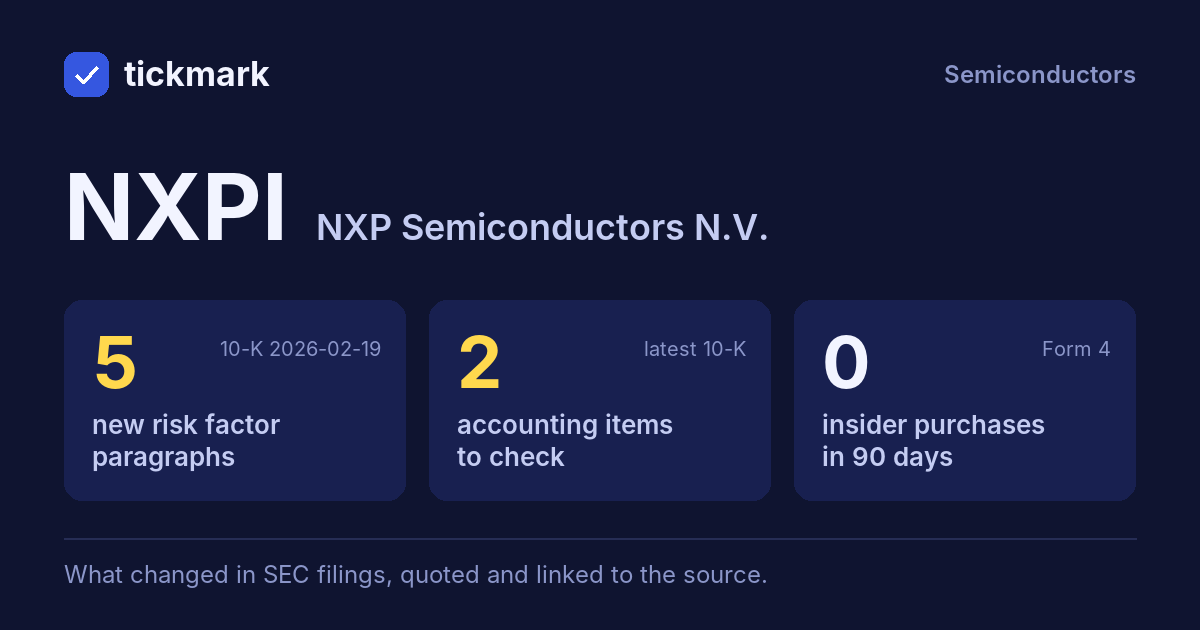
Sentences and paragraphs of NXPI's Risk Factors and MD&A, 10-K 2026-02-19 against 10-K 2025-02-20.
Each links to the text at sec.gov.
AddedRisk Factors
Recently announced and future tariffs and other trade restrictions could materially and adversely affect our business, financial condition and results of operations.
Read it in 10-K 2026-02-19 at sec.gov ↗
AddedRisk Factors
In 2025, the U.S. government announced a series of tariffs, including tariffs targeting a broad range of imports and targeted tariffs on goods from specific countries and industries. In response, many countries imposed reciprocal tariffs and other trade restrictions on the United States. Although many of these tariffs, countermeasures and other trade restrictions have since been eased or paused, their initial announcements triggered considerable volatility in global markets and heightened economic uncertainty, and the global trade situation, particularly between the United States and China, continues to be highly dynamic. Further, throughout 2025 the U.S. government has initiated numerous investigations into products and industries under Section 232 of the Trade Expansion Act of 1962. For example, in April 2025, the Department of Commerce launched an investigation into the national security impacts of imported semiconductors and semiconductor manufacturing equipment. While the results of this investigation remain unknown, it is expected to result in additional tariffs and trade restrictions that may adversely impact our business. Similar investigations on other industries or products, including automotive, copper, steel, aluminum, critical minerals and aircraft, may also adversely impact the semiconductor industry and our business. These changes have, and similar changes in the future may continue to, increase the cost or reduce the availability of raw materials and supplies we need to operate, cause customers to advance, delay, reduce, or cancel orders, shift buying patterns, impact demand in our end markets, complicate demand forecasting for us and our customers, increase supply chain complexity and contribute to volatility, a broader economic slowdown or recession. Any of these impacts or changes could materially and adversely affect our business, financial condition and results of operations.
Read it in 10-K 2026-02-19 at sec.gov ↗
AddedRisk Factors
Additionally, our acquisitions and other strategic investments may require approval by government agencies in applicable jurisdictions in which we operate. Certain agencies in the past have, and may in the future, deny the transaction or fail to approve in a timely manner, resulting in delays in closing and us not realizing the anticipated benefits of the proposed transactions.
Read it in 10-K 2026-02-19 at sec.gov ↗
AddedRisk Factors
that we seek legal or judicial enforcement of our intellectual property rights under the laws of such countries. Any inability on our part to adequately protect our intellectual property may have a material adverse effect on our business, financial condition and results of operations. Finally, the intellectual property ownership and license rights, including copyrights and patents, surrounding AI technologies, which we are and may in the future continue to build into our products, have not been fully addressed by U.S. or foreign courts, laws or regulations, and the use of AI in the development of our products and services could result in our loss of, or failure to obtain, intellectual property rights, as well as subject us to risks related to intellectual property infringement or misappropriation.
Read it in 10-K 2026-02-19 at sec.gov ↗
AddedRisk Factors
Effective October 28, 2025, Kurt Sievers voluntarily retired as our CEO and executive director and Rafael Sotomayor succeeded Mr. Sievers as President and CEO and temporary executive director of the Company. Any significant leadership change involves inherent risk, including potential disruptions to our operations or relationships with customers, suppliers and key employees, and can be inherently difficult to implement. If our CEO transition is not successful for any reason, it could have an adverse impact on our business.
Read it in 10-K 2026-02-19 at sec.gov ↗
AddedMD&A
Kurt Sievers, our former CEO, voluntarily retired as CEO and executive director of the Company, effective October 28, 2025. The Company's Board of Directors unanimously appointed Rafael Sotomayor to succeed Mr. Sievers as President and CEO and temporary executive director of the Company, effective as of October 28, 2025.
Read it in 10-K 2026-02-19 at sec.gov ↗
AddedMD&A
On June 17, 2025, NXP announced the closing of the acquisition of 100% of TTTech Auto for $766 million in cash ($675 million net of cash acquired). TTTech Auto is a leader in innovating unique safety-critical systems and middleware for software-defined vehicles (SDVs). The TTTech Auto acquisition complements and expands NXP’s system and software offerings in the Automotive and Industrial & IoT end markets.
Read it in 10-K 2026-02-19 at sec.gov ↗
AddedMD&A
On October 24, 2025, NXP closed the previously announced acquisition of 100% of Aviva Links for $222 million in cash ($202 million net of cash acquired) and $26 million through the settlement of previously held investments in Aviva Links. Aviva Links is a provider of Automotive SerDes Alliance (ASA) compliant in-vehicle connectivity solutions. The Aviva Links acquisition complements and expands NXP’s automotive networking solutions in the Automotive and Industrial & IoT end markets. On October 27, 2025, NXP closed the previously announced acquisition of 100% of Kinara, Inc. for $284 million in cash ($283 million net of cash acquired). Kinara is an industry leader in high performance, energy-efficient and programmable discrete neural processing units (NPUs). The Kinara acquisition complements and expands NXP’s solutions for AI-powered edge systems in the Industrial & IoT and Automotive end markets.
Read it in 10-K 2026-02-19 at sec.gov ↗
Show the other 9
AddedMD&A
See Note 3 to the consolidated financial statements for further information regarding NXP’s acquisition of TTTech Auto, Aviva Links, and Kinara, Inc.
Read it in 10-K 2026-02-19 at sec.gov ↗
AddedMD&A
On February 2, 2026, NXP completed the previously announced sale of our MEMS sensors business line for $900 million in cash before closing adjustments and up to an additional $50 million contingent upon the achievement of specified technical milestones.
Read it in 10-K 2026-02-19 at sec.gov ↗
AddedMD&A
Revenue by geographic region, which is based on the location where the sale originated, was as follows: 1) ($ in millions, unless otherwise stated) 2025 2024 Increase/(decrease) % APAC, excluding China 3,581 3,794 (213) (5.6)% Americas 3,376 3,471 (95) (2.7)% EMEA 3,276 3,428 (152) (4.4)% China 2) 2,036 1,921 115 6.0% Revenue 12,269 12,614 (345) (2.7)% 1) As of December 31, 2025, and applied retrospectively for all the periods presented, the Company revised its methodology for attributing revenue to geographic areas to reflect the location where sales originate, which represents where critical commercial decisions are made. This may differ from the customer's shipped-to location. The change in reporting basis was made to more appropriately reflect how we manage our business. For 2025, the largest impacts from the change were to the Americas region and the China region, which reflected changes of approximately 104.9% and (57.0)%, respectively. 2) China includes Mainland China and Hong Kong
Read it in 10-K 2026-02-19 at sec.gov ↗
AddedMD&A
The year-to-date change in revenue was primarily driven by a lower selling mix of products, slightly offset by higher shipment volumes. The combination of these two effects resulted in a net decrease of $345 million revenue.
Read it in 10-K 2026-02-19 at sec.gov ↗
AddedMD&A
+ Increased expenses driven by personnel and integration related costs of our acquisitions ($37 million)
Read it in 10-K 2026-02-19 at sec.gov ↗
AddedMD&A
2025 2024 $ % $ % Statutory income tax rate in the Netherlands 687 25.8 800 25.8 Foreign tax effects United States Statutory tax rate difference between United States and the Netherlands (34) (1.3) (52) (1.7) R&D tax credits (47) (1.8) (59) (1.9) Foreign-derived intangible income (67) (2.5) (127) (4.1) Other 20 0.8 10 0.3 Taiwan 25 0.9 * * Other foreign jurisdictions 16 0.6 27 0.9 Effect of Cross-border Tax Laws 16 0.6 23 0.7 Tax Credits (8) (0.3) (8) (0.3) Changes in Valuation Allowances 1 — (2) (0.1) Nontaxable or Nondeductible Items Netherlands tax incentive (99) (3.7) (113) (3.6) Other 13 0.5 19 0.6 Changes in Unrecognized Tax Benefits 7 0.3 28 0.9 Other Adjustments (5) (0.2) (1) — Effective Tax Rate 525 19.7 545 17.6
Read it in 10-K 2026-02-19 at sec.gov ↗
AddedMD&A
* The amount of the individual reconciling item during the year does not meet the 5% disaggregation threshold and is included in "Other foreign jurisdictions"
Read it in 10-K 2026-02-19 at sec.gov ↗
AddedMD&A
The effective income tax rate for 2025 was 19.7% compared to 17.6% for 2024. The increase was primarily driven by a different mix of income tax expense across our operating jurisdictions, as well as lower U.S. and NL tax incentives in 2025 due to a decrease in qualifying income and R&D expenses. In addition, the One Big Beautiful Bill Act was enacted in the U.S., which reduced the amount of claimable R&D tax credits. Taiwan also had higher tax expense in 2025 due to less undistributed earnings being considered indefinitely reinvested due to changes in the supply chain. These increases were partially offset by tax benefits from settlements with tax authorities.
Read it in 10-K 2026-02-19 at sec.gov ↗
AddedMD&A
On May 1, 2025, we repaid the $500 million aggregate principal amount of outstanding 2.7% senior unsecured notes due 2025 at maturity using available cash.
Read it in 10-K 2026-02-19 at sec.gov ↗