Added10-Q Nov 2, 2026 vs 10-K May 19, 2026
• Technology system limitations or failures, including those involving third parties, could harm our business.
Each branch is a paragraph in Risk Factors with nothing like it in the 10-K filed May 22, 2025. A box jumps to the paragraph as filed, below.
46 paragraphs in Risk Factors of the 10-K filed May 19, 2026 with nothing like them in the 10-K filed May 22, 2025. Quoted exactly. Paragraphs that were only edited are under 10-K change.
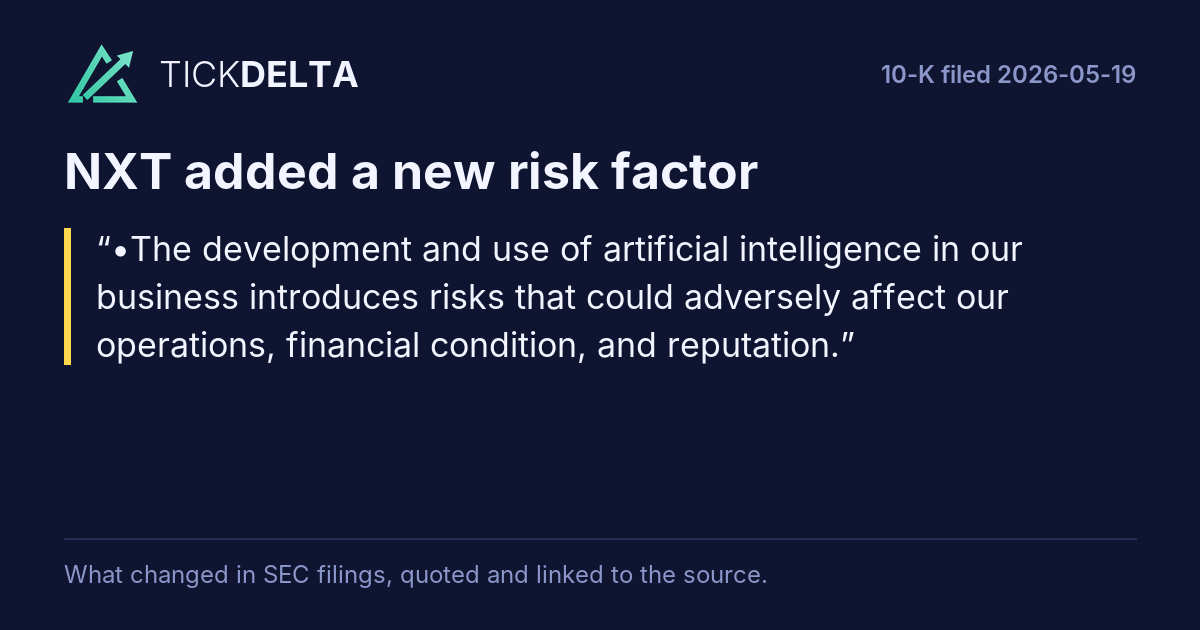
•The development and use of artificial intelligence in our business introduces risks that could adversely affect our operations, financial condition, and reputation.
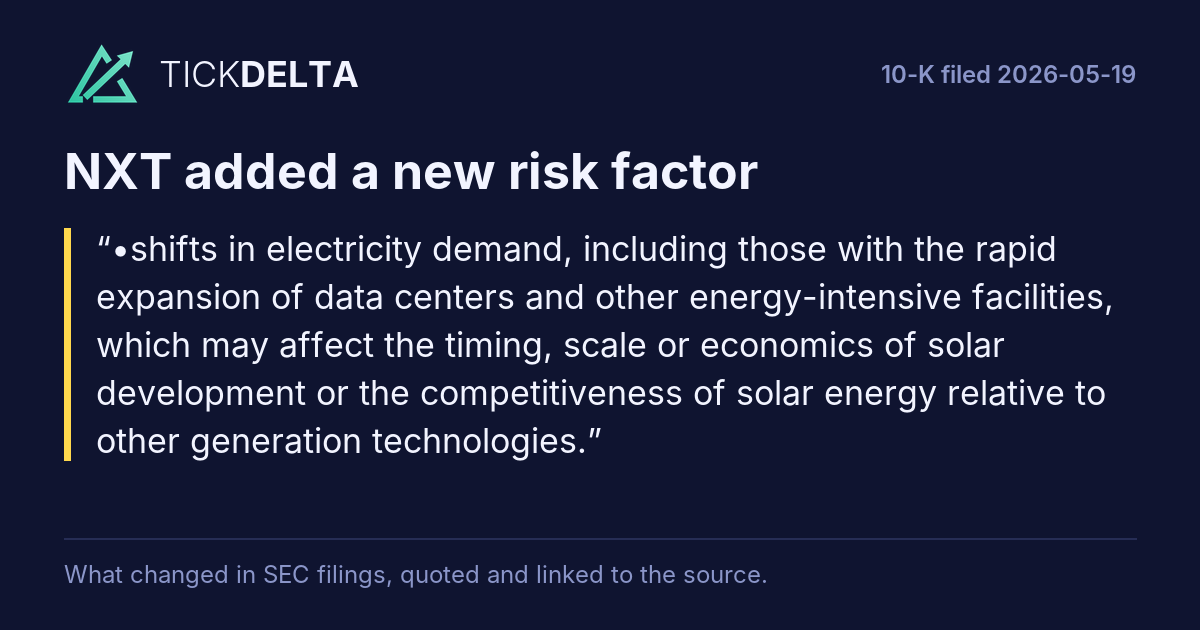
•shifts in electricity demand, including those with the rapid expansion of data centers and other energy-intensive facilities, which may affect the timing, scale or economics of solar development or the competitiveness of solar energy relative to other generation technologies.
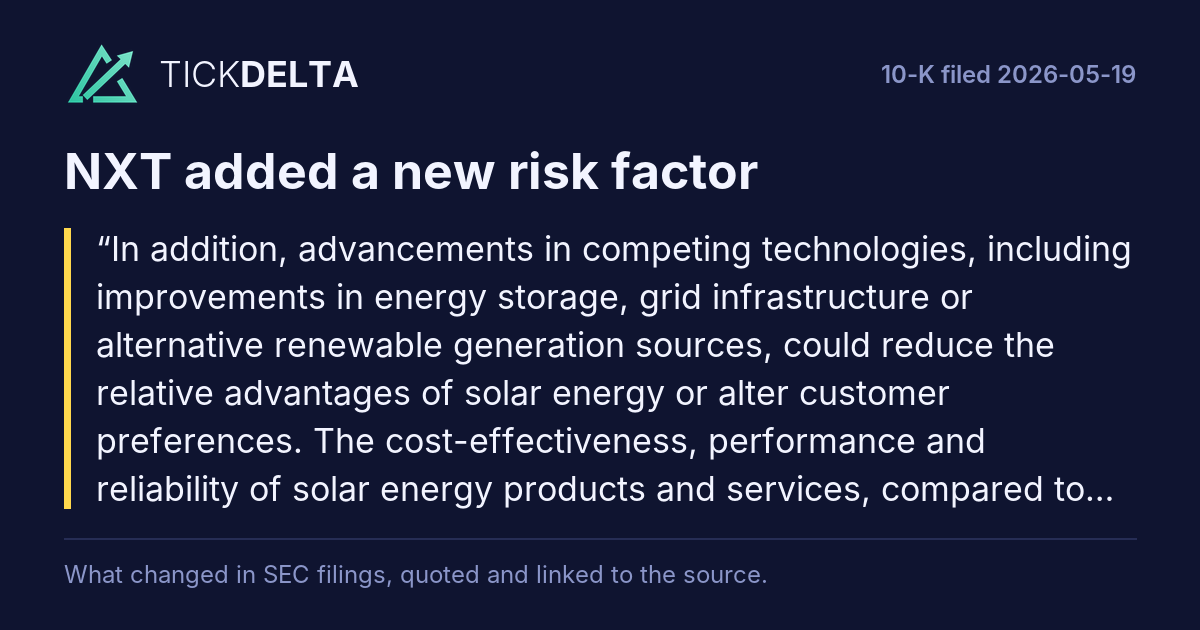
In addition, advancements in competing technologies, including improvements in energy storage, grid infrastructure or alternative renewable generation sources, could reduce the relative advantages of solar energy or alter customer preferences. The cost-effectiveness, performance and reliability of solar energy products and services, compared to conventional and other renewable energy sources, could materially and adversely affect the demand for our products and services, which could have a material adverse effect on our business, financial condition and results of operations.
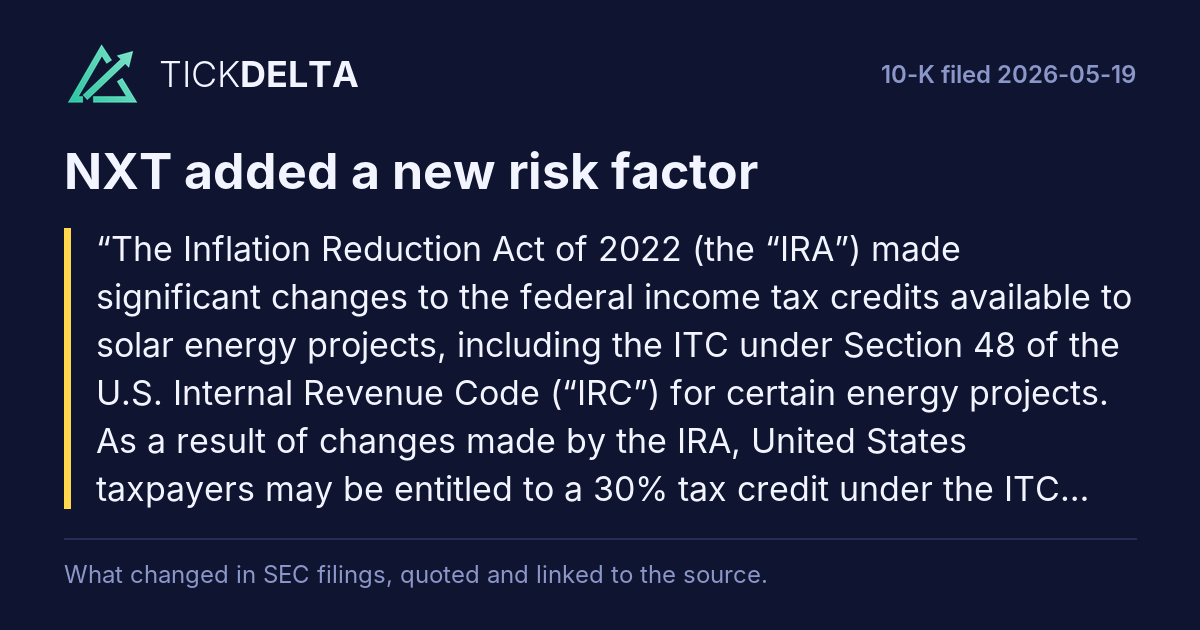
The Inflation Reduction Act of 2022 (the “IRA”) made significant changes to the federal income tax credits available to solar energy projects, including the ITC under Section 48 of the U.S. Internal Revenue Code (“IRC”) for certain energy projects. As a result of changes made by the IRA, United States taxpayers may be entitled to a 30% tax credit under the ITC (now Section 48E), for certain qualifying projects and increased further to 40% for projects that satisfy certain "domestic content" requirements. Guidance issued by the U.S. Treasury Department regarding the availability of the ITC (and its successor under
Section 48E commonly referred to as a “tech neutral” credit that became effective January 1, 2025) has changed in the past and is subject to change in the future. The IRA also introduced a per-unit tax credit (the “Section 45X Credit” or “45X Credit”) that is earned over time for certain clean energy components domestically produced and sold by a manufacturer. The IRA itself was substantially amended by the OBBBA (described below) on July 4, 2025, including with respect to the Section 48E and the Section 45X Credit, in a manner which materially reduced the future availability of these credits.
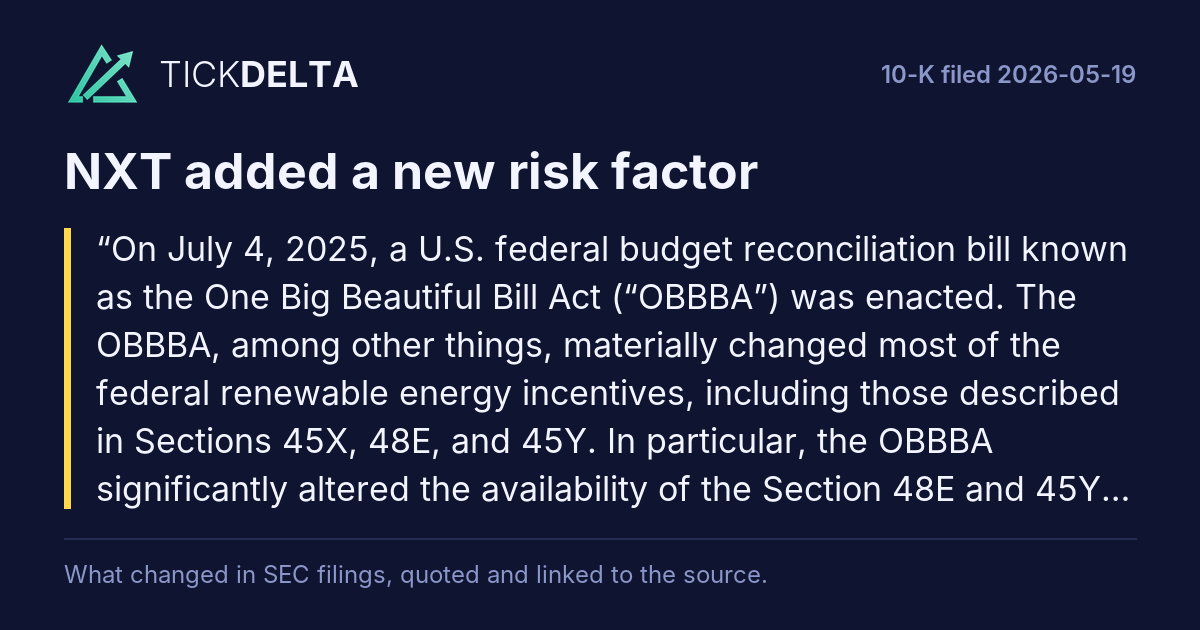
On July 4, 2025, a U.S. federal budget reconciliation bill known as the One Big Beautiful Bill Act (“OBBBA”) was enacted. The OBBBA, among other things, materially changed most of the federal renewable energy incentives, including those described in Sections 45X, 48E, and 45Y. In particular, the OBBBA significantly altered the availability of the Section 48E and 45Y tax credits our customers rely upon for qualified solar facilities. For example, whereas under the IRA, Section 48E and
45Y credits were available through 2032 or such later period until the U.S. power sector emitted 75% less carbon emissions than 2022 levels, the OBBBA substantially reduced this timeframe to require that projects begin construction by July 4, 2026 to utilize a continuity safe harbor that permits solar projects to be placed in service within four calendar years following the calendar year in which the project began construction for tax credit eligibility. Alternatively, solar projects that begin construction after July 4, 2026 must be placed in service by December 31, 2027 to qualify for the Section 48E and 45Y credits. Such acceleration in the expiration of these tax credits will reduce the number of projects in future years that would have otherwise qualified for such credits, likely reducing the overall project volume over time.
Additionally, on July 7, 2025 President Trump issued an Executive Order directing the Secretary of the Treasury to take measures to strictly enforce the termination of the Sections 48E and 45Y credits for wind and solar facilities. The Executive Order specifically directs the Secretary of the Treasury to issue new restrictions concerning “beginning of construction” requirements that appear in many provisions of the OBBBA and which govern eligibility for these tax credits. The Executive Order targets “safe harbor” practices in which our customers seek to establish that their projects have begun construction by the relevant deadline (and therefore qualify for the tax credit) by incurring 5% or more of applicable project costs. Treasury guidance required by this Executive Order was issued on August 22, 2025 in the form of IRS Notice 2025-42. Under this guidance the 5% safe harbor was eliminated effective September 2, 2025 and additional requirements were imposed on solar projects for purposes of demonstrating both the start of physical construction and continuous physical construction thereafter. Such requirements may diminish our customers’ ability to qualify their projects for Section 48E or 45Y tax credits, which in turn could reduce demand for our products and materially harm our business and results of operations.
In addition, the OBBBA introduced certain “foreign entity of concern” (“FEOC”) restrictions relating to prohibited foreign entities on owners of qualified facilities claiming such Section 48E and 45Y tax credits, as well as on manufacturers of components that otherwise qualify for the Section 45X credit. Under these rules, a “prohibited foreign entity” includes a “specified foreign entity” or “foreign influenced entity”, and in general means that certain entities (governments or companies) that are under the ownership, control, or influence of deemed foreign adversaries, such as China, are ineligible for such tax credits. Under the OBBBA a taxpayer must comply with the FEOC rules applicable to a tax credit in order to qualify for such tax credit. The FEOC restrictions apply to Sections 45X, 48E and 45Y in somewhat different ways. However, these rules generally require that Nextpower evaluate its ownership, the ownership of certain members of its supply chain partners, any rights regarding the ability to appoint board members and executives of Nextpower and its supply chain partners, certain payments made by Nextpower and its supply chain partners, and certain contractual arrangements entered into by Nextpower and its supply chain partners with other parties. On February 12, 2026, the U.S. Treasury Department issued interim guidance under Notice 2026-15 regarding material assistance tests related to prohibited foreign entities, and requested public comment. Additional Treasury guidance and/or regulations implementing the FEOC provisions of the OBBBA are pending and may alter current interpretations of the restrictions.
Nextpower is currently evaluating itself and its supply chain partners who provide components for U.S. qualified facilities and will continue to do so as the Treasury Department issues clarifying guidance or regulations. To the extent that our suppliers are disqualified from 45X eligibility as a result of FEOC restrictions, our cost of goods sold may increase and we may become less profitable and/or competitive. In addition, to the extent our tracker components are produced by suppliers which impair our customers’ ability to qualify their projects for Section 48E or 45Y credits (or related domestic content bonus credits), we may become less competitive and our business and results of operations could be materially harmed.
Although we continue to expand our international presence, the impact of the OBBBA, Executive Orders, Treasury Department guidance, and other regulatory actions on the U.S. solar market may adversely impact our business. The substantially reduced timelines for our customers to qualify for the Section 48E or 45Y tax credits may reduce the number of solar projects that our customers build in the United States and therefore reduce the demand for our trackers in the U.S. market. In addition, we may not have an adequate supply of tracker products that satisfy the FEOC or domestic content requirements to remain competitive and meet customer demand. Compliance with FEOC and domestic content requirements also may increase our record-keeping, accounting and production costs.
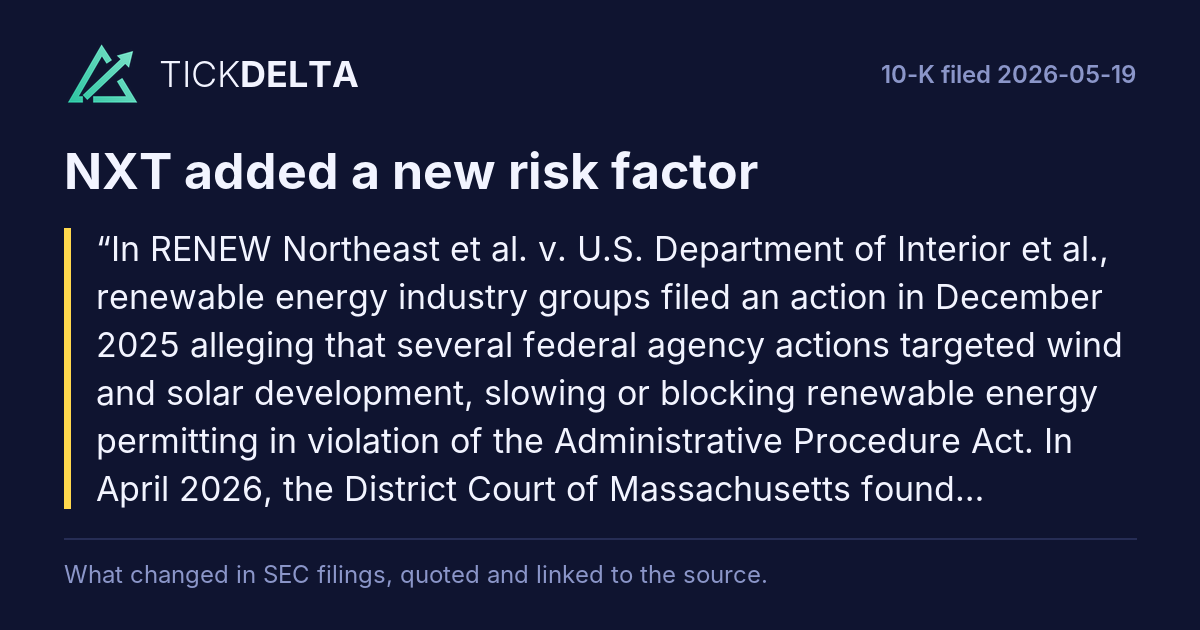
In RENEW Northeast et al. v. U.S. Department of Interior et al., renewable energy industry groups filed an action in December 2025 alleging that several federal agency actions targeted wind and solar development, slowing or blocking renewable energy permitting in violation of the Administrative Procedure Act. In April 2026, the District Court of Massachusetts found irreparable harm as plaintiffs showed imminent economic injuries, including permitting delays, increased compliance costs, disruption to existing investments, and project-related harms. The court held that the balance of equities and public interest favored relief, due to the asserted harms to renewable energy development, the grid, and the environment outweighed the agencies’ interest in continuing policies the court found likely unlawful. The injunction may reduce some immediate permitting barriers for covered entities, but it does not eliminate regulatory uncertainty as the case remains pending, the ruling is subject to appeal, and the agencies may pursue alternative actions.
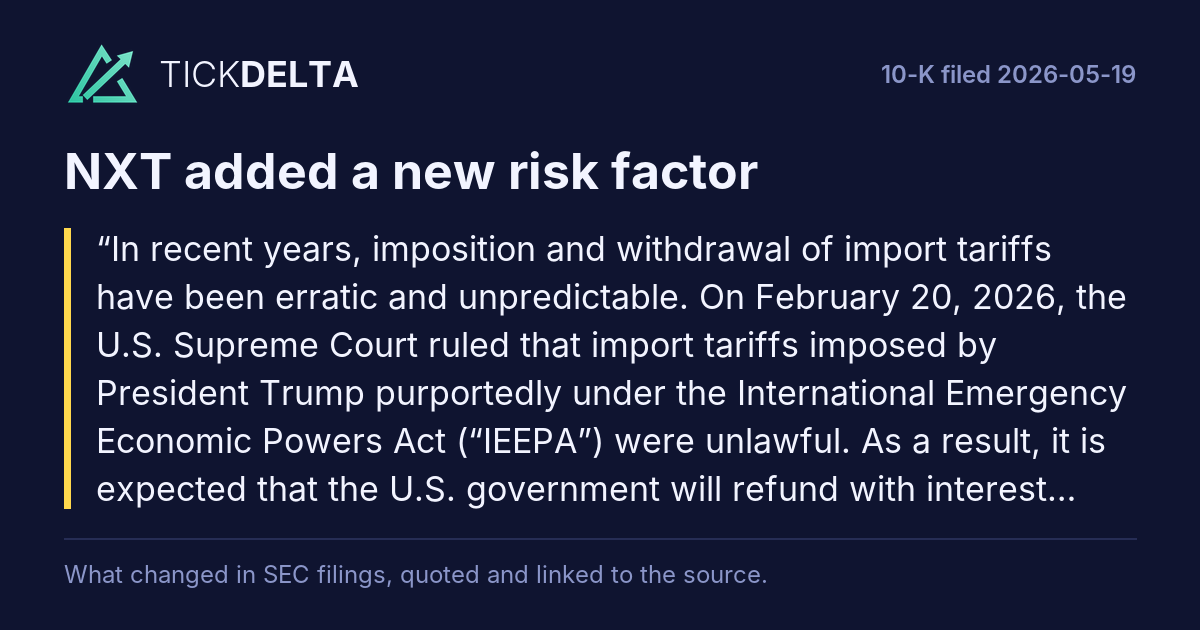
In recent years, imposition and withdrawal of import tariffs have been erratic and unpredictable. On February 20, 2026, the U.S. Supreme Court ruled that import tariffs imposed by President Trump purportedly under the International Emergency Economic Powers Act (“IEEPA”) were unlawful. As a result, it is expected that the U.S. government will refund with interest most or all of the IEEPA tariffs, although the timing and precise coverage of those tariff refunds remains uncertain.
Effective February 24, 2026, President Trump imposed a 10% tariff on most goods under Section 122 of the Trade Act of 1974 (“Section 122 Tariffs”). The Section 122 Tariffs generally apply uniformly against U.S. imports from all countries, but do not apply to imports of products that qualify for preferential treatment under the United States – Mexico – Canada Agreement (USMCA) or to imports of certain products that are ordinarily unrelated to solar energy projects.
There currently are Section 232 tariffs on imports of steel, aluminum and copper products, including certain derivative products, imposed under Section 232 of the Trade Expansion Act of 1962 (“Section 232”). Effective April 6, 2026, the Administration revised the Section 232 framework, including by applying different tariff rates depending on product category, metal content, and whether U.S.-origin metals are used in foreign-manufactured products. Certain products may qualify for reduced rates or exemptions, while others remain subject to significant tariff exposure. Section 232 tariffs are not additive to the Section 122 Tariffs. Although the April 6, 2026 revisions reduced our tariff exposure for certain imported components, Section 232 tariffs continue to affect our costs and gross margins and could result in interruptions in the steel, aluminum or copper supply chains.
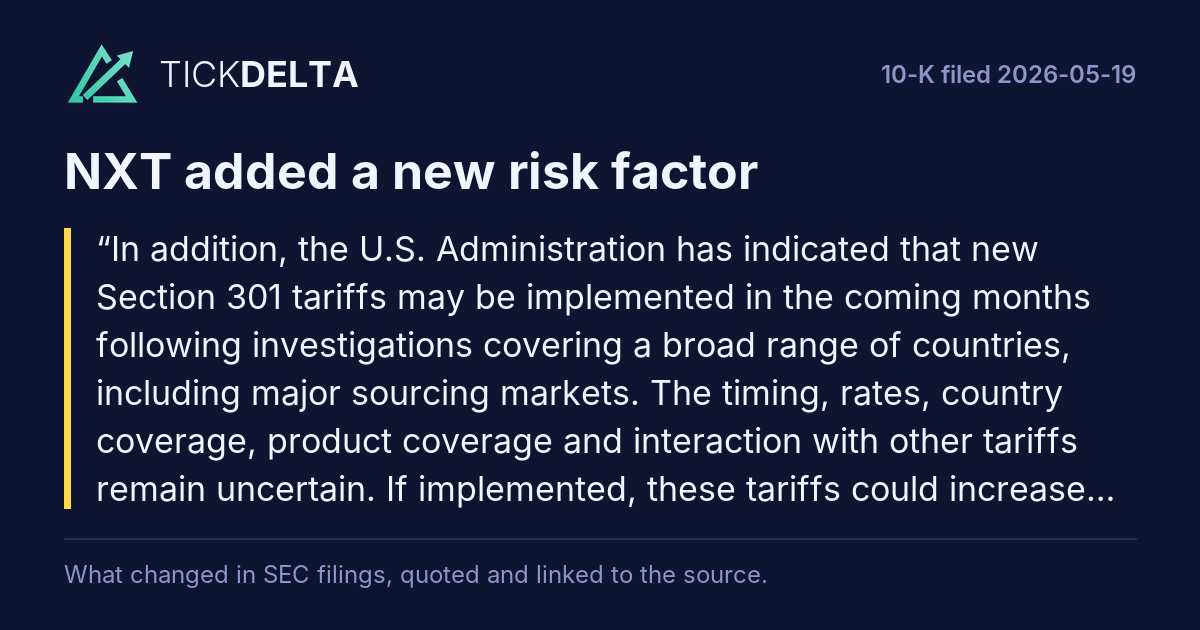
In addition, the U.S. Administration has indicated that new Section 301 tariffs may be implemented in the coming months following investigations covering a broad range of countries, including major sourcing markets. The timing, rates, country coverage, product coverage and interaction with other tariffs remain uncertain. If implemented, these tariffs could increase our costs, reduce our gross margins, adversely affect sourcing and pricing decisions, and otherwise adversely affect our business, financial condition, results of operations and cash flows.
components of solar energy projects, thereby adversely impacting the financial viability of solar energy projects in which our products are used, which could lead to decreased demand for our products.
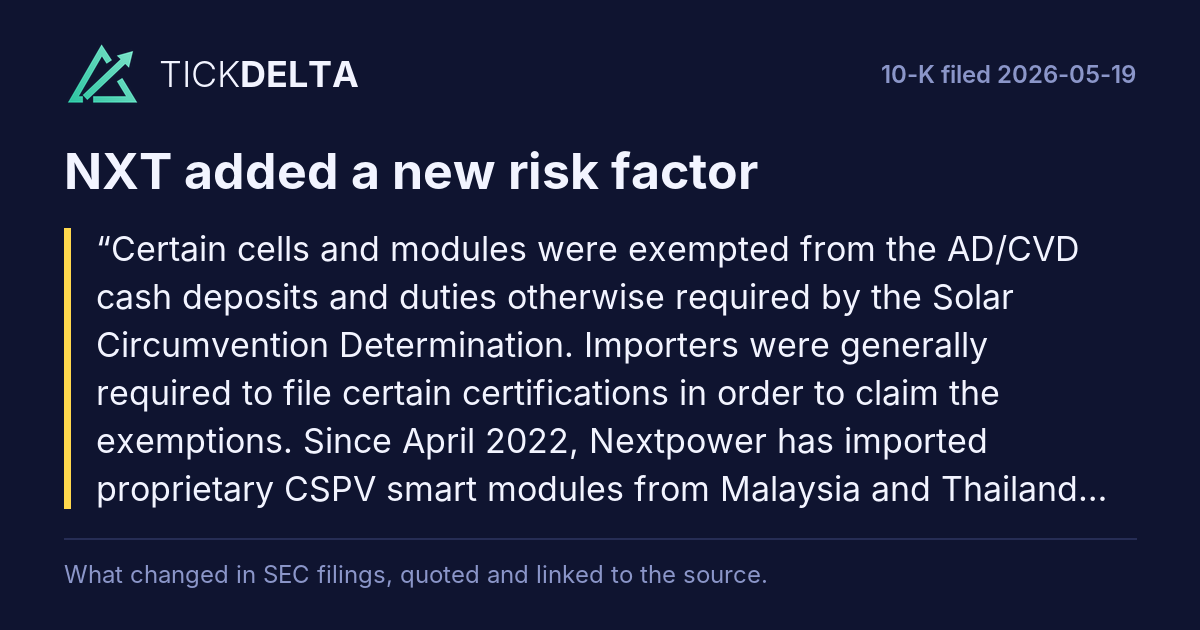
Certain cells and modules were exempted from the AD/CVD cash deposits and duties otherwise required by the Solar Circumvention Determination. Importers were generally required to file certain certifications in order to claim the exemptions. Since April 2022, Nextpower has imported proprietary CSPV smart modules from Malaysia and Thailand that provide off-grid power to our controllers. Nextpower submitted certifications for the modules to claim exemptions from any AD/CVD cash deposit or duty requirements imposed by the Solar Circumvention Determination, but Nextpower did not strictly follow all the certification procedures for a number of these entries. One of the exemptions claimed by Nextpower also is subject to a pending court challenge.
If the U.S. courts strike down one of the exemptions Nextpower relied upon or Nextpower’s certifications are found to be invalid, Nextpower could be required to pay AD/CVD amounts with respect to the applicable entries of the modules. To mitigate the AD/CVD duty risk, Nextpower has submitted a prior disclosure to CBP informing CBP of the potential procedural deficiencies with respect to the certifications submitted by Nextpower. To further mitigate the risk of possible invalidation of one of the exemptions relied upon by Nextpower and/or the potential procedural certification deficiencies, Nextpower filed a request for a changed circumstances review with Commerce, seeking an exclusion for its off-grid smart CSPV modules from the AD/CVD orders on CSPV cells and modules from China. In December 2025, Commerce issued the final results of the changed circumstances review and granted an exclusion for Nextpower’s off-grid smart CSPV modules for purposes of the CVD order on CSPV cells and modules from China, retroactive to January 1, 2022, and also for purposes of the AD order on CSPV cells and modules from China, retroactive to December 1, 2022. Following Commerce’s final grant of the retroactive exclusion, the potential AD/CVD duty liability, if any, with respect to such at risk entries has been substantially reduced but remains unknown. The outcome of the litigation challenging the duty exemption and CBP’s treatment of Nextpower’s certifications remains unclear.
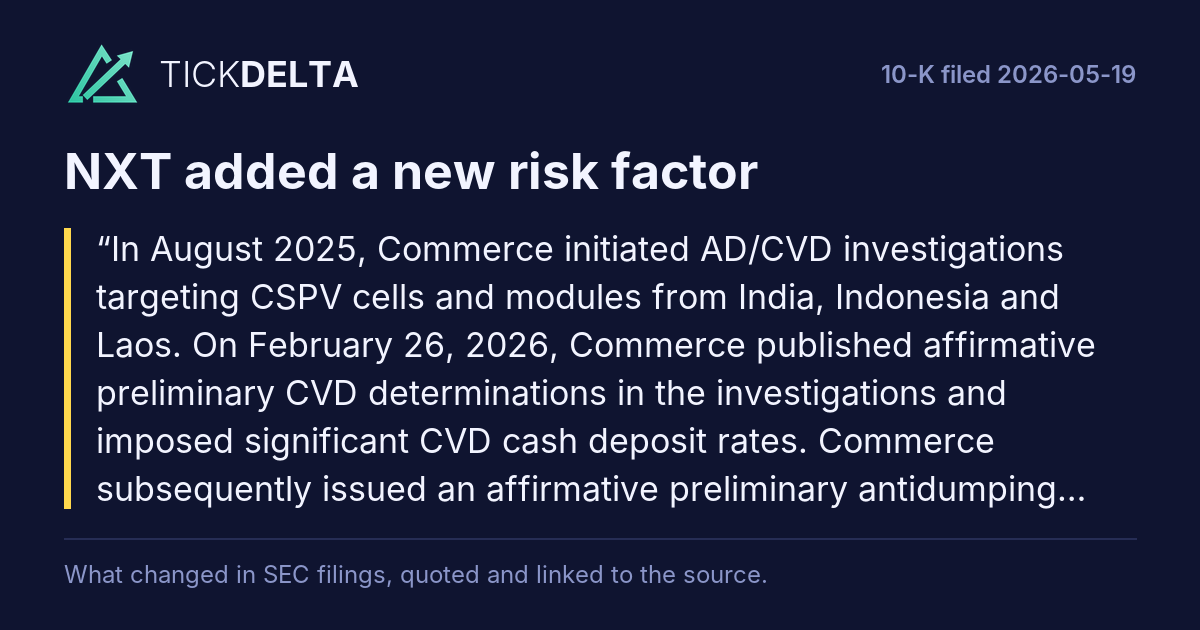
In August 2025, Commerce initiated AD/CVD investigations targeting CSPV cells and modules from India, Indonesia and Laos. On February 26, 2026, Commerce published affirmative preliminary CVD determinations in the investigations and imposed significant CVD cash deposit rates. Commerce subsequently issued an affirmative preliminary antidumping determination covering CSPV cells and modules from those countries. The preliminary determinations may require additional cash deposits, and certain findings could result in retroactive duty liability. Although we have taken steps to mitigate potential exposure through supply chain adjustments, any AD/CVD cash deposits, retroactive assessments, final determinations or changes in sourcing availability could adversely affect our costs, supply chain flexibility, project timing and results of operations.
On July 1, 2025, Commerce initiated a Section 232 investigation to determine the effects on U.S. national security of imports of polysilicon and its derivatives. Once completed, the investigation may result in President Trump imposing tariffs on imports into the United States of polysilicon and its derivatives. It is possible that such Section 232 tariffs could apply to CSPV cells and modules, which would negatively impact our business.
of indebtedness would result in increased fixed obligations and could also include covenants or other restrictions that would impede our ability to manage our operations.
Macroeconomic developments, such as the global or regional economic effects resulting from political tensions between the U.S. and Europe, the Ukraine-Russian war, and U.S.-Iran war (including the disruption of transporting goods through the Suez Canal and the Strait of Hormuz), further increases in inflation and related economic policy responses, evolving trade policies or trade wars, extended U.S. federal government shutdowns, or the occurrence of similar events that lead to uncertainty or instability in economic, political or market conditions, could have a material adverse effect on our business, financial condition and results of operations.
Our business depends, in part, on the integrity and performance of the technology systems supporting our products and services. Our products and services operate in conjunction with, and we are dependent upon, third-party systems, products, services, solutions and components, including third-party cloud providers. If new systems fail to operate as intended or our existing systems cannot expand to cope with increased demand or otherwise fail to perform, we could experience unanticipated
disruptions in service, slower response times and delays in the introduction of new products and services. We could experience a systems failure due to, among other things, human error by our employees, contractors or vendors, electrical or telecommunications failures or disruptions, including third-party cloud disruptions, hardware or software failures or defects, cyberattacks, sabotage or similar unexpected events. High-profile outages involving third-party cloud providers have caused widespread disruptions to their customers’ operations. If one of our third-party cloud providers experience a similar outage, our products and services could be disrupted. Additionally, there have been and may continue to be attacks on certain of our third-party providers, and we cannot guarantee that our or our third-party providers’ systems and networks have not been breached or that they do not contain exploitable defects or bugs that could result in a breach of or disruption to our products and services and to the networks or the systems of third parties that support our products and services or the compromise, loss or corruption of data. Our ability to monitor, remediate or recover from incidents involving third-party providers may be limited, and such providers may not meet our security or service expectations. Any such issue that causes an interruption in our products and services, decreases the responsiveness of our products and services or otherwise affects our products and services could impair our reputation, damage our brand name and negatively impact our business, financial condition and operating results.
Our customers, which include project owners, developers and engineering, procurement and construction (“EPC”) contractors, have in the past and may in the future cancel, suspend, delay or reduce the number or size of projects for which they procure our products and services for a variety of reasons, including capital constraints, changes in project economics, supply chain considerations, evolving market conditions, or an inability to obtain permits, financing or regulatory approvals. In addition, many of our contracts, purchase orders and framework or supply agreements may permit our customers to cancel or suspend orders, including for convenience, sometimes on relatively short notice and, in certain cases, with limited compensation beyond amounts payable for products delivered or costs incurred.
In certain cases, our customers enter into framework arrangements or volume commitments with us that contemplate the future execution of project-specific supply agreements or purchase orders. These arrangements may not result in binding orders for the full anticipated volumes, and customers may reduce or fail to fulfill such commitments. As a result, we may not realize the level of business or revenue contemplated at the time such arrangements are entered into. Furthermore, our customers may elect to source products from alternative suppliers, develop in-house capabilities, or pursue different technologies or system designs, including as a result of cost pressures, technological changes, domestic content requirements or other regulatory or commercial considerations. As a result, the demand for our products and services from existing or prospective customers may be reduced or may not materialize as expected.
While our contracts may provide for certain protections, including deposits, cancellation fees, or payment for work performed or costs incurred prior to cancellation, such protections may not fully compensate us for the loss of anticipated revenues or margins associated with canceled, suspended or delayed projects. In addition, the timing of customer decisions to cancel, suspend or delay projects may occur after we have made commitments to procure materials, allocate manufacturing capacity or incur other costs, which may not be fully recoverable.
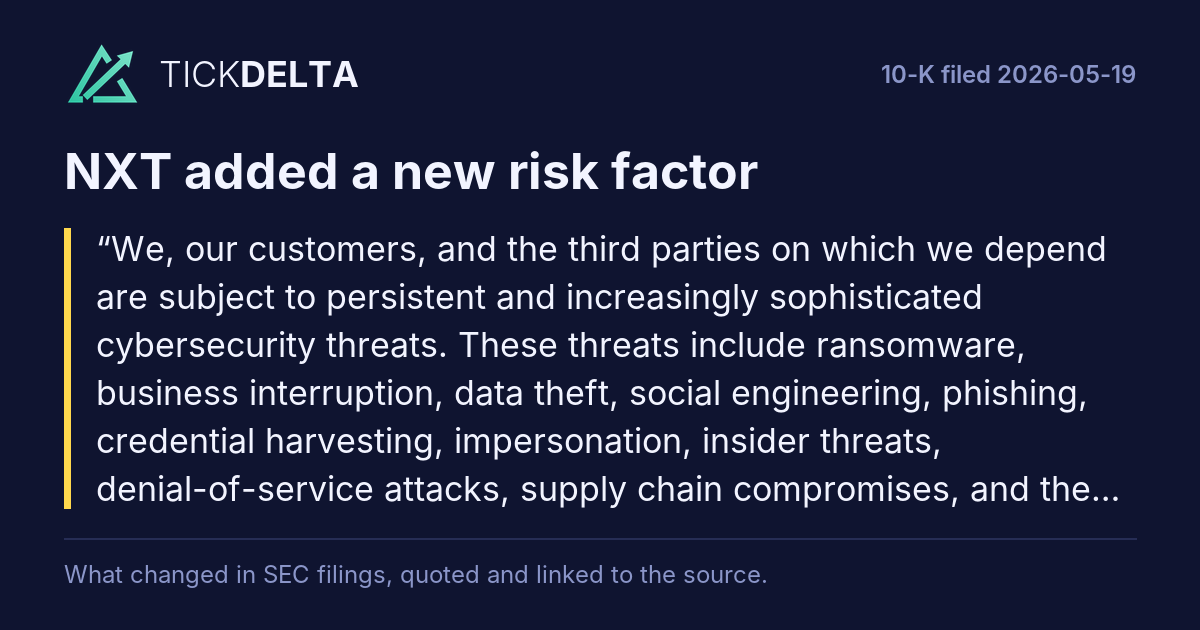
We, our customers, and the third parties on which we depend are subject to persistent and increasingly sophisticated cybersecurity threats. These threats include ransomware, business interruption, data theft, social engineering, phishing, credential harvesting, impersonation, insider threats, denial-of-service attacks, supply chain compromises, and the exploitation of software, firmware, and configuration vulnerabilities. Threat actors include criminal organizations, nation-state actors, insiders, and other malicious parties, and such threats may arise from external attacks, third-party failures, human error, or system design or implementation flaws. These threats and techniques continue to evolve rapidly, may not be detected in a timely manner or at all, and may increase in frequency, speed, scale, and complexity as malicious actors leverage artificial intelligence and other emerging technologies. Advances in artificial intelligence may compress the time between vulnerability identification and exploitation, increasing the volume of threats that must be identified and remediated.
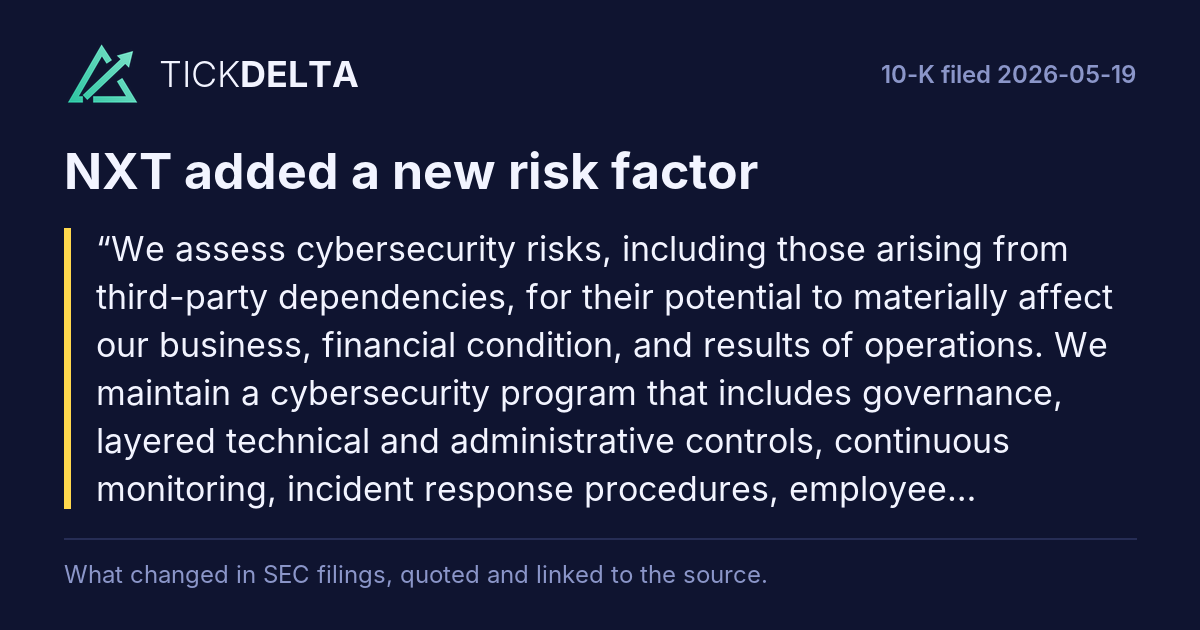
We assess cybersecurity risks, including those arising from third-party dependencies, for their potential to materially affect our business, financial condition, and results of operations. We maintain a cybersecurity program that includes governance, layered technical and administrative controls, continuous monitoring, incident response procedures, employee awareness training,
vulnerability management, and third-party risk assessment processes. We regularly evaluate and enhance our security posture, and we may identify vulnerabilities in our products, systems, or processes that require remediation or other mitigation measures. However, no program, control environment, or set of measures can eliminate all risk, and we may not be able to anticipate, prevent, detect, investigate, contain, or remediate all threats or incidents in a timely manner.
We depend on a range of third-party service providers, suppliers, software providers, and cloud vendors, and we have limited visibility into and control over their cybersecurity practices. While we perform diligence and impose contractual requirements on certain key providers, those measures may not be sufficient to prevent or mitigate all risks. A cybersecurity or other data security incident involving a third party could adversely affect our operations, expose data that we share with or that is processed by such third party, and could result in costs, liabilities, or other obligations to us, including where we may be held contractually or otherwise responsible for such incidents.
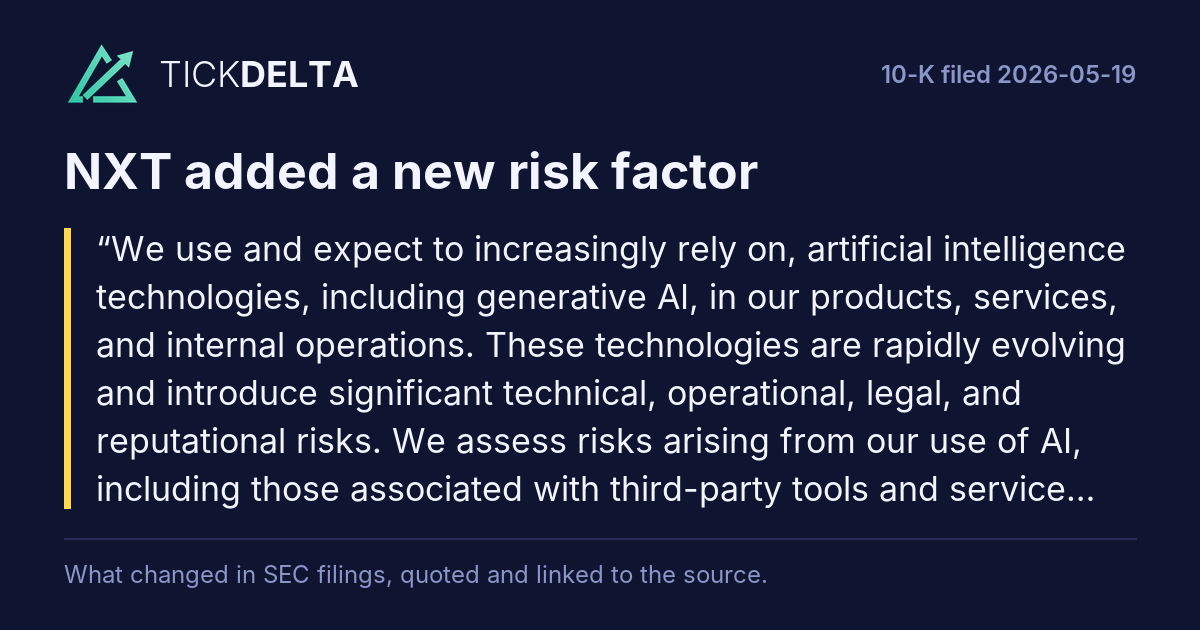
We use and expect to increasingly rely on, artificial intelligence technologies, including generative AI, in our products, services, and internal operations. These technologies are rapidly evolving and introduce significant technical, operational, legal, and reputational risks. We assess risks arising from our use of AI, including those associated with third-party tools and service providers, for their potential to materially affect our business, financial condition, and results of operations.
AI systems may produce inaccurate, incomplete, biased, or misleading outputs due to limitations in model design, training data, or system integration. These issues may not be readily detectable and could result in flawed decision-making, operational
errors, or unintended outcomes in our products or internal processes. The integration of AI into our products and operations may also introduce risks related to product quality, reliability, and customer expectations, particularly where AI-driven outputs influence system behavior or decision-making. The complexity and non-deterministic nature of many AI systems make them difficult to test, validate, and monitor effectively, and inadequate governance, testing, or oversight could result in errors or harmful outputs that negatively impact our business and reputation.
Advances in artificial intelligence may significantly accelerate the identification and exploitation of vulnerabilities, compressing the time between the introduction of a weakness and potential business impact to significantly shorter timeframes. As a result, we may be required to identify, assess, and remediate vulnerabilities more rapidly and at greater scale than in the past. If we are unable to adapt our security, development, and operational processes to this increased speed and volume, our risk of exposure to cybersecurity or operational incidents may increase.
We also face risks related to the use of third-party AI tools by our employees, contractors, service providers, or partners, including the potential exposure of confidential or proprietary information through external systems. Such use may result in unintended disclosure, loss of intellectual property protections, or incorporation of sensitive information into external training datasets, which could harm our competitive position and business.
In addition, there is legal uncertainty regarding the ownership, enforceability, and potential infringement of intellectual property rights associated with AI systems and their outputs. AI-generated content may not be subject to copyright protection, and the use of third-party data or models may expose us to claims related to intellectual property, privacy, data protection, or other rights. Ongoing litigation and regulatory scrutiny in this area may require us to modify our use of AI technologies or limit certain applications.
The legal and regulatory landscape governing AI is rapidly evolving and uncertain. New or changing laws and regulations, including the European Union’s Artificial Intelligence Act and similar frameworks in other jurisdictions, may impose additional requirements, restrict certain uses of AI, or increase compliance costs. We may be required to modify our products, services, or internal practices to comply with these requirements, and we may not be able to do so in a timely or cost-effective manner.
We also face competitive risks if other companies develop or deploy AI technologies more effectively or more rapidly than we do, which could reduce demand for our products and services.
The development, deployment, and operation of AI systems may require significant investment in technology, infrastructure, and personnel, and may increase our costs. As the use of AI continues to expand, it may introduce new or unanticipated ethical, technical, operational, legal, regulatory, and reputational risks. If we are unable to effectively manage these risks, it could adversely affect our business, financial condition, and results of operations.
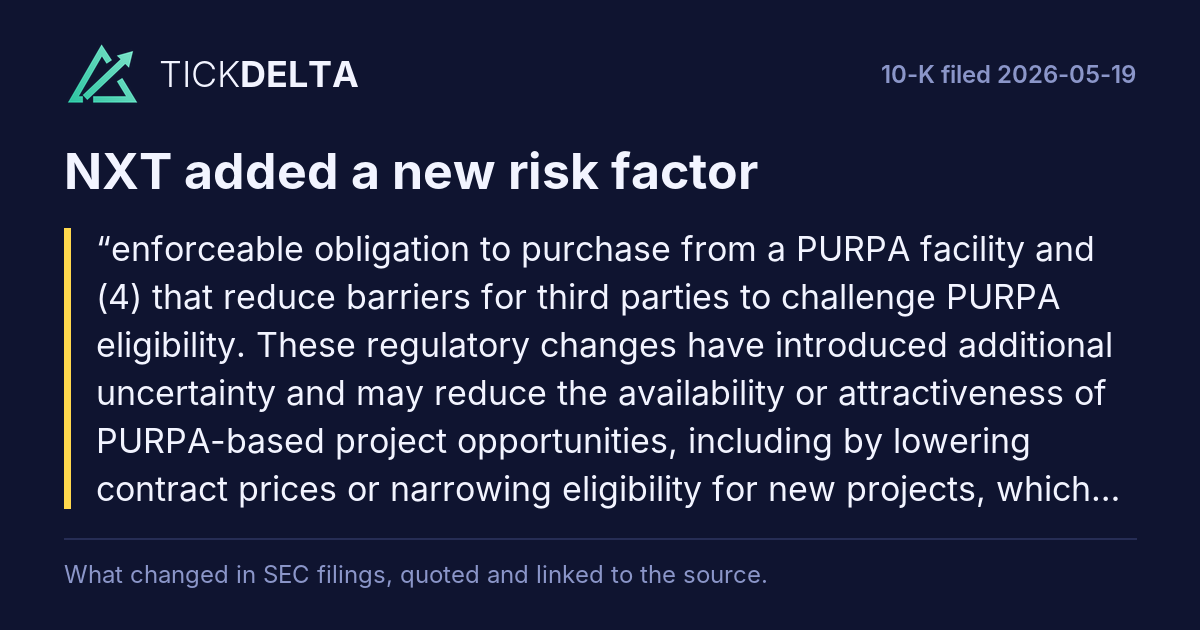
enforceable obligation to purchase from a PURPA facility and (4) that reduce barriers for third parties to challenge PURPA eligibility. These regulatory changes have introduced additional uncertainty and may reduce the availability or attractiveness of PURPA-based project opportunities, including by lowering contract prices or narrowing eligibility for new projects, which could reduce demand for solar energy systems.
and we may be subject to claims that such employees or contractors misappropriated relevant rights from their previous employers.
Our competitors, suppliers, and other third parties hold numerous patents related to technology used in our industry, and may hold or obtain patents, copyrights, trademarks or other intellectual property rights that could prevent, limit, or interfere with our ability to make, use, develop, sell or market our products and services. From time to time we may be subject to claims of infringement, misappropriation or other violation of patents or other intellectual property rights and related litigation. Such claims may also arise from the use of third-party components, technologies or services that are integrated into our products.
communications under the applicable federal securities laws and Nasdaq rules and evaluate and maintain our system of internal control over financial reporting under the Sarbanes-Oxley Act.
our stock price, regardless of the merit or ultimate results of such litigation, could result in substantial costs, which would harm our financial condition and operating results and divert management’s attention and resources from our business.
New in the latest 10-Q
64 paragraphs in the 10-Q filed Nov 2, 2026 with nothing like them in the 10-Q filed Aug 3, 2026 (at least half the words must differ; new numbers alone do not count). Quoted exactly, grouped by the item heading above them. This is text that changed, not a judgement of how serious it is.
Common stock Three-month period ended September 26, 2025 Shares outstanding Amounts Additional paid-in-capital Accumulated deficit Accumulated other comprehensive income (loss) Total stockholders’ equity BALANCE AT JUNE 27, 2025 147,963,974 $ 15 $ 4,208,133 $ (2,400,227) $ (777) $ 1,807,144 Net income — — — 146,861 — 146,861 Stock-based compensation expense — — 31,653 — — 31,653 Vesting of RSU awards 417,819 — — — — — Exercises of options awards 712 — — — — — Total other comprehensive income — — — — 40 40 BALANCE AT SEPTEMBER 26, 2025 148,382,505 $ 15 $ 4,239,786 $ (2,253,366) $ (737) $ 1,985,698
Read in the 10-Q
Common stock Six-month period ended September 26, 2025 Shares outstanding Amounts Additional paid-in-capital Accumulated deficit Accumulated other comprehensive loss Total stockholders’ equity BALANCE AT MARCH 31, 2025 145,648,231 $ 15 $ 4,185,823 $ (2,557,410) $ (298) $ 1,628,130 Net income — — — 304,044 — 304,044 Stock-based compensation expense — — 53,963 — — 53,963 Vesting of RSU and PSU awards 2,733,562 — — — — — Exercises of options awards 712 — — — — — Total other comprehensive loss — — — — (439) (439) BALANCE AT SEPTEMBER 26, 2025 148,382,505 $ 15 $ 4,239,786 $ (2,253,366) $ (737) $ 1,985,698
Read in the 10-Q
On August 19, 2026, the Company filed the Third Amended and Restated Certificate of Incorporation with the Secretary of State of the State of Delaware, reflecting the elimination of the Company’s legacy Class B common stock, the removal of other outdated provisions, and the retitling of the Company’s Class A common stock as common stock.
Read in the 10-Q
milestones reached or completed rows delivered. Contract assets increased by $ 82.5 million from March 31, 2026 to October 2, 2026 due to fluctuations in the timing and volume of billings for the Company’s revenue recognized over time.
Read in the 10-Q
During the six-month period ended October 2, 2026, additions to the Company’s goodwill are driven by its acquisitions of Prevalon Energy LLC (“Prevalon”), as well as complementary assets of Zigor Corporation’s power conversion business and its U.S.-based subsidiary, Apex Power (“Zigor/Apex”) as further described in Note 10.
Read in the 10-Q
The following table summarizes the activity in the Company’s goodwill during the six-month period ended October 2, 2026 (in thousands):
Read in the 10-Q
In addition, the Company maintains one inducement equity compensation plan, established in connection with the acquisition of Prevalon (the “Prevalon Plan”), through which inducement awards (“Inducement Awards”) have been granted to former Prevalon employees as a material inducement to their commencement of employment with the Company following the consummation of such acquisition. The Inducement Awards were granted in accordance with Nasdaq Listing Rule 5635(c)(4) and were unanimously approved by the Compensation and People Committee of the Board of Directors of the Company. While the Inducement Awards were granted outside of the 2022 Plan, the awards are subject to terms and conditions substantially consistent with those set forth under the 2022 Plan.
Read in the 10-Q
The following table summarizes the Company’s stock-based compensation expense for both the 2022 Plan and the Prevalon Plan:
Read in the 10-Q
No option awards were granted during the six-month period ended October 2, 2026.
Read in the 10-Q
For all periods presented, Nextpower has one reportable segment. As further described in Note 10, on July 17, 2026, the Company launched Energy Storage business with the acquisition of Prevalon Energy, a U.S.-headquartered provider of large-scale battery energy storage systems (“BESS”), power stabilization solutions, and lifecycle services. Financial results for Energy Storage were not material for all periods presented.
Read in the 10-Q
On July 17, 2026, the Company acquired 100 % of the ownership interests in Prevalon, a U.S.-headquartered provider of large-scale BESS, power stabilization solutions, and lifecycle services for a combination of cash and deferred stock consideration. Additionally, on July 30, 2026, as part of an all-cash transaction, the Company acquired 100 % of complementary assets of Zigor Corporation’s power conversion business and its U.S.-based subsidiary, Apex Power.
Read in the 10-Q
The acquisition of Prevalon extends the Company’s technology platform across BESS, energy management software, and power control technologies and lifecycle services supporting grid-connected storage, hybrid power plants, AI data center infrastructure, and other critical power applications. Further, the acquisition from Zigor/Apex expands the Company’s energy infrastructure technology portfolio, including UL-certified central inverters for utility-scale solar and energy storage projects in the United States.
Read in the 10-Q
The aggregate cash consideration of the foregoing business acquisitions was approximately $ 132.5 million, net of cash acquired. Their aggregate total purchase price, net of cash acquired, of $ 240.2 million includes $ 50.0 million of deferred common stock consideration expected to be settled in July 2027 and $ 57.8 million of contingent earnout in aggregate (with a possible contingent consideration of up to $ 197.7 million).
Read in the 10-Q
These business acquisitions contain various contingent earnout liabilities based on specific achievement criteria for various operational and/or performance targets. The fair value of the respective contingent earnout liabilities is estimated using the combination of a Scenario Based Method which identifies probability-weighted outcomes scenarios to arrive at an expected payoff and/or a Monte-Carlo simulation model. The Monte-Carlo simulation model is a probabilistic approach used to simulate future revenue and calculate the potential contingent consideration payments for each simulated path. The inputs are unobservable in the market and therefore categorized as Level 3 inputs in the fair value measurement. At each reporting period, the Company evaluates the fair value of its contingent earnout obligations and records any changes in fair value of such liabilities in other income, net in its unaudited condensed consolidated statements of operations. As of October 2, 2026, no changes in the fair value of the contingent earnout liabilities from fiscal year 2027 acquisitions were identified by management, and as such, the aggregate balance of $ 57.8 million was included in other liabilities in the unaudited condensed consolidated balance sheets.
Read in the 10-Q
The following table represents the activity related to the contingent earnout for the six-month period ended October 2, 2026 (in thousands):
Read in the 10-Q
(2) Includes contingent earnout payments for the acquisition of Bentek Corporation (“Bentek”) closed in May 2025 and the acquisition of OnSight Technology Inc. (“OnSight”) closed in May 2025.
Read in the 10-Q
The Company incurred immaterial and approximately $ 4.4 million of acquisition costs which are presented as selling, general and administrative expenses on the unaudited condensed consolidated statements of operations for the three and six-month periods ended October 2, 2026, respectively. The preliminary allocation of the purchase price to the tangible and identifiable intangible assets acquired and liabilities assumed was based on their preliminary estimated fair values as of the date of acquisitions. The excess of the purchase price over the tangible and identifiable intangible assets acquired and liabilities assumed has been allocated to goodwill. Goodwill recognized from the acquisitions of Prevalon and Zigor/Apex is deductible for income tax purposes. The results of operations of the acquisitions were included in the Company’s unaudited condensed consolidated financial statements beginning on the date of acquisition and were not material for all periods presented.
Read in the 10-Q
Additional information, which existed as of the acquisition dates, may become known to the Company during the remainder of the measurement period, a period not to exceed 12 months from the date of the relevant acquisition. Changes to amounts recorded as assets and liabilities may result in a corresponding adjustment to goodwill during the respective measurement period.
Read in the 10-Q
The following table represents the Company’s preliminary allocation of its fiscal year 2027 acquisitions total aggregate purchase price to the acquired assets and liabilities (in thousands):
Read in the 10-Q
Current assets $34,120 Property and equipment 3,315 Intangible assets 157,200 Goodwill 164,644 Other assets 4,872 Total assets 364,151 Current liabilities 121,789 Other liabilities, non-current 2,147 Total purchase price, net of cash acquired $240,215
Read in the 10-Q
Intangible assets are comprised of $ 83.0 million of developed technology to be amortized over an estimated weighted average useful life of 10.0 years, $ 49.0 million of customer relationships to be amortized over an estimated weighted average useful life of 3.0 years, $ 22.4 million of backlog to be amortized over an estimated useful life of 3.7 years, and $ 2.8 million of trade names to be amortized over an estimated useful life of 2.0 years. The fair value assigned to the identified intangible assets was estimated based on an income approach, which provides an indication of fair value based on the present value of cash flows that the acquired business is expected to generate in the future. Key assumptions used in the valuation included forecasted revenues, cost of sales and operating expenses, royalty rate, discount rate and weighted average cost of capital. The useful life of the acquired intangible assets for amortization purposes was determined by considering the period of expected cash flows used to measure the fair values of the asset, adjusted for certain factors that may limit the useful life.
Read in the 10-Q
Pro-forma results of operations have not been presented because the effects were not material to the Company’s unaudited condensed consolidated financial results for all periods presented.
Read in the 10-Q
On May 7, 2025, as part of an all-cash transaction, the Company acquired 100 % of the interests in Bentek, an industry pioneer and manufacturer of electrical infrastructure used in all types of solar power plants. Additionally, on May 9, 2025, the Company acquired 100 % of the interests in OnSight, a supplier of autonomous inspection robots and fire detection systems purpose-built for solar plants. Further, on September 8, 2025, the Company acquired 100 % of the interests in Origami Solar, Inc. (“Origami”), a pioneer in roll-formed steel frame technology for solar plants.
Read in the 10-Q
These business acquisitions expand Nextpower’s capabilities to provide its customers with electrical infrastructure components that collect and transport electricity from solar panels to the power grid, and certain services related to operations and maintenance. These business acquisitions continue Nextpower’s strategy of adding and incorporating complementary technologies into the company’s market-leading tracker platform to accelerate solar power plant construction, increase performance, and enhance long-term reliability.
Read in the 10-Q
The aggregate cash consideration of the foregoing business acquisitions was approximately $ 108.3 million, net of cash acquired. The aggregate total purchase price of these acquisitions of $ 140.2 million includes $ 2.9 million of deferred consideration expected to be paid within a 12-month period, and $ 28.9 million of contingent earnout in aggregate (with a maximum possible consideration of $ 57.5 million).
Read in the 10-Q
The contingent earnout related to the Bentek acquisition is subject to the receipt of an intellectual property “freedom to operate” legal opinion and safety standard certifications for a certain product. As of the acquisition date, the fair value of this contingent earnout liability was estimated to be $ 7.4 million based on a Scenario-Based Method, which identifies probability-weighted outcomes scenarios to arrive at an expected payoff.
Read in the 10-Q
The contingent earnout related to the OnSight acquisition is subject to a certain technology milestone and the achievement of future revenue performance targets, starting May 1, 2025 to March 31, 2028. As of the acquisition date, the fair value of this contingent earnout liability was estimated to be $ 7.0 million based on the combination of a Monte-Carlo simulation model for the revenue-based earnout and a Scenario-Based Method for the technology milestone-based earnout.
Read in the 10-Q
The contingent earnout related to Origami acquisition is subject to the achievement of future revenue performance targets, starting September 8, 2025 to June 30, 2028. As of the acquisition date, the fair value of this contingent earnout liability was estimated to be $ 14.5 million based on a Monte-Carlo simulation model for the revenue-based earnout.
Read in the 10-Q
Intangible assets were comprised of $ 21.0 million of developed technology to be amortized over an estimated weighted average useful life of 9.3 years, and $ 2.1 million of trade names to be amortized over an estimated useful life of 2.0 years, and $ 0.5 million of customer relationships to be amortized over an estimated weighted average useful life of 1.9 years.
Read in the 10-Q
Pro-forma results of operations have not been presented because the effects were not material to the Company’s unaudited condensed consolidated financial results for all periods presented.
Read in the 10-Q
In January 2026, the Company’s board of directors approved a share repurchase program to repurchase up to an aggregate of $ 500.0 million of its outstanding shares of common stock. The share repurchase program has a term of three years and may be modified, suspended, or terminated at any time. The number of shares to be repurchased and the timing of repurchases will be determined by the Company at its discretion and will depend on a number of factors, including, but not limited to, stock price, trading volume, and general market conditions, along with the Company’s working capital requirements, general business conditions, and other factors.
Read in the 10-Q
On October 21, 2026, the Company completed the previously announced acquisition of Zimmermann PV-Steel Group (“Zimmermann”), for total consideration of up to 230 million Euros in cash (approximately $ 258.2 million as of October 21, 2026), consisting of 200 million Euros (approximately $ 224.5 million as of October 21, 2026) in cash paid at closing, 15 million Euros (approximately $ 16.8 million as of October 21, 2026) subject to customary working capital adjustments as defined in the share purchase agreement, and 15 million Euros (approximately $ 16.8 million as of October 21, 2026) of collateral holdback consideration, to be paid in three annual installments on each anniversary of the closing date. This acquisition broadens the range of ground-mount solar applications Nextpower can serve and creates a great opportunity to attach products across the Company’s platform through an expanded European channel.
Read in the 10-Q
On July 17, 2026, we acquired 100% of the ownership interests in Prevalon, a U.S.-headquartered provider of large-scale BESS, power stabilization solutions, and lifecycle services for a combination of cash and deferred stock consideration. Additionally, on July 30, 2026, as part of an all-cash transaction, we acquired 100% of complementary assets of Zigor Corporation’s power conversion business and its U.S.-based subsidiary, Apex Power.
Read in the 10-Q
The acquisition of Prevalon extends our technology platform across BESS, energy management software, and power control technologies and lifecycle services supporting grid-connected storage, hybrid power plants, AI data center infrastructure, and other critical power applications. Further, the acquisition from Zigor/Apex expands our energy infrastructure technology portfolio, including UL-certified central inverters for utility-scale solar and energy storage projects in the United States.
Read in the 10-Q
The aggregate cash consideration of the foregoing business acquisitions was approximately $132.5 million, net of cash acquired. Their aggregate total purchase price, net of cash acquired, of $240.2 million includes $50.0 million of deferred common stock consideration expected to be settled in July 2027 and $57.8 million of contingent earnout in aggregate (with a possible contingent consideration of up to $197.7 million). See Note 10 in the notes to the unaudited condensed consolidated financial statements included elsewhere in this Quarterly Report for further detail on these acquisitions.
Read in the 10-Q
On October 21, 2026, we completed the previously announced acquisition of Zimmermann PV-Steel Group (“Zimmermann”), for total consideration of up to 230 million Euros in cash (approximately $258.2 million as of October 21, 2026), consisting of 200 million Euros (approximately $224.5 million as of October 21, 2026) in cash paid at closing, 15 million Euros (approximately $16.8 million as of October 21, 2026) subject to certain adjustments of the cash consideration as defined in the share purchase agreement, and 15 million Euros (approximately $16.8 million as of October 21, 2026) of collateral holdback consideration, to be paid in three installments on each anniversary of the closing date. This acquisition broadens the range of
Read in the 10-Q
ground-mount solar applications we can serve and creates a great opportunity to attach products across our platform through an expanded European channel.
Read in the 10-Q
Our capital allocation strategy includes both organic and in-organic growth through merger and acquisitions (“M&A”). We have a disciplined M&A approach, focusing on our core competencies and technological differentiation that provides value for customers.
Read in the 10-Q
(2) Debt extinguishment cost consists of nonrecurring costs for the termination of our former credit agreement originally entered into on February 13, 2023.
Read in the 10-Q
Comparison of the three-month periods ended October 2, 2026 and September 26, 2025
Read in the 10-Q
Comparison of the six-month periods ended October 2, 2026 and September 26, 2025
Read in the 10-Q
• Providing multiple interdependent products and services on the same project may increase our exposure to project performance and responsibility-allocation risks.
Read in the 10-Q
the amount or value of credits available to us or them, our cost of goods sold could increase, which could reduce our profitability and competitiveness.
Read in the 10-Q
On July 28, 2026, the Federal Communications Commission (“FCC”) added foreign-produced power inverters to its Covered List based on a national security risk determination. On August 20, 2026, following a further determination by the Department of War, the FCC revised the definition of covered power inverters and excluded certain foreign-produced inverters eligible for the Section 45X advanced manufacturing production credit. The FCC stated that covered new inverter models generally may not receive the equipment authorization required for import, marketing or sale in the United States, while previously authorized models may continue to be imported, marketed and sold; the FCC also established a conditional-approval process. The FCC’s action also does not affect devices purchased before July 28, 2026. In October 2026, the FCC updated the Covered List to reflect conditional approvals for specified inverter models, subject to ongoing compliance with manufacturer-specific conditions. The scope and application of these actions, including the impact on the manufacturing build-out of our Apex inverter business, may continue to evolve.
Read in the 10-Q
On August 26, 2026, President Trump issued Executive Order 14421, “Declaring a National Emergency to Secure the United States Bulk-Power System.” The Executive Order authorizes the Secretary of Energy, after specified determinations, to prohibit certain acquisitions, imports, transfers or installations initiated after the date of the order that involve foreign-produced bulk-power system electric equipment and a foreign-country interest. The order expressly includes utility-scale and other grid-connected inverters and battery energy storage systems within its definition of bulk-power system electric equipment. It also authorizes the Secretary, subject to specified considerations, to impose conditions on the continued use of certain equipment acquired or installed before the order, including requirements to monitor, isolate, secure, disconnect, replace or remove equipment. The Executive Order directs the Secretary of Energy to publish implementing rules or regulations by December 24, 2026, as needed. The Department of Energy has solicited information to guide implementation, and the scope and application of future restrictions remain uncertain.
Read in the 10-Q
On July 1, 2025, Commerce initiated a Section 232 investigation to determine the effects on U.S. national security of imports of polysilicon and its derivatives. On August 6, 2026, the Administration imposed tariffs on imports of polysilicon and polysilicon derivatives under Section 232. These tariffs, and any related exclusions, quotas, country-specific treatment or subsequent modifications, may increase the cost of solar modules and other components used in solar projects, adversely affect our suppliers and customers, and negatively impact our costs, margins, supply chain and demand.
Read in the 10-Q
In addition, our customer contracts may impose broader warranties, indemnities or liquidated damages than those available to us from our suppliers, contract manufacturers or other counterparties, which could leave us responsible for losses arising from components or systems supplied by third parties.
Read in the 10-Q
We may also be subject to climate- and sustainability-related disclosure requirements in other jurisdictions. For example, depending on applicable thresholds, rules and implementing requirements, we may be required to report under California’s climate disclosure laws, including SB 253 and SB 261. We may also be subject to the EU Corporate Sustainability Reporting Directive, as amended and implemented from time to time, and other EU or EU member -state requirements relating to sustainability, climate, supply chains and other ESG matters. These requirements vary across jurisdictions and may increase the complexity and cost of our compliance efforts, including the need to implement new systems, processes and controls.
Read in the 10-Q
depend on maintaining applicable contractor licenses, registrations, certifications and local qualifications, and failure to do so could delay projects, limit our ability to perform contracts or expose us to penalties, disgorgement or claims for damages. These measures may require us to reassess our own products as well as those of equipment suppliers, qualify alternative products, or address additional documentation and cybersecurity requirements, which could increase our costs or delay our customers’ projects.
Read in the 10-Q
Our warranty and performance obligations may extend for substantial periods, and estimating future failure rates, degradation, replacement costs, service costs and other liabilities may be difficult, including for newly introduced BESS and power-conversion products. Actual results may differ materially from our estimates, requiring increased reserves, charges or cash expenditures. Long-term service, availability, capacity, degradation and augmentation commitments may also require us to incur significant costs over the operating life of a project, including costs that exceed amounts recovered from customers or suppliers. A systemic defect in a component or product family could require a broad field inspection, retrofit, replacement or
Read in the 10-Q
remediation program, resulting in substantial warranty expense, inventory write-offs, customer claims, litigation and disruption to our operations. Because certain products will be deployed in grid-connected storage, data-center and other critical-power applications, failures may also result in grid disruption, interruption of customer operations, loss of production, emergency response costs or claims for consequential damages. In addition, incidents involving lithium-ion batteries or other energy-storage systems operated by third parties, even if unrelated to our products, could result in negative public perceptions, increased insurance costs, additional safety requirements or reduced demand for BESS solutions generally.
Read in the 10-Q
Providing multiple interdependent products and services on the same project may increase our exposure to project performance and responsibility-allocation risks.
Read in the 10-Q
Where customers procure multiple products or services from us for the same project, the performance of one offering may depend on the design, operation, data, controls, installation or performance of another offering or related equipment. If those offerings do not operate together as intended, or if a plant does not meet requirements allocated to us, project completion or commercial operation could be delayed, plant output could be reduced, remediation could be required, or we could face claims. Determining the cause of a plant-level problem, or allocating responsibility among us, EPC contractors and other parties, may be difficult. Subject to the limitations of liability and other contractual protections in our agreements, we may incur costs or liabilities that are not fully recoverable from responsible parties or covered by our contracts or insurance.
Read in the 10-Q
intelligence and other emerging technologies. Advances in artificial intelligence may compress the time between vulnerability identification and exploitation, increasing the volume of threats that must be identified and remediated.
Read in the 10-Q
be deceptive, unfair or misrepresentative of our actual practices, we may be subject to potential government or legal investigation or action, including by the Federal Trade Commission or applicable state attorneys general.
Read in the 10-Q
Our joint venture subjects us to risks, including limitations on our decision-making authority and the risk of disputes, which could adversely affect us.
Read in the 10-Q
We have entered into a joint venture arrangement with Abunayyan Holding in Riyadh, Kingdom of Saudi Arabia, to accelerate the deployment of utility-scale solar power plants in the Middle East and North Africa and to build a manufacturing facility in Jeddah, Saudi Arabia. Our joint venture partner may have business interests, goals, priorities or concerns that differ from ours. We do not have sole authority to make certain decisions about the joint venture, and decisions requiring both parties’ agreement could be delayed or deadlocked. Disputes could disrupt the joint venture’s operations or result in litigation, arbitration or termination of the arrangement. The joint venture may also fail to obtain required approvals, secure necessary funding or resources, complete construction on time or within budget, or achieve its expected commercial objectives. If Abunayyan Holding cannot meet its funding or other commitments, we may need to provide additional funding or support, or the joint venture’s projects could be delayed or impaired. Any of these events could reduce the value of our investment and adversely affect our business, financial condition and results of operations.
Read in the 10-Q
example, in June 2026, we filed a patent infringement lawsuit against GameChange Solar asserting infringement of four patents related to the company’s proprietary self-powered solar tracker controller technology, TrueCapture™ energy management control system, and split-cell energy boost technology. In September 2026, GameChange filed a patent infringement lawsuit against us asserting infringement of a patent related to a wind-shielding tracker apparatus. The merits of the parties respective claims and defenses are the subject of ongoing litigation. Such claims may also arise from the use of third-party components, technologies or services that are integrated into our products.
Read in the 10-Q
communications under the applicable federal securities laws and Nasdaq rules and evaluate and maintain our system of internal control over financial reporting under the Sarbanes-Oxley Act.
Read in the 10-Q
choice of forum provision contained in our amended and restated certificate of incorporation to be inapplicable or unenforceable in such action.
Read in the 10-Q
Period Total Number Average Price Total Number of Shares Approximate Dollar Value
Read in the 10-Q
(1) During the period from July 4, 2026 through October 2, 2026, all purchases were made pursuant to the share repurchase program. All purchases were made in accordance with Rule 10b-18 under the Securities Exchange Act of 1934.
Read in the 10-Q
October 2, 2026, certain of our officers or directors listed below adopted or terminated trading arrangements for the purchase or sale of shares of our common stock in amounts and prices determined in accordance with a formula set forth in each such plan:
Read in the 10-Q
(2) Not intended to satisfy the affirmative defense conditions of Rule 10b5-1(c).
Read in the 10-Q
Item 1A of the 10-Q filed Nov 2, 2026 against Item 1A of the 10-K filed May 19, 2026.
A 10-Q repeats only the risks that changed, so a 10-K paragraph that is missing from it is not counted as removed.
Added is a paragraph with nothing like it in the 10-K, Reworded a sentence that is in both with several words changed,
Quiet changes a sentence in both where one to four words changed and one is a hedge or a modal
(cut words struck through, new words highlighted).
Text on the page, not a score; each links to the filing at sec.gov.
The first 26 of 78 are shown (at most 12 of each type).
Two-word phrases in Risk Factors of the 10-K filed May 19, 2026 that are in none of the 1 earlier 10-Ks stored, back to May 22, 2025
Used at least twice, small words left out. Counted, not picked: a phrase can be new because the company renamed something.
28 paragraphs of last year's Risk Factors with nothing like them now. The longest are quoted.
Item 1A of each 10-K and 10-Q on EDGAR, quoted exactly. Each paragraph links to the filing at sec.gov.
10-K change: what was reworded or cut, section by section.
Excel workbook · CSV. Google Sheet that stays up to date: paste =IMPORTDATA("https://tickdelta.com/company/NXT/export.csv") into a cell.