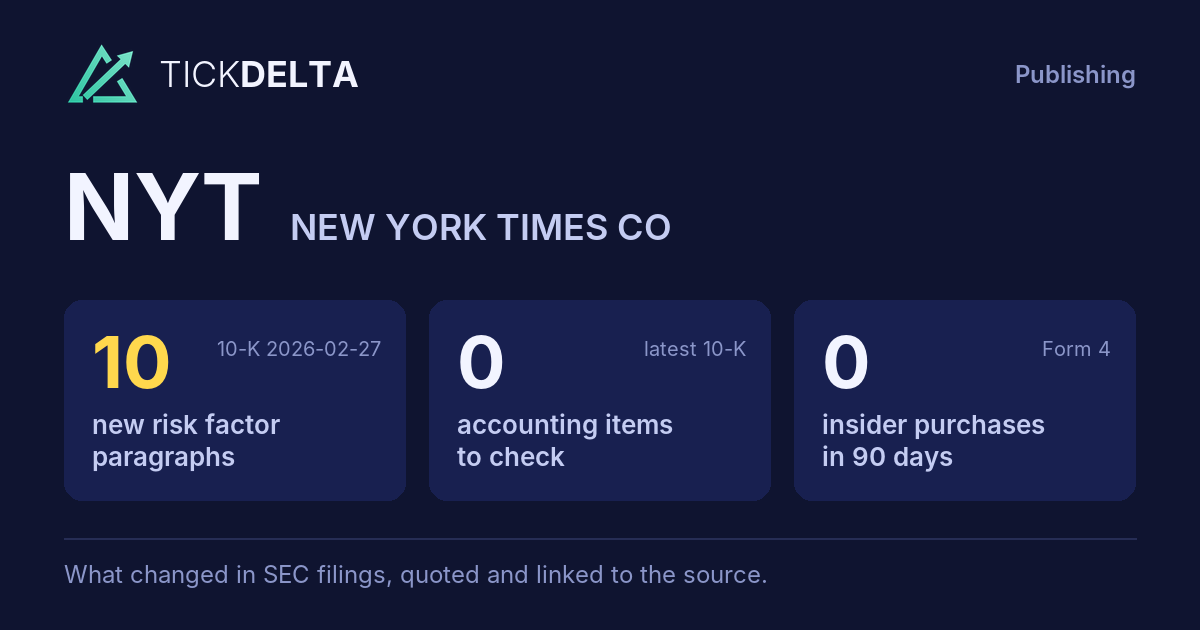
Screener / SEC EDGAR /CIK 0000071691 /10-K filed Feb 27, 2026, compared with Feb 27, 2025 /Numbers from the XBRL of the 10-Ks
NYSE Communication · Publishing

New York Times Co NYT

Compare with peers Embed
SEC comment letters, last 20 years

2 reviews of NYT's filings by SEC staff

UPLOAD and CORRESP
Reviews 2 latest letter Sep 19, 2023
Questions asked 9 each answered in the company's own letter
No closing letter 0 reviews without a letter saying the staff completed it

When the SEC's staff reviews a filing, it writes to the company with numbered questions, and the company answers each one in a letter. SEC publishes the exchange once the review is over, at least 20 business days later. A question is not an accusation; most reviews end with the company adding detail to its next filing.

How the reviews went

Every review on EDGAR, from the first staff letter to the letter that closes it

  1. 1. Staff letters 3 UPLOAD
  2. 2. Questions in them 9 numbered comments
  3. 3. Company replies 3 CORRESP
  4. 4. Reviews closed 2 of 2 closing letter

Half the closed reviews took 86 days or less from the first letter to the closing letter.

Form 10-K for the Fiscal Year Ended December 31, 2022

2023-09-19 to 2023-12-14 · 8 questions · 2 letters from the SEC, 2 from the company
Review closed 2023-12-14
Results discussion (MD&A)SegmentsNon-GAAP measuresRevenueGoodwill and impairmentAcquisitionsLeasesPensionsIncome taxesLiquidity and cashLegal and contingencies
Management's Discussion and Analysis of Financial Condition and Results of Operations · Results of Operations, page 32
SEC asked (1)
Where you describe two or more business reasons that contributed to a material change in a financial statement line item between periods, please quantify, where possible, the extent to which each change contributed to the overall change in that line item.
Rest of the question

In addition, when you discuss revenue fluctuations, specifically describe the extent to which changes are attributable to changes in prices or to changes in the volume or amount of goods or services being sold or to the introduction of new products or services. As an example, we note that you attribute the change in subscription revenue on page 33 to various factors, such as subscribers graduating to higher prices, the growth in the number of subscribers to your digital-only products, and the impact of an additional six days in the year. See Item 303(b)(2) of Regulation S-K and SEC Release No. 33-8350.

NYT answered
We acknowledge the Staff’s comment and in future interim and annual filings where we describe two or more business reasons that contributed to a material change in a financial statement line item between periods, we will quantify, where possible, the extent to which each change contributed to the overall change in that line item.
Rest of the answer

Additionally, when we discuss revenue fluctuations, we will, where possible, specifically describe the extent to which changes are attributable to changes in prices or to changes in the volume or amount of goods or services being sold or to the introduction of new products or services.

Read in the reply
In its next report

First report after the company's reply of Oct 18, 2023: 10-Q filed Nov 8, 2023 ↗, against the 10-Q filed Aug 8, 2023 ↗.

Tickdelta does not hold the text of both reports, so they are not compared here.

Management's Discussion and Analysis of Financial Condition and Results of Operations · Results of Operations, page 32
SEC asked (2)
We note that your statement of operations presents certain costs that are included within "operating profit" but excluded from the "total operating costs" line item. Furthermore, your discussion of "Operating Costs" within your Results of Operations section in MD&A does not include any discussion of these costs despite their inclusion in operating profit.
Rest of the question

Since acquisition-related costs, multi-employer pension plan liability adjustments, impairment charges, and lease termination charges appear to represent operating costs under U.S. GAAP, as evidenced by their inclusion within operating profit, please clarify why they are excluded from total operating costs and explain in sufficient detail how you determined your statement of operations presentation is consistent with Rule 5-03 of Regulation S-X. In light of the fact that some of these amounts are material to operating profit for the year ended December 31, 2022 and six months ended June 30, 2023, they should, at a minimum, be discussed within your Results of Operations section in MD&A as operating costs. Please revise future filings accordingly. Notes to the Consolidated Financial Statements 14. Stock-Based Awards, page 108

NYT answered
Rule 5-03 of Regulation S-X indicates the various captions that, if applicable, are required to be presented on the income statement. The Company’s Statement of Operations includes all applicable captions, and as such, is in compliance with this rule.

The Company’s Statement of Operations includes the following recurring captions - cost of revenue (excluding depreciation and amortization), sales and marketing, product development, general and administrative, and depreciation and amortization totaling to operating costs.
Rest of the answer

In the 2022 10-K (and other past filings), items included under these captions were sub-totaled under the caption “operating costs” on the Statement of Operations, and additional costs that did not fall within these captions (as they were outside the ordinary course of operations), but that were considered operating costs under U.S. GAAP, were listed separately after the operating costs subtotal but before operating profit.

We acknowledge the Staff’s comment and we will revise the Statement of Operations and all other applicable disclosures in our future filings substantially as set out below. This change will include recasting the prior periods presented. In addition, we will include a discussion of the aforementioned items in the Results of Operations section of the Management Discussion and Analysis (“MD&A”) in future interim and annual filings.

An example of the updated Statement of Operations operating costs section is as follows:

Years Ended

(In thousands) December 31, 2022 December 26, 2021 December 25, 2020

(52 weeks and six days) (52 weeks) (52 weeks)

Operating costs

Cost of revenue (excluding depreciation and amortization) $ 1,208,933 $ 1,039,568 $ 959,312

Sales and marketing 267,553 294,947 228,993

Product development 204,185 160,871 133,384

General and administrative 289,259 250,124 223,558

Depreciation and amortization 82,654 57,502 62,136

Acquisition-related costs 34,712 — —

Multiemployer pension plan liability adjustment 14,989 — —

Impairment charge 4,069 — —

Lease termination charge — 3,831 —

Total operating costs

$ 2,106,354 $ 1,806,843 $ 1,607,383

In addition, below is an example of the enhanced MD&A operating costs section:

“Acquisition-Related Costs

In 2022, the Company recorded $34.7 million of acquisition-related costs, which primarily include expenses paid in connection with the acceleration of The Athletic stock options and legal, accounting, financial advisory and integration planning expenses. There were no such costs recorded in 2021.

Multiemployer Pension Plan Liability Adjustment

In 2022, the Company recorded a $22.1 million charge in connection with the Company’s withdrawal from a plan, which was partially offset by a $7.1 million gain related to a multiemployer pension liability adjustment. There were no such charges recorded in 2021.

Impairment Charge

In 2022, the Company recorded a $4.1 million impairment charge for our indefinite-lived intangible asset relating to our Serial podcast. There were no impairment charges recorded in 2021.

Lease Termination Charge

In 2021, the Company recorded a $3.8 million charge resulting from the termination of a tenant’s lease in our headquarters building. There were no impairment charges recorded in 2022.”

Notes to the Consolidated Financial Statements

14. Stock-Based Awards, page 108

Read in the reply
In its next report

First report after the company's reply of Oct 18, 2023: 10-Q filed Nov 8, 2023 ↗, against the 10-Q filed Aug 8, 2023 ↗.

Tickdelta does not hold the text of both reports, so they are not compared here.

Management's Discussion and Analysis of Financial Condition and Results of Operations · Results of Operations, page 32
SEC asked (3)
It appears that you issue stock-based awards with market and performance conditions. Please tell us and disclose your accounting policy for recognition of stock-based compensation for awards with such conditions and, in doing so, clarify if you issue any awards that contain both market and performance conditions. 16. Segment Information , page 111
NYT answered
The Company accounts for its stock-based compensation in accordance with ASC 718, Compensation - Stock Compensation. The Company’s current practice is to issue long-term incentive compensation awards, which have components with market conditions (based on total shareholder return) and components with performance conditions (based on financial metrics).
Rest of the answer

All long-term incentive compensation awards are subject to a three-year service period.

The fair value of the component of long-term incentive compensation awards with a market condition is determined at the date of grant using a Monte Carlo simulation model and expensed over the service period on a straight-line basis, irrespective of the probability of the market condition being achieved, and is not reversed if the market condition is not met. The fair value of the component of long-term incentive compensation awards with performance conditions is determined by the average market price on the grant date and expensed based on the probable outcome of the performance conditions at each reporting date with a cumulative adjustment recorded in periods in which there is a change in the Company’s estimate of the number of shares expected to vest. In future annual filings, the Company will revise the disclosure in Note 14, Stock-Based Awards, with additional information related to the recognition of long-term incentive compensation awards substantially as set out below:

“Long-Term Incentive Compensation

The 2010 Incentive Plan provided, and 2020 Incentive Plan provides, for grants of cash and stock-settled long-term incentive compensation awards to key executives payable at the end of three-year cycles based on the achievement of financial goals tied to financial metrics, on stock price performance relative to companies in the Standard & Poor’s 500 Stock Index and on fulfilling the service condition. Cash-settled awards are classified as a liability in our Consolidated Balance Sheets. Stock-settled awards are payable in Class A Common Stock and are classified within equity. These awards include service, market and performance conditions.

Prior to 2022, cash-settled awards were granted with three-year performance cycles and are based on the achievement of a specified financial performance measure. There were payments of approximately $4 million in 2022, $1 million in 2021 and $4 million in 2020.

The long-term incentive compensation awards consist of restricted stock units (starting with the 2022 program) and performance-based awards. The performance-based awards are based on (i) relative Total Shareholder Return (“TSR”) (calculated as stock appreciation plus deemed reinvested dividends), a market condition and (ii) financial metrics (such as adjusted operating profit and digital subscription revenue), the performance conditions.

The fair value of the portion of the performance awards based on TSR is determined at the date of grant using a Monte Carlo simulation model and expensed over the service period on a straight-line basis, irrespective of the probability of the market condition being achieved. The cumulative expense is not reversed if the market condition is not met.

The fair value of the portion of the performance awards based on financial metrics is determined by the average market price on the grant date, expensed on a straight-line basis over the service period and adjusted at each reporting date based on the probable outcome of the performance conditions. A cumulative adjustment is recorded in periods in which there is a change in the Company’s estimate of the number of shares expected to vest.

The fair value of the restricted stock units is determined by the average market price on the grant date and expensed on a straight-line basis over the vesting period of the award.”

16. Segment Information, page 111

Read in the reply
In its next report

First report after the company's reply of Oct 18, 2023: 10-Q filed Nov 8, 2023 ↗, against the 10-Q filed Aug 8, 2023 ↗.

Tickdelta does not hold the text of both reports, so they are not compared here.

Management's Discussion and Analysis of Financial Condition and Results of Operations · Results of Operations, page 32
SEC asked (4)
We note from your previous response letter dated December 12, 2018 that Wirecutter represented an operating segment that did not meet the ASC 280-10-50-13 aggregation criteria to be combined with The New York Times Company operating segment. Please confirm whether or not Wirecutter still represents an operating segment that does not meet the ASC 280 aggregation criteria.
Rest of the question

If so, ensure that you revise your presentation to include Wirecutter in an "all other" category as required by ASC 280-10-50-15.

NYT answered
The Company has applied the accounting guidance prescribed in ASC Topic 280, Segment Reporting in its determination that as of fiscal year 2020 (and each subsequent period), Wirecutter was no longer an operating segment of the Company. As discussed in our previous response letter dated December 12, 2018, we determined that Wirecutter was an operating segment as a result of the way Wirecutter was managed at the time and the fact that discrete financial information was prepared and discussed with the Chief Operating Decision Maker (“CODM”) on a regular basis.

Since 2018, there have been
Rest of the answer

several changes to the facts and circumstances in our segment evaluation that resulted in the Company’s determination that Wirecutter no longer meets the criteria to be an operating segment. Our determination was based on the following factors:

1.Discrete financial information for Wirecutter is no longer reviewed by the CODM.

2.Wirecutter previously had an Advisory Board of which the CODM at the time was a member. The Advisory Board was intermittently shown discrete financial information for Wirecutter. This Advisory Board was disbanded in 2019.

3.At the time of acquisition in 2016, the President and General Manager of Wirecutter was granted a special one-time three-year cash incentive award based on the financial performance of Wirecutter. That award has since expired. No other incentive awards based on Wirecutter performance have been granted since.

As of December 12, 2018, the date of our previous response letter, Wirecutter operated largely as a separate business. For example, although Wirecutter shared some of the Company’s enterprise resources (such as human resources, legal and technology support), it generated its own content, maintained its own website, used business systems that were largely distinct from the Company’s and had an independent sales and advertising staff. Subsequent to that response, in 2020, Wirecutter content was brought onto the Company’s common website (www.nytimes.com). Additionally, in 2021, Wirecutter became a subscription business available as a standalone subscription as well as part of the Company's digital subscription package. For these reasons, Wirecutter is now more integrated into The New York Times Group (“NYTG”) operating segment, sharing resources that support subscription revenues (subscriber servicing, product development and marketing functions as well as certain general and administrative functions).

Beginning in the first quarter of 2022, the Company has two reportable segments: NYTG and The Athletic.

Read in the reply
In its next report

First report after the company's reply of Oct 18, 2023: 10-Q filed Nov 8, 2023 ↗, against the 10-Q filed Aug 8, 2023 ↗.

Tickdelta does not hold the text of both reports, so they are not compared here.

Management's Discussion and Analysis of Financial Condition and Results of Operations · Results of Operations, page 32
SEC asked (5)
We note that you present adjusted operating costs on both a segment and consolidated basis within your segment footnote and that you identify adjusted operating costs as a non-GAAP measure on pages 29 and 45. Please note that Item 10(e)(1)(ii)(C) of Regulation S-K prohibits the presentation of non-GAAP measures in the financial statement footnotes.
Rest of the question

Accordingly, please remove your presentation of these non-GAAP measures from your footnotes in future filings and ensure that you include the applicable non-GAAP reconciliations within MD&A, including adjusted operating costs on a segment basis. Ensure you also provide all necessary reconciliations on a segment basis within applicable Form 8-K earnings releases.

NYT answered
We acknowledge the Staff’s comment and will update future interim and annual filings to exclude adjusted operating costs from the financial statements and expand the reconciliation of operating costs under GAAP to adjusted operating costs by segment in the MD&A and the earnings releases to include adjusted operating costs on a segment basis. This expanded reconciliation will be substantially as follows:

Years Ended % Change

(in thousands) December 31, 2022 December 26, 2021 2022 vs.
Rest of the answer

2021

(52 weeks and six days)(1)

(52 weeks)

Total operating costs $ 2,106,354 $ 1,806,843 16.6 %

Less:

Depreciation and amortization 82,654 57,502 43.7 %

Severance 4,669 882 *

Multiemployer pension plan withdrawal costs 4,871 5,150 (5.4) %

Acquisition-related costs 34,712 — *

Multiemployer pension plan liability adjustment 14,989 — *

Impairment charge 4,069 — *

Lease termination charge — 3,831 *

Total adjusted operating costs $ 1,960,390 $ 1,739,478 12.7 %

Total adjusted operating costs by segment

The New York Times Group $ 1,834,627 $ 1,739,478 5.5 %

The Athletic 125,763 — *

(1) The results of The Athletic have been included in our Consolidated Financial Statements beginning February 1, 2022.

* Represents a change equal to or in excess of 100% or not meaningful.

Read in the reply
In its next report

First report after the company's reply of Oct 18, 2023: 10-Q filed Nov 8, 2023 ↗, against the 10-Q filed Aug 8, 2023 ↗.

Tickdelta does not hold the text of both reports, so they are not compared here.

Management's Discussion and Analysis of Financial Condition and Results of Operations · Results of Operations, page 32
SEC asked (6)
As required by ASC 280-10-50-30(b), please revise future filings to reconcile the total of your reportable segments' measure of profit or loss, total adjusted operating profit, to consolidated income before income taxes and discontinued operations. 18. Commitments and Contingent Liabilities, page 117
NYT answered
We acknowledge the Staff’s comment and will update the Company’s future interim and annual filings to include the following reconciliation of segment adjusted operating profit to consolidated income before income taxes in the financial statements footnotes disclosures:

Adjusted operating profit .

The New York Times Group $ 389,049 $ 335,399 16.0 %

The Athletic (41,118) — *

Total adjusted operating profit $ 347,931 $ 335,399 3.7 %

Other components of net periodic benefit costs 6,659 10,478 (36.4) %

Add:

Interest income and other, net 40,691 32,945 23.5 %

Income before income taxes $
Rest of the answer

235,999 $ 290,501 (18.8) %

18. Commitments and Contingent Liabilities, page 117

Read in the reply
In its next report

First report after the company's reply of Oct 18, 2023: 10-Q filed Nov 8, 2023 ↗, against the 10-Q filed Aug 8, 2023 ↗.

Tickdelta does not hold the text of both reports, so they are not compared here.

Management's Discussion and Analysis of Financial Condition and Results of Operations · Results of Operations, page 32
SEC asked (7)
We note your disclosure that "although the Company cannot predict the outcome of these matters, it is possible that an unfavorable outcome in one or more matters could be material to the Company’s consolidated results of operations or cash flows for an individual reporting period.
Rest of the question

However, based on currently available information, management does not believe that the ultimate resolution of these matters, individually or in the aggregate, is likely to have a material effect on the Company’s financial position." Please note that ASC 450-20-50-3 requires that if there is at least a reasonable possibility that additional loss may have been incurred, and an accrual has not been made or exposure exists in excess of the accrual, the footnotes should disclose the nature of the contingency and an estimate of the possible loss or range of loss or a statement that such an estimate cannot be made. Please advise or revise accordingly. Alternatively, if no amount of loss in excess of recorded accruals is believed to be reasonably possible, please state this in your disclosure. See guidance in ASC 450-20-50.

NYT answered
In accordance with ASC 450-20-50-3, the Company did not believe that there was a reasonable possibility that any litigation as of December 31, 2022, would result in a loss or an additional loss that needed to be disclosed in the notes to the Company’s financial statements.

In future interim and annual filings, unless circumstances change, we will revise our commitments and contingencies disclosure substantially as set out below, with the deletions struck out:

“We are involved in various legal actions incidental to our business that are now pending against us.
Rest of the answer

These actions generally have damage claims that are greatly in excess of the payments, if any, that we would be required to pay if we lost or settled the cases. We record a liability for legal claims when a loss is probable and the amount can be reasonably estimated. Although the Company cannot predict the outcome of these matters, no amount of loss in excess of recorded amounts as of December 31, 2022, is believed to be reasonably possible. it is possible that an unfavorable outcome in one or more matters could be material to the Company’s consolidated results of operations or cash flows for an individual reporting period. However, based on currently available information, management does not believe that the ultimate resolution of these matters, individually or in the aggregate, is likely to have a material effect on the Company’s financial position.”

____________________

If there are any questions, please contact the undersigned at 212-556-7001, or Diane Brayton, Executive Vice President and General Counsel, at 212-556-5995.
Read in the reply
In its next report

First report after the company's reply of Oct 18, 2023: 10-Q filed Nov 8, 2023 ↗, against the 10-Q filed Aug 8, 2023 ↗.

Tickdelta does not hold the text of both reports, so they are not compared here.

SEC asked
Segment Information, page 111 1. We note your response to comment 5 and the expanded non-GAAP reconciliation for consolidated adjusted operating costs that you intend to include in future filings. Please further revise your proposed disclosures to also reconcile adjusted operating costs by individual segment to the corresponding GAAP measure.
Rest of the question

The reconciliation should include detail of all significant adjusting amounts.

NYT answered
We acknowledge the Staff’s comment and will update future interim and annual filings to also reconcile adjusted operating costs by individual segment to the corresponding GAAP measure. This expanded reconciliation will be substantially as follows:

Years Ended

December 31, 2022 December 26, 2021

(52 weeks and six days)(1)

(52 weeks)

(in thousands) NYTG The Athletic Consolidated NYTG The Athletic Consolidated

Total operating costs $ 1,955,169 $ 151,185 $ 2,106,354 $ 1,806,843 $ — $ 1,806,843

Less:

Depreciation and amortization 57,392 25,262 82,654 57,502 — 57,502

Severance 4,509 160
Rest of the answer

4,669 882 — 882

Multiemployer pension plan withdrawal costs 4,871 — 4,871 5,150 — 5,150

Acquisition-related costs 34,712 — 34,712 — — —

Multiemployer pension plan liability adjustment 14,989 — 14,989 — — —

Impairment charge 4,069 — 4,069 — — —

Lease termination charge — — — 3,831 — 3,831

Total adjusted operating costs $ 1,834,627 $ 125,763 $ 1,960,390 $ 1,739,478 $ — $ 1,739,478

(1) The results of The Athletic have been included in our Consolidated Financial Statements beginning February 1, 2022.

____________________

If there are any questions, please contact the undersigned at 212-556-7001, or Diane Brayton, Executive Vice President and General Counsel, at 212-556-5995.

Read in the reply

Also in this review: request for more time, Sep 20, 2023, closing letter, 2023-12-14
Form 10-K for the Fiscal Year Ended December 31, 2017

2018-11-08 to 2018-12-17 · 1 question · 1 letter from the SEC, 1 from the company
Review closed 2018-12-17
RevenueSegmentsIncome taxes
Financial Statements · Notes to the Consolidated Financial Statements
SEC asked
Income Taxes, page 93 1. Please tell us and revise to disclose the components of income (loss) before income tax expense (benefit) as either domestic or foreign, if material. See Rule 4-08(h) of Regulation S-X. 17. Segment Information, page 101 2. We note that you have one reportable segment.
Rest of the question

In this regard, please tell us and revise to include further disclosure on how you determined your reportable segment in accordance with ASC 280-10-50-21. Also, as your business continues to evolve with the current environment, please tell us if you have more than one operating segment and how you evaluated your business for the existence of more than one operating segment during 2017 and 2018 under the guidance in ASC 280-10-50-1. As part of your response, please discuss your evaluation in terms of both different products as well as geographic areas. 3. We note from pages 2 and 3 of the 10-K that you have international circulation of your newspapers and digital content. To the extent you derive a material amount of revenues from your international subscriptions, please revise to disclose your revenues by geographic area in accordance with ASC 280-10-50-41.

NYT answered
The Company’s operations are primarily conducted out of our New York headquarters, including the distribution of content globally across the Company’s digital and print platforms, and the sale of advertising globally across both of these platforms. The activities of our foreign entities primarily consist of services provided in support of these operations (for example, certain newsroom support, as well as limited marketing and advertising sales support) under a structure that has been in place since January 1,

2017.
Rest of the answer

In 2016, our international print newspaper was

Securities and Exchange Commission

Page rebranded and the vast majority of the editing and production operations associated with the newspaper were relocated to the Company’s headquarters in New York. Prior to this, our foreign operations consisted primarily of activities to support the production and distribution of this newspaper.

The income (loss) before income tax expense from our foreign operations totaled approximately $5.5 million, ($9.8) million and ($0.1) million for 2017, 2016 and 2015, respectively, which the Company has determined, based on its assessment of quantitative and qualitative factors, to be immaterial. (The $9.8 million loss from 2016 was unusual and reflected one-time charges associated with the restructuring mentioned above.) To the extent the Company’s income before income tax expense from our foreign operations becomes a material component of our total income before income tax expense, we will include disclosure in future filings.

17. Segment Information, page 101

2. We note that you have one reportable segment. In this regard, please tell us and revise to include further disclosure on how you determined your reportable segment in accordance with ASC 280-10-50-21. Also, as your business continues to evolve with the current environment, please tell us if you have more than one operating segment and how you evaluated your business for the existence of more than one operating segment during 2017 and 2018 under the guidance in ASC 280-10-50-1. As part of your response, please discuss your evaluation in terms of both different products as well as geographical areas.

Response:

The

Company has applied the accounting guidance prescribed in ASC Topic 280, Segment Reporting (“ASC 280”), in its determination that it has one reportable segment. As more fully described below, as our business has continued to evolve and based on the current manner in which the Company’s operations are conducted and managed, the Company has concluded that it has two operating segments: The New York Times Company, which comprises substantially all of our operations; and

Wirecutter, our recently acquired product review and recommendation website. In addition, the Company has concluded that the Wirecutter operating segment is immaterial and accordingly separate segment disclosure for it is not warranted. As noted below, the Company did not utilize the aggregation criteria in determining its reportable segment.

The supporting analysis for this conclusion is presented below in the following sections:

I.

Identification of the Chief Operating Decision Maker (“CODM”)

II.

Determination of Operating Segments

A. Business Activities and Evolution of the Business

B. CODM’s Assessment of Performance and Allocation of Resources

C. Conclusion

III.

Determination of Reportable Segments

Identification of the CODM

As similarly described in the Company’s letter to the Staff dated January 20, 2016, we have determined that our Chief Executive Officer

(“CEO”), Mark Thompson, is the CODM because he is the person within the organization who makes the key operating decisions with respect to resource allocation and performance assessment across all functions of the organization.

As part of the identification of the Company’s CODM, we determined that no other senior executive, either individually or as a group, should be considered the CODM. Although other members of our senior management team participate in the resource allocation process from time to time, resource allocation and key operating decision-making authority resides with our CEO.

There has been no change in these determinations since our previous letter.

ASC Topic 280 states that an individual business is an operating segment if it meets all of the following criteria:

a)

It engages in business activities from which it may recognize revenues and incur expenses (including revenues and expenses relating to transactions with other components of the same public entity).

b)

Its operating results are regularly reviewed by the public entity’s CODM to make decisions about resources to be allocated to the segment and assess its performance.

c)

Its discrete financial information is available.

In applying this guidance, the Company has concluded that it has two operating segments: The New York Times Company, which comprises substantially all of our operations; and Wirecutter, our recently acquired product review and recommendation website.

A.

Business Activities and Evolution of the Business

The Company is a global media organization focused on creating, collecting and distributing high-quality news and information. This content is distributed globally across the Company’s digital and print platforms and, similarly, we sell advertising globally across both of these platforms.

We generate revenues principally from subscriptions and advertising. Subscription revenues consist of revenues from subscriptions to our digital and print products (which include our news product, as well as our Crossword and Cooking products) and single-copy sales of our print newspaper. Advertising revenues are generated from global sales of advertising across both our digital and print platforms. We also generate “Other revenues” from, among other things, commercial printing, the lease of space in our headquarters building, news services/syndication, Wirecutter, digital archive licensing, NYT Live (our live events business) and retail commerce. As our industry has continued to shift from print to digital media, our business has similarly evolved. Among other things, in recent years, we made three acquisitions, expanded our global reach and introduced or grew two additional revenue streams within “Other revenues.”

Acquisitions. In 2016, we purchased HelloSociety and Fake Love, two digital marketing agencies intended to broaden the range of marketing and creative services provided by our advertising group. HelloSociety is a digital marketing agency that leverages social media influencers to drive engagement for branded content campaigns, and Fake Love is an integrated experience design agency that specializes in anchoring brands in contemporary culture via creative programs, live experiences and virtual and mixed reality. These acquisitions are managed by the Company’s advertising department leadership as an expansion of its creative services offerings.

In addition, in 2016, the Company purchased Wirecutter, which aligns with the Company’s commitment to service journalism. Wirecutter produces product reviews and recommendations and generates revenues by offering direct links to merchants featured in its reviews in exchange for a portion of the sale price.

International. In recent years, we also focused on efforts to reach and engage readers around the world, investing in, among other things, a news bureau in Australia and opportunities to increase readership in the United Kingdom, Europe and Canada. As disclosed in the Company’s 2017 Annual Report on Form 10-K, as of the end of 2017, we had approximately 3.6 million paid subscriptions across 208 countries, as well as a monthly average of approximately 136 million unique visitors to our website globally.

Additional Revenue Streams. In addition, as our business has continued to evolve, the Company has identified two opportunities to generate new or increased revenue in certain areas. First, as a result of our recent headquarters redesign and consolidation, we have been able to generate increased revenue from the lease of unused space in our building. Second, in 2018, we began to utilize excess printing capacity at our production and distribution facility for commercial printing.

With certain limited exceptions, including Wirecutter (further described below), the operations and activities related to our products share the same resources overseen by the CODM (including, among others, newsroom, technology, marketing and advertising staff). For example, the content that is distributed globally through our digital and print products is generated by members of the same newsroom (whether located at our New York headquarters or in bureaus across the world); our content is published digitally on a common website worldwide

(www.nytimes.com), and although we produce and distribute a print newspaper that is tailored to international audiences, the content is generated by the same newsroom that generates content for our domestic audiences. In addition, with certain limited exceptions, our subscription marketing efforts for our digital and print platforms globally originate from the same marketing department, and the advertisements on our digital and print platforms globally are sold by the same advertising department.

As similarly described in the Company’s letter to the Staff dated January 20, 2016, with respect to our ASC 280 analysis, the CODM views the Company’s digital and print platforms not as separate businesses, but as different methods to distribute the same content to our readers and to offer our advertisers a variety of ways to reach them. In addition, the CODM views our international activities not as a separate business, but as a method to further expand the distribution of our content to readers and to offer our advertisers broader ways to reach them.

B.

CODM’s Assessment of Performance and Allocation of Resources

1. Management Structure

2. Information Provided to the CODM

3. International

4. Wirecutter

The Company’s CODM sets the overall strategy of the Company, establishes both the operational and financial priorities and assesses the performance of the Company based on the discrete financial information described below. The following provides an overview of the Company’s management structure, the information regularly reviewed by the CODM and the unique position of Wirecutter in this structure.

1. Management Structure

The following is a list of the executives who report directly to the CODM, and their titles:

•

Diane Brayton, Executive Vice President, General Counsel and Secretary

Roland A. Caputo, Executive Vice President and Chief Financial Officer (“CFO”)

Stephen Dunbar-Johnson, President, International

Meredith Kopit Levien, Executive Vice President and Chief Operating Officer (“COO”)

David Perpich, President and General Manager of Wirecutter

Nick Rockwell, Executive Vice President and Chief Technology Officer

Ellen C. Shultz, Executive Vice President, Talent and Inclusion

The Company’s management structure has evolved since our letter to the Staff dated January 20, 2016, to include Messrs. Dunbar-Johnson and Perpich.

Additionally, Ms. Kopit Levien was promoted in June 2017 from Chief Revenue Officer to the newly created COO role, and Mr. Caputo was promoted in April 2018 from head of the Company’s Print Products and Services Group to CFO.

In his role, Mr. Dunbar-Johnson advises on the Company’s global initiatives and oversees the distribution of the international edition of our print newspaper. He is responsible for the costs associated with the physical production and distribution of this print newspaper, as well as the print subscription revenues derived from the paper’s distribution (but not the advertising revenues derived therefrom).

Ms. Kopit Levien was named COO in June 2017. In this newly created role, she oversees the teams responsible for subscriptions and advertising revenues as well as the Company’s digital products, design, audience, live events and new product development. Ms. Kopit Levien is broadly responsible for advertising revenue and, other than as noted above, subscription revenue derived from the Company’s products globally, as well as expenses of the functional departments she oversees.

In his role as President and General

Manager of Wirecutter, Mr. Perpich leads all aspects of the business and operations of Wirecutter and is responsible for the revenues and costs associated with this business.

With respect to senior executive compensation, financial targets are set for the annual incentive and long-term performance awards based on consolidated enterprise-wide financial metrics, and not on any separate profit measures with respect to the Company’s products or geographic areas. However, following the acquisition of Wirecutter and in connection with his appointment as

President and General Manager, Mr. Perpich was granted a special one-time three-year cash incentive award based on the financial performance of Wirecutter as a portion of his total compensation.

2. Information Provided to the CODM

CODM meets regularly and as-needed with his direct reports, both individually and in formal meetings, including meetings of the Company’s senior management team, referred to as the Executive Committee.

The Executive Committee includes the CODM, his direct reports, the Company’s Chief Strategy Officer (who reports to the Chief Financial Officer) and the Publisher, Executive Editor, Managing Editor and Editorial Page Editor of The New York

Times.

Information prepared in connection with Executive Committee Meetings

As similarly described in the Company’s letter to the Staff dated January 20, 2016, the Executive Committee reviews Company financial updates approximately monthly, which include some or all of the following financial information for the Company (the “Executive Committee Material”):

total revenues, including advertising and subscription revenues and other revenues;

advertising and subscription revenue trends;

operating costs, including costs across functional areas such as advertising, marketing, products and technology, print production and distribution, general and administrative functions, and certain other operating costs;

consolidated adjusted operating profit (which excludes certain items);

diluted adjusted earnings per share (which excludes certain items);

information on the number of paid subscriptions to our digital-only product bundles;

a comparison of consolidated operating results compared with analyst consensus estimates; and historical stock price performance relative to relevant stock market indexes and peer companies.

In connection with certain Executive Committee meetings, the Executive Committee Material also includes periodic updates on progress with respect to various strategic initiatives and statistics that underlie certain key performance metrics for the consolidated business, such as audience reach and audience engagement, and average revenue per user.

Information prepared in connection with Quarterly Progress Reviews

On a quarterly basis, the CODM, along with other members of the Executive Committee, participate in meetings to review progress against the Company’s enterprise goals (which represent the Company’s strategic initiatives for the year). The information presented in connection with these reviews includes (i) statistics that underlie progress against the Company’s strategic initiatives, including among others subscription growth, audience reach and audience engagement, (ii) quarterly advertising and subscription revenue trends and (iii) consolidated financial information consistent with the Executive Committee Material.

Information prepared in connection with Annual Budget Reviews

In connection with the annual consolidated budget review, information is prepared for the CODM that provides details on assumptions and consolidated budgeted financial performance for the following year. This includes expectations with respect to the financial items included in the Executive Committee Material described above.

With the exception of Wirecutter, none of the information described above and provided to the CODM in connection with Executive Committee Meetings, Quarterly

Progress Reviews, Annual Budget Reviews or other meetings with his direct reports, would be considered discrete financial information, as that term is used in ASC Topic 280, for our digital or print platforms, recent acquisitions, international operations, additional revenue streams or any other operations, and our CODM does not regularly review or utilize any measure of profitability or operating performance associated with these operations separately to make performance decisions or allocate resources.

3. International

As discussed above, our newsroom generates content that is distributed globally across both the Company’s digital and print platforms and, similarly, we sell advertising globally across both of these platforms. The content that we distribute is generated by members of the same newsroom (whether located at our New York headquarters or in bureaus across the world), and with certain limited exceptions, our subscription marketing efforts originate from the same marketing department, and the advertisements placed on our digital and print platforms globally are sold by the same advertising department. As noted above, the CODM views the Company’s international activities not as a separate business, but as a method to further expand the distribution of our content to readers and to offer our advertisers broader ways to reach them.

In his role, Mr. Dunbar-Johnson advises on the Company’s global initiatives and oversees the distribution of the international edition of our print newspaper. Although Mr. Dunbar-Johnson oversees costs associated with the physical production and distribution of this newspaper, as well as the revenues derived from distribution of the newspaper, he is not responsible for the advertising revenue derived therefrom, nor is he responsible for the broader costs associated with generating content for this newspaper or the Company’s marketing efforts internationally, which are overseen by other members of the Executive Committee.

With respect to Mr. Dunbar-Johnson’s compensation, financial targets are set for the annual incentive and long-term performance awards based on consolidated enterprise-wide financial metrics, and not on any separate profit measures with respect to the Company’s geographic areas.

Finally, as discussed above, no discrete financial information, as that term is used in ASC Topic 280, is provided to the CODM with respect to our international operations, and our CODM does not regularly review or utilize any measure of profitability or operating performance associated with these operations separately to make performance decisions or allocate resources.

For these reasons, the Company has concluded that our international activities do not constitute a separate operating segment of the Company.

4. Wirecutter

As discussed above, the

Company acquired Wirecutter in 2016 as part of its effort to expand on the Company’s lifestyle products and services. Shortly following the acquisition, Mr. Perpich was named as President and General Manager of this business. Wirecutter has an Advisory Board, which meets approximately three times per year, and among others, includes certain Company executives, including the Company’s CODM. The purpose of the Advisory Board is to advise on Wirecutter’s strategic initiatives. Although the Advisory Board does not make decisions with respect to operations or resource allocations for Wirecutter, certain discrete financial information is shared from time to time in the context of its meetings.

Wirecutter operates largely as a separate business. For example, although Wirecutter shares some of the Company’s enterprise resources (such as human resources, legal and technology support), Wirecutter generates its own content, maintains its own website, uses business systems that are largely distinct from the Company’s and has an independent sales and advertising staff.

In addition, in his capacity as Mr. Perpich’s direct supervisor, the Company’s CODM meets regularly with Mr. Perpich. In the context of these meetings, Mr. Perpich regularly provides updates on the performance of Wirecutter, which includes updates on revenue, expenses and operating profit compared with forecasted amounts.

As part of the Company’s annual budget-setting process, the CODM, along with certain other members of the Executive Committee, reviews a standalone budget for Wirecutter.

Finally, as described above, although Mr. Perpich’s annual incentive and long-term performance awards are based on consolidated enterprise-wide financial metrics, following the acquisition of Wirecutter and in connection with his appointment as President and General Manager, he was granted a special one-time three-year cash incentive award based on the financial performance of Wirecutter.

Based on the analysis above, the Company determined that we have the following two operating segments:

The New York Times Company: we considered the way that the Company conducts its business activities, the organizational structure of the Company and the way the CODM assesses performance and allocates resources in reaching this conclusion. This includes our digital and print platforms, domestic and international operations, digital marketing agencies, and our building leasing, commercial printing and other revenue streams.

Wirecutter: we considered, among other things, the way this business is managed and the fact that discrete financial information is prepared and discussed with the CODM on a regular basis in reaching this conclusion.

III. Determination of Reportable Segments

Wirecutter did not meet the ASC

280-10-50-13 aggregation criteria to be combined with The New York Times Company operating segment. However, because Wirecutter was deemed to be an immaterial component of the consolidated Company, representing less than 2% of the Company’s revenues, adjusted operating profit (which is the key profit measure used by the CODM to assess profitability and operating performance and to allocate resources) and total assets and there were no other operating segments with which to combine Wirecutter into an “All Other” category, based on immateriality, the Company did not separately report Wirecutter in its 2017 Form 10-K and subsequent quarterly reports. As a result, the Company presented one reportable segment, which was at the consolidated entity level, in its 2017 Form

10-K.

In future filings, the Company will include the following additional disclosure with respect to its reportable segment determination:

The Company identifies a business as an operating segment if: i) it engages in business activities from which it may earn revenues and incur expenses; ii) its operating results are regularly reviewed by the Chief Operating Decision Maker, who is the Company’s President and Chief Executive Officer, to make decisions about resources to be allocated to the segment and assess its performance; and iii) it has available discrete financial information. The Company has determined that it has one reportable segment. Therefore, all required segment information can be found in the Condensed

Consolidated Financial Statements.

We will continue to monitor Wirecutter with respect to the performance indicators and other relevant factors to determine whether separate segment disclosure of Wirecutter is required.

3. We note from pages 2 and 3 of the 10-K that you have international circulation of your newspapers and digital content. To the extent you derive a material amount of revenues from your international subscriptions, please revise to disclose your revenues by geographic area in accordance with ASC 280-10-50-41.

Response:

Revenues derived from international subscriptions in 2017, 2016 and 2015 represented less than 10% of total subscription revenues for each period. We have historically viewed 10% of revenues as being material in regards to the disclosure requirements of ASC 280-10-50-41. Accordingly, we did not disclose revenue earned from geographic locations outside the United States in our 2017 Form 10-K.

We will continue to consider the quantitative and qualitative materiality of our international subscription revenue to ensure we are in compliance with the disclosure requirements of ASC 280-10-50-41.

If there are any questions, please contact the undersigned at

212-556-4222, or Diane Brayton, Executive Vice President, General Counsel and Secretary, at 212-556-5995.

Read in the reply

Also in this review: request for more time, Nov 9, 2018, closing letter, 2018-12-17

From the SEC's correspondence on EDGAR: staff letters (form UPLOAD) and company letters (form CORRESP), 10 letters filed since 2018-11-08. Questions and answers are matched by their numbers; topics come from words in each question. The reports are compared word for word (same form, before the first SEC letter against the first report after the company's reply). No AI.

Sources

The SEC's correspondence on EDGAR: staff letters (form UPLOAD) and company letters (form CORRESP), matched question by question. No AI.

Also

Filings: the letters in the filing list.

Work with it

Excel workbook · CSV. Google Sheet that stays up to date: paste =IMPORTDATA("https://tickdelta.com/company/NYT/export.csv") into a cell.

Next in Owners and insiders:Insider trades
Esc

Type a ticker such as AAPL, a name, an investor such as Buffett, or a topic such as tariffs. ↑ ↓ to move, Enter to open.