Added10-Q 2026-11-03 vs 10-K 2026-02-25
The following table presents the number and average price of shares purchased during the three months ended September 30, 2026:
Tickdelta is free for now. Sign up and get Pro free
19 paragraphs in Risk Factors of the 10-K filed Feb 25, 2026 with nothing like them in the 10-K filed Feb 25, 2025. Quoted exactly. Paragraphs that were only edited are under 10-K change.
Compared with the Risk Factors in the latest 10-K of the other 29 Real estate companies: a paragraph with at least half its words the same at another company is called similar, and the companies are listed under it. A paragraph most of them have is marked boilerplate. No line means no other company has one like it. This counts text; it does not say how serious a risk is.
•Property damage or casualty losses, including physical or weather-related damage to properties;
Similar paragraph at 1 of 29 other Real estate companies: KIMRead in the 10-K ↗
•The need to periodically renovate and repair our properties including capital expenditures, any of which may be unanticipated or result from changing regulations or building performance standards;
•Risks assumed as manager or financier for development or redevelopment projects;
Read in the 10-K ↗
•Acts of God, terrorism or war, and other factors beyond the control of our management.
Read in the 10-K ↗
•New investment verticals may be outside our core expertise and subject our investments to new and different business risks and exposures;
•New investment verticals or transaction structures may be more inherently speculative or carry a higher degree of risk to us than our traditional investment verticals or transaction structures, thereby potentially increasing our overall risk profile and volatility;
•Lending and related transaction structures may subject us to new regulatory regimes, more attenuated remedies and recourse, and compliance risk;
Read in the 10-K ↗
•Our agreements may contain certain exclusivity provisions or other restrictive covenants that may limit our flexibility to respond to other opportunities or financings or to optimize the terms of other transactions;
Read in the 10-K ↗
Our loans and investments, including in subordinated debt, expose us to risks associated with debt-oriented real estate investments generally.
We invest in debt instruments relating to real estate-related assets, which subject us to additional potential risks, including with respect to fluctuations in the value of the underlying assets, the risks of delinquency or defaults by borrowers, increased regulatory burdens or risks associated with lending, fluctuations in interest rates and credit spreads, loan repayment timing, the limitations on our rights with respect to, or control of, the underlying assets, risk of cost overruns, and increased illiquidity of the investments in light of the limited market for such investments. In addition, certain of our investments in debt instruments are subordinated, which can significantly reduce our ability to control decisions with respect to underlying assets or foreclosure, and, if a borrower were to default, the claims under our debt instrument would only be satisfied after senior debt is paid in full. As a result, a partial loss in the value of the underlying collateral can result in a total loss of the value of the debt instruments. For more information regarding the risks related to defaults by our borrowers, see “---The bankruptcy or insolvency of a client, borrower or guarantor could result in the termination of the lease agreement, loan agreement, or guarantee, as applicable.”
Read in the 10-K ↗
Many of our properties are also covered by flood and earthquake insurance policies (subject to substantial deductibles) obtained and paid for by our clients as part of their risk management programs. Additionally, we have
Read in the 10-K ↗
The success of our business is dependent on the financial stability of the clients occupying our properties. A default of a client on its lease payments may cause us to lose anticipated revenue from an investment property.
Read in the 10-K ↗
•Global economic (e.g., inflation, fluctuations in interest rates or foreign exchange rates, economic downturns or recessions), political and financial market conditions including as a result of geopolitical tensions and instability;
•Trade disputes, supply chain disruptions, the possibility of changes to international trade agreements, tariffs and other regulatory actions;
Read in the 10-K ↗
The bankruptcy or insolvency of a client, borrower or guarantor could result in the termination of the lease agreement, loan agreement, or guarantee, as applicable.
Read in the 10-K ↗
the amount of dividends or other distributions payable to holders of our common stock and any outstanding preferred stock or the amount of interest and principal we are able to pay on our indebtedness, or prevent us from paying those dividends, other distributions, interest or principal altogether, and may adversely affect our ability to qualify, or prevent us from qualifying, as a REIT.
Read in the 10-K ↗
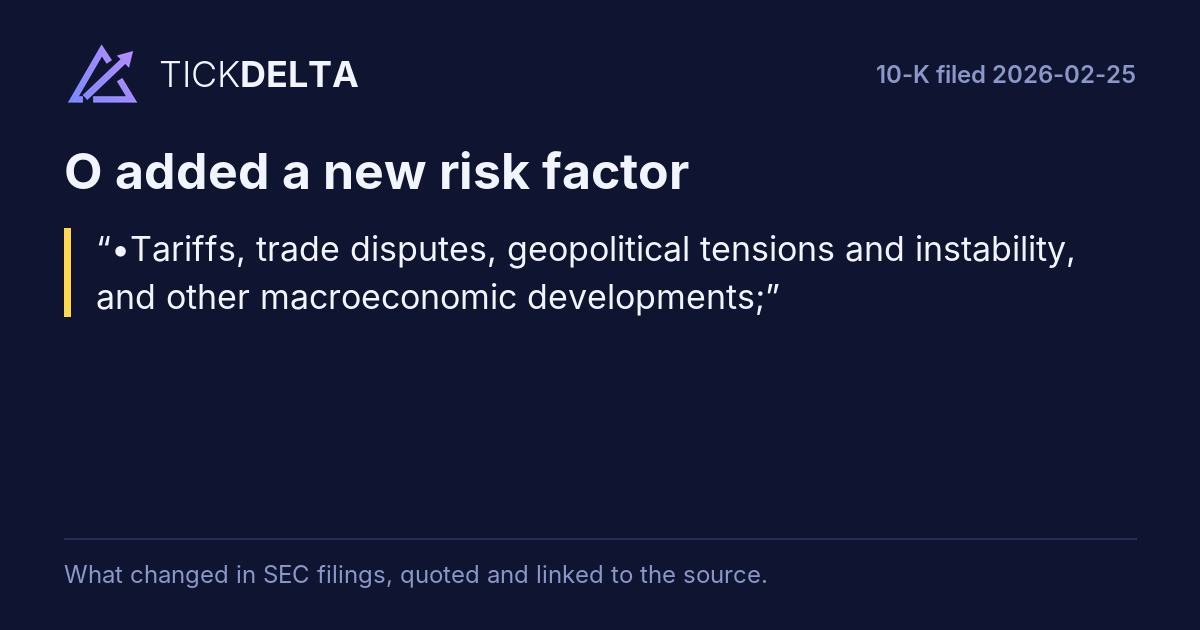
•Tariffs, trade disputes, geopolitical tensions and instability, and other macroeconomic developments;
Read in the 10-K ↗
Further, we also rely on innovation in our IT and our use of or inability to adopt and deliver new technological capabilities and enhancements in line with strategic objectives, including artificial intelligence and machine learning, may put us at a competitive disadvantage (including delayed implementation and utilization that causes us to lag behind our competitors); cause us to miss opportunities to innovate or achieve efficiencies; or adversely impact our business, reputation, results of operations, and financial condition. The use of emerging technologies, including artificial intelligence, entails risks including risks relating to the possibility of intellectual property infringement or misappropriation; data privacy; potential for inaccuracy; bias; new or enhanced governmental or regulatory scrutiny, requirements, litigation, or other liability; ethical concerns; negative perceptions as to automation and artificial intelligence; cybersecurity concerns; or other complications or liabilities that could adversely affect our business, reputation, results of operations, or financial results.
Similar paragraph at 1 of 29 other Real estate companies: PSARead in the 10-K ↗
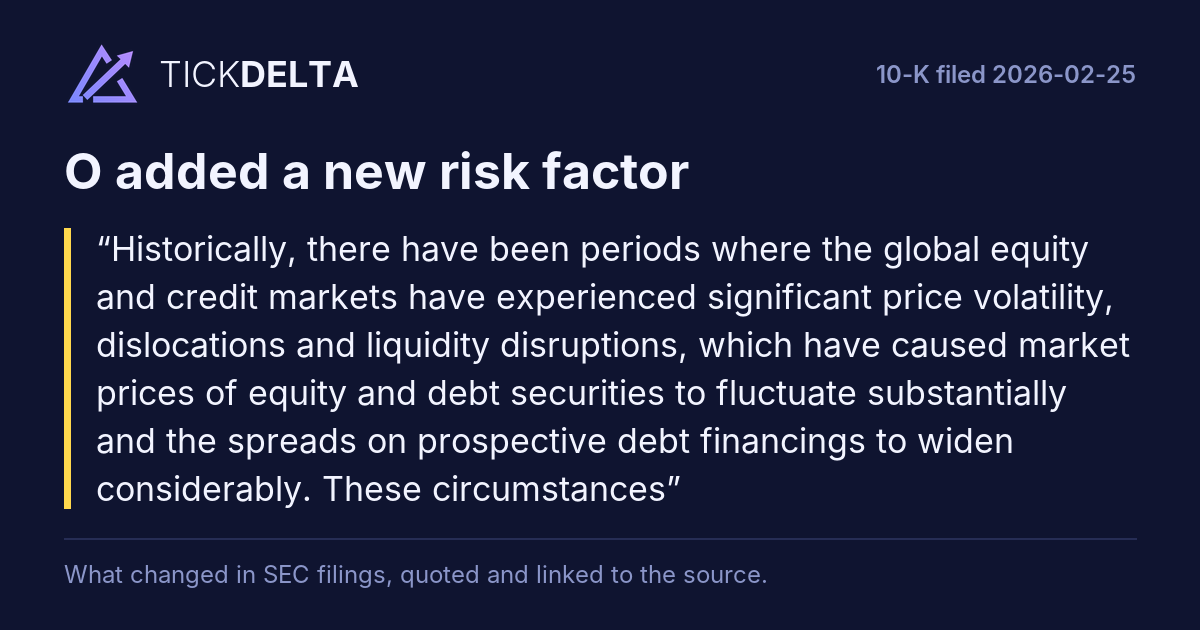
Historically, there have been periods where the global equity and credit markets have experienced significant price volatility, dislocations and liquidity disruptions, which have caused market prices of equity and debt securities to fluctuate substantially and the spreads on prospective debt financings to widen considerably. These circumstances
Read in the 10-K ↗
12 paragraphs in the 10-Q filed Nov 3, 2026 with nothing like them in the 10-Q filed Aug 6, 2026 (at least half the words must differ; new numbers alone do not count). Quoted exactly, grouped by the item heading above them. This is text that changed, not a judgement of how serious it is.
As of October 28, 2026, there were 950,997,048 shares of common stock outstanding.
Read in the 10-Q ↗
(4)USD-denominated other liabilities consists primarily of $ 20.8 million lease liabilities under finance leases, $ 10.6 million deferred rent on certain below-market leases, and
Read in the 10-Q ↗
(5)In July 2026, we invested approximately $ 245.4 million in a joint venture between Cloud Capital and a global institutional investor that indirectly owns a stabilized data center located in Northern Virginia. The investment amount includes $ 4.7 million related to amounts reserved in connection with the joint venture's financing. We have determined that this joint venture is a VOE. We have an effective 45.0 % ownership interest in the underlying property and account for our investment under the equity method. The unconsolidated entity had total debt outstanding of approximately $ 520.0 million as of September 30, 2026, all of which was non-recourse to us subject to limited customary exceptions.
Read in the 10-Q ↗
nine months ended September 30, 2026, we issued the following notes (in millions):
Read in the 10-Q ↗
On September 28, 2026, we completed the initial closing of a joint venture arrangement with KKR to own a diversified portfolio of existing European net lease real estate assets held through RI Vega JV SCSp (the “KKR JV”). We hold Class A partnership interests representing an aggregate 51 % interest in the KKR JV. KKR made an initial contribution of $ 600.5 million (€ 528 million) in exchange for Class B partnership interests, representing an aggregate 49 % interest (the “KKR JV Transaction”).
Read in the 10-Q ↗
The KKR JV is accounted for as a consolidated variable interest entity under the ASC 810 consolidation framework. The KKR JV Transaction was accounted for as an issuance of a noncontrolling interest in a consolidated subsidiary without a loss of control. No gain or loss was recognized. We recorded an increase in noncontrolling interests for KKR’s contribution and a $ 66.5 million adjustment to APIC, which represents the difference between the consideration received and the carrying amount of the 49 % noncontrolling interest in the KKR JV’s net assets. Direct and incremental transaction costs of $ 12.6 million were recorded as a reduction of APIC.
Read in the 10-Q ↗
Of KKR's total initial contribution, $ 71.7 million relates to a portfolio of assets for which regulatory clearance had not been obtained at closing. This amount is presented as restricted cash within 'Other assets, net' on our consolidated balance sheets and would be returned to KKR through a redemption of the corresponding portion of its Class B interests, without interest, if the related closing conditions did not occur. The related noncontrolling interest was presented as a redeemable noncontrolling interest within temporary equity on our consolidated balance sheet at September 30, 2026. Approval was obtained on October 28, 2026. The remaining Class B interests are classified as permanent equity because all of the redemption features are solely within our control.
Read in the 10-Q ↗
Relates primarily to build-to-suit developments where cash settlement will occur upon completion.
Read in the 10-Q ↗
In September 2026, we announced the formation of a new euro-denominated joint venture with KKR & Co. Inc.
Read in the 10-Q ↗
("KKR"). Under the terms of the transaction, we received gross proceeds of approximately €528 million in exchange for KKR’s acquisition of a 49% equity interest in a euro-denominated joint venture that indirectly owns a diversified portfolio of stabilized net lease assets across four countries in Europe. We have retained a 51% interest in the joint venture and continue to manage the properties under a long-term management agreement.
Read in the 10-Q ↗
Based on our credit rating agency ratings as of September 30, 2026, our credit facilities provide for a borrowing rate of 0.650% over the applicable benchmark rate. Including the 0.100% facility commitment fee, the all-in drawn rate is 0.750% above the applicable benchmark rate.
Read in the 10-Q ↗
(2)Represents non-cash foreign currency losses (gains) from remeasurement to USD and mark-to-market adjustments on investments and derivatives that are non-cash in nature.
Read in the 10-Q ↗
Item 1A of the 10-Q filed Nov 3, 2026 against Item 1A of the 10-K filed Feb 25, 2026.
A 10-Q repeats only the risks that changed, so a 10-K paragraph that is missing from it is not counted as removed.
Added is a paragraph with nothing like it in the 10-K, Reworded a sentence that is in both with several words changed,
Quiet changes a sentence in both where one to four words changed and one is a hedge or a modal
(cut words struck through, new words highlighted and underlined).
Text on the page, not a score; each links to the filing at sec.gov.
What the 10-Q itself says about its risk factors:
Read in the 10-Q ↗
You should carefully consider the risks described in "Item 1A, Risk Factors" in Part I of our annual report on Form 10-K for the year ended December 31, 2025, as our business, financial condition and results of operations could be adversely affected by any of the risks and uncertainties described therein. There have been no material changes to the risk factors disclosed in our annual report on Form 10-K for the year ended December 31, 2025. Item 2: Unregistered Sales of Equity Securities and Use of Proceeds