Paragraph 32 · 49% changed
Every version of it
Screener
/
SEC EDGAR
/CIK 0001393434
/10-K filed Feb 5, 2026, compared with Mar 3, 2025
/Numbers from the XBRL of the 10-Ks
Nasdaq
Health care · Pharmaceuticals
Ocular Therapeutix, Inc OCUL
The 10-K against last year's
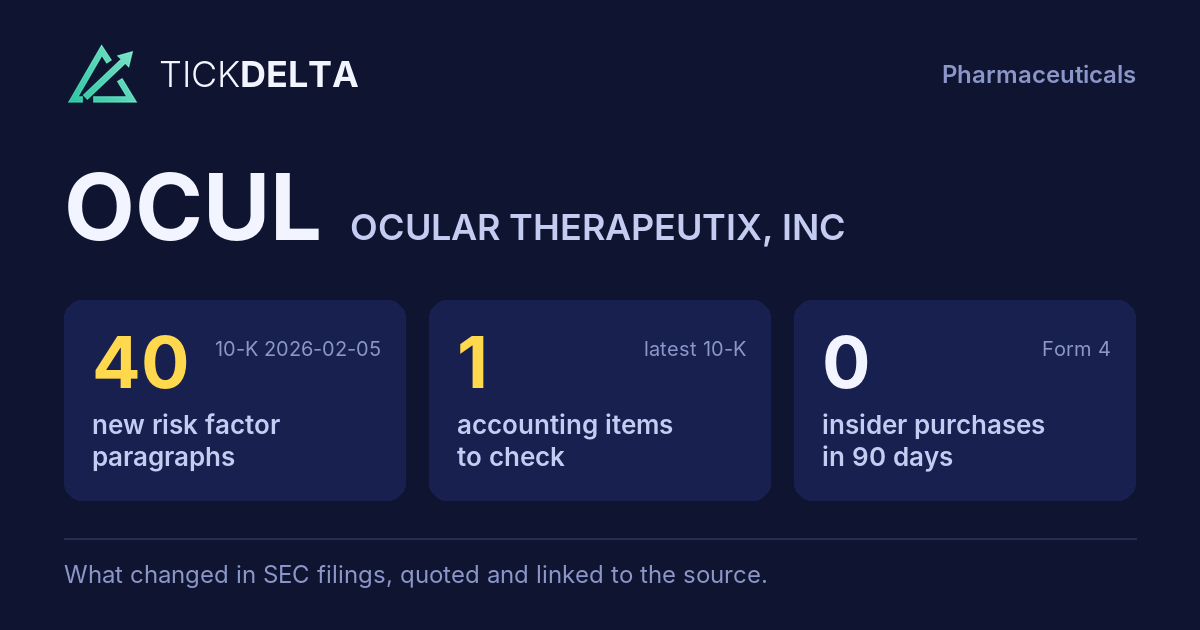
228 changes: 61 added, 40 removed, 122 reworded, 5 quiet changes
10-K Feb 5, 2026 vs Mar 3, 2025
Risk Factors
20.2%
of the text changed · 36,529 words now · 40 new paragraphs, 28 gone
MD&A
25.7%
of the text changed · 9,574 words now · 21 new paragraphs, 12 gone
Accounting Policies
4.5%
of the text changed · 5,244 words now
10-K 0001104659-26-010664 (Feb 5, 2026) vs 10-K 0001558370-25-002000 (Mar 3, 2025) Not compared: Legal Proceedings.
Every paragraph, and how much of it changed
One bar per paragraph, in the order of the 10-K. Height and colour show the share of its words not in the closest paragraph a year earlier; the tallest bars are new paragraphs.
Risk Factors
400 paragraphs · 40 new · 119 reworded · 28 gone · 10-K Feb 5, 2026 against Mar 3, 2025
New paragraph
Reworded (5% of its words or more)
Same or nearly
Paragraph 280 · 49% changed
Every version of it
Paragraph 340 · 49% changed
Every version of it
Additionally, we could face heightened risks with respect to obtaining marketing authorization in the United Kingdom as a result of the withdrawal of the United Kingdom from the European Union, commonly referred to as Brexit. The United Kingdom is no longer part of the European Single Market and EU Customs Union. As of January 1, 2025, the Medicines and Healthcare Products Regulatory Agency, or MHRA, is responsible for approving all medicinal products destined for the United Kingdom market (i.e., Great Britain and Northern Ireland). At On April 28, 2025, the same time, a new international recognition procedure (“IRP”) U.K. Parliament adopted amendments to improve and strengthen the U.K.’s clinical trials regulatory regime; they will apply, take effect on April 28, 2026. These changes were needed since the current U.K. requirements are based upon the now-repealed EU Clinical Trials Directive (2001/20/EC), which intends to facilitate approval of pharmaceutical products in has been replaced by the United Kingdom. The IRP is open to applicants that have already received an authorization for European Clinical Trials Regulation (Regulation EU No 536/2014). Since the same product from one of the MHRA’s specified Reference Regulators (“RRs”). The RRs notably include EMA and regulators in the EU/European Economic Area (“EEA”) member states for approvals in U.K. left the European Union centralized procedure and mutual recognition procedure prior to the date on which the EU CTR took effect, the UK legal framework did not benefit from the same revisions as well as the FDA (for product approvals granted in the United States). However, the concrete functioning of the IRP is currently unclear. Any delay in obtaining, or an inability to obtain, any marketing approvals may force us or our collaborators to restrict or delay efforts to seek regulatory approval in the United Kingdom for our product candidates, which could significantly and materially harm our business. occurred at EU level.
Paragraph 348 · 48% changed
Every version of it
In addition, the GDPR also imposes strict rules on the transfer of personal data to countries outside the European Union, including the United States and, as a result, increases the scrutiny that clinical trial sites located in the EEA should apply to transfers of personal data from such sites to countries that are considered to lack an adequate level of data protection, such as the United States. The GDPR also permits data protection authorities to require destruction of improperly gathered or used personal information and/or impose substantial fines for violations of the GDPR, which can be up to four percent of global revenues or 20 million Euros, whichever is greater, and it also confers a private right of action on data subjects and consumer associations to lodge complaints with supervisory authorities, seek judicial remedies, and obtain compensation for damages resulting from violations of the GDPR. In addition, the GDPR provides that European Union member states may make their own further laws and regulations limiting the processing of personal data, including genetic, biometric or health data. Similar laws and regulations have been approved, or are expected to be approved, in several jurisdictions beyond the European Union.
Paragraph 70 · 47% changed
Every version of it
Paragraph 5 · 47% changed
Every version of it
Paragraph 196 · 46% changed
Every version of it
Paragraph 279 · 46% changed
Every version of it
Paragraph 32 · 49% changed
Every version of it
10-K Mar 3, 2025the scope, progress, costs and outcome of preclinical development and any additional clinical trials we might determine in the future to conduct for our other product candidates, including PAXTRAVA for the reduction of intraocular pressure, or IOP, in patients with primary open-angle glaucoma, or OAG, or ocular hypertension, or OHT;
10-K Feb 5, 2026
intraocular pressure, or IOP, in patients with primary open-angle glaucoma, or OAG, or ocular hypertension, or OHT;
Paragraph 280 · 49% changed
Every version of it
10-K Mar 3, 2025Accordingly, if a prolonged government shutdown or other disruption occurs, it could significantly impact the ability of the FDA to timely review and process our regulatory submissions, which could have a material adverse effect on our business. Future shutdowns or other disruptions could also affect other government agencies such as the SEC, which may also impact our business by delaying review of our public filings, to the extent such review is necessary, and our ability to access the public markets.
10-K Feb 5, 2026
During the last several years the U.S. government has shut down several times and certain regulatory agencies, such as the FDA and the SEC, have had to furlough critical employees and stop critical activities. If a prolonged government shutdown occurs, it could significantly impact the ability of the FDA to timely review and process our regulatory submissions and could impact our ability to access the public markets and obtain necessary capital to properly capitalize and continue our operations.
Paragraph 340 · 49% changed
Every version of it
10-K Mar 3, 2025
Additionally, we could face heightened risks with respect to obtaining marketing authorization in the United Kingdom as a result of the withdrawal of the United Kingdom from the European Union, commonly referred to as Brexit. The United Kingdom is no longer part of the European Single Market and EU Customs Union. As of January 1, 2025, the Medicines and Healthcare Products Regulatory Agency, or MHRA, is responsible for approving all medicinal products destined for the United Kingdom market (i.e., Great Britain and Northern Ireland). At the same time, a new international recognition procedure (“IRP”) will apply, which intends to facilitate approval of pharmaceutical products in the United Kingdom. The IRP is open to applicants that have already received an authorization for the same product from one of the MHRA’s specified Reference Regulators (“RRs”). The RRs notably include EMA and regulators in the EU/European Economic Area (“EEA”) member states for approvals in the European Union centralized procedure and mutual recognition procedure as well as the FDA (for product approvals granted in the United States). However, the concrete functioning of the IRP is currently unclear. Any delay in obtaining, or an inability to obtain, any marketing approvals may force us or our collaborators to restrict or delay efforts to seek regulatory approval in the United Kingdom for our product candidates, which could significantly and materially harm our business.
10-K Feb 5, 2026
Additionally, we could face heightened risks with respect to obtaining marketing authorization in the United Kingdom as a result of the withdrawal of the United Kingdom from the European Union, commonly referred to as Brexit. The United Kingdom is no longer part of the European Single Market and EU Customs Union. As of January 1, 2025, the Medicines and Healthcare Products Regulatory Agency, or MHRA, is responsible for approving all medicinal products destined for the United Kingdom market (i.e., Great Britain and Northern Ireland). On April 28, 2025, the U.K. Parliament adopted amendments to improve and strengthen the U.K.’s clinical trials regulatory regime; they will take effect on April 28, 2026. These changes were needed since the current U.K. requirements are based upon the now-repealed EU Clinical Trials Directive (2001/20/EC), which has been replaced by the European Clinical Trials Regulation (Regulation EU No 536/2014). Since the U.K. left the European Union prior to the date on which the EU CTR took effect, the UK legal framework did not benefit from the same revisions as occurred at EU level.
Paragraph 348 · 48% changed
Every version of it
10-K Mar 3, 2025
In addition, the GDPR also imposes strict rules on the transfer of personal data to countries outside the European Union, including the United States and, as a result, increases the scrutiny that clinical trial sites located in the EEA should apply to transfers of personal data from such sites to countries that are considered to lack an adequate level of data protection, such as the United States. The GDPR also permits data protection authorities to require destruction of improperly gathered or used personal information and/or impose substantial fines for violations of the GDPR, which can be up to four percent of global revenues or 20 million Euros, whichever is greater, and it also confers a private right of action on data subjects and consumer associations to lodge complaints with supervisory authorities, seek judicial remedies, and obtain compensation for damages resulting from violations of the GDPR. In addition, the GDPR provides that European Union member states may make their own further laws and regulations limiting the processing of personal data, including genetic, biometric or health data. Similar laws and regulations have been approved, or are expected to be approved, in several jurisdictions beyond the European Union.
10-K Feb 5, 2026
In addition, the GDPR also imposes strict rules on the transfer of personal data to countries outside the European Union, including the United States and, as a result, increases the scrutiny that clinical trial sites located in the EEA should apply to transfers of personal data from such sites to countries that are considered to lack an adequate level of
Paragraph 70 · 47% changed
Every version of it
10-K Mar 3, 2025Moreover, preclinical and clinical data are often susceptible to varying interpretations and analyses, and many companies that have believed their product candidates performed satisfactorily in preclinical studies and clinical trials have nonetheless failed to obtain marketing approval of their products. The protocols for our clinical trials and other supporting information are subject to review by the FDA and regulatory authorities outside the United States. The FDA is not obligated to comment on our trial protocols, however, within any specified time-period or at all or to affirmatively clear or approve our planned pivotal clinical trials. Subject to a waiting period of 30 days for the initial IND submission, we could choose to initiate any clinical trial in the United States, including a pivotal clinical trial, without waiting for any additional period for comments from the FDA. Although the FDA may implicitly clear our clinical trial protocols or may provide comments regarding our development plans as part of a Special Protocol Assessment, or SPA, agreement or other request for formal feedback, final determinations for marketing application approval are made after a complete review of a marketing application and are based on the entirety of the data in the new drug application. We are conducting our SOL-1 trial under an SPA agreement, as amended, agreed to by the FDA. An SPA agreement indicates concurrence by the FDA with the adequacy and acceptability of specific critical elements of the overall protocol design for a clinical trial intended to support a future marketing application, but it does not indicate FDA concurrence on every protocol detail. If we determine to deviate from the terms of the SPA agreement without the FDA’s concurrence, or if the FDA determines that we have deviated from the terms of the SPA agreement, the SPA agreement could be invalidated. Moreover, the FDA retains significant discretion in interpreting the terms of an SPA agreement and the data and results from any trial that is the subject of an SPA agreement. An SPA agreement does not ensure the receipt of marketing approval by the FDA or other regulatory authorities, even if the clinical trial subject to the SPA agreement is successful or meets its primary endpoint, or that the approval process will be faster than conventional procedures.
10-K Feb 5, 2026
detail. If we determine to deviate from the terms of the SPA agreement without the FDA’s concurrence, or if the FDA determines that we have deviated from the terms of the SPA agreement, the SPA agreement could be invalidated. Moreover, the FDA retains significant discretion in interpreting the terms of a SPA agreement and the data and results from any trial that is the subject of a SPA agreement. A SPA agreement does not ensure the receipt of marketing approval by the FDA or other regulatory authorities, even if the clinical trial subject to the SPA agreement is successful or meets its primary endpoint, or that the approval process will be faster than conventional procedures.
Paragraph 5 · 47% changed
Every version of it
10-K Mar 3, 2025the progress, costs and outcome of our ongoing clinical trials of AXPAXLI for the treatment of wet AMD;
10-K Feb 5, 2026
initiate our planned SOL-X trial, our long-term extension study of AXPAXLI for the treatment of wet AMD;
Paragraph 196 · 46% changed
Every version of it
10-K Mar 3, 2025We have in the past entered into collaboration agreements with third parties, including our collaboration with AffaMed, and expect to utilize a variety of types of collaboration, distribution and other marketing arrangements with third parties to commercialize DEXTENZA, or any of our product candidates, including AXPAXLI, for which we may obtain marketing approval in markets outside the United States. We also may enter into arrangements with third parties to perform these services in the United States if we do not establish our own sales, marketing and distribution capabilities in the United States for such products or if we determine that such third-party arrangements are otherwise beneficial. We also may seek additional third-party collaborators for development and commercialization of product candidates, including AXPAXLI and PAXTRAVA. Our likely collaborators for any sales, marketing, distribution, development, licensing or broader collaboration arrangements include large and mid-size pharmaceutical companies, regional and national pharmaceutical companies and biotechnology companies. Our ability to generate revenues from these arrangements will depend on our collaborators’ abilities and efforts to successfully perform the functions assigned to them in these arrangements.
10-K Feb 5, 2026
development, licensing or broader collaboration arrangements include large and mid-size pharmaceutical companies, regional and national pharmaceutical companies and biotechnology companies. Our ability to generate revenues from these arrangements will depend on our collaborators’ abilities and efforts to successfully perform the functions assigned to them in these arrangements.
Paragraph 279 · 46% changed
Every version of it
10-K Mar 3, 2025The ability of the FDA to review and approve new products can be affected by a variety of factors, including government budget and funding levels, ability to hire and retain key personnel and accept the payment of user fees, and statutory, regulatory and policy changes. Average review times at the agency have fluctuated in recent years as a result. Disruptions at the FDA and other agencies may also slow the time necessary for new product candidates to be reviewed and/or approved by necessary government agencies, which would adversely affect our business. In addition, government funding of the SEC and other government agencies on which our operations may rely, including those that fund research and development activities, is subject to the political process, which is inherently fluid and unpredictable.
10-K Feb 5, 2026
In addition, government funding of the SEC and other government agencies on which our operations may rely, including those that fund research and development activities, is subject to the political process, which is inherently fluid and unpredictable.
MD&A
136 paragraphs · 21 new · 50 reworded · 12 gone · 10-K Feb 5, 2026 against Mar 3, 2025
New paragraph
Reworded (5% of its words or more)
Same or nearly
Paragraph 11 · 49% changed
We have completed the HELIOS trial of AXPAXLI for the treatment of NPDR. We intend to meet with the FDA in the first half of 2025 to discuss the design of a potential initiated our registrational clinical program for AXPAXLI for the treatment of diabetic retinal disease with the HELIOS-3 superiority clinical trial for the treatment of NPDR in November 2025. We plan to refine our development and DME and then evaluate regulatory strategy for AXPAXLI for the treatment of diabetic retinal disease based on our next steps. planned engagements with the FDA regarding the regulatory pathway for AXPAXLI for the treatment of wet AMD.
Paragraph 104 · 48% changed
Paragraph 78 · 47% changed
Paragraph 77 · 43% changed
continue our ongoing clinical trials, registrational programs, including the SOL-1 and the SOL-R trials, our two SOL registrational Phase 3 clinical trials program of AXPAXLI for the treatment of wet AMD; AMD, and the HELIOS registrational program of AXPAXLI for the treatment of diabetic retinal disease, including NPDR;
Paragraph 90 · 42% changed
the progress, costs and outcome outcomes of our ongoing clinical trials SOL and HELIOS registrational programs of AXPAXLI for the treatment of wet AMD; AMD and for the treatment of diabetic retinal disease, including NPDR, respectively;
Paragraph 4 · 42% changed
Paragraph 56 · 41% changed
Paragraph 70 · 39% changed
Paragraph 11 · 49% changed
10-K Mar 3, 2025
We have completed the HELIOS trial of AXPAXLI for the treatment of NPDR. We intend to meet with the FDA in the first half of 2025 to discuss the design of a potential registrational clinical program for AXPAXLI for the treatment of NPDR and DME and then evaluate our next steps.
10-K Feb 5, 2026
We have initiated our registrational program for AXPAXLI for the treatment of diabetic retinal disease with the HELIOS-3 superiority clinical trial for the treatment of NPDR in November 2025. We plan to refine our development and regulatory strategy for AXPAXLI for the treatment of diabetic retinal disease based on our planned engagements with the FDA regarding the regulatory pathway for AXPAXLI for the treatment of wet AMD.
Paragraph 104 · 48% changed
10-K Mar 3, 2025Until such time, if ever, as we can generate product revenues sufficient to achieve profitability, we expect to finance our cash needs through equity offerings, debt financings, collaborations, strategic alliances, licensing arrangements, royalty agreements, and marketing and distribution arrangements. We do not have any committed external source of funds, although our license agreement with AffaMed provides for AffaMed’s reimbursement of certain clinical expenses incurred by us in connection with our collaboration and for our potential receipt of development and sales milestone payments and royalty payments. To the extent that we raise additional capital through the sale of equity, preferred equity or convertible debt securities, our securityholders’ ownership interests will be diluted, and the terms of these securities may include liquidation or other preferences that adversely affect our existing securityholders’ rights as holders or beneficial owners of our common stock. Debt financing and preferred equity financing, if available, may involve agreements that include covenants limiting or restricting our ability to take specific actions, such as incurring additional debt, making capital expenditures or declaring dividends. The covenants under the Barings Credit Facility and our pledge of our assets as collateral to secure our obligations under the Barings Credit Facility pursuant to which we have a total borrowing capacity of $82.5 million, which has been fully drawn down, may limit our ability to obtain additional debt or other financing. If we raise additional funds through collaborations, strategic alliances, licensing arrangements, royalty agreements or marketing and distribution arrangements, we may have to relinquish valuable rights to our technologies, future revenue streams, research programs, products or product candidates or grant licenses on terms that may not be favorable to us. If we are unable to raise additional funds through equity or debt financings or other arrangements when needed, we may be required to delay, limit, reduce or terminate our product development or future commercialization efforts or grant rights to develop and market products or product candidates that we would otherwise prefer to develop and market ourselves.
10-K Feb 5, 2026
If we raise additional funds through collaborations, strategic alliances, licensing arrangements, royalty agreements or marketing and distribution arrangements, we may have to relinquish valuable rights to our technologies, future revenue streams, research programs, products or product candidates or grant licenses on terms that may not be favorable to us. If we are unable to raise additional funds through equity or debt financings or other arrangements when needed, we may be required to delay, limit, reduce or terminate our product development or future commercialization efforts or grant rights to develop and market products or product candidates that we would otherwise prefer to develop and market ourselves.
Paragraph 78 · 47% changed
10-K Mar 3, 2025the progress, costs and outcome of our ongoing clinical trials of AXPAXLI for the treatment of wet AMD;
10-K Feb 5, 2026
initiate our planned SOL-X trial, our long-term extension study of AXPAXLI for the treatment of wet AMD;
Paragraph 77 · 43% changed
10-K Mar 3, 2025
continue our ongoing clinical trials, including the SOL-1 and the SOL-R trials, our two registrational Phase 3 clinical trials of AXPAXLI for the treatment of wet AMD;
10-K Feb 5, 2026
continue our ongoing registrational programs, including the SOL registrational program of AXPAXLI for the treatment of wet AMD, and the HELIOS registrational program of AXPAXLI for the treatment of diabetic retinal disease, including NPDR;
Paragraph 90 · 42% changed
10-K Mar 3, 2025
the progress, costs and outcome of our ongoing clinical trials of AXPAXLI for the treatment of wet AMD;
10-K Feb 5, 2026
the progress, costs and outcomes of our ongoing SOL and HELIOS registrational programs of AXPAXLI for the treatment of wet AMD and for the treatment of diabetic retinal disease, including NPDR, respectively;
Paragraph 4 · 42% changed
10-K Mar 3, 2025We are a biopharmaceutical company committed to redefining the retina experience. AXPAXLI (axitinib intravitreal hydrogel, also known as OTX-TKI), our product candidate for retinal disease, is based on our proprietary ELUTYX bioresorbable hydrogel-based formulation technology. AXPAXLI is currently in two repeat-dosing Phase 3 clinical trials for the treatment of wet age-related macular degeneration, or wet AMD, which we refer to as the SOL-1 and the SOL-R trials. We have also completed a Phase 1 clinical trial of AXPAXLI for the treatment of non-proliferative diabetic retinopathy, or NPDR, which we refer to as the HELIOS trial. We intend to meet with the U.S. Food and Drug Administration, or FDA, in the first half of 2025 to discuss the design of a potential registrational clinical program for AXPAXLI for the treatment of NPDR and diabetic macular edema, or DME, and then evaluate our next steps.
10-K Feb 5, 2026
on our ELUTYX proprietary bioresorbable hydrogel-based formulation technology. AXPAXLI is currently being evaluated in a Phase 3 registrational program for wet age-related macular degeneration, or wet AMD, which we refer to as the SOL program. AXPAXLI is currently also being evaluated in a Phase 3 registrational program for diabetic retinal disease, including non-proliferative diabetic retinopathy, or NPDR, which we refer to as the HELIOS program.
Paragraph 56 · 41% changed
10-K Mar 3, 2025The increase was primarily due to an increase of $0.6 million in professional fees, an increase in facility-related and other costs of $0.3 million, and an increase in personnel costs, including stock-based compensation, of $0.1 million.
10-K Feb 5, 2026
professional fees, including costs related to corporate branding and pre-commercial activities for AXPAXLI, and an increase in other costs of $1.0 million.
Paragraph 70 · 39% changed
10-K Mar 3, 2025On December 18, 2023, we sold 35,420,000 shares of our common stock in an underwritten public offering at a public offering price of $3.25 per share. The total net proceeds of the public offering to us were approximately $107.7 million, after deducting underwriting discounts and commissions and other offering expenses payable by us.
10-K Feb 5, 2026
In October 2025, we completed the sale of 37,909,018 shares of our common stock pursuant to the 2025 Offering, resulting in net proceeds to us of $445.6 million after deducting underwriting discounts and commissions and estimated other offering expenses.
A paragraph is matched with the one last year that shares the most of its words; under half in common makes it new. The paragraphs shown are the 8 reworded the most in each section.
The paragraph that changed most in each section
The redline
Marked against last year's 10-K: cut words struck through, new words highlighted.
Risk Factors444 words changed in this paragraph; it is 30% similar to last year's version.
Further, the legislation subjects drug manufacturers to civil monetary penalties and a potential excise tax for failing to comply with the legislation by offering a price that is not equal to or less than the negotiated “maximum fair price” under the law or for taking price increases that exceed inflation. The legislation also requires manufacturers to pay rebates for drugs in Medicare Part B and D whose price increases exceed inflation. The new law also caps capped Medicare beneficiary out-of-pocket drug costs at an estimated $4,000 a per year in 2024 and, thereafter beginning in 2025, at $2,000 a year. In addition, year from 2025 onwards. While it remains to be seen how the drug pricing provisions imposed by the IRA potentially raises legal risks with respect to individuals participating in a Medicare Part D will affect the broader pharmaceutical industry, several pharmaceutical manufacturers and other industry stakeholders have challenged the law, including through lawsuits brought against the HHS, the Secretary of the HHS, CMS, and the CMS Administrator challenging the constitutionality and administrative implementation of the IRA’s drug price negotiation provisions. This litigation is ongoing and the results, and potential impacts on our business, are uncertain. The current presidential administration has indicated that reducing prescription drug plan who may experience prices will be a gap in coverage if they required coverage above their initial annual coverage limit before they reached the higher threshold, or “catastrophic period” of the plan. Individuals requiring services exceeding the initial annual coverage limit and below the catastrophic period, must pay 100% of focus, with CMS issuing a public statement on January 29, 2025, declaring that lowering the cost of their prescriptions until they reach prescription drugs is a top priority of the catastrophic period. Among other things, the IRA contains many provisions aimed at reducing this financial burden on individuals by reducing the co-insurance new administration and co-payment costs, expanding eligibility for lower income subsidy plans, and price caps on annual out-of-pocket expenses, each of which could have potential CMS is committed to considering opportunities to bring greater pricing transparency. Moreover, President Trump has signed multiple executive orders addressing prescription drug pricing and reporting implications. access, including: on April 15, 2025, outlining several actions the Secretary of the Department of HHS must take to optimize healthcare regulations that will provide access to prescription drugs at lower costs; on May 5, 2025, aiming to promote domestic production of critical medicines; and on May 12, 2025, aiming to establish a “most favored nation” drug pricing policy that would tie U.S. drug prices to the prices paid for drugs in other countries. Since the May 12, 2025 “most favored nation” executive order, the Trump administration has continued to exert pressure on drug manufacturers to implement “most favored nation” pricing, including by suggesting that the administration may impose significant tariffs on pharmaceuticals if such manufacturers do not reach agreements to implement “most favored nation” pricing. Additionally, in November 2025, CMS announced a new voluntary payment initiative called the GENEROUS Model (GENErating cost Reductions for U.S. Medicaid Model) where drug manufacturers may voluntarily offer supplemental rebates to participating state Medicaid programs that are intended to provide such Medicaid programs with a “most favored nation” price for participating manufacturers’ products.
Source: Item 1A, 10-K 0001104659-26-010664 vs Item 1A, 10-K 0001558370-25-002000
MD&A167 words changed in this paragraph; it is 67% similar to last year's version.
Source: Item 7, 10-K 0001104659-26-010664 vs Item 7, 10-K 0001558370-25-002000
Accounting Policies67 words changed in this paragraph; it is 49% similar to last year's version.
Source: 10-K text, Note 2 – Summary of Significant Accounting Policies, 10-K 0001104659-26-010664 vs 10-K text, Note 2 – Summary of Significant Accounting Policies, 10-K 0001558370-25-002000
Sentences and paragraphs added, removed or reworded
Every change, by type
Sentences and paragraphs of OCUL's Risk Factors and MD&A, 10-K Feb 5, 2026 against 10-K Mar 3, 2025. Each links to the text at sec.gov.
Quiet changes are sentences kept from last year with one to four words changed, at least one of them a hedge, a modal or a qualifier (may, could, will, not, significant, material…). A year or date rolling forward is not counted.
The full word list
adverse, adversely, all, although, anticipate, anticipates, any, approximately, believe, believes, can, cannot, certain, could, expect, expects, generally, however, if, intend, intends, largely, likely, many, material, materially, may, might, most, must, never, no, not, possible, primarily, probable, should, significant, significantly, some, substantial, substantially, unlikely, will, would
AddedRisk Factors
Changes in tax laws or in their implementation or interpretation could adversely affect our business and financial condition.
Read it in 10-K Feb 5, 2026 at sec.gov
AddedRisk Factors
Income, sales, use or other tax laws, statutes, rules, or regulations could be enacted or amended at any time, which could affect our business or financial condition, including causing potentially adverse impacts to our effective tax rate, tax liabilities, and cash tax obligations. For example, the IRA was signed into law in August 2022, and the OBBBA was signed into law in July 2025. The IRA introduced new tax provisions, including a one percent excise tax imposed on certain stock repurchases by publicly traded companies. The one percent excise tax generally applies to any acquisition of stock by the publicly traded company (or certain of its affiliates) from a stockholder of the company in exchange for
Read it in 10-K Feb 5, 2026 at sec.gov
AddedRisk Factors
money or other property (other than stock of the company itself), subject to a de minimis exception. Thus, the excise tax could apply to certain transactions that are not traditional stock repurchases. The OBBBA contains numerous tax law changes including tax rate extensions and changes to the business interest deduction limitation, the expensing of domestic research and development expenditures (in contrast to the continued capitalization and amortization of foreign research and development expenditures), the bonus depreciation deduction rules, and the international tax framework; we do not expect, however, that these changes will have a significant effect on our business or financial condition. Regulatory guidance under the IRA, the OBBBA, and other tax-related legislation is and continues to be forthcoming, and such guidance could ultimately increase or lessen the impact of these laws on our business and financial condition. In addition, it is uncertain if and to what extent various states will conform to changes to federal tax legislation.
Read it in 10-K Feb 5, 2026 at sec.gov
AddedRisk Factors
Additionally, although the FDA has indicated a general openness to requiring only one pivotal clinical trial for approval of a product candidate, the FDA has not yet provided specific guidance on how that approach is to be implemented. Our current plans call for the submission of an application for marketing approval of AXPAXLI for the treatment of wet AMD based on Week 52 data from the SOL-1 trial, prior to receipt of data from the SOL-R trial or SOL-X trial. Through future interactions and/or guidance from the FDA, we may learn that the FDA would not permit such an approach or would not agree that such an approach would provide sufficient efficacy or safety data to the FDA for its evaluation of the application, which could cause us to delay submission of such application until such time as we have collected and prepared information we believe to be sufficient to satisfy the FDA’s requirements. In the alternative, we may submit such an application and the FDA may refuse to accept the application for filing or, even if the FDA does accept such an application for filing, it may conclude that we have not provided sufficient efficacy or safety data and may not approve such application following its review. Either of these outcomes would delay our receipt of marketing approval for AXPAXLI.
Read it in 10-K Feb 5, 2026 at sec.gov
AddedRisk Factors
For example, following recent public statements from FDA leadership, pending the receipt of favorable topline results and planned interactions with the FDA, we intend to submit an NDA for AXPAXLI for the treatment of wet AMD based on Week 52 data from the SOL-1 trial. As the FDA has historically required two adequate and well-controlled clinical trials to demonstrate the safety and efficacy of ophthalmic product candidates, the FDA could refuse to accept our submission of our NDA without clinical data from a second adequate and well-controlled trial or could accept it but review it differently or more slowly than we anticipate or could deny the application. In addition, we may not be able to timely satisfy the FDA’s other requirements for regulatory approval of AXPAXLI, including the FDA’s Chemistry, Manufacturing and Controls requirements. Furthermore, although patients in the SOL-1 have already been re-dosed at Week 52, data for the primary endpoint in SOL-1 is based on a single administration of AXPAXLI and therefore uncertainty remains as to what restrictions, if any, may be imposed on the label for AXPAXLI, if approved, pending the receipt of additional clinical data or otherwise. Any of these outcomes could adversely affect our time to approval, time to profitability, cash runway and results of operations.
Read it in 10-K Feb 5, 2026 at sec.gov
AddedRisk Factors
In December 2022, with the passage of FDORA, Congress required sponsors to develop and submit a diversity action plan, or DAP, for each phase 3 clinical trial or any other “pivotal study” of a new drug or biological product. These plans are meant to encourage the enrollment of more diverse patient populations in late-stage clinical trials of
Read it in 10-K Feb 5, 2026 at sec.gov
AddedRisk Factors
FDA-regulated products. In June 2024, as mandated by FDORA, the FDA issued draft guidance outlining the general requirements for DAPs.
Read it in 10-K Feb 5, 2026 at sec.gov
AddedRisk Factors
On January 27, 2025, in response to an executive order issued by President Trump on January 21, 2025, relating to Diversity, Equity and Inclusion programs, the FDA removed the draft DAP guidance from its website. That action, along with similar actions by the Trump Administration to remove many other healthcare webpages, is currently the subject of ongoing litigation. On July 3, 2025, the U.S. District Court for the District of Columbia ruled that the Trump Administration’s actions to remove these webpages, including the draft DAP guidance, is unlawful under the Administrative Procedure Act. The court ordered the restoration of many of these webpages. In late July 2025, the FDA restored the draft DAP guidance to its website with a statement that “information on this page may be modified and/or removed in the future subject to the terms of the court’s order and implemented consistent with applicable law.” Accordingly, in light of these ongoing actions, there is considerable uncertainty surrounding the draft DAP guidance and how the FDA will consider DAPs in connection with its review of NDAs and BLAs. Similarly, the regulatory landscape related to clinical trials in the European Union recently evolved. The EU Clinical Trials Regulation, or CTR, which was adopted in April 2014 and repeals the EU Clinical Trials Directive, became applicable on January 31, 2022. While the Clinical Trials Directive required a separate clinical trial application to be submitted in each member state, to both the competent national health authority and an independent ethics committee, the CTR introduces a centralized process and only requires the submission of a single application to all member states concerned. If we are not able to fulfill these new requirements, our ability to conduct clinical trials may be delayed or halted.
Read it in 10-K Feb 5, 2026 at sec.gov
Show the other 69
AddedRisk Factors
the price of the product, as well as the availability of third-party coverage and adequate reimbursement;
Read it in 10-K Feb 5, 2026 at sec.gov
AddedRisk Factors
For example, in wet AMD and diabetic retinal disease, AXPAXLI will compete with anti-vascular endothelial growth factor, or anti-VEGF, compounds administered in their current formulation and prescribed for the treatment of wet AMD as these agents can in some instances deliver more than one or two months of therapeutic effect, as well as products based on gene therapy, if such products are approved.
Read it in 10-K Feb 5, 2026 at sec.gov
AddedRisk Factors
Anti-VEGF products that are currently approved by the FDA for the treatment of wet AMD include Vabysmo (faricimab), Eylea HD (aflibercept 8 mg), Lucentis (ranibizumab), Eylea (aflibercept 2 mg), Beovu (brolicizumab), and Susvimo (ranibizumab Port Delivery System). Biosimilars to ranibizumab and aflibercept 2 mg are commercially available as well. Products that are currently approved by the FDA for the treatment of various diabetic retinal disease indications include Vabysmo, Eylea HD, Lucentis, Eylea, Beovu and Susvimo. The FDA-approved labels for Vabysmo and Eylea HD contemplate dosing as infrequently as once every 16 weeks for a proportion of patients with wet AMD or diabetic retinal disease. The cancer therapy Avastin (bevacizumab) is used off-label for the treatment of wet AMD and diabetic retinal disease as well.
Read it in 10-K Feb 5, 2026 at sec.gov
AddedRisk Factors
extended-delivery fashion to the back of the eye. In addition, other companies are evaluating novel mechanisms of action for retinal diseases.
Read it in 10-K Feb 5, 2026 at sec.gov
RemovedRisk Factors
RemovedRisk Factors
RemovedRisk Factors
RemovedRisk Factors
RemovedRisk Factors
RemovedRisk Factors
RemovedRisk Factors
RemovedRisk Factors
RemovedRisk Factors
RemovedRisk Factors
RemovedRisk Factors
RemovedRisk Factors
RewordedRisk Factors
RewordedRisk Factors
In particular, the license agreement that we have entered into with Incept LLC, or Incept, an intellectual property holding company, which covers a significant portion of the patent rights and the technology for DEXTENZA, ReSure Sealant and our may cover certain aspects of other hydrogel platform technology product candidates, including AXPAXLI, such as OTX-TIC, to the extent they were invented prior to the September 2018 effective date of our latest amendment and restated license agreement with Incept, provides that, with limited exceptions, Incept has sole control and responsibility for ongoing prosecution for certain patents covered by the license agreement.
Read it in 10-K Feb 5, 2026 at sec.gov
RewordedRisk Factors
RewordedRisk Factors
We are currently prioritizing the advancement of AXPAXLI through Phase 3 clinical development for the treatment of wet AMD. AMD and for the treatment of diabetic retinal disease, as well as the scale-up of manufacturing operations and pre-commercialization activities to prepare for the potential commercial launch of AXPAXLI.
Read it in 10-K Feb 5, 2026 at sec.gov
RewordedRisk Factors
Other companies have advanced into Phase 3 clinical development biodegradable, programmed-release drug delivery product candidates that could compete with our products and product candidates, including EyePoint Pharmaceuticals which initiated two Phase 3 trials of their product candidate DURAVYU for the treatment of wet AMD in 2024 and two Phase 3 trials of DURAVYU for the treatment of DME in 2025, and 4DMT which has announced plans to initiate initiated two Phase 3 trials of their product candidate 4D-150 during for the treatment of wet AMD in 2025.
Read it in 10-K Feb 5, 2026 at sec.gov
RewordedRisk Factors
RewordedRisk Factors
For example, our certain owned and licensed patents related to cover the composition of our intracanalicular insert products and product candidates largely and associated methods that relate to the hydrogel composition of the intracanalicular inserts and certain drug-release features of the inserts. products and product candidates.
Read it in 10-K Feb 5, 2026 at sec.gov
RewordedRisk Factors
RewordedRisk Factors
We are conducting our SOL-1 trial under an a SPA agreement, as amended, agreed to by with the FDA. FDA, and will conduct, if needed, the HELIOS-2 trial, under a SPA agreement agreed to with the FDA in 2025.
Read it in 10-K Feb 5, 2026 at sec.gov
RewordedRisk Factors
From time to time, we may decide to conduct clinical trials to assess subjects’ clinical response to treatment and choose not to power such trials to measure the applicable efficacy endpoints with statistical significance, as we did in our Phase 2 have for earlier stage clinical trials of our former product candidate OTX-TP for the treatment of OAG or OHT. trials.
Read it in 10-K Feb 5, 2026 at sec.gov
RewordedRisk Factors
We have built our own highly targeted, key account sales force for DEXTENZA that has focused primarily focuses on ambulatory surgical centers, or ASCs, and their affiliates, as well as hospital outpatient departments, or HOPDs, that are collectively responsible for the largest volumes of cataract surgery. surgery in the United States.
Read it in 10-K Feb 5, 2026 at sec.gov
RewordedRisk Factors
In addition, we are, or may become, subject to various U.S. federal, state, and local laws, regulations, and recommendations relating to safe working conditions, laboratory and manufacturing practices, the experimental use of animals, and the use and disposal of hazardous substances, including radioactive compounds and infectious disease agents, used in connection with our research work.
Read it in 10-K Feb 5, 2026 at sec.gov
Quiet changesRisk Factors
Accordingly, we will likely need to obtain substantial additional funding to fully support our continuing and planned operations.
Read it in 10-K Feb 5, 2026 at sec.gov
Quiet changesRisk Factors
Our substantial significant indebtedness may limit cash flow available to invest in the ongoing needs of our business or otherwise affect our operations.
Read it in 10-K Feb 5, 2026 at sec.gov
Quiet changesRisk Factors
Our substantial significant debt combined with our other financial obligations and contractual commitments could have significant adverse consequences, including:
Read it in 10-K Feb 5, 2026 at sec.gov
Quiet changesRisk Factors
Our employees have administered and managed most a significant portion of our clinical development work to date.
Read it in 10-K Feb 5, 2026 at sec.gov
Quiet changesRisk Factors
While we have not experienced any such a material system failure, accident, cyberattack or security breach to date, if such an event were to occur and cause interruptions in our operations, it could result in a material disruption of our development programs, clinical trials and business operations, whether due to a loss of our trade secrets or other proprietary or confidential information or other similar disruptions, in addition to possibly requiring substantial expenditures of resources to remedy.
Read it in 10-K Feb 5, 2026 at sec.gov
AddedMD&A
We are an integrated biopharmaceutical company committed to redefining the retina experience. AXPAXLI, also known as OTX-TKI), our investigational product candidate for retinal disease, is an axitinib intravitreal hydrogel based
Read it in 10-K Feb 5, 2026 at sec.gov
AddedMD&A
Pending the receipt of favorable results from the SOL-1 trial and planned interactions with the FDA, we intend to submit a new drug application, or NDA, for AXPAXLI for the treatment of wet AMD based on Week 52 data from the SOL-1 trial, without necessarily waiting to receive additional clinical data from the SOL-1, SOL-R or other clinical trials. Because axitinib is FDA-approved for non-ophthalmic indications, we plan to submit an NDA under Section 505(b)(2) of the Federal Food, Drug, and Cosmetic Act, or FDCA, which has the potential to shorten the review timeline for AXPAXLI by up to two months compared to the traditional review pathway for new molecular entities.
Read it in 10-K Feb 5, 2026 at sec.gov
AddedMD&A
As of February 4, 2026, the SOL-1 trial continues to maintain an exceptional rate of subject retention and per protocol-defined treatment rescues. All subjects have completed their Week 52 visit and have been re-dosed according to their baseline treatment assignment. Oversight by an independent data and safety monitoring committee has not identified any safety signals in the SOL-1 trial to date.
Read it in 10-K Feb 5, 2026 at sec.gov
AddedMD&A
As of February 4, 2026, the results of the SOL-1 trial remain masked. We expect to present Week 52 results for the SOL-1 trial at the 49th Macula Society Annual Meeting, taking place between February 25 – 28, 2026.
Read it in 10-K Feb 5, 2026 at sec.gov
AddedMD&A
In November 2025, we announced that the SOL-R trial has achieved its randomization target of 555 subjects. We continued to allow randomization of previously enrolled subjects that were still in the loading phase when we achieved target randomization to maintain our commitment to both patients and investigators. We completed randomization of the SOL-R trial in December 2025 with 631 subjects randomized. We expect topline data from the SOL-R trial to be available in the first quarter of 2027, an acceleration from our previous guidance of the first half of 2027.
Read it in 10-K Feb 5, 2026 at sec.gov
AddedMD&A
We plan to initiate, in the second quarter of 2026, a multi-center, open-label long-term safety extension clinical trial, which we refer to as the SOL-X trial, to evaluate subjects who have completed their two-year safety follow-up visits in either the SOL-1 or SOL-R trials for an additional three years.
Read it in 10-K Feb 5, 2026 at sec.gov
AddedMD&A
In the third quarter of 2025, we completed a pilot repeat-dose sub-study in a subset of subjects from our Phase 2 clinical trial of OTX-TIC to evaluate the safety of a repeat, sustained release dose of OTX-TIC 26 µg. OTX-TIC 26 µg was generally well tolerated after both single and repeat dosing in patients with OAG or OHT. In addition, no new safety concerns were identified following repeat-dosing of OTX-TIC 26 µg in the small subset of subjects who participated in the sub-study. We are currently evaluating next steps for the OTX-TIC program.
Read it in 10-K Feb 5, 2026 at sec.gov
AddedMD&A
Our net product revenue was $51.8 million for the year ended December 31, 2025, reflecting a decrease of $11.6 million or 18.3% over the year ended December 31, 2024. We believe that the year-over-year decrease in net product revenue is primarily attributable to the Medicare reimbursement cap, the impact of rebates and discounts, and the impact of the inclusion of DEXTENZA into the cost performance category of the Centers for Medicare & Medicaid Services’ Merit-based Incentive Payment System, or MIPS, for 2025.
Read it in 10-K Feb 5, 2026 at sec.gov
AddedMD&A
Demand for DEXTENZA is determined by In-Market Sales, defined as unit sales from the SDs to ASCs, HOPDs, and physicians’ offices, and unit sales made directly by us to ASCs and physicians’ offices. We recorded In-Market Sales of approximately 180,000 units for the year ended December 31, 2025, an increase of approximately 5,000 units compared to the year ended December 31, 2024. Differences between In-Market Sales figures and the number of units of DEXTENZA sold by us to SDs and through Direct Sales as included in net product revenue recognized in our consolidated financial statements are attributable to distributor stocking patterns. We believe that clinicians are adjusting to the impact of MIPS, and together with our increased sales efforts directed towards HOPDs, we expect DEXTENZA unit growth to continue.
Read it in 10-K Feb 5, 2026 at sec.gov
AddedMD&A
Pursuant to 42 U.S.C. par. 1395 et seq., or the Medicare Statute, physician administered non-opioid pain medications have received separate payment in both the ASC and HOPD settings of care effective as of January 1, 2025. The Medicare Statute allows for continued separate payment of DEXTENZA in the ASC and HOPD settings in 2026.
Read it in 10-K Feb 5, 2026 at sec.gov
AddedMD&A
The Medicare Statute limits the separate payment for physician administered non-opioid pain medications. In October 2025, the Centers for Medicare & Medicaid Services, or CMS, released the final Medicare Physician Fee Schedule, or MPFS, for the calendar year 2026, or the CY 2026 MPFS, which resulted in a marginal decrease in physician payments compared to 2025 to $27.53 in the ASCs and HOPDs and a marginal increase compared to 2025 to $38.94 in the physician’s office for unilateral insertion. The CY 2026 MPFS confirmed the inclusion of DEXTENZA in the cost performance category of MIPS for 2026.
Read it in 10-K Feb 5, 2026 at sec.gov
AddedMD&A
The Trump administration has announced or imposed a series of tariffs on U.S. trading partners. In response, several countries have threatened or imposed retaliatory measures. At this time, we do not anticipate the tariffs and changes in trade policies in place as of the filing of this Annual Report on Form 10-K will have a significant adverse effect on our business or operations.
Read it in 10-K Feb 5, 2026 at sec.gov
RemovedMD&A
RemovedMD&A
RemovedMD&A
RemovedMD&A
RemovedMD&A
RemovedMD&A
RemovedMD&A
RemovedMD&A
RemovedMD&A
RemovedMD&A
RemovedMD&A
RemovedMD&A
RewordedMD&A
Net cash used provided by net unfavorable favorable changes in our operating assets and liabilities during the year ended December 31, 2024 2025 consisted primarily of increases of accounts receivable accrued expenses and other liabilities of $6.2 $5.2 million, resulting primarily from increased sales of DEXTENZA, and increases employee compensation-related accruals as well as accruals related to our clinical development, decreases of prepaid expenses and other current assets of $5.7 $2.6 million, and decreases of accounts receivable of $1.7 million, resulting predominantly from our clinical development activities, decreased net sales of DEXTENZA, partially offset by decreases of accounts payable of $0.9 million and other decreases, changes, net, of $1.6 $1.0 million.
Read it in 10-K Feb 5, 2026 at sec.gov
RewordedMD&A
In the year ended December 31, 2024, we executed and completed a strategic reduction in force as part of an initiative to prioritize our resources on the clinical development of AXPAXLI for wet AMD, or the Strategic Restructuring Personnel-related costs, including stock-based compensation, for the year ended December 31, 2024 include $1.6 million related to wages, severance, and other benefits under the Strategic Restructuring, and $9.3 million related to accrued severance and acceleration of stock-based compensation for certain former members of our senior leadership team who departed during the year ended December 31, 2024 separate from the Strategic Restructuring. Restructuring, including our former Chief Executive Officer, our former Chief Business Officer, and our former Chief Medical Officer.
Read it in 10-K Feb 5, 2026 at sec.gov
RewordedMD&A
RewordedMD&A
The net loss for the year ended December 31, 2024 comprises of a gain of $2.6 million from the change in the fair value of the Conversion Option Derivative Liability, a loss of $0.9 million from the change in the fair value of the Royalty Fee Derivative Liability, and an expense of $2.2 million related to royalty fees under the Barings Credit Agreement that we paid or accrued.
Read it in 10-K Feb 5, 2026 at sec.gov
RewordedMD&A
The increase decrease is primarily due to higher lower average balances of debt outstanding as a result of us drawing $82.5 million of debt under the Barings Credit Facility in August 2023, partially offset by us paying off the MidCap Credit Facility, of $25.0 million in August 2023, and the conversion of the Convertible Notes of $37.5 million in March 2024, and higher interest rates. 2024.
Read it in 10-K Feb 5, 2026 at sec.gov
RewordedMD&A
Personnel-related costs, including stock-based compensation, for the year ended December 31, 2024 2025 include $1.6 $1.5 million related to wages, severance, and other benefits under the Strategic Restructuring, and $9.3 million related to accrued severance and acceleration of stock-based compensation for certain former members of our senior leadership team executives who departed during the year years ended December 31, 2024 separate from the Strategic Restructuring. 2025 and 2024.
Read it in 10-K Feb 5, 2026 at sec.gov
RewordedMD&A
Net cash provided by financing activities for the year ended December 31, 2024 2025 was $332.1 $561.7 million and consisted of total net proceeds from the 2025 Offering of $445.6 million, total net proceeds from the issuance of common stock and pre-funded warrants in a private placement under the 2021 Sales Agreement of approximately $316.4 $94.0 million, proceeds from the exercise of stock options of $14.7 $20.5 million, and proceeds from issuing shares under our Employee Stock Purchase Plan, or ESPP, of $1.0 $1.6 million.
Read it in 10-K Feb 5, 2026 at sec.gov
RewordedMD&A
RewordedMD&A
We expect to continue to incur losses in connection with our ongoing activities, particularly as we advance the clinical trials of our product candidates in development, including AXPAXLI, specifically the SOL-1, SOL-R and increase our sales HELIOS-3 trials, as we initiate new clinical trials, specifically the planned SOL-X trial and, if needed, the HELIOS-2 trial, and marketing resources to as we support the commercialization of DEXTENZA and the potential launch commercialization of our product candidates, subject to receiving FDA approval.
Read it in 10-K Feb 5, 2026 at sec.gov
RewordedMD&A
The increase of $45.7 $62.4 million is related to timing and conduct of our various clinical trials for our product candidates, including the progression of the SOL-1 trial, which was fully randomized by December 2024, the initiation of the SOL-R trial, trial in June 2024 and its progression through 2025, the initiation of the HELIOS-3 trial in the fourth quarter of 2025, the completion of the HELIOS trial, HELIOS-1 trial in the first half of 2024, and development activities related to our preclinical programs.
Read it in 10-K Feb 5, 2026 at sec.gov
RewordedMD&A
The increase was primarily due to an increase of $18.9 $3.0 million in personnel-related costs including stock-based compensation, and an increase of $2.1 million in facility-related and other costs, including IT, partially offset by a decrease in professional fees of $4.7 million and an increase of $3.0 million in facility related and other costs. $1.4 million.
Read it in 10-K Feb 5, 2026 at sec.gov
RewordedMD&A
Sources
The two latest 10-Ks on EDGAR, section by section. Each change links to the text at sec.gov.
Also
New risk factors: paragraphs with nothing like them last year, quoted in full.
Work with it
Excel workbook · CSV. Google Sheet that stays up to date: paste =IMPORTDATA("https://tickdelta.com/company/OCUL/export.csv") into a cell.