Organon & Co. OGN
New risk paragraphs, branching off last year
Each branch is a paragraph in Risk Factors with nothing like it in the 10-K filed Feb 28, 2025. A box jumps to the paragraph as filed, below.
Paragraphs with nothing like them in last year's 10-K
55 paragraphs in Risk Factors of the 10-K filed Feb 24, 2026 with nothing like them in the 10-K filed Feb 28, 2025. Quoted exactly. Paragraphs that were only edited are under 10-K change.
•The imposition of tariffs on, or other trade restrictions or domestic sourcing requirements in, the territories and countries where we, our partners, suppliers, or customers do business, as well as any retaliatory actions with respect to such actions, could have a material adverse effect on our business, financial condition, results of operations, cash flows, ability to pay dividends or repurchase shares, or stock price.
•The completion of the self-initiated Audit Committee (as defined below) internal investigation and the subsequent implementation of our remediation plan has been time-consuming and expensive and may result in significant additional expense and/or litigation.
•We identified material weaknesses in our internal control over financial reporting, which could impact our ability to report our results of operations and financial condition accurately and in a timely manner.
•The use of artificial intelligence (“AI”) and its legislative and regulatory landscape continues to evolve and makes it difficult to fully understand and assess related risks.
•We may not be able to successfully execute our plan to deleverage our business or otherwise reduce our debt level, which could adversely affect our operating flexibility, business, financial condition, results of operations, or cash flows.
•Recent global healthcare reform initiatives and U.S., judicial decisions, laws, regulations, executive orders and political actions could adversely affect our future revenues and profitability.
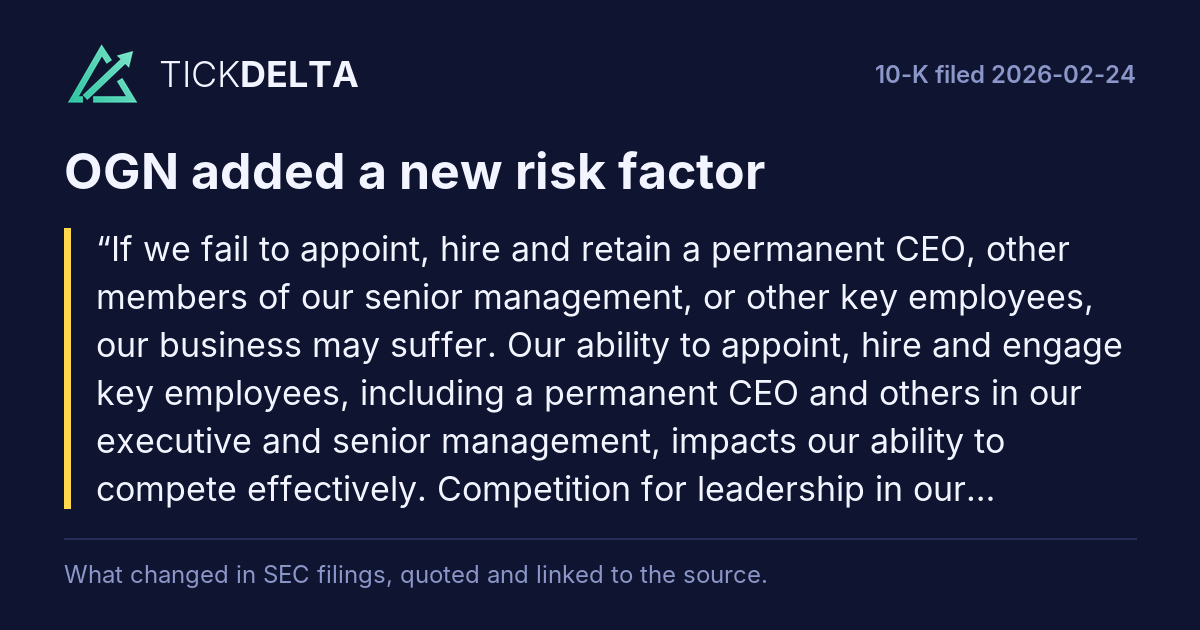
•If we fail to appoint, hire and retain a permanent CEO, other members of our senior management, or other key employees, our business may suffer.
•We may not realize benefits from our investments in China and emerging markets.
Show the other 21
•The FDA’s shift toward “radical transparency,” including plans to release future complete response letters promptly after they are issued to sponsors and increase enforcement in advertising and promotion, could have an adverse impact on our business and adversely affect our commercial prospects.
The imposition of tariffs on, or other trade restrictions or domestic sourcing requirements in, the territories and countries where we, our partners, suppliers, or customers do business, as well as any retaliatory actions with respect to such actions, could have a material adverse effect on our business, financial condition, results of operations, cash flows, ability to pay dividends or repurchase shares, or stock price.
The U.S. presidential administration has reached several bilateral trade agreements that seek to cap tariffs on imports into the U.S., including an agreement with the EU that would limit U.S. tariffs to 15% on certain brand pharmaceutical and to keep tariffs on generic medicines at 0%. The United States may reach additional trade agreements with other trading partners seeking to mitigate the impact of tariffs. In addition, the U.S. Department of Commerce has initiated an investigation under Section 232 of the Trade Expansion Act of 1962, as amended, to determine dependence on imported pharmaceuticals and pharmaceutical ingredients and the impact on national security. This investigation may lead to the imposition of additional tariffs on pharmaceutical imports in 2026.
The imposition of new, announced or proposed tariffs, trade restrictions or domestic sourcing requirements on pharmaceutical imports, including but not limited to products, ingredients, and other materials necessary for our business, could result in increased costs of goods and prices, disruptions to our supply chain, manufacturing delays, supply shortages, and adverse impacts to clinical trials. These measures could also result in decreased profit margins on certain of our products. In particular, any future tariffs on generic drugs, ingredients, or inputs, could significantly decrease profit margins on such products.
In addition, we may be restricted in our ability to adapt, or may be unable or unsuccessful in adapting, to these impacts and challenges due to, among other things, the terms of our current customer, wholesaler, supply or distribution agreements, or the need to obtain regulatory approval prior to making any changes to our manufacturing locations, processes or suppliers. Existing, announced, and future tariffs, trade agreements, or domestic sourcing requirements, as well as potential exemptions, could also provide our competitors with an advantage to the extent such future impacts disproportionately affect us compared to them.
The impact of any announced, new or proposed tariffs, trade restrictions or domestic sourcing requirements on our business continues to be subject to a number of factors that we cannot predict, including, but not limited to, the scope, nature, amount, effective date and duration of any such measures. Furthermore, general uncertainty related to announced, new or potential tariffs, trade restrictions and domestic sourcing requirements has in the past reduced and could in the future further reduce global economic activity, thereby resulting in additional adverse impacts to us.
The completion of the self-initiated Audit Committee internal investigation and the subsequent implementation of our remediation plan has been time-consuming and expensive and may result in significant additional expense and/or litigation.
As discussed in Item 9A. “Controls and Procedures”, after concerns regarding our sales practices for wholesalers for Nexplanon were brought to the attention of the Board, the Audit Committee (the “Audit Committee”) of our Board oversaw an independent, internal investigation into these sales practices. The Audit Committee’s investigation focused on our sales of Nexplanon to wholesalers in the United States. The investigation found that we asked two wholesalers in the United States to purchase greater quantities of Nexplanon during the Relevant Periods than they otherwise would have purchased based on wholesaler demand. While we have taken certain actions aimed at preventing the use of such improper sales practices with such wholesalers (including the appointment of a new Interim CEO, the termination and appointment of a new Interim Head of U.S. Commercial & Government Affairs, the appointment of an Executive Chair and the appointment of a Lead Independent Director) and are in the process of implementing additional measures, there is no assurance that these actions and procedures will continue to be effective over time.
Additionally, while the Audit Committee’s investigation is complete, we identified material weaknesses in our internal control over financial reporting and, as a result, our management has determined that our disclosure controls and procedures and internal control over financial reporting were not effective as of December 31, 2024 or as of December 31, 2025. To address the ineffective disclosure controls and procedures and internal control over financial reporting due to the material weaknesses, we, with the oversight of our Audit Committee, developed a remediation plan, which is described in Item 9A. “Controls and Procedures”. As we execute on our remediation plan, there can be no assurance that we will not discover additional matters that we will need to address that could have an adverse impact on us, our business and/or our results of operations, including determining that further changes to our internal controls are required. We have incurred significant expenses, including audit, legal, forensic accounting, consulting and other professional fees, in connection with the Audit Committee investigation and related matters, and we may incur additional time and expense as a result of the investigation and our efforts to address the investigation results. The incurrence of significant additional expense, or the requirement that management and the Board continue to devote significant time that could reduce the time available to execute on our business strategies, could have an adverse effect on our business, results of operations and financial condition.
On October 26, 2025, we made a voluntary self-disclosure to the SEC to advise it of the Audit Committee’s investigation, and the SEC subsequently opened an investigation into these matters. See Note 18 “Contingencies— Governmental Proceedings” to the Consolidated Financial Statements in this 2025 Form 10-K for additional information.
We (or our directors or officers) may be subject to future inquiries, investigations, claims, actions, or proceedings, and we cannot predict the outcome of any of the foregoing; however, regardless of outcome, any inquiries, investigations, claims, actions, or proceedings relating to the Audit Committee’s investigation would likely consume a significant amount of our resources and result in considerable legal and accounting costs.
Any legal proceedings, if decided adversely to us, could result in significant monetary damages, penalties and reputational harm, and will likely involve significant defense costs and other costs. We have previously entered into indemnification agreements with each of our directors and certain of our officers, and our Amended and Restated Bylaws require us to indemnify each of our directors and officers. Further, our insurance may not cover all claims that have been or may be brought against us, and insurance coverage may not continue to be available to us at a reasonable cost. As a result, we may be exposed to substantial uninsured liabilities, including pursuant to our indemnification obligations, which could adversely affect our business, prospects, results of operations or financial condition.
We identified material weaknesses in our internal control over financial reporting, which could impact our ability to report our results of operations and financial condition accurately and in a timely manner.
In connection with the Audit Committee investigation described in Item 9A. “Controls and Procedures”, we identified material weaknesses in our internal control over financial reporting. For a description of these material weaknesses, see “Controls and Procedures” in Part II, Item 9A. “Controls and Procedures” of this 2025 Form 10-K. While we developed a remediation plan, our material weaknesses cannot be considered remediated until the applicable remedial control is implemented and operates for a sufficient period of time to allow management to conclude, through testing, that this remediation plan has been implemented and the control is operating effectively. Our material weaknesses, if not fully addressed, could result in a material misstatement of our annual or interim financial statements, and we may be unable to remediate these material weaknesses in a timely manner, which could adversely impact the accuracy and timeliness of future reports and filings we make with the SEC. Any such failure could result in litigation or regulatory actions by the SEC or other regulatory authorities, which could further result in loss of investor confidence, a decline in the price of our Common Stock, delisting of our securities, harm to our reputation and financial condition and/or diversion of financial and management resources from the operation of our business.
The use of AI and its legislative and regulatory landscape continues to evolve and makes it difficult to fully understand and assess related risks.
In the ordinary course of business, we and our third-party providers collect, store and transmit large amounts of confidential
We may not be able to successfully execute our plan to deleverage our business or otherwise reduce our debt level, which could adversely affect our operating flexibility, business, financial condition, results of operations, or cash flows.
As of December 31, 2025, we had approximately $8.6 billion of outstanding indebtedness, and as a result we have shifted our top capital allocation priority from acquiring businesses and assets to expand our portfolio of products, to deleveraging our business. In 2025, we reduced our regular quarterly dividend by 90%, and in January 2026, we sold the Jada System, with the capital preserved or received being used to repay outstanding debt; however, these efforts combined with our cash from operations may not be sufficient to reduce our net leverage ratio. Our ability to de-lever and the pace thereof will depend on our future financial and operating performance, which will be affected by the prevailing economic conditions and financial, business, regulatory and other factors described herein, many of which are beyond our control. If we are unable to successfully reduce our debt to a level we believe appropriate, our credit ratings may be lowered, we may further reduce or eliminate our quarterly dividend, sell additional assets or businesses, or reduce or delay our planned capital expenditures or investments.
Notwithstanding our current intent to deleverage our business, we have approximately $8.6 billion of outstanding indebtedness (including approximately $3.6 billion of notes that mature in 2028) and may incur additional debt from time to time in the future. Current or future levels of indebtedness may increase the possibility that we will be unable to generate cash sufficient to pay amounts due in respect of such indebtedness. Our business may not generate sufficient cash flows from operations to service or reduce our indebtedness and make the necessary capital expenditures and support our growth strategies (including business development transactions), particularly in light of our current capital allocation priority to use a substantial portion of our cash flow from operations to repay our debt. If we are unable to generate such cash flows, we may be required to pursue one or more financing alternatives, which could include obtaining equity capital on dilutive terms, selling assets or businesses, or refinancing our current debt. Our ability to refinance our indebtedness will depend on the capital and credit markets and our financial condition at such time. If prevailing interest rates or other factors at the time of refinancing result in higher interest rates upon refinancing, then the expense relating to the refinancing would increase. Any of the foregoing may also adversely affect our ability to obtain and maintain our credit ratings and materially affect our business, financial condition, cash flows, or results of operations.
To address these adverse effects and remain competitive, we will continue to adapt our business and sales practices, particularly for our key products. These practices may include strategies such as offering product discounts and adjusting inventory levels. We review available inventory information; however, there is a risk that our predictions may be inaccurate or that we may decide to increase inventory in anticipation of customer demand. If actual demand does not materialize as expected, inventory levels may exceed customer needs. This could result in elevated channel inventory for certain products in a given quarter, which may negatively impact product revenue, increase return rates, contribute to product expirations, or reduce future inventory purchases.
Recent global healthcare reform initiatives, and U.S. judicial decisions, laws, regulations, executive orders and political actions could adversely affect our future revenues and profitability.
In the United States, there have been significant and wide-ranging federal policy and legislative reforms impacting drug pricing
and reimbursement. Key developments related to the IRA, MFN pricing policies, the OBBBA, and the Calendar Year 2026 Medicare Physician Fee Schedule are discussed in greater detail in Item 1. “Business – Competition” above.
In addition, there have been legislative and judicial efforts to modify, repeal or otherwise invalidate all or certain aspects of the Affordable Care Act (the “ACA”) or its implementing regulations. While the ACA remains in effect in its current form, it is unclear how any such efforts in the future will impact the ACA or our business. Moreover, the U.S. presidential administration is prioritizing efforts to restructure the U.S. Department of Health and Human Services (“HHS”), including substantial reductions in workforce. It is not clear how this restructuring of HHS will impact our business.
We continue to experience incremental gross-to-net sales pressures driven by evolving payor requirements and heightened healthcare budget constraints. In certain market segments, payors have increased reliance on mandatory rebates, clawbacks, and other price concession mechanisms to manage overall drug spending and meet fiscal obligations. As a result, we may be required to provide higher levels of financial incentives to maintain formulary access, satisfy contractual commitments and sustain product competitiveness. These dynamics could adversely impact our net revenues, profitability and the predictability of future financial performance modeling.
If we fail to appoint, hire and retain a permanent CEO, other members of our senior management, or other key employees, our business may suffer.
Our ability to appoint, hire and engage key employees, including a permanent CEO and others in our executive and senior management, impacts our ability to compete effectively. Competition for leadership in our industry can be intense, especially for employees with relevant scientific and technical expertise. Our ability to manage such human capital depends on a number of factors, including hiring practices of our competitors, compensation and benefits (as may be impacted by any financial performance challenges, including any related impact on outstanding equity awards), work location, work environment (including our competitors’ policies regarding remote or hybrid work arrangements), employee engagement and satisfaction, the market’s perception of our strategic initiatives, and economic conditions. We strive to build a strong culture with inclusion and belonging at our core, believing that this is fundamental to success and future innovation.
Additionally, the departures of members of our senior management team or other key employees could delay or hinder achievement of our financial, operating or strategic objectives. On October 26, 2025, Kevin Ali resigned as our CEO and as a member of our Board in connection with the Audit Committee’s internal investigation, as discussed in Item 9A. “Controls and Procedures.” Concurrently, Joseph Morrissey was appointed our Interim CEO. We appointed our Chairman of the Board, Carrie S. Cox, as Executive Chair for the interim period while we engage in the search for a permanent CEO. The Board has formed a Search Committee and engaged a nationally recognized search firm to assist in selecting a permanent CEO. The timeline for identifying, retaining and integrating a new CEO is currently unknown. Any failure to timely identify and hire a new CEO and successfully integrate and transition that person into his or her new role within our Company could adversely impact our ability to achieve our long-term financial, operating or strategic objectives.
We have experienced, and may continue to experience, attrition among our senior management team and key employees. Our
executive officers could terminate their employment with us at any time, and any such departure could be particularly disruptive in light of the other recent leadership changes. Any loss of services of key employees for any reason could significantly delay or prevent the achievement of our financial, operating or strategic objectives. If we are unable to mitigate these or other similar risks, our business, results of operations or financial condition may be adversely affected.
Our quantitative goodwill impairment analysis relies on projected cash flows and market assumptions. A significant decline in forecasted performance, whether due to external economic factors or internal operational challenges, could result in the fair value of either the U.S. or international reporting unit falling below its carrying amount. In such cases, we would be required to recognize a non-cash impairment charge, which could materially impact our financial condition and results of operations. For the year ended December 31, 2025, we recognized a $301 million impairment of goodwill which represents the amount by which the carrying value of goodwill exceeded its implied fair value. The goodwill impairment recorded reflects continued pressure on the U.S. reporting unit resulting from lower-than-expected financial performance, revised forward-looking projections, adverse geopolitical development market conditions, and uncertainty in the macroeconomic environment. As a result, the U.S. reporting unit is more susceptible to future impairment than the International reporting unit. We may be required to record impairment charges on goodwill related to a reporting unit if adverse macroeconomic or geopolitical developments materially affect our business outlook. These developments may include, but are not limited to, the implementation of tariffs or other trade restrictions, changes in trade policies, inflationary pressures, interest rates, supply chain disruptions, competitive pressures, or regulatory changes that reduce forecasts or increase operating costs. If we are unable to mitigate any such goodwill impairment, our business, results of operations or financial condition may be adversely affected.
Any expansion of our product offerings and geographic presence would likely rely on acquisitions of complementary businesses, licensing arrangements and strategic partnerships. In addition, our current strategy includes potential divestitures of certain products or business lines.
Any acquisitions or divestitures would require significant investment of time and resources, may disrupt our business and distract management from other responsibilities and may result in losses on the disposition of, or continued financial involvement in, the divested business, including through indemnification or other financial arrangements, for a period following the transaction, which could adversely affect our business, financial condition or results of operations. Further, any future transactions may not be completed in a timely manner, on a cost-effective basis, or at all.
Similarly, divestitures may adversely impact our business, operating results, or financial condition if we are unable to achieve the anticipated benefits from such divestitures, or if we are unable to offset impacts from the loss of revenue associated with the divested asset or business line. Even following a divestiture or other exit strategy, we may have certain continuing obligations to former employees, customers, suppliers, landlords or other third parties. We may also have continuing liabilities related to former employees, assets or businesses. Such obligations may have a material adverse impact on our results of operations or financial condition.
Our failure to achieve the long-term plan for acquired businesses, as well as any other adverse consequences associated with our acquisition, divestiture and strategic activities, could have a material adverse effect on our business, financial condition, or results of operations.
•scrutiny of advertising and promotion and changing regulation and enforcement of such activity;
We have on occasion, and may in the future, be required to seek a new manufacturer for certain of our products, which may involve substantial costs and delays. It is also difficult to identify a new manufacturer, enter into a new manufacturing and supply agreement with that party, and prepare the new entity to meet the logistical requirements associated with manufacturing our products. In addition, our third-party manufacturers may not perform as agreed, or may terminate their contracts with us, and we may not have adequate or any recourse against such parties to fully mitigate any resulting harm to our business.
Further, the current U.S. presidential administration is also engaged in negotiations with certain pharmaceutical companies to provide relief from certain tariffs in exchange for lower U.S. drug prices and expansions of domestic manufacturing, which could create disruptions in pharmaceutical supply chains, particularly for drugs that, like ours, are manufactured outside the United States.
•changes in U.S. federal funding for clinics that we rely on to purchase our contraceptive products (including Planned Parenthood);
The FDA’s shift toward “radical transparency,” including plans to release future complete response letters promptly after they are issued to sponsors and increase enforcement in advertising and promotion, could have an adverse impact on our business and adversely affect our commercial prospects.
There has been recent regulatory activity and enforcement in the United States stemming from an announced shift by FDA toward “radical transparency” resulting in increased scrutiny and transparency in the pharmaceutical drug space that may impact our business.
In July 2025, the FDA announced a policy shift toward public disclosure of complete response letters issued for drugs that had not been approved. Additionally, in September 2025, the FDA announced that it will release future complete response letters promptly after they are issued to sponsors and the agency released a number of unpublished complete response letters issued since 2024 associated with pending or withdrawn applications. Although the FDA has stated that all released letters will be redacted to remove confidential commercial information, trade secrets, and personal private information, public disclosure of any such letters we may receive could expose detailed information regarding our clinical data, chemistry, manufacturing and controls, or regulatory strategy. Although we have not received a complete response letter and, if we do in the future receive
one, we intend to coordinate closely with the FDA to protect proprietary information, there is no assurance that such efforts will be successful or that any inadvertent disclosures will be remedied. Moreover, once published, we may have limited ability to correct or contextualize the FDA’s statements.
Further, in September 2025, HHS and the FDA announced a series of measures to address “Misleading” direct-to-consumer prescription drug (“DTC”) advertisements. The measures include (1) rulemaking to rescind the “adequate provision” requirement, which permits manufacturers to include a general statement of risk alongside a webpage or publication and 1-800 number to access the full product labeling, (2) enhanced enforcement of DTC violations, and (3) expanded oversight of prescription drug advertising on social media. FDA issued letters to every sponsor of an approved drug or biologic directing them to remove any noncompliant advertising and bring all promotion communications into compliance. FDA subsequently issued approximately 100 enforcement letters to companies with purportedly deceptive ads, and continues to issue more. Although we have not received an enforcement letter from FDA relating to our specific advertising and promotional activities, there is no assurance that we will not receive one in the future. We continue to actively monitor the evolving regulatory landscape and follow the marketing regulations required by the governing regulatory authorities in the markets where we operate and work to ensure ongoing access to and education of important medicines and treatments by the patients and healthcare system who rely on them.
Nevertheless, these new policies of radical transparency and increased enforcement could result in unforeseen reputational, operational, financial regulatory and legal consequences for our Company and have the potential to impact our business and how we market our products.
•our ability to successfully execute our plan to deleverage our business or otherwise reduce our debt level;
Volatility in, or lack of performance of, our Common Stock price may also affect our ability to attract and retain key employees. Many of our key employees are, or will soon be, vested in a substantial number of shares of Common Stock or stock options. Employees may be more likely to terminate their employment with us if the shares they own or the shares underlying their vested options have significantly not appreciated in value relative to the original purchase prices of the shares or the exercise prices of the options, or, conversely, if the exercise prices of the options that they hold are significantly above the trading price of our Common Stock.
Paragraphs in the 10-Q filed Oct 30, 2026 that were not in the one before
New in the latest 10-Q
6 paragraphs in the 10-Q filed Oct 30, 2026 with nothing like them in the 10-Q filed Jul 31, 2026 (at least half the words must differ; new numbers alone do not count). Quoted exactly, grouped by the item heading above them. This is text that changed, not a judgement of how serious it is.
Financial statements and notes
(1) The expected dividend yield assumption is based on the Company's expected dividend payments at the grant date.
Read in the 10-Q
• certain Established Brands products within international markets, due to temporary supply chain and operational disruptions affecting availability.
Read in the 10-Q
• certain Established Brands products within international markets, due to temporary supply chain and operational disruptions affecting availability.
Read in the 10-Q
International revenue during the period was partially constrained by various supply-related challenges affecting the Company's ability to fully meet customer demand, primarily for certain of our Established Brands products. While some of these challenges surfaced in prior periods, the current period had compounding constraints across the supply chains and resulted in an unfavorable impact estimated to be approximately less than 2% to the Company’s consolidated revenue for the three and nine months ended September 30, 2026. These challenges included the impact of manufacturing disruptions at a key contract manufacturer, temporary operational constraints at certain facilities, labor-related disruptions at a third-party logistics provider, and geopolitical disruptions (the “Supply Constraints”). Management continues to implement mitigation strategies designed to improve production and supplier reliability, strengthen supply chain resilience, and support future demand. While certain of these challenges have been resolved, full recovery of the supply chains remain on-going.
Read in the 10-Q
Three Months Ended September 30, % Change Nine Months Ended September 30, % Change
Read in the 10-Q
Show the other 1
Item 6
*+10.2 Organon Executive Change in Control Severance Program, as amended and restated on April 15, 2025, as further amended on August 14, 2026.
Read in the 10-Q
The 10-Q's risk factors against the 10-K
Item 1A of the 10-Q filed Oct 30, 2026 against Item 1A of the 10-K filed Feb 24, 2026.
A 10-Q repeats only the risks that changed, so a 10-K paragraph that is missing from it is not counted as removed.
Added is a paragraph with nothing like it in the 10-K, Reworded a sentence that is in both with several words changed,
Quiet changes a sentence in both where one to four words changed and one is a hedge or a modal
(cut words struck through, new words highlighted).
Text on the page, not a score; each links to the filing at sec.gov.
What the 10-Q itself says about its risk factors:There have been no material changes in our risk factors from those disclosed in Item 1A. Risk Factors, in our Annual Report on Form 10-K for the year ended December 31, 2025 and Quarterly Report on Form 10-Q for the quarter ended March 31, 2026.
Read in the 10-Q
1 paragraph in the 10-Q's Item 1A, and none of them adds, rewords or quietly edits a paragraph of the 10-K's.
Phrases used for the first time
Two-word phrases in Risk Factors of the 10-K filed Feb 24, 2026 that are in none of the 1 earlier 10-Ks stored, back to Feb 28, 2025
Where each one is used
- key employees: •If we fail to appoint, hire and retain a permanent CEO, other members of our senior management, or other key employees, our business may suffer.
- audit committee: •The completion of the self-initiated Audit Committee (as defined below) internal investigation and the subsequent implementation of our remediation plan has been time-consuming and expensive and may result in significant additional expense and/or litigation.
- trade restrictions: •The imposition of tariffs on, or other trade restrictions or domestic sourcing requirements in, the territories and countries where we, our partners, suppliers, or customers do business, as well as any retaliatory actions with respect to such actions, could have a material adverse effect on our business, financial...
- domestic sourcing: •The imposition of tariffs on, or other trade restrictions or domestic sourcing requirements in, the territories and countries where we, our partners, suppliers, or customers do business, as well as any retaliatory actions with respect to such actions, could have a material adverse effect on our business, financial...
- sourcing requirements: •The imposition of tariffs on, or other trade restrictions or domestic sourcing requirements in, the territories and countries where we, our partners, suppliers, or customers do business, as well as any retaliatory actions with respect to such actions, could have a material adverse effect on our business, financial...
- remediation plan: •The completion of the self-initiated Audit Committee (as defined below) internal investigation and the subsequent implementation of our remediation plan has been time-consuming and expensive and may result in significant additional expense and/or litigation.
- internal control: •We identified material weaknesses in our internal control over financial reporting, which could impact our ability to report our results of operations and financial condition accurately and in a timely manner.
- permanent ceo: •If we fail to appoint, hire and retain a permanent CEO, other members of our senior management, or other key employees, our business may suffer.
Used at least twice, small words left out. Counted, not picked: a phrase can be new because the company renamed something.
What was taken out
18 paragraphs of last year's Risk Factors with nothing like them now. The longest are quoted.
Sources
Item 1A of each 10-K and 10-Q on EDGAR, quoted exactly. Each paragraph links to the filing at sec.gov.
Also
10-K change: what was reworded or cut, section by section.
Work with it
Excel workbook · CSV. Google Sheet that stays up to date: paste =IMPORTDATA("https://tickdelta.com/company/OGN/export.csv") into a cell.