Screener / SEC EDGAR /CIK 0000888491 /10-K filed Feb 9, 2026, compared with Feb 13, 2025 /Numbers from the XBRL of the 10-Ks
NYSE Real estate · REIT

Omega Healthcare Investors Inc OHI

Compare with peers Embed
SEC comment letters, last 20 years

4 reviews of OHI's filings by SEC staff

UPLOAD and CORRESP
Reviews 4 latest letter Jun 26, 2018
Questions asked 11 each answered in the company's own letter
No closing letter 1 reviews without a letter saying the staff completed it

When the SEC's staff reviews a filing, it writes to the company with numbered questions, and the company answers each one in a letter. SEC publishes the exchange once the review is over, at least 20 business days later. A question is not an accusation; most reviews end with the company adding detail to its next filing.

How the reviews went

Every review on EDGAR, from the first staff letter to the letter that closes it

  1. 1. Staff letters 5 UPLOAD
  2. 2. Questions in them 11 numbered comments
  3. 3. Company replies 12 CORRESP
  4. 4. Reviews closed 3 of 4 closing letter

Half the closed reviews took 29 days or less from the first letter to the closing letter.

Form 10-K for the Fiscal Year Ended December 31, 2017

2018-06-26 to 2018-07-30 · 1 question · 1 letter from the SEC, 1 from the company
Review closed 2018-07-30
Goodwill and impairment
Notes to the Consolidated Financial Statements · Note 5 – Other Investments
SEC asked
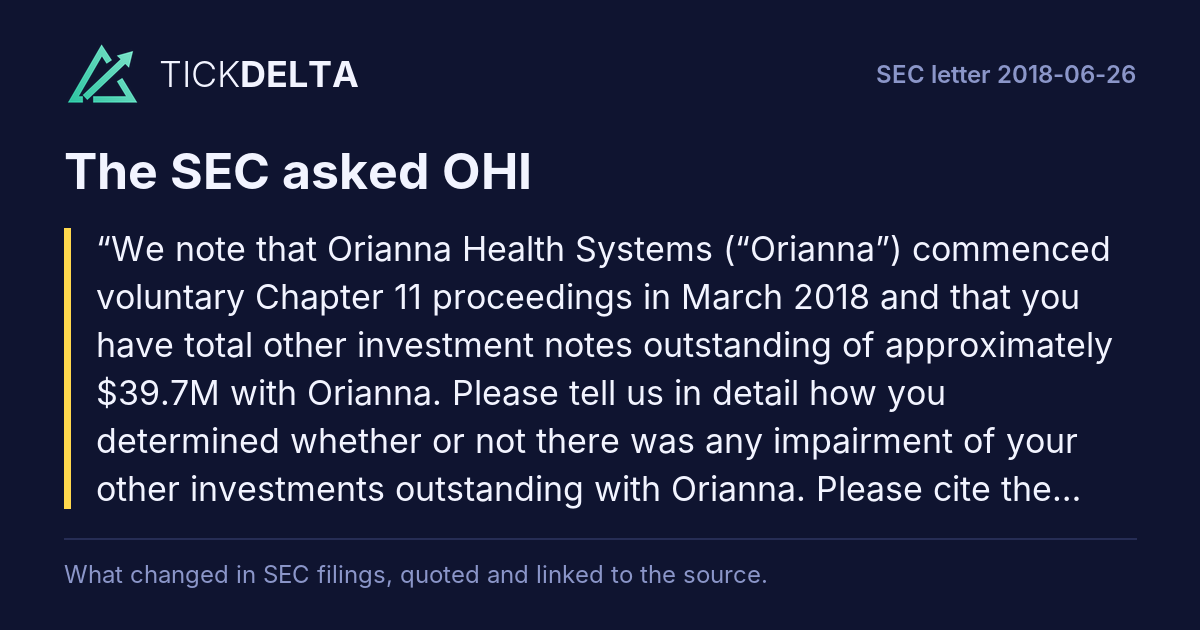
We note that Orianna Health Systems (“Orianna”) commenced voluntary Chapter 11 proceedings in March 2018 and that you have total other investment notes outstanding of approximately $39.7M with Orianna. Please tell us in detail how you determined whether or not there was any impairment of your other investments outstanding with Orianna. Please cite the applicable accounting guidance in your response.
OHI answered
As of March 31, 2018, we have not recorded impairment charges related to our other investment notes outstanding with Orianna pursuant to the guidance in ASC 310-10-35-2 as we believed it was probable that we would collect all of the interest and principal payments per the related agreements.

We based our collectability analysis, in part, on the following:

(a) as of March 31, 2018, $24.5 million of the other investments was owing under a $30.0 million senior secured super-priority debtor in possession loan (the "DIP Financing Loan") provided by Omega to Orianna in March 2018.
Rest of the answer

The DIP Financing Loan, which was approved by the U.S. Bankruptcy Court for the Northern District of Texas, is secured by a senior lien on substantially all assets of Orianna and entitled to super-priority claim status in Orianna's bankruptcy cases. Furthermore, under Orianna's bankruptcy plan (the "Plan"), Orianna proposes to repay the DIP Financing Loan in full.

(b) as of March 31, 2018, $15.2 million of the other investments was owing under a $18.8 million working capital note (the "Working Capital Note") originally issued in 2017. Under the Plan, Orianna proposes to make a distribution to Omega on account of Omega's allowed secured claims, and such distribution is currently anticipated to be in an amount sufficient to satisfy in full the amounts outstanding under the Working Capital Note.

Read in the reply
In its next report

First report after the company's reply of Jul 6, 2018: 10-Q filed Aug 8, 2018 ↗, against the 10-Q filed May 10, 2018 ↗.

Tickdelta does not hold the text of both reports, so they are not compared here.

Also in this review: closing letter, 2018-07-30

Form 10-K for the year ended December 31, 2015

2016-04-19 to 2016-05-13 · 3 questions · 1 letter from the SEC, 1 from the company
Review closed 2016-05-13
Form 10-K filed February 29, 2016 · Consolidated Statements of Operations, page F-4
SEC asked (1)
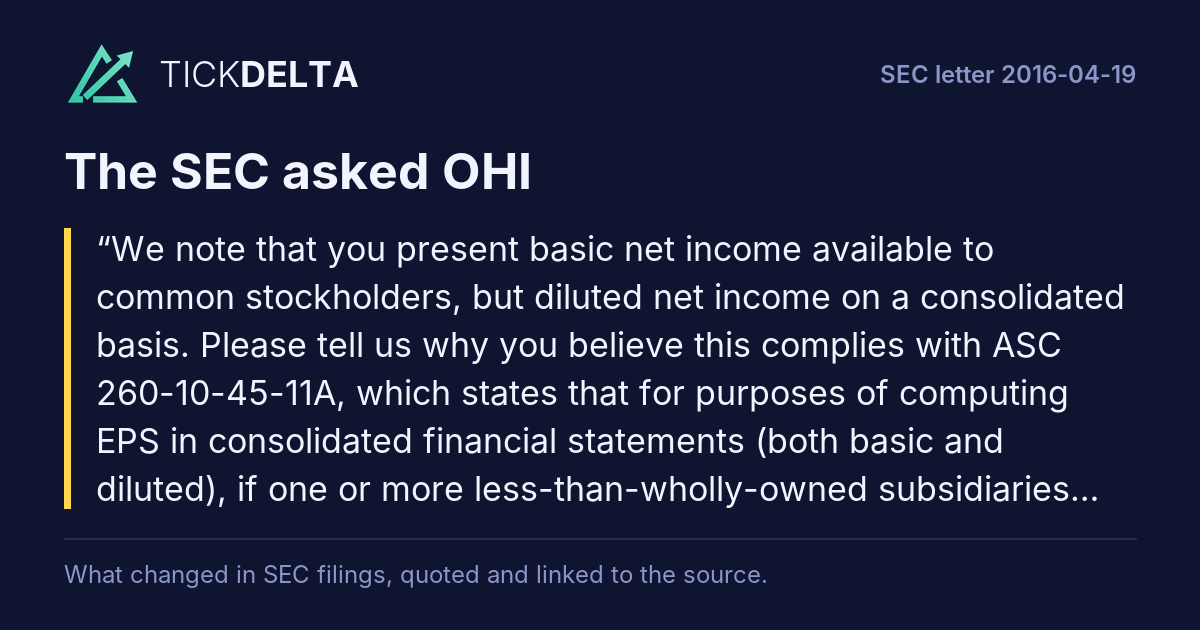
We note that you present basic net income available to common stockholders, but diluted net income on a consolidated basis. Please tell us why you believe this complies with ASC 260-10-45-11A, which states that for purposes of computing EPS in consolidated financial statements (both basic and diluted), if one or more less-than-wholly-owned subsidiaries is included in the consolidated group, income from continuing
Rest of the question

operations and net income shall exclude the income attributable to the noncontrolling interest in subsidiaries.

OHI answered
The noncontrolling interest referred to in our financial statements refers to a noncontrolling interest owned by third party partners in the Omega OP. We refer you to the following disclosure in Note 2 of our 2015 10-K on page F-15:

Redeemable Limited Partnership Unitholder Interests and Noncontrolling Interests

As of April 1, 2015 and after giving effect to the Aviv Merger, the Company owned approximately 138.8 million Omega OP Units and Aviv OP owned approximately 52.9 million Omega OP Units.
Rest of the answer

Each of the Omega OP Units (other than the Omega OP Units owned by Omega) is redeemable at the election of the Omega OP Unit holder for cash equal to the then-fair market value of one share of Omega common stock, par value $0.10 per share (“Omega Common Stock”), subject to the Company’s election to exchange the Omega OP Units tendered for redemption for unregistered shares of Omega Common Stock on a one-for-one basis, subject to adjustment as set forth in the Partnership Agreement. Effective June 30, 2015, the Company (through Merger Sub, in its capacity as the general partner of Aviv OP) caused Aviv OP to make a distribution of Omega OP Units held by Aviv OP (or equivalent value) to Aviv OP investors (the “Aviv OP Distribution”) in connection with the liquidation of Aviv OP. As a result of the Aviv OP Distribution, Omega directly and indirectly owned approximately 95% of the outstanding Omega OP Units, and the other investors own approximately 5% of the outstanding Omega OP Units. As a part of the Aviv OP Distribution, Omega settled approximately 0.2 million units via cash settlement. As of December 31, 2015, Omega directly and indirectly owns approximately 95% of the outstanding Omega OP Units, and the other investors own approximately 5% of the outstanding Omega OP Units.

Noncontrolling Interests

Noncontrolling interests is the portion of equity in the Omega OP not attributable to the Company. We present the portion of any equity that we do not own in consolidated entities as noncontrolling interests and classify those interests as a component of total equity, separate from total stockholders’ equity, on our Consolidated Balance Sheets. We include net income attributable to the noncontrolling interests in net income in our Consolidated Statements of Operations and Comprehensive Income.

As our ownership of a controlled subsidiary increases or decreases, any difference between the aggregate consideration paid to acquire the noncontrolling interests and our noncontrolling interest balance is recorded as a component of equity in additional paid-in capital, so long as we maintain a controlling ownership interest.

Furthermore, in computing basis EPS, we follow ASC 260-10-45-10, which states that basic EPS shall be computed by dividing income available to common stockholders by the weighted average number of common shares outstanding. We exclude the effect of the dilutive nature of the third party owners of Omega OP Units because the Omega OP Units are not outstanding common stock of Omega, but rather common stock equivalents that may be converted into common shares. We believe this is appropriate because Net income available to common stockholders includes the effect of the third party Omega OP Units holders (i.e., in 2015 Net income attributable to noncontrolling interest reduced our Net income available to common stockholders by approximately $8.8 million).

In determining diluted EPS, we apply the if-converted method to determine if the Omega OP Units are dilutive to EPS. In applying the if-converted method we add back to earnings (the Numerator) the impact associated with the Omega OP Units held by third parties (i.e., in 2015 Net income attributable to noncontrolling interest). In determining the denominator in the EPS calculation for diluted EPS, we include additional common stock that would have been outstanding if the diluted shares had been issued. We include in the diluted share count the potential Omega OP Units held by third parties that may be converted into Omega common stock.

We refer you to our disclosure in Note 2 to our 2015 10-K on Page F-15:

Earnings Per Share

Basic earnings per common share (“EPS”) is computed by dividing net income available to common stockholders by the weighted-average number of shares of common stock outstanding during the year. Diluted EPS is computed using the treasury stock method, which is net income divided by the total weighted-average number of common outstanding shares plus the effect of dilutive common equivalent shares during the respective period. Dilutive common shares reflect the assumed issuance of additional common shares pursuant to certain of our share-based compensation plans, including stock options, restricted stock and performance restricted stock units and the assumed issuance of additional shares related to Omega OP Units held by outside investors. All outstanding unvested share-based payment awards that contain rights to non-forfeitable dividends or dividend equivalents that participate in undistributed earnings with common stockholders are considered participating securities that shall be included in the two-class method of computing basic EPS. The impact of the two class method is immaterial. For additional information, see Note 20 – Earnings Per Share.

In accordance with ASC 260, because the inclusion of the common stock equivalents is dilutive to our EPS we disclose diluted EPS, accordingly.

We refer to our disclosure in Note 20 to our 2015 Form 10-K on Page F-43:

The following tables set forth the computation of basic and diluted earnings per share:

Year Ended December 31,

2015

2014

2013

(in thousands, except per share amounts)

Numerator:

Net income

$

233,315

221,349

172,521

Less: Net income attributable to noncontrolling interests

(8,791)

—

Net income available to common stockholders

224,524

Denominator:

Denominator for basic earnings per share

172,242

126,550

117,257

Effect of dilutive securities:

Common stock equivalents

1,539

744

843

Noncontrolling interest – OP units

6,727

Denominator for diluted earnings per share

180,508

127,294

118,100

Earnings per share - basic:

1.30

1.75

1.47

Earnings per share - diluted:

Read in the reply
In its next report

First report after the company's reply of May 3, 2016: 10-Q filed May 6, 2016 ↗, against the 10-Q filed Nov 6, 2015 ↗.

Tickdelta does not hold the text of both reports, so they are not compared here.

Note 3 – Properties · Aviv Merger, page F-19
SEC asked (2)
Please clarify why the value of shares and OP units exchanged in the Aviv merger ($2,276,260) differs from the amount disclosed as the fair value of merger consideration ($3,908,528).
OHI answered
The difference between the value of the shares and OP Units exchanged in the Aviv Merger of $2,276,260 and the disclosed fair value of the merger consideration of $3,908,528 relates to liabilities that we assumed in the merger. Our disclosure on page F-19 was intended to provide the reader with the scale of the transaction by combining the equity issued (which is consideration under ASC 805) and the debt and other liabilities assumed.
Rest of the answer

As disclosed, we indicate “based on the closing price of Omega’s common stock on April 1, 2015, we estimate the fair value of the consideration exchanged or assumed to be approximately $3.9 billion,” and perhaps it would have been more clear if we had said “fair value of the consideration exchanged and liabilities assumed” to more accurately reflect the two components.

In future filings, we will modify our presentation to clarify the consideration exchanged and the net assets acquired and update our disclosure as follows.

On April 1, 2015, Omega completed the Aviv Merger, which was structured as a stock-for-stock merger. Under the terms of the Merger Agreement, each outstanding share of Aviv common stock was converted into 0.90 of a share of Omega common stock. In connection with the Aviv Merger, Omega issued approximately 43.7 million shares of common stock to former Aviv stockholders. As a result of the Aviv Merger, Omega acquired 342 facilities, two facilities subject to direct financing leases, one medical office building, two mortgages and other investments. The facilities are located in 31 states and are operated by 38 third-party operators. Omega also assumed certain outstanding equity awards and other debt and liabilities. Based on the closing price of Omega’s common stock on April, 1, 2015, the fair value of the consideration exchanged was approximately $2.3 billion.

The following table highlights the preliminary fair value of the net assets acquired on April 1, 2015 and the consideration exchanged:

(in thousands)

Estimated fair value of assets acquired:

Land and buildings

3,108,078

Investment in direct financing leases

26,823

Mortgages notes receivable

19,246

Other investments

23,619

Total investments

3,177,766

Goodwill

630,404

Accounts receivables and other assets

15,500

Cash acquired

84,858

Accrued expenses and other liabilities assumed

(221,631

)

Debt assumed

(1,410,637

Read in the reply
In its next report

First report after the company's reply of May 3, 2016: 10-Q filed May 6, 2016 ↗, against the 10-Q filed Nov 6, 2015 ↗.

Tickdelta does not hold the text of both reports, so they are not compared here.

Form 8-K filed February 10, 2016 · Exhibit 99.1
SEC asked (3)
Please characterize “Funds from operations available to common stockholders” as “Funds from operations” in future filings to the extent that net income attributable to noncontrolling interest is included in the measure.
OHI answered
We will make the adjustment in future filings.

In connection with this response letter, the Company hereby acknowledges that:

· the Company is responsible for the adequacy and accuracy of the disclosure in the filing;

staff comments or changes to disclosure in response to staff comments do not foreclose the Commission from taking any action with respect to the filing; and the Company may not assert staff comments as a defense in any proceeding initiated by the Commission or any person under the federal securities laws of the United States.
Read in the reply
In its next report

First report after the company's reply of May 3, 2016: 10-Q filed May 6, 2016 ↗, against the 10-Q filed Nov 6, 2015 ↗.

Tickdelta does not hold the text of both reports, so they are not compared here.

Also in this review: closing letter, 2016-05-13

Form S-4

2015-05-13 to 2015-12-04 · 1 question · 1 letter from the SEC, 9 from the company
No closing letter
General
SEC asked
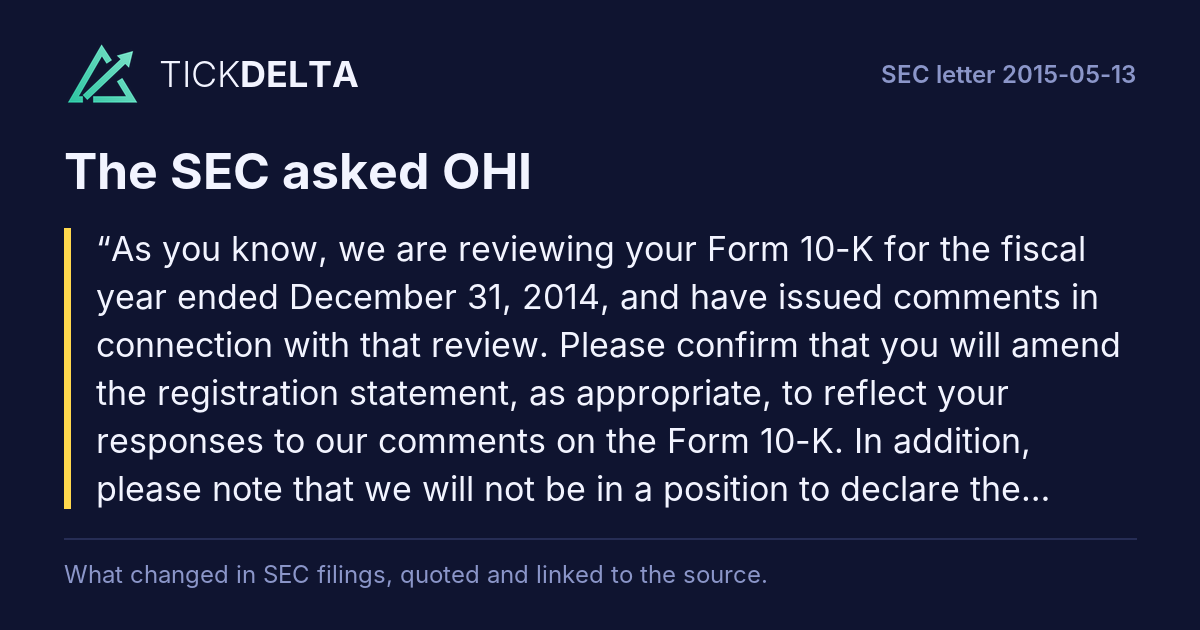
As you know, we are reviewing your Form 10-K for the fiscal year ended December 31, 2014, and have issued comments in connection with that review. Please confirm that you will amend the registration statement, as appropriate, to reflect your responses to our comments on the Form 10-K.
Rest of the question

In addition, please note that we will not be in a position to declare the registration statement effective until you have resolved all comments raised on the Form 10-K.

OHI answered
The New Ark investment is comprised of (i) four fifty-year direct financing leases that expire in 2063 and (ii) one twelve-year operating lease that expires in 2026. We note that Item 2 – Properties includes the total investment value of (i) $539,232 for

U. S. Securities and Exchange Commission our investment in the four New Ark direct financing leases under the section titled “Investment in Direct Financing Leases” and (ii) $34,600 for our investment in one

New Ark operating lease under the section “Leased Facilities”.
Rest of the answer

The combined investment of $573,832 represents approximately

13% of our total investments.

In addition to our disclosure in Item 2 –

Properties, we refer to our disclosure of our investments in direct financing leases in our consolidated financial statements.

Note 5 Direct Financing Leases states the following:

On November 27, 2013, we closed on an aggregate $529 million purchase/leaseback transaction in connection with the acquisition of Ark Holding Company, Inc. (“Ark

Holding”) by 4 West Holdings Inc. At closing, we acquired 55 SNFs and 1 ALF operated by Ark Holding and leased the facilities back to Ark Holding, now known as New Ark Investment Inc. (“New Ark”), pursuant to four 50-year master leases, with rental payments yielding 10.6% per annum over the term of the leases. The purchase/leaseback transaction is being accounted for as a direct financing lease.

The lease agreements allow the tenant the right to purchase the facilities for a bargain purchase price plus closing costs at the end of term. In addition, commencing in the 41st year of each lease, the tenant will have the right to prepay the remainder of its obligations thereunder for an amount equal to the sum of the unamortized portion of the original aggregate $529 million investment plus the net present value of the remaining payments under the lease, and closing costs. In the event the tenant exercises either of these options, we have the right to purchase the properties for fair market value at the time.

In addition to the disclosure of our investment in direct financing leases, we disclosed the acquisition of the three facilities subject to the operating lease in Note 3 –

Properties. The following is an excerpt from Note 3 – Properties:

Acquisition of Three SNFs in South

Carolina and Georgia

On June 27, 2014, we purchased two SNFs from an unrelated third party for approximately $17.3 million and leased them to an existing operator of

Omega. The SNFs, located in Georgia and South Carolina with a total of 213 beds, were combined into a new 12 year master lease with an initial annual cash yield of 9.5%.

In the third quarter of 2014, we purchased a third SNF in South Carolina with 132 beds that was added to the master lease. The combined purchase price, including the third SNF was $34.6 million.

In our future periodic Exchange Act reports, we will disclose the material terms of all material leases with New Ark and will clarify that only the four direct financing leases with New Ark have 50 year terms.

Read in the reply

Also in this review: company letter, Jun 15, 2015, company letter, Jun 15, 2015, company letter, Oct 6, 2015, company letter, Nov 12, 2015, company letter, Nov 13, 2015, company letter, Nov 13, 2015, company letter, Nov 13, 2015, company letter, Dec 4, 2015

Form 10-K for the Fiscal Year Ended December 31, 2014

2015-05-12 to 2015-06-10 · 6 questions · 2 letters from the SEC, 1 from the company
Review closed 2015-06-10
LeasesResults discussion (MD&A)Liquidity and cashAcquisitions
SEC letter of May 12, 2015 ↗ no reply letter on EDGAR
Item 2. Properties, page 33
SEC asked (1)
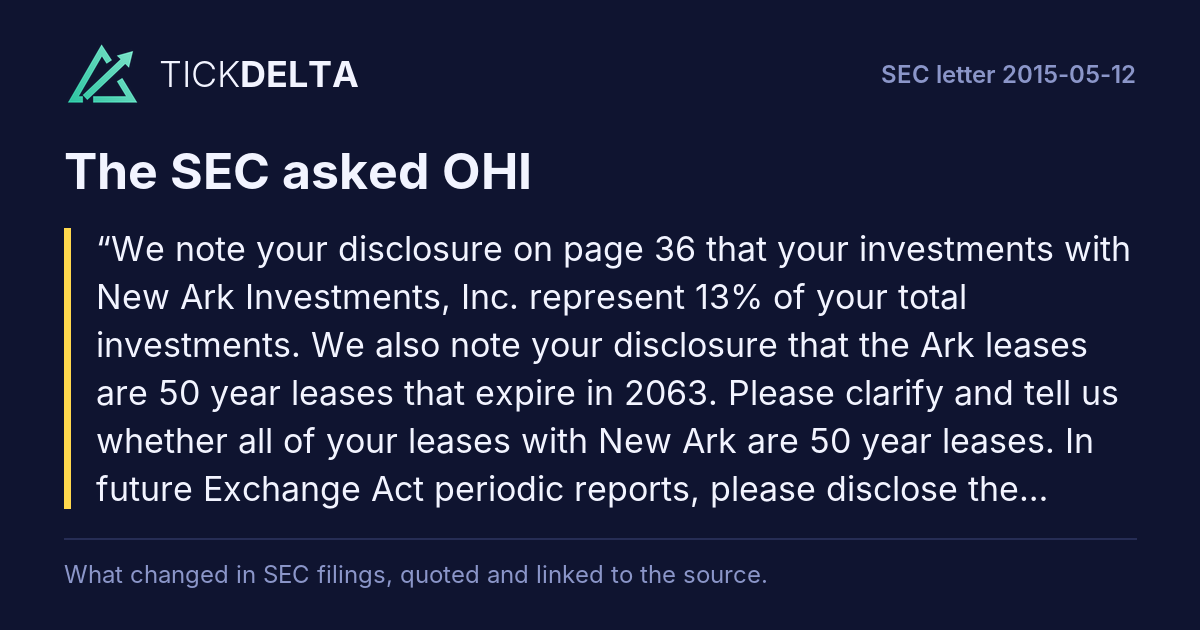
We note your disclosure on page 36 that your investments with New Ark Investments, Inc. represent 13% of your total investments. We also note your disclosure that the Ark leases are 50 year leases that expire in 2063. Please clarify and tell us whether all of your leases with New Ark are 50 year leases.
Rest of the question

In future Exchange Act periodic reports, please disclose the material terms of your agreements with new Ark or advise.

OHI answered

No reply letter found.

In its next report

First report after the SEC's letter of May 12, 2015: 10-Q filed Aug 5, 2015 ↗, against the 10-Q filed May 8, 2015 ↗.

Tickdelta does not hold the text of both reports, so they are not compared here.

Item 7. Management’s Discussion and Analysis of Financial Condition and Results of · Operations, page 40
SEC asked (2)
In future Exchange Act periodic reports, for material properties or operators, please discuss occupancy for those facilities that are not materially occupied.
OHI answered

No reply letter found.

In its next report

First report after the SEC's letter of May 12, 2015: 10-Q filed Aug 5, 2015 ↗, against the 10-Q filed May 8, 2015 ↗.

Tickdelta does not hold the text of both reports, so they are not compared here.

Note 2 – Summary of Significant Accounting Policies, page F-8 · In-Place Leases, page F-10
SEC asked (3)
With respect to your below-market lease intangibles, please tell us how you considered any fixed rate renewal options in your estimate of the remaining term of the underlying leases and your basis for your determination.
OHI answered

No reply letter found.

In its next report

First report after the SEC's letter of May 12, 2015: 10-Q filed Aug 5, 2015 ↗, against the 10-Q filed May 8, 2015 ↗.

Tickdelta does not hold the text of both reports, so they are not compared here.

Note 6 – Mortgage Notes Receivable, page F-21
SEC asked (4)
Please tell us how you complied with paragraph 29 of ASC 310-10-50, or tell us how you determined it was not necessary to provide applicable disclosures regarding credit quality information for your mortgage notes receivables.
OHI answered

No reply letter found.

In its next report

First report after the SEC's letter of May 12, 2015: 10-Q filed Aug 5, 2015 ↗, against the 10-Q filed May 8, 2015 ↗.

Tickdelta does not hold the text of both reports, so they are not compared here.

Note 20 – Consolidating Financial Statements, page F-40
SEC asked (5)
Please tell us how you determined it was not necessary to provide a consolidating statement of cash flows. Please refer to Rule 3-10 of Regulation S-X.
OHI answered

No reply letter found.

In its next report

First report after the SEC's letter of May 12, 2015: 10-Q filed Aug 5, 2015 ↗, against the 10-Q filed May 8, 2015 ↗.

Tickdelta does not hold the text of both reports, so they are not compared here.

Note 2 – Summary of Significant Accounting Policies, page F-8 · In-Place Leases, page F-10
SEC asked
We note your response to our prior comment three. Please address the following: a. Please provide more information regarding how you evaluate items (i) and (ii) noted in your response. Your response should address, but not necessarily be limited to, whether or not you use a threshold in your evaluation. To the extent you use thresholds, please tell us how you concluded that these thresholds are appropriate. b.
Rest of the question

Please tell us how you consider multiple factors in your evaluation. Your response should address, but not be limited to, if you consider all three factors noted in your response for each lease with a below market fixed rate renewal option, or if you only consider one or two of these items in certain circumstances. c. Please tell us the potential impact to your financial statements, including the impact from the acquisition of Aviv, if you were to conclude that all below market fixed rate renewal options would be exercised.

OHI answered
a. For each lease we assume through an acquisition of a property, we apply ASC 805-20-25-12 to determine whether the terms of the lease are favorable or unfavorable compared with the market terms of a lease for a similar property at the acquisition date. If the terms are favorable, an above-market lease intangible asset is recorded, and if the terms are unfavorable, a below-market lease liability is recorded.
Rest of the answer

ASC 805-20-25-12 does not provide us with further guidance on how to arrive at the fair value of the aboveor below-market lease intangible asset or liability, so we refer to ASC 820 and ASC 840 for the appropriate valuation guidance. We have historically used a discounted cash flow model to estimate the value of all assumed above and below market lease assets or liabilities based on the estimated difference between the projected future market rent and the contractual rent.

ASC

820 provides detailed guidance for using management’s judgment and other market participant considerations in assessing fair value when quoted prices are not available. We have extensive experience in underwriting and negotiating lease terms in the long-term healthcare and senior healthcare markets. Prior to the acquisition of Aviv on April 1, 2015, we had more than 500 facilities under lease, a significant portion of which were acquired from third parties and simultaneously leased to a new lessee, accordingly, no above or below market evaluation was required because no lease was assumed. We leverage our knowledge of acquiring these properties together with the knowledge gained through the countless lease transactions throughout our entire portfolio over the years as well as our understanding of market activities regarding the terms of other transactions that have recently closed in the long-term healthcare and senior housing industry to estimate the projected future market rent.

Primarily all of our existing above and below market leases (with one exception of one below market lease assumed in 2013 which is not material) resulted from our 2009 and 2010 acquisition of a 143 facility portfolio that was comprised of 58 leases, including several master lease agreements that covered multiple facilities. We evaluated each assumed lease individually to determine if it was above or below market. Based on our evaluation, we determined that twenty-four of the assumed leases were below market.

For all leases determined to be below market, we do not use a “bright line” threshold in our evaluation of whether we should include any or all lease extension options in our in-place lease evaluation. We considered each lease individually based on a collective evaluation of the following factors: (i) the significance of the estimated rent differential between projected future market rent and contractual rent, in conjunction with (ii) the time between the acquisition closing date(s) and (iii) lease extension date(s). We also consider the length of the period covered by the lease renewal option as well as the current and expected operating performance of the facility and/or lessee to evaluate the likelihood of their ability to comply with the terms of the lease agreement, including any renewal periods that we may include in our below market lease analysis. We do not believe it is appropriate to limit our analysis to any one factor or using a “bright line” in applying our judgment to evaluate how a market participant would value the in place lease. Accordingly, we believe that a renewal option must be “reasonably assured” of being exercised under ASC

840-10-20 (which defines bargain renewal options).

In every lease we have assumed, the lease agreement requires the lessee to be in compliance with the terms of the lease agreement at the time of the renewal notification in order to extend the lease the additional term; accordingly, evaluating the current and expected operating performance is an important part of the evaluations process we use to determine whether or not to included renewal options in our below market lease evaluation. If we determine the lessee is experiencing or may experience operational issues that could cause them to fail to comply with the lease terms, we would likely excluded any renewal periods. We also consider our history with the operator. We have not typically excluded renewal terms due to operator performance issues in the past, but may do so in the future if we determine it appropriate to do so.

We use this approach because we believe it reflects quantitative and qualitative factors that our tenants typically reference in making renewal decisions.

Example 1:

For example, for a lease assumed with a modest projected below market rent, but a relatively close extension date (i.e., a renewal notification period with in a few years of the acquisition date), we would likely include the first lease extension in our evaluation because it is unlikely that the market conditions between the acquisition date and the renewal notification date would change dramatically enough to change our assumption of projected market rent at the time of the lease renewal notification, however, depending on the renewal terms

(including the length of the additional lease term) we may or may not include additional renewals.

Example 2:

Assume the same facts in the previous example. Also assume that the lease includes two 10 year renewal options. As noted above, we may include the first renewal option that was due to be exercised in a few years of the date of acquisition because we would have a higher degree of confidence that the projected future market rent will not change significantly and therefore, believe it is reasonable assured that the renewal option will be exercised. However, it is less likely that we would include the second renewal option in our below market in-place lease evaluation because of the uncertainty regarding market rent more than a decade away.

Example 3:

Assume the same modest projected below market rent, but with a single lease renewal extension notification date that is 10 years from the date of acquisition, we would not include the extension in our evaluation for the same reason noted in example 2 (i.e., the uncertainty regarding market rent a decade away) unless there were other significant indicators present that led us to believe that renewal was reasonably assured.

In summary, to determine whether to include the lease renewal term(s) in our in-place lease evaluations we use all three of the factors collectively as noted above in our evaluation. Depending on the individual facts and circumstances of each lease, we assess whether to include any or all lease renewal periods.

b. As noted in our response to (a) above, we consider all three factors in our evaluation of each assumed leases.

c. We closed the Aviv acquisition on April 1, 2015. Due to the timing of the Aviv acquisition, we have not completed our evaluation of our preliminary purchase price accounting, including the determination of assumed below market leases. Accordingly, we are not in a position to estimate the impact of including all of the renewal options for below market leases of Aviv. However, as noted above, we will review each lease individually and include any renewal options that we believe are reasonably assured to be exercised in the lease term.

In response to your request, we quantified the incremental impact to our financial statements if we assumed all below market renewal options for in-place leases assumed in connection with all acquisitions through December 31, 2014. The following table summarizes the incremental impact of including all of the renewal options for below market leases ($ in millions):

Impact on financial statements

Projected incremental below market lease

Increase in acquired lease intangible liabilities

$ 22.3

Total assets as of December 31, 2014

$ 4,598.0

% of total assets as of December 31, 2014

0.48 %

In addition to the above, we estimate the additional rental income related to amortizing the acquired lease intangible liabilities would have resulted in less than $0.1 million in additional rental income in 2014. The additional rental income if recorded would have been less than 0.01% of our consolidated total operating revenue and net income for the year ended December 31, 2014.

Based on the foregoing, we respectfully represent to the Staff that the projected impact from including all below market renewal options, as opposed to the below market renewal options that we have included in our below market in-place lease analysis, would not have a material impact on our consolidated

2014 financial statements.

* * * * *

We would respectfully request your prompt consideration of our responses to your comments. We sincerely hope that the staff views our responses as complete and would very much appreciate the staff contacting us as soon as possible by telephone if there are any remaining issues. Please note that because Omega’s Form S-4 (SEC File No. 333-203447) was not declared effective on or before June 8, 2015, Omega is obligated to pay liquidated damages accruing at an annual rate of 0.25% on $250,000,000 of outstanding senior notes until such Form S-4 is declared effective. Accordingly,

Omega is committed to promptly addressing any remaining questions you may have so that Omega may promptly request that the Form

S-4 be declared effective.
Read in the reply
In its next report

First report after the company's reply of Jun 10, 2015: 10-Q filed Aug 5, 2015 ↗, against the 10-Q filed May 8, 2015 ↗.

Tickdelta does not hold the text of both reports, so they are not compared here.

Also in this review: closing letter, 2015-06-10

Letters without questions

Other letters

UPLOAD and CORRESP
4 other letters: notices that a filing will not be reviewed, requests to declare a registration effective, and the like
  • Apr 5, 2019 · OHI: letter to the SEC · Omega Healthcare Investors, Inc. · Amendment No. 2 to Registration · Statement on Form...
  • Mar 29, 2019 · OHI: letter to the SEC · Omega Healthcare Investors, Inc. · Registration Statement on Form S-4 · Filed February...
  • Nov 23, 2015 · SEC: will not review the filing · Omega Healthcare Investors, Inc. · Registration Statement on Form S-4 · Filed November...
  • Oct 22, 2015 · SEC: will not review the filing · Omega Healthcare Investors, Inc. · Registration Statement on Form S-4 · Filed October...

From the SEC's correspondence on EDGAR: staff letters (form UPLOAD) and company letters (form CORRESP), 24 letters filed since 2015-05-13. Questions and answers are matched by their numbers; topics come from words in each question. The reports are compared word for word (same form, before the first SEC letter against the first report after the company's reply). No AI.

Sources

The SEC's correspondence on EDGAR: staff letters (form UPLOAD) and company letters (form CORRESP), matched question by question. No AI.

Also

Filings: the letters in the filing list.

Work with it

Excel workbook · CSV. Google Sheet that stays up to date: paste =IMPORTDATA("https://tickdelta.com/company/OHI/export.csv") into a cell.

Next in Owners and insiders:Insider trades
Esc

Type a ticker such as AAPL, a name, an investor such as Buffett, or a topic such as tariffs. ↑ ↓ to move, Enter to open.