Screener / SEC EDGAR /CIK 0001639300 /10-K filed Mar 19, 2026, compared with Mar 26, 2025 /Numbers from the XBRL of the 10-Ks
Nasdaq Consumer staples · Discount Stores

Ollie's Bargain Outlet Holdings, Inc. OLLI

Compare with peers Embed
SEC comment letters, last 20 years

6 reviews of OLLI's filings by SEC staff

UPLOAD and CORRESP
Reviews 6 latest letter Jan 29, 2021
Questions asked 55 each answered in the company's own letter
No closing letter 3 reviews without a letter saying the staff completed it

When the SEC's staff reviews a filing, it writes to the company with numbered questions, and the company answers each one in a letter. SEC publishes the exchange once the review is over, at least 20 business days later. A question is not an accusation; most reviews end with the company adding detail to its next filing.

How the reviews went

Every review on EDGAR, from the first staff letter to the letter that closes it

  1. 1. Staff letters 11 UPLOAD
  2. 2. Questions in them 55 numbered comments
  3. 3. Company replies 10 CORRESP
  4. 4. Reviews closed 3 of 6 closing letter

Half the closed reviews took 25 days or less from the first letter to the closing letter.

Form 10-K for the Fiscal Year Ended February 1, 2020

2021-01-29 to 2021-02-19 · 1 question · 1 letter from the SEC, 1 from the company
Review closed 2021-02-19
Derivatives and hedging
After reviewing your response to this comment, we may have additional comments. Exhibits
SEC asked
We note that Article XI, Section 11.1 of your Third Amended and Restated Certificate of Incorporation provides that the Court of Chancery of the State of Delaware is the sole and exclusive forum for “any derivative action or proceeding brought on behalf of the Corporation.” Please tell us whether this provision applies to actions arising under the Exchange Act and/or the Securities Act, and disclose the same in
Rest of the question

future filings. In this regard, we note that Section 27 of the Exchange Act creates exclusive federal jurisdiction over all suits brought to enforce any duty or liability created by the Exchange Act or the rules and regulations thereunder, and that Section 22 of the Securities Act creates concurrent jurisdiction for federal and state courts over all suits brought to enforce any duty or liability created by the Securities Act or the rules and regulations thereunder. Please also disclose in future filings any risks or other impacts on investors related to the provision, including, but not limited to, increased costs to bring a claim, and that these provisions may discourage claims or limit investors' ability to bring a claim in a judicial forum that they find favorable. If the provision applies to Securities Act claims, please disclose in future filings that there is uncertainty as to whether a court would enforce such provision and that investors cannot waive compliance with the federal securities laws and the rules and regulations thereunder.

OLLI answered
The Company acknowledges the Staff’s comment and advises the Staff that the provision does not apply to actions where such choice of forum may be limited by applicable law, including by the Exchange Act or the Securities Act. Beginning with the Company’s Annual Report on Form 10-K for the fiscal year ending January 30, 2021, we propose to include a new risk factor in Item 1A Risk Factors in substantially the form set forth below regarding the Company’s exclusive forum provision and the applicability of such provision to actions arising under the Securities Act or Exchange Act.

Our third
Rest of the answer

amended and restated certificate of incorporation designates the Court of Chancery of the State of Delaware as the exclusive forum for certain litigation that may be initiated by our stockholders, which could increase costs of bringing a claim, discourage claims, or limit our stockholders’ ability to obtain a favorable judicial forum for disputes with us or our directors, officers, or employees. Specifically, the certificate of incorporation provides that, unless we consent in writing in advance to the selection of an alternative forum, the Court of Chancery of the State of Delaware is the sole and exclusive forum, to the fullest extent provided by law, for the following types of actions or proceedings:

• any derivative action or proceeding brought on behalf of the Company;

any action asserting a claim of breach of a fiduciary duty owed by, or any wrongdoing by, any director, officer or employee of the Company to the Company or the Company’s stockholders;

any action asserting a claim arising pursuant to any provision of the DGCL, this Certificate (including as it may be amended from time to time), or the Bylaws;

any action to interpret, apply, enforce or determine the validity of the Company’s Certificate of Incorporation or the Bylaws; or any action asserting a claim governed by the internal affairs doctrine.

Application of the choice of forum provision may be limited in some instances by law. Section 27 of the Securities Exchange Act of 1934 (“Exchange Act”) provides for exclusive federal court jurisdiction over Exchange Act claims. Accordingly, to the extent the exclusive forum provision is held to cover a shareholder derivative action asserting claims under the Exchange Act, such claims could not be brought in the

Delaware Court of Chancery and would instead be within the jurisdiction of the federal district court for the District of Delaware. Section 22 of the Securities Act of 1933 (“Securities Act”) creates concurrent jurisdiction for federal and state courts over all suits brought to enforce any duty or liability created by the Securities Act or the rules and regulations thereunder. Moreover, our stockholders will not be deemed by operation of our choice of forum provision to have waived our compliance with the federal securities laws and the regulations promulgated thereunder. It is also possible that, notwithstanding the forum selection clause, a court could rule that such a provision is inapplicable or unenforceable, which could adversely impact our results of operations, financial position and cash flows.

The Company hereby acknowledges that the Company and its management are responsible for the accuracy and adequacy of their disclosures, notwithstanding any review, comments, action or absence of action by the Staff. Please contact the undersigned at (717) 657-2300 ext 2182 or Robert Bertram, General Counsel, at (717) 657-2300 ext 2177 with any follow up questions you may have.

Read in the reply
In its next report

First report after the company's reply of Feb 10, 2021: 10-K filed Mar 24, 2021 ↗, against the 10-K filed Mar 25, 2020 ↗.

Tickdelta does not hold the text of both reports, so they are not compared here.
Also in this review: closing letter, 2021-02-19
Form 10-K for the Fiscal Year Ended February 3, 2018

2018-08-21 to 2018-10-22 · 3 questions · 3 letters from the SEC, 3 from the company
Review closed 2018-10-22
Critical estimatesResults discussion (MD&A)Goodwill and impairmentInventoryIncome taxesLiquidity and cashRisk factors
Operations · Critical Accounting Policies and Estimates, page 39
SEC asked
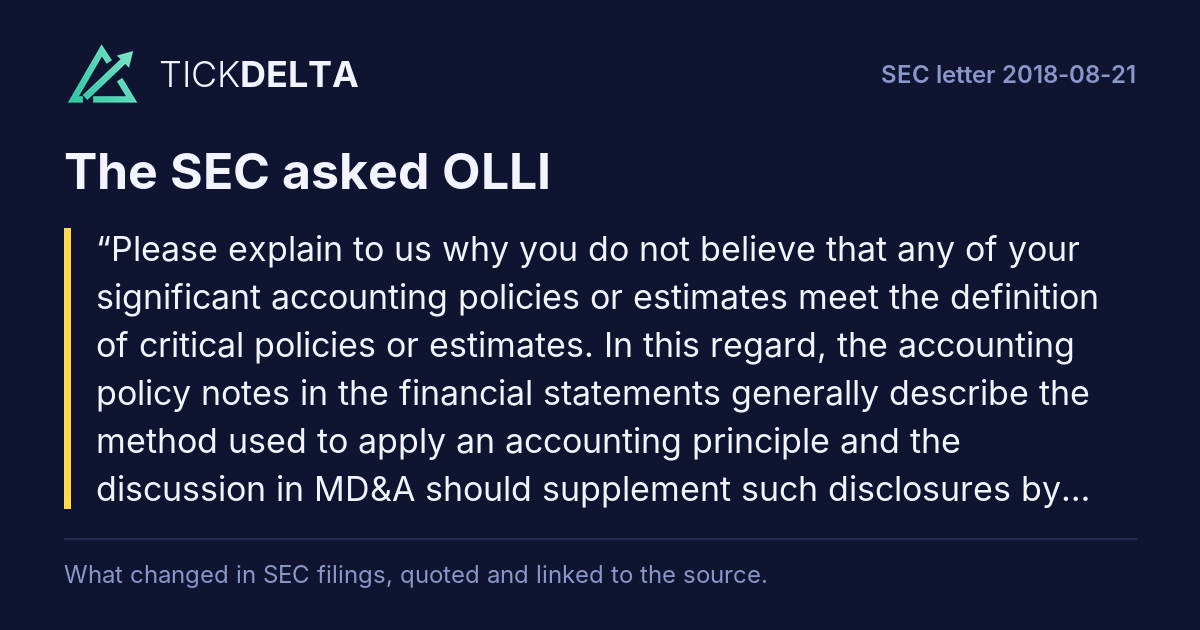
Please explain to us why you do not believe that any of your significant accounting policies or estimates meet the definition of critical policies or estimates. In this regard, the accounting policy notes in the financial statements generally describe the method used to apply an accounting principle and the discussion in MD&A should supplement such disclosures by presenting an analysis of the uncertainties involved
Rest of the question

in applying a principle at a given time and the variability that is reasonably likely to result from its application over time.

OLLI answered
Ollie’s acknowledges the Staff’s comment and respectfully submits to the Staff that it carefully reviews its significant accounting policies on an ongoing basis in line with the Staff’s guidance. In the course of its review of its Form 10-K, Ollie’s does not believe that any of its significant accounting policies or estimates meet the definition of critical accounting policies or estimates.
Rest of the answer

The Staff has indicated that a critical accounting policy is one that is “very important to the portrayal of the company’s financial condition and results, and requires management’s most difficult subjective and complex judgments” and that frequently requires “estimates about the effect of matters that are inherently uncertain” (see Speech by SEC Staff: Critical Accounting and

Critical Disclosures (January 24, 2002)) and has noted that a critical accounting estimate is “material due to the levels of subjectivity and judgment necessary to account for highly uncertain matters or the susceptibility of such matters to change” and has “a material impact on financial condition or operating performance” (see SEC Release No. 33-8350 (December 19, 2003)). The Public

Company Accounting Oversight Board defines critical accounting policies and practices and critical accounting estimates in the same manner in its Audit Standard No. 16.

Based on this guidance, Ollie’s respectfully submits to the Staff that it does not believe that its significant accounting policies and estimates for the periods presented in its Form 10-K involved the level of subjective analysis, judgment or uncertainty required to qualify as critical policies or estimates. For example, in assessing Goodwill and intangible assets, Ollie’s utilizes an assessment process with limited subjectivity that includes calculating the differential between the carrying amount of its sole reporting unit and Ollie’s market value, which has shown a market value in significant excess of carrying value.

Similarly, Stock-based compensation expense is measured taking into account (i) with respect to stock option awards, mechanical inputs tied to the Black-Scholes option pricing model and (ii) with respect to restricted stock unit awards, the closing trading value of Ollie’s stock on the grant date. Both of these factors are computable on a quantitative basis and are not linked to significant subjective assessment on the part of management, especially since Ollie’s does not utilize performance-based vesting for its equity awards.

Ollie’s respectfully advises the Staff that it will continue to assess its significant accounting policies and will, in future evaluations, continue to give consideration to accounting policies and estimates that involve a degree of management subjectivity or judgment. To the extent that future accounting policies or estimates are determined by Ollie’s to be critical accounting policies or estimates, Ollie’s will include disclosure relating to those policies or estimates in the accounting policy notes in its financial statements and in its MD&A, including by presenting an analysis of the uncertainties involved in applying a principle at a given time and the variability that is reasonably likely to result from its application over time.

Read in the reply
In its next report

First report after the company's reply of Aug 31, 2018: 10-Q filed Sep 7, 2018 ↗, against the 10-Q filed Jun 7, 2018 ↗.

Tickdelta does not hold the text of both reports, so they are not compared here.

Operations · Critical Accounting Policies and Estimates, page 39
SEC asked
We have read your response to comment 1 and are still unclear how you determined that you do not have any critical accounting policies or estimates. You previously disclosed on page 21 of your January 28, 2017 Form 10-K that, “Our operating results may be adversely affected if our assumptions change or if actual circumstances differ from those in our assumptions, which could cause our operating results to fall below
Rest of the question

the expectations of securities analysts and investors, resulting in a decline in our stock price. Significant assumptions and estimates used in preparing our consolidated financial statements include those related to inventory valuation, impairment of goodwill and intangible assets, impairment of long-lived assets, stock-based compensation expense and accounting for income taxes including deferred tax assets and liabilities.” In regards to inventory, you further disclose on page 48 of the current Form 10-K that “The retail inventory method uses estimates for shrinkage and markdowns to calculate ending inventory. These estimates made by management could significantly impact the ending inventory valuation at cost and the resulting gross margin.” Please explain to us in greater detail how you determined that each of these accounting policies do not involve estimates and assumptions that could have a material impact on your financial condition and operating performance and on the comparability of such reported information over different reporting periods. Ensure you tell us what changed from your prior year assessment and identify for us any comparable registrants that similarly do not disclose any critical accounting policies.

OLLI answered
Ollie’s acknowledges the Staff’s comment and respectfully submits to the Staff that it has carefully analyzed each of the listed accounting policies, and, in the course of its review of the periods presented in its Form 10-K, it determined that it did not have any critical accounting policies or estimates. Ollie’s notes that in the Commission’s interpretive release addressing critical accounting estimates, Release No.
Rest of the answer

33-8350 (December 19, 2003), the Commission provided that companies must consider a two part test in determining whether disclosure of critical accounting estimates is required:

· the nature of the estimates or assumptions is material due to the levels of subjectivity and judgment necessary to account for highly uncertain matters or the susceptibility of such matters to change; and the impact of the estimates and assumptions on financial condition or operating performance is material.

In its Form 10-K, Ollie’s concluded that the assumptions and estimates related to its accounting policies, as outlined below, do not involve the level of subjectivity or uncertainty required to qualify as critical accounting policies and estimates. The primary reason for the change from Ollie’s prior reporting of critical accounting policies and estimates is that Ollie’s has evolved and grown significantly since its initial public offering (“IPO”) in July 2015, with a longer period of results as a public company under its current operating model. As a result, certain assumptions and estimates relating to its accounting policies now have reduced elements of management subjectivity or uncertainty. Therefore, in its review with respect to its Form 10-K, Ollie’s eliminated its critical accounting policies and estimates for that period. Detail regarding Ollie’s evaluations are set out below. Ollie’s respectfully advises the Staff that it evaluates its critical accounting policies and estimates on an ongoing basis and that it may revise its assessment and determinations in future filings.

While Ollie’s is not aware of other comparable companies that disclose that they do not have any critical accounting policies and estimates, Ollie’s believes that the analysis of critical accounting policies and estimates is very company-specific and it is aware of other comparable companies that have reduced the number of critical accounting policies and estimates identified from year to year as their businesses changed. Ollie’s will take into consideration the practice of comparable companies in its future evaluations of its critical accounting policies and estimates and will consider future disclosure accordingly.

Below, we provide further detail regarding our evaluation of each of these prior year accounting policies.

Inventory valuation: Ollie’s inventories are stated at the lower of cost or market determined using the retail inventory method, which includes management estimates for shrinkage and inventory markdowns. Ollie’s level of shrinkage and markdowns have historically been stable and estimable with minimal variability for the periods presented in its Form 10-K. With respect to shrinkage, due to the timing of Ollie’s physical inventory counts, a large portion of the amount is known, reducing the amount that is subject to management estimates. With respect to markdowns, due to the closeout nature of Ollie’s discount retail business model, the volume of permanent markdowns was not material. For these reasons, Ollie’s concluded that inventory valuation was not currently a critical accounting policy.

Impairment of goodwill and intangible assets: Ollie’s utilized a qualitative assessment process, which does not require any estimates or assumptions, in its annual impairment testing of goodwill and intangible assets for the periods presented in its Form 10-K. This assessment involves, in addition to several other factors, calculating the differential between the carrying amount of its sole reporting unit’s goodwill and the implied fair value of that goodwill. Since Ollie’s IPO, the excess of implied fair value over the carrying value of its sole reporting unit’s goodwill has significantly increased, providing significant headroom in this assessment. Additionally, goodwill and indefinite life intangible assets were initially recorded in September 2012 as part of purchase accounting and net sales levels, the primary driver of fair value for indefinite life intangible assets within Ollie’s assessment process, have increased since Ollie’s IPO and have exceeded the original estimated net sales levels applied with purchase accounting prior to Ollie’s IPO. Finally, none of the other considerations under the qualitative assessment process indicated a potential impairment. During the periods presented in its Form 10-K, because the financial metrics on which Ollie’s assessment process is based have changed significantly since its IPO and Ollie’s has not recorded any impairment of goodwill or intangible assets or experienced any triggering events, Ollie’s concluded that impairment of goodwill and intangible assets was not currently a critical accounting policy.

Impairment of long-lived assets: If circumstances require a long-lived asset or asset group be tested for possible impairment, Ollie’s first compares undiscounted cash flows expected to be generated by that asset or asset group to its carrying value. If the carrying value of the long-lived asset or asset group is not recoverable on an undiscounted cash flow basis, impairment is recognized to the extent that the carrying value exceeds its fair value. Ollie’s operating model does not call for significant fixed asset investment at its stores and Ollie’s had high levels of cash flows over carrying values, thus, for the periods presented in its Form 10-K, none of Ollie’s long-lived assets or asset groups was required to be tested for impairment in connection with this assessment. As such, Ollie’s concluded that impairment of long-lived assets was not currently a critical accounting policy.

Revenue Recognition: Ollie’s recognizes retail sales in its stores when merchandise is sold and the customer takes possession of merchandise. Net Sales are presented net of returns and sales tax. Ollie’s provides an allowance for estimated retail merchandise returns based on historical experience, and the only related accounting estimate is the amount of estimated returns. Such amount was not material for the periods presented in Ollie’s Form 10-K and has not varied significantly. In addition, after the end of the fiscal year, Ollie’s utilizes actual merchandise return activity as part of its assessment of the allowance for estimated retail merchandise returns. Because of the limited variance and low materiality of estimated returns, Ollie’s concluded that revenue recognition was not currently a critical accounting policy.

Stock-based compensation expense: Ollie’s measures stock-based compensation expense by taking into account (i) with respect to stock option awards, mechanical inputs tied to the Black-Scholes option pricing model and (ii) with respect to restricted stock unit awards, the closing trading value of Ollie’s stock on the grant date.

The Black-Scholes mechanical inputs are as follows: (1) Risk-free rate of interest, which is obtained from external published sources; (2) Expected term, for which Ollie’s utilizes the simplified method based on the average of the vesting term and the expiration date; (3) Expected stock price volatility, for which Ollie’s utilizes the actual historical volatility for a consistent peer group of comparable companies given the relatively short historical trading period of its common stock; (4) Estimated fair value share price, which is based on the actual trading price for Ollie’s common stock; and (5) Dividend yield, for which Ollie’s has not historically paid dividends and does not intend to pay dividends in the near future. These factors are computable on a quantitative basis and are not linked to significant subjective assessment on the part of management, particularly given that Ollie’s does not, and, for the periods presented in its Form 10-K, did not, utilize performance-based vesting for its equity awards. Since Ollie’s IPO, any estimates relating to the fair value per share of Ollie’s common stock have also been eliminated. Because stock-based compensation expense is calculated without significant judgments, Ollie’s concluded that stock-based compensation was not currently a critical accounting policy.

Accounting for income taxes: Ollie’s accounts for income taxes under the asset and liability method. Deferred tax assets and liabilities are recognized for the future tax consequences attributable to differences between the financial statement carrying amounts of existing assets and liabilities and their respective tax bases and operating losses and tax credit carryforwards and are measured using enacted tax rates expected to apply to taxable income in the years in which those temporary differences are expected to be recovered or settled. Ollie’s recognizes the effect of income tax positions only if those positions are more likely than not of being sustained. Given Ollie’s significant profitability since its IPO, there were no potential exposures for valuation allowances and no related necessary estimates and Ollie’s did not maintain any uncertain tax positions for the periods presented in its Form 10-K. In addition, there are no significant judgments in Ollie’s effective tax rate assessment. Accordingly, Ollie’s concluded that accounting for income taxes was not currently a critical accounting policy.

As previously indicated to the Staff, Ollie’s will continue to assess its significant accounting policies and will, in each future evaluation, give further consideration based on the Staff’s review to its accounting policies and estimates that involve a significant degree of management subjectivity or judgment, and as a result, may include such items in its critical accounting policies and estimates in the future.

Read in the reply
In its next report

First report after the company's reply of Oct 3, 2018: 10-Q filed Dec 7, 2018 ↗, against the 10-Q filed Jun 7, 2018 ↗.

Tickdelta does not hold the text of both reports, so they are not compared here.

Operations · Critical Accounting Policies and Estimates, page 39
SEC asked
We have read your response to comment 1. Although you indicate that certain assumptions and estimates relating to your accounting policies more recently have reduced elements of management subjectivity or uncertainty, these assumptions and estimates appear susceptible to change and the resulting change(s) could materially impact your financial statements in the future.
Rest of the question

Accordingly, please revise future filings to include, at a minimum, critical accounting policies for inventory and goodwill and intangible asset impairment. We note that these items represent approximately 90% of your total assets as of fiscal year-end 2017. It appears there are accounting estimates and assumptions related to inventory valuation that are susceptible to change given the nature of your business and your exposure to general economic conditions which could have a material effect on your financial condition or operating performance. In addition to the page 48 disclosure cited in our previous comment, your risk factor disclosure on page 21 cautions investors that if higher levels of shrinkage were to occur it could have a material effect on your results of operations. In regards to impairment testing, there are numerous assumptions, events and circumstances that are susceptible to change. Examples of such events and circumstances include macroeconomic conditions, access to capital markets, adverse changes in equity or credit markets, changes in the market for your products, cost or expense factors that could negatively impact your earnings and cash flows, companyspecific events, or a sustained decline in your market capitalization.

OLLI answered
Ollie’s acknowledges the Staff’s comment and respectfully submits to the Staff that it will revise its future Form 10-K filings to include, at minimum, disclosure of critical accounting policies for inventory and goodwill and intangible asset impairment.
Read in the reply
In its next report

First report after the company's reply of Oct 18, 2018: 10-Q filed Dec 7, 2018 ↗, against the 10-Q filed Jun 7, 2018 ↗.

Tickdelta does not hold the text of both reports, so they are not compared here.

Also in this review: closing letter, 2018-10-22

Form Schedule

2017-06-12 to 2017-06-14 · 1 question · 1 letter from the SEC, 1 from the company
No closing letter
Executive pay
Elements of Our Executive Compensation and Benefits Programs · Long-Term Equity Incentive Compensation, page 16
SEC asked
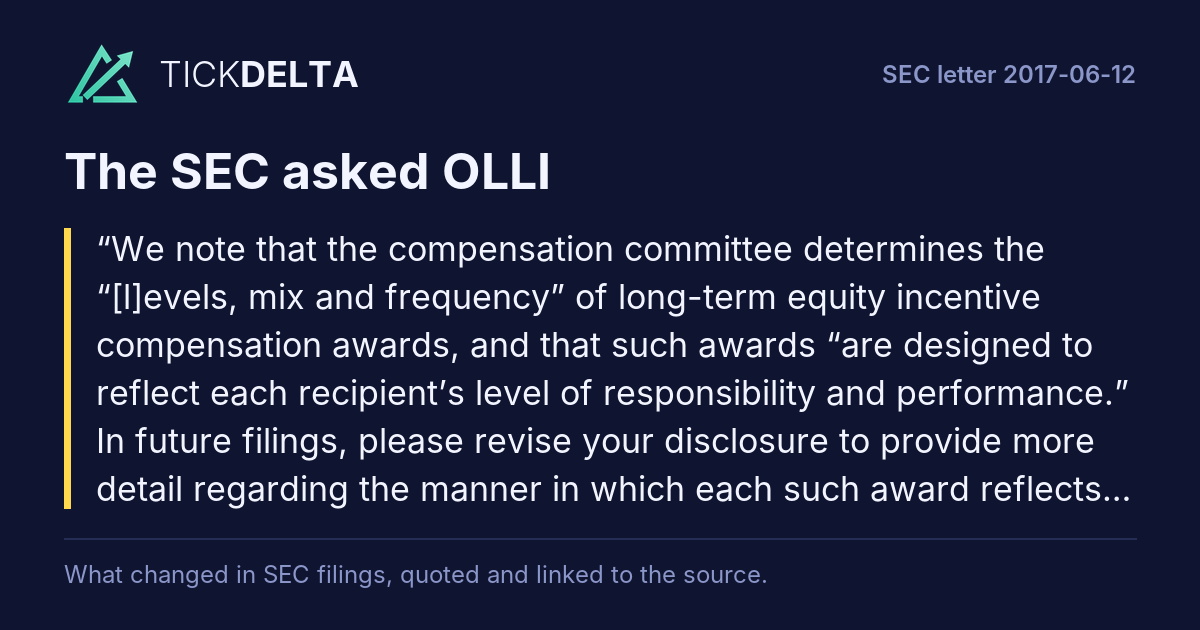
We note that the compensation committee determines the “[l]evels, mix and frequency” of long-term equity incentive compensation awards, and that such awards “are designed to reflect each recipient’s level of responsibility and performance.” In future filings, please revise your disclosure to provide more detail regarding the manner in which each such award reflects the recipient’s “level of responsibility and
Rest of the question

performance.” Refer to Item 402(b)(1)(v) of Regulation S-K.

OLLI answered
The Company acknowledges the Staff’s comment and respectfully advises the Staff that in future filings, it will revise its disclosure to provide additional disclosure regarding the manner in which the Company’s long-term equity compensation awards reflects the recipient’s “level of responsibility and performance” including how the Company determines the amount and/or formula, as applicable, for such awards as required by Item 402(b)(1)(v) of Regulation S-K.

Should any questions arise in connection with the filing or the substance of this response letter, please contact the undersigned at
Rest of the answer

717-657-2300 ext. 2224 or Robert Bertram, Vice President and General Counsel, at 717-657-2300 ext. 2177.

Read in the reply

Form 8-K

2016-09-22 to 2016-10-17 · 2 questions · 1 letter from the SEC, 1 from the company
Review closed 2016-10-17
Non-GAAP measures
Exhibit 99.1 · Supplemental Information, page 8
SEC asked (1)
In your next earnings release, please provide a more substantive, and concise, discussion of how each of your non-GAAP measures is useful to investors. Please provide us with your proposed changes in your response letter.
OLLI answered
The Company respectfully acknowledges the Staff’s comment. In its next earnings release, the Company proposes to include disclosure of how each of its non-GAAP measures is useful to investors, comparable to the following:

The Company reports its financial results in accordance with U.S. generally accepted accounting principles ("GAAP").
Rest of the answer

We have included the non-GAAP measures of Adjusted operating income, EBITDA, Adjusted EBITDA, Adjusted net income and Adjusted net income per diluted share in this press release as these are key measures used by our management and our board of directors to evaluate our operating performance and the effectiveness of our business strategies, make budgeting decisions, and evaluate compensation decisions. Management believes it is useful to investors and analysts to evaluate these non-GAAP measures on the same basis as management uses to evaluate the Company’s operating results. We believe that excluding items that may not be indicative of, or are unrelated to, our core operating results, and that may vary in frequency or magnitude, from Operating income, Net income and Net income per diluted share, enhances the comparability of our results and provides a better baseline for analyzing trends in our business.

The tables below reconcile the non-GAAP financial measures of Adjusted operating income to Operating income, Adjusted net income to Net income, Adjusted net income per diluted share to Net income per diluted share, and EBITDA and Adjusted EBITDA to Net income, in each case the most directly comparable GAAP measure.

Adjusted net income and Adjusted net income per diluted share give effect, net of tax, to transaction related expenses and loss on extinguishment of debt, which may not occur with the same frequency or magnitude in future periods. Adjusted operating income also gives effect to transaction related expenses. We define EBITDA as net income before net interest expense, loss on extinguishment of debt, depreciation and amortization expenses and income taxes. Adjusted EBITDA represents EBITDA as further adjusted for non-cash stock based compensation expense, non-cash purchase accounting items, transaction related expenses and debt financing expenses, which we do not consider representative of our ongoing operating performance.

Non-GAAP financial measures should be viewed as supplementing, and not as an alternative or substitute for, the Company’s financial results prepared in accordance with GAAP. Certain of the items that may be excluded or included in non-GAAP financial measures may be significant items that could impact the Company's financial position, results of operations and cash flows and should therefore be considered in assessing the Company's actual financial condition and performance. The methods used by the Company to calculate its non-GAAP financial measures may differ significantly from methods used by other companies to compute similar measures. As a result, any non-GAAP financial measures presented herein may not be comparable to similar measures provided by other companies.

Read in the reply
Reconciliation of Net Income to EBITDA and Adjusted EBITDA, page 9
SEC asked (2)
We note that you exclude pre-opening expenses from your non-GAAP measure Adjusted EBITDA. Please explain to us why these are not normal, recurring, cash operating expenses necessary to operate your business. See Question 100.01 of the updated Non- GAAP Compliance and Disclosure Interpretations issued on May 17, 2016.
OLLI answered
The Company respectfully acknowledges the Staff’s comment.

While the Company believes that excluding pre-opening expenses from Adjusted EBITDA has provided investors and analysts with useful information, due to potential material fluctuation in the amounts between periods presented, in future filings, the Company intends to eliminate pre-opening expenses from its calculation and reconciliation of Adjusted EBITDA.

We acknowledge that:

● the Company is responsible for the adequacy and accuracy of the disclosure in the filing;

staff comments or changes to disclosure in response to staff
Rest of the answer

comments do not foreclose the Commission from taking any action with respect to the filing; and the Company may not assert staff comments as a defense in any proceeding initiated by the Commission or any person under the federal securities laws of the United States.

Should any questions arise in connection with the filing or this response letter, please contact the undersigned at (212) 310-8048.

Read in the reply

Also in this review: closing letter, 2016-10-17

Form S-1

2016-05-26 to 2016-05-26 · 2 questions · 1 letter from the SEC, 0 from the company
No closing letter
SEC letter of May 26, 2016 ↗ no reply letter on EDGAR (the company may have answered in an amended filing)
Incorporation of Documents by Reference, page 73
SEC asked (1)
We note that your registration statement incorporates by reference your Form 10-K for the fiscal year ended January 30, 2016, which in turn incorporates by reference Part III information from a proxy statement which you filed on May 2, 2016. Prior to seeking effectiveness, please amend your registration statement to incorporate by reference your proxy statement.
OLLI answered

No reply letter found.

Exhibits, page II-3
SEC asked (2)
Please file all required exhibits, including the legal opinion, as promptly as possible. We will review the exhibits prior to granting effectiveness of the registration statement and may have further comments after our review.
OLLI answered

No reply letter found.

Form S-1

2015-05-15 to 2015-07-08 · 46 questions · 4 letters from the SEC, 4 from the company
No closing letter
Results discussion (MD&A)Liquidity and cashRevenueNon-GAAP measuresDebtAcquisitionsCritical estimatesInventoryGoodwill and impairmentRisk factorsSegmentsLegal and contingenciesReserves and insurance
SEC letter of May 15, 2015 ↗ no reply letter on EDGAR (the company may have answered in an amended filing)
General
SEC asked (1)
Please supplementally provide us with copies of all written communications, as defined in Rule 405 under the Securities Act, that you, or anyone authorized to do so on your behalf, present to potential investors in reliance on Section 5(d) of the Securities Act, whether or not they retain copies of the communications.
OLLI answered

No reply letter found.

General
SEC asked (2)
We note references in this section and throughout your prospectus to third-party sources for statistical, qualitative and comparative statements contained in your prospectus. For example, we note your references to research from Jeff Green Partners. Please provide copies of these source materials to us, appropriately marked to highlight the sections relied upon and cross-referenced to your prospectus.
Rest of the question

Please also tell us whether these reports and articles are publicly available without cost or at a nominal expense to investors and whether you commissioned any of the referenced sources.

OLLI answered

No reply letter found.

Summary · Our company, page 1
SEC asked (3)
In the second paragraph of this section, your disclosures suggest that your financial performance is not impacted by the economic environment. However, we note from your disclosures elsewhere, such as in your risk factors, that changing economic conditions can materially affect your performance.
Rest of the question

You also state that increased consumer spending related to lower gasoline prices contributed to an increase comparable store sales on page 52. Please revise your disclosures to explain consistently how, if at all, the historical and present economic environment has affected your operations.

OLLI answered

No reply letter found.

Summary · Our company, page 1
SEC asked (4)
Please explain why you “believe 100% of [y]our stores have generated positive four-wall EBITDA on a trailing 12-month basis” (emphasis added) when this data should be quantifiable.
OLLI answered

No reply letter found.

Summary · Our company, page 1
SEC asked (5)
We note the graphs on page 2 presenting five year CAGR for total stores, net sales and Adjusted EBITDA. We have the following comments concerning your presentation of fiscal year 2012:  We note the reconciliation of Adjusted EBITDA to net income on page 13.
Rest of the question

Please confirm our assumption, if true, that the adjustments to EBITDA remove all items related to the CCMP Acquisition which would cause the predecessor and successor periods of 2012 not to be comparable.  We note that you adjusted 2012 to eliminate the impact of the five week period ended February 2, 2013 and to reflect a 52 week period. Please explain to us why it is meaningful to present a fiscal year ending on December 29, 2012 after you changed your fiscal year end to the Saturday closest to January 31. It appears that you should instead present the 52 week period ending on February 2, 2013. Please advise or revise.

OLLI answered

No reply letter found.

Our competitive strengths · Strong and consistent store model built for growth, page 3
SEC asked (6)
We note a target cash-on-cash return of 55% in the first 12 months of store operations. Please disclose whether your new stores have achieved this target in the past and disclose the periods, if any, in which this target has been achieved.
OLLI answered

No reply letter found.

Summary historical consolidated financial and other data, page 10
SEC asked (7)
We note you intend to present pro forma as adjusted earnings per share which will give effect to the Stock Split, your sale of common stock in this offering and the expected use of proceeds. Please note that your presentation of pro forma earnings per share should comply with Article 11 of Regulation S-X.
Rest of the question

In doing so, the denominator used in computing pro forma earnings per share should include only those common shares whose proceeds are reflected in pro forma adjustments to the income statement. Since your Use of Proceeds disclosures indicate you intend to use a portion of the net proceeds for working capital and general corporate purposes, and these uses will not create pro forma adjustments to the income statement, the shares whose proceeds are used for these purposes should not be included in your calculation of pro forma earnings per share. However, we will not object if you wish to present additional earnings per share data reflecting the issuance of all shares in this offering if you consider this information meaningful. If you choose to present this additional earnings per share data, it should be presented in addition to the pro forma earnings per share data described above and should be labeled appropriately so that it does not imply this is pro forma earnings per share as that term is defined in Article 11 of Regulation S-X.

OLLI answered

No reply letter found.

Summary historical consolidated financial and other data, page 10
SEC asked (8)
Please revise footnote (3) to include disclosure that clearly shows the calculation of pro forma earnings per share and, if applicable, additional earnings per share for each period presented. In this regard, please ensure the revised disclosure explains all of the adjustments to compute the numerator and the denominator of the earnings per share data consistent with the pro forma footnote requirements of Rule
Rest of the question

11-02(b)(6) of Regulation S- X. Tabular disclosure of these adjustments may provide ease of understanding for your investors.

OLLI answered

No reply letter found.

Summary historical consolidated financial and other data, page 10
SEC asked (9)
We note you are using Adjusted EBITDA to assess operating performance of the Company. Please provide us with your analysis of whether you also are using this measure to assess liquidity. In this regard, we that you use this measure for the preparation of your internal annual operating budget and to assess compliance with various metrics associated with your Senior Secured Credit Facilities.
OLLI answered

No reply letter found.

Summary historical consolidated financial and other data, page 10
SEC asked (10)
You indicate in footnote (4) that Adjusted EBITDA provides additional information to investors about certain material non-cash items and about unusual items that you do not expect to continue at the same level in the future. Please tell us the “unusual items” that are excluded from Adjusted EBTIDA. Please also describe to us the nature of these amounts and your basis for determining that such items are unusual.
Rest of the question

In this regard, note that pursuant to Item 10(e)(1)(ii)(B) of Regulation S-K, you should not adjust a non- GAAP performance measure to eliminate or smooth items identified as non-recurring or unusual, when the nature of the charge or gain is such that it is reasonably likely to recur within two years or there was a similar charge or gain within the prior two years. The fact that you expect the amount of the charge or gain to vary from year to year does not warrant description of the item as unusual. If you believe that you have appropriately described certain adjusting items as “unusual,” please also revise your disclosure to explain to your investors which items are unusual and why you believe they are unusual.

OLLI answered

No reply letter found.

Use of proceeds, page 38
SEC asked (11)
We note you intend to use a portion of the net proceeds from this offering to repay some of the principal amount of your outstanding debt. When you determine the amount of debt to be repaid, please separately quantify the amount of proceeds that will be used to repay the principal amount of your debt and the amount of proceeds that will be used to pay any accrued interest or debt repayment fees such that your
Rest of the question

disclosure explains all cash payments related to this anticipated repayment of debt.

OLLI answered

No reply letter found.

Dilution, page 41
SEC asked (12)
Please quantify the amount of aggregate pro forma net tangible book value as of January 31, 2015. In this regard, while your stock split will change the number of shares outstanding and therefore the per share amount, it will not change the aggregate amount of your total stockholders’ equity.
OLLI answered

No reply letter found.

Management’s discussion and analysis of financial condition and results of operations, page 46
SEC asked (13)
We note your acknowledgement on page 16 that competitor consolidation may adversely affect your operations. Please provide management’s analysis of any known industry trends or uncertainties that may affect your operating results.
OLLI answered

No reply letter found.

Overview, page 46
SEC asked (14)
We note your statements highlighting “rapid growth and strong and consistent store performance.” We further note that more than 75% of the growth in net sales came from new store sales, which average $3.9 million in net sales during the first 12 months.
Rest of the question

Please provide more details regarding the historical performance of comparable store sales with a view to supporting your statements regarding their “strong and consistent” performance.

OLLI answered

No reply letter found.

How we assess the performance of our business · Comparable store sales, page 48
SEC asked (15)
We note the disclosure of certain performance metrics for new stores in their first one and two years of operations. Please provide a similar discussion of comparable store performance, such as average net sales, target estimates and adjusted EBITDA.
OLLI answered

No reply letter found.

Fiscal year 2014 compared to fiscal year 2013 · Net Sales, page 52
SEC asked (16)
You state, “The increase in comparable store sales was primarily driven by strong deals in food and other categories, including automotive, pets and personal health care, as well as increased consumer spending related to lower gasoline prices.” Tell us whether changes in your product mix, either between major categories of products or between brand name goods and private label brands, had a material impact on the
Rest of the question

number of transactions, overall sales trends and gross margins. If so, please revise your analysis of results to explain this impact in reasonable detail to your investors. Also, please disclose more detail about the material factors contributing to the increase in comparable store sales, such as any changes in selling prices, volumes and promotional activity. Refer to Item 303(a) of Regulation S-K and the Commission Guidance Regarding Management’s Discussion and Analysis of Financial Condition and Results of Operations, Release No. 33-8350.

OLLI answered

No reply letter found.

Selling, general and administrative expenses, page 52
SEC asked (17)
We note your statement that the increase in selling, general and administrative (SG&A) expense was primarily the result of increases in store-related expenses to support new store growth. Please elaborate on this explanation, including quantifying the increase in SG&A expense related to new store growth.
Rest of the question

Given your statement that a significant portion of your SG&A expenses are fixed, please tell us how you considered discussing changes in any fixed expenses that comprise SG&A expense, and revise to describe the underlying causes for any significant changes in your fixed expenses. Please refer to the Commission Guidance Regarding Management’s Discussion and Analysis of Financial Condition and Results of Operations, Release No. 33-8350.

OLLI answered

No reply letter found.

Critical accounting policies and estimates, page 57
SEC asked (18)
Please note that the accounting policy notes in the financial statements should generally describe the method you use to apply an accounting principle; whereas the discussion under this heading should present your analysis of the uncertainties involved in applying a principle at a given time or the variability that is reasonably likely to result from its application over time to the extent such uncertainty or
Rest of the question

variability could have a material impact on your financial statements. Please include an analysis, to the extent material, of factors such as how you arrived at critical estimates, how accurate the estimate has been in the past, how much the estimate has changed in the past and whether the estimate is reasonably likely to change in the future. In addition, your disclosure should address sensitivity of the estimate to change based on other outcomes that are reasonably likely to occur and would have a material effect. For example, if reasonably likely changes in markdowns used in accounting for your inventory would have a material effect on your financial condition or results of operations, the impact that could result given the range of reasonable outcomes should be disclosed and quantified. Please refer to the Commission Guidance Regarding Management’s Discussion and Analysis of Financial Condition and Results of Operations, Release No. 33-8350.

OLLI answered

No reply letter found.

Executive committee, page 80
SEC asked (19)
Please provide a description of the roles and responsibilities assigned to the Executive Committee.
OLLI answered

No reply letter found.

Certain relationships and related party transactions · Other transactions, page 94
SEC asked (20)
Please disclose the approximate dollar value of Mr. Butler’s interest in the corporate sponsorship relationship.
OLLI answered

No reply letter found.

Financial Statements for the Fiscal Year Ended January 31, 2015
SEC asked (21)
We note from page 9 that the stock split of your common stock is to be effected prior to the completion of this offering. Please tell us whether the stock split will be effected prior to your request for effectiveness of this Form S-1. If so, please confirm that you will give retroactive effect to the stock split in your financial statements, earnings per share, and related disclosures throughout this filing.
Rest of the question

Refer to the guidance in SAB Topic 4.C and ASC 260-10-55-12.

OLLI answered

No reply letter found.

Consolidated statements of income, page F-4
SEC asked (22)
Based on the description of cost of sales in Note 1, it appears that no depreciation and amortization expenses have been allocated to cost of sales. Please tell us your consideration of SAB Topic 11.B.
OLLI answered

No reply letter found.

Consolidated statements of income, page F-4
SEC asked (23)
We note the disclosure in Note 5 and Note 8 indicating that you paid a dividend in fiscal 2014 which exceeded earnings for that year. To comply with SAB Topic 1.B.3, please present pro forma earnings per share calculated in accordance with the SAB on the face of your income statement.
Rest of the question

Additionally, please explain the calculation of this pro forma measure in a prominent location within the footnotes to your financial statements. (1) Organization and summary of significant accounting policies, page F-7

OLLI answered

No reply letter found.

Consolidated statements of income, page F-4
SEC asked (24)
You disclose on page 3 that over 55% of your sales in fiscal year 2014 were from Ollie’s Army members. We also note from your website that members receive one point for every dollar they spend and for every 250 points earned you send a certificate for 10% off one purchase.
Rest of the question

Please tell us how you account for reward certificates you issue to members under this rewards program and reference for us the authoritative literature you relied upon to support your accounting. Lastly, tell us why an accounting policy is not warranted for the rewards program, including a quantified assessment of the materiality of your Ollie’s Army reward program.

OLLI answered

No reply letter found.

Consolidated statements of income, page F-4
SEC asked (25)
Please disclose revenues for each group of similar products unless it is impracticable to do. If providing the information is impracticable, please disclose that fact. Please refer to ASC 280-10-50-40. (m) Revenue recognition, page F-10
OLLI answered

No reply letter found.

Consolidated statements of income, page F-4
SEC asked (26)
Please tell us the amounts of your provisions for sales returns and the allowances for sales returns for each year presented. If material, please disclose the information prescribed by Rule 12-09 of Regulation S-X in Schedule II -Valuation and Qualifying Accounts or in the notes to the financial statements. See Rule 5-04 of Regulation S-X. (t) Self-insurance liabilities, page F-12
OLLI answered

No reply letter found.

Consolidated statements of income, page F-4
SEC asked (27)
We note your disclosure that you are self-insured for certain losses related to the Company sponsored employee health insurance program and you estimate the accrued liabilities for your self-insurance programs using historical claims experience and loss reserves.
Rest of the question

Please tell us whether your accruals include losses from incurred but not reported claims and incidents when the loss is both probable and reasonably estimable, and revise your disclosure to disclose your accounting policy for such claims. Refer to ASC 450-20-25-2 and ASC 720-20-25-14. Also tell us how you considered disclosing the amount of loss at which your stop-loss coverage begins to assist your investors in better understanding the maximum potential exposure resulting from your self-insurance. (3) Goodwill and other intangible assets, page F-14

OLLI answered

No reply letter found.

Consolidated statements of income, page F-4
SEC asked (28)
We note that goodwill and other intangible assets comprise approximately 74% of your total assets as of January 31, 2015 and 77% of your total assets as of February 1, 2014. Given the materiality of these accounts, we have the following comments:  We assume that all of the goodwill and tradename assets were recorded in connection with the fiscal year 2012 CCMP acquisition.
Rest of the question

Please confirm our assumption, or if our assumption is incorrect, please explain this matter to us in detail.  To assist us in understanding the material balances recorded for these assets, please provide us in your response with all of the information related to the CCMP acquisition that you would have been required to disclose in your financial statements if the acquisition had occurred during a current reporting period, including but not limited to the purchase price allocation and a reasonably detailed qualitative description of the factors that make up the goodwill recognized. Additionally, please briefly explain to us how each of the major categories of tangible assets, other intangible assets and liabilities were valued to better explain how you determined the residual related to goodwill.  We note that your tradename asset is indefinite lived. Please provide us with your reasonably detailed analysis of the criteria specified in ASC 350-30-35-3 to explain to us how you determined this asset has an indefinite life. (5) Debt obligations and financing arrangements, page F-15

OLLI answered

No reply letter found.

Consolidated statements of income, page F-4
SEC asked (29)
We note the Credit Facility and Amended Term Loan include restrictions on dividend payments and your disclosure elsewhere in the filing indicating that such restrictions may limit the ability of your subsidiaries to pay dividends. As such, it appears that you should provide the disclosures required by Rule 4-08(e)(3) of Regulation S-X.
Rest of the question

Please tell us the restricted net assets of consolidated subsidiaries and, if applicable, describe the nature of the restrictions on the ability of your subsidiary to transfer funds to you in the form of dividends, loans or advances in more detail and disclose the amount of retained earnings or net income restricted or free of restrictions. Refer to Rule 4-08(e)(3) of Regulation S- X. Also tell us how you considered the applicability of Schedule I.

OLLI answered

No reply letter found.

Item 17. Undertakings
SEC asked (30)
Please revise to provide the undertakings required by Item 512(a)(6) of Regulation S-K.
OLLI answered

No reply letter found.

Power of attorney, page II-6
SEC asked (31)
Please revise to indicate that Mr. Butler signs in his capacity as a Director or Chairman of the Board, in addition to his capacity as President and Chief Executive Officer.
OLLI answered

No reply letter found.

Capitalization, page 41
SEC asked (1)
We note that during the Recapitalization you borrowed $50.0 million under your Revolving Credit Facility and used $48.8 million of the proceeds to pay a cash dividend to your stockholders. Please tell us how you used the remaining $1.2 million of proceeds from your borrowing, and revise footnote 2 to clarify this matter to your investors.
OLLI answered
This letter relates to the Registration Statement on Form S-1 (Registration No. 333-204942) (the “Registration Statement”) of Ollie’s Bargain Outlet Holdings, Inc., a Delaware corporation (the “Company”). To assist the Staff in its evaluation of stock compensation disclosures and certain other matters, the Company confidentially advises the Staff that the Company currently estimates a preliminary price range of $13.00 to $15.00 per share (the “Price Range”) for the initial public offering (the “IPO”) of 8,925,000 shares of the Company’s common stock (or 10,263,750 shares of the Company’s common stock if the underwriters exercise their option to purchase additional shares in full), resulting
Rest of the letter

in a midpoint of the Price Range of $14.00 per share. The Company expects to include the Price Range in a pre-effective amendment to the Registration Statement that would shortly precede the commencement of the Company’s road show process and the distribution of any preliminary prospectus relating to the IPO. We have attached pages of the Registration Statement that reflect revisions based on the Price Range. We are providing this information to you supplementally to facilitate your review process. The Price Range has been estimated based, in part, upon current market conditions and input received from J.P. Morgan Securities LLC, Jefferies LLC and Merrill Lynch, Pierce, Fenner & Smith Incorporated (the “Lead Underwriters”), including discussions that took place on June 26, 2015 between senior management of the Company, members of the board of directors of the Company, and representatives of the Lead Underwriters. The Price Range does not take into account the current lack of liquidity for the Company’s common stock and assumes a successful IPO with no weighting attributed to any other outcome for the Company’s business, such as remaining a privately held company or being sold in an acquisition transaction. As is typical for initial public offerings, the Price Range was not derived using a formal determination of fair value, but was determined as a result of discussions among representatives of the Company’s management, board of directors, and the Lead Underwriters. During those discussions, the parties considered quantitative factors, as well as qualitative factors, such as the valuations of recently completed public offerings, the current valuations of public companies similar to the Company, similarities and differences between the Company and those companies, and recent market conditions. In response to the Staff’s comment number 7 in its letter dated June 17, 2015, the Company respectfully advises the Staff that assuming the midpoint of the Price Range of $14.00 per share, the Company calculated the impact of the incremental shares related to the dividends it declared in excess of earnings as set forth in Schedule I hereto. The Company respectfully advises the Staff that it has presented the pro forma earnings per share to comply with SAB Topic 1.B.3 on the face of its income statement for the most recent fiscal year and interim period. In addition, the company has added disclosure to explain the calculation of the pro forma earnings per share in the footnotes to its financial statements. Please see the attached pages F-4, F-14, F-15, F-29 and F-34. In addition, reference is also made to the Staff’s oral comment to the Company on June 30, 2015. The Company respectfully advises the Staff that it has revised its disclosure related to increases in comparable store sales on pages 56 and 57 of the Registration Statement (such pages supplementally provided herewith) in response to the Staff’s comment. Should any questions arise in connection with the filing or this letter, please contact the undersigned at (212) 310-8971.

One letter for all the questions, without numbered answers. Read the reply
Selected historical consolidated financial data, page 45
SEC asked (2)
You disclose in the last sentence of the first paragraph under this heading that you derived your consolidated balance sheet data as of May 2, 2015 and May 3, 2014 from your unaudited condensed consolidated financial statements included elsewhere in this prospectus.
Rest of the question

This statement appears partially incorrect since you neither present balance sheet data as of May 3, 2014 within your selected financial data nor include a balance sheet as of May 3, 2014 within your unaudited condensed consolidated financial statements included elsewhere in this filing. Please advise or revise.

OLLI answered

See the reply above.

Management’s discussion and analysis of financial condition and results of operations · Overview, page 48
SEC asked (3)
We have reviewed your response to comment 14. While we understand your focus is on revenue and profitability growth via expansion, we note that comparable store sales accounts for more than 80% of sales in 2014. Please include additional disclosures with respect to targets, goals, plans to drive sales and manage expenses, and other relevant discussions with similar specificity as provided for non-comparable stores.
OLLI answered

See the reply above.

First quarter 2015 compared to first quarter 2014 · Net Sales, page 55
SEC asked (4)
We note your reference to “strong deals” within your analysis of the increase in comparable store sales in both your year-end and interim analysis of results and have the following comments:  If you significantly increased your promotional activity during these periods resulting in lower sales prices for your products, and if this had a significant impact on your revenue, please clearly disclose this.
Rest of the question

 If your total promotional activity was consistent from period to period, but the merchandise categories varied that were being promoted, disclosure may be necessary to the extent that merchandise categories with unusually high or low gross margins were promoted in different periods and this change in product mix from one period to the next impacted your consolidated gross margin.  Additionally, please consider better explaining the timeframe during which any significant promotions occurred to provide your investors with greater insight into the extent to which increases in your revenue were dependent upon a significant level of promotional activity and the likelihood that you will be able to provide similar levels of promotional activity in the future. If you depend on frequent promotional activity to drive traffic to your stores, you should better describe your reliance on frequent promotional activity, how this frequent promotional activity impacts the prices at which you sell your goods and the volume of goods sold to clarify the net impact on your revenue, and management’s plans for continuing a similar level of promotional activity in the future.

OLLI answered

See the reply above.

First quarter 2015 compared to first quarter 2014 · Net Sales, page 55
SEC asked (5)
As previously requested, please disclose more detail about the underlying material factors contributing to the increases in comparable store sales in both your year-end and interim results discussions, such as any changes in selling prices, volumes or the introduction or discontinuance of popular products that had a significant impact on your revenue. Refer to Item 303(a)(3)(iii) of Regulation S-K.
Rest of the question

In this regard, your current disclosures such as stating that comparable store sales increase primarily due to “strong deals in electronics, pets and clothing” do not provide enough insight into the underlying factors that drove the increase in comparable store sales that investors can assess the likelihood that past results are indicative of future results. To the extent that multiple offsetting factors influenced your comparable store sales, you should discuss the impact of each significant factor. For example, if “strong deals” indicates that you lowered average prices through increased promotional activity, this would appear to decrease revenue; however, these lower prices may have been more than offset by higher volumes of products being sold. In this case, both the decrease in pricing and the increase in volume should be described.

OLLI answered

See the reply above.

Critical accounting policies and estimates, page 63
SEC asked (6)
Refer to comment 18. To assist us in understanding your disclosures regarding inventories, please respond to the following comments:  Please tell us in detail how accurate your permanent markdown estimates have been and what impact permanent markdowns had on your results of operations for the historical financial statement periods presented.
Rest of the question

 Also, tell us how many times your inventory turned over for each period presented in your financial statements.

OLLI answered

See the reply above.

Consolidated statements of income, page F-4
SEC asked (7)
Refer to comment 23. After you determine the pricing of your offering please show us how you are calculating the incremental shares related to the dividends you declared that were in excess of earnings. Please show us your calculations for both the interim and annual periods presented. (1) Organization and summary of significant accounting policies, page F-7
OLLI answered

See the reply above.

Consolidated statements of income, page F-4
SEC asked (8)
Refer to comment 24. Please either disclose an accounting policy for the Ollie’s Army rewards program or provide us with a quantified assessment demonstrating the immateriality of your reward program to your historical financial statements for each period presented.
Rest of the question

Unless the impact of the rewards program is clearly immaterial to your financial statements, please explain to us in further detail how you considered recording a balance sheet liability as points are earned that represents management’s best estimate of the cost of points earned that are expected to be redeemed in the future, and also tell us whether the cost of the loyalty program is recorded as an expense or a reduction of revenue. If an accounting policy is appropriate, please consider quantifying within a footnote the impact of your rewards program on your income statement and tell us how you considered analyzing changes in the income statement impact of your rewards program as part of your analysis of results of operations within MD&A. (5) Debt obligations and financing arrangements, page F-16

OLLI answered

See the reply above.

Consolidated statements of income, page F-4
SEC asked (9)
Refer to comment 29. Since your Amended Term Loan and the Credit Facility restricts all of the net assets of the Company’s consolidated subsidiaries, you meet the criteria in Rule 5-04 of Regulation S-X to provide Schedule I as prescribed by Rule 12-04 of Regulation S-X. Accordingly, please revise to include Schedule I.
OLLI answered

See the reply above.

Dilution, page 43
SEC asked (1)
You state that if the underwriters were to fully exercise their option to purchase additional shares, the dilution in net tangible book value per share to new investors in this offering would be $11.04. Please provide us with your calculation supporting the dilution per share amount of $11.04.
OLLI answered
The Company acknowledges the Staff’s comment and respectfully advises the Staff that it has revised its disclosure to reflect the dilution in net tangible book value (deficit) per share of $(16.96) if the underwriters were to fully exercise their option to purchase additional shares. The Company calculated the dilution in net tangible book value (deficit) of $(16.96) per share by adding the pro forma as adjusted net tangible book value (deficit), assuming that the underwriters fully exercise their option to purchase additional shares, of $(2.96) to the assumed initial public offering price of
Rest of the answer

$14.00 per share, the midpoint of the price range set forth on the cover page of the prospectus.

Please see page 43 for the revised disclosure.

Read in the reply
Dilution, page 43
SEC asked (2)
You state that if the offering price were to increase or decrease by $1.00, the pro forma as adjusted net tangible book value per share and the dilution in net tangible book value per share to new investors in this offering would each change by $0.38. Please provide us with your calculations supporting this change of $0.38.
OLLI answered
Company acknowledges the Staff’s comment respectfully advises the Staff that it has revised its disclosure to reflect a change of $0.15 in the pro forma as adjusted net tangible book value per share and the dilution in net tangible book value per share if the offering price were to increase or decrease by $1.00.
Rest of the answer

Please see page 43 for the revised disclosure.

The Company calculated the change in net tangible book value per share and the dilution in net tangible book value per share upon such increase in offering price as set forth below:

Number of shares in offering

8,925,000

Increase in price per share assumed

$

1.00

Gross additional proceeds

Less Commissions

(602,438

Read in the reply
Dilution, page 43
SEC asked (3)
We note the table at the top of page 44 presenting the cash consideration paid to you by the existing shareholders and by the new investors. We have the following comments:  Please provide us with your calculations supporting total effective cash consideration paid by your existing shareholders of $416,352,000.
Rest of the question

 Please revise the amount of cash effectively contributed by purchasers in this offering to reflect the gross proceeds of $124.95 million or tell us why you believe it is appropriate to present net proceeds.

OLLI answered
The Company acknowledges the Staff’s comment and respectfully advises the Staff that its calculations supporting the total effective cash consideration paid by its existing shareholders is as set forth below:

Cash consideration received from sale of 53,203,140 shares in September 2012

462,636,000

Cash paid for repurchase of 4,999,625 shares in fiscal year 2013

(46,198,000

Cash paid for repurchase of 2,875 shares in fiscal year 2014

(29,000

Cash paid for repurchase of 5,750 shares in first quarter of fiscal year 2015

(57,000

Total cash consideration

416,352,000

Please revise the
Rest of the answer

amount of cash effectively contributed by purchasers in this offering to reflect the gross proceeds of $124.95 million or tell us why you believe it is appropriate to present net proceeds.

The Company acknowledges the Staff’s comment and has revised its disclosure on page 44 in response to the Staff’s comment to reflect the gross proceeds of $124,950,000.

Read in the reply
Financial Statements for the Fiscal Year Ended January 31, 2015
SEC asked (4)
We note your calculation of pro forma EPS on the face of your statement of income, and we note the related disclosures in footnote 1(aa). It is unclear to us how the guidance in SAB Topic 1:B3 supports adjusting the numerator and denominator of your EPS calculation for your intended use of proceeds such that you would reflect adjustments for reduced interest expense and for the number of shares whose proceeds could
Rest of the question

be used to repay debt. Instead, SAB Topic 1:B3 solely appears to contemplate a calculation of EPS in which the denominator is adjusted for the number of shares whose proceeds would be necessary to pay the excess amount of your dividends. Please advise or revise. Please also apply this comment to the similar calculation of pro forma EPS on the face of your interim statement of income.

OLLI answered
acknowledges the Staff’s comment and respectfully advises the Staff that it has revised its pro forma EPS calculation accordingly. The revised pro forma EPS calculation does not reflect adjustments for reduced interest expense and for the number of shares whose proceeds could be used to repay debt. Accordingly, the net income for pro forma EPS calculation is $26.9 million for the fiscal year ended January 31, 2015 and $6.7 million for the 13 weeks ended May 2, 2015, in each case as reflected on the Company’s consolidated statements of income for such period.
Rest of the answer

The Company has revised its disclosure on pages F-14 and F-34 to remove any adjustments to net income used in the calculation of pro forma EPS.

The revised calculation for the pro forma weighted average common shares outstanding is set forth below for both the fiscal year ended January 31, 2015 and the 13 weeks ended May 2, 2015:

Reconciliation of historical net income to unaudited pro forma net income (in thousands)

Fiscal year ended

January 31, 2015

13 weeks ended

May 2, 2015

Weighted average common shares outstanding–basic

48,202,480

48,196,500

Incremental shares from assumed IPO related to dividends in excess of earnings

5,758,287

Unaudited pro forma weighted average common shares outstanding–basic

53,960,767

53,954,787

Incremental shares from the dilutive impact of stock options

406,870

1,348,605

Unaudited pro forma weighted average common shares outstanding–diluted

54,367,637

55,303,392

The Company has revised its pro forma net income per common share to $0.50 for the fiscal year ended

January 31, 2015 on page F-4 and respectfully advises the Staff that its pro forma net income per common share for the 13 weeks ended May 2, 2015 is $0.12 as set forth on page F-29. The Company has also revised its disclosure of its unaudited pro forma weighted average common shares outstanding on pages F-4, F-14, F-29, and F-34 to reflect the above calculation.

Should any questions arise in connection with the filing or this response letter, please contact the undersigned at (212) 310-8971.

Read in the reply
Dilution, page 43
SEC asked (1)
We note the table at the top of page 44 presenting the cash consideration paid to you by the existing shareholders and by the new investors. We also note your response to comment 3. Please tell us why your calculation of the effective cash consideration paid by your existing shareholders does not contemplate the dividends paid to those shareholders.
Rest of the question

In this regard, these cash dividends appear to reduce the effective cash cost of shares held by existing shareholders. You may also wish to include the calculation of the cash cost for existing shareholders in a footnote to this table so that your new investors understand how you derived that amount.

OLLI answered
The Company acknowledges the Staff’s comment and respectfully advises the Staff that it has revised its disclosure to reflect the effective cash cost of shares held by existing shareholders including the impact from the dividends. Please see page 44.
Read in the reply
Executive and director compensation · Employment agreements, page 93
SEC asked (2)
Please confirm that changes you expect to make to the employment agreements for Mark Butler and John Swygert have already been disclosed in the registration statement. If undisclosed changes remain, please provide them to us.
OLLI answered
The Company acknowledges the Staff’s comment and respectfully confirms to the Staff that the changes expected to be made to the employment agreements for Mark Butler and John Swygert have already been disclosed in the registration statement.

Should any questions arise in connection with the filing or this response letter, please contact the undersigned at (212) 310-8971.
Read in the reply

Also in this review: company letter, Jun 22, 2015

Letters without questions

Other letters

UPLOAD and CORRESP
8 other letters: notices that a filing will not be reviewed, requests to declare a registration effective, and the like

From the SEC's correspondence on EDGAR: staff letters (form UPLOAD) and company letters (form CORRESP), 32 letters filed since 2015-05-20. Questions and answers are matched by their numbers; topics come from words in each question. The reports are compared word for word (same form, before the first SEC letter against the first report after the company's reply). No AI.

Sources

The SEC's correspondence on EDGAR: staff letters (form UPLOAD) and company letters (form CORRESP), matched question by question. No AI.

Also

Filings: the letters in the filing list.

Work with it

Excel workbook · CSV. Google Sheet that stays up to date: paste =IMPORTDATA("https://tickdelta.com/company/OLLI/export.csv") into a cell.

Next in Owners and insiders:Insider trades
Esc

Type a ticker such as AAPL, a name, an investor such as Buffett, or a topic such as tariffs. ↑ ↓ to move, Enter to open.