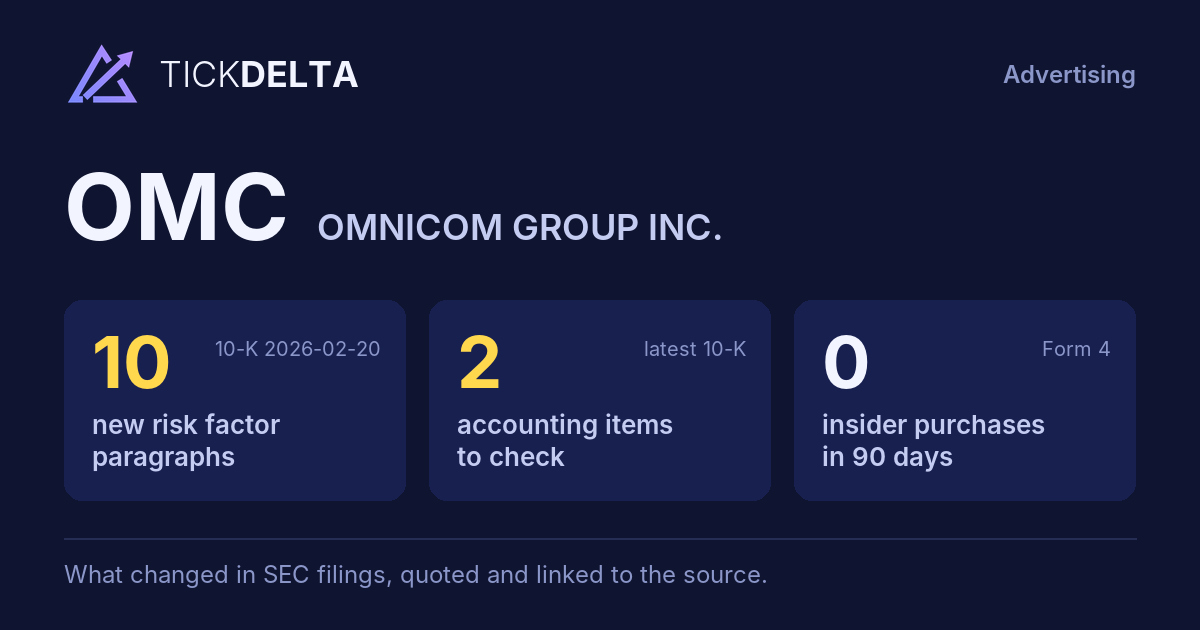
Sentences and paragraphs of OMC's Risk Factors and MD&A, 10-K 2026-02-20 against 10-K 2025-02-05.
Each links to the text at sec.gov.
AddedRisk Factors
Our industry is highly competitive and subject to rapid technological change. Our ability to remain competitive depends in part on our ability to anticipate, develop, acquire and integrate new technologies, platforms and capabilities, including data-driven solutions, automation, generative AI and agentic AI. These technologies may require significant and ongoing investment, involve long development cycles and uncertain returns, and may not be accepted by clients or generate expected benefits.
Read it in 10-K 2026-02-20 at sec.gov ↗
AddedRisk Factors
If we fail to keep pace with technological developments, or if competitors or new market entrants adopt new technologies more quickly or effectively, or if our clients develop their own AI-related capabilities, our services could become less attractive to clients, our competitive position could be harmed, and our revenues and profitability could decline. In addition, the use of emerging technologies presents risks related to intellectual property, ethics, data privacy, cybersecurity and regulatory compliance. Any failure to address these risks effectively could adversely affect our reputation, client relationships, business results of operations and financial condition.
Read it in 10-K 2026-02-20 at sec.gov ↗
AddedRisk Factors
Our agencies’ operating cash flows have a significant impact on our liquidity and access to short-term and long-term financing in the capital markets. We maintain a committed, unsecured multi-currency revolving credit facility, which also provides us with the ability to issue commercial paper, and to manage and support our operating liquidity in the short term. In addition, we issue senior long-term notes in the capital markets. If our agencies’ operating cash flow significantly declines or any of these sources were unavailable to us or insufficient, our liquidity and ability to refinance our long-term debt could be impeded. We could be required to restructure our debt, sell assets or take other actions, and our business, results of operations and financial condition would be adversely affected. In addition, our credit rating, which is also dependent on our agencies operating cash flows among other factors, has a direct effect on our ability to obtain bank financing and access the capital markets. A downgrade to our credit rating, for any reason, could increase our borrowing costs, reduce our capacity to borrow, or impede our ability to access the capital markets, and our results of operations and financial condition would be adversely affected. See Part II for further discussion of our liquidity and capital resources.
Read it in 10-K 2026-02-20 at sec.gov ↗
AddedRisk Factors
Regulators and legislators in the European Union, the United Kingdom, and the United States have increasingly focused on the use of online tracking technologies and the sharing of personal information with third parties for targeted or behavioral advertising. This has resulted in new or updated requirements under the General Data Protection Regulation (GDPR), the California Consumer Privacy Act (CCPA), and other U.S. state privacy laws. If these laws or regulations are adopted, interpreted, or enforced in a manner that restricts our current practices, or if private market participants impose limitations on tracking technologies in response to privacy concerns, our digital services could become less effective, more costly to deliver, or subject to additional legal and operational constraints.
Read it in 10-K 2026-02-20 at sec.gov ↗
Show the other 14
AddedRisk Factors
challenge our positions, and adverse outcomes from audits, investigations or litigation could result in additional tax liabilities, penalties or interest that differ materially from amounts previously recorded.
Read it in 10-K 2026-02-20 at sec.gov ↗
AddedRisk Factors
Our effective tax rate and cash flows could also be adversely affected by changes in tax laws or policies, including changes to statutory tax rates, digital services taxes, the interpretation or enforcement of existing laws, or the adoption or modification of global minimum tax regimes, such as the Global Anti-Base Erosion issued by the Organization for Economic Co-operation and Development. These developments could increase tax complexity and uncertainty and may require us to restructure operations or intercompany arrangements, potentially resulting in increased tax expense or reduced cash flows.
Read it in 10-K 2026-02-20 at sec.gov ↗
AddedMD&A
On the Closing Date, Omnicom completed its Merger with IPG. As previously reported, on December 8, 2024, Omnicom entered into the Merger Agreement with IPG and EXT Subsidiary Inc., a Delaware corporation and a direct wholly owned subsidiary of Omnicom (the “Merger Sub”). On the Closing Date, pursuant to the terms and conditions of the Merger Agreement, Merger Sub merged with and into IPG, with IPG continuing as the surviving corporation and a direct wholly owned subsidiary of Omnicom. Upon the Merger, each outstanding share of IPG common stock (other than certain excluded shares) converted into the right to receive 0.344 shares of Omnicom common stock and cash in lieu of fractional shares. Following the closing of the Merger, legacy Omnicom shareholders owned approximately 60.6% of the combined company and legacy IPG shareholders owned approximately 39.4%, on a fully diluted basis (see Note 5 to the consolidated financial statements).
Read it in 10-K 2026-02-20 at sec.gov ↗
AddedMD&A
Omnicom’s common stock continues to trade on the New York Stock Exchange , or NYSE, under the symbol “OMC,” and IPG’s common stock has ceased trading. The Merger qualified as a tax-free reorganization for U.S. federal income tax purposes, and the combined company operates under the Omnicom name with headquarters in New York, New York. Omnicom is the acquirer of IPG under U.S. GAAP, and as a result, the consolidated financial statements of Omnicom for periods prior to the Closing Date do not include the results of operations, financial position, or cash flows of IPG. The results of operations of IPG are included in Omnicom’s consolidated financial statements only from the Closing Date forward. Accordingly, Omnicom’s results of operations, financial condition and cash flows after the Closing Date are not comparable to prior periods due to the inclusion of IPG’s results from the Closing Date (see Note 5 to the consolidated financial statements).
Read it in 10-K 2026-02-20 at sec.gov ↗
AddedMD&A
In connection with the Merger, Omnicom commenced offers to exchange all outstanding notes of certain series issued by IPG for up to $2.95 billion in aggregate principal amount of new notes issued by Omnicom. As a result of these exchange offers, which were completed on December 2, 2025, approximately 94% of IPG's outstanding senior notes were exchanged for $2.76 billion in aggregate principal amount of new notes issued by Omnicom. The remaining approximately 6% of IPG's senior notes that were not tendered for exchange by holders remain outstanding obligations of IPG, a wholly owned subsidiary of Omnicom (see Note 7 to the consolidated financial statements).
Read it in 10-K 2026-02-20 at sec.gov ↗
AddedMD&A
Omnicom is a strategic holding company that operates through global networks, connected capabilities and specialized agencies, which connect its comprehensive portfolio of companies to deliver marketing, sales, communications, and commerce services to many of the largest global companies. Our products and service offerings support client objectives across our primary focus areas: media, content, commerce, generative AI, and branding communications.
Read it in 10-K 2026-02-20 at sec.gov ↗
AddedMD&A
Omnicom’s agencies integrate data, creativity, and technology to deliver coordinated marketing, communications, and commerce solutions. All of our agencies are supported by our integrated technology platform: Omni- including Acxiom and Interact, which were acquired from IPG and Flywheel Commerce Cloud, as well as privacy-focused identity and data management capabilities. These capabilities include the integration of emerging AI-based tools, such as generative AI, into planning, creative advertising, media, and analytics workflows.
Read it in 10-K 2026-02-20 at sec.gov ↗
AddedMD&A
Omnicom client teams collaborate and accelerate client-service innovation through two integral enterprise-wide solutions: the Global Growth Team (GGT) and our Client Success Leaders (CSLs). GGT ensures an integrated, enterprise-level view of client needs and innovative solutions across new business development. CSLs manage our agency’s capabilities, providing holistic, tailored solutions across our service lines for individual client strategies and key performance indicators (KPIs) to enable client success.
Read it in 10-K 2026-02-20 at sec.gov ↗
AddedMD&A
Our global networks include: Omnicom Advertising (OA), Omnicom Media (OM), the DAS Group of Companies (DAS), and the Communications Consultancy Network (CCN). OA includes our creative brands, BBDO, TBWA, and McCann, which we acquired from IPG, and the brands included within the Advertising Collective. OM includes OMD, PHD, Hearts & Sciences, as well as UM, Acxiom, Initiative and Mediahub, which we acquired from IPG. DAS includes Omnicom Precision Marketing and MRM, which we acquired from IPG and Omnicom Health, which includes IPG Health. CCN includes FleishmanHillard and Ketchum, as well as Golin and Weber Shandwick, which we acquired from IPG.
Read it in 10-K 2026-02-20 at sec.gov ↗
AddedMD&A
We believe generative AI and agentic AI have, and will continue to have, a significant impact on how we provide services to our clients and how we enhance the productivity of our people. As the marketing industry adjusts to the evolving AI landscape, we seek to leverage these technologies to better serve our clients and maintain our competitive advantage. In January 2026, we unveiled our next generation of Omni, our proprietary marketing intelligence platform. Omni integrates our connected capabilities, high-quality and comprehensive identity and data infrastructure, and cutting-edge AI into a single operating system that we believe will give clients a unified foundation to connect strategy, execution, and performance across their entire marketing ecosystem.
Read it in 10-K 2026-02-20 at sec.gov ↗
AddedMD&A
Given our size and breadth, we monitor several financial indicators. The KPIs that we focus on are revenue growth and variability of operating expenses.
Read it in 10-K 2026-02-20 at sec.gov ↗
AddedMD&A
computers, servers and off-the-shelf software and other overhead expenses. Finally, the expected benefits of our acquisitions are typically shared by multiple agencies in various regions as they work together to integrate the acquired agency into our virtual client network strategy.
Read it in 10-K 2026-02-20 at sec.gov ↗
AddedMD&A
•Constant currency growth represents the change in revenue from the prior year, excluding the effects of foreign currency exchange rate fluctuations. This measure is calculated by adjusting current-period revenue to eliminate the impact of changes in foreign exchange rates and comparing the resulting amount to prior-year revenue.
Read it in 10-K 2026-02-20 at sec.gov ↗
AddedMD&A
Brazilian Real against the U.S. Dollar, partially offset by the strengthening of the British Pound, Colombian Peso and Euro against the U.S. Dollar.
Read it in 10-K 2026-02-20 at sec.gov ↗