Paragraph 122 · 48% changed
Every version of it
Screener
/
SEC EDGAR
/CIK 0000707179
/10-K filed Feb 19, 2026, compared with Feb 19, 2025
/Numbers from the XBRL of the 10-Ks
Nasdaq
Financials · Banks
OLD National Bancorp ONB
The 10-K against last year's
127 changes: 18 added, 17 removed, 92 reworded
10-K Feb 19, 2026 vs Feb 19, 2025
Risk Factors
13.5%
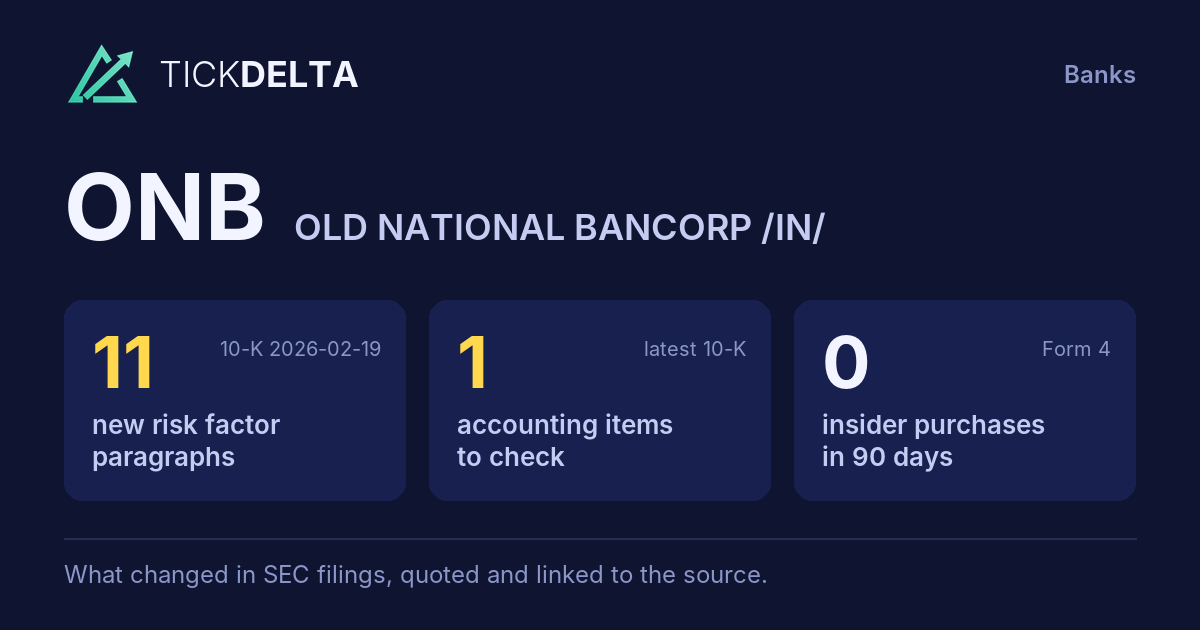
of the text changed · 11,853 words now · 11 new paragraphs, 9 gone
MD&A
13.4%
of the text changed · 12,800 words now · 7 new paragraphs, 8 gone
Legal Proceedings
6.6%
of the text changed · 394 words now
Accounting Policies
18.3%
of the text changed · 6,868 words now
10-K 0000707179-26-000010 (Feb 19, 2026) vs 10-K 0000707179-25-000005 (Feb 19, 2025)
Every paragraph, and how much of it changed
One bar per paragraph, in the order of the 10-K. Height and colour show the share of its words not in the closest paragraph a year earlier; the tallest bars are new paragraphs.
Risk Factors
140 paragraphs · 11 new · 42 reworded · 9 gone · 10-K Feb 19, 2026 against Feb 19, 2025
New paragraph
Reworded (5% of its words or more)
Same or nearly
Paragraph 111 · 47% changed
Every version of it
Old National regularly reviews and updates its internal controls, disclosure controls and procedures, and corporate governance policies and procedures. Old National also maintains an Enterprise Risk Management program designed to identify, manage, mitigate, monitor, aggregate, and report risks. Any system of controls and any system to reduce risk exposure, however well designed and operated, is based in part on certain assumptions and can provide only reasonable, not absolute, assurances that the objectives of the system are met. Additionally, instruments, systems, models, and strategies used to measure, hedge, or otherwise manage exposure to various types of market compliance, credit, liquidity, operational, and business risks and enterprise-wide risk could be less effective or accurate than anticipated. As a result, Old National may not be able to effectively mitigate its risk exposures in particular market environments or against particular types of risk.
Paragraph 48 · 42% changed
Every version of it
Significant harm to the Company’s reputation could also arise as a result of regulatory or governmental actions, litigation, employee misconduct or the activities of customers, other participants in the financial services industry or the Company’s contractual counterparties, such as service providers and vendors. A service disruption of the Company’s technology platforms or an impact to the Company’s branches could have a negative impact on a customer’s access to banking services, and harm the Company’s reputation with customers. In particular, a cybersecurity event impacting the Company’s or its customers’ data could have a negative impact on the Company’s reputation and customer confidence in the Company and its cybersecurity. Damage to the Company’s reputation could also adversely affect its credit ratings and access to the capital markets.
Paragraph 140 · 32% changed
Every version of it
Paragraph 30 · 24% changed
Every version of it
Paragraph 139 · 20% changed
Every version of it
Financial institutions are inherently exposed to fraud risk. A fraud can be perpetrated by an employee, a vendor, or members of the general public, or by or at a client of Old National. We are most subject to fraud and compliance risk in connection with the origination of loans, ACH transactions, wire transactions, ATM transactions, and checking transactions. Our largest fraud risk, associated with the origination of loans, includes the intentional misstatement of information in property appraisals or other underwriting documentation provided to us by third parties. Compliance risk is the risk that loans are not originated in compliance with applicable laws and regulations and our standards. There can be no assurance that we can prevent or detect acts of fraud or violation of law or our compliance standards by the third parties that we deal with. Repeated incidences of fraud or compliance failures would adversely impact the performance of our loan portfolio.
Paragraph 89 · 17% changed
Every version of it
As our reliance on technology systems and the connectivity of third parties (including contractors) and electronic devices to our systems increase, the potential risks of technology-related interruptions in our operations or the occurrence of cyber incidents incidents, including those resulting from the malicious introduction of destructive malware or ransomware, also increase. Our technologies, systems, and networks, and those of our external vendors, as well as our customers’ devices are periodically the target of cyberattacks and may be the target of future cyberattacks. Malicious actors actors, who are becoming increasingly sophisticated and may see their effectiveness enhanced by the use of artificial intelligence, deep-fake technologies, quantum computing and other novel technologies, may also attempt to fraudulently induce employees, customers or other users of our systems to disclose sensitive information, including passwords and other identifying information, in order to gain access to data or our systems.
Paragraph 112 · 16% changed
Every version of it
Paragraph 122 · 48% changed
Every version of it
10-K Feb 19, 2025Management has identified certain accounting policies as being critical because they require management’s judgment to ascertain the valuations of assets, liabilities, commitments and contingencies. A variety of factors could affect the ultimate value that is obtained either when earning income, recognizing an expense, recovering an asset, valuing an asset or liability, or recognizing or reducing a liability. Old National has established detailed policies and control procedures with respect to these critical accounting estimates. However, because of the uncertainty surrounding judgments and the estimates pertaining to these matters, Old National could be required to adjust accounting policies or restate prior period financial statements if those judgments and estimates prove to be incorrect. See “Item 7 — Critical Accounting Estimates” for a discussion of the Company’s critical accounting estimates.
10-K Feb 19, 2026
accounting policies or restate prior period financial statements if those judgments and estimates prove to be incorrect. See “Item 7 — Critical Accounting Estimates” for a discussion of the Company’s critical accounting estimates.
Paragraph 111 · 47% changed
Every version of it
10-K Feb 19, 2025
Old National regularly reviews and updates its internal controls, disclosure controls and procedures, and corporate governance policies and procedures. Old National also maintains an Enterprise Risk Management program designed to identify, manage, mitigate, monitor, aggregate, and report risks. Any system of controls and any system to reduce risk exposure, however well designed and operated, is based in part on certain assumptions and can provide only reasonable, not absolute, assurances that the objectives of the system are met. Additionally, instruments, systems, models, and strategies used to measure, hedge, or otherwise manage exposure to various types of market compliance, credit, liquidity, operational, and business risks and enterprise-wide risk could be less effective or accurate than anticipated. As a result, Old National may not be able to effectively mitigate its risk exposures in particular market environments or against particular types of risk.
10-K Feb 19, 2026
Old National regularly reviews and updates its internal controls, disclosure controls and procedures, and corporate governance policies and procedures. Old National also maintains an Enterprise Risk Management program designed to identify, manage, mitigate, monitor, aggregate, and report risks. Any system of controls and any system to reduce
Paragraph 48 · 42% changed
Every version of it
10-K Feb 19, 2025
Significant harm to the Company’s reputation could also arise as a result of regulatory or governmental actions, litigation, employee misconduct or the activities of customers, other participants in the financial services industry or the Company’s contractual counterparties, such as service providers and vendors. A service disruption of the Company’s technology platforms or an impact to the Company’s branches could have a negative impact on a customer’s access to banking services, and harm the Company’s reputation with customers. In particular, a cybersecurity event impacting the Company’s or its customers’ data could have a negative impact on the Company’s reputation and customer confidence in the Company and its cybersecurity. Damage to the Company’s reputation could also adversely affect its credit ratings and access to the capital markets.
10-K Feb 19, 2026
Significant harm to the Company’s reputation could also arise as a result of regulatory or governmental actions, litigation, employee misconduct or the activities of customers, other participants in the financial services industry or
Paragraph 140 · 32% changed
Every version of it
10-K Feb 19, 2025Financial institutions are inherently exposed to fraud risk. A fraud can be perpetrated by an employee, a vendor, or members of the general public, or by or at a client of Old National. We are most subject to fraud and compliance risk in connection with the origination of loans, ACH transactions, wire transactions, ATM transactions, and checking transactions. Our largest fraud risk, associated with the origination of loans, includes the intentional misstatement of information in property appraisals or other underwriting documentation provided to us by third parties. Compliance risk is the risk that loans are not originated in compliance with applicable laws and regulations and our standards. There can be no assurance that we can prevent or detect acts of fraud or violation of law or our compliance standards by the third parties that we deal with. Repeated incidences of fraud or compliance failures would adversely impact the performance of our loan portfolio.
10-K Feb 19, 2026
risk is the risk that loans are not originated in compliance with applicable laws and regulations and our standards. There can be no assurance that we can prevent or detect acts of fraud or violation of law or our compliance standards by the third parties that we deal with. Repeated incidences of fraud or compliance failures would adversely impact the performance of our loan portfolio.
Paragraph 30 · 24% changed
Every version of it
10-K Feb 19, 2025adversely affected by the increased competition resulting from the unprecedented involvement of the U.S. government and government-sponsored entities in the residential mortgage market. Other recent regulation has reduced the regulatory burden of large bank holding companies and raised the asset thresholds at which more onerous requirements apply, which could cause certain large bank holding companies with less than $250 billion in total consolidated assets, which were previously subject to more stringent enhanced prudential standards, to become more competitive or to pursue expansion more aggressively. There is also increased competition from out-of-market competitors through online and mobile channels. In addition, the emergence, adoption and evolution of new technologies that do not require intermediation, including distributed ledgers, as well as advances in automation, could significantly affect competition for financial services. Old National’s profitability depends upon our continued ability to compete successfully in our market area.
10-K Feb 19, 2026
government and government-sponsored entities in the residential mortgage market. Other recent regulation has reduced the regulatory burden of large bank holding companies and raised the asset thresholds at which more onerous requirements apply, which could cause certain large bank holding companies with less than $250 billion in total consolidated assets, which were previously subject to more stringent enhanced prudential standards, to become more competitive or to pursue expansion more aggressively. There is also increased competition from out-of-market competitors through online and mobile channels.
Paragraph 139 · 20% changed
Every version of it
10-K Feb 19, 2025
Financial institutions are inherently exposed to fraud risk. A fraud can be perpetrated by an employee, a vendor, or members of the general public, or by or at a client of Old National. We are most subject to fraud and compliance risk in connection with the origination of loans, ACH transactions, wire transactions, ATM transactions, and checking transactions. Our largest fraud risk, associated with the origination of loans, includes the intentional misstatement of information in property appraisals or other underwriting documentation provided to us by third parties. Compliance risk is the risk that loans are not originated in compliance with applicable laws and regulations and our standards. There can be no assurance that we can prevent or detect acts of fraud or violation of law or our compliance standards by the third parties that we deal with. Repeated incidences of fraud or compliance failures would adversely impact the performance of our loan portfolio.
10-K Feb 19, 2026
Financial institutions are inherently exposed to fraud risk. A fraud can be perpetrated by an employee, a vendor, or members of the general public, or by or at a client of Old National. We are most subject to fraud and compliance risk in connection with the origination of loans, ACH transactions, wire transactions, ATM transactions, and checking transactions. Our largest fraud risk, associated with the origination of loans, includes the intentional misstatement of information in property appraisals or other underwriting documentation provided to us by third parties. Compliance
Paragraph 89 · 17% changed
Every version of it
10-K Feb 19, 2025
As our reliance on technology systems and the connectivity of third parties (including contractors) and electronic devices to our systems increase, the potential risks of technology-related interruptions in our operations or the occurrence of cyber incidents also increase. Our technologies, systems, and networks, and those of our external vendors, as well as our customers’ devices are periodically the target of cyberattacks and may be the target of future cyberattacks. Malicious actors may also attempt to fraudulently induce employees, customers or other users of our systems to disclose sensitive information, including passwords and other identifying information, in order to gain access to data or our systems.
10-K Feb 19, 2026
As our reliance on technology systems and the connectivity of third parties (including contractors) and electronic devices to our systems increase, the potential risks of technology-related interruptions in our operations or the occurrence of cyber incidents, including those resulting from the malicious introduction of destructive malware or ransomware, also increase. Our technologies, systems, and networks, and those of our external vendors, as well as our customers’ devices are periodically the target of cyberattacks and may be the target of future cyberattacks. Malicious actors, who are becoming increasingly sophisticated and may see their effectiveness enhanced by the use of artificial intelligence, deep-fake technologies, quantum computing and other novel technologies, may also attempt to fraudulently induce employees, customers or other users of our systems to disclose sensitive information, including passwords and other identifying information, in order to gain access to data or our systems.
Paragraph 112 · 16% changed
Every version of it
10-K Feb 19, 2025Old National regularly reviews and updates its internal controls, disclosure controls and procedures, and corporate governance policies and procedures. Old National also maintains an Enterprise Risk Management program designed to identify, manage, mitigate, monitor, aggregate, and report risks. Any system of controls and any system to reduce risk exposure, however well designed and operated, is based in part on certain assumptions and can provide only reasonable, not absolute, assurances that the objectives of the system are met. Additionally, instruments, systems, models, and strategies used to measure, hedge, or otherwise manage exposure to various types of market compliance, credit, liquidity, operational, and business risks and enterprise-wide risk could be less effective or accurate than anticipated. As a result, Old National may not be able to effectively mitigate its risk exposures in particular market environments or against particular types of risk.
10-K Feb 19, 2026
risk exposure, however well designed and operated, is based in part on certain assumptions and can provide only reasonable, not absolute, assurances that the objectives of the system are met. Additionally, instruments, systems, models, and strategies used to measure, hedge, or otherwise manage exposure to various types of market compliance, credit, liquidity, operational, and business risks and enterprise-wide risk could be less effective or accurate than anticipated. As a result, Old National may not be able to effectively mitigate its risk exposures in particular market environments or against particular types of risk.
MD&A
178 paragraphs · 7 new · 54 reworded · 8 gone · 10-K Feb 19, 2026 against Feb 19, 2025
New paragraph
Reworded (5% of its words or more)
Same or nearly
Paragraph 83 · 48% changed
Other assets at December 31, 2024 2025 increased $175.8 $758.5 million compared to December 31, 2023 primarily due to 2024 reflecting Bremer other assets acquired and higher alternative investments. investments in partnerships, limited liability companies, and other ownership interests that support affordable housing.
Paragraph 57 · 44% changed
Noninterest expense increased $68.1 in 2025 included $140.9 million in 2024 compared of merger-related expenses and a $3.0 million reduction to 2023. a previously accrued FDIC special assessment. Noninterest expense in 2024 included $37.3 million of merger-related expenses, a $13.3 million non-cash, pre-tax expense associated with the distribution of excess pension assets with the resolution of the legacy First Midwest plan, $3.0 million for the FDIC special assessment, and $2.6 million of separation expense. Noninterest expense in 2023 included $28.7 million of merger-related expenses, a $19.1 million FDIC special assessment, $4.4 million of a contract termination charge, $3.4 million of expenses related to the Louisville tragedy, and $1.6 million for property optimization. Excluding these expenses, noninterest expense in 2024 increased $68.9 million, reflective of the additional operating costs associated with the acquisition of CapStar, as well as higher salary and employee benefits reflective of merit increases.
Paragraph 55 · 42% changed
Paragraph 91 · 40% changed
Paragraph 98 · 40% changed
Paragraph 5 · 38% changed
Paragraph 56 · 36% changed
Other income increased $9.1 $21.3 million in 2024 2025 compared to 2023 2024 primarily due to additional other income associated with the acquisition acquisitions of Bremer and CapStar, discrete items in 2024, the $5.1 million net gain associated with the freezing of the benefits of the Bremer pension plan and higher subsequent termination of the plan, and $4.2 million of net gains on sales of commercial loan fees. loans.
Paragraph 9 · 33% changed
Results for 2024 2025 were impacted by $37.3 $140.9 million of merger-related expenses, $15.3 $75.6 million of CECL Day 1 non-PCD provision expense related to the allowance for credit losses established on acquired non-PCD loans, a $13.3 $5.1 million non-cash, pre-tax expense net gain associated with the distribution of excess pension assets with the resolution freezing of the legacy First Midwest benefits of the Bremer pension plan and subsequent termination of the plan, and a $3.0 million for the reduction to previously accrued FDIC special assessment, $2.6 million of separation expense, and $0.2 million of net securities losses. assessment. Excluding these items, net income applicable to common shares for 2024 2025 was $808.6 million, or $2.21 per diluted common share on an adjusted basis. Refer to the “Non-GAAP Financial Measures” section for reconciliations to GAAP financial measures.
Paragraph 83 · 48% changed
10-K Feb 19, 2025
Other assets at December 31, 2024 increased $175.8 million compared to December 31, 2023 primarily due to higher alternative investments.
10-K Feb 19, 2026
Other assets at December 31, 2025 increased $758.5 million compared to December 31, 2024 reflecting Bremer other assets acquired and higher investments in partnerships, limited liability companies, and other ownership interests that support affordable housing.
Paragraph 57 · 44% changed
10-K Feb 19, 2025
Noninterest expense increased $68.1 million in 2024 compared to 2023. Noninterest expense in 2024 included $37.3 million of merger-related expenses, a $13.3 million non-cash, pre-tax expense associated with the distribution of excess pension assets with the resolution of the legacy First Midwest plan, $3.0 million for the FDIC special assessment, and $2.6 million of separation expense. Noninterest expense in 2023 included $28.7 million of merger-related expenses, a $19.1 million FDIC special assessment, $4.4 million of a contract termination charge, $3.4 million of expenses related to the Louisville tragedy, and $1.6 million for property optimization. Excluding these expenses, noninterest expense in 2024 increased $68.9 million, reflective of the additional operating costs associated with the acquisition of CapStar, as well as higher salary and employee benefits reflective of merit increases.
10-K Feb 19, 2026
Noninterest expense in 2025 included $140.9 million of merger-related expenses and a $3.0 million reduction to a previously accrued FDIC special assessment. Noninterest expense in 2024 included $37.3 million of merger-related expenses, a $13.3 million non-cash, pre-tax expense associated with the distribution of excess pension assets with
Paragraph 55 · 42% changed
10-K Feb 19, 2025Other income increased $9.1 million in 2024 compared to 2023 primarily due to additional other income associated with the acquisition of CapStar, discrete items in 2024, and higher commercial loan fees.
10-K Feb 19, 2026
Capital markets income increased $17.0 million in 2025 compared to 2024 primarily due to higher levels of commercial real estate client interest rate swap fees and the Bremer partnership.
Paragraph 91 · 40% changed
10-K Feb 19, 2025Shareholders’ equity totaled $6.3 billion, or 12% of total assets, at December 31, 2024 and $5.6 billion, or 11% of total assets, at December 31, 2023. Old National issued 24.0 million shares of Common Stock in conjunction with the acquisition of CapStar on April 1, 2024 adding $417.6 million in shareholders’ equity. Retained earnings were partially offset by dividends during 2024. Old National’s Common Stock is traded on the NASDAQ under the symbol “ONB” with 62,288 shareholders of record at December 31, 2024.
10-K Feb 19, 2026
the acquisition of Bremer on May 1, 2025 adding $1.0 billion in shareholders’ equity. In addition, Old National issued 21.9 million shares of Common Stock in the settlement of the forward sale agreements adding $443.2 million in shareholders’ equity. Retained earnings and changes in unrealized losses on available-for-sale investment securities also contributed to the increase in shareholders’ equity during 2025. These increases were partially offset by dividends and the repurchase of 2.2 million shares of Common Stock during 2025 under a share repurchase plan that was approved by the Company’s Board of Directors in the first quarter of 2025, which reduced equity by $50.0 million. As of December 31, 2025, Old National had remaining authorization to repurchase up to $150.0 million of its outstanding Common Stock through February 28, 2026. Old National’s Common Stock is traded on the NASDAQ under the symbol “ONB” with 76,618 shareholders of record at December 31, 2025.
Paragraph 98 · 40% changed
10-K Feb 19, 2025Counterparty exposure is the risk that the other party in a financial transaction will not fulfill its obligation. We define counterparty exposure as nonperformance risk in transactions involving federal funds sold and purchased, repurchase agreements, correspondent bank relationships, and derivative contracts with companies in the financial services industry. Old National manages exposure to counterparty risk in connection with its derivatives transactions by generally engaging in transactions with counterparties having ratings of at least “A” by Standard & Poor’s Rating Service or “A2” by Moody’s Investors Service. There are provisions in our agreements with the counterparties that allow for certain unsecured credit exposure up to an agreed threshold. Exposures in excess of the agreed thresholds are collateralized. Total credit exposure is monitored by counterparty and managed within limits that management believes to be prudent. Old National’s net counterparty exposure was an asset of $28.5 million at December 31, 2024.
10-K Feb 19, 2026
allow for certain unsecured credit exposure up to an agreed threshold. Exposures in excess of the agreed thresholds are collateralized. Total credit exposure is monitored by counterparty and managed within limits that management believes to be prudent. Old National’s net counterparty exposure was an asset of $48.9 million at December 31, 2025.
Paragraph 5 · 38% changed
10-K Feb 19, 2025In 2024, Old National successfully navigated a challenging interest rate environment while remaining on offense with our growth strategy, investing in client-facing and key support talent, and remaining opportunistic for new acquisitions. Our peer-leading deposit franchise, disciplined loan growth, strong credit quality, well-managed expenses, and dedicated team members who are committed to our clients and communities enabled us to exceed our expectations that we set as we began 2024. Highlights experienced in 2024 included:
10-K Feb 19, 2026
Old National’s 2025 results were driven by the completion and successful integration of Bremer and a focus on fundamentals—core deposit growth to support loan expansion, positive operating leverage, disciplined credit management, and healthy liquidity and capital ratios. We once again showed our unwavering commitment to shareholders, clients, team members, and communities. Our peer-leading deposit franchise, disciplined loan growth, strong credit quality, well-managed expenses, and dedicated team members who are committed to our clients and communities enabled us to exceed our expectations that we set as we began 2025. Highlights experienced in 2025 included:
Paragraph 56 · 36% changed
10-K Feb 19, 2025
Other income increased $9.1 million in 2024 compared to 2023 primarily due to additional other income associated with the acquisition of CapStar, discrete items in 2024, and higher commercial loan fees.
10-K Feb 19, 2026
Other income increased $21.3 million in 2025 compared to 2024 primarily due to additional other income associated with the acquisitions of Bremer and CapStar, the $5.1 million net gain associated with the freezing of the benefits of the Bremer pension plan and subsequent termination of the plan, and $4.2 million of net gains on sales of commercial loans.
Paragraph 9 · 33% changed
10-K Feb 19, 2025
Results for 2024 were impacted by $37.3 million of merger-related expenses, $15.3 million of CECL Day 1 non-PCD provision expense related to the allowance for credit losses established on acquired non-PCD loans, a $13.3 million non-cash, pre-tax expense associated with the distribution of excess pension assets with the resolution of the legacy First Midwest plan, $3.0 million for the FDIC special assessment, $2.6 million of separation expense, and $0.2 million of net securities losses. Excluding these items, net income applicable to common shares for 2024
10-K Feb 19, 2026
Results for 2025 were impacted by $140.9 million of merger-related expenses, $75.6 million of CECL Day 1 non-PCD provision expense related to the allowance for credit losses established on acquired non-PCD loans, a $5.1 million net gain associated with the freezing of the benefits of the Bremer pension plan and subsequent termination of the plan, and a $3.0 million reduction to previously accrued FDIC special assessment. Excluding these items, net income applicable to common shares for 2025 was $808.6 million, or $2.21 per diluted common share on an adjusted basis. Refer to the “Non-GAAP Financial Measures” section for reconciliations to GAAP financial measures.
A paragraph is matched with the one last year that shares the most of its words; under half in common makes it new. The paragraphs shown are the 8 reworded the most in each section.
The paragraph that changed most in each section
The redline
Marked against last year's 10-K: cut words struck through, new words highlighted.
Accounting Policies165 words changed in this paragraph; it is 36% similar to last year's version.
Source: Item 8, Note 1 – BASIS OF PRESENTATION AND SIGNIFICANT ACCOUNTING POLICIES, 10-K 0000707179-26-000010 vs Item 8, Note 1 – BASIS OF PRESENTATION AND SIGNIFICANT ACCOUNTING POLICIES, 10-K 0000707179-25-000005
MD&A151 words changed in this paragraph; it is 68% similar to last year's version.
Our net interest income increased 2% 34% to $1.5 $2.1 billion during 2024, 2025, driven by loans and securities acquired in the CapStar Bremer transaction as well as strong loan growth and the interest rate environment. lower costs of average interest-bearing liabilities, partially offset by higher balances of average interest-bearing liabilities. Provision for credit losses increased compared to 2023, 2024, reflective of provision expense associated with the CapStar merger Bremer acquisition as well as loan growth, credit migration, higher net charge-offs, and macroeconomic factors. Noninterest income increased from $333.3 million in 2023 to $354.7 million in 2024 to $466.5 million in 2025 primarily due to the impact of the CapStar merger, Bremer acquisition, higher wealth and investment services fees, mortgage banking revenues, revenue, capital markets income, and other income, partially offset by a gain on sale of Visa Class B restricted shares totaling $21.6 million in 2023. income. Noninterest expense increased $68.1 $390.9 million in 2024 2025 compared to 2023. 2024. Noninterest expense in 2025 included $140.9 million of merger-related expenses and a $3.0 million reduction to previously accrued FDIC special assessment. Noninterest expense in 2024 included $37.3 million of merger-related expenses, a $13.3 million non-cash, pre-tax expense associated with the distribution of excess pension assets with the resolution of the legacy First Midwest plan, $3.0 million for the an FDIC special assessment, and $2.6 million of separation expense. Noninterest expense in 2023 included $28.7 million of merger-related expenses, a $19.1 million FDIC special assessment, $4.4 million of a contract termination charge, $3.4 million of expenses related to the Louisville tragedy, and $1.6 million for property optimization. Excluding these expenses, noninterest expense in 2024 2025 increased $68.9 $309.3 million, reflective of the additional driven by operating costs associated with and additional amortization of intangibles related to the impact acquisitions of the CapStar merger, Bremer and CapStar, as well as higher salary and employee benefits reflective of merit increases. and performance-driven incentive accruals.
Source: Item 7, 10-K 0000707179-26-000010 vs Item 7, 10-K 0000707179-25-000005
Risk Factors94 words changed in this paragraph; it is 39% similar to last year's version.
Upgrading the Company’s computer systems, software, and networks subjects the Company to the risk of disruptions, failures, or delays due to the complexity and interconnectedness of the Company’s computer systems, software, and networks. The failure to properly upgrade or maintain these computer systems, software, and networks could result in greater susceptibility to cyber-attacks, particularly in light of the greater frequency and severity of attacks in recent years, as well as the growing prevalence of supply chain attacks affecting software and information service providers. Failures related to upgrades and maintenance also increase risks related to unauthorized access and misuse. There can be no assurance that any such disruptions, failures, or delays will not occur or, if they do occur, that they will be adequately addressed.
Source: Item 1A, 10-K 0000707179-26-000010 vs Item 1A, 10-K 0000707179-25-000005
Legal Proceedings23 words changed in this paragraph; it is 84% similar to last year's version.
In 2008, Old National received Visa Class B restricted shares as part of Visa’s initial public offering. During the fourth quarter of 2023, Old National sold the 65,466 Class B shares and recognized a $21.6 million pre-tax gain. Prior to the sale, the shares were carried at a zero cost basis due to uncertainty surrounding the ability of the Company to transfer or otherwise liquidate the shares. After the sale, the Company did not hold any remaining Visa Class B restricted shares.
Source: Item 3, via Note 20 – COMMITMENTS, CONTINGENCIES, AND FINANCIAL GUARANTEES, 10-K 0000707179-26-000010 vs Item 3, via Note 20 – COMMITMENTS, CONTINGENCIES, AND FINANCIAL GUARANTEES, 10-K 0000707179-25-000005
Sentences and paragraphs added, removed or reworded
Every change, by type
Sentences and paragraphs of ONB's Risk Factors and MD&A, 10-K Feb 19, 2026 against 10-K Feb 19, 2025. Each links to the text at sec.gov.
Quiet changes are sentences kept from last year with one to four words changed, at least one of them a hedge, a modal or a qualifier (may, could, will, not, significant, material…). A year or date rolling forward is not counted.
The full word list
adverse, adversely, all, although, anticipate, anticipates, any, approximately, believe, believes, can, cannot, certain, could, expect, expects, generally, however, if, intend, intends, largely, likely, many, material, materially, may, might, most, must, never, no, not, possible, primarily, probable, should, significant, significantly, some, substantial, substantially, unlikely, will, would
AddedRisk Factors
may also have a negative effect on the ability of Old National’s borrowers to make timely repayments of their loans, which would have an adverse impact on Old National’s earnings.
Read it in 10-K Feb 19, 2026 at sec.gov
AddedRisk Factors
In addition, the emergence, adoption and evolution of new technologies that do not require intermediation, including distributed ledgers, as well as advances in artificial intelligence and automation could significantly affect competition for financial services. For instance, in July 2025, President Trump signed into law the GENIUS Act, which establishes a regulatory framework for “payment stablecoins” and their issuers. Consumers and businesses may view payment stablecoins as a substitute for traditional bank deposits, resulting in deposit withdrawals. Depending on consumer and business interest in payment stablecoins, and the characteristics and utility of payment stablecoins, the passage of the GENIUS Act could result in increased competition with respect to Old National Bank’s deposit products. However, the GENIUS Act requires the U.S. Treasury Department and federal and state regulators to issue regulations on numerous topics to interpret and implement the statute, so the effect of the GENIUS Act will depend on what those regulations provide.
Read it in 10-K Feb 19, 2026 at sec.gov
AddedRisk Factors
Old National’s profitability depends upon our continued ability to compete successfully in our market area. Increased competition in any of these areas may require us to make additional capital investments in our businesses in order to remain competitive. Our failure to either anticipate, or participate in, the adoption of new technologies and developments within a given market area as successfully as our peers could make us less competitive and result in potential negative financial impact.
Read it in 10-K Feb 19, 2026 at sec.gov
AddedRisk Factors
In addition, due to divergent policies and viewpoints regarding climate change, we are at increased risk of being subject to different and potentially conflicting legal or regulatory requirements and stakeholder expectations. Furthermore, ongoing legislative or regulatory uncertainties and changes regarding climate-related matters may result in higher regulatory, compliance, credit, and other risks and costs.
Read it in 10-K Feb 19, 2026 at sec.gov
AddedRisk Factors
and/or customer perceptions of our company, which could lead to a loss of depositor confidence and an increase in deposit withdrawals, particularly among those with uninsured deposits.
Read it in 10-K Feb 19, 2026 at sec.gov
AddedRisk Factors
Upgrading the Company’s computer systems, software, and networks subjects the Company to the risk of disruptions, failures, or delays due to the complexity and interconnectedness of the Company’s computer systems,
Read it in 10-K Feb 19, 2026 at sec.gov
AddedRisk Factors
The development and use of artificial intelligence presents risks and challenges that may adversely impact Old National’s business.
Read it in 10-K Feb 19, 2026 at sec.gov
AddedRisk Factors
The use and development of artificial intelligence, including digital employees and digital engineers, by Old National and its third party vendors, clients, counterparties, and other market participants in certain business processes, models, including generative artificial intelligence models, services, or products may expose Old National to risks and potential liabilities. These risks may occur as a result of enhanced governmental or regulatory scrutiny, litigation, ethical concerns, confidentiality or other security risks, intellectual property concerns over data rights and protection, increased exposure to copyright infringement or intellectual property misappropriation claims, heightened susceptibility to cyberattacks, increased frequency and severity of cyberattacks, inaccurate or biased algorithms or underlying datasets, misuse or misappropriation as well as other factors that could adversely affect our business, reputation, and financial results. In addition, poor implementation of artificial intelligence by Old National or its third party service providers could subject Old National to additional risks that we may not adequately predict or mitigate.
Read it in 10-K Feb 19, 2026 at sec.gov
Show the other 51
AddedRisk Factors
The failure to strategically embrace the potential of artificial intelligence or to achieve the expected effectiveness, productivity, or cost-reduction from our adoption of artificial intelligence may result in a competitive disadvantage for us. If we cannot offer new artificial intelligence-facilitated technologies as quickly as our competitors, if our competitors develop more cost-effective solutions or other product offerings, if our employees do not adopt such technologies expediently, or if we are not able to source components we may require, such as artificial intelligence chips due to a supply chain shortage amid rising geopolitical uncertainty, we could experience a material adverse effect on our operating results, customer relationships, and growth opportunities. Our use and deployment of artificial intelligence solutions may introduce operational and control risks, including the risk of potential errors in automated decision-making, challenges in oversight and accountability, increased vulnerability to system failures or cyber incidents, and the risk that these technologies may not perform as intended under complex or unforeseen circumstances, which could materially disrupt our business operations and adversely affect our financial condition and reputation.
Read it in 10-K Feb 19, 2026 at sec.gov
AddedRisk Factors
The evolving legal, regulatory, and compliance framework for artificial intelligence both in the U.S. and internationally may impact our ability to protect our own data and intellectual property against infringing use and could require changes in our implementation of artificial intelligence technology and increase our compliance costs and the risk of non-compliance. Our efforts to evolve our governance, risk management, and control frameworks to manage the novel and amplified risks from our use of artificial intelligence may be insufficient or ineffective, which could expose us to operational disruptions, legal and regulatory sanctions, reputational harm, and adverse financial impacts. Additionally, we may not be able to control how third-party artificial intelligence solutions that we choose to use are developed or maintained including the source and quality of the data on which such models are trained or the frequency and nature of model updates. We may also be unable to govern or protect the integrity of the data we input into such tools, with respect to how such data is retained, reused, co-mingled with other data or disclosed, even where we have sought protections with respect to these matters.
Read it in 10-K Feb 19, 2026 at sec.gov
AddedRisk Factors
maintain an adequate compliance program, could result in significant fines, penalties, lawsuits, regulatory sanctions, reputational damage, or restrictions on our business.
Read it in 10-K Feb 19, 2026 at sec.gov
RemovedRisk Factors
RemovedRisk Factors
RemovedRisk Factors
RemovedRisk Factors
RemovedRisk Factors
RemovedRisk Factors
RemovedRisk Factors
RemovedRisk Factors
RemovedRisk Factors
RewordedRisk Factors
Malicious actors actors, who are becoming increasingly sophisticated and may see their effectiveness enhanced by the use of artificial intelligence, deep-fake technologies, quantum computing and other novel technologies, may also attempt to fraudulently induce employees, customers or other users of our systems to disclose sensitive information, including passwords and other identifying information, in order to gain access to data or our systems.
Read it in 10-K Feb 19, 2026 at sec.gov
RewordedRisk Factors
Unfavorable or uncertain economic and market conditions can be caused by declines in economic growth, business activity or investor or business confidence; limitations on the availability or increases in the cost of credit and capital; increases in inflation or interest rates; high unemployment; changes in tariffs and trade policies; natural disasters, the severity disasters and frequency of which are increasing as a result of climate change; extreme weather events; terrorist acts; or a combination of these or other factors.
Read it in 10-K Feb 19, 2026 at sec.gov
RewordedRisk Factors
In addition, we anticipate negative developments in the banking industry can result in increased regulatory scrutiny, in the course of routine examinations and otherwise, and new regulations in response to recent negative developments in the banking industry, regulations, which may increase our cost of doing business and reduce our profitability.
Read it in 10-K Feb 19, 2026 at sec.gov
RewordedRisk Factors
The Federal Reserve raised benchmark interest rates throughout 2022 and 2023 and held them at a high level until it decreased began decreasing the benchmark rate by 50 basis points in September 2024, by 25 basis points in November 2024 and by 25 basis points in through December 2024.
Read it in 10-K Feb 19, 2026 at sec.gov
RewordedRisk Factors
Although the Company has adopted policies and procedures designed to comply with these laws, rules, and regulations, any failure to comply with these laws, rules, and regulations, or to maintain an adequate compliance program, could result in significant fines, penalties, lawsuits, regulatory sanctions, reputational damage, or restrictions on our business.
Read it in 10-K Feb 19, 2026 at sec.gov
RewordedRisk Factors
However, because of the uncertainty surrounding judgments and the estimates pertaining to these matters, Old National could be required to adjust accounting policies or restate prior period financial statements if those judgments and estimates prove to be incorrect.
Read it in 10-K Feb 19, 2026 at sec.gov
RewordedRisk Factors
Our ability to originate residential mortgage loans has also been adversely affected by the increased competition resulting from the unprecedented involvement of the U.S.
Read it in 10-K Feb 19, 2026 at sec.gov
RewordedRisk Factors
As our reliance on technology systems and the connectivity of third parties (including contractors) and electronic devices to our systems increase, the potential risks of technology-related interruptions in our operations or the occurrence of cyber incidents incidents, including those resulting from the malicious introduction of destructive malware or ransomware, also increase.
Read it in 10-K Feb 19, 2026 at sec.gov
RewordedRisk Factors
The financial services industry is continually undergoing rapid technological change change, including with respect to development and implementation of artificial intelligence solutions, and with frequent introductions of new technology-driven products and services.
Read it in 10-K Feb 19, 2026 at sec.gov
RewordedRisk Factors
Checking and savings account balances and other forms of customer deposits may decrease when customers perceive alternative investments, alternatives, such as the stock market, market or payment stablecoins, as providing a better risk/return tradeoff. tradeoff or greater utility.
Read it in 10-K Feb 19, 2026 at sec.gov
RewordedRisk Factors
While we may contractually limit our liability in connection with attacks against third party providers, providers and also require these providers to maintain adequate insurance coverages, Old National remains exposed to the risk of loss associated with such vendors.
Read it in 10-K Feb 19, 2026 at sec.gov
RewordedRisk Factors
As cyber threats continue to evolve, including as a result of the increased use of artificial intelligence, we may be required to expend significant additional resources to continue to modify or enhance our systems or to investigate and remediate vulnerabilities.
Read it in 10-K Feb 19, 2026 at sec.gov
AddedMD&A
•completion of our Bremer partnership on May 1, 2025, solidifying our position as a premier mid-size bank;
Read it in 10-K Feb 19, 2026 at sec.gov
AddedMD&A
•stable credit metrics, including net charge-offs to average loans of 0.25%; and
Read it in 10-K Feb 19, 2026 at sec.gov
AddedMD&A
On May 1, 2025, Old National completed its acquisition of Bremer, and its wholly owned banking subsidiary, Bremer Bank, National Association. The majority of system conversions related to the Bremer transaction were completed in mid-October 2025. The successful execution of this conversion reinforced the strength of our disciplined integration framework and enhanced our operating platform across the expanded footprint.
Read it in 10-K Feb 19, 2026 at sec.gov
AddedMD&A
Driving tangible book value per share growth remains a key priority in 2026 as we build on the 15% growth achieved in 2025 despite the impact of closing our Bremer partnership, the associated merger-related charges, and the repurchase of 2.2 million shares in the second half of the year. We closed 2025 with 5% loan growth excluding our Bremer partnership and move into 2026 with a strong commercial pipeline and a loan-to-deposit ratio of 89%, providing sufficient liquidity to fund growth. We will remain on offense and rely on our ability to navigate changes in short-term interest rates, shifts in the yield curve, and overall economic conditions as we have for the past 190 years.
Read it in 10-K Feb 19, 2026 at sec.gov
AddedMD&A
Looking ahead to 2026, we remain focused on disciplined organic growth, prudent capital deployment, and continued investment in talent, technology, and client‑facing capabilities. Our proven ability to execute on these strategic priorities will support sustainable performance, maintain strong credit quality, and position the Company for long‑term value creation across economic cycles for our shareholders and communities.
Read it in 10-K Feb 19, 2026 at sec.gov
AddedMD&A
Noninterest income in 2025 included a $5.1 million net gain associated with the freezing of the benefits of the Bremer pension plan and subsequent termination of the plan. Excluding this gain, noninterest income increased $106.7 million compared to 2024 driven by the acquisition of Bremer in May 2025, the CapStar acquisition in April 2024, organic growth of fee-based businesses, and higher other income.
Read it in 10-K Feb 19, 2026 at sec.gov
AddedMD&A
Amortization of tax credit investments increased $12.8 million in 2025 compared to 2024 primarily due to additional amortization related to the Bremer acquisition. In addition, the recognition of tax credit amortization expense is contingent upon the successful completion of the rehabilitation of a historic building or completion of a solar project within the reporting period. Many factors including weather, labor availability, building regulations, inspections, and other unexpected construction delays related to a rehabilitation project can cause a project to exceed its estimated completion date. See Note 9 to the consolidated financial statements for additional information on our tax credit investments.
Read it in 10-K Feb 19, 2026 at sec.gov
RemovedMD&A
RemovedMD&A
RemovedMD&A
RemovedMD&A
RemovedMD&A
RemovedMD&A
RemovedMD&A
RemovedMD&A
RewordedMD&A
Commercial 4,547 1,623 4,172 4,610 Commercial real estate 2,717 2,713 2,417 1,095 BBCC 611 325 275 281 Residential real estate 505 883 1,268 760 Indirect 2,583 1,274 1,559 1,263 Direct 2,525 2,152 2,331 2,557 Home equity 1,249 330 531 616 Total recoveries 14,737 9,300 12,553 11,182 Net charge-offs (recoveries) 110,290 62,004 55,910 16,099 Provision for credit losses on loans 183,742 120,191 59,849 123,340 Ending allowance for credit losses on loans $ 569,520 $ 392,522 $ 307,610 $ 303,671 Beginning allowance for credit losses on unfunded loan commitments $ 31,226 $ 32,188 $ 10,879 Provision for credit losses on unfunded loan commitments acquired 1,763 — 11,013 during the period Provision (release) for provision for credit losses on unfunded loan (11,335) (962) 10,296 commitments Ending allowance for credit losses on unfunded loan commitments $ 21,654 $ 31,226 $ 32,188 Provision for credit losses on unfunded loan commitments acquired 6,458 1,763 — during the period Provision (release) for provision for credit losses on unfunded loan 7,521 (11,335) (962) commitments Ending allowance for credit losses on unfunded loan commitments $ 35,633 $ 21,654 $ 31,226 Allowance for credit losses $ 605,153 $ 414,176 $ 338,836 $ 335,859 Average loans for the year (1) $ 44,221,486 $ 35,506,298 $ 32,233,020 $ 27,582,530 Asset Quality Ratios:
Read it in 10-K Feb 19, 2026 at sec.gov
RewordedMD&A
Merger-related charges 140,883 37,325 28,716 CECL Day 1 non-PCD provision expense 75,604 15,312 Pension plan (gain) loss (5,123) — FDIC special assessment (2,994) 2,994 Debt securities (gains) losses 37 212 Distribution of excess pension assets expense — 13,318 — FDIC special assessment 2,994 19,052 Separation expense — 2,646 — Debt securities (gains) losses 212 6,265 Gain on sale of Visa Class B restricted shares — (21,635) Contract termination charge — 4,413 Louisville expenses — 3,361 Property optimization charges — 1,559 Less: tax effect on net total adjustments (2) (52,940) (16,806) (8,361) Net income applicable to common shares, adjusted (1) $ 808,589 $ 578,054 $ 599,227 Weighted average diluted common shares outstanding 365,464 311,001 291,855 Net income per common share, diluted $ 1.79 $ 1.68 $ 1.94 Adjusted net income per common share, diluted (1) $ 2.21 $ 1.86 $ 2.05 Tangible common book value:
Read it in 10-K Feb 19, 2026 at sec.gov
RewordedMD&A
Results for 2024 2025 were impacted by $37.3 $140.9 million of merger-related expenses, $15.3 $75.6 million of CECL Day 1 non-PCD provision expense related to the allowance for credit losses established on acquired non-PCD loans, a $13.3 $5.1 million non-cash, pre-tax expense net gain associated with the distribution of excess pension assets with the resolution freezing of the legacy First Midwest benefits of the Bremer pension plan and subsequent termination of the plan, and a $3.0 million for the reduction to previously accrued FDIC special assessment, $2.6 million of separation expense, and $0.2 million of net securities losses. assessment.
Read it in 10-K Feb 19, 2026 at sec.gov
RewordedMD&A
These items include merger-related charges associated with completed and pending acquisitions, debt securities gains/losses, separation pension plan gain/loss, FDIC special assessment expense, CECL Day 1 non-PCD provision expense, debt securities gains/losses, distribution of excess pension assets expense, FDIC special assessment expense, gain on sale of Visa Class B restricted shares, expenses related to the tragic April 10, 2023 event at our downtown Louisville location (“Louisville expenses”), contract termination charge, and property optimization charges. separation expense.
Read it in 10-K Feb 19, 2026 at sec.gov
RewordedMD&A
Noninterest income increased from $333.3 million in 2023 to $354.7 million in 2024 to $466.5 million in 2025 primarily due to the impact of the CapStar merger, Bremer acquisition, higher wealth and investment services fees, mortgage banking revenues, revenue, capital markets income, and other income, partially offset by a gain on sale of Visa Class B restricted shares totaling $21.6 million in 2023. income.
Read it in 10-K Feb 19, 2026 at sec.gov
RewordedMD&A
Derivatives designated as hedging instruments were in a net asset position with a fair value gain of $14.8 million at December 31, 2025, compared to a net liability position with a fair value loss of $7.0 million at December 31, 2024, compared to a net asset position with a fair value gain of $4.5 million at December 31, 2023. 2024.
Read it in 10-K Feb 19, 2026 at sec.gov
RewordedMD&A
Net interest income in 2024 2025 increased compared to 2023 primarily due to loans and securities acquired in 2024 driven by the CapStar transaction acquisition of Bremer as well as strong loan growth, higher rates on loans and investment securities, and higher accretion income, lower costs of average interest-bearing liabilities, partially offset by higher balances and costs of average interest-bearing liabilities.
Read it in 10-K Feb 19, 2026 at sec.gov
RewordedMD&A
Excluding these expenses, noninterest expense in 2024 2025 increased $68.9 $309.3 million, reflective of the additional driven by operating costs associated with and additional amortization of intangibles related to the impact acquisitions of the CapStar merger, Bremer and CapStar, as well as higher salary and employee benefits reflective of merit increases. and performance-driven incentive accruals.
Read it in 10-K Feb 19, 2026 at sec.gov
RewordedMD&A
Total criticized and classified assets were $2.5 $3.1 billion at December 31, 2024, 2025, an increase of $725.0 $616.6 million from December 31, 2023 including $222.1 million 2024 primarily due to $1.0 billion of criticized and classified loans related to the CapStar acquisition. Bremer acquisition, partially offset by a continued focus on active portfolio management.
Read it in 10-K Feb 19, 2026 at sec.gov
RewordedMD&A
The decrease increase in the net interest margin on a fully taxable equivalent basis in 2024 2025 when compared to 2023 2024 was primarily due to higher balances the impact of Bremer, loan growth, and lower costs of average interest-bearing liabilities, partially offset by loan growth as well as higher yields on loans. balances of average interest-bearing liabilities.
Read it in 10-K Feb 19, 2026 at sec.gov
RewordedMD&A
At December 31, 2024, 2025, commercial and commercial real estate loans were $26.6 $37.0 billion, an increase of $2.9 $10.4 billion compared to December 31, 2023 2024 driven primarily by the acquisition of CapStar, Bremer, as well as disciplined commercial loan production that was well balanced across our market footprint and product lines. lines, partly offset by the sale of $71 million of commercial real estate loans in 2025.
Read it in 10-K Feb 19, 2026 at sec.gov
RewordedMD&A
Our net interest income increased 2% 34% to $1.5 $2.1 billion during 2024, 2025, driven by loans and securities acquired in the CapStar Bremer transaction as well as strong loan growth and the interest rate environment. lower costs of average interest-bearing liabilities, partially offset by higher balances of average interest-bearing liabilities.
Read it in 10-K Feb 19, 2026 at sec.gov
Sources
The two latest 10-Ks on EDGAR, section by section. Each change links to the text at sec.gov.
Also
New risk factors: paragraphs with nothing like them last year, quoted in full.
Work with it
Excel workbook · CSV. Google Sheet that stays up to date: paste =IMPORTDATA("https://tickdelta.com/company/ONB/export.csv") into a cell.