Paragraph 396 · 49% changed
Every version of it
Screener
/
SEC EDGAR
/CIK 0001651308
/10-K filed Feb 26, 2026, compared with Feb 27, 2025
/Numbers from the XBRL of the 10-Ks
Nasdaq, OTC
Health care · Pharmaceuticals
BeOne Medicines Ltd. ONC
The 10-K against last year's
194 changes: 53 added, 32 removed, 108 reworded, 1 quiet changes
10-K Feb 26, 2026 vs Feb 27, 2025
Risk Factors
9.3%
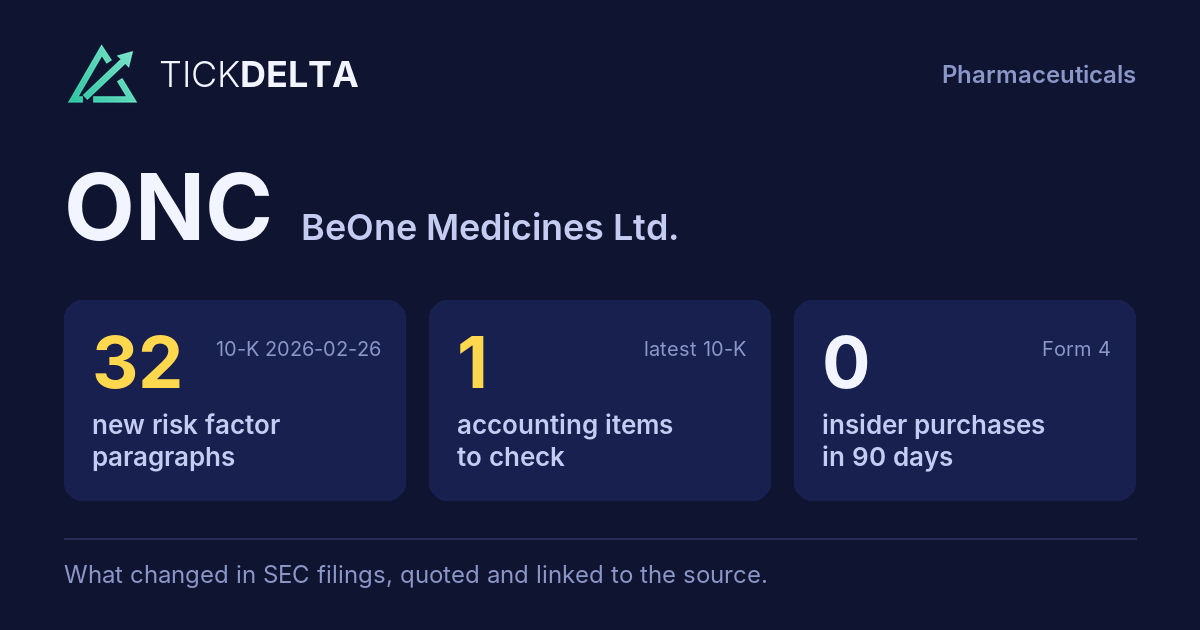
of the text changed · 48,391 words now · 32 new paragraphs, 11 gone
MD&A
37.7%
of the text changed · 7,041 words now · 21 new paragraphs, 21 gone
Legal Proceedings
38.3%
of the text changed · 423 words now
Accounting Policies
10.2%
of the text changed · 7,521 words now
10-K 0001628280-26-011946 (Feb 26, 2026) vs 10-K 0001651308-25-000031 (Feb 27, 2025)
Every paragraph, and how much of it changed
One bar per paragraph, in the order of the 10-K. Height and colour show the share of its words not in the closest paragraph a year earlier; the tallest bars are new paragraphs.
Risk Factors
445 paragraphs · 32 new · 113 reworded · 11 gone · 10-K Feb 26, 2026 against Feb 27, 2025
New paragraph
Reworded (5% of its words or more)
Same or nearly
Paragraph 31 · 49% changed
Every version of it
•As a result of increased shareholder voting requirements upon completion of the Continuation, we Swiss corporation, our flexibility will have less flexibility be limited with respect to certain aspects of capital management than previously. management.
Paragraph 435 · 49% changed
Every version of it
As a result of increased shareholder voting requirements upon completion of the Continuation, we Swiss corporation, our flexibility will have less flexibility be limited with respect to certain aspects of capital management than previously. management.
Paragraph 247 · 46% changed
Every version of it
Paragraph 392 · 46% changed
Every version of it
Paragraph 32 · 43% changed
Every version of it
•The Continuation will has resulted in and may continue to result in additional direct and indirect costs whether or not completed. costs.
Paragraph 440 · 43% changed
Every version of it
The Continuation will has resulted in and may continue to result in additional direct and indirect costs whether or not completed. costs.
Paragraph 309 · 42% changed
Every version of it
The nature of our international operations subjects us to local, state, regional and national tax laws in jurisdictions around the world. Our future tax expense could be affected by changes in the mix of earnings in countries with differing statutory tax rates, changes in the valuation of deferred tax assets and liabilities or changes in tax laws or their interpretation. For example, along with other recent U.S. federal tax reforms, the IRA and recently-enacted OBBBA have resulted in significant changes to the taxation of business entities including, among other changes, the imposition of a minimum tax on the book income of certain large corporations, changes to the taxation of income derived from international operations, changes in the deduction and amortization of research and development expenditures, and limitations on the deductibility of business interest. Future guidance from the Internal Revenue Service and other tax authorities with respect to any legislation may affect us, and certain aspects of such legislation could be repealed or modified or sunset in future years. Additionally, tax rules governing cross-border activities are continually subject to modification intended to address concerns over base erosion and profit shifting (“BEPS”) and other perceived international tax avoidance techniques as a result of both coordinated actions by governments, such as the OECD/G20 Inclusive Framework on BEPS, and unilateral measures designed by individual countries. For example, the Cayman Islands has enacted the International Tax Co-operation (Economic Substance) Law (2020 Revision) (the “Economic Substance Law”), which originally took effect on January 1, 2019, and which is accompanied by Guidance on Economic Substance for Geographically Mobile Activities (Version 2.0; April 30, 2019) published by the Cayman Islands Tax Information Authority. The Economic Substance Law embraces a global initiative to combat BEPS and demonstrates the continued commitment of the Cayman Islands to international best practice. The Economic Substance Law provides that relevant entities that existed before January 1, 2019 and that had been conducting relevant activities by that date must comply with the economic substance requirements from July 1, 2019, and relevant entities that are established from January 1, 2019 onwards must comply with the requirements from the date they commence the relevant activity. Although we believe that we currently are not obliged to meet the economic substance requirements under the Economic Substance Law, we cannot predict any changes to the legislation or its interpretation in the future. If we are obliged to meet certain economic substance requirements in the future, our business and results of operations could be negatively impacted if we are required to make changes to our business in order to gain compliance or if we fail to comply.
Paragraph 396 · 49% changed
Every version of it
10-K Feb 27, 2025Because we are a Cayman Islands company, our shareholders may have fewer shareholder rights than they would have under Hong Kong law, Chinese law or U.S. law and may face difficulties in protecting their interests.
10-K Feb 26, 2026
As we are a Swiss company, our shareholders may face difficulties in enforcing their interests.
Paragraph 31 · 49% changed
Every version of it
10-K Feb 27, 2025
•As a result of increased shareholder voting requirements upon completion of the Continuation, we will have less flexibility with respect to certain aspects of capital management than previously.
10-K Feb 26, 2026
•As a Swiss corporation, our flexibility will be limited with respect to certain aspects of capital management.
Paragraph 435 · 49% changed
Every version of it
10-K Feb 27, 2025
As a result of increased shareholder voting requirements upon completion of the Continuation, we will have less flexibility with respect to certain aspects of capital management than previously.
10-K Feb 26, 2026
As a Swiss corporation, our flexibility will be limited with respect to certain aspects of capital management.
Paragraph 247 · 46% changed
Every version of it
10-K Feb 27, 2025For example, the Sarbanes-Oxley Act of 2002 (the “Sarbanes-Oxley Act”) requires, among other things, that we maintain effective internal controls for financial reporting and disclosure controls and procedures. In particular, we must perform system and process evaluations and testing of our internal controls over financial reporting to allow management to report on the effectiveness of our internal controls over financial reporting, as required by Section 404 of the Sarbanes-Oxley Act. Such compliance may require that we incur substantial accounting expenses and expend significant management efforts. Our testing may reveal deficiencies in our internal controls over financial reporting that are deemed to be material weaknesses. In the event we identify significant deficiencies or material weaknesses in our internal controls that we cannot remediate in a timely manner, the market price of our shares could decline if investors and others lose confidence in the reliability of our financial statements, we could be subject to sanctions or investigations by the SEC, HKEx, CSRC, SSE or other applicable regulatory authorities, and our business could be harmed.
10-K Feb 26, 2026
the market price of our shares could decline if investors and others lose confidence in the reliability of our financial statements, we could be subject to sanctions or investigations by the SEC, HKEx, CSRC, SSE or other applicable regulatory authorities, and our business could be harmed.
Paragraph 392 · 46% changed
Every version of it
10-K Feb 27, 2025Because we are a Cayman Islands company, our shareholders may have fewer shareholder rights than they would have under Hong Kong law, Chinese law or U.S. law and may face difficulties in protecting their interests.
10-K Feb 26, 2026
As we are now a Swiss company, our shareholders have broader rights in certain aspects than they would have under Hong Kong law, Chinese law, U.S. law, or previously applicable Cayman Islands law. While these enhanced rights offer increased shareholder participation, our flexibility to swiftly implement certain initiatives or strategies may be limited, and situations may arise where greater flexibility could otherwise provide meaningful benefits to our shareholders.
Paragraph 32 · 43% changed
Every version of it
10-K Feb 27, 2025
•The Continuation will result in additional direct and indirect costs whether or not completed.
10-K Feb 26, 2026
•The Continuation has resulted in and may continue to result in additional direct and indirect costs.
Paragraph 440 · 43% changed
Every version of it
10-K Feb 27, 2025
The Continuation will result in additional direct and indirect costs whether or not completed.
10-K Feb 26, 2026
The Continuation has resulted in and may continue to result in additional direct and indirect costs.
Paragraph 309 · 42% changed
Every version of it
10-K Feb 27, 2025
The nature of our international operations subjects us to local, state, regional and national tax laws in jurisdictions around the world. Our future tax expense could be affected by changes in the mix of earnings in countries with differing statutory tax rates, changes in the valuation of deferred tax assets and liabilities or changes in tax laws or their interpretation. Additionally, tax rules governing cross-border activities are continually subject to modification intended to address concerns over base erosion and profit shifting (“BEPS”) and other perceived international tax avoidance techniques as a result of both coordinated actions by governments, such as the OECD/G20 Inclusive Framework on BEPS, and unilateral measures designed by individual countries. For example, the Cayman Islands has enacted the International Tax Co-operation (Economic Substance) Law (2020 Revision) (the “Economic Substance Law”), which originally took effect on January 1, 2019, and which is accompanied by Guidance on Economic Substance for Geographically Mobile Activities (Version 2.0; April 30, 2019) published by the Cayman Islands Tax Information Authority. The Economic Substance Law embraces a global initiative to combat BEPS and demonstrates the continued commitment of the Cayman Islands to international best practice. The Economic Substance Law provides that relevant entities that existed before January 1, 2019 and that had been conducting relevant activities by that date must comply with the economic substance requirements from July 1, 2019, and relevant entities that are established from January 1, 2019 onwards must comply with the requirements from the date they commence the relevant activity. Although we believe that we currently are not obliged to meet the economic substance requirements under the Economic Substance Law, we cannot predict any changes to the legislation or its interpretation in the future. If we are obliged to meet certain economic substance requirements in the future, our business and results of operations could be negatively impacted if we are required to make changes to our business in order to gain compliance or if we fail to comply.
10-K Feb 26, 2026
The nature of our international operations subjects us to local, state, regional and national tax laws in jurisdictions around the world. Our future tax expense could be affected by changes in the mix of earnings in countries with differing statutory tax rates, changes in the valuation of deferred tax assets and liabilities or changes in tax laws or their interpretation. For example, along with other recent U.S. federal tax reforms, the IRA and recently-enacted OBBBA have resulted in significant changes to the taxation of business entities including, among other changes, the imposition of a minimum tax on the book income of certain large corporations, changes to the taxation of income derived from international operations, changes in the deduction and amortization of research and development expenditures, and limitations on the deductibility of business interest. Future guidance from the Internal Revenue Service and other tax authorities with respect to any legislation may affect us, and certain aspects of such legislation could be repealed or modified or sunset in future years. Additionally, tax rules governing cross-border activities are continually subject to modification intended to address concerns over base erosion and profit shifting (“BEPS”) and other perceived international tax avoidance techniques as a result of both coordinated actions by governments, such as the OECD/G20 Inclusive Framework on BEPS, and unilateral measures designed by individual countries.
MD&A
82 paragraphs · 21 new · 32 reworded · 21 gone · 10-K Feb 26, 2026 against Feb 27, 2025
New paragraph
Reworded (5% of its words or more)
Same or nearly
Paragraph 49 · 50% changed
The following table provides information regarding summarizes our cash and cash equivalent balances, cash flows and unused borrowing capacity available under our Facilities Agreement for the years ended December 31, 2024 and 2023: indicated:
Paragraph 39 · 47% changed
Year Ended December 31, 2025 2024 2023 ( in thousands) thousands, except for per share data) Reconciliation of GAAP to adjusted cost of sales EPS - products: basic GAAP cost of sales earnings (loss) per share - products basic $ 594,089 0.20 $ 379,920 Less: (0.47) Plus: Share-based compensation expenses 0.36 0.32 Plus: Depreciation 42,707 8,578 Less: 0.09 0.12 Plus: Amortization of intangibles 4,729 3,739 0.01 0.00 Plus: Other 0.00 0.00 Plus: Impairment of equity investments 0.05 0.00 Plus: Discrete tax items 0.02 0.01 Plus: Income tax effect of non-GAAP adjustments (0.09) (0.04) Adjusted cost of sales earnings (loss) per share - products basic $ 546,653 0.65 $ 367,603 (0.04) Reconciliation of GAAP to adjusted research and development: EPS - diluted GAAP research and development earnings (loss) per share - diluted $ 1,953,295 0.19 $ 1,778,594 Less: (0.47) Plus: Share-based compensation expenses 186,113 163,550 Less: 0.35 0.32 Plus: Depreciation 98,814 56,084 0.09 0.12 Plus: Amortization of intangibles 0.01 0.00 Plus: Other 0.00 0.00 Plus: Impairment of equity investments 0.05 0.00 Plus: Discrete tax items 0.02 0.01 Plus: Income tax effect of non-GAAP adjustments (0.08) (0.04) Adjusted research and development earnings (loss) per share - diluted $ 1,668,368 0.62 $ 1,558,960 (0.04) Reconciliation of GAAP to adjusted selling, general and administrative: earnings (loss) per ADS - basic GAAP selling, general and administrative earnings (loss) per ADS - basic $ 1,831,056 2.63 $ 1,508,001 Less: (6.12) Plus: Share-based compensation expenses 255,680 204,038 Less: 4.68 4.20 Plus: Depreciation 25,417 15,774 Less: 1.21 1.59 Plus: Amortization of intangibles 95 3,500 0.09 0.05 Plus: Other 0.01 0.00 Plus: Impairment of equity investments 0.69 0.06 Plus: Discrete tax items 0.23 0.18 Plus: Income tax effect of non-GAAP adjustments (1.12) (0.47) Adjusted selling, general and administrative earnings (loss) per ADS - basic $ 1,549,864 8.41 $ 1,284,689 (0.52) Reconciliation of GAAP to adjusted operating expenses earnings (loss) per ADS - diluted GAAP operating expenses earnings (loss) per ADS - diluted1 $ 3,784,351 2.53 $ 3,286,595 Less: Share-based compensation expenses 441,793 367,588 Less: Depreciation 124,231 71,858 Less: Amortization of intangibles 95 3,500 Adjusted operating expenses $ 3,218,232 $ 2,843,649 Reconciliation of GAAP to adjusted loss from operations: GAAP loss from operations $ (568,199) $ (1,207,736) (6.12) Plus: Share-based compensation expenses 441,793 367,588 4.50 4.20 Plus: Depreciation 166,938 80,436 1.16 1.59 Plus: Amortization of intangibles 4,824 7,239 0.09 0.05 Plus: Other 0.01 0.00 Plus: Impairment of equity investments 0.67 0.06 Plus: Discrete tax items 0.22 0.18 Plus: Income tax effect of non-GAAP adjustments (1.08) (0.47) Adjusted income earnings (loss) from operations per ADS - diluted $ 45,356 8.09 $ (752,473) (0.52)
Paragraph 43 · 42% changed
Paragraph 31 · 38% changed
Interest income, net decreased expense increased by $26.2 $36.4 million, or 35.4%, 167.1%, to $47.8 $58.2 million for the year ended December 31, 2024, 2025, compared to $74.0 $21.8 million for the year ended December 31, 2023. The decrease in interest income was primarily attributable to lower interest rates earned on our cash and cash equivalents and lower cash balances in interest-bearing investments. 2024. Interest expense increased resulting from a higher debt balance, partially offset by an increase in interest capitalization expense recorded under the effective interest method related to the sale of future royalty liability, higher interest rates on debt balances and lower interest capitalized related to completion of certain phases of our Hopewell construction. facility.
Paragraph 53 · 38% changed
Financing activities provided $193.4 million $1.1 billion of cash for the year ended December 31, 2024, 2025, compared to $416.5 $193.4 million of cash provided in the prior year period due primarily to $911.0 million of proceeds from sale of future royalties and higher proceeds from option exercises and employee share purchase plan, partially offset by a net reduction in short-term debt borrowings. borrowings in the current year period and higher payroll tax payments upon vesting of share-based compensation awards.
Paragraph 17 · 38% changed
Global sales of BRUKINSA totaled $2.6 $3.9 billion for the year ended December 31, 2024, 2025, representing a 104.9% 48.6% increase compared to the prior year. U.S. sales of BRUKINSA totaled $2.0 $2.8 billion for the year ended December 31, 2024 2025 compared to $945.6 million $2.0 billion in the prior year, representing growth of 106.3%. U.S. volume growth continued to accelerate in the period due 45.1%, driven primarily to by robust demand growth coming from expanded use in CLL as across all indications and modest benefit due to net pricing. BRUKINSA continued continues to gain share in maintain its leading new patient starts in CLL and all other approved indications. In addition, U.S. sales were also positively impacted in share across the fourth quarter of 2024 by seasonality and the timing of customer order patterns of approximately $30.0 million. BTKi class due to its differentiated, best-in-class clinical profile. BRUKINSA sales in the EU totaled $358.8 $596.4 million for the year ended December 31, 2024, 2025, representing growth of 193.6% 66.2% compared to the prior-year period, driven by continued gains in market share across all major markets. markets, including Germany, Italy, Spain, France and the UK. BRUKINSA sales in China totaled $258.1 $344.1 million for the year ended December 31, 2024, 2025, representing growth of 33.2% 33.3% compared to the prior year.
Paragraph 32 · 38% changed
Other expense, net for the year ended December 31, 2024 2025 was $12.6 $42.6 million, due to foreign exchange losses, primarily from holding net monetary assets denominated in the RMB at certain U.S. dollar functional entities, including BeiGene, Ltd. (the “Parent Company”), and unrealized impairment losses recognized on our equity investments, investments partially offset by government subsidy income. income and foreign exchange gains.
Paragraph 19 · 33% changed
Paragraph 49 · 50% changed
10-K Feb 27, 2025
The following table provides information regarding our cash flows for the years ended December 31, 2024 and 2023:
10-K Feb 26, 2026
The following table summarizes our cash and cash equivalent balances, cash flows and unused borrowing capacity available under our Facilities Agreement for the years indicated:
Paragraph 39 · 47% changed
10-K Feb 27, 2025
Year Ended December 31, 2024 2023 ( in thousands) Reconciliation of GAAP to adjusted cost of sales - products: GAAP cost of sales - products $ 594,089 $ 379,920 Less: Depreciation 42,707 8,578 Less: Amortization of intangibles 4,729 3,739 Adjusted cost of sales - products $ 546,653 $ 367,603 Reconciliation of GAAP to adjusted research and development: GAAP research and development $ 1,953,295 $ 1,778,594 Less: Share-based compensation expenses 186,113 163,550 Less: Depreciation 98,814 56,084 Adjusted research and development $ 1,668,368 $ 1,558,960 Reconciliation of GAAP to adjusted selling, general and administrative: GAAP selling, general and administrative $ 1,831,056 $ 1,508,001 Less: Share-based compensation expenses 255,680 204,038 Less: Depreciation 25,417 15,774 Less: Amortization of intangibles 95 3,500 Adjusted selling, general and administrative $ 1,549,864 $ 1,284,689 Reconciliation of GAAP to adjusted operating expenses GAAP operating expenses $ 3,784,351 $ 3,286,595 Less: Share-based compensation expenses 441,793 367,588 Less: Depreciation 124,231 71,858 Less: Amortization of intangibles 95 3,500 Adjusted operating expenses $ 3,218,232 $ 2,843,649 Reconciliation of GAAP to adjusted loss from operations: GAAP loss from operations $ (568,199) $ (1,207,736) Plus: Share-based compensation expenses 441,793 367,588 Plus: Depreciation 166,938 80,436 Plus: Amortization of intangibles 4,824 7,239 Adjusted income (loss) from operations $ 45,356 $ (752,473)
10-K Feb 26, 2026
Year Ended December 31, 2025 2024 ( in thousands, except for per share data) Reconciliation of GAAP to adjusted EPS - basic GAAP earnings (loss) per share - basic $ 0.20 $ (0.47) Plus: Share-based compensation expenses 0.36 0.32 Plus: Depreciation 0.09 0.12 Plus: Amortization of intangibles 0.01 0.00 Plus: Other 0.00 0.00 Plus: Impairment of equity investments 0.05 0.00 Plus: Discrete tax items 0.02 0.01 Plus: Income tax effect of non-GAAP adjustments (0.09) (0.04) Adjusted earnings (loss) per share - basic $ 0.65 $ (0.04) Reconciliation of GAAP to adjusted EPS - diluted GAAP earnings (loss) per share - diluted $ 0.19 $ (0.47) Plus: Share-based compensation expenses 0.35 0.32 Plus: Depreciation 0.09 0.12 Plus: Amortization of intangibles 0.01 0.00 Plus: Other 0.00 0.00 Plus: Impairment of equity investments 0.05 0.00 Plus: Discrete tax items 0.02 0.01 Plus: Income tax effect of non-GAAP adjustments (0.08) (0.04) Adjusted earnings (loss) per share - diluted $ 0.62 $ (0.04) Reconciliation of GAAP to adjusted earnings (loss) per ADS - basic GAAP earnings (loss) per ADS - basic $ 2.63 $ (6.12) Plus: Share-based compensation expenses 4.68 4.20 Plus: Depreciation 1.21 1.59 Plus: Amortization of intangibles 0.09 0.05 Plus: Other 0.01 0.00 Plus: Impairment of equity investments 0.69 0.06 Plus: Discrete tax items 0.23 0.18 Plus: Income tax effect of non-GAAP adjustments (1.12) (0.47) Adjusted earnings (loss) per ADS - basic $ 8.41 $ (0.52) Reconciliation of GAAP to adjusted earnings (loss) per ADS - diluted GAAP earnings (loss) per ADS - diluted1 $ 2.53 $ (6.12) Plus: Share-based compensation expenses 4.50 4.20 Plus: Depreciation 1.16 1.59 Plus: Amortization of intangibles 0.09 0.05 Plus: Other 0.01 0.00 Plus: Impairment of equity investments 0.67 0.06 Plus: Discrete tax items 0.22 0.18 Plus: Income tax effect of non-GAAP adjustments (1.08) (0.47) Adjusted earnings (loss) per ADS - diluted $ 8.09 $ (0.52)
Paragraph 43 · 42% changed
10-K Feb 27, 2025To date, we have financed our existing operations and investments in long-term assets principally through proceeds from public and private offerings of our securities, proceeds from debt and our collaborations, and since the third quarter of 2024 cash flow from operations. Based on our current operating plan, we expect that our existing cash and cash equivalents as of December 31, 2024 will enable us to fund our operating expenses and planned long-term investments for at least the next 12 months after the date that the financial statements included in this report are issued. We have also financed our operations and investments with proceeds from debt incurred primarily from various banks both through our subsidiaries and the Parent Company of $1.0 billion at December 31, 2024. The majority of those debt obligations, or approximately $762.1 million, owed by BeiGene, Ltd., have due dates within the next 12 months. As of December 31, 2024, BeiGene, Ltd. will require loans or distributions from subsidiaries in fiscal year 2025 to fund its operations (see Note 10 in the Notes to the Financial Statements for further discussion of deferred taxes on the U.S. unremitted earnings expected to be distributed to the Parent Company). We believe we will have sufficient cash and cash equivalents and other sources of capital to be able to repay and/or refinance those debt obligations on a consolidated basis.
10-K Feb 26, 2026
Based on our recent and expected performance, we expect that our operating cash flows and existing cash and cash equivalents as of December 31, 2025 will enable us to fund our operating expenses and planned long-term investments for at least the next 12 months after the date that the financial statements included in this report are issued. In 2025 we generated proceeds from long-term debt of $855.0 million which was used to pay off all existing short-term working capital loans, and include certain restrictive covenants as laid out further below with respect to certain coverage ratios and maximum investment amounts. We believe we will have sufficient cash and cash equivalents and other sources of capital to be able to repay and/or refinance those debt obligations as they become due principally in 2027 and 2028.
Paragraph 31 · 38% changed
10-K Feb 27, 2025
Interest income, net decreased by $26.2 million, or 35.4%, to $47.8 million for the year ended December 31, 2024, compared to $74.0 million for the year ended December 31, 2023. The decrease in interest income was primarily attributable to lower interest rates earned on our cash and cash equivalents and lower cash balances in interest-bearing investments. Interest expense increased resulting from a higher debt balance, partially offset by an increase in interest capitalization related to Hopewell construction.
10-K Feb 26, 2026
Interest expense increased by $36.4 million, or 167.1%, to $58.2 million for the year ended December 31, 2025, compared to $21.8 million for the year ended December 31, 2024. Interest expense increased resulting from interest expense recorded under the effective interest method related to the sale of future royalty liability, higher interest rates on debt balances and lower interest capitalized related to completion of certain phases of our Hopewell facility.
Paragraph 53 · 38% changed
10-K Feb 27, 2025
Financing activities provided $193.4 million of cash for the year ended December 31, 2024, compared to $416.5 million of cash provided in the prior year period due primarily to a net reduction in short-term debt borrowings.
10-K Feb 26, 2026
Financing activities provided $1.1 billion of cash for the year ended December 31, 2025, compared to $193.4 million of cash provided in the prior year period due primarily to $911.0 million of proceeds from sale of future royalties and higher proceeds from option exercises and employee share purchase plan, partially offset by a net reduction in debt borrowings in the current year period and higher payroll tax payments upon vesting of share-based compensation awards.
Paragraph 17 · 38% changed
10-K Feb 27, 2025
Global sales of BRUKINSA totaled $2.6 billion for the year ended December 31, 2024, representing a 104.9% increase compared to the prior year. U.S. sales of BRUKINSA totaled $2.0 billion for the year ended December 31, 2024 compared to $945.6 million in the prior year, representing growth of 106.3%. U.S. volume growth continued to accelerate in the period due primarily to demand growth coming from expanded use in CLL as BRUKINSA continued to gain share in new patient starts in CLL and all other approved indications. In addition, U.S. sales were also positively impacted in the fourth quarter of 2024 by seasonality and the timing of customer order patterns of approximately $30.0 million. BRUKINSA sales in the EU totaled $358.8 million for the year ended December 31, 2024, representing growth of 193.6% compared to the prior-year period, driven by continued gains in market share across all major markets. BRUKINSA sales in China totaled $258.1 million for the year ended December 31, 2024, representing growth of 33.2% compared to the prior year.
10-K Feb 26, 2026
Global sales of BRUKINSA totaled $3.9 billion for the year ended December 31, 2025, representing a 48.6% increase compared to the prior year. U.S. sales of BRUKINSA totaled $2.8 billion for the year ended December 31, 2025 compared to $2.0 billion in the prior year, representing growth of 45.1%, driven primarily by robust demand growth across all indications and modest benefit due to net pricing. BRUKINSA continues to maintain its leading new patient share across the BTKi class due to its differentiated, best-in-class clinical profile. BRUKINSA sales in the EU totaled $596.4 million for the year ended December 31, 2025, representing growth of 66.2% compared to the prior-year period, driven by continued gains in market share across all major markets, including Germany, Italy, Spain, France and the UK. BRUKINSA sales in China totaled $344.1 million for the year ended December 31, 2025, representing growth of 33.3% compared to the prior year.
Paragraph 32 · 38% changed
10-K Feb 27, 2025
Other expense, net for the year ended December 31, 2024 was $12.6 million, due to foreign exchange losses, primarily from holding net monetary assets denominated in the RMB at certain U.S. dollar functional entities, including BeiGene, Ltd. (the “Parent Company”), and unrealized losses on equity investments, partially offset by government subsidy income.
10-K Feb 26, 2026
Other expense, net for the year ended December 31, 2025 was $42.6 million, due to impairment losses recognized on our equity investments partially offset by government subsidy income and foreign exchange gains.
Paragraph 19 · 33% changed
10-K Feb 27, 2025Collaboration revenue totaled $30.7 million for the year ended December 31, 2024, primarily related to revenue generated under the Novartis broad markets marketing and promotion agreement and royalty revenue under the Amgen collaboration. Collaboration revenue totaled $268.9 million for the year ended December 31, 2023, primarily related to the recognition of the remaining deferred revenue associated with the former Novartis tislelizumab and ociperlimab collaborations which were terminated in the prior year.
10-K Feb 26, 2026
Other revenue totaled $61.0 million and $30.7 million for the years ended December 31, 2025 and 2024, respectively, primarily related to royalty revenue under the Amgen collaboration and revenue generated under the Novartis broad markets marketing and promotion agreement.
A paragraph is matched with the one last year that shares the most of its words; under half in common makes it new. The paragraphs shown are the 8 reworded the most in each section.
The paragraph that changed most in each section
The redline
Marked against last year's 10-K: cut words struck through, new words highlighted.
Risk Factors323 words changed in this paragraph; it is 41% similar to last year's version.
The nature of our international operations subjects us to local, state, regional and national tax laws in jurisdictions around the world. Our future tax expense could be affected by changes in the mix of earnings in countries with differing statutory tax rates, changes in the valuation of deferred tax assets and liabilities or changes in tax laws or their interpretation. For example, along with other recent U.S. federal tax reforms, the IRA and recently-enacted OBBBA have resulted in significant changes to the taxation of business entities including, among other changes, the imposition of a minimum tax on the book income of certain large corporations, changes to the taxation of income derived from international operations, changes in the deduction and amortization of research and development expenditures, and limitations on the deductibility of business interest. Future guidance from the Internal Revenue Service and other tax authorities with respect to any legislation may affect us, and certain aspects of such legislation could be repealed or modified or sunset in future years. Additionally, tax rules governing cross-border activities are continually subject to modification intended to address concerns over base erosion and profit shifting (“BEPS”) and other perceived international tax avoidance techniques as a result of both coordinated actions by governments, such as the OECD/G20 Inclusive Framework on BEPS, and unilateral measures designed by individual countries. For example, the Cayman Islands has enacted the International Tax Co-operation (Economic Substance) Law (2020 Revision) (the “Economic Substance Law”), which originally took effect on January 1, 2019, and which is accompanied by Guidance on Economic Substance for Geographically Mobile Activities (Version 2.0; April 30, 2019) published by the Cayman Islands Tax Information Authority. The Economic Substance Law embraces a global initiative to combat BEPS and demonstrates the continued commitment of the Cayman Islands to international best practice. The Economic Substance Law provides that relevant entities that existed before January 1, 2019 and that had been conducting relevant activities by that date must comply with the economic substance requirements from July 1, 2019, and relevant entities that are established from January 1, 2019 onwards must comply with the requirements from the date they commence the relevant activity. Although we believe that we currently are not obliged to meet the economic substance requirements under the Economic Substance Law, we cannot predict any changes to the legislation or its interpretation in the future. If we are obliged to meet certain economic substance requirements in the future, our business and results of operations could be negatively impacted if we are required to make changes to our business in order to gain compliance or if we fail to comply.
Source: Item 1A, 10-K 0001628280-26-011946 vs Item 1A, 10-K 0001651308-25-000031
Accounting Policies252 words changed in this paragraph; it is 32% similar to last year's version.
In November 2024, the FASB issued ASU 2024-03, Income Statement - Reporting Comprehensive Income - Expense Disaggregation Disclosures (Subtopic 220-40): Disaggregation of Income Statement Expenses. This update requires that at each interim and annual reporting period public entities disclose (1) the amounts of purchases of inventory, employee compensation, depreciation, amortization, and depletion) in commonly presented expense captions; (2) certain amounts that are already required to be disclosed under current GAAP in the same disclosure as the other disaggregation requirements; (3) a qualitative description of the amounts remaining in relevant expense captions that are not separately disaggregated quantitatively; and (4) the total amount of selling expenses and, in annual reporting periods, the definition of selling expenses. In January September 2025, the FASB issued ASU 2024-03, Income Statement 2025-06, Intangibles - Reporting Comprehensive Income Goodwill and Other - Expense Disaggregation Disclosures Internal-Use Software (Subtopic 220-40): Clarifying 350-40): Targeted Improvements to the Effective Date. Accounting for Internal-Use Software. This update clarifies removes all references to prescriptive and sequential software development stages throughout Subtopic 350-40. The update requires an entity to start capitalizing software costs when management has authorized and committed to funding the software project, and it is probable that ASU 2024-03 the project will be completed and the software will be used to perform the function intended. The update further specifies that the disclosures in Subtopic 360-10 are required for all capitalized internal-use software costs. This update is effective for annual reporting periods beginning after December 15, 2026, 2027, and interim reporting periods within those annual reporting periods beginning after December 15, 2027. periods. Early adoption is permitted. The guidance can be applied using a prospective transition approach, a modified transition approach that is based on the status of the project and whether software costs were capitalized before the date of adoption, or a retrospective transition approach. The Company is currently evaluating the impact on its financial statements of adopting this guidance.
Source: Item 8, Note 2 – Summary of Significant Accounting Policies, 10-K 0001628280-26-011946 vs Item 8, Note 2 – Summary of Significant Accounting Policies, 10-K 0001651308-25-000031
MD&A201 words changed in this paragraph; it is 35% similar to last year's version.
Income tax expense was $111.8 $129.9 million ($120.5 million current tax) for the year ended December 31, 2024 2025 compared with $55.9 $111.8 million ($85.8 million current tax) for the year ended December 31, 2023. 2024. The current income tax expense for the year ended December 31, 2024 2025 was primarily attributable to higher pre-tax income resulting in current U.S. tax expense determined after other special tax deductions and research and development tax credits, including tax expense of $12.1 million due to the impact of tax reserves on uncertain tax positions related to research and development tax credits, lower currently taxable income primarily in China, higher Australia, and Italy, that resulted in an increase of $52.6 million offset with lower current tax expense in certain EU and ROW jurisdictions and the deferred impact of the Company’s unremitted earnings in the U.S. of $17.9 million. The Company’s tax expense for 2024 reflects the historic allocation of pre-tax earnings and losses among our significant jurisdictions. This allocation and resulting tax expense depends on various factors including the level of income and unremitted earnings generated decrease in the U.S., U.S. was driven by positive impacts of OBBBA, while the increase in other jurisdictions’ higher current taxable income was driven by (a) the increase in current year valuation allowances on short-term deferred tax assets that are triggered by our three-year cumulative loss position at a consolidated level, (b) increase in uncertain tax liabilities and amount of research and development costs incurred in China and therefore may vary from the historic allocation. (c) return to provision adjustments.
Source: Item 7, 10-K 0001628280-26-011946 vs Item 7, 10-K 0001651308-25-000031
Legal Proceedings175 words changed in this paragraph; it is 50% similar to last year's version.
On March 8, 2024, the Company’s two wholly-owned February 25, 2026, our subsidiaries, BeiGene USA, BeOne Medicines USA Inc. and BeiGene Switzerland GmbH BeOne Medicines I GmbH, filed a patent infringement suits suit under the Hatch-Waxman Act against Sandoz Inc. (“Sandoz”) and separately against MSN Pharmaceuticals, Zydus Pharmaceuticals (USA) Inc. and MSN Laboratories Private Ltd. (collectively “MSN”) Zydus Lifesciences Limited (collectively, “Zydus”) in the U.S. United States District Court for the District of New Jersey. The patent infringement suits are suit is in response to Sandoz’s and MSN’s notices Zydus’ notice to the Company BeOne concerning the filings filing of an Abbreviated New Drug Applications (“ANDAs”) Application (“ANDA”) with the U.S. Food and Drug Administration (“FDA”), seeking FDA approval to market a generic version of BRUKINSA BRUKINSA® (zanubrutinib) tablets along with “Paragraph IV certifications” challenging certain BRUKINSA BRUKINSA® Orange Book patents for invalidity, unenforceability invalidity and/or non-infringement. According to the notices, neither Sandoz nor MSN have notice, Zydus has not challenged BRUKINSA’s composition of matter patent, which remains intact in protecting BRUKINSA and protects BRUKINSA® from generic competition until its expiration in 2034. On August 15, 2024, the court entered a joint stipulation and order dismissing the suit against Sandoz. On November 14, 2024, BeiGene entered into a settlement agreement with MSN wherein BeiGene granted MSN the right to sell a generic version of BRUKINSA in the U.S. no earlier than June 15, 2037, subject to potential acceleration or extension under circumstances customary for settlement of this type. On November 19, 2024, the court entered a joint stipulation and order dismissing the suit against MSN.
Source: Item 3, 10-K 0001628280-26-011946 vs Item 3, 10-K 0001651308-25-000031
Sentences and paragraphs added, removed or reworded
Every change, by type
Sentences and paragraphs of ONC's Risk Factors and MD&A, 10-K Feb 26, 2026 against 10-K Feb 27, 2025. Each links to the text at sec.gov.
Quiet changes are sentences kept from last year with one to four words changed, at least one of them a hedge, a modal or a qualifier (may, could, will, not, significant, material…). A year or date rolling forward is not counted.
The full word list
adverse, adversely, all, although, anticipate, anticipates, any, approximately, believe, believes, can, cannot, certain, could, expect, expects, generally, however, if, intend, intends, largely, likely, many, material, materially, may, might, most, must, never, no, not, possible, primarily, probable, should, significant, significantly, some, substantial, substantially, unlikely, will, would
AddedRisk Factors
•Restrictive covenants in our facilities agreements may limit our ability to respond to changes in market conditions or pursue business opportunities.
Read it in 10-K Feb 26, 2026 at sec.gov
AddedRisk Factors
In April 2025, the Trump administration published Executive Order 14273 (90 Fed. Reg. 16441), “Lowering Drug Prices by Once Again Putting Americans First,” which generally directs the U.S. Department of Health and Human Services (“HHS”) to take steps to reduce drug prices. In May 2025, the administration published Executive Order 14297 (90 Fed. Reg. 20749), “Delivering Most-Favored-Nation Prescription Drug Pricing to American Patients” which generally, among other things, directs certain executive officials to “communicate most-favored-nation price targets to pharmaceutical manufacturers to bring prices for American patients in line with comparably developed nations” and facilitate direct-to-consumer and direct-to-business purchasing programs and directs the Secretary of Commerce and the U.S. Trade Representative to “take all necessary and appropriate action to ensure foreign countries are not engaged in any act, policy, or practice that may be unreasonable or discriminatory or that may impair United States national security . . . including by suppressing the price of pharmaceutical products below fair market value in foreign countries.” Subsequently, some pharmaceutical manufacturers have announced direct-to-consumer offerings with discounted prices or reached agreement with the federal government regarding prices for prescription drugs sold to U.S. patients and through Medicaid programs, and in February 2026, the Trump administration announced the launch of TrumpRx, a website operated by the federal government that is intended to redirect consumers to pharmaceutical companies’ direct-to-consumer channels. Additionally, in December 2025, the Centers for Medicare and Medicaid Services (“CMS”) proposed a rule to implement the Global Benchmark for Efficient Drug Pricing (GLOBE) Model and the Guarding U.S. Medicare Against Rising Drug Costs (GUARD) Model – both are new Medicare payment models under section 1115A of the Social Security Act. The scope, timing, and implementation details of these policies remain uncertain and may be subject to legal challenges, regulatory rulemaking, and changes in administrative priorities. If implemented, these policies could have a material impact on the pricing and reimbursement of our products in the United States, particularly those covered under Medicare Part B or Part D. Potential effects include reduced pricing flexibility, downward pressure on reimbursement rates and changes to market access dynamics and to pricing negotiations with commercial payors and international markets. Because the outcome, timing, and specifics of these policies are uncertain, we cannot predict the effect on our business, financial condition, results of operations, or prospects, but the impact could be material and adverse.
Read it in 10-K Feb 26, 2026 at sec.gov
AddedRisk Factors
In addition, at the state level, legislatures have increasingly passed legislation and implemented regulations similar to those under consideration at the federal level, as well as laws designed to control pharmaceutical and biotherapeutic product pricing, including restrictions on pricing or reimbursement at the state government level, limitations on discounts to patients, marketing cost disclosure and transparency measures, restrictions or other limitations on patient assistance, and, in some cases, policies to encourage importation from other countries (subject to federal approval) and bulk purchasing. Certain states are also pursuing cost containment efforts through Prescription Drug Affordability Boards and similar entities.
Read it in 10-K Feb 26, 2026 at sec.gov
AddedRisk Factors
Furthermore, on April 1, 2025, the Bureau of Industry and Security of the U.S. Department of Commerce (“BIS”) initiated an investigation into whether imports of pharmaceutical products present a risk to the national security of the U.S. This investigation could result in BIS recommending additional tariffs on imports of pharmaceutical products into the U.S. The scope or scale of any resulting tariffs as well as their secondary effects could adversely impact our business.
Read it in 10-K Feb 26, 2026 at sec.gov
AddedRisk Factors
Clinical development is expensive and can take many years to complete, and its outcome is inherently uncertain. Failure can occur at any time during the clinical trial process, and we cannot predict with any certainty the success of any clinical trial or whether or when we might complete a given clinical trial. We may also experience delays in initiating and conducting clinical trials of our drug candidates, and we do not know whether our clinical trials will begin on time, need to be redesigned, recruit and enroll patients on time or be completed on schedule, or at all.
Read it in 10-K Feb 26, 2026 at sec.gov
AddedRisk Factors
Federal legislative and regulatory efforts to implement reference pricing or most-favored-nation pricing models could impact our product revenues and materially harm our business.
Read it in 10-K Feb 26, 2026 at sec.gov
AddedRisk Factors
On May 12, 2025, President Trump issued an executive order calling on pharmaceutical manufacturers to voluntarily reduce the prices of medicines in the U.S. and directing the Secretary of HHS to communicate MFN price targets to pharmaceutical manufacturers to align prices with those in comparably developed nations and, in the event significant progress towards MFN pricing is not delivered, to propose rulemaking to impose MFN pricing.
Read it in 10-K Feb 26, 2026 at sec.gov
AddedRisk Factors
Since the May 12, 2025 order, the Trump administration has continued to exert pressure on drug manufacturers to implement MFN pricing, including by suggesting that the administration may impose significant tariffs on pharmaceuticals if such manufacturers do not reach agreements to implement MFN pricing. Further, in November 2025, the Centers for Medicare & Medicaid Services (CMS) introduced the GENEROUS (GENErating cost Reductions fOr U.S. Medicaid) Model, a voluntary Medicaid payment initiative under which participating drug manufacturers may voluntarily offer supplemental rebates to participating state Medicaid programs that are intended to provide such Medicaid programs with an MFN price for the manufacturers’ products. Additionally, in December 2025, CMS announced proposals for new mandatory demonstration payment models through two proposed rules under its Center for Medicare and Medicaid Innovation (“CMMI”) authority, the Global Benchmark for Efficient Drug Pricing (GLOBE) for Medicare Part B and Guarding U.S. Medicare Against Rising Drug Costs (GUARD) for Medicare Part D. If finalized, these models would impose additional mandatory rebates on manufacturers of certain Medicare Part B and Medicare Part D drugs, for select Medicare populations intended to represent 25% of Medicare patients, if the Medicare prices for such products exceed those paid in economically comparable countries. Both the GLOBE and GUARD models have proposed seven-year testing periods, with the GLOBE model proposed to begin on October 1, 2026 and the GUARD model proposed to begin on January 1, 2027.
Read it in 10-K Feb 26, 2026 at sec.gov
Show the other 64
AddedRisk Factors
If the GLOBE and GUARD models are finalized as proposed under CMMI authority, we could be required to pay additional rebates on products reimbursed by Medicare for the covered populations during the applicable model periods. In addition, if MFN pricing or similar reference pricing policies are enacted or implemented in the U.S. outside of the CMMI framework and applied more broadly, we could be required to pay rebates on products on utilization by a broader portion of U.S. patients to align with prices in certain reference countries. We currently derive the substantial portion of our revenue from U.S. sales, and any requirement to pay additional rebates in the U.S. to match international reference prices would impact our overall net revenue.
Read it in 10-K Feb 26, 2026 at sec.gov
AddedRisk Factors
MFN pricing models in the U.S. could also affect our international pricing strategy and future decisions on reimbursement and commercialization in certain jurisdictions. If our U.S. pricing becomes tied to international reference prices, we may face decisions regarding pricing in foreign markets that could result in reduced patient access internationally, affect our relationships with foreign regulatory authorities and payers, or impact our ability to obtain or maintain reimbursement approvals in ex-U.S. markets.
Read it in 10-K Feb 26, 2026 at sec.gov
AddedRisk Factors
These reforms remain subject to change, potential legal challenges, or expansion through additional rulemaking or sub regulatory guidance, creating uncertainty for our overall pricing strategy. It remains to be seen whether and how these drug pricing initiatives will apply to our products, how they will affect the broader pharmaceutical industry, and whether similar reform measures may be adopted in the future.
Read it in 10-K Feb 26, 2026 at sec.gov
AddedRisk Factors
In the U.S., China, Europe and some other jurisdictions, there have been a number of legislative and regulatory changes and proposed changes regarding healthcare that could prevent or delay regulatory approval of our drug candidates, restrict or regulate post-approval activities and affect our ability to profitably sell our medicines and any drug candidates for which we obtain regulatory approval. For example, in August 2022, the Inflation Reduction Act of 2022 (the “IRA”) was signed into law. The IRA includes several provisions that may impact our business to varying degrees, including provisions that create a $2,000 out-of-pocket cap for Medicare Part D beneficiaries, impose new manufacturer financial liability on all drugs in Medicare Part D, allow the U.S. government to negotiate Medicare Part B and Part D pricing for certain high-cost drugs and biologics without generic or biosimilar competition, require companies to pay rebates to Medicare for drug prices that increase faster than inflation, and delay the rebate rule that would require pass through of pharmacy benefit manager rebates to beneficiaries. Any reduction in reimbursement from Medicare or other government programs may result in a similar reduction in payments from private payors. The implementation of cost containment measures or other healthcare reforms may prevent us from being able to generate revenue, attain profitability, or commercialize our medicines and drug candidates. For additional information, please see the section of this Annual Report titled “Part I – Item 1 – Business – Government Regulation – U.S. Regulation – Healthcare Reform.”
Read it in 10-K Feb 26, 2026 at sec.gov
RemovedRisk Factors
RemovedRisk Factors
RemovedRisk Factors
RemovedRisk Factors
RemovedRisk Factors
RemovedRisk Factors
RemovedRisk Factors
RemovedRisk Factors
RemovedRisk Factors
RemovedRisk Factors
RemovedRisk Factors
RewordedRisk Factors
A U.S. holder that qualifies for benefits under the Convention between the United States of America U.S. and the Swiss Confederation for the Avoidance of Double Taxation with Respect to Taxes on Income, (the “U.S.-Swiss Treaty”), Treaty”) may apply for a refund of the tax amount withheld in excess of the U.S.-Swiss Treaty 15% treaty rate (or for a full refund in the case of qualified pension funds). funds, or a refund in excess of the 5% U.S.-Swiss Treaty rate if you are a corporate shareholder that directly holds at least 10% of our share capital).
Read it in 10-K Feb 26, 2026 at sec.gov
RewordedRisk Factors
Reports of what have come to be viewed as significant quality-control failures by Chinese vaccine manufacturers have led to enforcement actions against officials responsible for implementing national reforms favorable to innovative drugs (such as ours).This macro-industry event could cause state or private resources to be diverted away from fostering innovation and be redirected toward regulatory enforcement, which could adversely affect our research, development, manufacturing and commercialization activities and increase our compliance costs. ours).
Read it in 10-K Feb 26, 2026 at sec.gov
RewordedRisk Factors
RewordedRisk Factors
If a prolonged government shutdown occurs, such as occurred in October 2025, or if staffing changes prevent the FDA or other regulatory authorities from conducting their regular inspections, reviews, or other regulatory activities, including formal and informal interactions with product developers, it could significantly impact the ability of the FDA to timely review and process our regulatory submissions, which could have a material adverse effect on our business.
Read it in 10-K Feb 26, 2026 at sec.gov
RewordedRisk Factors
For risks associated with investing in us as a Cayman Islands Swiss company, see the risk factor titled “Because “As we are now a Cayman Islands Swiss company, our shareholders may have fewer shareholder broader rights in certain aspects than they would have under Hong Kong law, Chinese law law, U.S. law, or U.S. law and may face difficulties in protecting their interests.” previously applicable Cayman Islands law.
Read it in 10-K Feb 26, 2026 at sec.gov
RewordedRisk Factors
RewordedRisk Factors
RewordedRisk Factors
Under current Swiss law, share repurchases of shares for the purposes of capital reduction are treated as a partial liquidation subject to 35% Swiss withholding tax, tax on the difference between the par value plus qualifying capital contributions reserves and the repurchase price, irrespective of the shareholder’s tax residency of the shareholder. residency.
Read it in 10-K Feb 26, 2026 at sec.gov
RewordedRisk Factors
RewordedRisk Factors
RewordedRisk Factors
Our amended and restated memorandum and articles of association Swiss Articles designate specific courts as the sole and exclusive forum for certain types of actions and proceedings that may be disputes initiated by our shareholders, which could limit our shareholders’ ability to obtain a favorable judicial forum for disputes with us or us, our directors, officers officers, or other employees.
Read it in 10-K Feb 26, 2026 at sec.gov
RewordedRisk Factors
We recorded positive net cash flows from operating activities in 2025 and negative net cash flows from operating activities in 2024, 2024 and 2023 and 2022 primarily due to our net income of $0.3 billion, and net losses of $0.6 billion, $0.9 billion and $2.0 $0.9 billion, respectively.
Read it in 10-K Feb 26, 2026 at sec.gov
Quiet changesRisk Factors
These revenues are may not yet be sufficient to support our operations.
Read it in 10-K Feb 26, 2026 at sec.gov
AddedMD&A
Our fourth quarter and full year results show topline growth and a strong liquidity position to support ongoing operations and strategic priorities. BRUKINSA is the global revenue leader in the BTK inhibitor class and TEVIMBRA continues to gain new indications and expanded reimbursement in multiple markets. Our late-stage hematology assets are approaching commercialization and our solid tumor portfolio continues to deliver encouraging data.
Read it in 10-K Feb 26, 2026 at sec.gov
AddedMD&A
•GAAP diluted earnings per American Depositary Share (“ADS”) of $0.58 and $2.53 for the fourth quarter and full year, non-GAAP diluted earnings per ADS of $1.95 and $8.09 for the fourth quarter and full year.
Read it in 10-K Feb 26, 2026 at sec.gov
AddedMD&A
On December 7, 2025, we announced new data on sonrotoclax, a next-generation investigational BCL2 inhibitor, demonstrating meaningful clinical benefit as monotherapy and in combination across B-cell malignancies, and in January 2026, we received the first approval of sonrotoclax for adult patients with relapsed/refractory (“R/R”) mantle cell lymphoma (“MCL”) and R/R chronic lymphocytic leukemia (“CLL”)/small lymphocytic lymphoma (“SLL”).
Read it in 10-K Feb 26, 2026 at sec.gov
AddedMD&A
On November 26, 2025, we announced that the U.S. Food and Drug Administration (“FDA”) accepted and granted Priority Review to a New Drug Application (“NDA”) for sonrotoclax for the treatment of adult patients with R/R MCL, following treatment with a Bruton’s tyrosine kinase (“BTK”) inhibitor.
Read it in 10-K Feb 26, 2026 at sec.gov
AddedMD&A
On November 17, 2025, we announced positive top-line results from the Phase 3 HERIZON-GEA-01 trial evaluating ZIIHERA® (zanidatamab), a HER2-targeted bispecific antibody, in combination with chemotherapy, with or without PD-1 inhibitor TEVIMBRA® (tislelizumab), as first-line treatment for HER2-positive (“HER2+”) locally advanced or metastatic gastroesophageal adenocarcinoma (“GEA”), including cancers of the stomach, gastroesophageal junction, and esophagus.
Read it in 10-K Feb 26, 2026 at sec.gov
AddedMD&A
On November 13, 2025, we entered into the Facilities Agreement (the “Facilities Agreement”) with The Hongkong and Shanghai Banking Corporation Limited (“HSBC”) and certain financial institutions listed in the Facilities Agreement as lenders. The Facilities Agreement provides senior secured financing consisting of a U.S. dollar-denominated, B1 revolving loan facility in an aggregate principal amount of $140 million (the “B1 Revolving Loan Facility”), a U.S. dollar-denominated, B2 term loan facility in an aggregate principal amount of $560 million (the “B2 Term Loan Facility” and, together with the B1 Revolving Loan Facility, the “B Loan Facilities”); and a Renminbi-denominated, A term loan facility in an aggregate principal amount of approximately $300 million (the “A Loan Facility”) (collectively, the “Loan Facilities”). The A Loan Facility matures 36 months after the first utilization date of such facility and, unless extended, the B Loan Facilities mature 24 months after the first utilization date of a B Loan Facility. Subject to certain limitations, the Loan Facilities are secured on a first priority basis granted in favor of HSBC by a security interest in the equity interests of a number of our subsidiaries and security interests in, and mortgage on, our manufacturing and clinical R&D facility in New Jersey. The Facilities Agreement contains certain affirmative and negative covenants, as well as financing covenants applicable to the Loan Facilities. The A Loan Facility is subject to an interest rate equal to the Reference Rate (RMB) (as defined in the Facilities Agreement) plus a margin of 0.65% per annum. The B Loan Facilities are subject to an interest rate equal to the Reference Rate (USD) (as defined in the Facilities Agreement) plus a margin of 2.40% per annum. Subsequently, on December 16, 2025, we utilized a portion of the proceeds from borrowings under the Facilities Agreement to repay in full all outstanding amounts owed under the Company’s Facility Agreement, dated as of December 9, 2024, by and between the Company and China Merchants Bank Co., Ltd. (the “CMB Credit Facility”), and terminated all commitments by the lender to extend further credit under the CMB Credit Facility and all guarantees and security interests granted by the Company to the lender under the CMB Credit Facility.
Read it in 10-K Feb 26, 2026 at sec.gov
AddedMD&A
On August 25, 2025, BeOne Medicines Ltd. entered into a Royalty Purchase Agreement (the “Royalty Agreement”) with Royalty Pharma plc (“Royalty Pharma”), pursuant to which we agreed to sell a significant portion of our rights to royalty payments from Amgen based on annual net revenue from sales outside of China of any and all products that consist of Amgen’s IMDELLTRA®. Under the terms of the Royalty Agreement, we received a non-refundable upfront payment of $885 million upon the closing of the Royalty Agreement, and subsequently exercised our option to sell to Royalty Pharma an additional portion of our rights to royalty payments for approximately $26 million. We will share in a portion of the royalties on annual ex-China net revenue from IMDELLTRA® above $1.5 billion, and will maintain royalty and all other rights to other assets under the terms of the existing collaboration with Amgen, including xaluritamig, a first-in-class STEAP1 x CD3 XmAb currently being studied in patients with metastatic castration-resistant prostate cancer (mCRPC). The upfront payment received from Royalty Pharma is classified as a financing liability according to ASC 470, Debt. The repayment of this obligation to Royalty Pharma will be made upon the receipt of royalties from Amgen throughout the royalty period, which is anticipated to extend at least through 2041.
Read it in 10-K Feb 26, 2026 at sec.gov
AddedMD&A
Our total income tax expense is substantially equal to our current tax expense and thus does not reflect any deferred tax benefits related to our net deferred tax assets due to the ASC 740, Income Taxes requirement to establish a valuation allowance against all such assets in all jurisdictions, thereby negating the tax benefit in the income statement, due to our three-year cumulative loss position. Our discussion of income tax expense below is thus based on a comparison of our current tax expense in 2025 versus 2024.
Read it in 10-K Feb 26, 2026 at sec.gov
AddedMD&A
Income tax expense was $129.9 million ($120.5 million current tax) for the year ended December 31, 2025 compared with $111.8 million ($85.8 million current tax) for the year ended December 31, 2024. The current income tax expense for the year ended December 31, 2025 was primarily attributable to higher currently taxable income primarily in China, Australia, and Italy, that resulted in an increase of $52.6 million offset with lower current tax in the U.S. of $17.9 million. The decrease in the U.S. was driven by positive impacts of OBBBA, while the increase in other jurisdictions’ higher current taxable income was driven by (a) the increase in current year valuation allowances on short-term deferred tax assets that are triggered by our three-year cumulative loss position at a consolidated level, (b) increase in uncertain tax liabilities and (c) return to provision adjustments.
Read it in 10-K Feb 26, 2026 at sec.gov
AddedMD&A
Given the Company’s recent history of earnings, management believes that there is a reasonable possibility that, within the next twelve months, sufficient positive evidence may become available to allow management to reach a conclusion that a significant portion of the valuation allowance recorded against the deferred tax assets held will be reversed. The reversal would result in an income tax benefit for the quarterly and annual fiscal period in which the Company releases the valuation allowance. However, the exact timing and amount of the valuation allowance release are subject to change on the basis of the level of profitability that the Company actually achieves. Prior to reversal, income tax expense should trend with earnings per historical relationship.
Read it in 10-K Feb 26, 2026 at sec.gov
AddedMD&A
On July 4, 2025, the reconciliation bill (H.R. 1), commonly referred to as the OBBBA, was signed into law and includes a broad range of tax reform provisions. The OBBBA allows an elective deduction for domestic research and development expenses and, a reinstatement of elective 100% first-year bonus depreciation effective in tax year 2025, and a more favorable tax rate on foreign-derived deduction eligible income effective in tax year 2026. The impact of certain elective provisions of the OBBBA has been included in the 2025 tax provision, resulting in a reduction of U.S. income tax expense within our consolidated financial statements.
Read it in 10-K Feb 26, 2026 at sec.gov
AddedMD&A
Net cash provided by (used in) operating activities (GAAP) $ 1,127,580 $ (140,631)
Read it in 10-K Feb 26, 2026 at sec.gov
RemovedMD&A
RemovedMD&A
RemovedMD&A
RemovedMD&A
RemovedMD&A
RemovedMD&A
RemovedMD&A
RemovedMD&A
RemovedMD&A
RemovedMD&A
RemovedMD&A
RemovedMD&A
RewordedMD&A
Year Ended December 31, 2025 2024 2023 (in thousands) Cash, cash equivalents and restricted cash at beginning of period $ 2,638,747 $ 3,185,984 $ 3,875,037 Net cash provided by (used in) operating activities 1,127,580 (140,631) Net cash used in operating activities (140,631) (1,157,453) Net cash (used in) provided by investing activities (276,155) (548,350) 60,004 Net cash provided by financing activities 1,059,451 193,449 416,478 Net effect of foreign exchange rate changes 60,024 (51,705) (8,082) Net decrease increase (decrease) in cash, cash equivalents and restricted cash 1,970,900 (547,237) (689,053) Cash, cash equivalents and restricted cash at end of period $ 4,609,647 $ 2,638,747 Unused borrowing capacity available under the Facilities Agreement, at end of year $ 3,185,984 140,000 $ —
Read it in 10-K Feb 26, 2026 at sec.gov
RewordedMD&A
Cash used in provided by operating activities improved increased by $1.3 billion versus the prior year due to our significantly improved revenue and $1.1 $1.5 billion of increase in gross margin in the current year and a decrease in cash used to fund working capital, year, offset by continued funding of our development pipeline, pipeline and commercial operations operations, and positive cash flows from changes in working capital due to support our global expansion. timing of accounts receivable collections and payments on accrued expenses.
Read it in 10-K Feb 26, 2026 at sec.gov
RewordedMD&A
Financing activities provided $193.4 million $1.1 billion of cash for the year ended December 31, 2024, 2025, compared to $416.5 $193.4 million of cash provided in the prior year period due primarily to $911.0 million of proceeds from sale of future royalties and higher proceeds from option exercises and employee share purchase plan, partially offset by a net reduction in short-term debt borrowings. borrowings in the current year period and higher payroll tax payments upon vesting of share-based compensation awards.
Read it in 10-K Feb 26, 2026 at sec.gov
RewordedMD&A
Cost of development programs $ 753,868 $ 539,446 $ 551,417 $ (11,971) (2.2)% 214,422 39.7% Upfront license and development milestone fees 709 114,049 46,800 67,249 143.7% (113,340) (99.4)% Amgen co-development expenses1 104,143 75,165 53,315 21,850 41.0% 28,978 38.6% Total external research and development expenses 858,720 728,660 651,532 77,128 11.8% 130,060 17.8% Internal research and development expenses 1,287,148 1,224,635 1,127,062 97,573 8.7% 62,513 5.1% Total research and development expenses $ 2,145,868 $ 1,953,295 $ 1,778,594 $ 174,701 9.8% 192,573 9.9% Adjusted research and development expense2 $ 1,855,979 $ 1,668,368 $ 1,558,960 $ 109,408 7.0% 187,611 11.2%
Read it in 10-K Feb 26, 2026 at sec.gov
RewordedMD&A
Investing activities used $548.4 $276.2 million of cash for the year ended December 31, 2024, 2025, compared to $60.0 $548.4 million of cash provided used in the prior year due primarily to a decrease in proceeds from sales and maturities of investment securities, capital expenditures, partially offset by a decrease an increase in capital expenditures. acquired in-process research and development and regulatory milestone payments.
Read it in 10-K Feb 26, 2026 at sec.gov
RewordedMD&A
Total revenue increased by $1.4 $1.5 billion to $5.3 billion for the year ended December 31, 2025, from $3.8 billion for the year ended December 31, 2024, from $2.5 billion for the year ended December 31, 2023, primarily due to increased sales of BRUKINSA, TEVIMBRA, as well as increased sales of in-licensed products from Amgen and tislelizumab. Amgen.
Read it in 10-K Feb 26, 2026 at sec.gov
RewordedMD&A
Year Ended December 31, 2025 2024 2023 ( in thousands) thousands, except for per share data) Reconciliation of GAAP to adjusted cost of sales EPS - products: basic GAAP earnings (loss) per share - basic $ 0.20 $ (0.47) Plus:
Read it in 10-K Feb 26, 2026 at sec.gov
RewordedMD&A
RewordedMD&A
U.S. sales of BRUKINSA totaled $2.0 $2.8 billion for the year ended December 31, 2024 2025 compared to $945.6 million $2.0 billion in the prior year, representing growth of 106.3%. 45.1%, driven primarily by robust demand growth across all indications and modest benefit due to net pricing.
Read it in 10-K Feb 26, 2026 at sec.gov
RewordedMD&A
RewordedMD&A
Selling, general and administrative expense increased by $323.1 $250.4 million, or 21.4%, 13.7%, to $2.1 billion for the year ended December 31, 2025, from $1.8 billion for the year ended December 31, 2024, from $1.5 billion for the year ended December 31, 2023. 2024.
Read it in 10-K Feb 26, 2026 at sec.gov
RewordedMD&A
Sources
The two latest 10-Ks on EDGAR, section by section. Each change links to the text at sec.gov.
Also
New risk factors: paragraphs with nothing like them last year, quoted in full.
Work with it
Excel workbook · CSV. Google Sheet that stays up to date: paste =IMPORTDATA("https://tickdelta.com/company/ONC/export.csv") into a cell.