Onto Innovation Inc. ONTO
New risk paragraphs, branching off last year
Each branch is a paragraph in Risk Factors with nothing like it in the 10-K filed Feb 25, 2025. A box jumps to the paragraph as filed, below.
Paragraphs with nothing like them in last year's 10-K
13 paragraphs in Risk Factors of the 10-K filed Feb 24, 2026 with nothing like them in the 10-K filed Feb 25, 2025. Quoted exactly. Paragraphs that were only edited are under 10-K change.
•The use or anticipated use of new and evolving technologies, such as AI, by us or third parties may increase or create new operational risks.
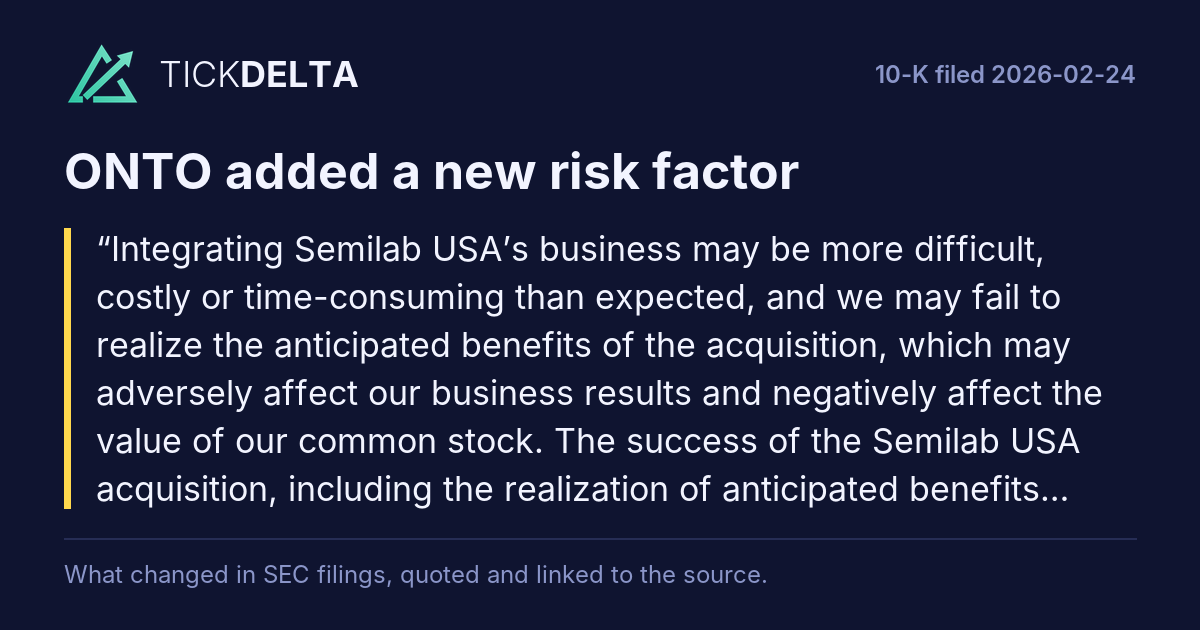
•Integrating Semilab USA’s business may be more difficult, costly or time-consuming than expected, and we may fail to realize the anticipated benefits of the acquisition, which may adversely affect our business results and negatively affect the value of our common stock.
financial condition and results of operations. If we cannot timely deliver our systems, our results from operations and cash flows could be materially and adversely affected.
The use or anticipated use of new and evolving technologies, such as AI, by us or third parties may increase or create new operational risks.
We have in the past and will in the future integrate new and evolving technologies, such as AI, into our business. AI technologies offer numerous potential benefits, such as creating or increasing operational efficiencies, and we expect an increase in the use of AI and generative AI by us, third parties on our behalf, and other market actors, including our competitors. However, the deployment of such technologies also poses certain risks, including that the algorithms may be flawed, misused or otherwise function in an unexpected manner; data sets may be insufficient, of poor quality, or contain biased information;
and inappropriate or controversial data practices by data scientists, engineers, and end-users could impair results. If the analyses that AI-based applications assist in producing are or are perceived to be deficient, inaccurate or biased, we could be subjected to competitive harm, potential legal liability and brand or reputational harm. The introduction of AI technologies into our operations may also potentially result in new or enhanced compliance requirements, governmental or regulatory scrutiny, litigation, confidentiality or security risks or other complications. The rapid evolution of AI will also require the application of significant resources to design, develop, test, oversee and maintain our products and services to help ensure that AI is implemented in accordance with applicable law and regulation to minimize any real or perceived unintended harmful impacts. If improperly managed, increase reliance on AI could result in damage our reputation, result in the loss of valuable property and information, cause us to breach applicable laws and regulations, and adversely impact our business.
We are also subject to evolving and increasingly complex laws, regulations and standards relating to data protection, privacy, and cybersecurity in the United States and globally, as well as to the SEC’s disclosure requirements regarding cybersecurity risk management, strategy, governance and incident reporting. Failure to prevent or timely detect and remediate a cybersecurity incident, or to comply with applicable laws, regulations, contracts, or industry standards, could result in governmental inquiries or enforcement, regulatory penalties, private litigation, indemnity obligations, and other adverse consequences.
We maintain cybersecurity insurance; however, coverage may not be sufficient to cover all losses or impacts from a cybersecurity incident.
Show the other 4
products that may be affected by these recent U.S. government actions, including potential order cancellations. If the sale of these products is delayed or we are unable to return or dispose of our inventory on favorable economic terms, we may incur additional carrying costs for the inventory or otherwise record charges associated with this inventory.
to existing tax laws or have proposed or enacted new laws that could increase our tax obligations in countries where we do business or cause us to change the way we operate our business. Any of these developments or changes in federal, state, or international tax laws or tax rulings could adversely affect our effective tax rate and our results of operations.
and sourcing, manufacturing, and distributing our products in a responsible and environmentally friendly manner, and any failure on our part to do so may cause reputational harm for the Company.
Integrating Semilab USA’s business may be more difficult, costly or time-consuming than expected, and we may fail to realize the anticipated benefits of the acquisition, which may adversely affect our business results and negatively affect the value of our common stock.
The success of the Semilab USA acquisition, including the realization of anticipated benefits, will depend, in part, on our ability to successfully combine our and Semilab USA’s businesses. The integration may be more difficult, costly or time consuming than expected. It is possible that the integration process could result in the loss of key employees or the disruption of each company’s ongoing businesses or that the alignment of standards, controls, procedures and policies may adversely affect the combined company’s ability to maintain relationships with clients, customers, suppliers and employees or to fully achieve the anticipated benefits and cost savings of the transaction. The loss of key employees could adversely affect our ability to successfully conduct our business in the markets in which Semilab USA now operates, which could have an adverse effect on our financial results. Other potential difficulties of combining our and Semilab USA’s businesses include unanticipated issues in integrating manufacturing, logistics, information communications and other systems. If we experience difficulties with the integration process, the anticipated benefits of the Semilab USA acquisition may not be realized fully or at all, or may take longer to realize than expected. Integration efforts between the two companies may also divert management attention and resources. These integration matters could have an adverse effect on our business and Semilab USA during this transition period and for an undetermined period after completion of the Semilab USA acquisition on the combined company.
Paragraphs in the 10-Q filed Nov 9, 2026 that were not in the one before
New in the latest 10-Q
21 paragraphs in the 10-Q filed Nov 9, 2026 with nothing like them in the 10-Q filed Aug 6, 2026 (at least half the words must differ; new numbers alone do not count). Quoted exactly, grouped by the item heading above them. This is text that changed, not a judgement of how serious it is.
Financial statements and notes
On February 18, 2026, the Company’s Board of Directors (“Board”) changed the Company’s fiscal year-end from a 52-53-week fiscal year ending on the Saturday closest to December 31 to a December 31 fiscal year-end. The Company made the fiscal year change on a prospective basis and will not adjust operating results for prior periods. Additionally, the Company has adopted calendar quarter fiscal period ends commencing with the first quarter ended March 31, 2026. The change affects the prior year comparability of the Company’s fiscal quarters in 2025 and has resulted in shifts in the quarterly periods, which is not expected to have a material impact on our quarterly financial results. Our fiscal year ended January 3, 2026 was a 53-week fiscal year. The third quarter of the fiscal year ended January 3, 2026 ended on September 27, 2025. Throughout this document, the three month period ended September 30, 2026 represents the quarterly period that commenced on July 1, 2026, and ended on September 30, 2026. The three month period ended September 27, 2025 represents the quarterly period that commenced on June 29, 2025 and ended on September 27, 2025. The nine month period ended September 30, 2026 represents the period that commenced on January 4, 2026, the first day of our fiscal year, and ended on September 30, 2026. The nine month period ended September 27, 2025 represents the period that commenced on December 29, 2024 and ended on September 27, 2025.
Read in the 10-Q
The preparation of financial statements in conformity with U.S. GAAP requires management to make estimates and assumptions that affect the reported amounts of assets and liabilities and disclosure of contingent assets and liabilities as of the date of the financial statements and the reported amounts of revenue and expenses during the reporting period. Estimates made by management include excess and obsolete inventory, fair value of assets acquired and liabilities assumed in a business combination, recoverability and useful lives of property, plant and equipment and identifiable intangible assets, recoverability of goodwill, recoverability of deferred tax assets, allowance for credit losses, liabilities for product warranty, share-based payments and liabilities for tax uncertainties. Actual results could differ from those estimates.
Read in the 10-Q
These estimates and assumptions are based on historical experience and on various other factors which the Company believes to be reasonable under the circumstances. The Company may engage third-party valuation specialists to assist with estimates related to the valuation of financial instruments, assets and stock awards associated with various contractual arrangements. Such estimates often require the selection of appropriate valuation methodologies and significant judgment. Actual results could differ from these estimates under different assumptions or circumstances and such differences could be material.
Read in the 10-Q
In addition to the significant accounting policies disclosed in the Company’s Annual Report on Form 10-K for the fiscal year ended January 3, 2026, the Company has adopted the following accounting policy during the period.
Read in the 10-Q
Investments in equity securities in which a company has the ability to exercise significant influence, but not control, are accounted for under the equity method in accordance with ASC 323, Investments - Equity Method and Joint Ventures, unless the company elects the fair value option under ASC 825, Financial Instruments. The fair value option may be elected on an instrument-by-instrument basis, must be elected at initial recognition, and is irrevocable once made.
Read in the 10-Q
Show the other 16
For equity securities for which the fair value option has been elected, the investment is measured at fair value at each reporting date, with all changes in fair value recognized in net income. For investments denominated in foreign currency, the investment is remeasured to U.S. dollars at the closing spot exchange rate at each reporting date, and the change in the U.S. dollar fair value attributable to both the change in the security’s quoted price and the change in exchange rates is recognized in net income without bifurcation. No amounts related to these investments are recorded in other comprehensive income. Dividends are recognized as income when the Company’s right to receive payment is established and do not reduce the carrying amount of the investment.
Read in the 10-Q
Upon initial recognition, the Company elected the fair value option for its investment in Rigaku Holdings Corporation (“Rigaku”). For further information, see Note 2, “Acquisitions and Investments,” and Note 3, “Fair Value Measurements.”
Read in the 10-Q
In December 2025, the FASB issued ASU 2025-12, “Codification Improvements,” which addresses suggestions received from stakeholders regarding the ASC and makes other incremental improvements to U.S. GAAP. The update represents changes to the ASC that clarify, correct errors in or make other improvements to a variety of topics that are intended to make it easier to understand and apply. The amendments in this update are effective for the Company beginning January 1, 2027, with early adoption permitted. The Company adopted this ASU during the quarter ended June 30, 2026. In connection with the adoption, the Company elected an accounting policy to allocate the excess of the repurchase price over par for all shares repurchased and retired to additional paid-in capital on a prospective basis.
Read in the 10-Q
On August 10, 2026, the Company completed the previously announced acquisition of 61,123,436 shares (27% of the issued and outstanding shares) of common stock of Rigaku for $719.5 million from Atom Investment, L.P., an affiliate of The Carlyle Group (the “Rigaku Transaction”), funded with a portion of the net proceeds from the issuance and sale of the Company’s 0.00% Convertible Senior Notes due 2031 (“2031 Notes”) and cash on hand. Rigaku’s common stock is listed on the Tokyo Stock Exchange. In connection with the Rigaku Transaction, the Company received the right to nominate one director to Rigaku’s board of directors.
Read in the 10-Q
The Company’s 27% ownership interest results in a presumption of significant influence under ASC 323, Investments - Equity Method and Joint Ventures. At initial recognition, the Company irrevocably elected the fair value option under ASC 825, Financial Instruments, for its investment in Rigaku. The Company elected the fair value option because Rigaku’s shares are publicly traded and have a readily determinable fair value, and management believes fair value provides the most relevant and transparent measure of the economic value of the investment. The Company does not control Rigaku and does not consolidate Rigaku’s financial results.
Read in the 10-Q
The investment in Rigaku is presented as “Investment in Rigaku,” a non-current asset, on the Condensed Consolidated Balance Sheets. The investment is remeasured to fair value at each reporting date based on the quoted market price of Rigaku’s common stock on the Tokyo Stock Exchange, translated into U.S. dollars at the closing spot exchange rate. All changes in the U.S. dollar fair value of the investment, including amounts attributable to changes in Rigaku’s share price and changes in the Japanese yen to U.S. dollar exchange rate, are recognized in net income within “Unrealized gain (loss) on investment in Rigaku” under “Other income, net” in the Condensed Consolidated Statements of Operations. The components are not bifurcated, and no amounts related to this investment are recorded in other comprehensive income. Dividends declared by Rigaku, if any, are recognized as dividend income when the Company’s right to receive payment is established and do not reduce the carrying amount of the investment.
Read in the 10-Q
Under the fair value option, the Company does not recognize its proportionate share of Rigaku’s net income or loss, amortization of acquisition-date basis difference, or equity method adjustments for Rigaku’s other comprehensive income items. Changes in the fair value of the investment are recognized currently in net income but are not taxable or deductible until realized. The resulting difference between the carrying amount of the investment and its tax basis is a temporary difference, for which the Company recognizes deferred taxes.
Read in the 10-Q
The following table summarizes the activity in the Company’s investment in Rigaku:
Read in the 10-Q
The Company’s effective tax rate was 27.9% and 18.0% for the three and nine month periods ended September 30, 2026, respectively, compared to 12% for both the three and nine month period ended September 27, 2025. The effective tax rate for the three and nine month periods ended September 30, 2026 was impacted by various tax items, primarily the tax impact associated with the unrealized loss on the Company’s investment in Rigaku for which no benefit was recognized due to a valuation allowance, which increased the effective tax rate by 10.8 and 3.5 percentage points, respectively.
Read in the 10-Q
The Company’s effective tax rate differed from the U.S. federal statutory rate of 21% primarily due to the impact of foreign taxes, including the Pillar Two global minimum tax, the tax impact associated with the unrealized loss on the Company’s
Read in the 10-Q
• the Company’s ability to realize the anticipated benefits of the Rigaku Transaction;
Read in the 10-Q
On August 10, 2026, the Company completed the Rigaku Transaction, funded with a portion of the net proceeds from the 2031 Notes and cash on hand. In connection with the Rigaku Transaction, we received the right to nominate one director to Rigaku’s board of directors.
Read in the 10-Q
The Company does not control Rigaku and does not consolidate Rigaku’s financial results. At initial recognition, the Company irrevocably elected the fair value option under ASC 825, Financial Instruments, for its investment in Rigaku, which is presented as “Investment in Rigaku,” a non-current asset, on the Condensed Consolidated Balance Sheets. The investment is remeasured to fair value at each reporting date based on the quoted market price of Rigaku’s common stock on the Tokyo Stock Exchange, translated into U.S. dollars at the closing spot exchange rate. All changes in the U.S. dollar fair value of the investment, including amounts attributable to changes in Rigaku’s share price and changes in the Japanese yen to U.S. dollar exchange rate, are recognized in net income within “Unrealized gain (loss) on investment in Rigaku” under “Other income (expense), net” in the Condensed Consolidated Statements of Operations. We recognized an unrealized loss of $40.8 million for the three and nine months ended September 30, 2026.
Read in the 10-Q
The following table reconciles our GAAP effective tax rate to our non-GAAP adjusted effective tax rate, which excludes the tax impact associated with the investment in Rigaku. We believe the non-GAAP adjusted effective tax rate provides useful information to investors in evaluating our effective tax rate because the changes in the fair value are driven by the market price of Rigaku’s shares and, because no tax benefit is recognized on unrealized losses due to a valuation allowance, may result in significant period to period variability in our effective tax rate. Management uses the non-GAAP adjusted effective tax rate to evaluate tax impacts from ordinary operations.
Read in the 10-Q
There was no comparable adjustment in the 2025 periods because the investment in Rigaku occurred in 2026.
Read in the 10-Q
Market risk
As discussed in Note 1, “Basis of Presentation,” the Company is exposed to equity price related to its investment in Rigaku. The investment is measured at fair value based on Rigaku’s quoted market price on the Tokyo Stock Exchange. Accordingly, changes in the fair value of the investment are recognized in earnings.
Read in the 10-Q
The 10-Q's risk factors against the 10-K
Item 1A of the 10-Q filed Nov 9, 2026 against Item 1A of the 10-K filed Feb 24, 2026.
A 10-Q repeats only the risks that changed, so a 10-K paragraph that is missing from it is not counted as removed.
Added is a paragraph with nothing like it in the 10-K, Reworded a sentence that is in both with several words changed,
Quiet changes a sentence in both where one to four words changed and one is a hedge or a modal
(cut words struck through, new words highlighted).
Text on the page, not a score; each links to the filing at sec.gov.
What the 10-Q itself says about its risk factors:There have been no material changes from the risk factors previously disclosed under the heading “Risk Factors” in the 2025 Form 10-K, as updated by the risk factors previously disclosed under the heading “Risk Factors” in the Company’s Quarterly Reports on Form 10-Q for the quarterly periods ended March 31, 2026, filed with the SEC on May 5, 2026, and June 30, 2026, filed with the SEC on August 6, 2026. We may disclose additional changes to risk factors or additional factors from time to time in our future filings with the SEC.
Read in the 10-Q
1 paragraph in the 10-Q's Item 1A, and none of them adds, rewords or quietly edits a paragraph of the 10-K's.
Phrases used for the first time
Two-word phrases in Risk Factors of the 10-K filed Feb 24, 2026 that are in none of the 1 earlier 10-Ks stored, back to Feb 25, 2025
Where each one is used
- anticipated benefits: •Integrating Semilab USA’s business may be more difficult, costly or time-consuming than expected, and we may fail to realize the anticipated benefits of the acquisition, which may adversely affect our business results and negatively affect the value of our common stock.
- semilab usa: •Integrating Semilab USA’s business may be more difficult, costly or time-consuming than expected, and we may fail to realize the anticipated benefits of the acquisition, which may adversely affect our business results and negatively affect the value of our common stock.
- semilab usa’s: •Integrating Semilab USA’s business may be more difficult, costly or time-consuming than expected, and we may fail to realize the anticipated benefits of the acquisition, which may adversely affect our business results and negatively affect the value of our common stock.
- recently implemented: •We recently implemented a new enterprise resource planning system. Our failure to effectively operate and maintain the new system could have a material adverse effect on us.
- new system: •We recently implemented a new enterprise resource planning system. Our failure to effectively operate and maintain the new system could have a material adverse effect on us.
- evolving technologies: •The use or anticipated use of new and evolving technologies, such as AI, by us or third parties may increase or create new operational risks.
- difficult costly: •Integrating Semilab USA’s business may be more difficult, costly or time-consuming than expected, and we may fail to realize the anticipated benefits of the acquisition, which may adversely affect our business results and negatively affect the value of our common stock.
- tariffs imposed: Recent changes in U.S. trade policy have adversely affected and may continue to adversely affect our business. In 2025, the U.S. implemented a number of tariffs on goods imported into the U.S. (“U.S. Tariffs”). In addition, in retaliation for the tariffs imposed on U.S. imports, a number of other countries...
Used at least twice, small words left out. Counted, not picked: a phrase can be new because the company renamed something.
What was taken out
4 paragraphs of last year's Risk Factors with nothing like them now. The longest are quoted.
Sources
Item 1A of each 10-K and 10-Q on EDGAR, quoted exactly. Each paragraph links to the filing at sec.gov.
Also
10-K change: what was reworded or cut, section by section.
Work with it
Excel workbook · CSV. Google Sheet that stays up to date: paste =IMPORTDATA("https://tickdelta.com/company/ONTO/export.csv") into a cell.