Paragraph 107 · 50% changed
Every version of it
Screener
/
SEC EDGAR
/CIK 0000704532
/10-K filed Feb 24, 2026, compared with Feb 25, 2025
/Numbers from the XBRL of the 10-Ks
NYSE
Technology · Measuring Instruments
Onto Innovation Inc. ONTO
The 10-K against last year's
83 changes: 15 added, 6 removed, 61 reworded, 1 quiet changes
10-K Feb 24, 2026 vs Feb 25, 2025
Risk Factors
12.6%
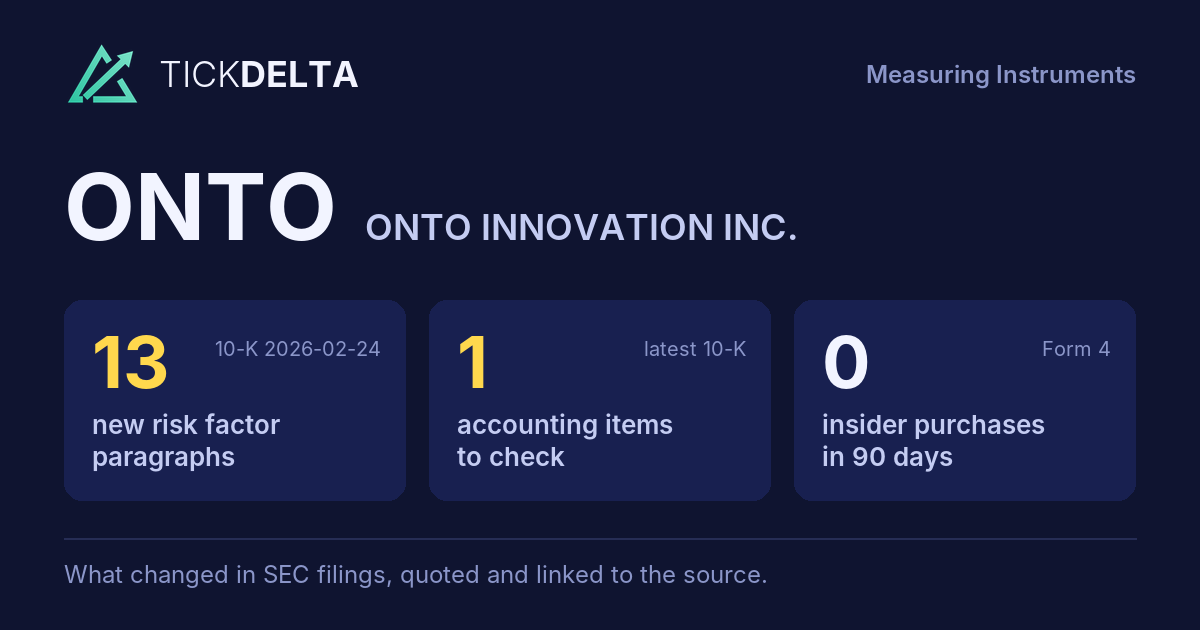
of the text changed · 13,803 words now · 13 new paragraphs, 4 gone
MD&A
15.4%
of the text changed · 4,990 words now · 2 new paragraphs, 2 gone
10-K 0001193125-26-066937 (Feb 24, 2026) vs 10-K 0000950170-25-026729 (Feb 25, 2025) Not compared: Legal Proceedings, Accounting Policies.
Every paragraph, and how much of it changed
One bar per paragraph, in the order of the 10-K. Height and colour show the share of its words not in the closest paragraph a year earlier; the tallest bars are new paragraphs.
Risk Factors
174 paragraphs · 13 new · 42 reworded · 4 gone · 10-K Feb 24, 2026 against Feb 25, 2025
New paragraph
Reworded (5% of its words or more)
Same or nearly
Paragraph 102 · 42% changed
Every version of it
Many of our existing and potential customers in the semiconductor device manufacturing industry are large companies that require global support and service for their semiconductor capital equipment. Some of our competitors have more extensive support and service infrastructures than we do, which could place us at a disadvantage when competing for the business of global semiconductor device manufacturers. Many of our competitors are investing heavily in the development of new systems that will compete directly with our systems. We have, from time to time, selectively reduced prices on our systems in order to protect our market share, and competitive pressures may necessitate further price reductions. We expect our competitors in each product area to continue to improve the design and performance of their products and to introduce new products with competitive prices and performance characteristics. These product introductions would likely require us to decrease the prices of our systems and increase the level of discounts that we grant our customers. Price reductions or lost sales as a result of these competitive pressures would reduce our total revenue and could adversely impact our financial results.
Paragraph 159 · 31% changed
Every version of it
Paragraph 95 · 29% changed
Every version of it
those suppliers, which could hamper our ability to ship our products to our customers, harming our results of operations and our customer relationships. Any or all of the above issues could negatively affect our ability to attract new customers, cause existing customers to choose to purchase from our competitors, result in reputational damage or subject us to third-party lawsuits, regulatory fines or other action or liability, which could adversely affect our operating results.
Paragraph 40 · 28% changed
Every version of it
We need to continually evaluate our global supply chains chain and assess opportunities to reduce costs. We must also enhance quality, speed and flexibility to meet changing demand for our products and product mix and uncertain market conditions. Our success also depends in part on refining our cost structure and supply chains so that we have flexibility and can maintain and improve profitability. Deterioration Recent changes in the tariff environment such as discussed herein under the heading “Tariffs, export regulations, and other market barriers have impacted and may continue to impact cause fluctuation in our ability to compete for the business of domestic customers in China and other jurisdictions, which has adversely affected and may continue to adversely affect our, business, financial condition and results of operations,” political instability or changes in suppliers may cause our costs to increase and, if costs. If we are not able unable to successfully negotiate price reductions with our suppliers, adjust our operations to reduce tariff exposure, and/or offset the increased costs by charging higher sales prices, our margins will decline, resulting in an adverse impact to our business and results of operations. Political instability and/or changes in suppliers may also cause a decline in our margins. To improve margins on our products, we would need costs to negotiate price reductions with our vendors. But we cannot be certain that we will be able to do so in a timely manner, or at all. Failure to achieve the desired level of cost reductions could adversely affect our financial results. increase. Despite our efforts to control costs and increase efficiency in our facilities, changes in demand could still cause us to realize lower operating margins and profitability.
Paragraph 132 · 28% changed
Every version of it
The OECD has released guidance covering various topics, including country-by-country reporting, definitional changes to permanent establishment and Base Erosion and Profit Shifting (“BEPS”), an initiative that aims to standardize and modernize global tax policy. The guidance also established a global minimum tax of 15%. This guidance has been implemented by several jurisdictions, including jurisdictions in which we operate, and many other jurisdictions are in the process of implementing it. Depending on the final form of legislation ultimately enacted, there may be significant consequences for us due to our international business activities, including, but not limited to, an increase in our tax uncertainty and adverse effects on our provision for income taxes. The U.S. presidential administration has directed On January 5, 2026, the U.S. Department OECD announced that the Inclusive Framework on Base Erosion and Profit Shifting agreed to a new package of Treasury to develop options for “protective measures” in response to tax rules imposed by non-U.S. countries that are extraterritorial or disproportionately affect U.S. companies (which may include taxes imposed administrative guidance under the OECD guidance) and legislation has been introduced Pillar Two global minimum tax rules. The new administrative guidance allows for U.S. multinationals to provide for a Side-by-Side Safe Harbor that would increase exclude U.S.-parented multinational groups from the global minimum tax rule’s Income Inclusion Rule and Undertaxed Profits Rule on the grounds that the existing U.S. tax rates on non-U.S. companies law is sufficiently robust in its taxation of domestic and investors if their home jurisdictions impose discriminatory or extraterritorial taxes on foreign profits. Although we will continue to monitor U.S. companies, but and international legislative developments in this area, we cannot predict whether such protective measures or legislation will be adopted or what, by non-U.S. countries, if any, and whether the U.S. would have any responsive measures will be adopted by non-U.S. countries. measures.
Paragraph 11 · 28% changed
Every version of it
•We are implementing recently implemented a new enterprise resource planning system. Our failure to implement it successfully, on time effectively operate and on budget maintain the new system could have a material adverse effect on us.
Paragraph 67 · 28% changed
Every version of it
We are implementing recently implemented a new enterprise resource planning system. Our failure to implement it successfully, on time effectively operate and on budget maintain the new system could have a material adverse effect on us.
Paragraph 107 · 50% changed
Every version of it
10-K Feb 25, 2025•If we do not manage our supply chain effectively, our operating results may be adversely affected, and any increases in material, labor, supplier, logistics and other operating costs, or supply chain delays and shortages, could lower our margins or result in lost sales.
10-K Feb 24, 2026
Recent changes in U.S. trade policy have adversely affected and may continue to adversely affect our business. In 2025, the U.S. implemented a number of tariffs on goods imported into the U.S. (“U.S. Tariffs”). In addition, in retaliation for the tariffs imposed on U.S. imports, a number of other countries announced reciprocal tariffs on goods imported from the U.S. The U.S. Tariffs and reciprocal tariffs imposed by other countries may continue to evolve. As discussed above under the heading “If we do not manage our supply chain effectively, our operating results may be adversely affected, and any increases in material, labor, supplier, logistics and other operating costs, or supply chain delays and shortages, could lower our margins or result in lost sales,” the U.S. Tariffs have increased, and may continue to increase, our supply chain costs. Reciprocal tariffs imposed by other countries have harmed and may continue to harm demand for our products from customers in those regions, or may cause our customers in those regions to push out or cancel previously placed purchase orders.
Paragraph 102 · 42% changed
Every version of it
10-K Feb 25, 2025
Many of our existing and potential customers in the semiconductor device manufacturing industry are large companies that require global support and service for their semiconductor capital equipment. Some of our competitors have more extensive support and service infrastructures than we do, which could place us at a disadvantage when competing for the business of global semiconductor device manufacturers. Many of our competitors are investing heavily in the development of new systems that will compete directly with our systems. We have, from time to time, selectively reduced prices on our systems in order to protect our market share, and competitive pressures may necessitate further price reductions. We expect our competitors in each product area to continue to improve the design and performance of their products and to introduce new products with competitive prices and performance characteristics. These product introductions would likely require us to decrease the prices of our systems and increase the level of discounts that we grant our customers. Price reductions or lost sales as a result of these competitive pressures would reduce our total revenue and could adversely impact our financial results.
10-K Feb 24, 2026
Many of our existing and potential customers in the semiconductor device manufacturing industry are large companies that require global support and service for their semiconductor capital equipment. Some of our competitors have more extensive support and service infrastructures than we do, which could place us at a disadvantage when competing for the business of
Paragraph 159 · 31% changed
Every version of it
10-K Feb 25, 2025We may also experience supplier or customer issues as a result of adverse macroeconomic conditions. If our customers have difficulties in obtaining capital or financing, this could result in lower sales. Customers with liquidity issues could also result in an increase in bad debt expense. These conditions could also affect our key suppliers, which could affect their ability to supply parts and result in delays of our customer shipments.
10-K Feb 24, 2026
result in an increase in bad debt expense. These conditions could also affect our key suppliers, which could affect their ability to supply parts and result in delays of our customer shipments.
Paragraph 95 · 29% changed
Every version of it
10-K Feb 25, 2025
existing customers to choose to purchase from our competitors, result in reputational damage or subject us to third-party lawsuits, regulatory fines or other action or liability, which could adversely affect our operating results.
10-K Feb 24, 2026
those suppliers, which could hamper our ability to ship our products to our customers, harming our results of operations and our customer relationships. Any or all of the above issues could negatively affect our ability to attract new customers, cause existing customers to choose to purchase from our competitors, result in reputational damage or subject us to third-party lawsuits, regulatory fines or other action or liability, which could adversely affect our operating results.
Paragraph 40 · 28% changed
Every version of it
10-K Feb 25, 2025
We need to continually evaluate our global supply chains and assess opportunities to reduce costs. We must also enhance quality, speed and flexibility to meet changing demand for our products and product mix and uncertain market conditions. Our success also depends in part on refining our cost structure and supply chains so that we have flexibility and can maintain and improve profitability. Deterioration in the tariff environment such as discussed herein under the heading “Tariffs, export regulations, and other market barriers have impacted and may continue to impact our ability to compete for the business of domestic customers in China and other jurisdictions, which has adversely affected and may continue to adversely affect our, business, financial condition and results of operations,” political instability or changes in suppliers may cause our costs to increase and, if we are not able to offset the increased costs by charging higher sales prices, will cause a decline in our margins. To improve margins on our products, we would need to negotiate price reductions with our vendors. But we cannot be certain that we will be able to do so in a timely manner, or at all. Failure to achieve the desired level of cost reductions could adversely affect our financial results. Despite our efforts to control costs and increase efficiency in our facilities, changes in demand could still cause us to realize lower operating margins and profitability.
10-K Feb 24, 2026
We need to continually evaluate our global supply chain and assess opportunities to reduce costs. We must also enhance quality, speed and flexibility to meet changing demand for our products and product mix and uncertain market conditions. Our success also depends in part on refining our cost structure and supply chains so that we have flexibility and can maintain and improve profitability. Recent changes in the tariff environment may continue to cause fluctuation in our costs. If we are unable to successfully negotiate price reductions with our suppliers, adjust our operations to reduce tariff exposure, and/or offset the increased costs by charging higher sales prices, our margins will decline, resulting in an adverse impact to our business and results of operations. Political instability and/or changes in suppliers may also cause our costs to increase. Despite our efforts to control costs and increase efficiency in our facilities, changes in demand could still cause us to realize lower operating margins and profitability.
Paragraph 132 · 28% changed
Every version of it
10-K Feb 25, 2025
The OECD has released guidance covering various topics, including country-by-country reporting, definitional changes to permanent establishment and Base Erosion and Profit Shifting (“BEPS”), an initiative that aims to standardize and modernize global tax policy. The guidance also established a global minimum tax of 15%. This guidance has been implemented by several jurisdictions, including jurisdictions in which we operate, and many other jurisdictions are in the process of implementing it. Depending on the final form of legislation ultimately enacted, there may be significant consequences for us due to our international business activities, including, but not limited to, an increase in our tax uncertainty and adverse effects on our provision for income taxes. The U.S. presidential administration has directed the U.S. Department of Treasury to develop options for “protective measures” in response to tax rules imposed by non-U.S. countries that are extraterritorial or disproportionately affect U.S. companies (which may include taxes imposed under the OECD guidance) and legislation has been introduced that would increase U.S. tax rates on non-U.S. companies and investors if their home jurisdictions impose discriminatory or extraterritorial taxes on U.S. companies, but we cannot predict whether such protective measures or legislation will be adopted or what, if any, responsive measures will be adopted by non-U.S. countries.
10-K Feb 24, 2026
The OECD has released guidance covering various topics, including country-by-country reporting, definitional changes to permanent establishment and Base Erosion and Profit Shifting (“BEPS”), an initiative that aims to standardize and modernize global tax policy. The guidance also established a global minimum tax of 15%. This guidance has been implemented by several jurisdictions, including jurisdictions in which we operate, and many other jurisdictions are in the process of implementing it. Depending on the final form of legislation ultimately enacted, there may be significant consequences for us due to our international business activities, including, but not limited to, an increase in our tax uncertainty and adverse effects on our provision for income taxes. On January 5, 2026, the OECD announced that the Inclusive Framework on Base Erosion and Profit Shifting agreed to a new package of administrative guidance under the Pillar Two global minimum tax rules. The new administrative guidance allows for U.S. multinationals to provide for a Side-by-Side Safe Harbor that would exclude U.S.-parented multinational groups from the global minimum tax rule’s Income Inclusion Rule and Undertaxed Profits Rule on the grounds that the existing U.S. law is sufficiently robust in its taxation of domestic and foreign profits. Although we will continue to monitor U.S. and international legislative developments in this area, we cannot predict whether such protective measures or legislation will be adopted by non-U.S. countries, if any, and whether the U.S. would have any responsive measures.
Paragraph 11 · 28% changed
Every version of it
10-K Feb 25, 2025
•We are implementing a new enterprise resource planning system. Our failure to implement it successfully, on time and on budget could have a material adverse effect on us.
10-K Feb 24, 2026
•We recently implemented a new enterprise resource planning system. Our failure to effectively operate and maintain the new system could have a material adverse effect on us.
Paragraph 67 · 28% changed
Every version of it
10-K Feb 25, 2025
We are implementing a new enterprise resource planning system. Our failure to implement it successfully, on time and on budget could have a material adverse effect on us.
10-K Feb 24, 2026
We recently implemented a new enterprise resource planning system. Our failure to effectively operate and maintain the new system could have a material adverse effect on us.
MD&A
62 paragraphs · 2 new · 28 reworded · 2 gone · 10-K Feb 24, 2026 against Feb 25, 2025
New paragraph
Reworded (5% of its words or more)
Same or nearly
Paragraph 58 · 46% changed
Indefinite-Lived and Long-Lived Assets. Goodwill is tested for impairment during the fourth quarter, or whenever events or circumstances indicate that its carrying value may not be recoverable. Goodwill impairment is tested at the reporting unit level, which is defined as an operating segment or one level below the operating segment. Goodwill is reviewed for impairment using either a qualitative assessment or a quantitative goodwill impairment test. If the Company chooses to perform a qualitative assessment and determine the fair value more likely than not exceeds the carrying value, no further evaluation is necessary. When the Company performs the quantitative goodwill impairment test, it compares fair value to carrying value, which includes goodwill. If fair value exceeds carrying value, the goodwill is not considered impaired. If the carrying value is higher than the fair value, the difference would be recognized as an impairment loss.
Paragraph 27 · 45% changed
Paragraph 9 · 37% changed
•Gross profit as a percentage of revenue increased decreased to 49.7% for fiscal 2025 compared to 52.2% for fiscal 2024 compared to 51.5% for fiscal 2023. 2024. This was primarily driven by an increase in volume write-downs of excess and change in product mix, partially offset by write-downs obsolete inventory, restructuring costs related to the impairment infrastructure transition and exit of certain lithography inventory costs related to contract manufacturing set-up in fiscal 2024. 2025.
Paragraph 10 · 34% changed
•The increase in operating expenses in fiscal 2024 2025 compared to fiscal 2023 2024 was primarily due to increases in research increased restructuring expenses, transaction and development, and sales and marketing expenses amortization costs related to increased headcount and compensation costs, project costs, travel expenses and write-off the acquisition of purchased in process Semilab USA, research and development assets. project costs and compensation cost.
Paragraph 30 · 30% changed
The income tax provision differs from the federal statutory income tax rate of 21% for 2024 2025 primarily due to a benefit related to the Foreign Derived Intangible Income Deduction (“FDII”) of $17.0 million, tax effect of share-based compensation of $6.9 million, tax benefits for research and development credits of $6.6 million, a decrease to the Company’s valuation allowance of $1.8 $7.2 million, and a one-time benefit excess tax benefits of $3.2 million related to the recognition share-based compensation of a tax benefit associated with the lapse of a statute of limitations. $2.4 million. These benefits were partially offset by non-deductible officer’s compensation of $3.4 $3.1 million. The effective tax rate for the year ended Jan 3, 2026 was impacted by the enactment of the One Big Beautiful Bill Act (“OBBBA”) that resulted in less FDII benefit from the prior fiscal year.
Paragraph 48 · 28% changed
Paragraph 36 · 26% changed
Cash provided by operating activities during fiscal 2023 2025 was $172.0 $328.3 million, which reflects net income, adjusted to exclude the effect of non-cash operating charges, of $204.5 $131.5 million. Significant non-cash operating charges included depreciation, amortization, share-based compensation, provision for inventory valuation and deferred income taxes. Cash provided by operating activities in fiscal 2023 2025 increased compared to fiscal 2022 2024 primarily due to improved inventory management cash collections and lower higher accounts payable balances driven by increased contract manufacturing activity, partially offset by higher cash outflows for income tax payments. taxes resulting from the timing of payments and the settlement of prior period liabilities, as well as a use of cash in accrued and other liabilities.
Paragraph 47 · 25% changed
Revenue Recognition. Revenue is recognized when control of the promised goods or services are transferred to our customers in an amount that reflects the consideration we expect to be entitled to receive in exchange for those goods or services. We account for a contract when it has approval and commitment from both parties, the rights of the parties and payment terms are identified, the contract has commercial substance and collectability of consideration is probable.
Paragraph 58 · 46% changed
10-K Feb 25, 2025
Indefinite-Lived and Long-Lived Assets. Goodwill is tested for impairment during the fourth quarter, or whenever events or circumstances indicate that its carrying value may not be recoverable. Goodwill impairment is tested at the reporting unit level, which is defined as an operating segment or one level below the operating segment. Goodwill is reviewed for impairment using either a qualitative assessment or a quantitative goodwill impairment test. If the Company chooses to perform a qualitative assessment and determine the fair value more likely than not exceeds the carrying value, no further evaluation is necessary. When the Company performs the quantitative goodwill impairment test, it compares fair value to carrying value, which includes goodwill. If fair value exceeds carrying value, the goodwill is not considered impaired. If the carrying value is higher than the fair value, the difference would be recognized as an impairment loss.
10-K Feb 24, 2026
Indefinite-Lived and Long-Lived Assets. Goodwill is tested for impairment during the fourth quarter, or whenever events or circumstances indicate that its carrying value may not be recoverable. Goodwill impairment is tested at the reporting unit
Paragraph 27 · 45% changed
10-K Feb 25, 2025•General and Administrative. General and administrative expenses are primarily comprised of salaries and related costs for general administrative personnel, as well as other non-personnel related expenses. Our general and administrative expenses were $85.8 million, $83.1 million and $69.6 million in fiscal years 2024, 2023 and 2022, respectively. The year-over-year dollar increase from 2023 through 2024 was primarily due to increases in depreciation expense of $1.8 million and facilities expense of $1.4 million, partially offset by a decrease in freight and duty costs of $0.5 million. The year-over-year dollar increase from 2022 through 2023 was primarily due increased litigation expenses of $7.4 million, restructuring charges of $3.6 million for employee severance costs during the 2023 period, an increase in depreciation expense of $1.9 million and an increase in facilities expenses of $0.4 million.
10-K Feb 24, 2026
•Restructuring and Other. Restructuring and other expenses were $18.4 million, $9.0 million and $3.6 million in fiscal years 2025, 2024 and 2023, respectively. The year-over-year increase from 2024 through 2025 was primarily due to an increase in business transformation projects that includes the streamlining of various operating activities. The year-over-year increase from 2023 through 2024 was primarily due to an increase in employee severance costs and business transformation projects that includes the streamlining of various operating activities.
Paragraph 9 · 37% changed
10-K Feb 25, 2025
•Gross profit as a percentage of revenue increased to 52.2% for fiscal 2024 compared to 51.5% for fiscal 2023. This was primarily driven by an increase in volume and change in product mix, partially offset by write-downs related to the impairment and exit of certain lithography inventory in fiscal 2024.
10-K Feb 24, 2026
•Gross profit as a percentage of revenue decreased to 49.7% for fiscal 2025 compared to 52.2% for fiscal 2024. This was primarily driven by write-downs of excess and obsolete inventory, restructuring costs related to infrastructure transition and costs related to contract manufacturing set-up in fiscal 2025.
Paragraph 10 · 34% changed
10-K Feb 25, 2025
•The increase in operating expenses in fiscal 2024 compared to fiscal 2023 was primarily due to increases in research and development, and sales and marketing expenses related to increased headcount and compensation costs, project costs, travel expenses and write-off of purchased in process research and development assets.
10-K Feb 24, 2026
•The increase in operating expenses in fiscal 2025 compared to fiscal 2024 was primarily due to increased restructuring expenses, transaction and amortization costs related to the acquisition of Semilab USA, research and development project costs and compensation cost.
Paragraph 30 · 30% changed
10-K Feb 25, 2025
The income tax provision differs from the federal statutory income tax rate of 21% for 2024 primarily due to a benefit related to the Foreign Derived Intangible Income Deduction (“FDII”) of $17.0 million, tax effect of share-based compensation of $6.9 million, tax benefits for research and development credits of $6.6 million, a decrease to the Company’s valuation allowance of $1.8 million, and a one-time benefit of $3.2 million related to the recognition of a tax benefit associated with the lapse of a statute of limitations. These benefits were partially offset by non-deductible officer’s compensation of $3.4 million.
10-K Feb 24, 2026
The income tax provision differs from the federal statutory income tax rate of 21% for 2025 primarily due to a benefit related to the Foreign Derived Intangible Income Deduction (“FDII”) of $6.9 million, tax benefits for research and development credits of $7.2 million, and excess tax benefits of share-based compensation of $2.4 million. These benefits were partially offset by non-deductible officer’s compensation of $3.1 million. The effective tax rate for the year ended Jan 3, 2026 was impacted by the enactment of the One Big Beautiful Bill Act (“OBBBA”) that resulted in less FDII benefit from the prior fiscal year.
Paragraph 48 · 28% changed
10-K Feb 25, 2025Revenue Recognition. Revenue is recognized when control of the promised goods or services are transferred to our customers in an amount that reflects the consideration we expect to be entitled to receive in exchange for those goods or services. We account for a contract when it has approval and commitment from both parties, the rights of the parties and payment terms are identified, the contract has commercial substance and collectability of consideration is probable.
10-K Feb 24, 2026
services. We account for a contract when it has approval and commitment from both parties, the rights of the parties and payment terms are identified, the contract has commercial substance and collectability of consideration is probable.
Paragraph 36 · 26% changed
10-K Feb 25, 2025
Cash provided by operating activities during fiscal 2023 was $172.0 million, which reflects net income, adjusted to exclude the effect of non-cash operating charges, of $204.5 million. Significant non-cash operating charges included depreciation, amortization, share-based compensation, provision for inventory valuation and deferred income taxes. Cash provided by operating activities in fiscal 2023 increased compared to fiscal 2022 primarily due to improved inventory management and lower income tax payments.
10-K Feb 24, 2026
Cash provided by operating activities during fiscal 2025 was $328.3 million, which reflects net income, adjusted to exclude the effect of non-cash operating charges, of $131.5 million. Significant non-cash operating charges included depreciation, amortization, share-based compensation, provision for inventory valuation and deferred income taxes. Cash provided by operating activities in fiscal 2025 increased compared to fiscal 2024 primarily due to improved cash collections and higher accounts payable balances driven by increased contract manufacturing activity, partially offset by higher cash outflows for income taxes resulting from the timing of payments and the settlement of prior period liabilities, as well as a use of cash in accrued and other liabilities.
Paragraph 47 · 25% changed
10-K Feb 25, 2025
Revenue Recognition. Revenue is recognized when control of the promised goods or services are transferred to our customers in an amount that reflects the consideration we expect to be entitled to receive in exchange for those goods or services. We account for a contract when it has approval and commitment from both parties, the rights of the parties and payment terms are identified, the contract has commercial substance and collectability of consideration is probable.
10-K Feb 24, 2026
Revenue Recognition. Revenue is recognized when control of the promised goods or services are transferred to our customers in an amount that reflects the consideration we expect to be entitled to receive in exchange for those goods or
A paragraph is matched with the one last year that shares the most of its words; under half in common makes it new. The paragraphs shown are the 8 reworded the most in each section.
The paragraph that changed most in each section
The redline
Marked against last year's 10-K: cut words struck through, new words highlighted.
Risk Factors172 words changed in this paragraph; it is 61% similar to last year's version.
The OECD has released guidance covering various topics, including country-by-country reporting, definitional changes to permanent establishment and Base Erosion and Profit Shifting (“BEPS”), an initiative that aims to standardize and modernize global tax policy. The guidance also established a global minimum tax of 15%. This guidance has been implemented by several jurisdictions, including jurisdictions in which we operate, and many other jurisdictions are in the process of implementing it. Depending on the final form of legislation ultimately enacted, there may be significant consequences for us due to our international business activities, including, but not limited to, an increase in our tax uncertainty and adverse effects on our provision for income taxes. The U.S. presidential administration has directed On January 5, 2026, the U.S. Department OECD announced that the Inclusive Framework on Base Erosion and Profit Shifting agreed to a new package of Treasury to develop options for “protective measures” in response to tax rules imposed by non-U.S. countries that are extraterritorial or disproportionately affect U.S. companies (which may include taxes imposed administrative guidance under the OECD guidance) and legislation has been introduced Pillar Two global minimum tax rules. The new administrative guidance allows for U.S. multinationals to provide for a Side-by-Side Safe Harbor that would increase exclude U.S.-parented multinational groups from the global minimum tax rule’s Income Inclusion Rule and Undertaxed Profits Rule on the grounds that the existing U.S. tax rates on non-U.S. companies law is sufficiently robust in its taxation of domestic and investors if their home jurisdictions impose discriminatory or extraterritorial taxes on foreign profits. Although we will continue to monitor U.S. companies, but and international legislative developments in this area, we cannot predict whether such protective measures or legislation will be adopted or what, by non-U.S. countries, if any, and whether the U.S. would have any responsive measures will be adopted by non-U.S. countries. measures.
Source: Item 1A, 10-K 0001193125-26-066937 vs Item 1A, 10-K 0000950170-25-026729
MD&A112 words changed in this paragraph; it is 77% similar to last year's version.
•Research and Development. We believe that it is critical to continue to make substantial investments in research and development to ensure the availability of innovative technology that meets the current and projected requirements of our customers’ most advanced designs. We have maintained, and intend to continue, our commitment to investing in research and development in order to continue to offer new products and technologies. Accordingly, we devote a significant portion of our technical, management and financial resources to research and development programs. Research and development expenditures consist primarily of salaries and related expenses of employees engaged in research, design and development activities. They also include consulting fees, the cost of related supplies and legal costs to defend our intellectual property. Our research and development expenses were $116.8 $132.0 million, $104.4 $113.9 million and $112.0 $104.4 million in fiscal years 2024, 2023 2025, 2024 and 2022, 2023, respectively. The year-over-year dollar increase from 2024 through 2025 was primarily due to increases in compensation costs, production expenses and depreciation and amortization. The year-over-year dollar increase from 2023 through 2024 was primarily due to write-off of acquired in-process research and development of $4.0 million and increased increase in compensation costs of $1.6 million, costs, outside services costs of $3.3 million, costs, product development costs of $1.9 million, costs, travel costs of $0.6 million, costs, research and development project costs of $0.5 million, costs, freight and duty costs of $0.2 million costs, and depreciation expenses of $0.2 million. The year-over-year dollar decrease from 2022 through 2023 was primarily due to decreases of $4.6 million for the write-off of acquired in-process research and development assets and cost containment initiatives of $3.3 million, partially offset by increases in depreciation expenses of $0.6 million and travel expenses of $0.3 million. expenses. We continue to maintain our commitment to investing in new product development and enhancement to existing products.
Source: Item 7, 10-K 0001193125-26-066937 vs Item 7, 10-K 0000950170-25-026729
Sentences and paragraphs added, removed or reworded
Every change, by type
Sentences and paragraphs of ONTO's Risk Factors and MD&A, 10-K Feb 24, 2026 against 10-K Feb 25, 2025. Each links to the text at sec.gov.
Quiet changes are sentences kept from last year with one to four words changed, at least one of them a hedge, a modal or a qualifier (may, could, will, not, significant, material…). A year or date rolling forward is not counted.
The full word list
adverse, adversely, all, although, anticipate, anticipates, any, approximately, believe, believes, can, cannot, certain, could, expect, expects, generally, however, if, intend, intends, largely, likely, many, material, materially, may, might, most, must, never, no, not, possible, primarily, probable, should, significant, significantly, some, substantial, substantially, unlikely, will, would
AddedRisk Factors
•The use or anticipated use of new and evolving technologies, such as AI, by us or third parties may increase or create new operational risks.
Read it in 10-K Feb 24, 2026 at sec.gov
AddedRisk Factors
•Integrating Semilab USA’s business may be more difficult, costly or time-consuming than expected, and we may fail to realize the anticipated benefits of the acquisition, which may adversely affect our business results and negatively affect the value of our common stock.
Read it in 10-K Feb 24, 2026 at sec.gov
AddedRisk Factors
financial condition and results of operations. If we cannot timely deliver our systems, our results from operations and cash flows could be materially and adversely affected.
Read it in 10-K Feb 24, 2026 at sec.gov
AddedRisk Factors
The use or anticipated use of new and evolving technologies, such as AI, by us or third parties may increase or create new operational risks.
Read it in 10-K Feb 24, 2026 at sec.gov
AddedRisk Factors
We have in the past and will in the future integrate new and evolving technologies, such as AI, into our business. AI technologies offer numerous potential benefits, such as creating or increasing operational efficiencies, and we expect an increase in the use of AI and generative AI by us, third parties on our behalf, and other market actors, including our competitors. However, the deployment of such technologies also poses certain risks, including that the algorithms may be flawed, misused or otherwise function in an unexpected manner; data sets may be insufficient, of poor quality, or contain biased information;
Read it in 10-K Feb 24, 2026 at sec.gov
AddedRisk Factors
and inappropriate or controversial data practices by data scientists, engineers, and end-users could impair results. If the analyses that AI-based applications assist in producing are or are perceived to be deficient, inaccurate or biased, we could be subjected to competitive harm, potential legal liability and brand or reputational harm. The introduction of AI technologies into our operations may also potentially result in new or enhanced compliance requirements, governmental or regulatory scrutiny, litigation, confidentiality or security risks or other complications. The rapid evolution of AI will also require the application of significant resources to design, develop, test, oversee and maintain our products and services to help ensure that AI is implemented in accordance with applicable law and regulation to minimize any real or perceived unintended harmful impacts. If improperly managed, increase reliance on AI could result in damage our reputation, result in the loss of valuable property and information, cause us to breach applicable laws and regulations, and adversely impact our business.
Read it in 10-K Feb 24, 2026 at sec.gov
AddedRisk Factors
We are also subject to evolving and increasingly complex laws, regulations and standards relating to data protection, privacy, and cybersecurity in the United States and globally, as well as to the SEC’s disclosure requirements regarding cybersecurity risk management, strategy, governance and incident reporting. Failure to prevent or timely detect and remediate a cybersecurity incident, or to comply with applicable laws, regulations, contracts, or industry standards, could result in governmental inquiries or enforcement, regulatory penalties, private litigation, indemnity obligations, and other adverse consequences.
Read it in 10-K Feb 24, 2026 at sec.gov
AddedRisk Factors
We maintain cybersecurity insurance; however, coverage may not be sufficient to cover all losses or impacts from a cybersecurity incident.
Read it in 10-K Feb 24, 2026 at sec.gov
Show the other 37
AddedRisk Factors
products that may be affected by these recent U.S. government actions, including potential order cancellations. If the sale of these products is delayed or we are unable to return or dispose of our inventory on favorable economic terms, we may incur additional carrying costs for the inventory or otherwise record charges associated with this inventory.
Read it in 10-K Feb 24, 2026 at sec.gov
AddedRisk Factors
to existing tax laws or have proposed or enacted new laws that could increase our tax obligations in countries where we do business or cause us to change the way we operate our business. Any of these developments or changes in federal, state, or international tax laws or tax rulings could adversely affect our effective tax rate and our results of operations.
Read it in 10-K Feb 24, 2026 at sec.gov
AddedRisk Factors
and sourcing, manufacturing, and distributing our products in a responsible and environmentally friendly manner, and any failure on our part to do so may cause reputational harm for the Company.
Read it in 10-K Feb 24, 2026 at sec.gov
AddedRisk Factors
Integrating Semilab USA’s business may be more difficult, costly or time-consuming than expected, and we may fail to realize the anticipated benefits of the acquisition, which may adversely affect our business results and negatively affect the value of our common stock.
Read it in 10-K Feb 24, 2026 at sec.gov
RemovedRisk Factors
RemovedRisk Factors
RemovedRisk Factors
RemovedRisk Factors
RewordedRisk Factors
In addition, these export controls may also reduce overall global demand for our customers’ products or for other products produced or manufactured in the U.S. or based on U.S. technology, in turn reducing demand for our products, which could have a material adverse effect on our business, financial condition and results of operations.
Read it in 10-K Feb 24, 2026 at sec.gov
RewordedRisk Factors
Many countries and organizations, such as the Organization for Economic Cooperation and Development (“OECD”), which is discussed further below, are also actively considering changes to existing tax laws or have proposed or enacted new laws that could increase our tax obligations in countries where we do business or cause us to change the way we operate our business.
Read it in 10-K Feb 24, 2026 at sec.gov
RewordedRisk Factors
In addition to the potential adverse effects on our business operations of such an event, we are committed to maintaining safe working conditions for our employees and sourcing, manufacturing, and distributing our products in a responsible and environmentally friendly manner, and any failure on our part to do so may cause reputational harm for the Company.
Read it in 10-K Feb 24, 2026 at sec.gov
RewordedRisk Factors
Likewise, cybersecurity events impacting our suppliers could result in substantial delays in our ability to obtain necessary components for our products from those suppliers, which could hamper our ability to ship our products to our customers, harming our results of operations and our customer relationships.
Read it in 10-K Feb 24, 2026 at sec.gov
RewordedRisk Factors
Tax Cuts and Jobs Act of 2017 (“TCJA”) eliminated the existing option to deduct U.S. domestic and foreign research and development expenditures on the U.S. tax returns and requires required taxpayers to capitalize and amortize them over five years and fifteen years, respectively, pursuant to IRC Section 174.
Read it in 10-K Feb 24, 2026 at sec.gov
RewordedRisk Factors
RewordedRisk Factors
Our failure to implement it successfully, on time effectively operate and on budget maintain the new system could have a material adverse effect on us.
Read it in 10-K Feb 24, 2026 at sec.gov
RewordedRisk Factors
Our efforts to mitigate any cost increases, including any cost increases resulting from existing or future tariffs, labor impacts and supply chain delays delays, disruptions and shortages may not be successful, and we cannot predict the duration of these current trends or other future increases in operating costs.
Read it in 10-K Feb 24, 2026 at sec.gov
RewordedRisk Factors
Our failure to implement it successfully, on time effectively operate and on budget maintain the new system could have a material adverse effect on us.
Read it in 10-K Feb 24, 2026 at sec.gov
RewordedRisk Factors
To be competitive in our demanding market, we must continually design, develop and introduce in a timely manner new lithography, inspection and metrology process control systems products that meet the performance and price demands of semiconductor device manufacturers. our customers.
Read it in 10-K Feb 24, 2026 at sec.gov
RewordedRisk Factors
For example, we are, or may become subject to various new or proposed climate-related and other sustainability laws and regulations, including, for example, the state of California’s new climate change disclosure requirements, requirements and the EU’s new Corporate Sustainability Reporting Directive and proposed climate-change disclosure requirements from the SEC. Directive.
Read it in 10-K Feb 24, 2026 at sec.gov
RewordedRisk Factors
Quiet changesRisk Factors
AddedMD&A
•In fiscal 2025, revenue increased 2% compared to fiscal 2024, primarily due to higher sales to NAND and OSAT customers as well as revenue attributed to the acquired Semilab USA business, partially offset by lower sales to Foundry and DRAM customers.
Read it in 10-K Feb 24, 2026 at sec.gov
AddedMD&A
Year Ended January 3, December 28, December 30, 2026 2024 2023 Revenue 100.0 100.0% 100.0 Cost of revenue 50.3 47.8% 48.5 Gross profit 49.7 52.2% 51.5 Operating expenses: Research and development 13.1 11.5% 12.7 Sales and marketing 7.0 7.7% 7.6 General and administrative 10.7 8.1% 9.8 Amortization 3.9 5.0% 6.7 Restructuring and other 1.8 0.9% 0.4 Total operating expenses 36.5 33.2% 37.2 Operating income 13.2 19.0% 14.3 Interest income, net 3.5 3.4% 2.5 Other expense, net (0.5 —% (0.5 Income before provision for income taxes 16.2 22.4% 16.3 Provision for income taxes 2.6 1.9% 1.4 Net income 13.6 20.5% 14.9
Read it in 10-K Feb 24, 2026 at sec.gov
RemovedMD&A
RemovedMD&A
RewordedMD&A
The income tax provision differs from the federal statutory income tax rate of 21% for 2024 2025 primarily due to a benefit related to the Foreign Derived Intangible Income Deduction (“FDII”) of $17.0 million, tax effect of share-based compensation of $6.9 million, tax benefits for research and development credits of $6.6 million, a decrease to the Company’s valuation allowance of $1.8 $7.2 million, and a one-time benefit excess tax benefits of $3.2 million related to the recognition share-based compensation of a tax benefit associated with the lapse of a statute of limitations. $2.4 million.
Read it in 10-K Feb 24, 2026 at sec.gov
RewordedMD&A
The year-over-year dollar increase from 2023 through 2024 was primarily due to write-off of acquired in-process research and development of $4.0 million and increased increase in compensation costs of $1.6 million, costs, outside services costs of $3.3 million, costs, product development costs of $1.9 million, costs, travel costs of $0.6 million, costs, research and development project costs of $0.5 million, costs, freight and duty costs of $0.2 million costs, and depreciation expenses of $0.2 million. expenses.
Read it in 10-K Feb 24, 2026 at sec.gov
RewordedMD&A
Total systems and software revenue increased $167.1 decreased $2.6 million for the year ended December 28, 2024, January 3, 2026, as compared to the year ended December 30, 2023, 28, 2024, primarily due to an increase a decrease in units shipped of our inspection product line to customers in support of advanced packaging needs for chips used in AI applications. applications, partially offset by an increase in metrology product line units shipped to customers in Advanced Nodes and units shipped to Semilab USA customers in SiC specialty devices.
Read it in 10-K Feb 24, 2026 at sec.gov
RewordedMD&A
The year-over-year dollar increase decrease from 2023 2024 through 2024 2025 was primarily due to increases decreases in total compensation costs of $13.0 million, travel costs of $0.7 million, costs, outside services costs of $0.3 million, sales and marketing costs of $0.3 million fees, and production expenses of $0.1 million. facilities expenses.
Read it in 10-K Feb 24, 2026 at sec.gov
RewordedMD&A
RewordedMD&A
The year-over-year dollar increase from 2023 through 2024 was primarily due to increases in total compensation costs of $13.0 million, compensations costs, travel costs of $0.7 million, costs, outside services costs of $0.3 million, service costs, sales and marketing costs of $0.3 million and production expenses of $0.1 million. expenses.
Read it in 10-K Feb 24, 2026 at sec.gov
RewordedMD&A
Our cash, cash equivalents and marketable securities balance increased decreased to $639.6 million at the end of fiscal 2025 from $852.3 million at the end of fiscal 2024 from $697.8 million at the end of fiscal 2023. 2024.
Read it in 10-K Feb 24, 2026 at sec.gov
RewordedMD&A
The consecutive year-over-year dollar decreases decrease from 2022 through 2024 were primarily to 2025 was due to certain assets becoming fully amortized. amortized, partially offset by Semilab USA amortization of $5.6 million.
Read it in 10-K Feb 24, 2026 at sec.gov
RewordedMD&A
Year Ended January 3, December 28, December 30, December 31, 2026 2024 2023 2022 (in thousands, except for percentages) Income before provision for income taxes $ 220,447 162,902 $220,447 $132,582 $241,584 Provision for income taxes $ 18,777 26,143 $18,777 $11,423 $18,250 Effective tax rate 8.5% 8.6% 7.6% 16% 9% 9%
Read it in 10-K Feb 24, 2026 at sec.gov
RewordedMD&A
Year Ended January 3, December 28, December 30, 2026 2024 2023 (in thousands, except for percentages and per share data) Revenue $1,005,263 $987,321 $815,868 Gross profit $499,770 $515,308 $420,254 Gross profit as a percent of revenue 49.7% 52.2% 51.5% Total operating expenses $366,843 $328,205 $304,176 Net income $136,759 $201,670 $121,159 Diluted earnings per share $2.78 $4.06 $2.46
Read it in 10-K Feb 24, 2026 at sec.gov
RewordedMD&A
Our revenue was $1,005.3 million, $987.3 million, $815.9 million and $1,005.2 $815.9 million for the years ended January 3, 2026, December 28, 2024, 2024 and December 30, 2023 and December 31, 2022, 2023, respectively.
Read it in 10-K Feb 24, 2026 at sec.gov
RewordedMD&A
Year Ended January 3, December 28, December 30, 2026 2024 2023 (in thousands) Cash and cash equivalents $ 212,945 $ 233,508 346,119 $212,945 Marketable securities 293,503 639,383 464,303 Total cash, cash equivalents and marketable securities $ 852,328 $ 697,811 639,622 $852,328
Read it in 10-K Feb 24, 2026 at sec.gov
Sources
The two latest 10-Ks on EDGAR, section by section. Each change links to the text at sec.gov.
Also
New risk factors: paragraphs with nothing like them last year, quoted in full.
Work with it
Excel workbook · CSV. Google Sheet that stays up to date: paste =IMPORTDATA("https://tickdelta.com/company/ONTO/export.csv") into a cell.