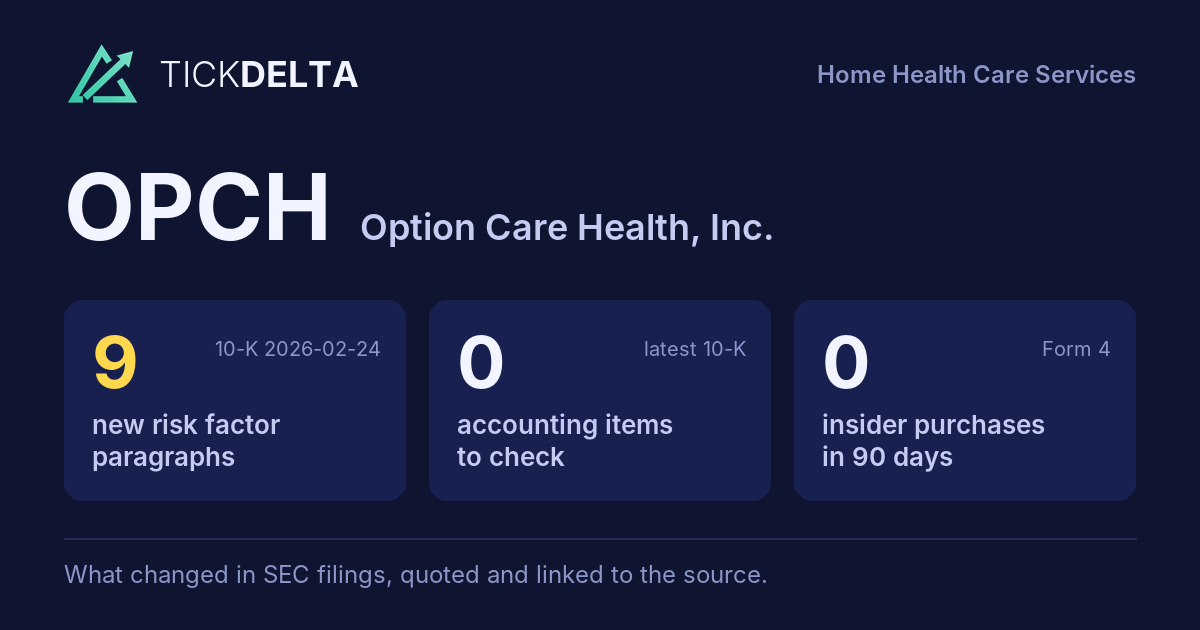
Screener / SEC EDGAR /CIK 0001014739 /10-K filed Feb 24, 2026, compared with Feb 26, 2025 /Numbers from the XBRL of the 10-Ks
Nasdaq Health care · Home Health Care Services

Option Care Health, Inc. OPCH

Compare with peers Embed
The 10-K against last year's

80 changes: 14 added, 18 removed, 45 reworded, 3 quiet changes

10-K Feb 24, 2026 vs Feb 26, 2025

10-K 0001014739-26-000008 (Feb 24, 2026) vs 10-K 0001014739-25-000012 (Feb 26, 2025)

Every paragraph, and how much of it changed

One bar per paragraph, in the order of the 10-K. Height and colour show the share of its words not in the closest paragraph a year earlier; the tallest bars are new paragraphs.

Risk Factors

104 paragraphs · 9 new · 34 reworded · 9 gone · 10-K Feb 24, 2026 against Feb 26, 2025
New paragraph Reworded (5% of its words or more) Same or nearly
Paragraph 27 · 47% changed Every version of it
Technology, including the ability to capture and report outcomes, is also an important component of our business as we continue to utilize new and better channels to communicate and interact with our clients, members and business partners. If we fail to successfully integrate AI into our competitors are more successful than us in employing new technology, our ability platform and business processes, or if we fail to attract new clients, retain existing clients keep pace with rapidly evolving AI technological developments, including attracting and operate efficiently retaining talented AI developers and programmers, we may suffer. Any significant shifts in the structure of the healthcare products and services industry in general could alter the industry dynamics and adversely affect our ability to attract or retain clients. Our failure to anticipate or appropriately adapt to changes in the industry could negatively impact our face a competitive position and adversely affect our business and results of operations. disadvantage.
Paragraph 63 · 27% changed Every version of it
Despite our indebtedness, we We may still incur significantly more additional debt, which could exacerbate increase the risks associated with our substantial leverage.
Paragraph 56 · 24% changed Every version of it
The (“DQSA”) DQSA amended the Federal Drug & Cosmetic Act (“FDCA”) FDCA to grant the FDA additional authority to regulate and monitor the manufacturing of compounded pharmaceutical drugs. In 2013, Congress passed the DQSA, which creates a new category of compounding facilities called outsourcing facilities that are regulated by the FDA. The Company complies with all federal and state regulations, as well as all PCAB Accreditation Standards for Sterile and Non-Sterile Pharmacy Compounding, and pursues accreditation from quality associations. The Company believes it complies in all material respects with all applicable requirements of a non-outsourcing-facility pharmacy, as outlined in Section 503A of the FDCA. Title II of this measure, known as In addition, the Company believes it complies in all material respects with the Drug Supply Chain Security Act (“DSCSA”), established requirements in November 2013 to facilitate the tracing of prescription drug products through the pharmaceutical supply distribution chain. These requirements included a 10-year timeline culminating in the building of "an which includes an electronic, interoperable system to identify and trace certain prescription drugs as they are distributed in the United States.” The law’s track and trace requirements are applicable to manufacturers, wholesalers, re-packagers and dispensers (e.g., pharmacies) of prescription drugs. The Company is currently materially compliant with the DSCSA provisions currently in effect. As an eligible trading partner, the Company believes it is materially compliant with the additional provisions of DSCSA, which requires the electronic receipt and exchange of transaction information (with specific product identifiers for each package) and transaction statements. Please note that the FDA has issued an exemption from the enhanced drug distribution security requirements of section 582 of the FDCA for eligible trading partners until November 27, 2025. States. These regulatory measures, future DSCSA regulatory measures and the potential for increased DSCSA enforcement by the FDA could increase pharmacy costs. Noncompliance with these regulations could have an adverse impact on our reputation and profitability.
Paragraph 43 · 20% changed Every version of it
The reimbursement process for the services we provide is complex, resulting in delays between the time we bill for a service and receipt of payment that can be significant. Reimbursement and procedural issues often require us to resubmit claims multiple times and respond to multiple administrative requests before payment is remitted. The collection of accounts receivable is challenging and requires constant focus and involvement by management and ongoing enhancements to information systems and billing center operating procedures. While management believes that our controls and processes are satisfactory, there can be no assurance that collections of accounts receivable will continue at historical rates. The risks associated with third-party payers and the inability to collect outstanding accounts receivable could have a material adverse effect on our liquidity, cash flows and results of operations. For example, in the first quarter of 2024, Change Healthcare, a subsidiary of UnitedHealth Group, experienced a cybersecurity incident that disrupted its operations, causing us to disconnect from certain Change Healthcare applications until the end of the quarter, preventing us from processing claims for services and reducing our cash flows from operations in the first quarter of 2024. The majority of previously unprocessed claims were recognized in the second quarter of 2024. While we have substantially addressed the backlog and resumed normal billing operations as of the fourth quarter of 2024, we continue to evaluate the impact of the incident on our broader revenue cycle management processes.
Paragraph 58 · 20% changed Every version of it
As of December 31, 2024, 2025, we had $1,131.6 $1,176.3 million of outstanding borrowings, including (i) $631.6 $676.3 million under our First Lien Term Loan (as defined herein) and (ii) $500.0 million under our 4.375% Senior Unsecured Notes due 2029 (the “Senior Notes”). All obligations under the First Lien Term Loan are secured by first-priority perfected security interests in substantially all of our assets and the assets of our subsidiaries, subject to permitted liens and other exceptions. Our indebtedness, or any additional indebtedness we may incur, could require us to divert funds identified for other purposes for debt service and impair our liquidity position. If we cannot generate sufficient cash flow from operations to service our debt, we may need to refinance our debt, dispose of assets or issue equity to obtain necessary funds. We do not know whether we will be able to take any of these actions on a timely basis, on terms satisfactory to us or at all.
Paragraph 15 · 18% changed Every version of it
We have contractual relationships with pharmaceutical manufacturers to purchase the pharmaceuticals that we dispense. In order to have access to these pharmaceuticals, and to be able to participate in the launch of new pharmaceuticals, we must maintain a good working relationship with these manufacturers. Most of the manufacturers of the pharmaceuticals we sell have the right to cancel their supply contracts with us without cause and after giving only minimal notice. Any changes to these relationships, including, but not limited to, the loss of a manufacturer relationship, drug shortages or changes in pricing, could have an adverse effect on our business and financial results. For example, in October 2024, we received notice of a manufacturer’s intention to significantly reduce the spread at which we procure a certain therapy relative to drug reference prices beginning in early 2025, which is expected to negatively impact gross profit by approximately $60 million to $70 million dollars in 2025.
Paragraph 66 · 18% changed Every version of it
Our ability to make scheduled payments or to refinance outstanding debt obligations depends on our financial and operating performance, which will be affected by prevailing economic, industry and competitive conditions and by financial, business and other factors beyond our control. We may not be able to maintain a sufficient level of cash flow from operating activities to permit us to pay the principal, premium, if any, and interest on our indebtedness. Any failure to make payments of interest and principal on our outstanding indebtedness on a timely basis would likely result in a reduction of our credit rating, which would also harm our ability to incur additional indebtedness.
Paragraph 77 · 16% changed Every version of it
We cannot guarantee that our stock repurchase program will be fully implemented or that it will enhance long-term stockholder value.

MD&A

54 paragraphs · 5 new · 23 reworded · 9 gone · 10-K Feb 24, 2026 against Feb 26, 2025
New paragraph Reworded (5% of its words or more) Same or nearly
Paragraph 31 · 46% changed
The Company’s primary uses of cash and cash equivalents include supporting our ongoing business activities, internal investment in resources to support future growth, investment in capital expenditures in both facilities and technology, the pursuit of acquisitions, and the pursuit of acquisitions and share repurchases. Ongoing operating cash outflows are associated with procuring and dispensing drugs, personnel and other costs associated with servicing patients, as well as paying cash interest on outstanding debt and cash taxes. Ongoing investing cash flows are primarily associated with capital projects and business acquisitions, the improvement and maintenance of our pharmacy facilities and investment in our information technology systems. Ongoing financing cash flows are primarily associated with the quarterly principal payments on its outstanding debt, along with potential future share repurchases.
Paragraph 19 · 37% changed
The increase in net revenue during the year ended December 31, 2024 2025 was primarily driven by organic growth in the Company’s portfolio of therapies, consisting of acute revenue that had high single digits mid-teens growth relative to the prior year while chronic revenue grew in the high teens. low double-digits. Acute growth was largely driven by the impact of shifts in the competitive landscape, which increased the volume of patient service. The increase in cost of revenue was primarily driven by the growth in revenue, revenue and therapy mix, and acute drug supply chain disruption, as well as the comparable impact of certain temporary favorable therapy procurement dynamics in the prior year. mix. The decrease in gross profit margin was primarily due to the launch of mix, including certain new higher cost therapies included within chronic growth (including rare and orphan therapies) and to the same comparable impact of as well as biosimilar adoption, partially offset by certain temporary favorable procurement dynamics mitigation efforts executed in the prior year that did not continue into 2024. Additionally, the Company received notice first quarter of a manufacturer’s intention to significantly reduce the spread at which the Company procures a certain therapy relative to drug reference prices beginning in early 2025, which is expected 2025. Management expects these dynamics to negatively impact gross profit by approximately $60 $25 million to $70 $35 million in 2025. 2026.
Paragraph 42 · 34% changed
The decrease increase in cash used in investing activities during the year ended December 31, 2024 2025 was primarily due related to prior year the Intramed Plus acquisition activity with no comparable activity during the year ended December 31, 2024. See Note 3, Business Acquisitions and Divestitures, of the consolidated financial statements for more information.
Paragraph 21 · 30% changed
The increase in selling, general and administrative expenses during the year ended December 31, 2024 2025 was primarily due to an increase investment in salaries, benefits, internal resources and other general costs to support the business; however, these both ongoing business needs as well as future business growth. Selling, general and administrative expenses have declined as a percentage of revenue to 12.1% for the year ended December 31, 2025 compared to 12.6% for the year ended December 31, 2024 compared to 14.1% for the year ended December 31, 2023, 2024, due to the Company’s focus on leveraging existing infrastructure to control spending. The increase in depreciation and amortization expense was primarily due to the Intramed Plus acquisition. See Note 3, Business Acquisitions, of the consolidated financial statements for further information.
Paragraph 35 · 27% changed
On May 8, 2024, September 22, 2025, the Company entered into the third fourth amendment (“the Fourth Amendment”) to the amended and restated First Lien Credit Agreement (the “Credit Agreement”) dated as of October 27, 2021 (the “Third Amendment”). 2021. The Third Fourth Amendment, among other things, (i) provides for an additional $50.0 million refinances the existing term loans with a new class of incremental First term loans (the “First Lien Term Loan indebtedness and (ii) Loan”), reduces the interest rate on the First Lien Term Loan from Term Secured Overnight Financing Rate (“SOFR”) (including a credit spread adjustment) plus 2.75% 2.25% to Term SOFR plus 2.25% 1.75% and removes extends the credit spread adjustment with respect to such maturity date of the First Lien Term Loan. Loan to September 22, 2032, (ii) provides for an additional $49.6 million of incremental First Lien Term Loan indebtedness, and (iii) extends the maturity date of the revolving credit commitments under the Credit Agreement (the “Revolver Facility”) to September 22, 2030.
Paragraph 25 · 22% changed
The Company recorded income tax expense of $71.8 $75.3 million and $91.7 $71.8 million, which represents an effective tax rate of 26.6% and 25.3% and 25.5% for the years ended December 31, 2024 2025 and 2023, 2024, respectively. The variance in the Company’s effective tax rate of 25.3% and 25.5% for the years ended December 31, 2024 and 2023, respectively, was primarily attributable to the difference in state taxes, various non-deductible expenses, and a change in state valuation allowance. The variance in the Company’s effective tax rate of 25.3% for the year ended December 31, 2024, compared to the federal statutory rate of 21%, was also primarily attributable to state taxes, various non-deductible expenses, and a change in state valuation allowance. The income tax expense for the year ended December 31, 2023 2025 includes $21.8 million of tax expense related to the Termination Fee received, under the terms of the Mutual Termination Agreement, net of merger-related expenses, and the release of $5.8 $0.4 million of state valuation allowance allowance, compared to a $2.2 million release in September 2023. 2024. The variance in the Company’s effective tax rate of 26.6% and 25.3% for the years ended December 31, 2025 and 2024, respectively, compared to the federal statutory rate of 21%, as well as year-over-year changes, was primarily attributable to the inclusion of state taxes in multiple jurisdictions, various non-deductible expenses, and changes in state valuation allowance.
Paragraph 36 · 20% changed
The Under the Fourth Amendment, the principal balance of the First Lien Term Loan is repayable in quarterly installments of $1.6 $1.7 million plus interest, with a final payment of all remaining outstanding principal due on October 27, 2028. The quarterly principal payments commenced in March 2022. Under the Third Amendment, interest September 22, 2032. Interest on the First Lien Term Loan is payable monthly on either (i) the SOFR (with a floor of 0.50% per annum) plus an applicable margin of 2.25% 1.75% for Term SOFR Loans (as such term is defined in the Third Amendment); Loans; or (ii) a base rate determined in accordance with the Third Amendment, rate, plus 1.25% 0.75% for Base Rate Loans (as such term is defined in the Third Amendment). Loans.
Paragraph 43 · 19% changed
The decrease increase in cash used in financing activities was primarily related to the Company’s $310.0 million repurchase of common stock and related excise taxes during the year ended December 31, 2025, compared to $252.7 million repurchase of common stock and related excise taxes during the year ended December 31, 2024. The increase was partially offset by the Company’s debt refinancing in May 2024, September 2025, in which $50.0 $49.6 million in net proceeds from issuance of debt was received, which partially offset $250.0 million in repurchase of common stock during the year ended December 31, 2024, whereas the cash used in financing activities during the year ended December 31, 2023 was primarily related to the Company’s $250.0 million repurchase of common stock. received.

A paragraph is matched with the one last year that shares the most of its words; under half in common makes it new. The paragraphs shown are the 8 reworded the most in each section.

The paragraph that changed most in each section

The redline

Marked against last year's 10-K: cut words struck through, new words highlighted.

Accounting Policies255 words changed in this paragraph; it is 33% similar to last year's version.
In December 2023, November 2024, the FASB issued ASU 2023-09, 2024-03, Income Taxes (Topic 740): Improvements to Statement - Reporting Comprehensive Income Tax Disclosures. - Expense Disaggregation Disclosures (Subtopic 220-40): Disaggregation of Income Statement Expenses. This ASU addresses investor requests for more transparency about income tax information through improvements to income tax disclosures primarily related to the rate reconciliation and income taxes paid information. The ASU improves the transparency disclosures around a public business entity’s expenses and addresses requests from investors for more detailed information about the types of income tax disclosures by requiring consistent categories expenses (including purchases of inventory, employee compensation, depreciation, amortization, and greater disaggregation depletion) in commonly presented expense captions (such as cost of sales, SG&A, and research and development). The amendments in this ASU do not change or remove current presentation requirements or current expense disclosure requirements. However, the amendments affect where this information appears in the rate reconciliation and income taxes paid disaggregated by jurisdiction. The ASU allows investors notes to better assess, financial statements because entities are required to include certain current disclosures in their capital allocation decisions, how an entity’s worldwide operations and related tax risks and tax planning and operational opportunities affect its income tax rate and prospects for future cash flows. This ASU also improves the effectiveness and comparability of disclosures by adding disclosures of pretax income (loss) and income tax expense (benefit) to be consistent with U.S. Securities and Exchange Commission (“SEC”) Regulation S-X and removing disclosures that no longer are considered cost beneficial or relevant. same tabular format disclosure as the other disaggregation requirements in the amendments. The Company is required to adopt this ASU for annual reporting periods beginning after December 15, 2024, 2026, and interim reporting periods beginning after December 15, 2027, with early adoption permitted. The Company is currently evaluating the impact of this ASU on its results of operations, cash flows, financial position, and disclosures.

Source: Item 8, Note 2 – SUMMARY OF SIGNIFICANT ACCOUNTING POLICIES, 10-K 0001014739-26-000008 vs Item 8, Note 2 – SUMMARY OF SIGNIFICANT ACCOUNTING POLICIES, 10-K 0001014739-25-000012

Risk Factors164 words changed in this paragraph; it is 65% similar to last year's version.
The (“DQSA”) DQSA amended the Federal Drug & Cosmetic Act (“FDCA”) FDCA to grant the FDA additional authority to regulate and monitor the manufacturing of compounded pharmaceutical drugs. In 2013, Congress passed the DQSA, which creates a new category of compounding facilities called outsourcing facilities that are regulated by the FDA. The Company complies with all federal and state regulations, as well as all PCAB Accreditation Standards for Sterile and Non-Sterile Pharmacy Compounding, and pursues accreditation from quality associations. The Company believes it complies in all material respects with all applicable requirements of a non-outsourcing-facility pharmacy, as outlined in Section 503A of the FDCA. Title II of this measure, known as In addition, the Company believes it complies in all material respects with the Drug Supply Chain Security Act (“DSCSA”), established requirements in November 2013 to facilitate the tracing of prescription drug products through the pharmaceutical supply distribution chain. These requirements included a 10-year timeline culminating in the building of "an which includes an electronic, interoperable system to identify and trace certain prescription drugs as they are distributed in the United States.” The law’s track and trace requirements are applicable to manufacturers, wholesalers, re-packagers and dispensers (e.g., pharmacies) of prescription drugs. The Company is currently materially compliant with the DSCSA provisions currently in effect. As an eligible trading partner, the Company believes it is materially compliant with the additional provisions of DSCSA, which requires the electronic receipt and exchange of transaction information (with specific product identifiers for each package) and transaction statements. Please note that the FDA has issued an exemption from the enhanced drug distribution security requirements of section 582 of the FDCA for eligible trading partners until November 27, 2025. States. These regulatory measures, future DSCSA regulatory measures and the potential for increased DSCSA enforcement by the FDA could increase pharmacy costs. Noncompliance with these regulations could have an adverse impact on our reputation and profitability.

Source: Item 1A, 10-K 0001014739-26-000008 vs Item 1A, 10-K 0001014739-25-000012

MD&A134 words changed in this paragraph; it is 59% similar to last year's version.
The increase in net revenue during the year ended December 31, 2024 2025 was primarily driven by organic growth in the Company’s portfolio of therapies, consisting of acute revenue that had high single digits mid-teens growth relative to the prior year while chronic revenue grew in the high teens. low double-digits. Acute growth was largely driven by the impact of shifts in the competitive landscape, which increased the volume of patient service. The increase in cost of revenue was primarily driven by the growth in revenue, revenue and therapy mix, and acute drug supply chain disruption, as well as the comparable impact of certain temporary favorable therapy procurement dynamics in the prior year. mix. The decrease in gross profit margin was primarily due to the launch of mix, including certain new higher cost therapies included within chronic growth (including rare and orphan therapies) and to the same comparable impact of as well as biosimilar adoption, partially offset by certain temporary favorable procurement dynamics mitigation efforts executed in the prior year that did not continue into 2024. Additionally, the Company received notice first quarter of a manufacturer’s intention to significantly reduce the spread at which the Company procures a certain therapy relative to drug reference prices beginning in early 2025, which is expected 2025. Management expects these dynamics to negatively impact gross profit by approximately $60 $25 million to $70 $35 million in 2025. 2026.

Source: Item 7, 10-K 0001014739-26-000008 vs Item 7, 10-K 0001014739-25-000012

Legal Proceedings23 words changed in this paragraph; it is 90% similar to last year's version.
The Company is involved in legal proceedings and is subject to investigations, inspections, audits, inquiries, and similar actions by governmental authorities, arising in the normal course of the Company’s business. Some of these suits may purport or may be determined to be class actions and/or involve parties seeking large and/or indeterminate amounts, including punitive or exemplary damages, and may remain unresolved for several years. From time to time, the Company may also be involved in legal proceedings as a plaintiff involving antitrust, tax, contract, intellectual property, and other matters. Material loss contingencies, if any, are accrued for when they are probable and reasonably estimable, and are disclosed when they are reasonably possible. Gain contingencies, if any, are recognized when they are realized.

Source: Item 3, via Note 14 – COMMITMENTS AND CONTINGENCIES, 10-K 0001014739-26-000008 vs Item 3, via Note 14 – COMMITMENTS AND CONTINGENCIES, 10-K 0001014739-25-000012

Sentences and paragraphs added, removed or reworded

Every change, by type

Sentences and paragraphs of OPCH's Risk Factors and MD&A, 10-K Feb 24, 2026 against 10-K Feb 26, 2025. Each links to the text at sec.gov.

Quiet changes are sentences kept from last year with one to four words changed, at least one of them a hedge, a modal or a qualifier (may, could, will, not, significant, material…). A year or date rolling forward is not counted.

The full word list

adverse, adversely, all, although, anticipate, anticipates, any, approximately, believe, believes, can, cannot, certain, could, expect, expects, generally, however, if, intend, intends, largely, likely, many, material, materially, may, might, most, must, never, no, not, possible, primarily, probable, should, significant, significantly, some, substantial, substantially, unlikely, will, would

AddedRisk Factors
Increasing competition from established and vertically integrated healthcare providers, coupled with industry consolidation and cost pressures, may limit our ability to grow revenue, maintain pricing, secure favorable contracts, and access critical pharmaceutical products.
Read it in 10-K Feb 24, 2026 at sec.gov
AddedRisk Factors
Contracts and fee schedules for prescription drug reimbursement, including our contracts with commercial payers, PBMs, and Medicaid programs, generally use certain published benchmarks to establish pricing. These benchmarks include Average Wholesale Price (“AWP”), Wholesale Acquisition price (“WAC”), Average Selling Price (“ASP”), among others. Future changes to the use of AWP, WAC, ASP or other public pricing benchmarks used to establish drug pricing, including changes in reimbursement calculations by federal and state healthcare programs, could impact our reimbursement and our ability to negotiate rebates and/or discounts with drug manufacturers and wholesalers.
Read it in 10-K Feb 24, 2026 at sec.gov
AddedRisk Factors
Our business could be adversely affected if we fail to effectively adopt and integrate evolving technologies such as artificial intelligence (“AI”), attract and retain necessary technical talent, or adapt to competitive, technological, or structural changes in the healthcare products and services industry, any of which could impair our ability to attract and retain clients and maintain our competitive position.
Read it in 10-K Feb 24, 2026 at sec.gov
AddedRisk Factors
Ongoing reimbursement rate reductions, pricing pressures from Third-Party Payers and managed care payers, and increasing payer consolidation could significantly impact revenue, reduce profitability, and concentrate financial dependence on a few large payers.
Read it in 10-K Feb 24, 2026 at sec.gov
AddedRisk Factors
Regulatory changes, increased scrutiny, or reclassification of our compounding practices as an FDA-regulated outsourcing facility could lead to costly compliance requirements, operational disruptions, and reputational harm.
Read it in 10-K Feb 24, 2026 at sec.gov
AddedRisk Factors
Pursuing acquisitions or strategic investments and alliances may expose us to integration challenges, valuation uncertainties, operational disruptions, and potential financial losses if these investments fail to deliver expected benefits.
Read it in 10-K Feb 24, 2026 at sec.gov
AddedRisk Factors
Reliance on third-party hosting services exposes us to potential security breaches, service disruptions, and pricing changes that could negatively impact operations and financial performance.
Read it in 10-K Feb 24, 2026 at sec.gov
AddedRisk Factors
The development and use of AI technologies could expose us to significant governance, compliance, and legal liabilities, including evolving regulatory requirements, heightened scrutiny, litigation risk, and substantial compliance costs, that may adversely affect our operations, financial condition, and ability to successfully adopt and deploy AI.
Read it in 10-K Feb 24, 2026 at sec.gov
Show the other 51
RemovedRisk Factors
Our contracts generally use certain published benchmarks to establish pricing for the reimbursement of prescription medications we dispense. These benchmarks include AWP, wholesale acquisition cost, ASP and average manufacturer price. Many of our contracts utilize the AWP benchmark. Publication of the AWP benchmark was expected to cease in 2011 as a result of the settlement of class-action lawsuits brought against First Databank and Medi-Span, third-party publishers of various pricing benchmarks. However, Medi-Span continues to publish the AWP benchmark and has indicated that it will continue to do so until a new benchmark is widely accepted. Several industry participants have explored establishing a new benchmark but there is not currently a viable generally accepted alternative to the AWP benchmark. Without a suitable pricing benchmark in place, many of our contracts may need to be modified, which could potentially change the economic structure of our agreements.
Read it in 10-K Feb 26, 2025 at sec.gov
RemovedRisk Factors
We may issue shares of preferred stock in the future, which could make it difficult for another company to acquire us or could otherwise adversely affect holders of our common stock, which could depress the price of our common stock.
Read it in 10-K Feb 26, 2025 at sec.gov
RemovedRisk Factors
Our third amended and restated certificate of incorporation authorizes us to issue one or more series of preferred stock. Our Board of Directors has the authority to determine the preferences, limitations and relative rights of the shares of preferred stock and to fix the number of shares constituting any series and the designation of such series, without any further vote or action by our stockholders. Our preferred stock could be issued with voting, liquidation, dividend and other rights superior to the rights of our common stock. The potential issuance of preferred stock may delay or prevent a change in control, discouraging bids for our common stock at a premium to the market price, and materially and adversely affecting the market price and the voting and other rights of the holders of our common stock.
Read it in 10-K Feb 26, 2025 at sec.gov
RewordedRisk Factors
If personal personally identifiable information or protected health information is improperly accessed, tampered with or disclosed as a result of a security breach, we may incur significant costs to notify, and mitigate potential harm to the affected individuals, and we may be subject to sanctions and civil or criminal penalties if we are found to be in violation of the privacy or security rules under HIPAA or other federal or state laws protecting confidential personal information. individuals.
Read it in 10-K Feb 24, 2026 at sec.gov
RewordedRisk Factors
If personal information or protected health information is improperly accessed, tampered with or disclosed as a result of a security breach, we may incur significant costs to notify, and mitigate potential harm to the affected individuals, and we We may be subject to sanctions and civil or criminal penalties if we are found to be in violation of the privacy or security rules under HIPAA or other federal or state laws protecting confidential personal information.
Read it in 10-K Feb 24, 2026 at sec.gov
RewordedRisk Factors
These requirements included a 10-year timeline culminating In addition, the Company believes it complies in all material respects with the building of "an Drug Supply Chain Security Act (“DSCSA”), which includes an electronic, interoperable system to identify and trace certain prescription drugs as they are distributed in the United States.
Read it in 10-K Feb 24, 2026 at sec.gov
RewordedRisk Factors
Increases in interest rates may directly impact the amount of interest we are required to pay pay, as our First Lien Term Loan has an applicable interest rate of Term SOFR plus 1.75%, and reduce earnings accordingly.
Read it in 10-K Feb 24, 2026 at sec.gov
RewordedRisk Factors
We maintain our information technology systems with safeguards against cyber-attacks including passive intrusion protection, prevention and detection, firewalls and virus detection software. continuous monitoring of our environment for viruses and malware.
Read it in 10-K Feb 24, 2026 at sec.gov
RewordedRisk Factors
Cybersecurity refers to the combination of technologies, processes and procedures established to protect information technology systems and data from unauthorized access, attack, or damage. damage as well as the development of a company culture of security and data protection.
Read it in 10-K Feb 24, 2026 at sec.gov
RewordedRisk Factors
Although we have taken steps to protect the security of our information technology systems and the data maintained in those systems, it is possible that our safety and security measures will not prevent the systems’ improper functioning or damage or the improper access or disclosure of personal health information or personally identifiable information such as in the event of cyber-attacks. a cyber-attack or employee error or misuse of the system.
Read it in 10-K Feb 24, 2026 at sec.gov
RewordedRisk Factors
Most recently, the Inflation Reduction Act of 2022 (the “IRA”) granted CMS the authority to negotiate drug prices under Medicare Part D, with price controls taking effect in 2026. D.
Read it in 10-K Feb 24, 2026 at sec.gov
RewordedRisk Factors
The (“DQSA”) DQSA amended the Federal Drug & Cosmetic Act (“FDCA”) FDCA to grant the FDA additional authority to regulate and monitor the manufacturing of compounded pharmaceutical drugs.
Read it in 10-K Feb 24, 2026 at sec.gov
RewordedRisk Factors
As a result of operating in the home infusion industry, our business is subject to inherent risk of claims, losses and potential lawsuits alleging medical professional liability incidents involving our employees that are likely to occur in a patient’s home. home or alternate site.
Read it in 10-K Feb 24, 2026 at sec.gov
Quiet changesRisk Factors
Our revenue and profitability will could decline if the pharmaceutical industry undergoes certain changes, including limiting or discontinuing research, development, production and marketing of the pharmaceuticals that are compatible with the services we provide.
Read it in 10-K Feb 24, 2026 at sec.gov
Quiet changesRisk Factors
In the absence of such cash flow and resources, we could face substantial liquidity problems and might be required to sell material assets or operations to attempt to meet our debt service obligations.
Read it in 10-K Feb 24, 2026 at sec.gov
AddedMD&A
Option Care Health and its wholly-owned subsidiaries provide infusion therapy and other ancillary healthcare services through a national network of 196 locations around the United States. Our national footprint enables us to collaborate with health systems and national payers to provide high quality care at an appropriate cost in a comfortable setting. We have established key relationships that allow us access to local resources to ensure responsiveness to our patients’ needs. At the center of everything we do is the patient. This is the driving force behind all of our actions and the partnerships that we have broadly across the healthcare ecosystem.
Read it in 10-K Feb 24, 2026 at sec.gov
AddedMD&A
The change in other, net during the year ended December 31, 2025 was primarily attributable to accruals for an abandoned or unclaimed property voluntary disclosure agreement program related to the pre-merger operations of BioScrip, Inc. (“BioScrip”), which was entered into by BioScrip prior to its merger with the Company in 2019. As of December 31, 2025, the matters related to this program are ongoing. Additionally, the change in other, net was attributable to the $4.7 million loss on extinguishment of debt from the Company’s debt refinancing during the year ended December 31, 2025 with no comparable activity during the year ended December 31, 2024.
Read it in 10-K Feb 24, 2026 at sec.gov
AddedMD&A
The change in cash provided by operating activities during the year ended December 31, 2025 was primarily due to increases in inventories due to strategic purchases and a focus on maximizing the impact from volume based rebates and prompt pay purchase discounts. The change was also largely related to an increase in accounts receivable driven by revenue growth. The change in cash provided by operating activities for the year ended December 31, 2024 was largely driven by an increase in accounts payable due to timing of strategic purchases in inventories ahead of expected future price increases on certain drugs.
Read it in 10-K Feb 24, 2026 at sec.gov
RemovedMD&A
Option Care Health and its wholly-owned subsidiaries provide infusion therapy and other ancillary healthcare services through a national network of 185 locations around the United States. The Company contracts with managed care organizations, third-party payers, hospitals, physicians, and other referral sources to provide pharmaceuticals and complex compounded solutions to patients for intravenous delivery in the patients’ homes or other non-hospital settings. Our services are provided in coordination with, and under the direction of, the patient’s physician. Our multidisciplinary team of clinicians, including pharmacists, nurses, dietitians and respiratory therapists, work with the physician to develop a plan of care suited to each patient’s specific needs. We provide home infusion services consisting of anti-infectives, nutrition support, therapies for neurological disorders and chronic inflammatory disorders, immunoglobulin therapy, and other therapies for chronic and acute conditions. The Company operates in one segment, infusion services.
Read it in 10-K Feb 26, 2025 at sec.gov
RemovedMD&A
As previously disclosed, on February 21, 2024, Change Healthcare, a subsidiary of UnitedHealth Group, experienced an incident in which a cybersecurity threat actor gained access to some of its information technology systems (“Change Healthcare Cybersecurity Incident”). Since the time of the system disruption, Option Care Health has worked continuously to find alternative processes to help maintain patient care and overall operations.
Read it in 10-K Feb 26, 2025 at sec.gov
RemovedMD&A
As of December 31, 2024, the Company has not identified any compromise or unauthorized access of its systems or networks due to this third party incident. As of the end of the second quarter of 2024, the Company reconnected to key applications maintained by Change Healthcare and as of the end of the fourth quarter of 2024, the Company has fully recovered.
Read it in 10-K Feb 26, 2025 at sec.gov
RemovedMD&A
During the fourth quarter of 2024, the Company did not experience a material financial impact from the Change Healthcare Cybersecurity Incident on the financial results as reported. The Company continues to maintain strong liquidity and, having resumed submission of all claims to payers, has determined that the Change Healthcare Cybersecurity Incident did not materially impact the Company, including its business operations, financial condition or results of operations.
Read it in 10-K Feb 26, 2025 at sec.gov
RemovedMD&A
Other, Net. During the year ended December 31, 2024, other income (expense) primarily includes activity related to non-operating income and expenses. During the year ended December 31, 2023, other income (expense) primarily includes the termination fee, net of merger-related expenses, received on behalf of Amedisys, Inc. (“Amedisys”). On May 3, 2023, the Company entered into a definitive merger agreement (the “Amedisys Merger Agreement”) with Amedisys, a leading provider of healthcare in home health and hospice settings. On June 26, 2023, the Company entered into an agreement to terminate the Amedisys Merger Agreement (the “Mutual Termination Agreement”). Under the terms of the Mutual Termination Agreement, the Company received a payment of $106.0 million in cash on behalf of Amedisys (the “Termination Fee”).
Read it in 10-K Feb 26, 2025 at sec.gov
RemovedMD&A
The decrease in other, net during the year ended December 31, 2024 was due to the $106.0 million payment received on behalf of Amedisys, under the terms of the Mutual Termination Agreement, net of merger-related expenses during the year ended December 31, 2023. There was no comparable activity during the year ended December 31, 2024.
Read it in 10-K Feb 26, 2025 at sec.gov
RemovedMD&A
The change in net income for the year ended December 31, 2024 was attributable to the $106.0 million payment received on behalf of Amedisys, under the terms of the Mutual Termination Agreement, net of merger-related expenses during the year ended December 31, 2023. There was no comparable activity during the year ended December 31, 2024.
Read it in 10-K Feb 26, 2025 at sec.gov
RemovedMD&A
Year Ended December 31, 2024 2023 Variance (in thousands) Net cash provided by operating activities $ 323,392 $ 371,295 $ (47,903) Net cash used in investing activities (36,470) (56,506) 20,036 Net cash used in financing activities (218,206) (265,126) 46,920 Net increase in cash and cash equivalents 68,716 49,663 19,053 Cash and cash equivalents - beginning of period 343,849 294,186 49,663 Cash and cash equivalents - end of period $ 412,565 $ 343,849 $ 68,716
Read it in 10-K Feb 26, 2025 at sec.gov
RemovedMD&A
The decrease in cash provided by operating activities during the year ended December 31, 2024 was primarily due to the $106.0 million payment received on behalf of Amedisys, under the terms of the Mutual Termination Agreement, net of merger-related expenses during the year ended December 31, 2023, changes in accounts receivable and accrued compensation and employee benefits. Additionally, changes in accounts payable and inventory were driven by organic growth in the Company as well as strategic supply chain purchases.
Read it in 10-K Feb 26, 2025 at sec.gov
RewordedMD&A
The increase in selling, Selling, general and administrative expenses during the year ended December 31, 2024 was primarily due to an increase in salaries, benefits, and general costs to support the business; however, these expenses have declined as a percentage of revenue to 12.1% for the year ended December 31, 2025 compared to 12.6% for the year ended December 31, 2024 compared to 14.1% for the year ended December 31, 2023, 2024, due to the Company’s focus on leveraging existing infrastructure to control spending.
Read it in 10-K Feb 24, 2026 at sec.gov
RewordedMD&A
Under the Third Amendment, interest Interest on the First Lien Term Loan is payable monthly on either (i) the SOFR (with a floor of 0.50% per annum) plus an applicable margin of 2.25% 1.75% for Term SOFR Loans (as such term is defined in the Third Amendment); Loans; or (ii) a base rate determined in accordance with the Third Amendment, rate, plus 1.25% 0.75% for Base Rate Loans (as such term is defined in the Third Amendment). Loans.
Read it in 10-K Feb 24, 2026 at sec.gov
RewordedMD&A
The Revolver Facility matures on the date that is the earlier of (i) December 7, 2028 September 22, 2030 and (ii) the date that is 91 days prior to the stated maturity date applicable to the Senior Notes to the extent any Term B Loans. amount of the Senior Notes remains unpaid and outstanding as of the date that is 91 days prior to the stated maturity date applicable to the Senior Notes.
Read it in 10-K Feb 24, 2026 at sec.gov
RewordedMD&A
The decrease in gross profit margin was primarily due to the launch of mix, including certain new higher cost therapies included within chronic growth (including rare and orphan therapies) and to the same comparable impact of as well as biosimilar adoption, partially offset by certain temporary favorable procurement dynamics mitigation efforts executed in the prior year that did not continue into 2024. first quarter of 2025.
Read it in 10-K Feb 24, 2026 at sec.gov
RewordedMD&A
Net comprehensive income decreased to $200.6 million for the year ended December 31, 2025, compared to net comprehensive income of $207.9 million for the year ended December 31, 2024, compared to net comprehensive income of $260.9 million for the year ended December 31, 2023, primarily as a result of the changes factors described in net income discussed above. the above sections.
Read it in 10-K Feb 24, 2026 at sec.gov
RewordedMD&A
The income tax expense for the year ended December 31, 2023 2025 includes $21.8 million of tax expense related to the Termination Fee received, under the terms of the Mutual Termination Agreement, net of merger-related expenses, and the release of $5.8 $0.4 million of state valuation allowance allowance, compared to a $2.2 million release in September 2023. 2024.
Read it in 10-K Feb 24, 2026 at sec.gov
RewordedMD&A
Our business strategy includes the strategic deployment of capital to pursue internal investments in resources, infrastructure, and technologies to support future growth, the pursuit of strategic tuck-in and adjacent acquisitions that complement our existing operations. operations and the pursuit of share repurchases.
Read it in 10-K Feb 24, 2026 at sec.gov
RewordedMD&A
The increase in cost of revenue was primarily driven by the growth in revenue, revenue and therapy mix, and acute drug supply chain disruption, as well as the comparable impact of certain temporary favorable therapy procurement dynamics in the prior year. mix.
Read it in 10-K Feb 24, 2026 at sec.gov
RewordedMD&A
The Second Amendment, among other things, Company’s Revolver Facility provides for revolving credit commitments by the applicable Revolving Credit Lenders in an aggregate amount of borrowings up to $400.0 million (the “Revolver Facility”) pursuant to which such lenders have agreed to make Revolving Credit Loans to the Company.
Read it in 10-K Feb 24, 2026 at sec.gov
RewordedMD&A
The decrease increase in interest expense, net during the year ended December 31, 2024 2025 was primarily attributable to additional less interest income generated from our cash and cash equivalents, equivalents due to lower interest rates, partially offset by an increase a decrease in the interest rate on the Company’s First Lien Term Loan principal balance, Loan, compared to the year ended December 31, 2023. 2024.
Read it in 10-K Feb 24, 2026 at sec.gov
RewordedMD&A
The variance in the Company’s effective tax rate of 26.6% and 25.3% for the year years ended December 31, 2025 and 2024, respectively, compared to the federal statutory rate of 21%, as well as year-over-year changes, was also primarily attributable to the inclusion of state taxes, taxes in multiple jurisdictions, various non-deductible expenses, and a change changes in state valuation allowance.
Read it in 10-K Feb 24, 2026 at sec.gov
RewordedMD&A
Change in unrealized (loss) gain on cash flow hedges, net of income tax benefit (expense) (6,941) (3,931) (6,181) 2,250 (36.4)% (3,010) 76.6% Other comprehensive (loss) income (6,941) (3,931) (6,181) 2,250 (36.4)% (3,010) 76.6% Net comprehensive income $ 200,644 $ 207,892 $ 260,909 $ (53,017) (20.3)% (7,248) (3.5)%
Read it in 10-K Feb 24, 2026 at sec.gov

Sources

The two latest 10-Ks on EDGAR, section by section. Each change links to the text at sec.gov.

Also

New risk factors: paragraphs with nothing like them last year, quoted in full.

Work with it

Excel workbook · CSV. Google Sheet that stays up to date: paste =IMPORTDATA("https://tickdelta.com/company/OPCH/export.csv") into a cell.

Next:Related parties
Esc

Type a ticker such as AAPL, a name, an investor such as Buffett, or a topic such as tariffs. ↑ ↓ to move, Enter to open.