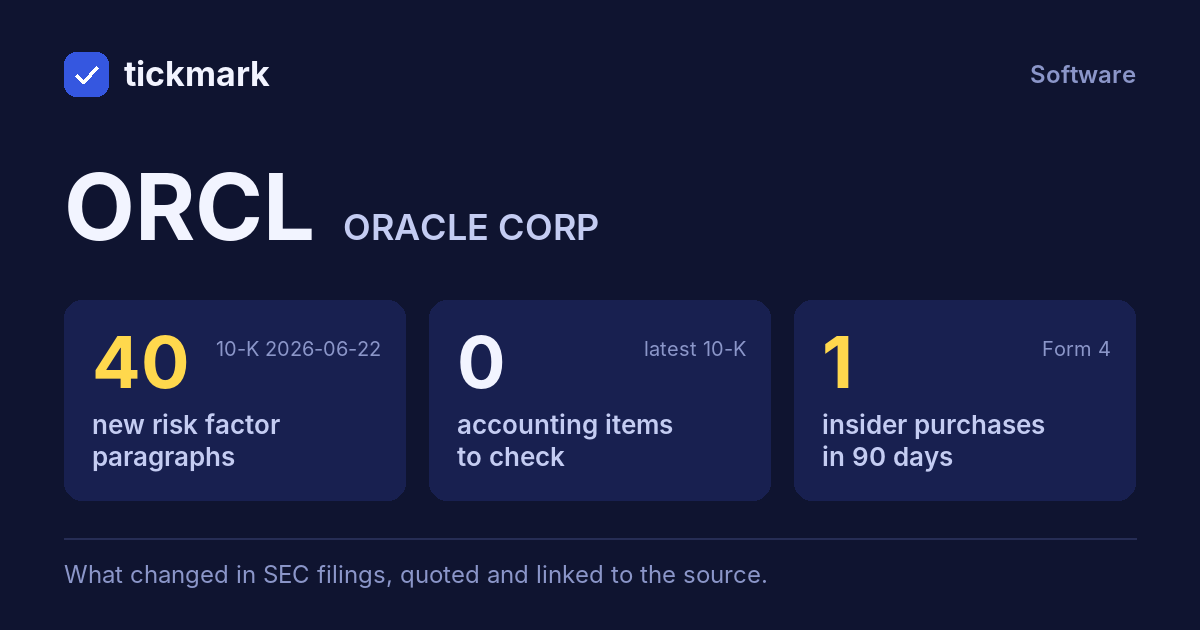
Sentences and paragraphs of ORCL's Risk Factors and MD&A, 10-K 2026-06-22 against 10-K 2025-06-18.
Each links to the text at sec.gov.
AddedRisk Factors
•We may be unsuccessful in developing and selling new products and services, integrating acquired products and services and enhancing our existing products and services.
Read it in 10-K 2026-06-22 at sec.gov ↗
AddedRisk Factors
•If we do not successfully execute our Oracle Cloud strategy, including our offerings of Oracle Cloud, our revenues and profitability may decline.
Read it in 10-K 2026-06-22 at sec.gov ↗
AddedRisk Factors
•If we are unable to secure data center capacity at affordable rates or do not accurately plan for and manage our infrastructure capacity requirements, our profitability may decline.
Read it in 10-K 2026-06-22 at sec.gov ↗
AddedRisk Factors
•Our cloud offerings and hardware offerings are complex, and if we cannot successfully manage this complexity, including the sourcing of technologies and components, the results of these businesses will suffer.
Read it in 10-K 2026-06-22 at sec.gov ↗
AddedRisk Factors
•Our products and services may not function properly if we experience significant coding, manufacturing or configuration errors in our cloud, software and hardware offerings.
Read it in 10-K 2026-06-22 at sec.gov ↗
Show the other 10
AddedRisk Factors
•Any failure to offer high-quality technical support services may adversely affect our relationships with our customers and our financial results.
Read it in 10-K 2026-06-22 at sec.gov ↗
AddedRisk Factors
•We are subject to risks with respect to environmental, social and governance (ESG) matters.
Read it in 10-K 2026-06-22 at sec.gov ↗
AddedRisk Factors
•We are subject to business, financial and reputational risks related to cybersecurity incidents and data breaches.
Read it in 10-K 2026-06-22 at sec.gov ↗
AddedRisk Factors
•Third parties have claimed, and in the future may claim, infringement or misuse of intellectual property rights and/or breach of license agreement provisions.
Read it in 10-K 2026-06-22 at sec.gov ↗
AddedMD&A
substantially affect our quarterly software license revenues due to the point-in-time nature of revenue recognition for software license transactions. Software license customers have the option to purchase and renew software support contracts, as further described below; and
Read it in 10-K 2026-06-22 at sec.gov ↗
AddedMD&A
Costs associated with our cloud and software business are included in cloud and software expenses and sales and marketing expenses. These costs are largely infrastructure- and personnel-related and include the cost of providing our cloud and software support offerings, salaries and commissions earned by our sales force for the sale of our cloud and software offerings and marketing program costs.
Read it in 10-K 2026-06-22 at sec.gov ↗
AddedMD&A
Revolving Credit Agreement: In March 2026, we terminated our existing $6.0 billion, five-year revolving credit agreement. On the same date, we entered into a new $10.0 billion, five-year revolving credit agreement (the Revolving Credit Agreement). As of May 31, 2026, we did not have any outstanding borrowings under the Revolving Credit Agreement. The description above is a summary and is qualified in its entirety by reference to the full text of the Revolving Credit Agreement, which is incorporated by reference herein as Exhibit 10.14.
Read it in 10-K 2026-06-22 at sec.gov ↗
AddedMD&A
Commercial Paper Program: In March 2026, our commercial paper program was increased to $10.0 billion. Our commercial paper program allows us to issue and sell unsecured short-term promissory notes (Commercial Paper Notes) pursuant to a private placement exemption from the registration requirements under federal and state securities laws pursuant to dealer agreements with various banks and an Issuing and Paying Agency Agreement with Deutsche Bank Trust Company Americas. There were $1.5 billion of outstanding Commercial Paper Notes as of May 31, 2026. We used the net proceeds from the issuance of commercial paper for general corporate purposes.
Read it in 10-K 2026-06-22 at sec.gov ↗
AddedMD&A
Mandatory Convertible Preferred Stock: On February 5, 2026, we issued 100,000,000 depositary shares, representing 50,000 shares of our 6.50% Series D Mandatory Convertible Preferred Stock (Mandatory Convertible Preferred Stock). We received cash proceeds of $5.0 billion, net of issuance costs. The other terms and conditions of the Mandatory Convertible Preferred Stock are set forth in the Certificate of Designations, which is incorporated by reference herein as Exhibit 3.03.
Read it in 10-K 2026-06-22 at sec.gov ↗
AddedMD&A
Common Stock: On February 2, 2026, we entered into an equity distribution agreement with certain sales agents party thereto, pursuant to which we may sell shares of our common stock having aggregate sales proceeds of up to $20 billion from time to time through an “at-the-market” offering program (the ATM Program). As of May 31, 2026, we have not sold any shares of our common stock under the ATM Program.
Read it in 10-K 2026-06-22 at sec.gov ↗